

The DOI matches its Crossref record; 50 of the 50 references it cites were found in a registry or an index.
Predicting Academic Misconduct Intentions and Behavior Using the Theory of Planned Behavior and Personality
Open accessAbstract
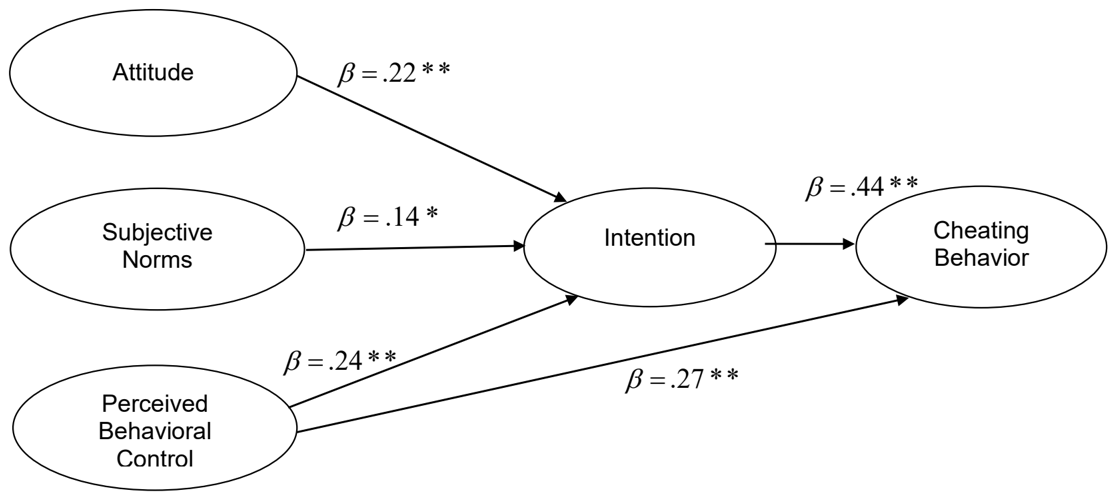
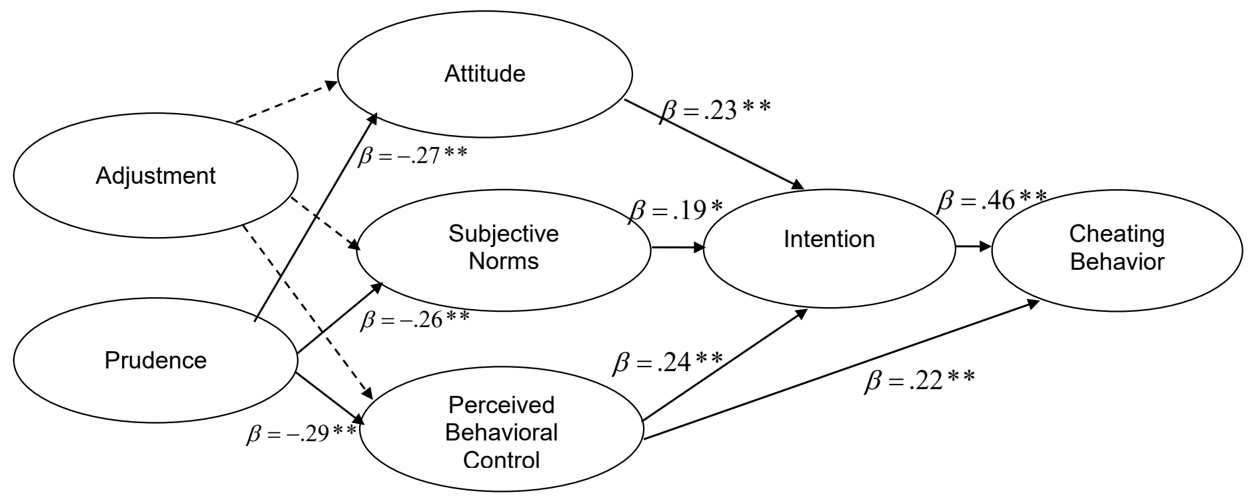
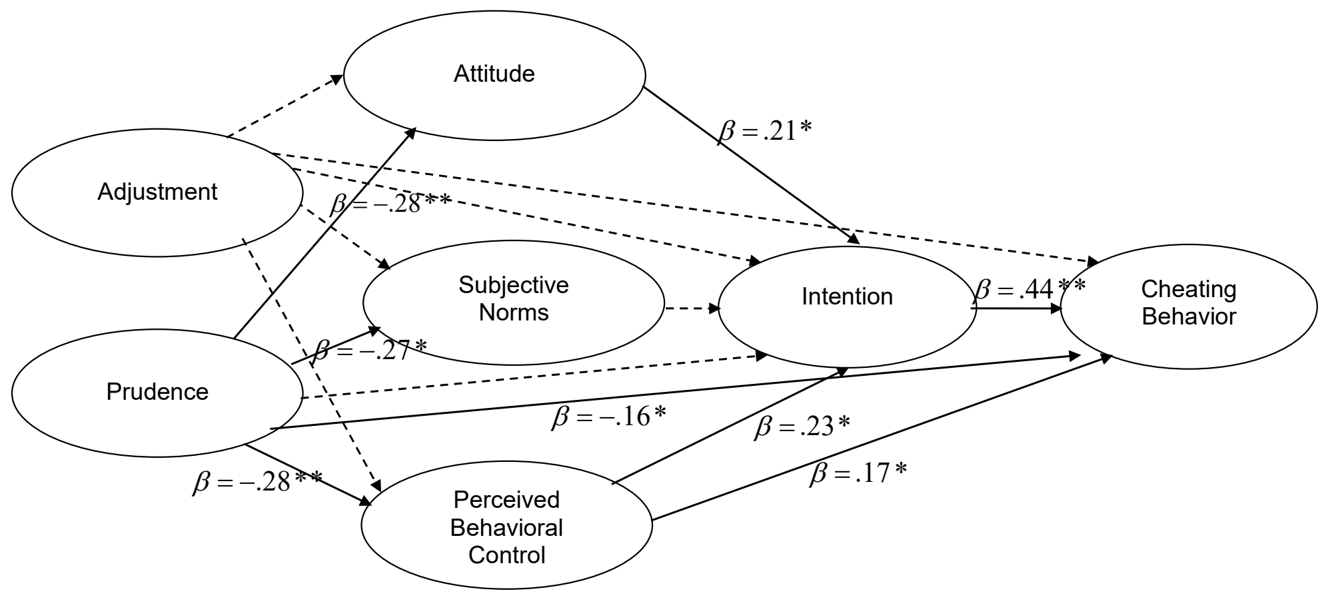
The efficacy of Azjen's (1985, 1991) Theory of Planned Behavior (TPB) for the prediction of cheating intentions and behaviors was examined in a sample of 241 business undergraduates. Mediated structural equation models of the TPB, with personality constructs, adjustment, and prudence, as antecedents were examined. The TPB model explained 21% of the variance in cheating intentions and 36% of cheating behavior. Results support both the TPB model and a partially mediated model in which prudence, but not adjustment, is significantly related to model components, attitudes, norms, control, and behavior but not intention to cheat. These results suggest that the TPB model may parsimoniously integrate and advance academic misconduct research. Further TPB research and practical implications are discussed.
Overview
The claims and statistics of this paper haven’t been checked yet.
Run the check — free, no account needed. It reads the open-access text and checks the sources it cites.
Integrity signals
Registry
Cites
Statistics
Figures
Verification
Claims the paper makes
The claims and statistics of this paper haven’t been checked yet.
Run the check — free, no account needed. It reads the open-access text and checks the sources it cites.
Claims other papers make about this one
Each is checked against this paper’s own text: does it say what the citing paper says it does?
In the citing paper
“Research indicates that attitudes significantly influence the intention to engage in or avoid academic misconduct.”
From Addressing student non-compliance in AI use declarations: implications for academic integrity and assessment in higher education (2025) · cites this paper as Stone, Jawahar, and Kisamore 2010
Self-check
Percentages, sums and reported differences re-computed from the paper’s own numbers.
The self-check needs the paper’s full text.
Citations
Cites
The theory of planned behavior
Ajzen, I. (1991) · Organizational Behavior and Human Decision Processes · doi:10.1016/0749-5978(91)90020-t · Cited by 90,587
Structural equation modeling in practice: A review and recommended two-step approach
Anderson, J. C., & Gerbing, D. W. (1988) · Psychological Bulletin · doi:10.1037/0033-2909.103.3.411 · Cited by 41,941
(1975) · PhilPapers (PhilPapers Foundation) · Cited by 36,737
(1980) · Medical Entomology and Zoology · Cited by 25,810
Generalized expectancies for internal versus external control of reinforcement.
Rotter, J. B. (1966) · Psychological Monographs: General and Applied · doi:10.1037/h0092976 · Cited by 21,937
From Intentions to Actions: A Theory of Planned Behavior
Ajzen, I. (1985) · Action Control · doi:10.1007/978-3-642-69746-3_2 · Cited by 19,057
Gottfredson, M. R., & Hirschi, T. (1990) · doi:10.1515/9781503621794 · Cited by 10,127
Efficacy of the Theory of Planned Behaviour: A meta‐analytic review
Armitage, C. J., & Conner, M. (2001) · British Journal of Social Psychology · doi:10.1348/014466601164939 · Cited by 9,970
(1993) · Medical Entomology and Zoology · Cited by 7,690
Perceived Behavioral Control, Self‐Efficacy, Locus of Control, and the Theory of Planned Behavior 1
Ajzen, I. (2002) · Journal of Applied Social Psychology · doi:10.1111/j.1559-1816.2002.tb00236.x · Cited by 7,629
Research works printed but not linked: 9
- Aizen I., 2009, TPB bibliography
- 10.1207/S15324834BASP2104_4 · DOI
- Barringer J. M., 2005, Hesperia, 74, 211, 10.2972/hesp.74.2.211 · DOI
- Hogan R., 1995, Hogan Personality Inventory Manual
- 10.1037/0022-0663.78.3.230 · DOI
- Joreskog K. G., 1982, Systems under indirect observation: Causality, structure, and prediction, 263
- 2006, The ethics of American youth
- McCabe D. L., 2005, Promoting academic integrity in business schools
- Stone T. H., 2007, Proceedings of the 2007 Management Education Division of the Administrative Sciences Association of Canada
Cited by
Sorted by citations
Big Five personality and academic dishonesty: A meta-analytic review
Giluk, T. L., & Postlethwaite, B. E. (2014) · Personality and Individual Differences · doi:10.1016/j.paid.2014.08.027 · Cited by 277
Cronan, T. P., Mullins, J. K., & Douglas, D. E. (2015) · Journal of Business Ethics · doi:10.1007/s10551-015-2988-3 · Cited by 177
Alam, M. Z., Kousar, S., & Rehman, C. A. (2019) · Journal of global entrepreneurship research · doi:10.1186/s40497-019-0175-1 · Cited by 160
Personality, attitude, and demographic correlates of academic dishonesty: A meta-analysis.
Lee, S. D., Kuncel, N. R., & Gau, J. (2020) · Psychological Bulletin · doi:10.1037/bul0000300 · Cited by 154
Gonsalves, C. (2025) · Assessment & Evaluation in Higher Education · doi:10.1080/02602938.2024.2415654 · Cited by 212
“For instance, Stone, Jawahar, and Kisamore (2010) show that attitudes towards academic dishonesty, such as cheating, directly impact students’ intentions to engage in such behaviours.”
Zhao, L., Mao, H., Compton, B. J., Peng, J., Fu, G., Fang, F., Heyman, G. D., & Lee, K. (2022) · Educational Research Review · doi:10.1016/j.edurev.2022.100455 · Cited by 120
Investigating antecedents of plagiarism using extended theory of planned behavior
Uzun, A. M., & Kilis, S. (2019) · Computers & Education · doi:10.1016/j.compedu.2019.103700 · Cited by 115
AI and academic integrity: Exploring student perceptions and implications for higher education
Lund, B. D., Lee, T. H., Mannuru, N. R., & Arutla, N. (2025) · Journal of Academic Ethics · doi:10.1007/s10805-025-09613-3 · Cited by 96
AMERICAN JOURNAL OF PSYCHOLOGICAL RESEARCH
Dixon, S. (2009) · Cited by 92
Ampuni, S., Kautsari, N., Maharani, M., Kuswardani, S., & Buwono, S. B. S. (2019) · Journal of Academic Ethics · doi:10.1007/s10805-019-09352-2 · Cited by 112
Assignment outsourcing: moving beyond contract cheating
Awdry, R. (2020) · Assessment & Evaluation in Higher Education · doi:10.1080/02602938.2020.1765311 · Cited by 86
Simha, A., & Parboteeah, K. P. (2019) · Journal of Business Ethics · doi:10.1007/s10551-019-04142-7 · Cited by 78
Hendy, N. T., & Montargot, N. (2018) · The International Journal of Management Education · doi:10.1016/j.ijme.2018.12.003 · Cited by 85
Halal Purchase Intention Among the Singaporean Muslim Minority
Abu–Hussin, M. F., Johari, F. B., Hehsan, A., & Nawawi, M. S. A. B. M. (2016) · Journal of Food Products Marketing · doi:10.1080/10454446.2016.1141139 · Cited by 72
Investigating academic dishonesty among Chinese undergraduate students: does gender matter?
Zhang, Y., Yin, H., & Li, Z. (2017) · Assessment & Evaluation in Higher Education · doi:10.1080/02602938.2017.1411467 · Cited by 82
Factors Influencing Academic Dishonesty among Undergraduate Students at Russian Universities
Maloshonok, N., & Шмелева, Е. (2019) · Journal of Academic Ethics · doi:10.1007/s10805-019-9324-y · Cited by 75
Blau, I., & Eshet‐Alkalai, Y. (2017) · Computers in Human Behavior · doi:10.1016/j.chb.2017.03.074 · Cited by 65
Honor Codes and Academic Integrity: Three Decades of Research
Tatum, H. E. (2022) · Journal of College and Character · doi:10.1080/2194587x.2021.2017977 · Cited by 63
Personality, intelligence, and counterproductive academic behaviors: A meta-analysis
Cuadrado, D., Salgado, J. F., & Moscoso, S. (2021) · Journal of Personality and Social Psychology · doi:10.1037/pspp0000285 · Cited by 63
Cultural Differences in Academic Dishonesty: A Social Learning Perspective
Hendy, N. T., Montargot, N., & Papadimitriou, A. (2021) · Journal of Academic Ethics · doi:10.1007/s10805-021-09391-8 · Cited by 76
Imran, A. M., & Nordin, M. S. (2013) · Journal of Academic Ethics · doi:10.1007/s10805-013-9183-x · Cited by 61
Factors influencing future educational technologists' intentions to participate in online teaching
Hung, W., & Jeng, I. (2012) · British Journal of Educational Technology · doi:10.1111/j.1467-8535.2012.01294.x · Cited by 60
de Leeuw, A., Valois, P., Morin, A. J. S., & Schmidt, P. (2014) · Journal of Consumer Policy · doi:10.1007/s10603-014-9262-4 · Cited by 53
Iqbal, A., Melhem, Y. S., & Kokash, H. A. (2012) · Cited by 50
Curtis, G. J., Clare, J., Vieira, E., Selby, E., & Jonason, P. K. (2021) · Personality and Individual Differences · doi:10.1016/j.paid.2021.111277 · Cited by 44
Hangartner, R. B., Totura, C. M. W., Labouliere, C. D., Gryglewicz, K., & Karver, M. S. (2018) · Suicide and Life-Threatening Behavior · doi:10.1111/sltb.12430 · Cited by 44
Do Birds of a Feather Cheat Together? How Personality and Relationships Affect Student Cheating
Scrimpshire, A. J., Stone, T. H., Kisamore, J. L., & Jawahar, I. M. “. (2016) · Journal of Academic Ethics · doi:10.1007/s10805-016-9267-5 · Cited by 47
Self-citationCheating Behaviors among Undergraduate College Students: Results from a Factorial Survey
Freiburger, T. L., Romain, D. M., Randol, B. M., & Marcum, C. D. (2017) · Journal of Criminal Justice Education · doi:10.1080/10511253.2016.1203010 · Cited by 42
Predicting Students’ Intention to Plagiarize: an Ethical Theoretical Framework
Camara, S. K., Eng-Ziskin, S., Wimberley, L., Dabbour, K. S., & Lee, C. M. (2016) · Journal of Academic Ethics · doi:10.1007/s10805-016-9269-3 · Cited by 42
Barriers and motivations for health insurance subscription in Cape Coast, Ghana: a qualitative study
Kumi-Kyereme, A., Amu, H., & Darteh, E. K. M. (2017) · Archives of Public Health · doi:10.1186/s13690-017-0192-x · Cited by 40
Rajah-Kanagasabai, C. J., & Roberts, L. D. (2015) · Frontiers in Psychology · doi:10.3389/fpsyg.2015.00535 · Cited by 47
Ababneh, K. I., Ahmed, K., & Dedousis, E. (2022) · The International Journal of Management Education · doi:10.1016/j.ijme.2022.100713 · Cited by 49
Cyberfaking: I Can, So I Will? Intentions to Fake in Online Psychological Testing
Grieve, R., & Elliott, J. (2013) · Cyberpsychology Behavior and Social Networking · doi:10.1089/cyber.2012.0271 · Cited by 36
Lee, Y. L. (2018) · Thinking Skills and Creativity · doi:10.1016/j.tsc.2018.02.003 · Cited by 39
Wu, S.-I., & Wu, Y. (2014) · International Journal of Quality & Reliability Management · doi:10.1108/ijqrm-01-2013-0019 · Cited by 34
Perceptions of Academic Dishonesty in a South African University: A Q-Methodology Approach
Finchilescu, G., & Cooper, A. (2017) · Ethics & Behavior · doi:10.1080/10508422.2017.1279972 · Cited by 38
Examining the relationship between student attitude and academic cheating
Yu, H., Glanzer, P. L., & Johnson, B. R. (2020) · Ethics & Behavior · doi:10.1080/10508422.2020.1817746 · Cited by 42
Ghanem, C. M., & Mozahem, N. A. (2019) · Journal of Academic Ethics · doi:10.1007/s10805-019-9325-x · Cited by 31
Meng, C. L., Othman, J., D’Silva, J. L., & Omar, Z. B. (2014) · International Education Studies · doi:10.5539/ies.v7n3p126 · Cited by 35
Intentions to Cheat: Ajzen's Planned Behavior and Goal-Related Personality Facets
Lonsdale, D. J. (2016) · The Journal of Psychology · doi:10.1080/00223980.2016.1241737 · Cited by 30
Wang, Y., & Wang, H. (2024) · Frontiers in Psychology · doi:10.3389/fpsyg.2024.1477470 · Cited by 37
Measuring students’ attitudes toward plagiarism
Farooq, R., & Sultana, A. (2021) · Ethics & Behavior · doi:10.1080/10508422.2020.1860766 · Cited by 31
Predicting college students' intention to graduate: A test of the theory of planned behavior
Sutter, N. (2014) · Cardinal Scholar (Ball State University) · Cited by 28
Influence of Neutralization Attitude in Academic Dishonesty among Undergraduates
Meng, C. L., Othman, J., D’Silva, J. L., & Omar, Z. B. (2014) · International Education Studies · doi:10.5539/ies.v7n6p66 · Cited by 28
Ofem, U. J., Valentine Joseph Owan, P. D., Iyam, M. A., Udeh, M. I., Anake, P. M., & Ovat, S. V. (2024) · Education and Information Technologies · doi:10.1007/s10639-024-12850-5 · Cited by 43
Zhang, Y. (2023) · Higher Education · doi:10.1007/s10734-023-01024-w · Cited by 26
Fadersair, K., & Subagyo, S. (2019) · Jurnal Akuntansi Bisnis · doi:10.30813/jab.v12i2.1786 · Cited by 25
Goh, E. (2015) · Journal of Hospitality & Tourism Education · doi:10.1080/10963758.2015.1033101 · Cited by 24
The Theory of Planned Behaviour: Will Faculty Confront Students Who Cheat?
Coren, A. (2012) · Journal of Academic Ethics · doi:10.1007/s10805-012-9162-7 · Cited by 23
Juan, L. X., Tao, W. Y., Veloo, P. K., & Supramaniam, M. (2022) · SAGE Open · doi:10.1177/21582440221140391 · Cited by 27
Academic Misconduct among Business Students: A Comparison of the US and UAE
Williams, S., Tanner, M., Beard, J., & Chacko, J. (2014) · Journal of Academic Ethics · doi:10.1007/s10805-013-9200-0 · Cited by 21
Odongo, D. A., Agyemang, E., & Forkuor, J. B. (2021) · Education Research International · doi:10.1155/2021/6639429 · Cited by 21
Understanding Undergraduate Plagiarism in the Context of Students’ Academic Experience
de Lima, J. Á., Sousa, Á., Medeiros, A., Misturada, B., & Novo, C. (2021) · Journal of Academic Ethics · doi:10.1007/s10805-021-09396-3 · Cited by 21
What Prevents Students from Reporting Academic Misconduct? A Survey of Croatian Students
Pupovac, V., Popović, S., & Blažina, V. (2019) · Journal of Academic Ethics · doi:10.1007/s10805-019-09341-5 · Cited by 26
Stone, T. H., Kisamore, J. L., Jawahar, I. M. “., & Bolin, J. H. (2014) · Journal of Academic Ethics · doi:10.1007/s10805-014-9216-0 · Cited by 23
Self-citationLiu, X., & Alias, N. (2022) · Higher Education Evaluation and Development · doi:10.1108/heed-11-2021-0081 · Cited by 19
The illusory dichotomy of plagiarism
Stuhmcke, A., Booth, T., & Wangmann, J. (2015) · Assessment & Evaluation in Higher Education · doi:10.1080/02602938.2015.1053428 · Cited by 18
Ajzen's Theory of Planned Behavior Applied to the Use of Social Networking by College Students
Cameron, R. (2010) · Cited by 18
Ng, P. M. L., Lee, D., Wong, P., & Lam, R. (2020) · Online Information Review · doi:10.1108/oir-07-2019-0218 · Cited by 18
Academic cheating with generative AI: Exploring a moral extension of the theory of planned behavior
Huang, D., Hash, N., Cummings, J. J., & Prena, K. (2025) · Computers and Education Artificial Intelligence · doi:10.1016/j.caeai.2025.100424 · Cited by 36
Arabyat, R. M., Qawasmeh, B. R., Al-Azzam, S. I., Nusair, M. B., & Alzoubi, K. H. (2022) · Journal of Empirical Research on Human Research Ethics · doi:10.1177/15562646221078655 · Cited by 16
Forced-Choice Personality Measures and Academic Dishonesty: a Comparative Study
Hendy, N. T. (2017) · Journal of Academic Ethics · doi:10.1007/s10805-017-9280-3 · Cited by 18
An Examination of Academic Misconduct Intentions and the Ineffectiveness of Syllabus Statements
Staats, S. R., & Hupp, J. M. (2012) · Ethics & Behavior · doi:10.1080/10508422.2012.661313 · Cited by 15
Tindle, R., Pozzebon, K., Willis, R., & Moustafa, A. A. (2023) · PsyArXiv (OSF Preprints) · doi:10.31234/osf.io/hwkgu · Cited by 26
Kokkinos, C. M., Antoniadou, N., & Voulgaridou, I. (2023) · Ethics & Behavior · doi:10.1080/10508422.2023.2216816 · Cited by 14
Bagraim, J. J., Goodman, S., & Pulker, S. (2014) · Industry and Higher Education · doi:10.5367/ihe.2014.0222 · Cited by 14
Understanding Academic Fraud: The Role of Dark Triad Personality and Situational Factor
Srirejeki, K., Faturokhman, A., Praptapa, A., & Irianto, B. S. (2022) · Journal of Criminal Justice Education · doi:10.1080/10511253.2022.2068630 · Cited by 15
Abrupt academic dishonesty: Pressure, opportunity, and deterrence
Choo, F., & Tan, K. B. (2023) · The International Journal of Management Education · doi:10.1016/j.ijme.2023.100815 · Cited by 17
Academic Integrity Scholarship: The Importance of Theory
Curtis, G. J., & Clare, J. (2024) · Springer international handbooks of education · doi:10.1007/978-3-031-54144-5_164 · Cited by 15
Researchers experience of misconduct in research in Malaysian higher education institutions
Olesen, A. P., Amin, L., & Mahadi, Z. (2018) · Accountability in Research · doi:10.1080/08989621.2018.1429925 · Cited by 13
Plagiarism of Chinese Secondary School Students in Hong Kong
Kam, C. C. S., Hue, M. T., & Cheung, H. Y. (2017) · Ethics & Behavior · doi:10.1080/10508422.2017.1333909 · Cited by 14
Al-Nuaimi, M. N., & Uzun, A. M. (2023) · Cogent Psychology · doi:10.1080/23311908.2023.2168362 · Cited by 17
Kokkinos, C. M., & Antoniadou, N. (2023) · The Journal of Genetic Psychology · doi:10.1080/00221325.2023.2297850 · Cited by 12
Hamdani, R., Siregar, D. I., Marpaung, A. P., Gonggo, R. A., & Sulistyanti, U. (2022) · Journal of Contemporary Accounting · doi:10.20885/jca.vol4.iss1.art2 · Cited by 17
Hybrid governance of platform entrepreneurs
Koo, W. W.-Y. (2023) · Research Policy · doi:10.1016/j.respol.2023.104916 · Cited by 10
Yusliza, M. Y., Fawehinmi, O. O., Mat, N. H. N., & Mohamed, M. (2022) · International Journal of Business and Society · doi:10.33736/ijbs.4857.2022 · Cited by 10
Aderibigbe, N. A., Ocholla, D. N., & Britz, J. (2021) · Libri · doi:10.1515/libri-2019-0062 · Cited by 12
Divakaran, P. K. P. (2012) · Behaviour and Information Technology · doi:10.1080/0144929x.2012.681069 · Cited by 10
AL-Dossary, S. A. (2017) · International Education Studies · doi:10.5539/ies.v10n8p40 · Cited by 10
Lester, C., Anglim, J., & Fullarton, C. (2015) · Australasian Journal of Organisational Psychology · doi:10.1017/orp.2015.7 · Cited by 10
Amponsah, B., Dey, N. E. Y., & Oti-Boadi, M. (2021) · Cogent Psychology · doi:10.1080/23311908.2021.1998976 · Cited by 13
Whistle-Blowing in the Classroom?
Stone, T. H., Kisamore, J. L., Kluemper, D. H., & Jawahar, I. M. “. (2012) · Cited by 9
Self-citationMolavi, H. (2024) · Review of Education · doi:10.1002/rev3.3481 · Cited by 14
The 10 most wanted test cheaters in medical education
Royal, K. D., Hedgpeth, M., Mulkey, J. R., & Fremer, J. J. (2016) · Medical Education · doi:10.1111/medu.13096 · Cited by 8
DOES GRIT GUARANTEE STUDENTS DO NOT ACADEMIC DISHONESTY?
Herdian, H., & Wahidah, F. R. N. (2021) · Panorama · doi:10.15765/pnrm.v15i29.1708 · Cited by 8
Hope moderates the relationship between students’ sense of belonging and academic misconduct
Coetzee, T., Pryce-Jones, K., Grant, L., & Tindle, R. (2022) · International Journal for Educational Integrity · doi:10.1007/s40979-022-00121-0 · Cited by 8
Academic fraud and motivation of modern universities students’ educational activities
Spasennikov, V., & Androsov, K. (2020) · Ergodesign · doi:10.30987/2658-4026-2020-2-72-80 · Cited by 8
A Study on the Role of Social Learning in Academic Cheating
Aliverdinia, A., Zadeh, H. J., & Dhkhan, S. O. (2016) · بررسی مسائل اجتماعی ایران · doi:10.18869/acadpub.jspi.6.2.71 · Cited by 7
Yu, S., Assor, A., Yu, H., & Wang, Q. (2022) · Learning and Individual Differences · doi:10.1016/j.lindif.2022.102245 · Cited by 8
Awdry, R., & Groves, A. (2023) · International Journal for Educational Integrity · doi:10.1007/s40979-023-00126-3 · Cited by 7
Yuliyanto, H. (2016) · Jurnal Vokasi Indonesia · doi:10.7454/jvi.v3i1.28 · Cited by 7
Herdian, H., & Rahayu, E. (2022) · Journal of Learning Theory and Methodology · doi:10.17309/jltm.2022.1.04 · Cited by 7
Academic misconduct: Evidence from online class
Srirejeki, K., Faturokhman, A., Praptapa, A., & Irianto, B. S. (2022) · International Journal of Evaluation and Research in Education (IJERE) · doi:10.11591/ijere.v11i4.23556 · Cited by 7
Contract Cheating: The Influence of Attitudes and Emotions
Curtis, G. J., & Tindall, I. K. (2022) · Springer eBooks · doi:10.1007/978-3-031-12680-2_10 · Cited by 7
Behavior-goal consistency and the role of anticipated and retrospective regret in self-regulation.
Valshtein, T. J., & Seta, C. E. (2018) · Motivation Science · doi:10.1037/mot0000101 · Cited by 7
Knowledge, Attitude, and Action of Community towards Waste Management in River Bank of Martapura
My, R., Hidayat, T., Yanuwiadi, B., & Suyadi, S. (2015) · International journal of applied psychology · Cited by 7
Imran, A. M., Hussien, S., & Araimi, A. A. (2024) · Journal of Academic Ethics · doi:10.1007/s10805-024-09548-1 · Cited by 9
Intishar, I. N., Ampuni, S., & Buwono, S. B. S. (2024) · Jurnal Psikologi · doi:10.22146/jpsi.90823 · Cited by 11
Li, T., T. L. Brown, G., & Hawe, E. (2023) · Assessment & Evaluation in Higher Education · doi:10.1080/02602938.2023.2222232 · Cited by 6
Metadata
- Authors
- Stone, T. H., Jawahar, I. M., & Kisamore, J. L.
- Affiliations
- Oklahoma State University (US)
- Illinois State University (US)
- University of Oklahoma - Tulsa (US)
- Corresponding author
- Stone, Thomas H.
- Venue
- Basic and Applied Social Psychology
- Publisher
- Informa UK Limited
- Published
- 2010-02-23
- Volume
- 32
- Issue
- 1
- Pages
- 35-45
- ISSN
- 0197-3533 (ISSN-L)
- 1532-4834
- OpenAlex
- W1964988792
- Cited by
- 198
- References
- 50
- Citations by year
- 2026: 11 · 2025: 11 · 2024: 17 · 2023: 23 · 2022: 23 · 2021: 18 · 2020: 12 · 2019: 13 · 2018: 13 · 2017: 10 · 2016: 12 · 2015: 10 · 2014: 9 · 2013: 5 · 2012: 7
- FWCI
- 12.59
- Type
- journal article
- Language
- en
- Open access
- green
- hdl.handle.net
- Licence
- cc-by-nc
- Locations
- Basic and Applied Social Psychology (publishedVersion)
- SHAREOK (University of Oklahoma; Oklahoma State University; Central Oklahoma University) (submittedVersion, cc-by-nc)
- Topics
- Social Sciences › Education › Academic integrity and plagiarism
- Social Sciences › Psychology › Applied Psychology › Behavioral Health and Interventions
- Social Sciences › Business, Management and Accounting › Organizational Behavior and Human Resource Management › Ethics in Business and Education
- Keywords
- academic misconduct, cheating, theory of planned behavior, prudence, personality, adjustment, undergraduate business students, mediation, attitudes, social norms, perceived behavioral control
About these checks
Registry, retraction, Cites and statistics results are computed, not judged, with one exception: a printed reference that no index lists is read once by a model before it counts as a citation error. Claims are extracted by a model and kept only when their quote appears verbatim in the text; each cited source is then checked, with a model’s help, for whether it says what the claim relies on. Those verdicts can be wrong — read the claim’s quote and the cited source before relying on one.
Statistics and arithmetic are recomputed, not judged.
Confidence bands are shown only for fields calibrated on our annotated test set. None is calibrated yet, so no band is shown.
What counts as a claim ›How we measure confidence ›How we check this ›
Are you an author, or do you see a problem with this page? Request a review
