

Interventions and facilitators of oral assessment performance in higher education: a systematic review
Open accessThe DOI matches its Crossref record; 66 of the 68 references it cites were found in a registry or an index; none of the 62 sources its claims cite is checked for support yet.
Abstract
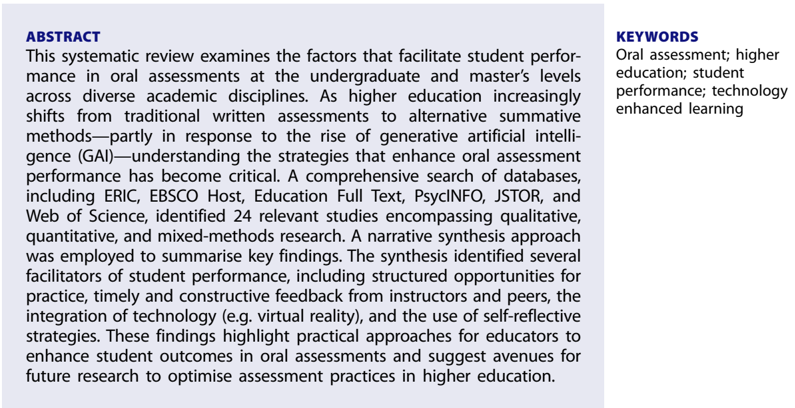
This systematic review examines the factors that facilitate student performance in oral assessments at the undergraduate and master’s levels across diverse academic disciplines. As higher education increasingly shifts from traditional written assessments to alternative summative methods—partly in response to the rise of generative artificial intelligence (GAI)—understanding the strategies that enhance oral assessment performance has become critical. A comprehensive search of databases, including ERIC, EBSCO Host, Education Full Text, PsycINFO, JSTOR, and Web of Science, identified 24 relevant studies encompassing qualitative, quantitative, and mixed-methods research. A narrative synthesis approach was employed to summarise key findings. The synthesis identified several facilitators of student performance, including structured opportunities for practice, timely and constructive feedback from instructors and peers, the integration of technology (e.g. virtual reality), and the use of self-reflective strategies. These findings highlight practical approaches for educators to enhance student outcomes in oral assessments and suggest avenues for future research to optimise assessment practices in higher education.
Overview
CoChat Summary
TL;DR
This systematic review synthesizes 24 studies on interventions and facilitators of university students’ oral assessment performance. It finds that feedback, structured practice, self-reflection, and technology—especially VR—can support performance, though VR’s effects on anxiety are mixed.
Key findings
- Feedback was a key facilitator: instructor feedback produced the highest performance scores (t = 0.47, p = 0.02; van Ginkel et al., 2017), faculty evaluations improved scores by 6.60 points (p < 0.01; Gunderson et al., 2021), and peer feedback yielded a 10% improvement that diminished after one month (Murillo-Zamorano & Montanero, 2018).
- Structured practice and mock oral examinations improved preparedness and performance: first-time pass rates rose from 76.0% to 100% (p = 0.025; Fischer et al., 2016), and 77.1% of students rated mock orals very or extremely helpful (Higgins et al., 2016).
- VR practice improved oral presentation performance (M = 42.82 to M = 49.85, p < 0.001; Boetje et al., 2020), but one study found VR practice produced significantly higher public speaking anxiety (p = 0.05) with no significant final performance difference (p = 0.39; Davis et al., 2020).
- Self-reflection and metacognitive strategies were associated with better performance: reflective writing scores predicted oral examination performance (p < 0.01; Tsingos-Lucas et al., 2017), and self-assessment in a VR oral examination simulator scored significantly higher in clarity, timing, and content organisation (p = 0.03; Serafini & Chittaro, 2024).
Methods
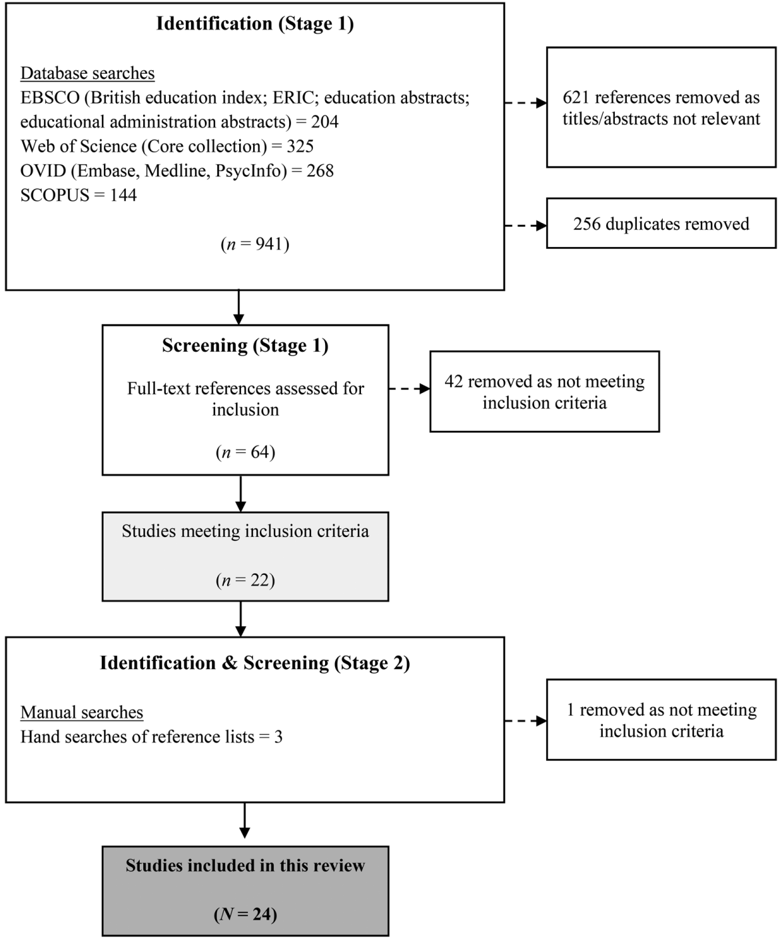
- Systematic review using SPIDER inclusion criteria; searched ERIC, EBSCO Host, Education Full Text, PsycINFO, JSTOR, and Web of Science in November 2024, limited to English-language peer-reviewed studies from 2015 onward; 941 records were identified, and 24 studies were included after screening and manual reference searching.
- Included qualitative, quantitative, and mixed-methods studies of university students (undergraduate or postgraduate) on practices/interventions aimed at improving oral assessment performance; studies were quality assessed with the Mixed Methods Appraisal Tool (MMAT), and findings were synthesised narratively following Popay et al. (2006).
Limitations
- Stated: the review was restricted to English-language publications, potentially introducing language bias; the diversity of interventions and disciplines may limit generalisability to specific educational settings; some studies had small sample sizes (e.g., Dickson et al., 2019).
- Evident from the text: the review reports mixed or inconsistent findings for VR’s impact on anxiety and for peer feedback retention, and two included studies did not report participant numbers, which may affect the robustness of conclusions.
Model-written summary. Check it against the paper before relying on it.
Integrity signals
Registry
Cites
Statistics
Figures


Verification
Claims the paper makes
0 Valid · 1 Not valid · 58 Not checked · 30 Own results and interpretations
A result the paper reports from its own data — it cites no other source for it, so there is none to check. The quote shows it is in the paper.
In the paper
“A comprehensive search of databases, including ERIC, EBSCO Host, Education Full Text, PsycINFO, JSTOR, and Web of Science, identified 24 relevant studies encompassing qualitative, quantitative, and mixed-methods research.”
- Also stated in: § Identification and screening of studies · plain
“The final number of articles for inclusion in the review was 24.”
§ Interventions and facilitators of oral assessment performance in higher education: a systematic review > Abstract
plain- Asserted: passes — The authors put it forward as true.
- Checkable: passes — It can be checked against evidence.
- Load-bearing: passes — The paper’s conclusions depend on it.
- Based: passes — The paper gives a reason why it holds.
- Also stated in: § Identification and screening of studies · plain
None of the sources cited for this claim have been checked yet.
In the paper
“Mock orals in the studies reviewed (Fischer et al., 2016;Higgins et al., 2016) were typically part of coursework or professional training assessments, distinct from doctoral viva examinations.”
§ Interventions and facilitators of oral assessment performance in higher education: a systematic review > Feedback benefits performance on oral assessments across educational contexts
What the sources say
- Not checked yetcites Fischer et al., 2016 matched to “Evaluating the effectiveness of a mock oral educational program” (2016) source
- Not matchedcites Higgins et al., 2016
An author–year citation the paper’s reference list doesn’t settle. We don’t search these by name.
plain- Asserted: passes — The authors put it forward as true.
- Checkable: passes — It can be checked against evidence.
- Load-bearing: unclear — It is unclear whether the paper’s conclusions depend on it.
- Based: passes — The paper gives a reason why it holds.
None of the sources cited for this claim have been checked yet.
In the paper
“Nikolic et al. (2018) and Ritchie (2016) further supported the value of peer feedback, with both studies highlighting improvements in students' critical reflection and oral communication skills through peer-assessment activities.”
§ Interventions and facilitators of oral assessment performance in higher education: a systematic review > Peer feedback
What the sources say
- Not matchedcites Nikolic et al. (2018)
An author–year citation the paper’s reference list doesn’t settle. We don’t search these by name.
- Not checked yetcites Ritchie (2016) matched to “Self-assessment of video-recorded presentations: Does it improve skills?” (2016) source
plainstates a cause- Asserted: passes — The authors put it forward as true.
- Checkable: passes — It can be checked against evidence.
- Load-bearing: passes — The paper’s conclusions depend on it.
- Based: passes — The paper gives a reason why it holds.
- Not matched
A result the paper states — it cites no source for it, so there is none to check. The quote shows it is in the paper.
In the paper
“Six studies focused on formal training exercises and repeated practice to improve presentation confidence and delivery.”
§ Interventions and facilitators of oral assessment performance in higher education: a systematic review > Structured Training and repeated practice
plain- Asserted: passes — The authors put it forward as true.
- Checkable: passes — It can be checked against evidence.
- Load-bearing: unclear — It is unclear whether the paper’s conclusions depend on it.
- Based: passes — The paper gives a reason why it holds.
In the paper
“Serafini and Chittaro (2024) used a vR oral examination simulator, with students who engaged in self-assessment scoring significantly higher (p = 0.03) in clarity, timing, and content organisation.”
§ Interventions and facilitators of oral assessment performance in higher education: a systematic review > Self-reflection and metacognitive strategies
What the sources say
- Not checked yetcites Serafini and Chittaro (2024) matched to “Trial of a desktop virtual reality application as a method of exposure for test anxiety: a qualitative study” (2025) source
plainstates a cause- Asserted: passes — The authors put it forward as true.
- Checkable: passes — It can be checked against evidence.
- Load-bearing: unclear — It is unclear whether the paper’s conclusions depend on it.
- Based: passes — The paper gives a reason why it holds.
33 more claims
Create a free account to see all 89 claims and to verify the 49 references still open.
- It may state two separate claims as one. 34
- Probably not a substantial claim. 22
Self-check
Percentages, sums and reported differences re-computed from the paper’s own numbers.
Each contradiction between two passages listed here was confirmed by an independent check.
Rated minor: it would not touch a result — a value no result rests on, a p-value that stays on the same side of the significance level, or a conflict that is clerical, resolved elsewhere in the paper, or outside its own findings.
In the paper
§ Interventions and facilitators of oral assessment performance in higher education: a systematic review > Identification and screening of studies
“Searches across the four databases yielded 941 results.”
§ Interventions and facilitators of oral assessment performance in higher education: a systematic review > Abstract
“A comprehensive search of databases, including ERIC, EBSCO Host, Education Full Text, PsycINFO, JSTOR, and Web of Science, identified 24 relevant studies”
Citations
Cites
Hattie, J., & Timperley, H. (2007) · Review of Educational Research · doi:10.3102/003465430298487 · Cited by 12,905
The Mixed Methods Appraisal Tool (MMAT) version 2018 for information professionals and researchers
Hong, Q. N., Fàbregues, S., Bartlett, G., Boardman, F., Cargo, M., Dagenais, P., Gagnon, M.-P., Griffiths, F., Nicolau, B., O’Cathain, A., et al. (2018) · Education for Information · doi:10.3233/efi-180221 · Cited by 4,737 · cited 1×
“All studies were quality assessed using the Mixed Methods Appraisal Tool (MMAT) (Hong et al., 2018) by the lead author.”
(1985) · Medical Entomology and Zoology · Cited by 3,952
Beyond PICO: The SPIDER Tool for Qualitative Evidence Synthesis
Cooke, A., Smith, D., & Booth, A. (2012) · Qualitative Health Research · doi:10.1177/1049732312452938 · Cited by 2,608 · cited 1×
“Inclusion and exclusion criteria were developed within the ‘SPIDER’ framework (Sample, Phenomenon of Interest, Design, Evaluation, Research type) (Cooke et al., 2012).”
Popay, J., Roberts, H., Sowden, A., Petticrew, M., Arai, L., Rodgers, M., Britten, N., Roen, K., & Duffy, S. (2006) · Lancaster University · doi:10.13140/2.1.1018.4643 · Cited by 2,070
ChatGPT in higher education: considerations for academic integrity and student learning
(2023) · Journal of Applied Learning & Teaching · doi:10.37074/jalt.2023.6.1.17 · Cited by 853
Generative AI tools and assessment: Guidelines of the world's top-ranking universities
Moorhouse, B. L., Yeo, M. A., & Wan, Y. (2023) · Computers and Education Open · doi:10.1016/j.caeo.2023.100151 · Cited by 461 · cited 5×
“In the ever-evolving landscape of higher education, educators are increasingly tasked with designing assessments that are resilient to the capabilities of generative artificial intelligence (GAI) (Moorhouse et al., 2023).”
InfluentialProceedings of the 2005 American Society for Engineering Education Annual Conference & Exposition
Nielsen, S. H. (2005) · Cited by 436
ChatGPT improves creative problem-solving performance in university students: An experimental study
Urban, M., Děchtěrenko, F., Lukavský, J., Hrabalová, V., Svacha, F., Brom, C., & Urban, K. (2024) · Computers & Education · doi:10.1016/j.compedu.2024.105031 · Cited by 396 · cited 1×
“At best, using GAI saves students time, supports their learning through personalised feedback, and can lead to less stress in solving open-ended problems (urban et al., 2024).”
Fostering Metacognition to Support Student Learning and Performance
Stanton, J. D., Sebesta, A. J., & Dunlosky, J. (2021) · CBE—Life Sciences Education · doi:10.1187/cbe.20-12-0289 · Cited by 284 · cited 1×
“This aligns with metacognitive theories that emphasise the importance of self-evaluation in the learning process (Stanton et al., 2021).”
Sokhanvar, Z., Salehi, K., & Sokhanvar, F. (2021) · Studies in Educational Evaluation · doi:10.1016/j.stueduc.2021.101030 · Cited by 231
Peer assessment of language proficiency
Cheng, W., & Warren, M. (2005) · Language Testing · doi:10.1191/0265532205lt298oa · Cited by 226
Grez, L. D., Valcke, M., & Roozen, I. T. M. (2009) · Computers & Education · doi:10.1016/j.compedu.2009.01.005 · Cited by 195
van Ginkel, S., Gulikers, J., Biemans, H., & Mulder, M. (2015) · Educational Research Review · doi:10.1016/j.edurev.2015.02.002 · Cited by 189
Oral versus written assessments: a test of student performance and attitudes
Huxham, M., Campbell, F., & Westwood, J. (2012) · Assessment & Evaluation in Higher Education · doi:10.1080/02602938.2010.515012 · Cited by 187 · cited 1×
“However, implementing oral assessments introduces considerations regarding student anxiety, as some learners find these formats to be particularly stress-inducing (Huxham et al., 2012).”
Yu, Z., & Xu, W. (2022) · Computer Applications in Engineering Education · doi:10.1002/cae.22532 · Cited by 162
Fostering oral presentation competence through a virtual reality-based task for delivering feedback
van Ginkel, S., Gulikers, J., Biemans, H., Noroozi, O., Roozen, M., Bos, T., van Tilborg, R., van Halteren, M., & Mulder, M. (2019) · Computers & Education · doi:10.1016/j.compedu.2019.02.006 · Cited by 111
Beyond Fairness and Consistency in Grading: The Role of Rubrics in Higher Education
Ragupathi, K., & Lee, A. (2020) · Diversity and Inclusion in Global Higher Education · doi:10.1007/978-981-15-1628-3_3 · Cited by 107
Wu, Y., Lin, X., & Philbin, S. P. (2023) · Sustainability · doi:10.3390/su15129711 · Cited by 106
Undergraduate Writing Assignments: An Analysis of Syllabi at One Canadian College
Graves, R., Hyland, T. A., & Samuels, B. M. (2010) · Written Communication · doi:10.1177/0741088310371635 · Cited by 94
The impact of the feedback source on developing oral presentation competence
van Ginkel, S., Gulikers, J., Biemans, H., & Mulder, M. (2017) · Studies in Higher Education · doi:10.1080/03075079.2015.1117064 · Cited by 94 · cited 2×
“Instructor feedback, in particular, demonstrated a strong impact on performance outcomes (van Ginkel et al., 2017), likely due to the perceived authority and expertise of educators in shaping student development.”
InfluentialOral presentations in higher education: a comparison of the impact of peer and teacher feedback
Murillo-Zamorano, L. R., & Montanero, M. (2018) · Assessment & Evaluation in Higher Education · doi:10.1080/02602938.2017.1303032 · Cited by 92
Writing and Conceptual Learning in Science: An Analysis of Assignments
Gere, A. R., Limlamai, N., Wilson, E., Saylor, K., & Pugh, R. (2018) · Written Communication · doi:10.1177/0741088318804820 · Cited by 84
Krupp, L., Steinert, S., Kiefer-Emmanouilidis, M., Avila, K. E., Lukowicz, P., Kuhn, J., Küchemann, S., & Karolus, J. (2024) · Frontiers in Artificial Intelligence and Applications · doi:10.3233/faia240195 · Cited by 82
Using Reflective Writing as a Predictor of Academic Success in Different Assessment Formats
Lucas, C., Bosnic-Anticevich, S. Z., Schneider, C. R., & Smith, L. D. (2017) · American Journal of Pharmaceutical Education · doi:10.5688/ajpe8118 · Cited by 80
Liu, J. Y. W., Yin, Y.-H., Kor, P. P. K., Cheung, D. S. K., Zhao, I. Y., Wang, S., Su, J. J., Christensen, M., Tyrovolas, S., & Leung, A. Y. M. (2023) · Journal of Medical Internet Research · doi:10.2196/39989 · Cited by 75
Nash, G., Crimmins, G., & Oprescu, F. (2016) · Assessment & Evaluation in Higher Education · doi:10.1080/02602938.2015.1032212 · Cited by 73
Assessing students’ critical thinking abilities via a systematic evaluation of essays
Calma, A., & Davies, M. (2025) · Studies in Higher Education · doi:10.1080/03075079.2025.2470969 · Cited by 59
van Ginkel, S., Gulikers, J., Biemans, H., & Mulder, M. (2017) · Assessment & Evaluation in Higher Education · doi:10.1080/02602938.2016.1212984 · Cited by 53
Oral Assessments: Improving Retention, Grades, and Understanding
Nelson, M. (2010) · PRIMUS · doi:10.1080/10511970902869176 · Cited by 41
Chen, B., Lewis, C. M., West, M., & Zilles, C. (2024) · Proceedings of the Eleventh ACM Conference on Learning @ Scale · doi:10.1145/3657604.3662046 · Cited by 39 · cited 1×
“There are growing concerns about assessment integrity and learning quality due to the emergence of generative AI (GAI) (Sullivan et al., 2023; Chen et al., 2024; Kostanek & Li, 2025).”
A case study of the variety of writing assignments in an undergraduate English department
Tasker, D. G. (2022) · English for Specific Purposes · doi:10.1016/j.esp.2021.12.001 · Cited by 36
Nikolic, S., Stirling, D., & Ros, M. (2018) · European Journal of Engineering Education · doi:10.1080/03043797.2017.1298569 · Cited by 33
Self-assessment of video-recorded presentations: Does it improve skills?
Ritchie, S. M. (2016) · Active Learning in Higher Education · doi:10.1177/1469787416654807 · Cited by 32
A systematic review of virtual and augmented realities in higher education: Trends and issues
Sümer, M., & Vaněček, D. (2025) · Innovations in Education and Teaching International · doi:10.1080/14703297.2024.2382854 · Cited by 32
Cavanagh, T. M., Leeds, C., & Peters, J. M. (2019) · Business and Professional Communication Quarterly · doi:10.1177/2329490619853242 · Cited by 30
Davis (2020) · doi:10.1037/edu0000412 · Cited by 25
Testing the test: Are exams measuring understanding?
Sato, B. K., Hill, C. F. C., & Lo, S. M. (2019) · Biochemistry and Molecular Biology Education · doi:10.1002/bmb.21231 · Cited by 23
Dickson, H., Harvey, J., & Blackwood, N. (2019) · Assessment & Evaluation in Higher Education · doi:10.1080/02602938.2018.1528341 · Cited by 21
Evaluating the effectiveness of a mock oral educational program
Fischer, L. E., Snyder, M., Sullivan, S. A., Foley, E. F., & Greenberg, J. A. (2016) · Journal of Surgical Research · doi:10.1016/j.jss.2016.06.088 · Cited by 21
Higgins, R. M., Deal, R. A., Rinewalt, D. E., Hollinger, E. F., Janssen, İ., Poirier, J., Austin, D., Rendina, M. A., Francescatti, A. B., Myers, J. A., et al. (2015) · The American Journal of Surgery · doi:10.1016/j.amjsurg.2015.09.008 · Cited by 20
Speech: An Enhancement to (Technical) Writing
Piirto, J. (2000) · Journal of Engineering Education · doi:10.1002/j.2168-9830.2000.tb00489.x · Cited by 20
Pradhananga, P., ElZomor, M., & Santi Kasabdji, G. (2022) · Journal of Civil Engineering Education · doi:10.1061/(asce)ei.2643-9115.0000060 · Cited by 18
Should oral examination be reimagined in the era of AI?
Eachempati, P., Komattil, R., & Arakala, A. (2025) · Advances in Physiology Education · doi:10.1152/advan.00191.2024 · Cited by 18
Student experience of oral communication assessment tasks online from a multi-disciplinary trial
McBain, B., Drew, A., James, C., Phelan, L., Harris, K. M., & Archer, J. (2016) · Education + Training · doi:10.1108/et-10-2014-0124 · Cited by 16
The Effect Of Problem Based Learning On Undergraduate Oral Communication Competency
Mandeville, D. S., Ho, T., & Valdez, L. A. (2017) · Journal of College Teaching & Learning (TLC) · doi:10.19030/tlc.v14i1.9957 · Cited by 16
The Three-Minute Slide as an Effective Tool for Developing Oral Communication Skills
Applebee, M. S., Johanson, A. P., Lawler-Sagarin, K. A., Losey, E. N., & Munro-Leighton, C. (2018) · Journal of Chemical Education · doi:10.1021/acs.jchemed.7b00649 · Cited by 16
Can Oral Exams Increase Student Performance and Motivation?
Delson, N., Baghdadchi, S., Ghazinejad, M., Lubarda, M. V., Minnes, M., Phan, A., Schurgers, C., & Qi, H. (2024) · ASEE Annual Conference & Exposition · doi:10.18260/1-2--41127 · Cited by 14
Miskam, N. N. (2020) · International Journal of Psychosocial Rehabilitation · doi:10.37200/ijpr/v24i5/pr2020235 · Cited by 14
Jers, C. O., & Wärnsby, A. (2017) · Assessment & Evaluation in Higher Education · doi:10.1080/02602938.2017.1383356 · Cited by 13
O’Neill, L. D. (2024) · Active Learning in Higher Education · doi:10.1177/14697874241245665 · Cited by 13
Developing undergraduate student oral science communication through video reflection
Oliveira, A. W., Brown, A. O., Carroll, M. L., Blenkarn, E., Austin, B., & Bretzlaff, T. (2021) · International Journal of Science Education, Part B · doi:10.1080/21548455.2021.1907630 · Cited by 12
HHAI 2024: Hybrid Human AI Systems for the Social Good
Muscato, B., Bushipaka, P., Gezi̇ci, G., Passaro, L., & Giannotti, F. (2024) · Frontiers in artificial intelligence and applications · doi:10.3233/faia386 · Cited by 12
Stout, R. P. (2019) · Journal of Chemical Education · doi:10.1021/acs.jchemed.9b00258 · Cited by 12
Learner perception of oral and written examinations in an international medical training program
Kelly, S. P., Weiner, S. G., Anderson, P. D., Irish, J. T., Ciottone, G. R., Pini, R., Grifoni, S., Rosen, P. L., & Ban, K. (2010) · International Journal of Emergency Medicine · doi:10.1007/s12245-009-0147-2 · Cited by 11
Kitto, K. L. (2008) · IEEE Frontiers in Education Conference (FIE) · doi:10.1109/fie.2008.4720264 · Cited by 11
Sox, C. M., Tenney-Soeiro, R., Lewin, L. O., Ronan, J., Brown, M., King, M., Thompson, R., Noelck, M., Sutherell, J. S., Silverstein, M., et al. (2018) · Academic Pediatrics · doi:10.1016/j.acap.2017.12.010 · Cited by 9
Crecelius, A. R., DeRuisseau, L. R., & Brandauer, J. (2021) · AJP Advances in Physiology Education · doi:10.1152/advan.00028.2021 · Cited by 9
using videos to Improve Oral Presentation Skills in Distance Learning Engineering Master's Degrees
Galindo, C., Gregori, P., & Martínez, V. (2020) · International Journal of Mathematical Education in Science and Technology · doi:10.1080/0020739x.2019.1662118 · Cited by 8
Kim, M., Pilegard, C., Qi, H., Schurgers, C., Lubarda, M. V., Baghdadchi, S., & Phan, A. (2024) · ASEE Annual Conference & Exposition · doi:10.18260/1-2--41102 · Cited by 7
Lantsoght, E. O. L. (2018) · Springer Texts in Education · doi:10.1007/978-3-319-77425-1 · Cited by 7
Love, R. R., Newcomb, P. A., Schiller, J. H., Wilding, G., & Stone, H. L. (1993) · Journal of Cancer Education · doi:10.1080/08858199309528218 · Cited by 7
Integrating Rubric-Based Metacognitive Reflection to Improve Scientific Research Presentations
Gunderson, J. E. C., MacDonald, L. J., & Gunderson, W. A. (2021) · Journal of Chemical Education · doi:10.1021/acs.jchemed.0c01470 · Cited by 6
Serafini, M., & Chittaro, L. (2025) · Behaviour & Information Technology · doi:10.1080/0144929x.2023.2299738 · Cited by 6
The False Sense of Achievement: Navigating Academic Integrity and Assessment Challenges of GenAI
Kostanek, E., & Li, F. (2025) · Advances in Educational Marketing, Administration, and Leadership · doi:10.4018/979-8-3693-6351-5.ch002 · Cited by 6
Belboukhaddaoui, I., & van Ginkel, S. (2019) · Research on Education and Media · doi:10.2478/rem-2019-0005 · Cited by 6
Effective direct student observation strategies in neurology
Evans, S. J. (2010) · Medical Education · doi:10.1111/j.1365-2923.2010.03642.x · Cited by 6
Using Oral Exams to Assess Conceptual Understanding in Proof Writing Courses
Harsy, A. (2024) · Emerald Group Publishing Limited eBooks · doi:10.1108/979-8-88730-579-020251023 · Cited by 3
Research works printed but not linked: 3
- Boetje, R., S. van Ginkel, and M. Meijer. 2020. "Enhancing Oral Presentation Skills with virtual Reality Practice: A Randomized Controlled Trial. " Educational Technology Research and Development 68 (4): 2125-2140. doi:10.1007/ s11423-020-09777-3. · doi:10.1007/s11423-020-09777-3
- Borkin, H. 2020. Locating Bias in Higher Education Marking Practices. York, uK: Advance HE.
- Kolber, B. J. 2011. "Practice and Self-Reflection Bolster Oral Communication Skills. " Journal of College Science Teaching 40 (6): 87-91.
Cited by
Giving voice to women students: designing oral assessments for inclusion and validity
Rae, M., Tai, J., & Dawson, P. (2025) · Assessment & Evaluation in Higher Education · doi:10.1080/02602938.2025.2580622 · Cited by 8
Towards Embodied Conversational Agents for Reducing Oral Exam Anxiety in Extended Reality
Grubert, J., Sedelmaier, Y., & Landes, D. (2025) · IEEE International Symposium on Mixed and Augmented Reality Adjunct (ISMAR-Adjunct) · doi:10.1109/ismar-adjunct68609.2025.00113 · Cited by 4
Flores, V., RIOS, H., Gentili, C. G., Donato, M., & Rapacioli, M. (2026) · Advances in Medical Education and Practice · doi:10.2147/amep.s622464 · Cited by 1
Secure online assessments: Strategies to mitigate generative AI risks in higher education
Jonathan, J., & Walsh, C. (2025) · ASCILITE Publications · doi:10.65106/apubs.2025.2680
Medina-Pozos, J. M., & Nieto-Jalil, J. M. (2025) · Mexican International Conference on Computer Science · doi:10.1109/enc68268.2025.11311879 · Cited by 1
Metadata
- Authors
- Stephenson, Z., Johnson-Glauch, N., & Cruchley, S.
- Affiliations
- University of Birmingham (GB)
- California Polytechnic State University
- Corresponding author
- Stephenson, Zoe
- Venue
- Assessment & Evaluation in Higher Education
- Publisher
- Informa UK Limited
- Published
- 2025-06
- Volume
- 50
- Issue
- 7
- Pages
- 1140-1153
- ISSN
- 0260-2938 (ISSN-L)
- 1469-297X
- OpenAlex
- W4410929298
- Cited by
- 25
- References
- 65
- Citations by year
- 2026: 19 · 2025: 6
- FWCI
- 2.56
- Type
- journal article
- Language
- en
- Open access
- hybrid
- doi.org
- Licence
- Locations
- Assessment & Evaluation in Higher Education (publishedVersion, cc-by)
- University of Birmingham Research Portal (University of Birmingham) (submittedVersion, other-oa)
- Topics
- Social Sciences › Education › Student Assessment and Feedback
- Social Sciences › Education › Evaluation of Teaching Practices
- Social Sciences › Education › Innovative Teaching Methods
- Keywords
- oral assessment, student performance, practice opportunities, feedback, peer feedback, virtual reality, self-reflection, generative AI, alternative assessment, assessment practices
About these checks
Registry, retraction, Cites and statistics results are computed, not judged, with one exception: a printed reference that no index lists is read once by a model before it counts as a citation error. Claims are extracted by a model and kept only when their quote appears verbatim in the text; each cited source is then checked, with a model’s help, for whether it says what the claim relies on. Those verdicts can be wrong — read the claim’s quote and the cited source before relying on one.
A language model drew the claims from the paper on 2026-11-16, under version 3 of the claim definition (model deepseek-v4.1-flash, prompt extract-v3).
A second model labelled each claim on 2026-11-16 (model jev-1.13-20260917, definition revision gold-guideline-v0.2).
Statistics and arithmetic are recomputed, not judged.
Confidence bands are shown only for fields calibrated on our annotated test set. None is calibrated yet, so no band is shown.
What counts as a claim ›How we measure confidence ›How we check this ›
Are you an author, or do you see a problem with this page? Request a review
Data sources
Bibliographic data: Semantic Scholar, OpenAlex, Crossref.
Contains information from the Semantic Scholar Academic Graph Datasets, made available under the ODC Attribution License (ODC-BY 1.0).
Semantic Scholar’s data is described in: Kinney, R., et al. (2023). The Semantic Scholar Open Data Platform. arXiv:2301.10140.
