

Interventions and facilitators of oral assessment performance in higher education: a systematic review
Open accessThe DOI matches its Crossref record; 64 of the 68 references it cites were found in a registry or an index; none of the 62 sources its claims cite is checked for support yet.
Abstract
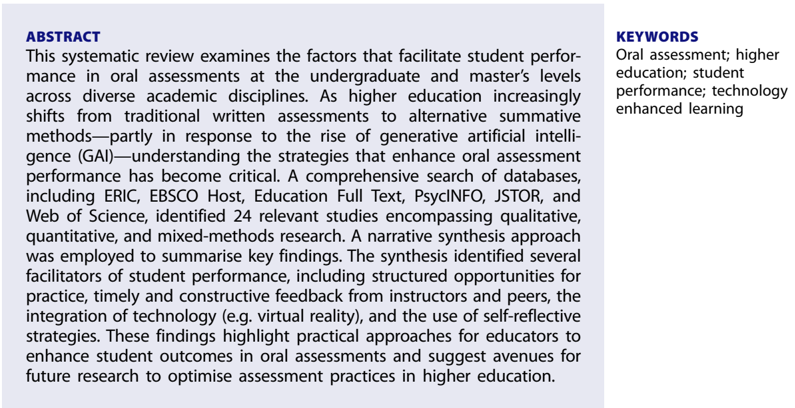
This systematic review examines the factors that facilitate student performance in oral assessments at the undergraduate and master’s levels across diverse academic disciplines. As higher education increasingly shifts from traditional written assessments to alternative summative methods—partly in response to the rise of generative artificial intelligence (GAI)—understanding the strategies that enhance oral assessment performance has become critical. A comprehensive search of databases, including ERIC, EBSCO Host, Education Full Text, PsycINFO, JSTOR, and Web of Science, identified 24 relevant studies encompassing qualitative, quantitative, and mixed-methods research. A narrative synthesis approach was employed to summarise key findings. The synthesis identified several facilitators of student performance, including structured opportunities for practice, timely and constructive feedback from instructors and peers, the integration of technology (e.g. virtual reality), and the use of self-reflective strategies. These findings highlight practical approaches for educators to enhance student outcomes in oral assessments and suggest avenues for future research to optimise assessment practices in higher education.
Overview
CoChat Summary
TL;DR
This systematic review synthesizes 24 studies on interventions and facilitators of university students’ oral assessment performance. It finds that feedback, structured practice, self-reflection, and technology—especially VR—can support performance, though VR’s effects on anxiety are mixed.
Key findings
- Feedback was a key facilitator: instructor feedback produced the highest performance scores (t = 0.47, p = 0.02; van Ginkel et al., 2017), faculty evaluations improved scores by 6.60 points (p < 0.01; Gunderson et al., 2021), and peer feedback yielded a 10% improvement that diminished after one month (Murillo-Zamorano & Montanero, 2018).
- Structured practice and mock oral examinations improved preparedness and performance: first-time pass rates rose from 76.0% to 100% (p = 0.025; Fischer et al., 2016), and 77.1% of students rated mock orals very or extremely helpful (Higgins et al., 2016).
- VR practice improved oral presentation performance (M = 42.82 to M = 49.85, p < 0.001; Boetje et al., 2020), but one study found VR practice produced significantly higher public speaking anxiety (p = 0.05) with no significant final performance difference (p = 0.39; Davis et al., 2020).
- Self-reflection and metacognitive strategies were associated with better performance: reflective writing scores predicted oral examination performance (p < 0.01; Tsingos-Lucas et al., 2017), and self-assessment in a VR oral examination simulator scored significantly higher in clarity, timing, and content organisation (p = 0.03; Serafini & Chittaro, 2024).
Methods
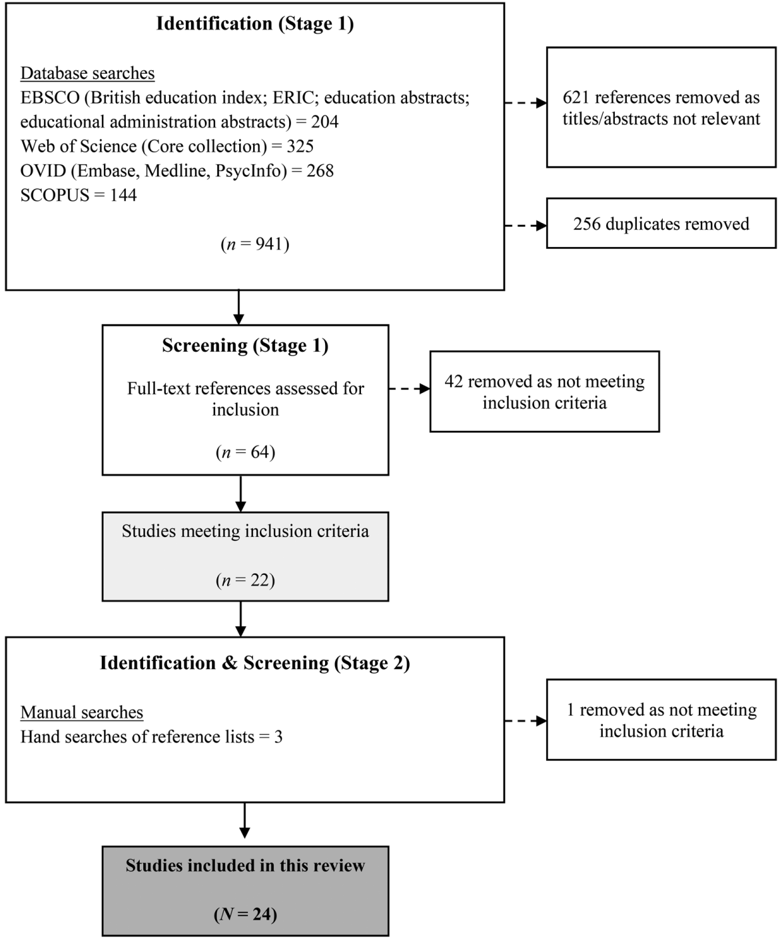
- Systematic review using SPIDER inclusion criteria; searched ERIC, EBSCO Host, Education Full Text, PsycINFO, JSTOR, and Web of Science in November 2024, limited to English-language peer-reviewed studies from 2015 onward; 941 records were identified, and 24 studies were included after screening and manual reference searching.
- Included qualitative, quantitative, and mixed-methods studies of university students (undergraduate or postgraduate) on practices/interventions aimed at improving oral assessment performance; studies were quality assessed with the Mixed Methods Appraisal Tool (MMAT), and findings were synthesised narratively following Popay et al. (2006).
Limitations
- Stated: the review was restricted to English-language publications, potentially introducing language bias; the diversity of interventions and disciplines may limit generalisability to specific educational settings; some studies had small sample sizes (e.g., Dickson et al., 2019).
- Evident from the text: the review reports mixed or inconsistent findings for VR’s impact on anxiety and for peer feedback retention, and two included studies did not report participant numbers, which may affect the robustness of conclusions.
Model-written summary. Check it against the paper before relying on it.
Integrity signals
Registry
Cites
Statistics
Figures


Verification
Claims the paper makes
0 Valid · 1 Not valid · 58 Not checked · 30 Own results and interpretations
A result the paper reports from its own data — it cites no other source for it, so there is none to check. The quote shows it is in the paper.
In the paper
“A comprehensive search of databases, including ERIC, EBSCO Host, Education Full Text, PsycINFO, JSTOR, and Web of Science, identified 24 relevant studies encompassing qualitative, quantitative, and mixed-methods research.”
- Also stated in: § Identification and screening of studies · plain
“The final number of articles for inclusion in the review was 24.”
§ Interventions and facilitators of oral assessment performance in higher education: a systematic review > Abstract
plain- Asserted: passes — The authors put it forward as true.
- Checkable: passes — It can be checked against evidence.
- Load-bearing: passes — The paper’s conclusions depend on it.
- Based: passes — The paper gives a reason why it holds.
- Also stated in: § Identification and screening of studies · plain
In the paper
“Mock orals in the studies reviewed (Fischer et al., 2016;Higgins et al., 2016) were typically part of coursework or professional training assessments, distinct from doctoral viva examinations.”
§ Interventions and facilitators of oral assessment performance in higher education: a systematic review > Feedback benefits performance on oral assessments across educational contexts
What the sources say
- Check pendingcites Fischer et al., 2016 matched to “Evaluating the effectiveness of a mock oral educational program” (2016) source
- Not checked yetcites Higgins et al., 2016 matched to “The utility of Mock Oral Examinations in Preparation for the American Board of Surgery Certifying Examination” (2016) source
plain- Asserted: passes — The authors put it forward as true.
- Checkable: passes — It can be checked against evidence.
- Load-bearing: unclear — It is unclear whether the paper’s conclusions depend on it.
- Based: passes — The paper gives a reason why it holds.
In the paper
“Nikolic et al. (2018) and Ritchie (2016) further supported the value of peer feedback, with both studies highlighting improvements in students' critical reflection and oral communication skills through peer-assessment activities.”
§ Interventions and facilitators of oral assessment performance in higher education: a systematic review > Peer feedback
What the sources say
- Not checked yetcites Nikolic et al. (2018) matched to “Formative Assessment to Develop Oral Communication Competency using YouTube: Self-and Peer-Assessment in Engineering” (2018) source
- Check pendingcites Ritchie (2016) matched to “Self-assessment of video-recorded presentations: Does it improve skills?” (2016) source
plainstates a cause- Asserted: passes — The authors put it forward as true.
- Checkable: passes — It can be checked against evidence.
- Load-bearing: passes — The paper’s conclusions depend on it.
- Based: passes — The paper gives a reason why it holds.
A result the paper states — it cites no source for it, so there is none to check. The quote shows it is in the paper.
In the paper
“Six studies focused on formal training exercises and repeated practice to improve presentation confidence and delivery.”
§ Interventions and facilitators of oral assessment performance in higher education: a systematic review > Structured Training and repeated practice
plain- Asserted: passes — The authors put it forward as true.
- Checkable: passes — It can be checked against evidence.
- Load-bearing: unclear — It is unclear whether the paper’s conclusions depend on it.
- Based: passes — The paper gives a reason why it holds.
In the paper
“Serafini and Chittaro (2024) used a vR oral examination simulator, with students who engaged in self-assessment scoring significantly higher (p = 0.03) in clarity, timing, and content organisation.”
§ Interventions and facilitators of oral assessment performance in higher education: a systematic review > Self-reflection and metacognitive strategies
What the sources say
- Check pendingcites Serafini and Chittaro (2024) matched to “Trial of a desktop virtual reality application as a method of exposure for test anxiety: a qualitative study” (2025) source
plainstates a cause- Asserted: passes — The authors put it forward as true.
- Checkable: passes — It can be checked against evidence.
- Load-bearing: unclear — It is unclear whether the paper’s conclusions depend on it.
- Based: passes — The paper gives a reason why it holds.
33 more claims
Create a free account to see all 89 claims and to verify the 58 references still open.
- It may state two separate claims as one. 34
- Probably not a substantial claim. 22
Self-check
Percentages, sums and reported differences re-computed from the paper’s own numbers.
Each contradiction between two passages listed here was confirmed by an independent check.
Rated minor: it would not touch a result — a value no result rests on, a p-value that stays on the same side of the significance level, or a conflict that is clerical, resolved elsewhere in the paper, or outside its own findings.
In the paper
§ Interventions and facilitators of oral assessment performance in higher education: a systematic review > Identification and screening of studies
“Searches across the four databases yielded 941 results.”
§ Interventions and facilitators of oral assessment performance in higher education: a systematic review > Abstract
“A comprehensive search of databases, including ERIC, EBSCO Host, Education Full Text, PsycINFO, JSTOR, and Web of Science, identified 24 relevant studies”
Citations
Cites
Hattie, J., & Timperley, H. (2007) · Review of Educational Research · doi:10.3102/003465430298487 · Cited by 12,905
The Mixed Methods Appraisal Tool (MMAT) version 2018 for information professionals and researchers
Hong, Q. N., Fàbregues, S., Bartlett, G., Boardman, F., Cargo, M., Dagenais, P., Gagnon, M.-P., Griffiths, F., Nicolau, B., O’Cathain, A., et al. (2018) · Education for Information · doi:10.3233/efi-180221 · Cited by 4,737 · cited 1×
“All studies were quality assessed using the Mixed Methods Appraisal Tool (MMAT) (Hong et al., 2018) by the lead author.”
(1985) · Medical Entomology and Zoology · Cited by 3,952
Beyond PICO: The SPIDER Tool for Qualitative Evidence Synthesis
Cooke, A., Smith, D., & Booth, A. (2012) · Qualitative Health Research · doi:10.1177/1049732312452938 · Cited by 2,608 · cited 1×
“Inclusion and exclusion criteria were developed within the ‘SPIDER’ framework (Sample, Phenomenon of Interest, Design, Evaluation, Research type) (Cooke et al., 2012).”
Popay, J., Roberts, H., Sowden, A., Petticrew, M., Arai, L., Rodgers, M., Britten, N., Roen, K., & Duffy, S. (2006) · Lancaster University · doi:10.13140/2.1.1018.4643 · Cited by 2,070
ChatGPT in higher education: considerations for academic integrity and student learning
(2023) · Journal of Applied Learning & Teaching · doi:10.37074/jalt.2023.6.1.17 · Cited by 853
Generative AI tools and assessment: Guidelines of the world's top-ranking universities
Moorhouse, B. L., Yeo, M. A., & Wan, Y. (2023) · Computers and Education Open · doi:10.1016/j.caeo.2023.100151 · Cited by 461 · cited 5×
“In the ever-evolving landscape of higher education, educators are increasingly tasked with designing assessments that are resilient to the capabilities of generative artificial intelligence (GAI) (Moorhouse et al., 2023).”
InfluentialProceedings of the 2005 American Society for Engineering Education Annual Conference & Exposition
Nielsen, S. H. (2005) · Cited by 436
ChatGPT improves creative problem-solving performance in university students: An experimental study
Urban, M., Děchtěrenko, F., Lukavský, J., Hrabalová, V., Svacha, F., Brom, C., & Urban, K. (2024) · Computers & Education · doi:10.1016/j.compedu.2024.105031 · Cited by 396 · cited 1×
“At best, using GAI saves students time, supports their learning through personalised feedback, and can lead to less stress in solving open-ended problems (urban et al., 2024).”
Fostering Metacognition to Support Student Learning and Performance
Stanton, J. D., Sebesta, A. J., & Dunlosky, J. (2021) · CBE—Life Sciences Education · doi:10.1187/cbe.20-12-0289 · Cited by 284 · cited 1×
“This aligns with metacognitive theories that emphasise the importance of self-evaluation in the learning process (Stanton et al., 2021).”
Research works printed but not linked: 3
- Boetje, R., S. van Ginkel, and M. Meijer. 2020. "Enhancing Oral Presentation Skills with virtual Reality Practice: A Randomized Controlled Trial. " Educational Technology Research and Development 68 (4): 2125-2140. doi:10.1007/ s11423-020-09777-3. · doi:10.1007/s11423-020-09777-3
- Borkin, H. 2020. Locating Bias in Higher Education Marking Practices. York, uK: Advance HE.
- Kolber, B. J. 2011. "Practice and Self-Reflection Bolster Oral Communication Skills. " Journal of College Science Teaching 40 (6): 87-91.
Cited by
Giving voice to women students: designing oral assessments for inclusion and validity
Rae, M., Tai, J., & Dawson, P. (2025) · Assessment & Evaluation in Higher Education · doi:10.1080/02602938.2025.2580622 · Cited by 8
Towards Embodied Conversational Agents for Reducing Oral Exam Anxiety in Extended Reality
Grubert, J., Sedelmaier, Y., & Landes, D. (2025) · IEEE International Symposium on Mixed and Augmented Reality Adjunct (ISMAR-Adjunct) · doi:10.1109/ismar-adjunct68609.2025.00113 · Cited by 4
Flores, V., RIOS, H., Gentili, C. G., Donato, M., & Rapacioli, M. (2026) · Advances in Medical Education and Practice · doi:10.2147/amep.s622464 · Cited by 1
Secure online assessments: Strategies to mitigate generative AI risks in higher education
Jonathan, J., & Walsh, C. (2025) · ASCILITE Publications · doi:10.65106/apubs.2025.2680
Medina-Pozos, J. M., & Nieto-Jalil, J. M. (2025) · Mexican International Conference on Computer Science · doi:10.1109/enc68268.2025.11311879 · Cited by 1
Metadata
- Authors
- Stephenson, Z., Johnson-Glauch, N., & Cruchley, S.
- Affiliations
- University of Birmingham (GB)
- California Polytechnic State University
- Corresponding author
- Stephenson, Zoe
- Venue
- Assessment & Evaluation in Higher Education
- Publisher
- Informa UK Limited
- Published
- 2025-06
- Volume
- 50
- Issue
- 7
- Pages
- 1140-1153
- ISSN
- 0260-2938 (ISSN-L)
- 1469-297X
- OpenAlex
- W4410929298
- Semantic Scholar
- 69c0a8e91dc03d26cc4d0587e6ee1ec157bf0124
- Cited by
- 25
- References
- 65
- Citations by year
- 2026: 19 · 2025: 6
- FWCI
- 2.56
- Type
- journal article
- Language
- en
- Open access
- hybrid
- doi.org
- Licence
- Locations
- Assessment & Evaluation in Higher Education (publishedVersion, cc-by)
- University of Birmingham Research Portal (University of Birmingham) (submittedVersion, other-oa)
- Topics
- Social Sciences › Education › Student Assessment and Feedback
- Social Sciences › Education › Evaluation of Teaching Practices
- Social Sciences › Education › Innovative Teaching Methods
- Keywords
- oral assessment, student performance, practice opportunities, feedback, peer feedback, virtual reality, self-reflection, generative AI, alternative assessment, assessment practices
About these checks
Registry, retraction, Cites and statistics results are computed, not judged, with one exception: a printed reference that no index lists is read once by a model before it counts as a citation error. Claims are extracted by a model and kept only when their quote appears verbatim in the text; each cited source is then checked, with a model’s help, for whether it says what the claim relies on. Those verdicts can be wrong — read the claim’s quote and the cited source before relying on one.
A language model drew the claims from the paper on 2026-11-16, under version 3 of the claim definition (model deepseek-v4.1-flash, prompt extract-v3).
A second model labelled each claim on 2026-11-16 (model jev-1.13-20260917, definition revision gold-guideline-v0.2).
Statistics and arithmetic are recomputed, not judged.
Confidence bands are shown only for fields calibrated on our annotated test set. None is calibrated yet, so no band is shown.
What counts as a claim ›How we measure confidence ›How we check this ›
Are you an author, or do you see a problem with this page? Request a review
Data sources
Bibliographic data: Semantic Scholar, OpenAlex, Crossref.
Contains information from the Semantic Scholar Academic Graph Datasets, made available under the ODC Attribution License (ODC-BY 1.0).
Semantic Scholar’s data is described in: Kinney, R., et al. (2023). The Semantic Scholar Open Data Platform. arXiv:2301.10140.
