

How university students work on assessment tasks with generative artificial intelligence: matters of judgement
Open accessThe DOI matches its Crossref record; 24 of the 24 references it cites were found in a registry or an index; 5 of the 6 sources its claims cite were checked for support.
Abstract
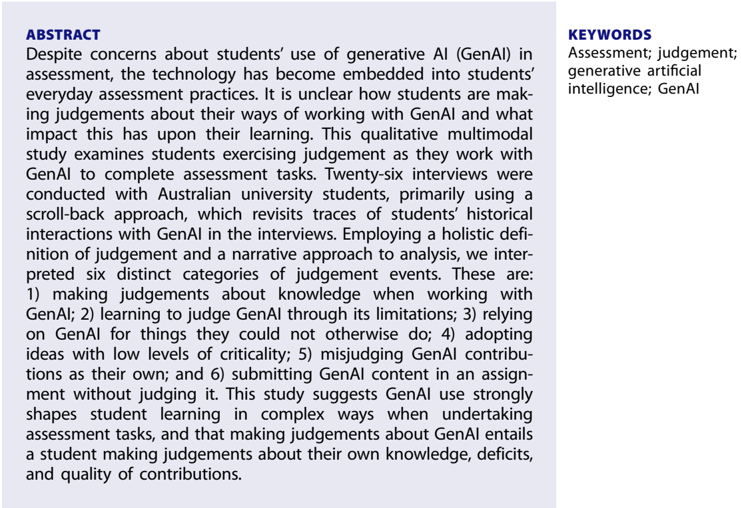
Despite concerns about students’ use of generative AI (GenAI) in assessment, the technology has become embedded into students’ everyday assessment practices. It is unclear how students are making judgements about their ways of working with GenAI and what impact this has upon their learning. This qualitative multimodal study examines students exercising judgement as they work with GenAI to complete assessment tasks. Twenty-six interviews were conducted with Australian university students, primarily using a scroll-back approach, which revisits traces of students’ historical interactions with GenAI in the interviews. Employing a holistic definition of judgement and a narrative approach to analysis, we interpreted six distinct categories of judgement events. These are: 1) making judgements about knowledge when working with GenAI; 2) learning to judge GenAI through its limitations; 3) relying on GenAI for things they could not otherwise do; 4) adopting ideas with low levels of criticality; 5) misjudging GenAI contributions as their own; and 6) submitting GenAI content in an assignment without judging it. This study suggests GenAI use strongly shapes student learning in complex ways when undertaking assessment tasks, and that making judgements about GenAI entails a student making judgements about their own knowledge, deficits, and quality of contributions.
Overview
CoChat Summary
TL;DR
This qualitative multimodal study of 26 Australian university students used scroll-back interviews to examine how students exercise judgement when using generative AI (GenAI) in assessment. It identifies six categories of judgement events and argues that GenAI use strongly shapes learning in complex ways, with judgements about GenAI entangled with judgements about students’ own knowledge, deficits, and contributions.
Key findings
- The analysis identified six distinct categories of judgement events: (1) making judgements about knowledge when working with GenAI; (2) learning to judge GenAI through its limitations; (3) relying on GenAI for things they could not otherwise do; (4) adopting ideas with low levels of criticality; (5) misjudging GenAI contributions as their own; and (6) submitting GenAI content in an assignment without judging it.
- Of 52 judgement events identified, 30 related to assessment; these were clustered into the six categories.
- Judgements about GenAI were strongly intertwined with judgements about self: students judged their own knowledge, deficits, and contributions, and some misjudged GenAI contributions as their own even when traces showed little change between generated and submitted text.
- GenAI use both supported and hindered learning: some students learned about writing or became less reliant over time, while others adopted ideas uncritically or copy-pasted GenAI outputs without judging them, with some calling this “cheating.”
Methods
- Qualitative multimodal design with 26 online Zoom interviews of undergraduate students at one large Australian university, recruited via the institution’s disability/accessibility unit (11 students) and subject convenors across faculties (15 students); participants self-identified as motivated GenAI users.
- Scroll-back interview approach: participants shared historical GenAI interactions via screen sharing, with screen recording and artefacts; 7 interviewees did not bring historical interactions, so interviews used completed artefacts, recreations, or joint review of settings/comments.
- Holistic narrative analysis: researchers wrote narrative accounts of judgement events, then focused on the 30 of 52 events related to assessment and clustered them into six thematically similar categories.
Limitations
- The paper states the analytic approach was “highly interpretive,” and researchers sometimes experienced unease when participant accounts and artefacts contradicted each other.
- No formal limitations section is included; evident from the text, the study is qualitative, based at a single large Australian university, and uses 26 self-identified motivated GenAI users, so findings are context-bound and not statistically generalizable.
- Evident from the text, 7 of 26 interviewees did not bring historical interactions, and some GenAI tools did not leave traces amenable to scrolling back, so some data relied on completed artefacts, recreations, or joint review of software settings or unresolved comments.
Model-written summary. Check it against the paper before relying on it.
Integrity signals
Registry
Cites
Statistics
Figures


Verification
Claims the paper makes
5 Valid · 1 Not valid · 1 Not checked · 56 Own results and interpretations
Every source the paper cites for this claim was checked and supports it.
In the paper
“Our observations of the potential for misjudging performance aligns with an experimental quantitative study conducted by Urban et al. (2024).”
§ How university students work on assessment tasks with generative artificial intelligence: matters of judgement > Discussion
What the sources say
- Supportedcites Urban et al. (2024) matched to “ChatGPT improves creative problem-solving performance in university students: An experimental study” (2024) source
The section “Perceived Usefulness of ChatGPT as a Heuristic Cue in Metacognitive Monitoring” (page not provided) reports that participants who found ChatGPT more useful tended to overestimate the quality and originality of their answers. This supports the cited sentence’s limited claim that the experimental study aligns with observations about the potential for misjudging performance. (LLM, conf=0.92)
plainstates an association- Asserted: passes — The authors put it forward as true.
- Checkable: passes — It can be checked against evidence.
- Load-bearing: unclear — It is unclear whether the paper’s conclusions depend on it.
- Based: passes — The paper gives a reason why it holds.
- Supported
A result the paper reports from its own data — it cites no other source for it, so there is none to check. The quote shows it is in the paper.
In the paper
“For some students, involvement in a pattern of judgement over time was understood as a means by which to cultivate personal knowledge that could persist beyond interactions with the GenAI tool.”
§ How university students work on assessment tasks with generative artificial intelligence: matters of judgement > Relying on GenAI for things they could not otherwise do
plainstates a causeSingle case- Asserted: passes — The authors put it forward as true.
- Checkable: passes — It can be checked against evidence.
- Load-bearing: passes — The paper’s conclusions depend on it.
- Based: passes — The paper gives a reason why it holds.
A result the paper reports from its own data — it cites no other source for it, so there is none to check. The quote shows it is in the paper.
In the paper
“As mentioned above, this did not necessarily replace evaluation on the students' part, which took place on receipt of the outputs of the technology.”
§ How university students work on assessment tasks with generative artificial intelligence: matters of judgement > Relying on GenAI for things they could not otherwise do
hedged- Asserted: passes — The authors put it forward as true.
- Checkable: passes — It can be checked against evidence.
- Load-bearing: passes — The paper’s conclusions depend on it.
- Based: passes — The paper gives a reason why it holds.
A result the paper reports from its own data — it cites no other source for it, so there is none to check. The quote shows it is in the paper.
In the paper
“For some students, such as Sally (who studies Psychology), the uncritical adoption of ideas in one judgement event influenced her future judgements-she explained that her decision to adopt ideas uncritically in the past had led to poor results”
§ How university students work on assessment tasks with generative artificial intelligence: matters of judgement > Adopting ideas with low levels of criticality
plainstates a causeSingle case- Asserted: passes — The authors put it forward as true.
- Checkable: passes — It can be checked against evidence.
- Load-bearing: unclear — It is unclear whether the paper’s conclusions depend on it.
- Based: passes — The paper gives a reason why it holds.
A result the paper reports from its own data — it cites no other source for it, so there is none to check. The quote shows it is in the paper.
In the paper
“Some students, for instance, cited the fact that 'everyone is doing it' as a justification for their choices.”
§ How university students work on assessment tasks with generative artificial intelligence: matters of judgement > Submitting GenAI work in the assignment without judging it
plain- Asserted: passes — The authors put it forward as true.
- Checkable: passes — It can be checked against evidence.
- Load-bearing: unclear — It is unclear whether the paper’s conclusions depend on it.
- Based: passes — The paper gives a reason why it holds.
29 more claims
Create a free account to see all 63 claims and to verify the 1 reference still open.
- Probably not a substantial claim. 15
- It may state two separate claims as one. 18
- Borderline: one of the tests for a substantial claim is unclear. 1
Citations
Cites
Narrative Methods for the Human Sciences
(2008) · Gender in Management: An International Journal · doi:10.1108/17542410810897562 · Cited by 3,784 · cited 1×
“Two team members (JW, MB) clustered these judgement event narratives into thematically similar categories (Riessman 2008), which were discussed and reviewed by all.”
Developing evaluative judgement: enabling students to make decisions about the quality of work
Tai, J., Ajjawi, R., Boud, D., Dawson, P., & Panadero, E. (2018) · Higher Education · doi:10.1007/s10734-017-0220-3 · Cited by 810 · cited 1×
“Bearman et al. (2024) propose that students are constantly judging the quality of their work and that of the GenAI outputs—what is commonly called evaluative judgement (Tai et al. 2018).”
Self-citationFan, Y., Tang, L., Le, H., Shen, K., Tan, S., Zhao, Y., Shen, Y., Li, X., & Gašević, D. (2025) · British Journal of Educational Technology · doi:10.1111/bjet.13544 · Cited by 805
Quantitative studies of student self-assessment in higher education: a critical analysis of findings
Boud, D., & Falchikov, N. (1989) · Higher Education · doi:10.1007/bf00138746 · Cited by 616 · cited 1×
“…outputs is enmeshed with how a student makes judgements about their own pre-existing knowledge or deficits, or the quality of their contribution in altering GenAI outputs (resonating in turn with longstanding issues raised in studies of self-assessment; see for example Boud and Falchikov 1989).”
Self-citationA Scoping Review on How Generative Artificial Intelligence Transforms Assessment in Higher Education
Xia, Q., Weng, X., Ouyang, F., Lin, T. J., & Chiu, T. K. F. (2024) · International Journal of Educational Technology in Higher Education · doi:10.1186/s41239-024-00468-z · Cited by 493 · cited 1×
“Topical concerns about student use of GenAI include the effects upon learning, challenges to academic integrity through students submitting GenAI outputs as if they were their own, and the value of a degree in the academy (Jensen et al. 2025; Xia et al. 2024).”
Indeterminacy in the use of preset criteria for assessment and grading
Sadler, D. R. (2009) · Assessment & Evaluation in Higher Education · doi:10.1080/02602930801956059 · Cited by 489 · cited 3×
“These trajectories of judgement are not simply cognitive events, but involve tacit evaluation (Sadler 2009), mediated by material constraints and affordances (Esterhazy and Damşa 2019).”
ChatGPT improves creative problem-solving performance in university students: An experimental study
Urban, M., Děchtěrenko, F., Lukavský, J., Hrabalová, V., Svacha, F., Brom, C., & Urban, K. (2024) · Computers & Education · doi:10.1016/j.compedu.2024.105031 · Cited by 396 · cited 2×
“Taking both Urban et al. (2024) and our own study into account, we propose that one of the primary risks facing learners when working with GenAI to complete assessment tasks may be the potential to misjudge themselves and their own work.”
Developing evaluative judgement for a time of generative artificial intelligence
Bearman, M., Tai, J., Dawson, P., Boud, D., & Ajjawi, R. (2024) · Assessment & Evaluation in Higher Education · doi:10.1080/02602938.2024.2335321 · Cited by 312 · cited 2×
“Bearman et al. (2024) propose that students are constantly judging the quality of their work and that of the GenAI outputs—what is commonly called evaluative judgement (Tai et al. 2018).”
Self-citationHow to Conduct a Practice-based Study: Problems and Methods
Gherardi, S. (2012) · Edward Elgar Publishing eBooks · doi:10.4337/9780857933386 · Cited by 286 · cited 1×
“Students come to know what Gherardi (2012) might call the ‘texture’ of judgement, which emerges through the ‘warp and weft’ of choices and actions that play out when students interact with other actors and artefacts in the world around them.”
Comparing Generative AI and teacher feedback: student perceptions of usefulness and trustworthiness
Henderson, M., Bearman, M., Chung, J., Fawns, T., Buckingham Shum, S., Matthews, K. E., & de Mello Heredia, J. (2026) · Assessment & Evaluation in Higher Education · doi:10.1080/02602938.2025.2502582 · Cited by 211 · cited 2×
“Some determine if, when, and how GenAI should provide them with feedback information, and then make judgements about what to do next (Henderson et al. 2025).”
Self-citation
Cited by
On the essay in a time of GenAI
Corbin, T., Walton, J., Bannister, P., & Deranty, J. (2025) · Educational Philosophy and Theory · doi:10.1080/00131857.2025.2572802 · Cited by 27
“We have mounting evidence that students use AI to support their reading (Corbin et al., 2024), to generate and interpret feedback (henderson et al., 2025), and, most disruptively for our purposes, to understand, produce, reference, critique, and polish assessment tasks (Walton et al., 2025).”
Self-citationEducational integrity in GenAI-augmented assessment: making judgement visible
Sharma, S. (2026) · International Journal for Educational Integrity · doi:10.1007/s40979-026-00216-y · Cited by 24
Yang, B. (2026) · Studies in Higher Education · doi:10.1080/03075079.2026.2648696 · Cited by 4
Why the User-Friendliness of AI Undermines Education. Commentary on Wieczorek 2025
Dekker, I., & Hermans, F. (2026) · Philosophy & Technology · doi:10.1007/s13347-026-01093-6 · Cited by 3
“Research by Walton et al. ( 2025) shows that after outsourcing a task to AI, students tend to later misremember the out - put as their own.”
Educating What AI Cannot: Character and the Future of Higher Education
Grove, M. J., & Harrison, T. (2026) · British Journal of Educational Studies · doi:10.1080/00071005.2026.2678972 · Cited by 4
Fawns, T., Bearman, M., Corbin, T., Henderson, M., McLean, J., Matthews, K., Oberg, G., Liang, Y., & Walton, J. (2026) · Higher Education · doi:10.1007/s10734-026-01730-1 · Cited by 3
Self-citationFeedback futures: Beyond the limits of human and GenAI capacities
Zhan, Y., Wood, J., Carless, D., & Yan, Z. (2026) · Assessment & Evaluation in Higher Education · doi:10.1080/02602938.2026.2672830 · Cited by 2
“Metacognitive skills matter because students need to monitor when GenAI support is helping them think more effectively, when it is narrowing that thinking, and when it is beginning to substitute for their own reflective work (Zhan and Yan 2026; Walton et al. 2025).”
InfluentialZeivots, S., Wright, S., Harris, L., Cram, A., Huber, E., Raduescu, C., White, A. W., & Brodzeli, A. (2026) · Studies in Higher Education · doi:10.1080/03075079.2026.2619909 · Cited by 3
Jiang, X. (2026) · Interactive Technology and Smart Education · doi:10.1108/itse-01-2026-0004 · Cited by 2
Cournoyea, M., & Seeley, S. (2026) · Assessment & Evaluation in Higher Education · doi:10.1080/02602938.2026.2656286 · Cited by 2
Gonsalves, C., Vuren, S. V., & Gill-Simmen, L. (2026) · Journal of Marketing Education · doi:10.1177/02734753261454375 · Cited by 3
Decision-making in programmatic assessment is only a challenge when we make it one
Beekman, K., & Schuwirth, L. (2026) · Advances in Health Sciences Education · doi:10.1007/s10459-026-10560-w · Cited by 1
Hernández, P. T., Haines, A. M., Mousseau, V., Elbourne, M., & Hanna, T. (2026) · Forensic Science International Synergy · doi:10.1016/j.fsisyn.2026.100723 · Cited by 2
“The integration of Generative Artificial Intelligence (GenAI) into teaching, learning, and assessment is globally revolutionising how students engage with their academic journey, with many relying on these tools to help them prepare for and complete assessment tasks [1].”
Which inference is at risk? Assessment validity reasoning and generative AI
Weidlich, J. (2026) · Assessment & Evaluation in Higher Education · doi:10.1080/02602938.2026.2734795 · Cited by 7
Learning to Work With Artificial Intelligence as Part of Clinical Education
Bearman, M. (2025) · The Clinical Teacher · doi:10.1111/tct.70260
“In classrooms, students are using it for everyday tasks—to summarise readings [5], to create academic outputs [6], to complete quizzes and other assessments [7] and for feedback on work [8].”
Self-citationXyrafaki, S., Giannakaki, M.-A., Nikovia, K., Anastasiou, P.-K., Zingiridis, M., Katsampoxaki-Hodgetts, K., & Neochoritis, C. G. (2026) · Journal of Chemical Education · doi:10.1021/acs.jchemed.5c01205
Visual Hermeneutic Prompting: an AI-assisted approach for Analysis & Design modelling
Meresz, M., & Sammon, D. (2026) · Journal of Decision System · doi:10.1080/12460125.2026.2673375
‘A bit of chaos and madness’: the AI assessment scale and the work of assessment reform
Perkins, M., Postma, D., Roe, J., Sisay, S., & Holdcroft, C. (2026) · Assessment & Evaluation in Higher Education · doi:10.1080/02602938.2026.2724300 · Cited by 1
“…tasks from learning outcomes, ensuring disciplinary standards are maintained, and requiring suitable evidence that learning outcomes are being met, including how students will demonstrate evaluative judgement and accountability for AI-supported work (Dawson et al., 2024; Walton et al., 2025).”
Zhang, Q., Xiao, L., Wu, X., Chen, G., & Chiang, F. (2026) · Communications in computer and information science · doi:10.1007/978-3-032-29788-4_41 · Cited by 1
Zubtsova, Y. Y., Sushchenko, L., Шульга, Л., Andryushchenko, O., & Шульга, О. (2026) · Journal of Interdisciplinary Studies in Education · doi:10.32674/n7pdhe28
Uçan, S. (2026) · Assessment & Evaluation in Higher Education · doi:10.1080/02602938.2026.2711422 · Cited by 2
How artificial intelligence transforms the feedback ecosystem in higher education
Bearman, M., Corbin, T., Walton, J., Tai, J., Nieminen, J. H., Dawson, P., Crawford, N., & Boud, D. J. (2026) · Assessment & Evaluation in Higher Education · doi:10.1080/02602938.2026.2730625 · Cited by 2
Self-citationYan, Z., Fang, Z., & Zou, W. (2026) · Frontiers in Psychology · doi:10.3389/fpsyg.2026.1939286 · Cited by 3
“Third, because GenAI outputs lack stable epistemic authority and must be assessed in context, learners are obliged to evaluate relevance and accuracy, which strengthens their capacity to judge feedback quality (Carless and Boud, 2018; Walton et al., 2026).”
InfluentialMensah, F. S., Acheampong, P. A., Amewonye, V. K. A., Sam, T., Emilio, D. K., Baidoo, S., Oppong, K., & Baidoo, P. K. (2026) · Frontiers in Education · doi:10.3389/feduc.2026.1941201
“…Huang, 2025), instructional design (Chai et al., 2025; Kim, 2026; Kozan et al., 2025; Wu et al., 2025), assessment development (Kadel et al., 2026; Walton et al., 2025; Wang et al., 2024; Xia et al., 2024), reflective practice (Al-Fattal, 2026; Cao et al., 2026; Combrinck and Loubser, 2025; Li et…”
Rocha, A., Ferreira, J. P., de Oliveira, P. C., Alves, M., & Sousa, A. J. (2026) · Computers · doi:10.3390/computers15100647
Teacher authority, responsibility, and platform governance in generative AI-supported classrooms
Zhang, X., & Li, H. (2026) · Discover Education · doi:10.1007/s44217-026-02214-1 · Cited by 4
“Walton et al. show that students’ use of generative AI in assessment is bound up with matters of judgement rather than mere rule compliance [28].”
Ayala, M. G. L., & Osuna-Flores, I. (2026) · Revista Científica Arbitrada de la Fundación MenteClara · doi:10.32351/rca.v11.443
“Walton et al. (2026) similarly show that university students exercise different forms of judgement while working with GenAI, including judgements concerning knowledge, system limitations, contribution, reliance, and submission.”
Metadata
- Authors
- Walton, J., Bearman, M., Crawford, N., Tai, J., & Boud, D.
- Affiliations
- Deakin University (AU)
- Corresponding author
- Walton, Jack
- Venue
- Assessment & Evaluation in Higher Education
- Publisher
- Informa UK Limited
- Published
- 2025-10-13
- Volume
- 51
- Issue
- 6
- Pages
- 1066-1082
- ISSN
- 0260-2938 (ISSN-L)
- 1469-297X
- OpenAlex
- W4415139151
- Semantic Scholar
- 9d47fb1699e7f1ebd94c912533488cd26bc39a57
- Cited by
- 28
- References
- 23
- Citations by year
- 2026: 26 · 2025: 2
- FWCI
- 28.86
- Type
- journal article
- Language
- en
- Open access
- hybrid
- doi.org
- Licence
- cc-by-nc-nd
- creativecommons.org/licenses/by-nc-nd/4.0/ (vor)
- doi.org/10.1080/policies-text-data-mining (tdm)
- Locations
- Assessment & Evaluation in Higher Education (publishedVersion, cc-by-nc-nd)
- Figshare (submittedVersion)
- OPUS - Open Publications of UTS Scholars (University of Technology Sydney) (submittedVersion, cc-by-nc-nd)
- Topics
- Social Sciences › Education › Artificial Intelligence in Education
- Social Sciences › Education › Academic integrity and plagiarism
- Social Sciences › Education › Student Assessment and Feedback
- Keywords
- generative AI, judgment, university students, assessment tasks, AI-generated content, academic integrity, criticality, student learning, AI limitations, student self-assessment
About these checks
Registry, retraction, Cites and statistics results are computed, not judged, with one exception: a printed reference that no index lists is read once by a model before it counts as a citation error. Claims are extracted by a model and kept only when their quote appears verbatim in the text; each cited source is then checked, with a model’s help, for whether it says what the claim relies on. Those verdicts can be wrong — read the claim’s quote and the cited source before relying on one.
A language model drew the claims from the paper on 2026-10-05, under version 3 of the claim definition (model deepseek-v4.1-flash, prompt extract-v3).
A second model labelled each claim on 2026-10-05 (model jev-1.13-20260917, definition revision gold-guideline-v0.2).
Cited sources are checked with a language model’s help (gpt-6-sol).
Statistics and arithmetic are recomputed, not judged.
Confidence bands are shown only for fields calibrated on our annotated test set. None is calibrated yet, so no band is shown.
What counts as a claim ›How we measure confidence ›How we check this ›
Are you an author, or do you see a problem with this page? Request a review
Data sources
Bibliographic data: Semantic Scholar, OpenAlex, Crossref.
Contains information from the Semantic Scholar Academic Graph Datasets, made available under the ODC Attribution License (ODC-BY 1.0).
Semantic Scholar’s data is described in: Kinney, R., et al. (2023). The Semantic Scholar Open Data Platform. arXiv:2301.10140.
