

The DOI matches its Crossref record; 61 of the 62 references it cites were found in a registry or an index.
Development and aetiology of body dissatisfaction in adolescent boys and girls
Open accessAbstract
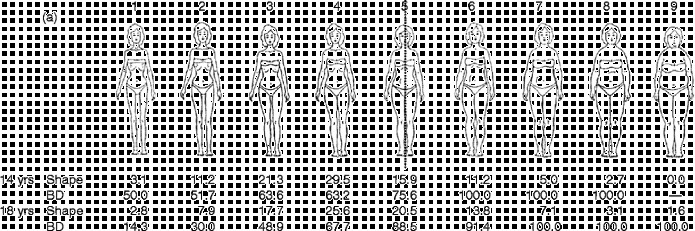
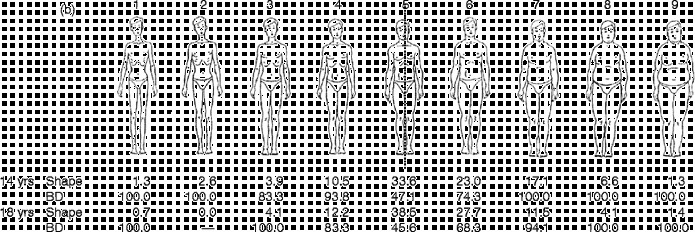
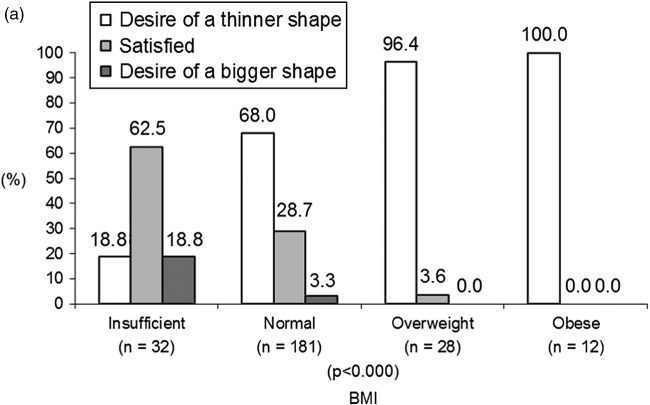
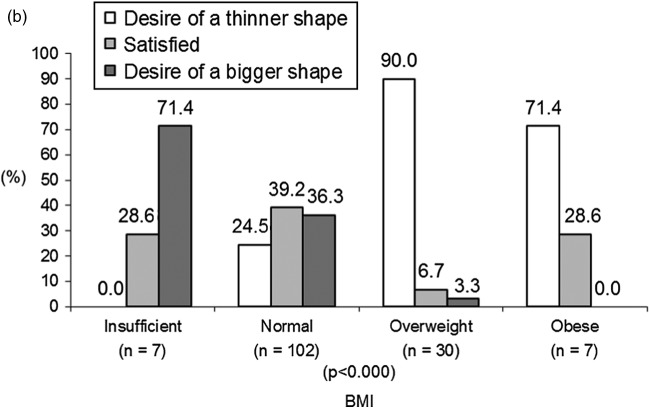
between the ages of 14 and 18, and to identify factors associated with BD at age 18, among 413 adolescents. Between the ages of 14 and 18, the proportion of girls wanting to be thinner increased, although it remained unchanged among boys. A ratio of 1:2 girls and 1:5 boys reported having seriously tried to lose weight. Factors associated with BD in girls at age 18 were (1) wanting to be thinner, (2) body mass index (BMI), (3) weight control behaviours and (4) negative comments about weight. Factors associated with BD in boys at age 18 were (1) wanting to be thinner or bigger, (2) BMI, (3) having experienced sexual intercourse and (4) negative comments about weight. The high prevalence of BD and weight-related concerns suggest a need for early interventions.
Overview
The claims and statistics of this paper haven’t been checked yet.
Run the check — free, no account needed. It reads the open-access text and checks the sources it cites.
Integrity signals
Registry
Cites
Statistics
Figures
Verification
Claims the paper makes
The claims and statistics of this paper haven’t been checked yet.
Run the check — free, no account needed. It reads the open-access text and checks the sources it cites.
Claims other papers make about this one
Each is checked against this paper’s own text: does it say what the citing paper says it does?
In the citing paper
“Dion et al. [24] found a greater prevalence of body dissatisfaction (wanting to be thinner) in females from age 14 to 18.”
From Effects of Social Media and Smartphone Use on Body Esteem in Female Adolescents: Testing a Cognitive and Affective Model (2020) · cites this paper as [24]
Self-check
Percentages, sums and reported differences re-computed from the paper’s own numbers.
The self-check needs the paper’s full text.
Citations
Cites
Exacting beauty: Theory, assessment, and treatment of body image disturbance.
Thompson, J. K., Heinberg, L. J., Altabe, M., & Tantleff-Dunn, S. (1999) · doi:10.1037/10312-000 · Cited by 3,100
Risk and maintenance factors for eating pathology: A meta-analytic review.
Stice, E. M. (2002) · Psychological Bulletin · doi:10.1037/0033-2909.128.5.825 · Cited by 2,710 · cited 4×
“…control behaviours as well as eating pathologies (Crow, Eisenberg, Story, & Neumark-Sztainer, 2008; Neumark-Sztainer, Paxton, Hannan, Haines, & Story, 2006b; Paxton, Neumark-Sztainer, Hannan, & Eisenberg, 2006b; Stice, 2002; Stice & Bearman, 2001; Stice, Marti, & Durant, 2011; Tiggemann, 2005).”
BackgroundInfluentialAsia Pacific Journal of Clinical Nutrition
(2010) · Asia Pacific Journal of Clinical Nutrition · doi:10.1111/(issn)1440-6047 · Cited by 1,852
Body image: a handbook of theory, research, and clinical practice
(2003) · Choice Reviews Online · doi:10.5860/choice.40-3703 · Cited by 1,834
Rosenberg, M. (2011) · PsycTESTS Dataset · doi:10.1037/t01038-000 · Cited by 1,226
Neumark-Sztainer, D., Paxton, S. J., Hannan, P. J., Haines, J., & Story, M. (2006) · Journal of Adolescent Health · doi:10.1016/j.jadohealth.2005.12.001 · Cited by 1,087 · cited 1×
“Preventive programmes should target a broad spectrum of weight-related problematic conditions and behaviours, such as obesity, eating disorders and BD (Neumark-Sztainer, 2005; Neumark-Sztainer et al., 2006a).”
BackgroundRisk factors for body dissatisfaction in adolescent girls: A longitudinal investigation.
Stice, E. M., & Whitenton, K. (2002) · Developmental Psychology · doi:10.1037/0012-1649.38.5.669 · Cited by 846 · cited 1×
“Nonetheless, some studies did not find depression (Holsen, Kraft, & Roysamb, 2001; Stice & Whitenton, 2002) or low self-esteem (Tiggeman, 2005) to prospectively predict BD. Finally, some social and family-related factors are reported to predict BD in longitudinal studies, for example, friends…”
BackgroundNeumark‐Sztainer, D., Wall, M. M., Larson, N., Eisenberg, M. E., & Loth, K. A. (2011) · Journal of the American Dietetic Association · doi:10.1016/j.jada.2011.04.012 · Cited by 772 · cited 1×
“As found in other studies (Eaton et al., 2008; Neumark-Sztainer et al., 2002, 2011), moderate weight control behaviours (e.g. reducing sugar and fat intake) were more common than extreme ones (e.g. skipping meals, using laxatives, purging).”
ResultDevelopment and Validation of a New Body-Image Assessment Scale
Thompson, M. A., & Gray, J. J. (1995) · Journal of Personality Assessment · doi:10.1207/s15327752jpa6402_6 · Cited by 738 · cited 4×
“These students were interested in participating in the longitudinal study and were authorised to do so by their parents.”
BackgroundMethodInfluentialPaxton, S. J., Neumark‐Sztainer, D., Hannan, P. J., & Eisenberg, M. E. (2006) · Journal of Clinical Child & Adolescent Psychology · doi:10.1207/s15374424jccp3504_5 · Cited by 715 · cited 4×
“…explore how adolescent sexuality (such as the circumstances of the first intercourse and sexual risk taking) could be associated with BD. Self-esteem was found to be related to BD in previous longitudinal studies (e.g. Cantin & Stan, 2010; Paxton et al., 2006a), with one exception (Tiggeman, 2005).”
BackgroundResultInfluential
Research works printed but not linked: 2
- CashT. F. & PruzinskyT. (2011). Body image: A Handbook of theory research and clinical Practice. New York NY: The Guilford Press.
- TomkinsC. (2006). An introduction to non-parametric statistics for health scientists. University of Alberta Health Sciences Journal, 3, 20–26.
Cited by
Sorted by citations
Body dissatisfaction and psychological distress in adolescents: Is self-esteem a mediator?
Duchesne, A.-P., Dion, J., Lalande, D. R., Bégin, C., Émond, C., Lalande, G., & McDuff, P. (2016) · Journal of Health Psychology · doi:10.1177/1359105316631196 · Cited by 169
“%) of body dissatisfaction among adolescents, which corroborates previous research (e.g. Bearman et al., 2006; Dion et al., 2015).”
InfluentialScully, M., Swords, L., & Nixon, E. (2023) · Irish Journal of Psychological Medicine · doi:10.1017/ipm.2020.93 · Cited by 156
“Body dissatisfaction levels in early adolescence are the single best predictor of body dissatisfaction levels in late adolescence (Dion et al. 2015).”
BackgroundKelly, A. S., Armstrong, S., Michalsky, M. P., & Fox, C. K. (2024) · JAMA · doi:10.1001/jama.2024.11809 · Cited by 165
Body Image Dissatisfaction and Anxiety Trajectories During Adolescence
Vannucci, A., & Ohannessian, C. M. (2017) · Journal of Clinical Child & Adolescent Psychology · doi:10.1080/15374416.2017.1390755 · Cited by 158
“Body image dissatisfaction is common among adolescents, with prevalence rates ranging from 30% to 80% (Dion et al., 2015).”
BackgroundInsatisfação com a imagem corporal e fatores associados em adolescentes
de Carvalho, G. X., Nunes, A. P. N., de Moraes, C. L., & da Veiga, G. V. (2020) · Ciência & Saúde Coletiva · doi:10.1590/1413-81232020257.27452018 · Cited by 101
“Dieting and unhealthy weight control behaviors during adolescence: Do they predict changes in weight ten years later? J Adolesc Health 2012; 50(1):80-86.”
BackgroundMethodInfluential
Metadata
- Authors
- Dion, J., Blackburn, M.-E., Auclair, J., Laberge, L., Veillette, S., Gaudreault, M., Vachon, P., Perron, M., & Touchette, É.
- Affiliations
- Université du Québec à Chicoutimi (CA)
- ,
- Cégep de Jonquière (CA)
- Université du Québec à Trois-Rivières (CA)
- Corresponding author
- Dion, Jacinthe
- Venue
- International Journal of Adolescence and Youth
- Publisher
- Informa UK Limited
- Published
- 2014-12-03
- Volume
- 20
- Issue
- 2
- Pages
- 151-166
- ISSN
- 0267-3843 (ISSN-L)
- 2164-4527
- PMC
- PMC4391290
- OpenAlex
- W1999993784
- Cited by
- 141
- References
- 62
- Citations by year
- 2026: 9 · 2025: 13 · 2024: 13 · 2023: 24 · 2022: 10 · 2021: 17 · 2020: 14 · 2019: 16 · 2018: 4 · 2017: 7 · 2016: 9 · 2015: 5
- FWCI
- 8.28
- Type
- journal article
- Language
- en
- Open access
- gold
- doi.org
- Locations
- International Journal of Adolescence and Youth (publishedVersion)
- PubMed Central (publishedVersion, cc-by)
- PubMed (publishedVersion)
- Constellation (Université du Québec à Chicoutimi) (acceptedVersion)
- Le dépôt institutionnel (Université du Québec à Trois-Rivières) (acceptedVersion)
- Funders
- Université du Québec à Chicoutimi
- Topics
- Social Sciences › Psychology › Clinical Psychology › Eating Disorders and Behaviors
- Social Sciences › Psychology › Clinical Psychology › Body Image and Dysmorphia Studies
- Health Sciences › Nursing › Nutrition and Dietetics › Nutrition, Health and Food Behavior
- Keywords
- body dissatisfaction, adolescents, body image, weight concern, body mass index, weight control behaviors, sexual intercourse, gender differences, etiology, development (biology), early intervention
About these checks
Registry, retraction, Cites and statistics results are computed, not judged, with one exception: a printed reference that no index lists is read once by a model before it counts as a citation error. Claims are extracted by a model and kept only when their quote appears verbatim in the text; each cited source is then checked, with a model’s help, for whether it says what the claim relies on. Those verdicts can be wrong — read the claim’s quote and the cited source before relying on one.
Statistics and arithmetic are recomputed, not judged.
Confidence bands are shown only for fields calibrated on our annotated test set. None is calibrated yet, so no band is shown.
What counts as a claim ›How we measure confidence ›How we check this ›
Are you an author, or do you see a problem with this page? Request a review
