

Real is the new sexy: the influence of perceived realness on self-reported arousal to sexual visual stimuli
Open accessThe DOI matches its Crossref record; 49 of the 51 references it cites were found in a registry or an index.
Abstract
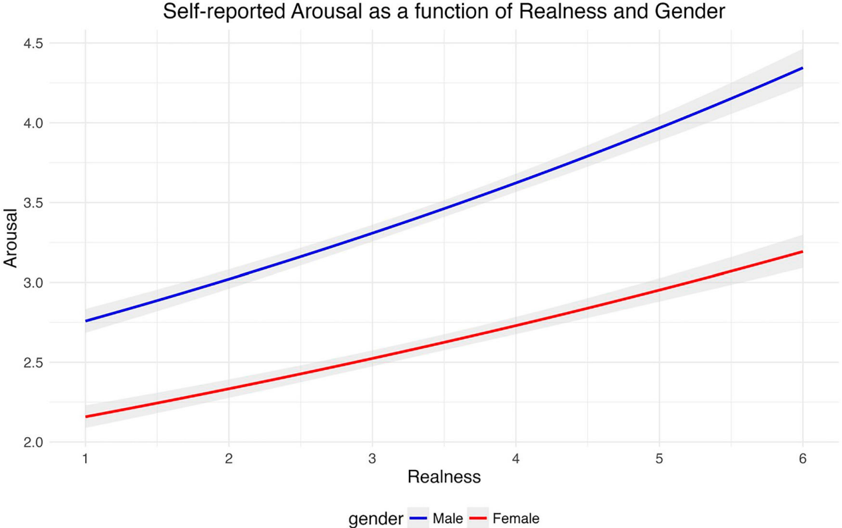
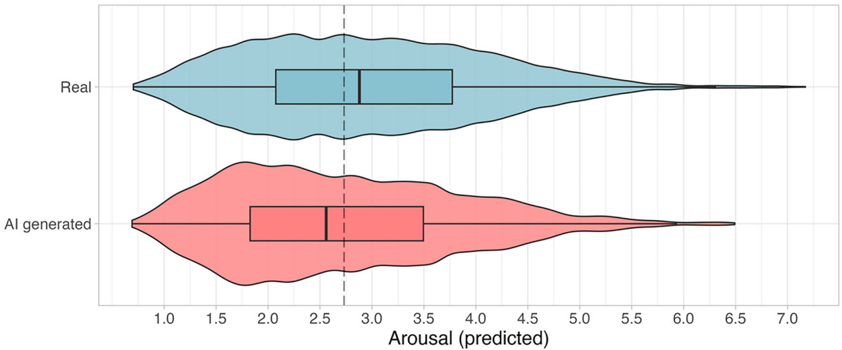
As state-of-art technology can create artificial images that are indistinguishable from real ones, it is urgent to understand whether believing that a picture is real or not has some import over affective phenomena such as sexual arousal.Thus, in two preregistered online studies, we tested whether 60 images depicting models in underwear elicited higher self-reported sexual arousal when believed to be (N = 57) or presented as (N = 108) real photographs as opposed to artificially generated.In both cases, Realness correlated with significantly higher scores on self-reported sexual arousal.Consistently with the literature on downregulation of emotional response to fictional works, our result indicates that sexual images that are perceived to be fake are less arousing than those believed to portray real people.
Overview
The claims and statistics of this paper haven’t been checked yet.
Free: it reads the open-access text and checks the first 5 claims that cite a source we can check. Create a free account to check every claim.
Integrity signals
Registry
Cites
Statistics
Figures


Verification
Claims the paper makes
The claims and statistics of this paper haven’t been checked yet.
Free: it reads the open-access text and checks the first 5 claims that cite a source we can check. Create a free account to check every claim.
Claims other papers make about this one
Each is checked against this paper’s own text: does it say what the citing paper says it does?
The check wasn’t confident either way, so it gives no verdict — never disputed.
In the citing paper
“*Marinietal.(2024)[140]has an error in Table2(lines for AI images and photos are switched for Study 2) as confirmed by the corresponding author via personal communication.”
From The Impact of Artificial Intelligence on Human Sexuality: A Five-Year Literature Review 2020–2024 (2024) · cites this paper as [140]
Experimental — accuracy not yet measured
Self-check
Percentages, sums and reported differences re-computed from the paper’s own numbers.
The self-check needs the paper’s full text.
Citations
Cites
Faul, F., Erdfelder, E., Lang, A.-G., & Buchner, A. (2007) · Behavior Research Methods · doi:10.3758/bf03193146 · Cited by 65,971
What is coefficient alpha? An examination of theory and applications
Cortina, J. M. (1993) · Journal of Applied Psychology · doi:10.1037/0021-9010.78.1.98 · Cited by 8,810 · cited 1×
“The internal reliability was completely satisfactory according to the common thresholds used in the literature (Cortina, 1993; Dunn et al., 2014): Study 1: α = .82; ω = .83; Study 2: α = .83; ω = .83.”
MethodDunn, T. J., Baguley, T., & Brunsden, V. (2014) · British Journal of Psychology · doi:10.1111/bjop.12046 · Cited by 3,596 · cited 1×
“The internal reliability was completely satisfactory according to the common thresholds used in the literature (Cortina, 1993; Dunn et al., 2014): Study 1: α = .82; ω = .83; Study 2: α = .83; ω = .83.”
MethodEvaluating significance in linear mixed-effects models in R
Luke, S. G. (2017) · Behavior Research Methods · doi:10.3758/s13428-016-0809-y · Cited by 1,704
Judd, C. M., Westfall, J., & Kenny, D. A. (2012) · Journal of Personality and Social Psychology · doi:10.1037/a0028347 · Cited by 1,236 · cited 2×
“This approach helps to account for the correlation and heterogeneity in Arousal measurements within and between participants, allowing for more accurate and reliable estimation of the fi xed e ff ects (e.g. e ff ects of independent variables) (Judd et al., 2012) and overall variability in Arousal.”
BackgroundDeep Fakes: A Looming Challenge for Privacy, Democracy, and National Security
Chesney, R., & Citron, D. K. (2018) · SSRN Electronic Journal · doi:10.2139/ssrn.3213954 · Cited by 880 · cited 1×
“…concerning the legal status of AI-generated images and who holds their rights, as the novelty of the question and the discrepancy between di ff erent states makes it unclear in which cases such images can be used lawfully and ethically, especially when sexuality is involved (Chesney & Citron, 2019).”
BackgroundA Sex Difference in the Specificity of Sexual Arousal
Chivers, M. L., Rieger, G., Latty, E., & Bailey, J. M. (2004) · Psychological Science · doi:10.1111/j.0956-7976.2004.00750.x · Cited by 534 · cited 1×
“The literature suggests a di ff er-ence in men ’ s and women ’ s arousal when confronted with sexual stimuli in experimental settings (Chivers et al., 2004; Murnen & Stockton, 1997; Rupp & Wallen, 2008).”
Background(2020) · SAGE Research Methods Foundations · doi:10.4135/9781526421036831710 · Cited by 506
Schepman, A., & Rodway, P. (2023) · International Journal of Human–Computer Interaction · doi:10.1080/10447318.2022.2085400 · Cited by 503 · cited 3×
“Lastly, participants ’ attitude toward Arti fi cial Intelligence was measured using a subset of six items from the General Attitudes toward Arti fi cial Intelligence Scale (GAAIS: Schepman & Rodway, 2022) as in Study 1.”
MethodInfluentialExperiments with More Than One Random Factor: Designs, Analytic Models, and Statistical Power
Judd, C. M., Westfall, J., & Kenny, D. A. (2017) · Annual Review of Psychology · doi:10.1146/annurev-psych-122414-033702 · Cited by 466
A probability-based measure of effect size: Robustness to base rates and other factors.
Ruscio, J. (2008) · Psychological Methods · doi:10.1037/1082-989x.13.1.19 · Cited by 398 · cited 1×
“R 2 ), as per the following formula (Ruscio, 2008): Since, to the best of our knowledge, no study has ever investigated similar research questions by operatio-nalising both realness and sexual arousal as continuous variables, a sensitivity power analysis was conducted using the power analysis…”
MethodAI-synthesized faces are indistinguishable from real faces and more trustworthy
Nightingale, S. J., & Farid, H. (2022) · Proceedings of the National Academy of Sciences · doi:10.1073/pnas.2120481119 · Cited by 397 · cited 3×
“…than their real counterparts (Balas & Pacella, 2017), recent research suggests that AI-synthesized faces generated by up-to-date technology are already indistinguishable from real ones, and even judged as more trustworthy (Nightingale & Farid, 2022; Tucciarelli et al., 2022, studies 1 – 2).”
BackgroundModulation of aesthetic value by semantic context: An fMRI study
Kirk, U., Skov, M., Hulme, O., Christensen, M. S., & Zeki, S. (2009) · NeuroImage · doi:10.1016/j.neuroimage.2008.10.009 · Cited by 381 · cited 2×
“…tend to appreciate more works of art (poems, music, and paintings) when they think they are human-made rather than compu-ter-made (Chamberlain et al., 2018; Chiarella et al., 2022; Di Dio et al., 2023; Kirk et al., 2009; Ragot et al., 2020; Shank et al., 2023; Wu et al. 2020, studies 1 & 3).”
BackgroundResultSands, S., Ferraro, C., Demsar, V., & Chandler, G. (2022) · Business Horizons · doi:10.1016/j.bushor.2022.08.002 · Cited by 318
Chivers, M. L., Seto, M. C., & Blanchard, R. (2007) · Journal of Personality and Social Psychology · doi:10.1037/0022-3514.93.6.1108 · Cited by 284
The Epistemic Threat of Deepfakes
Fallis, D. (2021) · Philosophy & Technology · doi:10.1007/s13347-020-00419-2 · Cited by 266 · cited 2×
“A popular argument is that the spread of these technologies will sow distrust in bystanders, hence diminishing their epistemic credentials (e.g. Fallis, 2021; Harris, 2021).”
BackgroundSex Differences in Response to Visual Sexual Stimuli: A Review
Rupp, H. A., & Wallen, K. (2008) · Archives of Sexual Behavior · doi:10.1007/s10508-007-9217-9 · Cited by 257
Putting the art in artificial: Aesthetic responses to computer-generated art.
Chamberlain, R., Mullin, C., Scheerlinck, B., & Wagemans, J. (2018) · Psychology of Aesthetics, Creativity, and the Arts · doi:10.1037/aca0000136 · Cited by 225 · cited 3×
“Our fi ndings are consistent with extant literature (Chamberlain et al., 2018; Chiarella et al., 2022; Di Dio et al., 2023; Kirk et al., 2009; Makowski et al., 2019; Mocaiber et al., 2010, 2011; Ragot et al., 2020; Shank et al., 2023; Sperduti et al., 2016, 2017; Wu et al. 2020), as well as with our…”
BackgroundResultAI-generated vs. Human Artworks. A Perception Bias Towards Artificial Intelligence?
Ragot, M., Martin, N., & Cojean, S. (2020) · Extended Abstracts of the 2020 CHI Conference on Human Factors in Computing Systems · doi:10.1145/3334480.3382892 · Cited by 189 · cited 2×
“…tend to appreciate more works of art (poems, music, and paintings) when they think they are human-made rather than compu-ter-made (Chamberlain et al., 2018; Chiarella et al., 2022; Di Dio et al., 2023; Kirk et al., 2009; Ragot et al., 2020; Shank et al., 2023; Wu et al. 2020, studies 1 & 3).”
BackgroundNg, V. K. Y., & Cribbie, R. A. (2017) · Current Psychology · doi:10.1007/s12144-015-9404-0 · Cited by 179
Chiarella, S. G., Torromino, G., Gagliardi, D. M., Rossi, D., Babiloni, F., & Cartocci, G. (2022) · Computers in Human Behavior · doi:10.1016/j.chb.2022.107406 · Cited by 131 · cited 2×
“…tend to appreciate more works of art (poems, music, and paintings) when they think they are human-made rather than compu-ter-made (Chamberlain et al., 2018; Chiarella et al., 2022; Di Dio et al., 2023; Kirk et al., 2009; Ragot et al., 2020; Shank et al., 2023; Wu et al. 2020, studies 1 & 3).”
BackgroundResultGender and Self-Reported Sexual Arousal in Response to Sexual Stimuli: A Meta-Analytic Review
Murnen, S. K., & Stockton, M. (1997) · Sex Roles · doi:10.1023/a:1025639609402 · Cited by 122 · cited 2×
“Furthermore, Murnen and Stockton ’ s (1997) meta-analytic review revealed that across 46 studies, there was a small to moderate-sized gender advantage in sexual arousal in response to sexual stimuli in men.”
BackgroundHenry, N., McGlynn, C., Flynn, A., Johnson, K., Powell, A., & Scott, A. J. (2020) · doi:10.4324/9781351135153 · Cited by 120 · cited 1×
“Scholars studying non-consensual dissemination of intimate images and other image-based sexual abuses (Henry et al., 2020) are reporting a particularly worrisome trend.”
BackgroundFlynn, A., Powell, A., Scott, A. J., & Cama, E. (2022) · The British Journal of Criminology · doi:10.1093/bjc/azab111 · Cited by 120 · cited 1×
“…conducted in 2019, and involving 6109 participants from UK, Australia and New Zealand, aged 16 – 64, it has been reported that roughly 14% have been victim of some form of deepfake-based abuse such as dissemination of their deepfake intimate contents or the threat to do so (Flynn et al., 2022).”
BackgroundGeneralized linear mixed models modern concepts, methods and applications
Stroup, W. W. (2012) · Cited by 116
Fact or fiction? An event-related potential study of implicit emotion regulation
Mocaiber, I., Pereira, M. G., Erthal, F. S., Machado‐Pinheiro, W., David, I. A., Cagy, M., Volchan, E., & Oliveira, L. (2010) · Neuroscience Letters · doi:10.1016/j.neulet.2010.04.008 · Cited by 112 · cited 1×
“…consistent with extant literature (Chamberlain et al., 2018; Chiarella et al., 2022; Di Dio et al., 2023; Kirk et al., 2009; Makowski et al., 2019; Mocaiber et al., 2010, 2011; Ragot et al., 2020; Shank et al., 2023; Sperduti et al., 2016, 2017; Wu et al. 2020), as well as with our general…”
ResultVerifying images: deepfakes, control, and consent
van der Nagel, E. (2020) · Porn Studies · doi:10.1080/23268743.2020.1741434 · Cited by 110 · cited 1×
“…engaging in sexting (sending sexy pictures to some digital partner) could soon have the onus of certifying the reality of the pictures they present, just like users in the subreddit for sharing amateur sexy pictures Gonewild have adopted some tactics to verify their identity (van der Nagel, 2020).”
BackgroundWu, Y., Mou, Y., Li, Z., & Xu, K. (2020) · Computers in Human Behavior · doi:10.1016/j.chb.2019.106186 · Cited by 94 · cited 3×
“…tend to appreciate more works of art (poems, music, and paintings) when they think they are human-made rather than compu-ter-made (Chamberlain et al., 2018; Chiarella et al., 2022; Di Dio et al., 2023; Kirk et al., 2009; Ragot et al., 2020; Shank et al., 2023; Wu et al. 2020, studies 1 & 3).”
BackgroundTrustworthiness perception is disrupted in artificial faces
Balas, B., & Pacella, J. (2017) · Computers in Human Behavior · doi:10.1016/j.chb.2017.08.045 · Cited by 84 · cited 1×
“And while some years ago arti fi cial faces were deemed less trust-worthy than their real counterparts (Balas & Pacella, 2017), recent research suggests that AI-synthesized faces generated by up-to-date technology are already indistinguishable from real ones, and even judged as more trustworthy…”
BackgroundThe paradox of fiction: Emotional response toward fiction and the modulatory role of self-relevance
Sperduti, M., Arcangeli, M., Makowski, D., Wantzen, P., Zalla, T., Lemaire, S., Dokic, J., Pelletier, J., & Piolino, P. (2016) · Acta Psychologica · doi:10.1016/j.actpsy.2016.02.003 · Cited by 82 · cited 2×
“…et al., 2022; Di Dio et al., 2023; Kirk et al., 2009; Makowski et al., 2019; Mocaiber et al., 2010, 2011; Ragot et al., 2020; Shank et al., 2023; Sperduti et al., 2016, 2017; Wu et al. 2020), as well as with our general hypothesis: we found a signi fi cant e ff ect of Realness on elicited…”
BackgroundA Review of Image Processing Techniques for Deepfakes
Shahzad, H. F., Rustam, F., Flores, E. S., Luís Vidal Mazón, J., de la Torre Diez, I., & Ashraf, I. (2022) · Sensors · doi:10.3390/s22124556 · Cited by 79 · cited 1×
“While computer scientists are devising technological solutions for identifying deepfakes (Shahzad et al., 2022), philosophers are re fl ecting on the epistemic threats they pose (Fallis, 2021; Harris, 2021).”
BackgroundThe distinctive role of executive functions in implicit emotion regulation
Sperduti, M., Makowski, D., Arcangeli, M., Wantzen, P., Zalla, T., Lemaire, S., Dokic, J., Pelletier, J., & Piolino, P. (2017) · Acta Psychologica · doi:10.1016/j.actpsy.2016.12.001 · Cited by 72 · cited 2×
“In later studies employing emotion-inducing pictures presented as either real or fi ctional, the same team (Makowski et al., 2019; Sperduti et al., 2017) found that negative stimuli believed to be fake were judged less intense, as well as eliciting a lower physiological activation, and that this a ff…”
BackgroundGeen, R. G. (1975) · Journal of Research in Personality · doi:10.1016/0092-6566(75)90002-1 · Cited by 71 · cited 1×
“Old studies aimed at assessing the emotional impact of violent TV contents show that the anger-eliciting e ff ect of some clips is downplayed when they are believed to be false (Geen, 1975; Thomas & Tell, 1974).”
BackgroundVideo on demand: what deepfakes do and how they harm
Harris, K. R. (2021) · Synthese · doi:10.1007/s11229-021-03379-y · Cited by 68 · cited 2×
“A popular argument is that the spread of these technologies will sow distrust in bystanders, hence diminishing their epistemic credentials (e.g. Fallis, 2021; Harris, 2021).”
BackgroundAffective and Semantic Representations of Valence: A Conceptual Framework
Itkes, O., & Kron, A. (2019) · Emotion Review · doi:10.1177/1754073919868759 · Cited by 66 · cited 1×
“The instructions were meant to cue participants to focus on their fi rst-person a ff ective experience rather than on third-person, semantic judgments (cf. Itkes & Kron, 2019).”
BackgroundAI composer bias: Listeners like music less when they think it was composed by an AI.
Shank, D. B., Stefanik, C., Stuhlsatz, C., Kacirek, K., & Belfi, A. M. (2023) · Journal of Experimental Psychology: Applied · doi:10.1037/xap0000447 · Cited by 65 · cited 7×
“…mitigated or disappears in some speci fi c conditions, e.g. with stimuli already perceived as intrinsically computer-made such as electronic music (Shank et al., 2023, study 2) or when subjects are exposed to the process of creation enacted by an anthropomorphic robot (Chamberlain et al., 2018,…”
BackgroundResultInfluentialMocaiber, I., Sanchez, T. A., Pereira, M. G., Erthal, F. S., Joffily, M., de Araújo, D. B., Volchan, E., & Oliveira, L. (2011) · Neuroscience · doi:10.1016/j.neuroscience.2011.07.003 · Cited by 64 · cited 1×
“…consistent with extant literature (Chamberlain et al., 2018; Chiarella et al., 2022; Di Dio et al., 2023; Kirk et al., 2009; Makowski et al., 2019; Mocaiber et al., 2010, 2011; Ragot et al., 2020; Shank et al., 2023; Sperduti et al., 2016, 2017; Wu et al. 2020), as well as with our general…”
ResultDeepfakes and the epistemic apocalypse
Habgood-Coote, J. (2023) · Synthese · doi:10.1007/s11229-023-04097-3 · Cited by 62
On the realness of people who do not exist: The social processing of artificial faces
Tucciarelli, R., Vehar, N., Chandaria, S., & Tsakiris, M. (2022) · iScience · doi:10.1016/j.isci.2022.105441 · Cited by 57 · cited 3×
“So far, the few studies that explicitly deal with the social perception of fake persons demonstrated that faces are trusted less when presented as fake (Liefooghe et al., 2023), or even only suspected to be fake (Tucciarelli et al., 2022, study 3).”
BackgroundArt made by artificial intelligence: The effect of authorship on aesthetic judgments.
Dio, C. D., Ardizzi, M., Schieppati, S. V., Massaro, D., Gilli, G., Gallese, V., & Marchetti, A. (2023) · Psychology of Aesthetics Creativity and the Arts · doi:10.1037/aca0000602 · Cited by 52 · cited 2×
“…tend to appreciate more works of art (poems, music, and paintings) when they think they are human-made rather than compu-ter-made (Chamberlain et al., 2018; Chiarella et al., 2022; Di Dio et al., 2023; Kirk et al., 2009; Ragot et al., 2020; Shank et al., 2023; Wu et al. 2020, studies 1 & 3).”
BackgroundResultSex-Specific Content Preferences for Visual Sexual Stimuli
Rupp, H. A., & Wallen, K. (2009) · Archives of Sexual Behavior · doi:10.1007/s10508-008-9402-5 · Cited by 51 · cited 1×
“The literature suggests a di ff er-ence in men ’ s and women ’ s arousal when confronted with sexual stimuli in experimental settings (Chivers et al., 2004; Murnen & Stockton, 1997; Rupp & Wallen, 2008).”
Designed to abuse? Deepfakes and the non-consensual diffusion of intimate images
Viola, M., & Voto, C. (2023) · Synthese · doi:10.1007/s11229-022-04012-2 · Cited by 43 · cited 2×
“In a similar vein, Viola and Voto (2023) have argued that the awareness, or even just the suspicion, that some images are fake rather than genuinely photographically generated, might decrease the arousal they exert on onlookers.”
BackgroundSelf-citationEffects of viewing real versus fantasy violence upon interpersonal aggression
Thomas, M. H., & Tell, P. M. (1974) · Journal of Research in Personality · doi:10.1016/0092-6566(74)90016-6 · Cited by 37 · cited 1×
“Old studies aimed at assessing the emotional impact of violent TV contents show that the anger-eliciting e ff ect of some clips is downplayed when they are believed to be false (Geen, 1975; Thomas & Tell, 1974).”
BackgroundEmbracing deepfakes and AI‐generated images in neuroscience research
Becker, C., & Laycock, R. (2023) · European Journal of Neuroscience · doi:10.1111/ejn.16052 · Cited by 32 · cited 1×
“So much, indeed, that it has been recently suggested that synthetic images could enrich the toolbox of experimental psychology and neuroscience with stimuli that are both ecologically valid and experimentally manipulable (Becker & Laycock, 2023).”
BackgroundLees, D., Bashford‐Rogers, T., & Keppel‐Palmer, M. (2021) · Convergence The International Journal of Research into New Media Technologies · doi:10.1177/13548565211030452 · Cited by 28 · cited 1×
“…plea may be doomed to drown amidst an ever-growing multitude of virtual in fl uencers (Sands et al., 2022), dead actors or historical characters “ resur-rected ” via computer-generated imagery (CGI; Lees et al., 2021), and alleged people that are produced, reproduced, or altered with digital means.”
BackgroundAre Natural Faces Merely Labelled as Artificial Trusted Less?
Liefooghe, B., Oliveira, M., Leisten, L. M., Hoogers, E., Aarts, H., & Hortensius, R. (2023) · Collabra Psychology · doi:10.1525/collabra.73066 · Cited by 22
Wrong outside, wrong inside: A social functionalist approach to the uncanny feeling
Rosa, A. O. L. (2018) · New Ideas in Psychology · doi:10.1016/j.newideapsych.2018.03.004 · Cited by 17 · cited 1×
“Another non-mutually exclusive explanation is that knowing or thinking that a person is arti fi cially generated might trigger aversive negation due to some feeling of uncanny (Mori, 1970; Olivera-La Rosa, 2018).”
BackgroundMakowski, D., Sperduti, M., Pelletier, J., Blondé, P., Corte, V. L., Arcangeli, M., Zalla, T., Lemaire, S., Dokic, J., Nicolas, S., et al. (2019) · Cognitive Affective & Behavioral Neuroscience · doi:10.3758/s13415-018-00681-0 · Cited by 14 · cited 2×
“In later studies employing emotion-inducing pictures presented as either real or fi ctional, the same team (Makowski et al., 2019; Sperduti et al., 2017) found that negative stimuli believed to be fake were judged less intense, as well as eliciting a lower physiological activation, and that this a ff…”
BackgroundResultA body of evidence : ‘feeling in seeing’ predicts realness judgments for photojournalistic images.Preprint
Azevedo, R. T., Tucciarelli, R., Beukelaer, S. D., Ambroziak, K. B., Jones, I. L., & Tsakiris, M. (2020) · PsyArXiv (OSF Preprints) · doi:10.31234/osf.io/p7kan · Cited by 4 · cited 3×
“…is consistent with three possible underlying mechanisms: (1) Arousal judgment a ff ects Realness judgment, consistently with the results by Azevedo et al. (2020; see also the discussion of Shank et al., 2023, study 1); (2) Real-ness judgment a ff ects Arousal judgment, as per our…”
BackgroundResultInfluential
Research works printed but not linked: 2
- Mori, M. (1970). The uncanny valley: The original essay by Masahiro Mori. IEEE Spectrum, 6, 1-6.
- Stroup, W. W. (2013). Generalized linear mixed models: Modern concepts, methods and applications. CRC Press, Taylor & Francis Group.
Cited by
The Impact of Artificial Intelligence on Human Sexuality: A Five-Year Literature Review 2020–2024
Döring, N., Le, T. D., Vowels, L. M., Vowels, M. J., & Marcantonio, T. L. (2024) · Current Sexual Health Reports · doi:10.1007/s11930-024-00397-y · Cited by 65
“The two experiments showed an “anti-AI bias” in the sense that participants rated identical images as less sexually arousing when they believed they were AI-generated [140].”
Lapointe, V. A., Dubé, S., Rukhlyadyev, S., Kessai, T., & Lafortune, D. (2025) · Archives of Sexual Behavior · doi:10.1007/s10508-025-03099-1 · Cited by 40
AI Performer Bias: Listeners Like Music Less When They Think it was Performed by an AI
Ansani, A., Koehler, F., Giombini, L., Hämäläinen, M., Chen, M., Marini, M., & Saarikallio, S. H. (2025) · Empirical Studies of the Arts · doi:10.1177/02762374241308807 · Cited by 39
“In greater detail, consistently with Marini et al. (2024), the 6 items with the highest factor loadings in the validation study (Schepman & Rodway, 2022) were extracted (i.e., the 3 best items of the positive facet and 3 best items of the negative facet).”
Self-citationDeepfake Technology and Gender-Based Violence: A Scoping Review
Lazard, L., Capdevila, R., Turley, E. L., Gilfoyle, K., & Stavropoulou, N. (2025) · Trauma Violence & Abuse · doi:10.1177/15248380251384271 · Cited by 34
Experiences with AI-Generated Pornography: A Quantitative Content Analysis of Reddit Posts
Döring, N., Le, T. D., & Miller, D. J. (2025) · Archives of Sexual Behavior · doi:10.1007/s10508-025-03227-x · Cited by 15
Metadata
- Authors
- Marini, M., Ansani, A., Demichelis, A., Mancini, G., Paglieri, F., & Viola, M.
- Affiliations
- IMT School for Advanced Studies Lucca (IT)
- Roma Tre University (IT)
- Institute of Cognitive Sciences and Technologies, National Research Council, Rome, Italy
- Corresponding author
- Ansani, Alessandro
- Venue
- Cognition and Emotion
- Publisher
- Informa UK Limited
- Published
- 2024-01-16
- Volume
- 38
- Issue
- 3
- Pages
- 348-360
- ISSN
- 0269-9931 (ISSN-L)
- 1464-0600
- OpenAlex
- W4390919784
- Cited by
- 11
- References
- 51
- Citations by year
- 2026: 1 · 2025: 7 · 2024: 3
- FWCI
- 5.51
- Type
- journal article
- Language
- en
- Open access
- hybrid
- doi.org
- Licence
- Locations
- Cognition & Emotion (publishedVersion, cc-by)
- PubMed (publishedVersion)
- Jyväskylä University Digital Archive (University of Jyväskylä) (submittedVersion, cc-by)
- Iris (Roma Tre University) (submittedVersion)
- PsyArXiv (OSF Preprints) (submittedVersion)
- Funders
- Scuola IMT Alti Studi Lucca
- Università degli Studi di Padova
- Topics
- Social Sciences › Psychology › Clinical Psychology › Sexuality, Behavior, and Technology
- Life Sciences › Neuroscience › Cognitive Neuroscience › Aesthetic Perception and Analysis
- Social Sciences › Communication › Media Influence and Health
- Keywords
- sexual arousal, synthetic images, AI-generated images, fictional works, self-reported arousal
- MeSH terms
- Sexual Arousal, Adolescent, Adult, Female, Humans, Male, Photic Stimulation, Visual Perception, Young Adult, Self Report
About these checks
Registry, retraction, Cites and statistics results are computed, not judged, with one exception: a printed reference that no index lists is read once by a model before it counts as a citation error. Claims are extracted by a model and kept only when their quote appears verbatim in the text; each cited source is then checked, with a model’s help, for whether it says what the claim relies on. Those verdicts can be wrong — read the claim’s quote and the cited source before relying on one.
Statistics and arithmetic are recomputed, not judged.
Confidence bands are shown only for fields calibrated on our annotated test set. None is calibrated yet, so no band is shown.
What counts as a claim ›How we measure confidence ›How we check this ›
Are you an author, or do you see a problem with this page? Request a review
Data sources
Bibliographic data: Semantic Scholar, OpenAlex, Crossref.
Contains information from the Semantic Scholar Academic Graph Datasets, made available under the ODC Attribution License (ODC-BY 1.0).
Semantic Scholar’s data is described in: Kinney, R., et al. (2023). The Semantic Scholar Open Data Platform. arXiv:2301.10140.
