

Does gradeless learning affect students’ academic performance? A study of effects over time
Open accessThe DOI matches its Crossref record; 61 of the 61 references it cites were found in a registry or an index; 4 of the 38 sources its claims cite were checked for support.
Abstract
This study examines the effect of gradeless learning on well-being, stress, motivation, learning approach, and later academic performance.
Overview
CoChat Summary
TL;DR
This study examines whether replacing first-year grades with pass/fail assessment and feedback affects later academic performance in a Danish Business and Psychology bachelor’s programme. It finds no significant average effect on later exam grades, but gradeless learning increased motivation and reduced surface-strategy learning.
Key findings
- Gradeless learning had no statistically significant effect on later academic achievement: third-semester GPA coefficients were 0.164 (SE 0.111) for the class of 2021 and 0.132 (SE 0.124) for the class of 2022; fourth-semester GPA coefficients were −0.198 (SE 0.122) and −0.163 (SE 0.148); bachelor’s thesis coefficients were 0.018 (SE 0.139) and 0.041 (SE 0.154).
- Students in the gradeless programme were significantly more motivated, both intrinsically (b = .741, p < .001) and extrinsically (b = .686, p < .001).
- Students in the gradeless programme were significantly less likely to use a surface-strategy learning approach (b = −.833, p < .000); other learning-approach subscales were not statistically significant.
- Well-being outcomes showed expected signs but were statistically insignificant: stress (b = −0.218), loneliness (b = −0.123), and social integration (b = 0.291). The paper also reports a tendency for students with higher prior achievement to be negatively affected by gradeless learning.
Methods
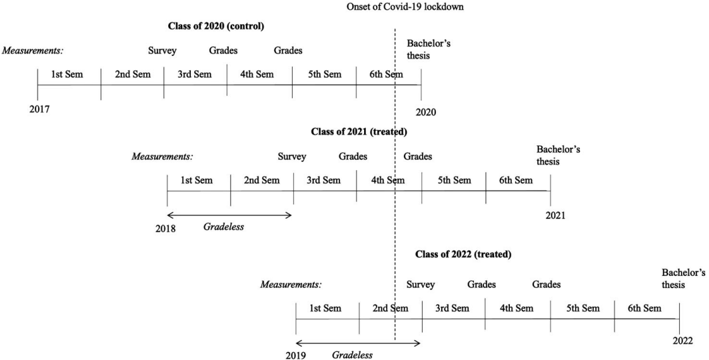
- The study uses a cohort-comparison design around a 2018 intervention in the first year of a Business and Psychology bachelor’s programme at a large Danish business school. All first-year grades were replaced with pass/fail assessments and written/oral feedback from teachers and peers; the class of 2020 was the pre-intervention comparison cohort, and the classes of 2021 and 2022 were treatment cohorts.
- Data came from administrative records on attrition, grades, and demographics, plus surveys on well-being, study approach, and motivation. Survey response rates were 23% for the class of 2020 and 47% for the class of 2021; the class of 2022 survey was not comparable because of Covid-19.
- Main outcomes were GPA from the third semester, GPA from the fourth semester, and the final bachelor’s thesis grade, all on a 7-point scale. The authors estimate OLS regressions with a gradeless-treatment dummy and controls for age, gender, nationality, and prior academic achievement, plus interactions for gender and high school GPA.
Limitations
- The authors state that the results come from a single study programme attracting high-achieving students, so generalizability to other contexts, student types, and cultural settings is unknown.
- The authors state that survey response rates varied from 23% to 47%, raising concerns about differential attrition; exam scores are imperfect proxies for learning; unobservable differences between non-responders may remain; and the last data collection coincided with the Covid-19 pandemic.
- Evident from the text: the design is not randomized, and Table 1 shows cohort differences, including that the class of 2022 was on average one year younger and had higher admission GPAs, with the authors noting admission requirements increased over time.
Model-written summary. Check it against the paper before relying on it.
Integrity signals
Registry
Cites
Statistics
Figures


Verification
Claims the paper makes
4 Valid · 3 Not valid · 18 Not checked · 31 Own results and interpretations
The cited sources support only part of this claim — read each source’s verdict below.
In the paper
“Contrary to expectation, our findings did not replicate previous results regarding a reduction in stress and an increase in well-being among students in gradeless learning (see e.g.Matthews and Noyes 2016;McMorran and Ragupathi 2020).”
§ Does gradeless learning affect students' academic performance? A study of effects over time > Discussion
What the sources say
- Not matchedcites Matthews and Noyes 2016
Couldn’t be matched to a paper in Crossref, so it can’t be checked.
- Partly supportedcites McMorran and Ragupathi 2020 sourceExperimental — accuracy not yet measured
The Results and ‘Benefit: less stress, smoother university transition’ sections report that students and faculty perceived reduced stress and an easier transition during the grade-free first semester. The paper does not report a measured increase in student well-being; its findings are survey respondents’ perceptions of benefits, including reduced stress. (LLM, conf=0.85)
plain- Asserted: passes — The authors put it forward as true.
- Checkable: passes — It can be checked against evidence.
- Load-bearing: unclear — It is unclear whether the paper’s conclusions depend on it.
- Based: passes — The paper gives a reason why it holds.
- Not matched
The cited sources support only part of this claim — read each source’s verdict below.
In the paper
“From previous studies of gradeless learning we know that students feel more comfortable collaborating with others in a gradeless learning setting (Kjærgaard, Mikkelsen, and Buhl-Wiggers 2022) and that it positively influences students' willingness to explore new opportunities (Hayek et al. 2015), which points to how gradeless learning can support students in developing their generic skills.”
§ Does gradeless learning affect students' academic performance? A study of effects over time > Discussion
What the sources say
- Not matchedcites Kjærgaard, Mikkelsen, and Buhl-Wiggers 2022
Couldn’t be matched to a paper in Crossref, so it can’t be checked.
- Partly supportedcites Hayek et al. 2015 sourceExperimental — accuracy not yet measured
Our copy of Hayek et al. (2015) reports only that the expectation of individual grades reduced cooperative groups' pooling of unshared information in hidden-profile problem-solving tasks (General Discussion; Overview of Experiments), with the non-graded control conditions exchanging a higher proportion of that novel information — so a benefit of the absence of grading on openness to new information is in it, but as a group information-sharing measure in a laboratory task, not as students' 'willingness to explore new opportunities'. No passage of our copy addresses exploring opportunities, generic skills, or gradeless learning as an educational setting; where adjacent outcomes appear (reduced creativity, amplified confirmatory tendencies, impaired learning), the paper credits them to other works (Amabile, 1983; Hayek, Toma, Oberlé, & Butera, 2014; Butler & Nisan, 1986) rather than reporting them (Controversial Effects of Grades). The strongest general statement is the recommendation 'to avoid grading individuals in cooperative groups' (General Discussion), which is directional, not a finding about exploration. (LLM, conf=0.68)
hedgedstates a possible cause- Asserted: passes — The authors put it forward as true.
- Checkable: passes — It can be checked against evidence.
- Load-bearing: unclear — It is unclear whether the paper’s conclusions depend on it.
- Based: passes — The paper gives a reason why it holds.
- Not matched
A result the paper reports from its own data — it cites no other source for it, so there is none to check. The quote shows it is in the paper.
In the paper
“Table 4 shows no clear tendency of differential effects between males and females.”
§ Does gradeless learning affect students' academic performance? A study of effects over time > Results
plain- Asserted: passes — The authors put it forward as true.
- Checkable: passes — It can be checked against evidence.
- Load-bearing: unclear — It is unclear whether the paper’s conclusions depend on it.
- Based: passes — The paper gives a reason why it holds.
- Rests on an assumption not shown here.
A result the paper reports from its own data — it cites no other source for it, so there is none to check. The quote shows it is in the paper.
In the paper
“Panel B in Table 2 presents the effects of gradeless learning on students' learning approach, showing that students in the gradeless programme were significantly less likely to have a surfacestrategy approach than students not exposed to gradeless learning (b = -.833;p < .000).”
- Also stated in: § Results · plain
“Students exposed to gradeless learning were thus less likely to employ a learning approach based on rote learning than students not exposed to gradeless learning.”
§ Does gradeless learning affect students' academic performance? A study of effects over time > Results
plainstates a cause- Asserted: passes — The authors put it forward as true.
- Checkable: passes — It can be checked against evidence.
- Load-bearing: passes — The paper’s conclusions depend on it.
- Based: passes — The paper gives a reason why it holds.
- Rests on an assumption not shown here.
- Also stated in: § Results · plain
A result the paper reports from its own data — it cites no other source for it, so there is none to check. The quote shows it is in the paper.
In the paper
“For the class of 2022 we see a negative effect in the fourth semester for males.”
§ Does gradeless learning affect students' academic performance? A study of effects over time > Results
plainstates a cause- Asserted: passes — The authors put it forward as true.
- Checkable: passes — It can be checked against evidence.
- Load-bearing: unclear — It is unclear whether the paper’s conclusions depend on it.
- Based: passes — The paper gives a reason why it holds.
- Rests on 2 assumptions not shown here.
21 more claims
Create a free account to see all 56 claims and to verify the 3 references still open.
- Probably not a substantial claim. 21
- It may state two separate claims as one. 11
- The quote only partly states this claim. 3
Self-check
Percentages, sums and reported differences re-computed from the paper’s own numbers.
Each contradiction between two passages listed here was confirmed by an independent check.
Rated minor: it would not touch a result — a value no result rests on, a p-value that stays on the same side of the significance level, or a conflict that is clerical, resolved elsewhere in the paper, or outside its own findings.
In the paper
§ Does gradeless learning affect students' academic performance? A study of effects over time > Setting and study population
“The average age was between 20.3 and 21.6”
§ Does gradeless learning affect students' academic performance? A study of effects over time > Conclusion
“| Age | 21.410 | 21.636 | 20.223 | -0.227 | 1.187*** | 1.413*** |”
Rated minor: it would not touch a result — a value no result rests on, a p-value that stays on the same side of the significance level, or a conflict that is clerical, resolved elsewhere in the paper, or outside its own findings.
In the paper
§ Does gradeless learning affect students' academic performance? A study of effects over time > Setting and study population
“their admission GPAs lay between 9.3 and 10.1”
§ Does gradeless learning affect students' academic performance? A study of effects over time > Conclusion
“| High school | 9.325 | 9.611 | 10.158 | -0.285* | -0.832 | |”
Rated minor: it would not touch a result — a value no result rests on, a p-value that stays on the same side of the significance level, or a conflict that is clerical, resolved elsewhere in the paper, or outside its own findings.
In the paper
§ Does gradeless learning affect students' academic performance? A study of effects over time > Setting and study population
“76-78% were female”
§ Does gradeless learning affect students' academic performance? A study of effects over time > Conclusion
“| Female | .795 | .760 | .769 | 0.035 | 0.026 | -0.009 |”
Citations
Cites
A Global Measure of Perceived Stress
Cohen, S., Kamarck, T., & Mermelstein, R. (1983) · Journal of Health and Social Behavior · doi:10.2307/2136404 · Cited by 32,807 · cited 1×
“We measured stress levels by means of a validated translation of the Perceived Stress Scale (Cohen, Kamarck, and Mermelstein 1983; Eskildsen et al. 2015) and social integration by asking three questions, each based on a 5-point Likert scale and then combined into an index.”
MethodA Short Scale for Measuring Loneliness in Large Surveys: Results From Two Population-Based Studies
Hughes, M. E., Waite, L. J., Hawkley, L. C., & Cacioppo, J. T. (2004) · Research on Aging · doi:10.1177/0164027504268574 · Cited by 4,781 · cited 1×
“To measure loneliness, we used the Three-Item Loneliness Scale (T-ILS) (Hughes et al. 2004).”
MethodThe revised two‐factor Study Process Questionnaire: R‐SPQ‐2F
Biggs, J., Kember, D., & Leung, D. Y. P. (2001) · British Journal of Educational Psychology · doi:10.1348/000709901158433 · Cited by 2,122 · cited 1×
“To measure the learning approach, we used a validated translation of the Biggs Study Approach Questionnaire (Biggs, Kember, and Leung 2001; Lassesen 2011).”
MethodExtrinsic Rewards and Intrinsic Motivation in Education: Reconsidered Once Again
Deci, E. L., Koestner, R., & Ryan, R. M. (2001) · Review of Educational Research · doi:10.3102/00346543071001001 · Cited by 1,596 · cited 2×
“…e ff ect (Dobrow, Smith, and Posner 2011; Pulfrey, Buchs, and Butera 2011), whereas others criticize grades for shifting students ’ focus from an intrinsic motivation for learning to an extrinsic motivation for rewards (Butler 1988; Deci, Koestner, and Ryan 2001; Pulfrey, Darnon, and Butera 2013).”
BackgroundPunished by Rewards: The Trouble with Gold Stars, Incentive Plans, A'S, Praise, and Other Bribes
Kohn, A. (1999) · Cited by 1,356
BUTLER, R. (1988) · British Journal of Educational Psychology · doi:10.1111/j.2044-8279.1988.tb00874.x · Cited by 536 · cited 1×
“…e ff ect (Dobrow, Smith, and Posner 2011; Pulfrey, Buchs, and Butera 2011), whereas others criticize grades for shifting students ’ focus from an intrinsic motivation for learning to an extrinsic motivation for rewards (Butler 1988; Deci, Koestner, and Ryan 2001; Pulfrey, Darnon, and Butera 2013).”
BackgroundExplaining the Gender Gap in Math Test Scores: The Role of Competition
Niederle, M., & Vesterlund, L. (2010) · Journal of Economic Perspectives · doi:10.1257/jep.24.2.129 · Cited by 527 · cited 1×
“Previous literature has found that females tend to shy away from competition (Niederle and Vesterlund 2010) and that assessment based on teacher assessment favours females while assessments based on exams tend to favour males (Angelo and Reis 2021).”
BackgroundMotivated Strategies for Learning Questionnaire
Pintrich, P. R., & De Groot, E. V. (2012) · PsycTESTS Dataset · doi:10.1037/t09161-000 · Cited by 399
Teaching More by Grading Less (or Differently)
Schinske, J., & Tanner, K. (2014) · CBE—Life Sciences Education · doi:10.1187/cbe.cbe-14-03-0054 · Cited by 326
Graduate attributes for 2020 and beyond: recommendations for Australian higher education providers
Oliver, B., & Jorre de St Jorre, T. (2018) · Higher Education Research & Development · doi:10.1080/07294360.2018.1446415 · Cited by 266 · cited 2×
“…skills or ‘ holistic competences ’ (Chan and Yeung 2021) is also an important area for research, as such competences are important for students graduating into an increasingly globalized and unpredictable world (Hendry 2006; Longmore, Grant, and Golnaraghi 2018; Oliver and Jorre de St Jorre 2018).”
Background
Research works printed but not linked: 1
- Brookhart, S. 2004. Grading. Upper Saddle River, NJ: Pearson Education.
Cited by
Explaining the Gender Gap in Math Test Scores: The Role of Competition
Niederle, M., & Vesterlund, L. (2010) · Journal of Economic Perspectives · doi:10.1257/jep.24.2.129 · Cited by 527
Jansson, A., Boman, J., Schéle, I., Holmström, S., Rozental, A., Semb, O., Fahlström, M., Stenman, L., Bitar, A., & Lindquist, D. (2025) · Frontiers in Medicine · doi:10.3389/fmed.2025.1623792 · Cited by 16
Mesny, A., Roberge‐Maltais, I., & Galy, A. (2025) · The International Journal of Management Education · doi:10.1016/j.ijme.2025.101307 · Cited by 24
Lindskov, C. M. (2025) · Youth & Society · doi:10.1177/0044118x251343633 · Cited by 7
“Grades were also a significant concern among students and are a significant debate within educational science, with several critical voices highlighting the potential damaging effects of grades as a performance measurement (Chamberlin et al., 2023; Kjærgaard et al., 2024; Klapp et al., 2024).”
Chakiso, Z. T., Bushisso, E. W., & Wanna, W. (2025) · Language Testing in Asia · doi:10.1186/s40468-025-00356-x · Cited by 12
“However, scholars have underscored the limitations of relying solely on statistical analyses to capture the multifaceted and dynamic nature of academic performance and English language learning, particularly in ESL/EFL contexts (Lee & Greene, 2007; Kjærgaard et al., 2024).”
Metadata
- Authors
- Kjærgaard, A., Buhl-Wiggers, J., & Mikkelsen, E. N.
- Affiliations
- Copenhagen Business School (DK)
- Corresponding author
- Kjærgaard, Annemette
- Venue
- Studies in Higher Education
- Publisher
- Informa UK Limited
- Published
- 2023-07-05
- Volume
- 49
- Issue
- 2
- Pages
- 336-350
- ISSN
- 0307-5079 (ISSN-L)
- 1470-174X
- OpenAlex
- W4383344029
- Cited by
- 23
- References
- 60
- Citations by year
- 2026: 3 · 2025: 17 · 2024: 2
- FWCI
- 16.30
- Type
- journal article
- Language
- en
- Open access
- hybrid
- doi.org
- Licence
- Locations
- Studies in Higher Education (publishedVersion, cc-by-nc-nd)
- CBS Research Portal (Copenhagen Business School) (submittedVersion, cc-by-nc-nd)
- Topics
- Social Sciences › Education › Student Assessment and Feedback
- Social Sciences › Education › Evaluation of Teaching Practices
- Social Sciences › Psychology › Developmental and Educational Psychology › Education, Achievement, and Giftedness
- Keywords
- academic performance, student well-being, student stress, student motivation, surface learning, performance grading, university students
About these checks
Registry, retraction, Cites and statistics results are computed, not judged, with one exception: a printed reference that no index lists is read once by a model before it counts as a citation error. Claims are extracted by a model and kept only when their quote appears verbatim in the text; each cited source is then checked, with a model’s help, for whether it says what the claim relies on. Those verdicts can be wrong — read the claim’s quote and the cited source before relying on one.
The claim verdicts this report counts are experimental: their accuracy is not yet measured.
A language model drew the claims from the paper on 2026-10-10, under version 3 of the claim definition (model deepseek-v4.1-flash, prompt extract-v3).
A second model labelled each claim on 2026-10-10 (model jev-1.13-20260917, definition revision gold-guideline-v0.2).
Cited sources are checked with a language model’s help (gpt-6-sol and qwen3.8-omni-flash).
Statistics and arithmetic are recomputed, not judged.
Confidence bands are shown only for fields calibrated on our annotated test set. None is calibrated yet, so no band is shown.
What counts as a claim ›How we measure confidence ›How we check this ›
Are you an author, or do you see a problem with this page? Request a review
How to cite
Cite CoChat for the checks on this page, and the paper for its own findings.
- This page
- CoChat. (2026). Citation check: Does gradeless learning affect students’ academic performance? A study of effects over time. https://app.cochat.ai/papers/10.1080/03075079.2023.2233007
- The paper
- Kjærgaard, A., Buhl-Wiggers, J., & Mikkelsen, E. N. (2024). Does gradeless learning affect students’ academic performance? A study of effects over time. Studies in Higher Education. https://doi.org/10.1080/03075079.2023.2233007
Data sources
Bibliographic data: Semantic Scholar, OpenAlex, Crossref.
Contains information from the Semantic Scholar Academic Graph Datasets, made available under the ODC Attribution License (ODC-BY 1.0).
Semantic Scholar’s data is described in: Kinney, R., et al. (2023). The Semantic Scholar Open Data Platform. arXiv:2301.10140.
