

Friendship motivations, challenges and the role of masking for girls with autism in contrasting school settings
Open accessThe DOI matches its Crossref record; 49 of the 50 references it cites were found in a registry or an index, and 1 are not checked yet.
Abstract
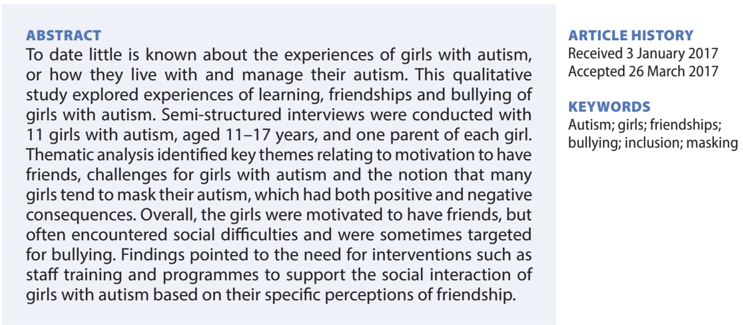
To date little is known about the experiences of girls with autism, or how they live with and manage their autism. This qualitative study explored experiences of learning, friendships and bullying of girls with autism. Semi-structured interviews were conducted with 11 girls with autism, aged 11–17 years, and one parent of each girl. Thematic analysis identified key themes relating to motivation to have friends, challenges for girls with autism and the notion that many girls tend to mask their autism, which had both positive and negative consequences. Overall, the girls were motivated to have friends, but often encountered social difficulties and were sometimes targeted for bullying. Findings pointed to the need for interventions such as staff training and programmes to support the social interaction of girls with autism based on their specific perceptions of friendship.
Overview
The claims and statistics of this paper haven’t been checked yet.
Free: it reads the open-access text and checks the first 5 claims that cite a source we can check. Create a free account to check every claim.
Integrity signals
Registry
Cites
Statistics
Figures





Verification
Claims the paper makes
The claims and statistics of this paper haven’t been checked yet.
Free: it reads the open-access text and checks the first 5 claims that cite a source we can check. Create a free account to check every claim.
Claims other papers make about this one
Each is checked against this paper’s own text: does it say what the citing paper says it does?
The cited source says what the claim attributes to it.
In the citing paper
“Six papers discussed compensatory behaviours as barriers to diagnosis for females (Beteta 2008; Cook et al. 2018; Cridland et al. 2014; Dean et al. 2017; Rynkiewicz et al. 2016; Watson 2014).”
From Barriers to Autism Spectrum Disorder Diagnosis for Young Women and Girls: a Systematic Review (2021) · cites this paper as Cook et al. 2018
The cited source says what the claim attributes to it.
In the citing paper
“During interviews, parents also described their daughters masking their autistic behaviours, adjusting their behaviours to fit in with their peers (Cook et al. 2018).”
From Barriers to Autism Spectrum Disorder Diagnosis for Young Women and Girls: a Systematic Review (2021) · cites this paper as Cook et al. 2018
The cited source says what the claim attributes to it.
In the citing paper
“Three qualitative studies identified the perceptions of others to be a barrier to female ASD diagnosis, based on interviews conducted with adolescent girls with ASD and their mothers (Cook et al. 2018; Cridland et al. 2014; Navot et al. 2017).”
From Barriers to Autism Spectrum Disorder Diagnosis for Young Women and Girls: a Systematic Review (2021) · cites this paper as Cook et al. 2018
The cited source says what the claim attributes to it.
In the citing paper
“These papers discussed how females with ASD might go unnoticed due to their behaviours appearing similar to their neurotypical peers.”
From Barriers to Autism Spectrum Disorder Diagnosis for Young Women and Girls: a Systematic Review (2021) · cites this paper as Cook et al. 2018
The cited source says what the claim attributes to it.
In the citing paper
“Parents suggested ASD girls were less likely to be identified as autistic by their teachers, due to masking of differences.”
From Barriers to Autism Spectrum Disorder Diagnosis for Young Women and Girls: a Systematic Review (2021) · cites this paper as Cook et al. 2018
1 more claim about this paper
Create a free account to see every claim other papers make about this one.
Self-check
Percentages, sums and reported differences re-computed from the paper’s own numbers.
The self-check needs the paper’s full text.
Citations
Cites
Using thematic analysis in psychology
Braun, V., & Clarke, V. (2006) · Qualitative Research in Psychology · doi:10.1191/1478088706qp063oa · Cited by 194,414 · cited 1×
“Thematic analysis (Braun and Clarke 2006) was used to analyse the data.”
MethodDoes the autistic child have a “theory of mind” ?
Baron-Cohen, S., Leslie, A. M., & Frith, U. (1985) · Cognition · doi:10.1016/0010-0277(85)90022-8 · Cited by 8,599 · cited 1×
“…their difficulties with social communication, through learning the rules (Happe 1995), but they may still lack the ability to appreciate the thoughts and feelings of others, or detect the subtle cues required in reciprocal relationships (Baron-Cohen, Leslie, and Frith 1985; Tager-Flusberg 2007).”
BackgroundRelational Aggression, Gender, and Social-Psychological Adjustment
Crick, N. R., & Grotpeter, J. K. (1995) · Child Development · doi:10.1111/j.1467-8624.1995.tb00900.x · Cited by 3,954 · cited 2×
“This type of relational aggression is more likely than physical aggression in girls (Crapanzano, Frick, and Terranova 2010; Crick and Grotpeter 1995), and is also more socially complex.”
BackgroundResultGender schema theory: A cognitive account of sex typing.
Bem, S. L. (1981) · Psychological Review · doi:10.1037/0033-295x.88.4.354 · Cited by 3,861 · cited 1×
“Likewise, social cognitive theories of gender expectations (Bem 1981; Bussey, Bandura, and Bjork Robert 1999) propose that gender-appropriate conduct is learned through modelling the © 2017 the author(s). published by informa uK limited, trading as taylor & francis Group. this is an open access…”
BackgroundSocial cognitive theory of gender development and differentiation.
Bussey, K., & Bandura, A. (1999) · Psychological Review · doi:10.1037/0033-295x.106.4.676 · Cited by 2,476
Relational Aggression, Gender, and Social-Psychological Adjustment
Crick, N. R., & Grotpeter, J. K. (1995) · Child Development · doi:10.2307/1131945 · Cited by 2,373
The extreme male brain theory of autism
Baron-Cohen, S. (2002) · Trends in Cognitive Sciences · doi:10.1016/s1364-6613(02)01904-6 · Cited by 2,007 · cited 2×
“…male diagnoses, but also since the majority of studies focus on gender differences from a biogenic viewpoint or using quantitative methodology (e.g. Baron-Cohen 2002; Dworzynski et al., 2012; Hartley and Sikora 2009; McGillivray and Evert 2014; Wing 1981), which while valuable do not offer the…”
BackgroundCard, N. A., Stucky, B. D., Sawalani, G. M., & Little, T. D. (2008) · Child Development · doi:10.1111/j.1467-8624.2008.01184.x · Cited by 1,917 · cited 3×
“), in line with previous research (Card et al. 2008; Crapanzano, Frick, and Terranova 2010; Crick and Grotpeter 1995; Cridland et al. 2014).”
BackgroundResultPrevalence of Autism Spectrum Disorders in a Total Population Sample
Kim, Y. S., Leventhal, B. L., Koh, Y.-J., Fombonne, E., Laska, E., Lim, E.-C., Cheon, K.-A., Kim, S.-J., Kim, Y.-K., Lee, H., et al. (2011) · American Journal of Psychiatry · doi:10.1176/appi.ajp.2011.10101532 · Cited by 1,524 · cited 1×
“The male–female ratio for the prevalence of autism is reported to be 4–5:1 (Kim et al. 2011).”
BackgroundThe Extreme Male-Brain Theory of Autism
Baron-Cohen, S. (1999) · Neurodevelopmental Disorders · doi:10.7551/mitpress/4945.003.0023 · Cited by 1,413
Research works printed but not linked: 3
- Attwood, T. 2006. 'The Pattern of Abilities and Development for Girls with Asperger's Syndrome.' In Asperger's and Girls , edited by T. Attwood and T. Grandin, 1-7. Arlington, TX: Future Horizons.
- 10.1111/jcpp.2014.55.issue-11 · doi:10.1111/jcpp.2014.55.issue-11
- Reid, B. 2011. We've Got Great Expectations: The Chance of a Lifetime for Children with Autism. National Autistic Society . London: NAS.
Cited by
Items 101–178 of 178
Oliver, M., Poysden, Z., & Gillespie‐Smith, K. (2024) · Review Journal of Autism and Developmental Disorders · doi:10.1007/s40489-024-00472-z · Cited by 4
Short report: Prison-reported rates of autism in female prisons in England
Payne, K.-L., & Gooding, E. (2024) · Autism · doi:10.1177/13623613241275477 · Cited by 4
The Role of Gender and Strong Interests in Self-Reported Camouflaging of Autistic Adults
Putnam, O. C., Swisher, M., McFayden, T. C., Chan, D. V., & Harrop, C. (2025) · Neurodiversity · doi:10.1177/27546330251351732 · Cited by 15
“Camou fl aging is thought to stem from stigma directed at autism at the individual level (e.g., being bullied for expressing autistic behaviors; A. Cook et al., 2018; Hull et al., 2017; Livingston et al., 2019) or at the population level (e.g., harmful stereotypes, widespread discrimination and…”
Drapalik, K. N., Magin, D. J., Rinaldi, M. L., & Christodulu, K. V. (2025) · Autism · doi:10.1177/13623613251345855 · Cited by 7
“…Ross et al., 2023; Tierney et al., 2016), increased stress (Bernardin, Lewis, et al., 2021), loneliness, low self-esteem, and peer rejection (Halsall et al., 2021), and falling behind in educational contexts due to going unnoticed (A. Cook et al., 2018; Halsall et al., 2021; Tierney et al., 2016).”
InfluentialDevelopment of performative identities in autism writers’ autobiographies
Norvaišaite, A., & Tateo, L. (2024) · European Journal of Special Needs Education · doi:10.1080/08856257.2024.2407660 · Cited by 3
“Despite observing and grasping what socialising behaviours were expected, she found herself incapable of performing them (A. Cook, Ogden, and Winstone 2018; Predescu, Al Ghazi, and Darjan 2018; Rynkiewicz et al. 2016).”
InfluentialCamouflaging in Autism Spectrum Conditions in the Context of Self-Esteem Level
Kossewska, J., & Milczarek, M. (2022) · Psychologia Rozwojowa · doi:10.4467/20843879pr.22.012.17469 · Cited by 4
Autism Spectrum Disorder in Adolescents and Adults: An Introduction
Volkmar, F. R., Reichow, B., & McPartland, J. C. (2024) · Springer eBooks · doi:10.1007/978-3-031-46463-8_1 · Cited by 5
Petrina, N., Carter, M., & Stephenson, J. R. (2021) · Springer eBooks · doi:10.1007/978-3-319-91280-6_102405 · Cited by 6
Experiences of friendship among autistic adults: a scoping review
Tian, W., & Wang, D.-C. (2025) · Frontiers in Psychiatry · doi:10.3389/fpsyt.2025.1523506 · Cited by 8
Whybrow, S., Milbourn, B. T., Afsharnejad, B., Kasari, C. L., Bölte, S., & Girdler, S. J. (2025) · Review Journal of Autism and Developmental Disorders · doi:10.1007/s40489-025-00518-w · Cited by 3
Effects of Neurotype and Neurotype Matching on Conversational Rapport and Masking
Wolford, G. W. (2025) · American Journal of Speech-Language Pathology · doi:10.1044/2025_ajslp-24-00463 · Cited by 4
Dighton, S., & McAloon, J. (2026) · Advances in Neurodevelopmental Disorders · doi:10.1007/s41252-026-00476-2 · Cited by 4
“Finally, qualitative research has reported that adolescent autistic females who camouflaged having breakdowns or meltdowns once they returned home from interactions in which they camouflaged (Bargiela et al., 2016; Cook et al., 2018).”
Rebours, C., Kostrubiec, V., & Kruck, J. (2026) · Autism · doi:10.1177/13623613261433985 · Cited by 7
“Beyond EF and IF, Theory of Mind (ToM) has been proposed as a factor in camouflaging, with high camouflagers showing greater recognition of expressions and more effective nonverbal communication (Cook et al., 2018; Lai et al., 2011).”
Boddy, A., & Cook, A. (2026) · Autism · doi:10.1177/13623613261457949 · Cited by 3
“…formation and maintenance, heightened exposure to stigma and bullying, and the use of masking to avoid peer rejection – often with detrimental effects on wellbeing (Cook et al., 2018; Carrington et al., 2017; Cook et al., 2016; Goodall, 2018a; Halsall et al., 2021; Humphrey & Lewis, 2008).”
Self-citationFigueroa, K., Baczewski, L. M., & Kasari, C. L. (2022) · Autism and child psychopathology series · doi:10.1007/978-3-030-98507-3_22 · Cited by 4
The world is nuanced but pixelated: Autistic individuals’ perspective on HIPPEA
Todorova, G. K., Hatton, R. E. M., Sadique, S., & Pollick, F. E. (2023) · Autism · doi:10.1177/13623613231176714 · Cited by 3
“These reasons for masking have been previously reported (e.g. A. Cook et al., 2017; Sedgewick et al., 2021).”
BackgroundHopkins, N., Iles, J. E., & Satherley, R. (2023) · Review Journal of Autism and Developmental Disorders · doi:10.1007/s40489-023-00419-w · Cited by 2
“…participant ages (Gray et al., 2021; Mademtzi et al., 2018; Milner et al., 2019; Navot et al., 2017), but the remaining studies indicated parental ages ranging from 27 to 59 years (Anderson et al., 2020; Cook et al., 2018; Cridland et al., 2014; Fowler & O’Connor, 2021; Rabbitte et al., 2017).”
InfluentialOKUL ÖNCESİ DÖNEMDE SOSYAL BECERİLER ALANINDAKİ LİSANSÜSTÜ TEZLERİN İNCELENMESİ
Deveci, D., & Bolat, Y. (2024) · İstanbul Ticaret Üniversitesi Sosyal Bilimler Dergisi · doi:10.46928/iticusbe.1113537 · Cited by 2
Loo, B. R. Y., Teo, T. J. Y., Liang, M. J., Leong, D.-J., Tan, D. W., Zhuang, S., Hull, L., Livingston, L. A., Mandy, W., Happe, F. G. E., et al. (2021) · doi:10.31219/osf.io/cg8ak · Cited by 2
Petrina, N., Carter, M., & Stephenson, J. R. (2020) · Springer eBooks · doi:10.1007/978-1-4614-6435-8_102405-1 · Cited by 2
Autismo, género y performatividad: alteridades enmascaradas
Marrero, A. B. (2022) · Estudios LGBTIQ+ Comunicación y Cultura · doi:10.5209/eslg.81953 · Cited by 4
Woman with autism spectrum condition. An outline of the characteristics
Buchholz, A. (2021) · Man – Disability – Society · doi:10.5604/01.3001.0015.0625 · Cited by 1
Sandberg, S. G., Nyroos, M., Waling, M., & Olsson, C. (2025) · The Journal of School Nursing · doi:10.1177/10598405251319982 · Cited by 4
“The overrepresentation of boys may be due to boys meeting the diagnostic criteria for ASD or ADHD at an earlier age (Klefsjö et al., 2021; Loomes et al., 2017), or that girls show a stronger tendency to mask their interactional de fi - ciencies (Cook et al., 2017).”
Sex-typical toy, activity, and playmate preferences in autistic and non-autistic children
To, J. C. S., & Kung, K. T. F. (2025) · Autism · doi:10.1177/13623613251321207 · Cited by 3
“Other studies have examined camouflaging in older children and adolescents on the autism spectrum (Howe et al., 2023; Livingston et al., 2019), and it has been reported that some autistic girls can successfully camou-flage and see camouflaging as a solution to their problems (A. Cook et al., 2018).”
Kofke, M., Brown, H. M., & Lindstrom, L. (2025) · Career Development and Transition for Exceptional Individuals · doi:10.1177/21651434251337452 · Cited by 1
“Echoing existing research in this area (A. Cook et al., 2018) in their response to peer victimization and stigma, masking techniques were employed by the girls to conform to expected social behaviors and can be indicative of a less positive autistic identity (Davies et al., 2024).”
Supporting adolescent autistic girls’ wellbeing in school: harnessing the “well” in “being”
Connolly, K. S., & Bunn, H. (2025) · Educational Psychology in Practice · doi:10.1080/02667363.2025.2538576 · Cited by 2
“Camouflaging difference is a common short-term coping strategy for social integration (Brennan De Vine, 2022; Cook et al., 2018); however this often has a longer-term detrimental effect on friendship retention (Tierney et al., 2016) and contributes to a vicious cycle whereby school staff do not…”
Villegas, F. E., van der Steen, S., & Minnaert, A. E. M. G. (2025) · European Journal of Special Needs Education · doi:10.1080/08856257.2025.2545930 · Cited by 2
“Another issue is that schools may not adequately address incidents reported by autistic girls, perceiving their accounts as exaggerated or embellished (Cook, Ogden, and Winstone 2018).”
Lundwall, R. A., Cutrer‐Párraga, E. A., Lundwall, R., Squires, M. E., Beck, J. S., & Gabrielsen, T. P. (2025) · Research in Autism · doi:10.1016/j.reia.2025.202725 · Cited by 1
Rice, E. H., Berman, A., Offutt, K., & Whitlow, D. (2025) · European Journal of Special Needs Education · doi:10.1080/08856257.2025.2593886 · Cited by 1
Norozi, M., Sarmukadam, K., Paterra, V., Parks, E. L., & Hogan, A. L. (2025) · Journal of Speech Language and Hearing Research · doi:10.1044/2025_jslhr-25-00219 · Cited by 2
Expanding Understanding of Autism Spectrum Disorder in Girls and Women: A New Paradigm
Bitensky, D., Clauss‐Ehlers, C. S., & Veksler, K. M. (2026) · Behavioral Sciences · doi:10.3390/bs16030396 · Cited by 1
“The camouflage hypothesis helps explain this pattern: to meet social expectations, many girls hide autistic traits, shaping peer relations and bullying risk, impacting the time of diagnosis (Cook et al., 2018).”
InfluentialThe impact of specialist resource centres on autistic pupils’ experience of mainstream school
Cook, A., & Boddy, A. (2026) · Autism · doi:10.1177/13623613261426099 · Cited by 2
“Autistic girls in particular may mask differences to avoid negative attention, a strategy that can carry mental health costs (Cook et al., 2018; Dean et al., 2017; Halsall et al., 2021; Hull et al., 2020; Tierney et al., 2016).”
Self-citationWhite, E.-M., & Fox, L. (2026) · Research in Neurodiversity · doi:10.1016/j.rin.2026.100028 · Cited by 1
Herbert, G., Hanley, M., & Riby, D. M. (2026) · Research in Neurodiversity · doi:10.1016/j.rin.2026.100037 · Cited by 2
Gordon, A. G., Fox, L., & Asbury, K. (2026) · Disabilities · doi:10.3390/disabilities6030051 · Cited by 1
“For many women across the study, experiences of school were negative and characterised by a feeling that they did not fit in and, for many, involved being bullied by their peers, a finding that is in line with those of the previous literature [37,38].”
From Difference to Diversity in School
Wood, R. (2020) · ENLIGHTEN (Jurnal Bimbingan dan Konseling Islam) · Cited by 1
Exploring the Lack of Research About Autistic Women
Bennett, M., & Goodall, E. (2022) · Emerald Group Publishing Limited eBooks · doi:10.1108/978-1-80382-463-520221005 · Cited by 3
Mainstream Education for Children with Autism Spectrum Disorder
Reed, P., & Osborne, L. A. (2024) · Autism and child psychopathology series · doi:10.1007/978-3-031-64499-3_22 · Cited by 1
Atkinson, T. (2021) · Lancaster EPrints (Lancaster University) · doi:10.17635/lancaster/thesis/1253 · Cited by 2
Exploring the friendship experiences of autistic children in mainstream primary schoolPreprint
Fox, L., & Asbury, K. (2024) · doi:10.31234/osf.io/rzxqm · Cited by 1
Inclusion, but not necessarily integration: Centring student perspectives and needs in education
Dwyer, P. S. R., Nosova, E., Kermond, C., & Leadbitter, K. (2026) · Autism · doi:10.1177/13623613261425303 · Cited by 1
“…levels: from physical, where autistic students report that school sensory environments are uncomfortable and overwhelming (Price & Romualdez, 2025), to social, where students face pressure to mask their autism in integrated schools (Atkinson et al., 2025; Cook et al., 2018; Moyse & Porter, 2015).”
Autistic Dreaming: a phenomenological study of dreaming and well-being
Pindar, S.-A. (2019) · Sheffield Hallam University · doi:10.7190/shu-thesis-00319 · Cited by 2
Challenged Motherhood: Mothers to Adult Daughters With Asperger Syndrome
Haller, R. L. (2021) · The European Proceedings of Social & Behavioural Sciences · doi:10.15405/epsbs.2021.03.02.43
Teaching Interventions for the Development of Friendship in Students with ASD
Orfanos, P. (2022) · International Journal of Social Science and Human Research · doi:10.47191/ijsshr/v5-i3-02
Autismus – eine einleitende Charakterisierung
Habermann, L., & Kißler, C. (2022) · Springer eBooks · doi:10.1007/978-3-658-37602-4_2
Equity in education for autistic students: professional learning to accommodate inclusive education
Petersson‐Bloom, L. (2022) · doi:10.24834/isbn.9789178773176 · Cited by 11
Zhuang, S., Tan, D. W., Reddrop, S., Dean, L., Maybery, M. T., & Magiati, I. (2023) · doi:10.31219/osf.io/cgzbu
Lacroix, A. (2023) · UGA Éditions eBooks · doi:10.4000/books.ugaeditions.29935
Chen, F. (2023) · Lecture Notes in Education Psychology and Public Media · doi:10.54254/2753-7048/14/20230963 · Cited by 4
“Friendship building is to establish and maintain friendships between individuals with autism and others, enabling them to participate in social activities [36].”
BackgroundNeurodiversidade (en)cena: gênero e sexualidade na série Atypical
da Cruz, P. S. G. (2022) · doi:10.47749/t/unicamp.2022.1253751 · Cited by 1
Das Autismus Spektrum im Spannungsfeld schulischer Anforderungen
Haider, S., Jencio-Stricker, E., & Schwanda, A. (2023) · Springer eBooks · doi:10.1007/978-3-662-67954-8_1
Day, E., & Middleton, T. (2024) · Support for Learning · doi:10.1111/1467-9604.12464
“This is No Time for Being Underwater”: Ableism, Rape Culture and Care Work in The Nowhere Girls
Moore, A., & Kelley, L. (2024) · Research on Diversity in Youth Literature · doi:10.21900/j.rydl.v5i2.1159 · Cited by 2
Self-reported Social Camouflaging in Sexual Minority and Heterosexual Autistic AdultsPreprint
McQuaid, G. A., Lee, N., & Wallace, G. L. (2024) · doi:10.31234/osf.io/p2tdy
Gordon, A. G., Fox, L., & Asbury, K. (2024) · OSF Preprints (OSF Preprints) · doi:10.31219/osf.io/hse29
Hepburn, S. (2024) · International review of research in developmental disabilities · doi:10.1016/bs.irrdd.2024.09.010 · Cited by 1
Jensen, M. K., Lydiksen, T. W., Pedersen, S. H., & Bentz, M. (2024) · Journal of Psychiatry and Brain Science · doi:10.20900/jpbs.20240009
“This may complicate identifying autism, as highlighted by Hiller et al. [46], and it supports the hypothesis put forward in studies by Halsall et al. [20] and Cook et al. [19] that compensatory behaviours in the YP and parents may prolong the time to diagnosis.”
Perich, E. (2024) · Queensland University of Technology · doi:10.5204/thesis.eprints.254565 · Cited by 1
Autism Spectrum Disorder – Contemporary Issues and the Provision of Support in Schools
Erdei, R. (2024) · Practice and theory in systems of education · doi:10.63145/ptse.v19i2.23
Drapalik, K. N. (2023) · Scholars Archive - University at Albany (University at Albany, State University of New York) · doi:10.54014/p2x7-yvb2
Jugendliche im Autismus-Spektrum in der inklusiven Schule – Belastungen und Bewältigungsstrategien
Sagrauske, M., & Lindmeier, C. (2025) · Verlag Julius Klinkhardt eBooks · doi:10.35468/6149-14
Deacon, L., Bikova, Z., Deacon, M., Thurgood, Y., & Barrett, M. (2025) · IGI Global eBooks · doi:10.4018/979-8-3693-8044-4.ch001 · Cited by 4
Li, J., & Shum, K. K. (2025) · Journal of Autism and Developmental Disorders · doi:10.1007/s10803-025-07039-9 · Cited by 2
Roberts, K. A. (2025) · Educational and Child Psychology · doi:10.53841/bpsecp.2025.42.4.73
Silva, M. A., Bennett, K. D., & Dare, E. A. (2026) · Journal of Child and Family Studies · doi:10.1007/s10826-025-03249-y
“An important aspect of the Black et al. (2024) review— that is germane to the current investigation—is that multiple studies simultaneously sought the perspectives of adolescents with ASD, their parents, school personnel, or friends (e.g., Cook et al., 2018; O’Hagan, & Hebron, 2017).”
Halsall, J., Robinson, E., Cook, A., Halsall, A., & Crane, L. (2026) · Autism · doi:10.1177/13623613251414302
Self-citationBera, M. K., & Sharma, R. (2026) · Journal of School Leadership · doi:10.1177/10526846261424071
“Research fi nding supports the argument of Cook et al. (2018) and illustrate that academic emotions were positively associated with constructive criticism and aided in resolving con fl ict.”
Klein, J., Krahn, R., Howe, S. J., Cormier, A., Rush, J., Ames, M. E., McMorris, C. A., & Macoun, S. J. (2026) · BMJ Open · doi:10.1136/bmjopen-2025-111221
Wolford, G. W., Varela, G., Freeland, R. E., & Bellon-Harn, M. L. (2026) · Autism · doi:10.1177/13623613261435994
“However, potentially counter-productive to building autistic friendships, many autistic adults use masking as a primary way of developing new friendships (A. Cook et al., 2018; Hull et al., 2017).”
Portelli, C., & Camilleri, L. J. (2026) · International Journal of Inclusive Education · doi:10.1080/13603116.2026.2688235
Social and Emotional Wellbeing for Females With Autism at School: A Qualitative Analysis
Jarman, B., & Beswick, K. (2026) · Australasian Journal of Special and Inclusive Education · doi:10.1017/jsi.2026.10014
“Furthermore, similar to the findings of Cook et al. (2018), females with autism in the present study were sometimes the targets of bullying because of characteristics associated with autism, such as a lack of eye contact.”
A Systematic Review of the Risk and Protective Factors for Suicide in Autism Spectrum Disorder
Tubío-Fungueiriño, M., Cruz, S., Zubizarreta, S. C.-P., Pozo-Rodríguez, M., Hervas, A., Carracedo, Á., & Fernández-Prieto, M. (2026) · The Spanish Journal of Psychology · doi:10.1017/sjp.2026.10034
“…by social groups (Hull et al., 2017), has been identified as a risk factor for suicide-related behaviors, which has been reported in recent studies that did not meet the inclusion criteria for this systematic review (Cook et al., 2018; Tierney & Burns, 2017; Tubío-Fungueiriño et al., 2022).”
Harrison, S., Mathew, D., Iarocci, G., & Boldut, E. (2026) · Advances in Autism · doi:10.1108/aia-05-2026-0067
Sandberg, S. G. (2026) · Food and Foodways · doi:10.1080/07409710.2026.2736399
Autistic girls' experience of a sense of belonging in Swedish secondary schools
Josefsson, H. (2026) · Journal of Research in Special Educational Needs · doi:10.1111/1471-3802.70171
Chronic Invalidation: An Underexplored Source of Autistic Distress
Palser, E. R., Catron, E. J., & Kuo, J. R. (2026) · Autism in Adulthood · doi:10.1177/25739581261495704
Vélez, W. A. Z., LILIBETH, A. P. J., Quinde, G. A. L., García, J. M. V. V., Cusme, M. V. P., Peñafiel, L. Y. R., Zavala, G. A. S., & Jumbo, A. E. U. (2026) · Education Sciences · doi:10.3390/educsci16101741
Sensory profiles for young males and females with ADHD and autistic characteristics
Hollingdale, J., Bang-Andersen, T., & Woodhouse, E. (2026) · Child Neuropsychology · doi:10.1080/09297049.2026.2755799
Metadata
- Authors
- Cook, A., Ogden, J., & Winstone, N.
- Affiliations
- University of Surrey (GB)
- Corresponding author
- Cook, Anna
- Venue
- European Journal of Special Needs Education
- Publisher
- Informa UK Limited
- Published
- 2017-04-11
- Volume
- 33
- Issue
- 3
- Pages
- 302-315
- ISSN
- 0885-6257 (ISSN-L)
- 1469-591X
- OpenAlex
- W2607052951
- Cited by
- 178
- References
- 50
- Citations by year
- 2026: 25 · 2025: 28 · 2024: 33 · 2023: 22 · 2022: 28 · 2021: 17 · 2020: 11 · 2019: 7 · 2018: 6 · 2017: 1
- FWCI
- 3.93
- Type
- journal article
- Language
- en
- Open access
- hybrid
- doi.org
- Licence
- Locations
- European Journal of Special Needs Education (publishedVersion, cc-by-nc-nd)
- Own your potential (DEAKIN) (submittedVersion)
- Figshare (submittedVersion, cc-by)
- Topics
- Life Sciences › Neuroscience › Cognitive Neuroscience › Autism Spectrum Disorder Research
- Social Sciences › Education › Inclusion and Disability in Education and Sport
- Social Sciences › Psychology › Social Psychology › Bullying, Victimization, and Aggression
- Keywords
- autistic girls, friendship, social motivation, masking, bullying, social difficulties, school environment, parental attitudes, social interaction support, employee training, autism spectrum disorder
About these checks
Registry, retraction, Cites and statistics results are computed, not judged, with one exception: a printed reference that no index lists is read once by a model before it counts as a citation error. Claims are extracted by a model and kept only when their quote appears verbatim in the text; each cited source is then checked, with a model’s help, for whether it says what the claim relies on. Those verdicts can be wrong — read the claim’s quote and the cited source before relying on one.
Statistics and arithmetic are recomputed, not judged.
Confidence bands are shown only for fields calibrated on our annotated test set. None is calibrated yet, so no band is shown.
What counts as a claim ›How we measure confidence ›How we check this ›
Are you an author, or do you see a problem with this page? Request a review
Data sources
Bibliographic data: Semantic Scholar, OpenAlex, Crossref.
Contains information from the Semantic Scholar Academic Graph Datasets, made available under the ODC Attribution License (ODC-BY 1.0).
Semantic Scholar’s data is described in: Kinney, R., et al. (2023). The Semantic Scholar Open Data Platform. arXiv:2301.10140.
