

Friendship motivations, challenges and the role of masking for girls with autism in contrasting school settings
Open accessThe DOI matches its Crossref record; 49 of the 50 references it cites were found in a registry or an index, and 1 are not checked yet.
Abstract
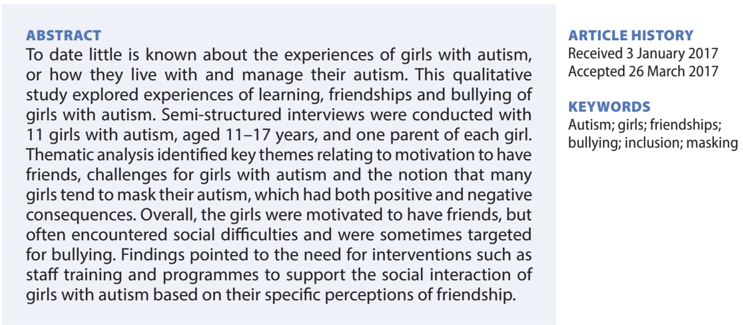
To date little is known about the experiences of girls with autism, or how they live with and manage their autism. This qualitative study explored experiences of learning, friendships and bullying of girls with autism. Semi-structured interviews were conducted with 11 girls with autism, aged 11–17 years, and one parent of each girl. Thematic analysis identified key themes relating to motivation to have friends, challenges for girls with autism and the notion that many girls tend to mask their autism, which had both positive and negative consequences. Overall, the girls were motivated to have friends, but often encountered social difficulties and were sometimes targeted for bullying. Findings pointed to the need for interventions such as staff training and programmes to support the social interaction of girls with autism based on their specific perceptions of friendship.
Overview
The claims and statistics of this paper haven’t been checked yet.
Free: it reads the open-access text and checks the first 5 claims that cite a source we can check. Create a free account to check every claim.
Integrity signals
Registry
Cites
Statistics
Figures





Verification
Claims the paper makes
The claims and statistics of this paper haven’t been checked yet.
Free: it reads the open-access text and checks the first 5 claims that cite a source we can check. Create a free account to check every claim.
Claims other papers make about this one
Each is checked against this paper’s own text: does it say what the citing paper says it does?
The cited source says what the claim attributes to it.
In the citing paper
“Six papers discussed compensatory behaviours as barriers to diagnosis for females (Beteta 2008; Cook et al. 2018; Cridland et al. 2014; Dean et al. 2017; Rynkiewicz et al. 2016; Watson 2014).”
From Barriers to Autism Spectrum Disorder Diagnosis for Young Women and Girls: a Systematic Review (2021) · cites this paper as Cook et al. 2018
The cited source says what the claim attributes to it.
In the citing paper
“During interviews, parents also described their daughters masking their autistic behaviours, adjusting their behaviours to fit in with their peers (Cook et al. 2018).”
From Barriers to Autism Spectrum Disorder Diagnosis for Young Women and Girls: a Systematic Review (2021) · cites this paper as Cook et al. 2018
The cited source says what the claim attributes to it.
In the citing paper
“Three qualitative studies identified the perceptions of others to be a barrier to female ASD diagnosis, based on interviews conducted with adolescent girls with ASD and their mothers (Cook et al. 2018; Cridland et al. 2014; Navot et al. 2017).”
From Barriers to Autism Spectrum Disorder Diagnosis for Young Women and Girls: a Systematic Review (2021) · cites this paper as Cook et al. 2018
The cited source says what the claim attributes to it.
In the citing paper
“These papers discussed how females with ASD might go unnoticed due to their behaviours appearing similar to their neurotypical peers.”
From Barriers to Autism Spectrum Disorder Diagnosis for Young Women and Girls: a Systematic Review (2021) · cites this paper as Cook et al. 2018
The cited source says what the claim attributes to it.
In the citing paper
“Parents suggested ASD girls were less likely to be identified as autistic by their teachers, due to masking of differences.”
From Barriers to Autism Spectrum Disorder Diagnosis for Young Women and Girls: a Systematic Review (2021) · cites this paper as Cook et al. 2018
1 more claim about this paper
Create a free account to see every claim other papers make about this one.
Self-check
Percentages, sums and reported differences re-computed from the paper’s own numbers.
The self-check needs the paper’s full text.
Citations
Cites
Using thematic analysis in psychology
Braun, V., & Clarke, V. (2006) · Qualitative Research in Psychology · doi:10.1191/1478088706qp063oa · Cited by 194,414 · cited 1×
“Thematic analysis (Braun and Clarke 2006) was used to analyse the data.”
MethodDoes the autistic child have a “theory of mind” ?
Baron-Cohen, S., Leslie, A. M., & Frith, U. (1985) · Cognition · doi:10.1016/0010-0277(85)90022-8 · Cited by 8,599 · cited 1×
“…their difficulties with social communication, through learning the rules (Happe 1995), but they may still lack the ability to appreciate the thoughts and feelings of others, or detect the subtle cues required in reciprocal relationships (Baron-Cohen, Leslie, and Frith 1985; Tager-Flusberg 2007).”
BackgroundRelational Aggression, Gender, and Social-Psychological Adjustment
Crick, N. R., & Grotpeter, J. K. (1995) · Child Development · doi:10.1111/j.1467-8624.1995.tb00900.x · Cited by 3,954 · cited 2×
“This type of relational aggression is more likely than physical aggression in girls (Crapanzano, Frick, and Terranova 2010; Crick and Grotpeter 1995), and is also more socially complex.”
BackgroundResultGender schema theory: A cognitive account of sex typing.
Bem, S. L. (1981) · Psychological Review · doi:10.1037/0033-295x.88.4.354 · Cited by 3,861 · cited 1×
“Likewise, social cognitive theories of gender expectations (Bem 1981; Bussey, Bandura, and Bjork Robert 1999) propose that gender-appropriate conduct is learned through modelling the © 2017 the author(s). published by informa uK limited, trading as taylor & francis Group. this is an open access…”
BackgroundSocial cognitive theory of gender development and differentiation.
Bussey, K., & Bandura, A. (1999) · Psychological Review · doi:10.1037/0033-295x.106.4.676 · Cited by 2,476
Relational Aggression, Gender, and Social-Psychological Adjustment
Crick, N. R., & Grotpeter, J. K. (1995) · Child Development · doi:10.2307/1131945 · Cited by 2,373
The extreme male brain theory of autism
Baron-Cohen, S. (2002) · Trends in Cognitive Sciences · doi:10.1016/s1364-6613(02)01904-6 · Cited by 2,007 · cited 2×
“…male diagnoses, but also since the majority of studies focus on gender differences from a biogenic viewpoint or using quantitative methodology (e.g. Baron-Cohen 2002; Dworzynski et al., 2012; Hartley and Sikora 2009; McGillivray and Evert 2014; Wing 1981), which while valuable do not offer the…”
BackgroundCard, N. A., Stucky, B. D., Sawalani, G. M., & Little, T. D. (2008) · Child Development · doi:10.1111/j.1467-8624.2008.01184.x · Cited by 1,917 · cited 3×
“), in line with previous research (Card et al. 2008; Crapanzano, Frick, and Terranova 2010; Crick and Grotpeter 1995; Cridland et al. 2014).”
BackgroundResultPrevalence of Autism Spectrum Disorders in a Total Population Sample
Kim, Y. S., Leventhal, B. L., Koh, Y.-J., Fombonne, E., Laska, E., Lim, E.-C., Cheon, K.-A., Kim, S.-J., Kim, Y.-K., Lee, H., et al. (2011) · American Journal of Psychiatry · doi:10.1176/appi.ajp.2011.10101532 · Cited by 1,524 · cited 1×
“The male–female ratio for the prevalence of autism is reported to be 4–5:1 (Kim et al. 2011).”
BackgroundThe Extreme Male-Brain Theory of Autism
Baron-Cohen, S. (1999) · Neurodevelopmental Disorders · doi:10.7551/mitpress/4945.003.0023 · Cited by 1,413
Research works printed but not linked: 3
- Attwood, T. 2006. 'The Pattern of Abilities and Development for Girls with Asperger's Syndrome.' In Asperger's and Girls , edited by T. Attwood and T. Grandin, 1-7. Arlington, TX: Future Horizons.
- 10.1111/jcpp.2014.55.issue-11 · doi:10.1111/jcpp.2014.55.issue-11
- Reid, B. 2011. We've Got Great Expectations: The Chance of a Lifetime for Children with Autism. National Autistic Society . London: NAS.
Cited by
Barriers to Autism Spectrum Disorder Diagnosis for Young Women and Girls: a Systematic Review
Lockwood Estrin, G., Milner, V., Spain, D., Happé, F., & Colvert, E. (2021) · Review Journal of Autism and Developmental Disorders · doi:10.1007/s40489-020-00225-8 · Cited by 444
A qualitative exploration of the female experience of autism spectrum disorder (ASD)
Milner, V., McIntosh, H., Colvert, E., & Happé, F. (2019) · Journal of Autism and Developmental Disorders · doi:10.1007/s10803-019-03906-4 · Cited by 262
Challenges Surrounding the Diagnosis of Autism in Children
Hus, Y., & Segal, O. (2021) · Neuropsychiatric Disease and Treatment · doi:10.2147/ndt.s282569 · Cited by 173
“Female adolescents with ASD, for example, established friendships with their peers, despite their limitations in communication or difficulties in maintaining social relationships.(130,131) Although camouflaging behaviors may assist girls in adjusting to the social environment at least superficially, such behaviors hav…”
BackgroundAutistic experiences of applied behavior analysis
Anderson, L. K. (2023) · Autism · doi:10.1177/13623613221118216 · Cited by 168
“Masking and camouflaging have been linked to high incidences of stress, anxiety, and social alienation in autistic people, suggesting that any practice that teaches masking is harmful to autistic people (Cage et al., 2018; Cook et al., 2018; Hull et al., 2017; Lai et al., 2017).”
BackgroundSocial Camouflaging in Females with Autism Spectrum Disorder: A Systematic Review
Tubío-Fungueiriño, M., Cruz, S., Sampaio, A., Carracedo, A., & Fernández-Prieto, M. (2021) · Journal of Autism and Developmental Disorders · doi:10.1007/s10803-020-04695-x · Cited by 168
Radulski, E. M. (2022) · Human Development · doi:10.1159/000524122 · Cited by 150
“Supporting Participant 26’s view that masking involves blending in with a non-Autistic Majority, Cook et al. (2021) found that a key component of masking/camouflaging in-”
BackgroundReconsidering autistic ‘camouflaging’ as transactional impression management
Ai, W., Cunningham, W. A., & Lai, M.-C. (2022) · Trends in Cognitive Sciences · doi:10.1016/j.tics.2022.05.002 · Cited by 140
Sex differences in social attention in autism spectrum disorder
Harrop, C., Jones, D., Zheng, S., Nowell, S. W., Boyd, B. A., & Sasson, N. (2018) · Autism Research · doi:10.1002/aur.1997 · Cited by 125
“, 2017] and self-report of greater social motivation in ASD females [Cook et al., 2018; Vine Foggo & Webster, 2017].”
BackgroundMethodAllely, C. S. (2019) · Advances in Autism · doi:10.1108/aia-09-2018-0036 · Cited by 123
Is There a Bias Towards Males in the Diagnosis of Autism? A Systematic Review and Meta-Analysis
Cruz, S., Zubizarreta, S. C.-P., Costa, A. D., Araújo, R., Martinho, J., Tubío-Fungueiriño, M., Sampaio, A., Cruz, R., Carracedo, Á., & Fernández‐Prieto, M. (2024) · Neuropsychology Review · doi:10.1007/s11065-023-09630-2 · Cited by 191
“Studies show that autistic females often mimic other people’s facial expressions (Cook et al., 2018), suppress repetitive behaviours (Wiskerke et al., 2018), or maintain appropriate eye contact (Lai et al., 2017) to conform to social group norms.”
Woodgate, R. L., González, M., Demczuk, L., Snow, W. M., Barriage, S., & Kirk, S. A. (2019) · Disability and Rehabilitation · doi:10.1080/09638288.2018.1561955 · Cited by 189
“facilitated experiencing a sense of belonging and strengthened the friendship [46,48].”
BackgroundInfluentialVisual attention to faces in children with autism spectrum disorder: are there sex differences?
Harrop, C., Jones, D., Zheng, S., Nowell, S., Schultz, R., & Parish-Morris, J. (2019) · Molecular Autism · doi:10.1186/s13229-019-0276-2 · Cited by 107
“For example, females with ASD socialize differently than males [19], report more same-sex typical friendships [20, 21] and experience heightened social motivation [22].”
BackgroundHalsall, J., Clarke, C., & Crane, L. (2021) · Autism · doi:10.1177/13623613211012819 · Cited by 96
Horgan, F., Kenny, N., & Flynn, P. (2022) · Autism · doi:10.1177/13623613221105089 · Cited by 150
“Students across the studies employed their own tactics to avoid bullying such as ignoring hurtful comments, walking away from bullies or telling their teacher or parents (Cook et al., 2018; Humphrey & Lewis, 2008a; Saggers, 2015).”
BackgroundInfluentialExperiences of Friendships for Individuals on the Autism Spectrum: A Scoping Review
Black, M. H., Kuzminski, R., Wang, J., Ang, J., Lee, C., Hafidzuddin, S., & McGarry, S. (2022) · Review Journal of Autism and Developmental Disorders · doi:10.1007/s40489-022-00332-8 · Cited by 136
“…who were my friends” Participants reported difficulty maintaining friendships, having conflicts with friends, or needing to develop new friend-ships (Carrington et al., 2003; Cook et al., 2018; Forster & Pearson, 2020; Milner et al., 2019; Potter, 2015; Ryan et al., 2020; Sedgewick et al., 2019).”
InfluentialZhuang, S., Tan, D. W., Reddrop, S., Dean, L., Maybery, M., & Magiati, I. (2023) · Clinical Psychology Review · doi:10.1016/j.cpr.2023.102335 · Cited by 90
Developing Social Skills and Social Competence in Children with Autism
Silveira-Zaldivar, T., Özerk, G., & Özerk, K. Z. (2021) · lnternational Electronic Journal of Elementary Education · doi:10.26822/iejee.2021.195 · Cited by 212
“Children with ASD have fewer friends and report a lower quality of friendships than typical peers (Calder et al., 2013; Cook et al., 2017; Kasari et al., 2011).”
BackgroundPetersson‐Bloom, L., & Holmqvist, M. (2022) · Autism & Developmental Language Impairments · doi:10.1177/23969415221123429 · Cited by 217
“In 36 articles, some aspects of social or communicative training or attitudes were examined by studying the social situation of autistic students (Hay & Winn, 2005; Humphrey & Lewis, 2008b) or social relationships and friendships (e.g., Calder et al., 2013; Cook et al., 2018; Daniel & Billingsley, 2010; Jones & Howley…”
BackgroundKnutsen, J., Crossman, M., Perrin, J., Shui, A., & Kuhlthau, K. (2019) · Autism · doi:10.1177/1362361318786490 · Cited by 78
“…rates compared to boys: preschool-aged higher functioning girls may not be old enough to mask social communication difficulties; however, primary school-aged girls are known to conceal these behaviors (e.g. Cook et al., 2017), and suggests why we might be seeing the observed pattern of findings.”
BackgroundPutnam, O. C., McFayden, T. C., & Harrop, C. (2024) · Journal of Autism and Developmental Disorders · doi:10.1007/s10803-024-06498-w · Cited by 82
“The constructs of social motivation and camouflaging are tightly linked, as many individuals cite a desire for social closeness as a motivation for engaging in camouflaging behaviors (Cook et al., 2018; Livingston et al., 2019).”
A Systematic Review of Passing as Non-autistic in Autism Spectrum Disorder
Libsack, E. J., Keenan, E. G., Freden, C. E., Mirmina, J., Iskhakov, N., Krishnathasan, D., & Lerner, M. D. (2021) · Clinical Child and Family Psychology Review · doi:10.1007/s10567-021-00365-1 · Cited by 68
The relationship between camouflaging and mental health in autistic children and adolescents
Ross, A., Grove, R., & McAloon, J. (2022) · Autism Research · doi:10.1002/aur.2859 · Cited by 85
“For example, autistic girls are more likely than autistic boys to sit near peer groups without contributing to conversation, as opposed to engaging in solitary activities (Dean et al., 2017).”
BackgroundFriend matters: sex differences in social language during autism diagnostic interviews
Cola, M., Yankowitz, L. D., Tena, K. G., Russell, A. R. B., Bateman, L., Knox, A., Plate, S. N., Cubit, L. S., Zampella, C., Pandey, J., et al. (2022) · Molecular Autism · doi:10.1186/s13229-021-00483-1 · Cited by 73
“This explanation fits with the results of qualitative research, wherein autistic girls report experiencing increased relational conflict from NT peers who punish them for “not getting it” socially by excluding them from the group or making them the butt of jokes [27, 58, 108].”
ResultSumiya, M., Igarashi, K., & Miyahara, M. (2018) · PLoS ONE · doi:10.1371/journal.pone.0191538 · Cited by 62
The school experiences of autistic girls and adolescents: a systematic review
Tomlinson, C., Bond, C., & Hebron, J. (2019) · European Journal of Special Needs Education · doi:10.1080/08856257.2019.1643154 · Cited by 69
“The need for clear language and checking of understanding and difficulties was also echoed in specialist provision (Cook, Ogden, and Winstone 2018).”
BackgroundInfluentialBailey, J., & Baker, S. T. (2020) · Journal of Research in Special Educational Needs · doi:10.1111/1471-3802.12490 · Cited by 66
Field, S. L., Williams, M. O., Jones, C. R. G., & Fox, J. R. E. (2024) · Autism · doi:10.1177/13623613231223036 · Cited by 45
“Subsequent research has investigated this experience further, referring to it as ‘masking’ (A. Cook et al., 2018) ‘compensatory strategies’ (Livingston et al., 2019) or ‘social camouflag-ing’ (Hull et al., 2017).”
BackgroundO’Connor, R., van den Bedem, N. P., Blijd-Hoogewys, E. M. A., Stockmann, L., & Rieffe, C. J. (2022) · Autism · doi:10.1177/13623613211073448 · Cited by 55
Understanding camouflaging and identity in autistic children and adolescents using photo-elicitation
Howe, S. J., Hull, L., Sedgewick, F., Hannon, B., & McMorris, C. A. (2023) · Research in Autism · doi:10.1016/j.rasd.2023.102232 · Cited by 121
“…in autistic children and adolescents is scarce and has relied on informant reports or semi-structured interviews to collect information about the thoughts, feelings, and behaviours of autistic children and adolescents (e.g., Bernardin et al., 2021a; Cook et al., 2018; Tierney et al., 2016).”
The Anxiety Caused by Secondary Schools for Autistic Adolescents: In Their Own Words
Costley, D., Emerson, A., Ropar, D., & Sheppard, E. (2021) · Education Sciences · doi:10.3390/educsci11110726 · Cited by 48
“Social camouflaging is defined as the use of strategies to “mask” or hide autistic characteristics from others during social interactions [20].”
BackgroundSelf-perception of friendship style: Young adults with and without autism spectrum disorder
Finke, E. H., McCarthy, J. H., & Sarver, N. A. (2019) · Autism & Developmental Language Impairments · doi:10.1177/2396941519855390 · Cited by 42
Silveira-Zaldivar, T., & Curtis, H. (2019) · lnternational Electronic Journal of Elementary Education · doi:10.26822/iejee.2019155337 · Cited by 55
“Cook et al. (2017) found that several adolescent girls try to conceal their autism characteristics to make friends.”
BackgroundCook, A., Ogden, J., & Winstone, N. (2020) · Autism · doi:10.1177/1362361320937088 · Cited by 47
“First, the research questions emerged from existing literature and previous interviews with autistic young people and their parents (Cook et al., 2016, 2017); second, these research questions were developed and formulated for this study in collaboration with a working group established by the…”
Self-citationBanks, J., McCoy, S., & Frawley, D. (2017) · European Journal of Special Needs Education · doi:10.1080/08856257.2017.1327397 · Cited by 53
A systematic review of social camouflaging in autistic adults and youth: Implications and theory
Klein, J. L., Krahn, R., Howe, S. J., Lewis, J., McMorris, C. A., & Macoun, S. J. (2024) · Development and Psychopathology · doi:10.1017/s0954579424001159 · Cited by 48
Perceptions of friendship among girls with Autism Spectrum Disorders
Ryan, C., Coughlan, M., Maher, J., Vicario, P., & Garvey, A. (2020) · European Journal of Special Needs Education · doi:10.1080/08856257.2020.1755930 · Cited by 43
Educación inclusiva en el alumnado con TEA: una revisión sistemática de la investigación
de Rivera, T. G., Fernández-Blázquez, M. A. L. M., Rueda, C. S., & ionandia, G. E. S. (2022) · Siglo Cero: Revista Española sobre Discapacidad Intelectual · doi:10.14201/scero2022531115135 · Cited by 68
“– Falta de preocupación de la escuela por el ámbito social (Cook et al., 2018; Johansson, 2014; Larcombe et al., 2019).”
BackgroundInfluentialMcKinlay, M., Thorpe, D., Cage, E., Grainger, C., Jasper, C., & Stewart, M. E. (2024) · Autism · doi:10.1177/13623613241285974 · Cited by 39
“Feeling a connection with others who also viewed themselves as different may work well: ‘[my friends] didn’t really care too much what other people thought, which is a lot like what I am . . . that’s probably why I got along with them so much’ (Cook et al., 2018, p. 7).”
McKinney, A., O’Brien, S., Maybin, J. A., Chan, S. W. Y., Richer, S., & Rhodes, S. (2024) · JCPP Advances · doi:10.1002/jcv2.12294 · Cited by 38
Birkett, L., McGrath, L., & Tucker, I. M. (2022) · Emotion, space and society · doi:10.1016/j.emospa.2022.100872 · Cited by 35
‘I just rolled up my sleeves’: Mothers’ perspectives on raising girls on the autism spectrum
Fowler, K., & O’Connor, C. (2020) · Autism · doi:10.1177/1362361320956876 · Cited by 39
“Furthermore, the school environment is particularly fraught for autistic girls, where peer isolation and bullying can have a detrimental impact on mental health (Cook et al., 2018; Honeybourne, 2015; Sedgewick et al., 2018).”
BackgroundO’Hagan, S., Bond, C., & Hebron, J. (2022) · International Journal of Inclusive Education · doi:10.1080/13603116.2022.2049378 · Cited by 38
“The girls benefited from ongoing support with social skills and friendship development; enhancement of these skills is likely to reduce social anxiety (Cook, Ogden, and Winstone 2018).”
Autism - A Comprehensive Array of Prominent Signs and Symptoms
Nadeem, M. S., Murtaza, B. N., Al-Ghamdi, M. A., Ali, A., Zamzami, M. A., Khan, J. A., Ahmad, A., Rehman, M. U., & Kazmi, I. A. (2021) · Current Pharmaceutical Design · doi:10.2174/1381612827666210120095829 · Cited by 34
Lacroix, A., Dutheil, F., Logemann, A., Cserjesi, R., Peyrin, C., Biro, B., Gomot, M., & Mermillod, M. (2022) · Autism · doi:10.1177/13623613211062776 · Cited by 21
“Transgender/nonbinary individuals (6.5% of our autistic group) were included in the analysis (with their natal sex; discussed in the limitations) as gender diversity is common in autism (Cooper et al., 2018).”
BackgroundInfluentialMorton, H. E., Gillis, J. L., Zale, E. L., Brimhall, K. C., & Romanczyk, R. G. (2021) · Journal of Autism and Developmental Disorders · doi:10.1007/s10803-021-05330-z · Cited by 22
The Kind of Friend I Think I Am: Perceptions of Autistic and Non-autistic Young Adults
Finke, E. H. (2022) · Journal of Autism and Developmental Disorders · doi:10.1007/s10803-022-05573-4 · Cited by 32
“This would also support the ‘double empathy problem’ theory (Milton, 2012) and first hand reports from autistic people themselves who have stated a preference for being friends and interacting with other autistics (e.g., Bauminger & Shulman, 2003; Cook et al., 2017; Crompton et al., 2020).”
BackgroundResultTruman, C., Crane, L., Howlin, P., & Pellicano, E. (2021) · International Journal of Inclusive Education · doi:10.1080/13603116.2021.1916108 · Cited by 30
“Masking (or ‘ putting on my best normal ’ ; Hull et al. 2017, 2591) is common among autistic children (Cook, Ogden, and Winstone 2017) and adults (Hull et al. 2017, 2020).”
BackgroundLoo, B. R. Y., Teo, T. J. Y., Liang, M. J., Leong, D.-J., Tan, D. W., Zhuang, S., Hull, L., Livingston, L. A., Mandy, W., Happe, F. G. E., et al. (2023) · Autism · doi:10.1177/13623613231180075 · Cited by 27
“While most camouflaging research to date has involved autistic adults, there is increasing qualitative (Bernardin, Mason, et al., 2021; Cook et al., 2018; Halsall et al., 2021; Tierney et al., 2016) and quantitative evidence (Bernardin, Lewis, et al., 2021; Corbett et al., 2021; Hull, Petrides, et…”
BackgroundDSM-5 and Challenges to Female Autism Identification
Suckle, E. (2020) · Journal of Autism and Developmental Disorders · doi:10.1007/s10803-020-04574-5 · Cited by 33
Self-regulation predicts companionship in children with autism
Nuske, H. J., Shih, W., Sparapani, N., Baczewski, L. M., Nunnally, A. D., Hochheimer, S., Garcia, C., Castellón, F. A., Levato, L., Fischer, E., et al. (2021) · International Journal of Developmental Disabilities · doi:10.1080/20473869.2021.1917109 · Cited by 25
“I Was Like a Bird Without Wings”: Autistic Women’s Retrospective Experiences in General Schools
Zakai-Mashiach, M. (2022) · Journal of Autism and Developmental Disorders · doi:10.1007/s10803-022-05717-6 · Cited by 31
“However, participants’ descriptions of their challenges and experiences are consistent with what has been reported by several authors (e.g., Attwood, 2007; Cook et al., 2018).”
BackgroundResultInfluentialGray, L., Bownas, E., Hicks, L., Hutcheson-Galbraith, E., & Harrison, S. (2021) · Educational Psychology in Practice · doi:10.1080/02667363.2020.1863188 · Cited by 32
Neuro-Normative Epistemic Injustice – Consequences for the UK Education Crisis and School Anxiety
Fisher, E., MacLennan, K., Mullally, S. L., & Rodgers, J. (2025) · Neurodiversity · doi:10.1177/27546330251353565 · Cited by 19
“Notably, camou fl aging often leads educators to neglect hidden dif fi culties, resulting in missed diagnoses, unmet needs and, thus, school anxiety (Cook et al., 2018; Crane et al., 2023; Milner et al., 2024).”
Establishing Social Inclusion the Autism Way: Denying the “They Don’t Want Friends” Myth
Bennett, M., Webster, A. A., Goodall, E., & Rowland, S. (2018) · Springer eBooks · doi:10.1007/978-981-13-3359-0_9 · Cited by 22
Exploring the Lived Experiences of Autistic Women: A Thematic Synthesis
Gosling, J., Purrington, J., & Hartley, G. (2023) · Review Journal of Autism and Developmental Disorders · doi:10.1007/s40489-023-00367-5 · Cited by 28
“A high incidence of autistic children being bullied is well-documented (Wainscot et al., 2008; Zablotsky et al., 2014), but little research has explored autistic girls’ experiences of bullying (Cook et al., 2018), which should be an avenue for further research.”
Wellness Efforts for Autistic Women
Tint, A., Hamdani, Y., Sawyer, A., Desarkar, P., Ameis, S. H., Bardikoff, N., & Lai, M. (2018) · Current Developmental Disorders Reports · doi:10.1007/s40474-018-0148-z · Cited by 19
Can a Person be ‘A Bit Autistic’? A Response to Francesca Happé and Uta Frith
Chown, N., & Leatherland, J. (2020) · Journal of Autism and Developmental Disorders · doi:10.1007/s10803-020-04541-0 · Cited by 21
Lissack, K., & Boyle, C. (2022) · Review of Education · doi:10.1002/rev3.3372 · Cited by 24
Atkinson, E., Wright, S., & Wood‐Downie, H. (2025) · Journal of Autism and Developmental Disorders · doi:10.1007/s10803-024-06668-w · Cited by 27
Płatos, M., & Pisula, E. (2020) · Research in Autism · doi:10.1016/j.rasd.2020.101716 · Cited by 20
Fox, L., Asbury, K., Code, A., & Toseeb, U. (2022) · Autism · doi:10.1177/13623613221123734 · Cited by 17
Consolidating a framework of autistic camouflaging strategies: An integrative systematic review
Nel, J., Spedding, M. F., & Malcolm‐Smith, S. (2025) · Autism · doi:10.1177/13623613251335472 · Cited by 20
Zakai-Mashiach, M. (2023) · Research in Developmental Disabilities · doi:10.1016/j.ridd.2022.104419 · Cited by 11
Person-environment fit and social camouflaging in autism
Klein, J., & Macoun, S. J. (2024) · New Ideas in Psychology · doi:10.1016/j.newideapsych.2024.101112 · Cited by 16
Goscicki, B. L., Scoggins, M. E., Espinosa, G. H., & Hodapp, R. M. (2025) · Journal of Autism and Developmental Disorders · doi:10.1007/s10803-024-06716-5 · Cited by 14
“In another study (Cook et al., 2018), parents of girls in main-stream (vs. specialized) settings more often talked about camouflaging.”
Experiences of friendships among autistic children in UK schools: A qualitative meta-synthesis
Fox, L., Williams, R., & Asbury, K. (2024) · Neurodiversity · doi:10.1177/27546330241272250 · Cited by 13
“As friendships shift to more emotional and complex social interactions, many autistic children fi nd friendships increasingly challenging (Cook et al., 2018).”
Atkinson, E., Wood‐Downie, H., & Wright, S. (2024) · Neurodiversity · doi:10.1177/27546330241275160 · Cited by 14
“Previous research has found that autistic children are motivated by friendships (Cook et al., 2018; Myles et al., 2019; Tierney et al., 2016).”
Disability barriers autistic girls face in secondary education: A systematic review
Urbaniak, K., & D’Amico, M. (2024) · Autism · doi:10.1177/13623613241294189 · Cited by 19
“Young women described their teenage female peers’ social abilities as more sophisticated or complex (Bargiela et al., 2016; Cook et al., 2018).”
InfluentialFox, L., & Asbury, K. (2024) · Autism & Developmental Language Impairments · doi:10.1177/23969415241275934 · Cited by 15
“…studies have highlighted key gender differences in autistic children ’ s friendships, with girls reporting more relational and overall con fl ict compared to autistic boys and non-autistic peers (Sedgewick et al., 2019), and many favoring companionship over emotional closeness (Cook et al., 2017).”
BackgroundExperiences of Females With Late Diagnosis of Autism: Descriptive Qualitative Study
Garcia-Simon, M. I., Navarro-Jimenez, E. D. M., Martinez‐Ortigosa, A., Ropero‐Padilla, C., Román, P., & Rodríguez-Arrastia, M. J. (2025) · Nursing Research · doi:10.1097/nnr.0000000000000825 · Cited by 18
Therapeutically applied Minecraft groups with neurodivergent youth
Kilmer, E. D., Spangler, J., & Kilmer, J. N. (2023) · F1000Research · doi:10.12688/f1000research.129090.2 · Cited by 12
“In order to avoid social rejection and fit in among their neurotypical peers, many neurodivergent individuals intentionally camouflage or ‘ mask ’ their symptoms and behaviours (such as stimming, echolalia, and interrupting behaviour) to appear more neurotypical or “ normative ” (Cook et al., 2018;…”
Jones, K. M., Leonards, U., & Metatla, O. (2024) · CHI Conference on Human Factors in Computing Systems · doi:10.1145/3613904.3642940 · Cited by 8
“…crossmodal communication strategies that the BVI person has already adopted to help themselves navigate their social environment and tries to replace them with orienting behaviours toward the sighted partner, especially as so much natural behaviour is suppressed or masked already [5, 28, 72].”
BackgroundBrowne, K., Lawson, W. B., McGarry, S., Scott, M., Girdler, S. J., & Milbourn, B. T. (2024) · Autism in Adulthood · doi:10.1089/aut.2024.0141 · Cited by 10
“20 While many autistic individuals experience social anxiety 21 and bullying, 22,23 and struggle with developing and maintaining friendships, 24 the impact of these experiences is reduced when autism acceptance is promoted.”
Zakai-Mashiach, M. (2025) · Autism · doi:10.1177/13623613241310295 · Cited by 15
“This feeling aligns with previous research indicating that autistic students may experience feelings of being misunderstood and separated compared to their non-autistic peers (Cook et al., 2018; Rotheram-Fuller et al., 2010).”
Putting on a disguise to fit in: A mixed methods study of experiences in autistic camouflaging
Jones, S., Sharpe, B. T., King, R., Waldeck, D., & Tyndall, I. T. (2025) · Research in Neurodiversity · doi:10.1016/j.rin.2025.100004 · Cited by 8
Ayirebi, K., & Thomas, G. (2024) · Journal of Research in Special Educational Needs · doi:10.1111/1471-3802.12641 · Cited by 15
Daily living skill support for autistic people through a neurodiversity‐affirming practice lens
Morrison, C., Cashin, A. J., & Foley, K. (2024) · Australian Occupational Therapy Journal · doi:10.1111/1440-1630.13002 · Cited by 12
“Masking, like other autistic behaviours are not always detrimental, can be related to seeking social acceptance and connection (Cook et al., 2018).”
Exploration of Teachers' Role in Resource Class: A Case from an Integrated School
Sherpa, D., & Baraily, K. (2021) · AMC Journal · doi:10.3126/amcj.v2i1.35786 · Cited by 9
“In the proper identification of children with disability, individualized education plan formation process become smooth and the children get appropriate education whatever they need in running their life (Cook et al., 2018)or how they live with and manage their autism.”
BackgroundOswald, C., Paleczek, L., Maitz, K., Husny, M., & Gasteiger‐Klicpera, B. (2023) · Review Journal of Autism and Developmental Disorders · doi:10.1007/s40489-023-00369-3 · Cited by 15
“…are different from those of boys and men with ASD in areas such as getting a diagnosis, friendships with peers, or fitting in and being catered for in autism programs which are often mainly targeting boys and their interests (Cook et al., 2018; Cridland et al., 2014; Milner et al., 2019).”
Peer Interactions of School-Aged Girls on the Autism Spectrum: A Scoping Review
Tso, M., Strnadová, I., Danker, J., & O'Neill, S. C. (2023) · Australasian Journal of Special and Inclusive Education · doi:10.1017/jsi.2023.2 · Cited by 6
Grzeszak, A., & Pisula, E. (2025) · Frontiers in Psychiatry · doi:10.3389/fpsyt.2025.1578963 · Cited by 11
“They do it in order to avoid anticipated stigmatization (29, 74, 83, 90, 91, 94, 142) and to make the establishment of positive social relations more likely (29, 73, 78, 81, 94, 100, 128).”
Approaching Autism Diagnosis and Care Through the Lens of Gender Diversity
Goss, M., Huynh, C. K., Taing, M., & Brumback, A. C. (2023) · Child Neurology Open · doi:10.1177/2329048x231219201 · Cited by 6
Zañartu, I., & Pérez-Salas, C. (2023) · International Journal of Special Education (IJSE) · doi:10.52291/ijse.2023.38.31 · Cited by 9
‘Sea‐glass survivors’: Autistic testimonies about education experiences
Shepherd, J., Sutton, B., Smith, S., & Szlenkier, M. (2024) · British Journal of Special Education · doi:10.1111/1467-8578.12506 · Cited by 28
Franklin, M. D., Taylor, E. E., Floríndez, D. C., Guzman, M., Lawson, T. L., Rios, J., & Angell, A. M. (2025) · Autism in Adulthood · doi:10.1089/aut.2023.0070 · Cited by 9
Anxiety in female adolescents with autism spectrum disorder: Lessons for healthcare professionals
Jackson, L., Keville, S., & Ludlow, A. (2022) · Qualitative Health Communication · doi:10.7146/qhc.v1i2.128871 · Cited by 7
Zhong, N., Grimm, R. P., Kanne, S. M., & Mazurek, M. O. (2022) · Autism Research · doi:10.1002/aur.2845 · Cited by 8
“, 2014) and that they may show greater social motivation than males with ASD (Cook et al., 2018; Sedgewick et al., 2016; Tierney et al., 2016).”
BackgroundSpontaneous instrumental approach-avoidance learning in social contexts in autism
Beaurenaut, M., Kovarski, K., Destais, C. A., Mennella, R., & Grèzes, J. (2024) · Molecular Autism · doi:10.1186/s13229-024-00610-8 · Cited by 8
Putnam, O. C., Sasson, N. J., Parish‐Morris, J., & Harrop, C. (2022) · Autism Research · doi:10.1002/aur.2851 · Cited by 7
Challenges in Educational Inclusion of Students with Autism Disorders in Primary Schools
Šilc, M., & Krajnc, M. S. (2022) · Revija za elementarno izobraževanje · doi:10.18690/rei.15.2.181-198.2022 · Cited by 12
Beyond the mask: The role of camouflaging in managing an autistic identity for girls and women
Burns, J., & Tierney, S. (2023) · Principles of Gender-Specific Medicine · doi:10.1016/b978-0-323-88534-8.00046-8 · Cited by 8
El-Salahi, S., Khaki, Z., & Vohora, R. (2023) · Review Journal of Autism and Developmental Disorders · doi:10.1007/s40489-023-00405-2 · Cited by 18
“Whilst masking seems to enable CYP-AS to hide their differences to be accepted and feel a sense of belonging, parents were often concerned that it led to symptoms being missed and more significant problems subsequently developing (Cook et al., 2018; Whitaker, 2007).”
Autistic Adults’ Relationship Perceptions and Preferences: A Scoping Review
Minnell, H., Bowden, C. J., Barbaro, J., Sainsbury, W. J., Gardiner, S., & Waddington, H. L. (2025) · Autism in Adulthood · doi:10.1089/aut.2024.0358 · Cited by 5
Osborne, C., Barker, J., Cole, A., & Russell, R. (2026) · Research in Neurodiversity · doi:10.1016/j.rin.2026.100025 · Cited by 5
wheeler, M. (2026) · Frontiers in Education · doi:10.3389/feduc.2026.1830274 · Cited by 5
Self-reported masking in sexual minority and heterosexual autistic adults
McQuaid, G. A., Lee, N., & Wallace, G. L. (2025) · Autism · doi:10.1177/13623613251335738 · Cited by 7
“These experiences have been variously termed masking (A. Cook et al., 2018; Pearson & Rose, 2021; Wiley, 1999), social camouflaging or camouflaging The narratives of autistic people and the extant findings from qualitative and quantitative research underscore the importance of work that advances…”
A Systematic Literature Review of Autistic Adolescents’ Understanding and Experiences of Belonging
Gies, L. M., Duncan, A. W., Stough, C. C. O., Jacquez, F., Clark, N. I., & Wade, S. L. (2025) · Review Journal of Autism and Developmental Disorders · doi:10.1007/s40489-025-00504-2 · Cited by 10
Leaf, J. B., Creem, A. N., Bukszpan, A. R., Hickey, J., & Hillhouse, B. J. (2023) · Education and Training in Autism and Developmental Disabilities · doi:10.1177/215416472305800304 · Cited by 8
Helbig, K. A., Schrieber, S. R., Radley, K. C., & Derieux, J. R. (2023) · Journal of Educational and Psychological Consultation · doi:10.1080/10474412.2023.2239796 · Cited by 6
“…deficits impact a multitude of domains and are often associated with adverse outcomes in academic achievement, classroom behavior, relationship quality, mental health, and obtaining employment (Bush & Tasse, 2017; Cook et al., 2017; Hillier et al., 2011; Lauderdale-Litten et al., 2013).”
BackgroundGoscicki, B. L. (2023) · International review of research in developmental disabilities · doi:10.1016/bs.irrdd.2023.09.004 · Cited by 6
Metadata
- Authors
- Cook, A., Ogden, J., & Winstone, N.
- Affiliations
- University of Surrey (GB)
- Corresponding author
- Cook, Anna
- Venue
- European Journal of Special Needs Education
- Publisher
- Informa UK Limited
- Published
- 2017-04-11
- Volume
- 33
- Issue
- 3
- Pages
- 302-315
- ISSN
- 0885-6257 (ISSN-L)
- 1469-591X
- OpenAlex
- W2607052951
- Cited by
- 178
- References
- 50
- Citations by year
- 2026: 25 · 2025: 28 · 2024: 33 · 2023: 22 · 2022: 28 · 2021: 17 · 2020: 11 · 2019: 7 · 2018: 6 · 2017: 1
- FWCI
- 3.93
- Type
- journal article
- Language
- en
- Open access
- hybrid
- doi.org
- Licence
- Locations
- European Journal of Special Needs Education (publishedVersion, cc-by-nc-nd)
- Own your potential (DEAKIN) (submittedVersion)
- Figshare (submittedVersion, cc-by)
- Topics
- Life Sciences › Neuroscience › Cognitive Neuroscience › Autism Spectrum Disorder Research
- Social Sciences › Education › Inclusion and Disability in Education and Sport
- Social Sciences › Psychology › Social Psychology › Bullying, Victimization, and Aggression
- Keywords
- autistic girls, friendship, social motivation, masking, bullying, social difficulties, school environment, parental attitudes, social interaction support, employee training, autism spectrum disorder
About these checks
Registry, retraction, Cites and statistics results are computed, not judged, with one exception: a printed reference that no index lists is read once by a model before it counts as a citation error. Claims are extracted by a model and kept only when their quote appears verbatim in the text; each cited source is then checked, with a model’s help, for whether it says what the claim relies on. Those verdicts can be wrong — read the claim’s quote and the cited source before relying on one.
Statistics and arithmetic are recomputed, not judged.
Confidence bands are shown only for fields calibrated on our annotated test set. None is calibrated yet, so no band is shown.
What counts as a claim ›How we measure confidence ›How we check this ›
Are you an author, or do you see a problem with this page? Request a review
Data sources
Bibliographic data: Semantic Scholar, OpenAlex, Crossref.
Contains information from the Semantic Scholar Academic Graph Datasets, made available under the ODC Attribution License (ODC-BY 1.0).
Semantic Scholar’s data is described in: Kinney, R., et al. (2023). The Semantic Scholar Open Data Platform. arXiv:2301.10140.
