

Which emotion regulation strategies are mediating the outcome of acceptance and commitment therapy compared to cognitive-behaviour therapy in the treatment of anxiety symptoms?
Open accessThe DOI matches its Crossref record; 53 of the 53 references it cites were found in a registry or an index; 17 of the 43 sources its claims cite were checked for support.
Abstract
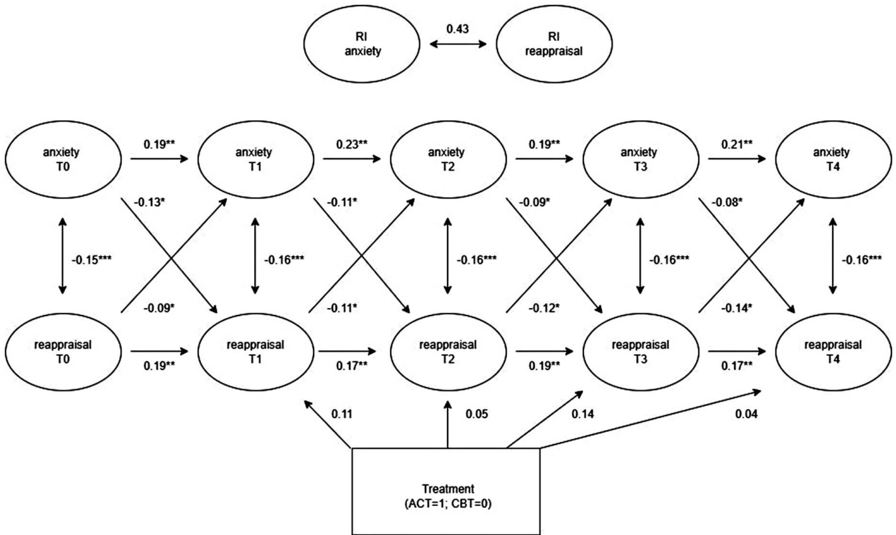
AbstractObjectiveMethodResultsConclusionsTo examine multiple emotion regulation strategies as mediators in ACT compared to CBT for anxiety. It was hypothesized that augmenting acceptance and reducing suppression, distraction, and perseverative thinking would mediate the effect of ACT compared to CBT. Cognitive reappraisal was included as a competitive mediator.Data were collected as part of a randomized controlled trial comparing ACT and CBT in a sample of 314 older adults with anxiety symptomatology. Participants filled in self-report questionnaires assessing anxiety symptom severity (Generalized Anxiety Disorder-2) and the putative mediators a total of five times over the course of treatment. Latent growth curve models, parallel process models, random intercept-cross lagged panel models, and autoregressive latent trajectory models were used to model the hypothesized prospective and mediational relationship.ACT differentially affected acceptance, suppression, and distraction, and changes in all mediators (except acceptance) showed significant cross-sectional associations with outcome. Only cognitive reappraisal predicted subsequent anxiety levels and vice versa, irrespective of treatment. However, none of the emotion regulation variables mediated the effect of ACT.The discrepancy with previous positive findings on emotion regulation as a mediator may be attributed to earlier studies not using a longitudinal design and analysis on the within-person level.
Overview
CoChat Summary
## TL;DR
In a randomized trial of older adults with anxiety symptoms, ACT and CBT produced comparable reductions in anxiety, but none of the tested emotion regulation strategies mediated ACT’s effect relative to CBT. Cognitive reappraisal was the only strategy that prospectively predicted later anxiety, and it did so irrespective of treatment condition.
## Key findings
- The sample included 314 older adults with anxiety symptomatology (CBT n = 164; ACT n = 150), assessed five times over treatment.
- In latent growth models, ACT produced a larger increase in acceptance and larger decreases in distraction and suppression than CBT; there were no significant differences between conditions for anxiety slope, cognitive reappraisal, or perseverative thinking.
- In the parallel process models, the slope of anxiety was significantly associated with changes in cognitive reappraisal (B = -0.69, p < .001), perseverative thinking (B = 0.99, p < .001), distraction (B = 0.65, p < .001), and suppression (B = 0.96, p < .05), but none of these slopes mediated treatment condition’s effect on anxiety.
- In the RI-CLPM, only cognitive reappraisal showed a bidirectional prospective relation with anxiety; all modeled indirect paths were not statistically significant.
- The authors note the study’s previous RCT found no important differences between ACT and CBT on anxiety severity and that both showed significant reductions with sustained effects at one-year follow-up; in this paper, the mediation finding remained null.
## Methods
- Design: Secondary mediation analysis of data from a cluster-randomized, single-blind controlled trial comparing blended ACT with face-to-face CBT.
- Sample/data: Participants were adults aged 55–75 recruited from 38 general practices in the Netherlands; inclusion required mild to moderate anxiety symptoms (GAD-7 5–15). The mediation analysis used baseline, three post-session assessments, and posttreatment data; the 6- and 12-month follow-ups were not used.
- Analysis: The authors used latent growth models, parallel process models, random intercept cross-lagged panel models, and autoregressive latent trajectory models; analyses were intention-to-treat with FIML for missing data and 5,000 bootstrap samples for indirect effects.
## Limitations
- The paper explicitly says five measurement moments may not have been sufficiently fine-grained to capture therapeutic change; the null findings may reflect that assessments were too far apart.
- The study relied entirely on self-report instruments, which the authors say may be imperfect for identifying and remembering mental processes.
- The paper used self-developed one-item measures for most mediators, and the authors say they cannot be certain these items reliably measured the intended constructs or were sufficiently sensitive to change.
- Evident from the text: the analysis was limited to older adults aged 55–75 in primary care, so generalizability to younger samples is uncertain.
Model-written summary. Check it against the paper before relying on it.
Integrity signals
Registry
Cites
Statistics
Figures



Verification
Claims the paper makes
16 Valid · 4 Not valid · 16 Not checked · 56 Own results and interpretations
The sources with a verdict support this claim; the rest weren’t checked yet, have no full text we could read, or their verdicts aren’t rated yet.
In the paper
“More recent studies have demonstrated that Accep tance and Commitment Therapy (ACT) has similar effects as CBT in the treatment of anxiety disorders and symptoms in adults”
What the sources say
- Not matchedcites Arch et al., 2021
An author–year citation the paper’s reference list doesn’t settle. We don’t search these by name.
- Supportedcites Avdagic et al., 2014 matched to “A randomised controlled trial of acceptance and commitment therapy and cognitive-behaviour therapy for generalised anxiety disorder” (2014) source
The Discussion (page unavailable) concludes that ACT was as efficacious as CBT for generalised anxiety disorder and reports similar improvements in anxiety and other outcomes. The paper also describes comparable ACT and CBT improvements in studies of mixed anxiety disorders, supporting the broader wording of the claim. (LLM, conf=0.90)
- Not checked — no full text of the sourcecites Forman et al., 2012 matched to “Using Session-by-Session Measurement to Compare Mechanisms of Action for Acceptance and Commitment Therapy and Cognitive Therapy” (2012) source
boosted- Asserted: passes — The authors put it forward as true.
- Checkable: passes — It can be checked against evidence.
- Load-bearing: passes — The paper’s conclusions depend on it.
- Based: passes — The paper gives a reason why it holds.
- Not matched
Every source the paper cites for this claim was checked and supports it.
In the paper
“No important differences between the two interventions regarding their effects on anxiety severity and associated clinical outcomes were observed.”
What the sources say
- Supportedcites Witlox et al., 2021 matched to “Blended Acceptance and Commitment Therapy Versus Face-to-face Cognitive Behavioral Therapy for Older Adults With Anxiety Symptoms in Primary Care: Pragmatic Single-blind Cluster Randomized Trial.” (2021) source
The Discussion concludes that the trial found no differences between blended ACT and face-to-face CBT in anxiety symptom severity and several related clinical outcomes in a large sample of older adults. It also reports two differences—long-term positive mental health and treatment satisfaction—so the finding should not be read as applying to every outcome. (LLM, conf=0.90)
plain- Asserted: passes — The authors put it forward as true.
- Checkable: passes — It can be checked against evidence.
- Load-bearing: passes — The paper’s conclusions depend on it.
- Based: passes — The paper gives a reason why it holds.
- Supported
Every source the paper cites for this claim was checked and supports it.
In the paper
“A major shortcoming of available studies mentioned in the reviews, however, is that almost no studies included repeated assess ments of outcome and putative mediators in the course of therapy.”
What the sources say
- Supportedcites Macri & Rogge, 2024 matched to “Examining domains of psychological flexibility and inflexibility as treatment mechanisms in acceptance and commitment therapy: A comprehensive systematic and meta-analytic review” (2024) source
In §4.1 (p. 9), the review reports that 48 of 54 studies with pre- to post-treatment outcome data analyzed only those two assessment waves; only a handful used a mid-treatment assessment. Section 4.1 (p. 10) likewise says that although some studies assessed clients repeatedly during therapy, most assessed them only before and after treatment. This supports the citing sentence’s characterization of repeated within-treatment assessments as rare. (LLM, conf=0.90)
plain- Asserted: passes — The authors put it forward as true.
- Checkable: passes — It can be checked against evidence.
- Load-bearing: passes — The paper’s conclusions depend on it.
- Based: passes — The paper gives a reason why it holds.
- Supported
The cited sources support only part of this claim — read each source’s verdict below.
In the paper
“many psychotherapies share some components of change with their theoretical cousins possibly dilut ing mediation effects.”
What the sources say
- Partly supportedcites Stockton et al. (2019) matched to “Identifying the Underlying Mechanisms of Change During Acceptance and Commitment Therapy (ACT): A Systematic Review of Contemporary Mediation Studies” (2019) sourceExperimental — accuracy not yet measured
The Clinical implications section (p. 21) explicitly says that psychotherapies share some components of change with their theoretical cousins. It also describes ACT mechanisms that are not distinct from those in CBT, but does not state that this overlap dilutes mediation effects; that proposed consequence is not supported by the passage. (LLM, conf=0.84)
hedgedstates a possible cause- Asserted: passes — The authors put it forward as true.
- Checkable: passes — It can be checked against evidence.
- Load-bearing: passes — The paper’s conclusions depend on it.
- Based: passes — The paper gives a reason why it holds.
- Partly supported
The cited sources support only part of this claim — read each source’s verdict below.
In the paper
“mediation effects in studies comparing ACT with other active treatments (as in the present study) reported significantly smaller mediation effects than in studies comparing ACT with passive or active control conditions (Macri & Rogge, 2024).”
What the sources say
- Partly supportedcites Macri & Rogge, 2024 matched to “Examining domains of psychological flexibility and inflexibility as treatment mechanisms in acceptance and commitment therapy: A comprehensive systematic and meta-analytic review” (2024) sourceExperimental — accuracy not yet measured
In §3.5 (p. 8), the review reports that comparing ACT with another active treatment significantly weakened the estimated path A effect—ACT’s reduction in psychological inflexibility—relative to studies without a comparison group. It does not report a significant difference between active-treatment and waitlist comparisons, or establish that mediation effects as a whole were significantly smaller across the control conditions named in the claim. (LLM, conf=0.87)
plain- Asserted: passes — The authors put it forward as true.
- Checkable: passes — It can be checked against evidence.
- Load-bearing: passes — The paper’s conclusions depend on it.
- Based: passes — The paper gives a reason why it holds.
- Partly supported
35 more claims
Create a free account to see all 92 claims and to verify the 1 reference still open.
- Probably not a substantial claim. 34
- It may state two separate claims as one. 23
- Borderline: one of the tests for a substantial claim is unclear. 1
- The quote only partly states this claim. 6
Citations
Cites
Hu, L., & Bentler, P. M. (1999) · Structural Equation Modeling A Multidisciplinary Journal · doi:10.1080/10705519909540118 · Cited by 108,788
The PHQ-9: Validity of a brief depression severity measure
Kroenke, K., Spitzer, R. L., & Williams, J. B. W. (2001) · Journal of General Internal Medicine · doi:10.1046/j.1525-1497.2001.016009606.x · Cited by 44,910
A Brief Measure for Assessing Generalized Anxiety Disorder: The GAD-7
Spitzer, R. L., Kroenke, K., Williams, J. B. W., & Löwe, B. (2006) · Archives of Internal Medicine · doi:10.1001/archinte.166.10.1092 · Cited by 31,765
Kessler, R. C., Berglund, P., Demler, O., Jin, R., Merikangas, K. R., & Walters, E. E. (2005) · Archives of General Psychiatry · doi:10.1001/archpsyc.62.6.593 · Cited by 20,391 · cited 1×
“Anxiety disorders and symptoms form the most prevalent class of adult psychological problems (Kessler et al., 2005; Kessler et al., 2012).”
Gross, J. J., & John, O. P. (2003) · Journal of Personality and Social Psychology · doi:10.1037/0022-3514.85.2.348 · Cited by 11,929
Structural Equation Modelling: Guidelines for Determining Model Fit
Hooper, D., Coughlan, J., & Mullen, M. R. (2008) · Dublin Institute of Technology · doi:10.21427/d7cf7r · Cited by 8,746 · cited 2×
“For the RMSEA and SRMR values smaller than 0.08 and 0.05 were considered indicators of respectively acceptable and good model fit (Hooper et al., 2008; Hu & Bentler, 1999).”
InfluentialAnxiety disorders in primary care: prevalence, impairment, comorbidity, and detection
Kroenke, K., Spitzer, R. L., Williams, J. B. W., Monahan, P. O., & Löwe, B. (2007) · Annals of Internal Medicine · doi:10.7326/0003-4819-146-5-200703060-00004 · Cited by 4,741 · cited 4×
“Inclusion criteria were: age between 55 and 75 years, presence of mild to moderate anxiety symptoms (GAD-7 score between 5 and 15 (Spitzer et al., 2006)), mastery of the Dutch language, internet access, and the possibility to spend up to 30 min per day on the intervention.”
InfluentialA critique of the cross-lagged panel model
Hamaker, E. L., Kuiper, R. M., & Grasman, R. P. P. P. (2015) · Psychological Methods · doi:10.1037/a0038889 · Cited by 4,005 · cited 13×
“In RI-CLPM the variance of the observed score is divided into variance due to a between-person stable invariant trait (by adding a random intercept) and variance due to within-person fluctuation.”
InfluentialBond, F. W., Hayes, S. C., Baer, R. A., Carpenter, K. M., Guenole, N., Orcutt, H. K., Waltz, T., & Zettle, R. D. (2011) · Behavior Therapy · doi:10.1016/j.beth.2011.03.007 · Cited by 3,950
Lecrubier, Y., Sheehan, D., Weiller, E., Amorim, P., Bonora, I., Sheehan, K. H., Janavs, J., & Dunbar, G. (1997) · European Psychiatry · doi:10.1016/s0924-9338(97)83296-8 · Cited by 3,513 · cited 1×
“Plus (Lecrubier et al., 2020)); substance use disorder (M.I.N.I.-”
Kessler, R. C., Petukhova, M., Sampson, N. A., Zaslavsky, A. M., & Wittchen, H. (2012) · International Journal of Methods in Psychiatric Research · doi:10.1002/mpr.1359 · Cited by 2,947 · cited 1×
“Anxiety disorders and symptoms form the most prevalent class of adult psychological problems (Kessler et al., 2005; Kessler et al., 2012).”
Validity and reliability of the Experience-Sampling Method
CSIKSZENTMIHALYI, M., & LARSON, R. (1987) · The Journal of Nervous and Mental Disease · doi:10.1097/00005053-198709000-00004 · Cited by 2,544
Mediators and Mechanisms of Change in Psychotherapy Research
Kazdin, A. E. (2007) · Annual Review of Clinical Psychology · doi:10.1146/annurev.clinpsy.3.022806.091432 · Cited by 2,504
Handbook of research methods in personality psychology
(2007) · Choice Reviews Online · doi:10.5860/choice.45-2315 · Cited by 2,373
Handbook of research methods for studying daily life
(2012) · Choice Reviews Online · doi:10.5860/choice.50-1159 · Cited by 2,111
Plummer, F., Manea, L., Trepel, D., & McMillan, D. (2016) · General Hospital Psychiatry · doi:10.1016/j.genhosppsych.2015.11.005 · Cited by 1,882 · cited 1×
“The GAD-2 is a reliable, valid, and sufficiently sensitive and specific instrument (Plummer et al., 2016).”
The Cognitive Emotion Regulation Questionnaire
Garnefski, N., & Kraaij, V. (2007) · European Journal of Psychological Assessment · doi:10.1027/1015-5759.23.3.141 · Cited by 1,039
Self-citationAssessing Psychiatric Impairment in Primary Care with the Sheehan Disability Scale
Leon, A. C., Olfson, M., Portera, L., Farber, L., & Sheehan, D. V. (1997) · The International Journal of Psychiatry in Medicine · doi:10.2190/t8em-c8yh-373n-1uwd · Cited by 987 · cited 1×
“…psychological or psychopharmacological treatment (stable benzo-diazepine or SSRI use excepted) within the last three months; severe role impairment in at least two life areas (score of ≥ 8 on two or three items of the Sheehan Disability Scale (SDS) (Leon et al., 1997); high suicide risk (M.I.N.I.-”
Carpenter, J. K., Andrews, L. A., Witcraft, S. M., Powers, M. B., Smits, J. A. J., & Hofmann, S. G. (2018) · Depression and Anxiety · doi:10.1002/da.22728 · Cited by 846 · cited 1×
“During the last decades, cognitive behavioral therapy (CBT) has become the strongest empirically supported psychological treatment for anxiety (Carpenter et al., 2018; Norton & Price, 2007; Stewart & Chambless, 2009).”
Testing prospective effects in longitudinal research: Comparing seven competing cross-lagged models.
Orth, U., Clark, D. A., Donnellan, M. B., & Robins, R. W. (2021) · Journal of Personality and Social Psychology · doi:10.1037/pspp0000358 · Cited by 801
Kraemer, H. C., Measelle, J. R., Ablow, J. C., Essex, M. J., Boyce, W. T., & Kupfer, D. J. (2003) · American Journal of Psychiatry · doi:10.1176/appi.ajp.160.9.1566 · Cited by 765
Understanding how and why psychotherapy leads to change
Kazdin, A. E. (2009) · Psychotherapy Research · doi:10.1080/10503300802448899 · Cited by 728 · cited 1×
“This precludes the establishment of a timeline that shows that the candidate mediator precedes the outcome, which is a necessary (but not sufficient) condition for mediation (Kazdin, 2007, 2009).”
A Meta-Analytic Review of Adult Cognitive-Behavioral Treatment Outcome Across the Anxiety Disorders
Norton, P. J., & Price, E. C. (2007) · Journal of Nervous & Mental Disease · doi:10.1097/01.nmd.0000253843.70149.9a · Cited by 612 · cited 1×
“During the last decades, cognitive behavioral therapy (CBT) has become the strongest empirically supported psychological treatment for anxiety (Carpenter et al., 2018; Norton & Price, 2007; Stewart & Chambless, 2009).”
Validity and Reliability of the Experience-Sampling Method
Csikszentmihalyi, M., & Larson, R. (2014) · Flow and the Foundations of Positive Psychology · doi:10.1007/978-94-017-9088-8_3 · Cited by 578
(2010) · Redalyc (Universidad Autónoma del Estado de México) · Cited by 542
Stewart, R. E., & Chambless, D. L. (2009) · Journal of Consulting and Clinical Psychology · doi:10.1037/a0016032 · Cited by 483 · cited 1×
“During the last decades, cognitive behavioral therapy (CBT) has become the strongest empirically supported psychological treatment for anxiety (Carpenter et al., 2018; Norton & Price, 2007; Stewart & Chambless, 2009).”
Cognitive Therapy of Anxiety Disorders: Science and Practice
Sudak, D. M. (2010) · Journal of Psychiatric Practice · doi:10.1097/01.pra.0000386918.08053.3d · Cited by 479
Autoregressive Latent Trajectory (ALT) Models A Synthesis of Two Traditions
Bollen, K. A., & Curran, P. J. (2004) · Sociological Methods & Research · doi:10.1177/0049124103260222 · Cited by 447 · cited 1×
“Next, we used Autoregressive Latent Trajectory (ALT) growth modeling (Bollen & Curran, 2004) as a sensitivity analysis to estimate time-specific autoregressive, cross-sectional and cross-lagged effects of emotion regulation strategies on succeeding anxiety levels, while accounting for stable,…”
Arch, J. J., Eifert, G. H., Davies, C., Vilardaga, J. C. P., Rose, R. D., & Craske, M. G. (2012) · Journal of Consulting and Clinical Psychology · doi:10.1037/a0028310 · Cited by 443
A unified framework of longitudinal models to examine reciprocal relations.
Usami, S., Murayama, K., & Hamaker, E. L. (2019) · Psychological Methods · doi:10.1037/met0000210 · Cited by 437 · cited 1×
“By separating within-person variance from between-person variance, RI-CLPM allows for statements regarding within-person processes, which are more likely to reflect causal effects than between-person associations (Hamaker et al., 2015; Usami et al., 2019).”
Mills-Koonce, W. R., Gariépy, J.-L., Propper, C., Sutton, K., Calkins, S., Moore, G., & Cox, M. (2007) · Infant Behavior and Development · doi:10.1016/j.infbeh.2006.11.010 · Cited by 366
Zilcha-Mano, S. (2017) · American Psychologist · doi:10.1037/a0040435 · Cited by 303 · cited 1×
“Only with such studies can we begin to elucidate whether hypothesized mechanisms of change indeed seem to play a causal role or if they are merely correlates of treatment outcomes (Zilcha-Mano, 2017).”
Sudden gains during psychological treatments of anxiety and depression: A meta-analysis
Aderka, I. M., Nickerson, A., Bøe, H. J., & Hofmann, S. G. (2012) · Journal of Consulting and Clinical Psychology · doi:10.1037/a0026455 · Cited by 240 · cited 1×
“…a complex chain of changes: different mechanisms of change (at either the physiological, cognitive, behavioral, or affective level or on multiple levels) occur at different time points and rates during treatment, and certain changes might occur suddenly instead of gradually (Aderka et al., 2012).”
Hayes, S. C., Ciarrochi, J., Hofmann, S. G., Chin, F., & Sahdra, B. (2022) · Behaviour Research and Therapy · doi:10.1016/j.brat.2022.104155 · Cited by 234 · cited 2×
“Hayes et al. (2022) excluded comparisons between active treatments in their large review of mediational findings of randomized trials of psychological interventions for mental health outcomes.”
Stockton, D., Kellett, S., Berrios, R., Sirois, F., Wilkinson, N., & Miles, G. (2019) · Behavioural and Cognitive Psychotherapy · doi:10.1017/s1352465818000553 · Cited by 193
The within-between dispute in cross-lagged panel research and how to move forward.
Hamaker, E. L. (2026) · Psychological Methods · doi:10.1037/met0000600 · Cited by 172 · cited 1×
“Although the cross-lagged panel model (CLPM) was the preferred modelling approach for many years, it has been criticized for its inability to separate within-person dynamics from stable between-person differences (Hamaker, 2012, 2023).”
Smits, J. A. J., Julian, K., Rosenfield, D., & Powers, M. B. (2012) · Journal of Consulting and Clinical Psychology · doi:10.1037/a0028957 · Cited by 162
Kraaij, V., & Garnefski, N. (2019) · Personality and Individual Differences · doi:10.1016/j.paid.2018.07.036 · Cited by 158
Self-citationForman, E. M., Chapman, J. E., Herbert, J. D., Goetter, E. M., Yuen, E. K., & Moitra, E. (2012) · Behavior Therapy · doi:10.1016/j.beth.2011.07.004 · Cited by 151
Johannsen, M., Nissen, E. R., Lundorff, M., & O'Toole, M. S. (2022) · Clinical Psychology Review · doi:10.1016/j.cpr.2022.102156 · Cited by 116
Macri, J. A., & Rogge, R. D. (2024) · Clinical Psychology Review · doi:10.1016/j.cpr.2024.102432 · Cited by 89
Avdagic, E., Morrissey, S. A., & Boschen, M. J. (2014) · Behaviour Change · doi:10.1017/bec.2014.5 · Cited by 74
Acceptance and Commitment Therapy Processes and Mediation: Challenges and How to Address Them
Arch, J. J., Fishbein, J. N., Finkelstein, L. B., & Luoma, J. B. (2023) · Behavior Therapy · doi:10.1016/j.beth.2022.07.005 · Cited by 72
Witlox, M., Garnefski, N., Kraaij, V., de Waal, M. W. M., Smit, F., Bohlmeijer, E., & Spinhoven, P. (2021) · Journal of Medical Internet Research · doi:10.2196/24366 · Cited by 43
Self-citationFalkenström, F. (2024) · Clinical Psychology Review · doi:10.1016/j.cpr.2024.102435 · Cited by 39 · cited 1×
“…the growing number of alternative mediation models with differences in conceptualisation of mediating variables and statistical characteristics (Falkenström, 2024; Orth et al., 2021), we performed sensitivity analyses to examine to what extent the results of the RI-CLPM mediation analyses…”
Mechanisms of the acceptance and commitment therapy: A meta-analytic structural equation model
REN, Z., ZHAO, C., BIAN, C., ZHU, W., JIANG, G., & ZHU, Z. (2019) · Acta Psychologica Sinica · doi:10.3724/sp.j.1041.2019.00662 · Cited by 36
Zilcha-Mano, S., & Webb, C. A. (2021) · Frontiers in Psychiatry · doi:10.3389/fpsyt.2020.609585 · Cited by 25 · cited 1×
“In these alternative models, state-like components reflect within-client processes of change and may point to active ingredients of successful treat-ment, while trait-like components may represent pre-scriptive or prognostic variables of successful treatment (Zilcha-Mano & Webb, 2021).”
Witlox, M., Kraaij, V., Garnefski, N., de Waal, M. W. M., Smit, F., Hoencamp, E., Gussekloo, J., Bohlmeijer, E. T., & Spinhoven, P. (2018) · Trials · doi:10.1186/s13063-018-2731-3 · Cited by 23
Self-citationDoes cognitive behavioral therapy for anxiety disorders improve threat reappraisal?: A meta-analysis
Draheim, A. A., & Anderson, P. L. (2021) · Journal of Behavioral and Cognitive Therapy · doi:10.1016/j.jbct.2020.12.004 · Cited by 18 · cited 1×
“Meta-analyses show that CBT for anxiety disorders leads to improvements in threat cognitive reappraisal (Draheim & Anderson, 2021) and that these improvements are associated with reductions in anxiety symptom severity (Smits et al., 2012).”
Monteregge, S., Tsagkalidou, A., Cuijpers, P., & Spinhoven, P. (2020) · Clinical Psychology: Science and Practice · doi:10.1037/h0101777 · Cited by 17
Self-citationAcceptance and commitment therapy as a treatment for anxiety disorders
Twohig, M. P., Masuda, A., Varra, A. A., & Hayes, S. C. (2007) · Series in Anxiety and Related Disorders · doi:10.1007/0-387-25989-9_4 · Cited by 9
Barbero (2014) · doi:10.1016/j · Cited by 1
Emotion regulation in acceptance and commitment therapy
Blackledge, J. T., & Hayes, S. C. (2001) · Journal of Clinical Psychology · doi:10.1002/1097-4679(200102)57:2<243::aid-jclp9>3.0.co;2-x · cited 1×
“Consistent with study hypotheses based on the theories of change in ACT (Blackledge & Hayes, 2001; Twohig et al., 2005), LGMs showed that the rate of improvement of emotion regulation strategies specifically targeted by ACT (i.e., distraction, suppression, and acceptance) was larger in ACT then in…”
Research works printed but not linked: 5
- Blackledge, J. T., & Hayes, S. C. (2001). Emotion regulation in acceptance and commitment therapy. Journal of Clinical Psychology , 57 (2), 243-255. https://doi.org/10.1002/10974679(200102)57:2 Bohlmeijer, E. T., & Hulsbergen, M. (2008). Voluit leven mindful ness of de kunst van het aanvaarden . Boom. · doi:10.1002/10974679(200102)57:2
- Bohlmeijer, E. T., & Hulsbergen, M. A. (2015). A beginner's guide to mindfulness: Live in the moment . McGraw-Hill.
- Ciarrochi, J., Bilich, L., & Godsel, C. (2010). Psychological flexi bility as a mechanism of change in acceptance and commitment therapy. In R. Baer (Ed.), Assessing mindfulness and acceptance: Illuminating the processes of change (pp. 51-76). New Harbinger. - Clark, D. A., & Beck, A. T. (2010). Cognitive therapy of anxiety dis orders: Science and practice . Guilford Press.
- IBM Corp. (2017). IBM SPSS statistics for windows, version 25.0.
- Muthén, L. K., & Muthén, B. O. (1998-2017). Mplus user's guide. Eighth edition . Muthén & Muthén.
Cited by
Carpallo-González, M., Esteller-Collado, G., González‐Blanch, C., Prieto-Vila, M., Ruiz‐Rodríguez, P., Moriana, J. A., Vindel, A. C., & Muñoz‐Navarro, R. (2026) · Behaviour Research and Therapy · doi:10.1016/j.brat.2026.105045 · Cited by 1
Hartmann, S. F., Borm, I., Barnow, S., Timm, C., & Pruessner, L. (2026) · Behaviour Research and Therapy · doi:10.1016/j.brat.2026.105121
Metadata
- Authors
- Spinhoven, P., Kraaij, V., Garnefski, N., Bohlmeijer, E., & Witlox, M.
- Affiliations
- Leiden University (NL)
- University of Twente (NL)
- Corresponding author
- Spinhoven, Philip
- Venue
- Psychotherapy Research
- Publisher
- Informa UK Limited
- Published
- 2025-09-16
- Volume
- 36
- Issue
- 8
- Pages
- 1568-1580
- ISSN
- 1050-3307 (ISSN-L)
- 1468-4381
- OpenAlex
- W4414299180
- Cited by
- 2
- References
- 49
- Citations by year
- 2026: 2
- FWCI
- 1.65
- Type
- journal article
- Language
- en
- Update notices
- correction (2025-10-09)
- Open access
- hybrid
- doi.org
- Licence
- cc-by
- creativecommons.org/licenses/by/4.0/ (vor)
- doi.org/10.1080/policies-text-data-mining (tdm)
- Locations
- Psychotherapy Research (publishedVersion, cc-by)
- PubMed (publishedVersion)
- Leiden Repository (Leiden University) (submittedVersion, cc-by)
- University of Twente Research Information (submittedVersion, cc-by)
- Funders
- ZonMw (531001205)
- Topics
- Social Sciences › Psychology › Clinical Psychology › Mindfulness and Compassion Interventions
- Social Sciences › Psychology › Experimental and Cognitive Psychology › Anxiety, Depression, Psychometrics, Treatment, Cognitive Processes
- Social Sciences › Psychology › Clinical Psychology › Psychotherapy Techniques and Applications
- Keywords
- emotion regulation strategies, acceptance and commitment therapy, cognitive behavioral therapy, anxiety symptoms, older adults, acceptance, cognitive reappraisal, suppression, distraction, perseverative thinking, mediation, treatment outcomes
- MeSH terms
- Emotional Regulation, Coping Skills, Generalized Anxiety Disorder, Aged, Anxiety Disorders, Female, Humans, Male, Middle Aged, Cognitive Behavioral Therapy, Outcome Assessment, Health Care, Acceptance and Commitment Therapy
About these checks
Registry, retraction, Cites and statistics results are computed, not judged, with one exception: a printed reference that no index lists is read once by a model before it counts as a citation error. Claims are extracted by a model and kept only when their quote appears verbatim in the text; each cited source is then checked, with a model’s help, for whether it says what the claim relies on. Those verdicts can be wrong — read the claim’s quote and the cited source before relying on one.
The claim verdicts this report counts are experimental: their accuracy is not yet measured.
A language model drew the claims from the paper on 2026-10-11, under version 3 of the claim definition (model deepseek-v4.1-flash, prompt extract-v3).
A second model labelled each claim on 2026-10-11 (model jev-1.13-20260917, definition revision gold-guideline-v0.2).
Cited sources are checked with a language model’s help (gpt-6-sol).
Statistics and arithmetic are recomputed, not judged.
Confidence bands are shown only for fields calibrated on our annotated test set. None is calibrated yet, so no band is shown.
What counts as a claim ›How we measure confidence ›How we check this ›
Are you an author, or do you see a problem with this page? Request a review
Data sources
Bibliographic data: Semantic Scholar, OpenAlex, Crossref.
Contains information from the Semantic Scholar Academic Graph Datasets, made available under the ODC Attribution License (ODC-BY 1.0).
Semantic Scholar’s data is described in: Kinney, R., et al. (2023). The Semantic Scholar Open Data Platform. arXiv:2301.10140.
