

Internet-delivered guided self-help acceptance and commitment therapy for family carers of people with dementia (iACT4CARERS): a feasibility study.
Open accessThe DOI matches its Crossref record; 38 of the 41 references it cites were found in a registry or an index; 7 of the 24 sources its claims cite were checked for support.
Abstract
The feasibility of research into internet-delivered guided self-help Acceptance and Commitment Therapy (ACT) for family carers of people with dementia is not known. This study assessed this in an uncontrolled feasibility study. Family carers of people with dementia with mild to moderate anxiety or depression were recruited from primary and secondary healthcare services in the UK. Participants were offered eight, guided, self-help online ACT sessions adapted for the needs of family carers of people with dementia with optional online peer support groups. Pre-defined primary indicators of success included recruitment of 30 eligible carers over 6 months and ≥70% completing at least two online sessions. Thirty-three participants (110% of the target sample) were recruited over 6 months and 30 participants (91%) completed two or more sessions, and thus both indicators of success were met. Further, 70% of participants completed seven or all eight sessions, and 27% of participants were lost to follow-up, but none of the reasons for early withdrawal were related to the intervention. This study supports the feasibility, including recruitment and treatment completion. A full-scale trial to assess the clinical- and cost-effectiveness of the intervention including its long-term effects is warranted.
Overview
CoChat Summary
## TL;DR
This uncontrolled feasibility study found that internet-delivered guided self-help ACT for family carers of people with dementia met its pre-specified feasibility targets: 33 participants were recruited in 6 months and 30 (91%) completed at least two sessions. The intervention also appeared acceptable and workable, but the paper stresses that any clinical benefit signals are preliminary and need testing in a full-scale trial.
## Key findings
- Recruitment target was met: 33 participants were recruited over 6 months, which was 110% of the target of 30.
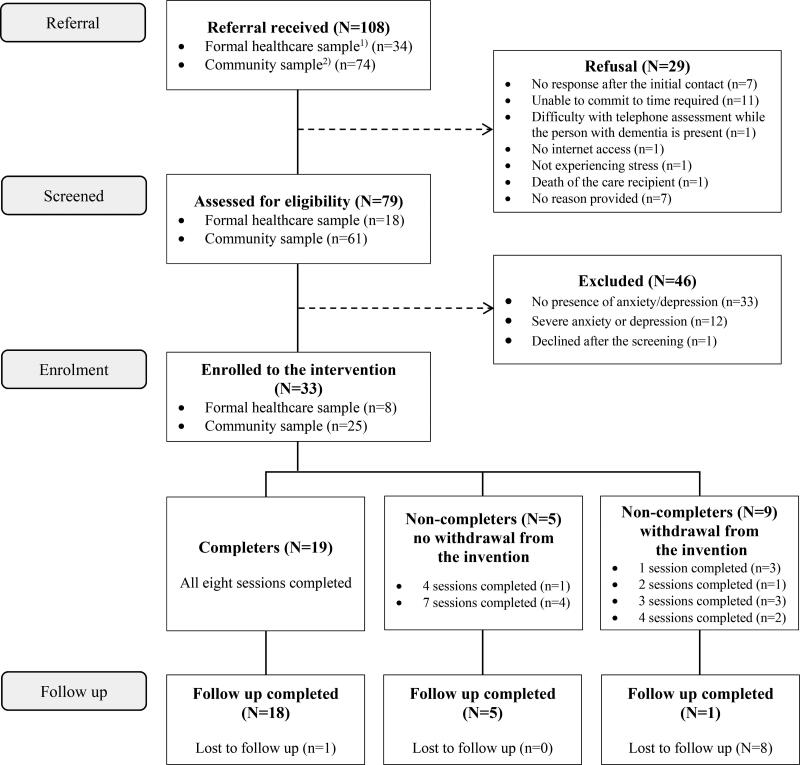
- Engagement target was met: 30 participants (91%) completed at least two online sessions; 29 (70%) completed more than 7 sessions and 19 (58%) completed all 8 sessions.
- Attrition and delivery were feasible: 9 of 33 participants (27%) were lost to follow-up, and 96% of therapist responses were provided within 7 days; on average, therapists took 2.72 days to respond and 20.08 min to write each response.
- Preliminary clinical signals were observed: among those with mild/moderate anxiety at screening, 8 of 20 (40%) showed reliable improvement on GAD-7; among those with mild/moderate depression, 5 of 19 (26%) improved on PHQ-9, while 2 participants showed reliable deterioration on PHQ-9.
## Methods
- Multi-site, single-arm feasibility study in the UK, with recruitment from one primary care service and two secondary care services; conducted remotely during the COVID-19 pandemic.
- Included 33 eligible unpaid carers aged 18+ of relatives with dementia who had mild-to-moderate anxiety or depressive symptoms; 108 were referred and 79 were screened.
- Intervention was eight guided online ACT sessions over 12 weeks, with optional three-session peer support groups; feasibility outcomes were summarized descriptively, and Reliable Change Index plus Cohen’s d were calculated for secondary clinical outcomes.
## Limitations
- The paper states this was a single-arm feasibility study, so clinical improvement findings are preliminary and not conclusive; the authors also note the design may overestimate recruitment and retention in an RCT.
- The paper states there was no follow-up beyond post-intervention, so maintenance of treatment gains is unknown.
- The paper states ethnic diversity was limited because recruitment occurred in an area where the largest source county was more than 90% White British.
- Evident from the text: the intervention fidelity measure was non-validated because a standardised ACT fidelity measure was not possible in this therapist role context.
Model-written summary. Check it against the paper before relying on it.
Integrity signals
Registry
Cites
Statistics
Figures
Verification
Claims the paper makes
6 Valid · 1 Not valid · 17 Not checked · 52 Own results and interpretations
At least one cited source doesn’t support this claim or points to a different paper, and none confirmed it — see the verdicts below.
In the paper
“A meta-analysis focusing solely on internet- or DVD-delivered self-help CBT for family carers of people with dementia demonstrated that an overall effect of CBT on depression appeared reduced in comparison to in-person or telephone CBT (d = 0.27) when a self-help format is used”
§ Internet-delivered guided self-help acceptance and commitment therapy for family carers of people with dementia (iACT4CARERS): a feasibility study > Introduction
What the sources say
- Disputedcites Scott et al., 2016 matched to “Caring for the carer: a systematic review of pure technology-based cognitive behavioral therapy (TB-CBT) interventions for dementia carers” (2016) sourceExperimental — accuracy not yet measured
Our copy reports the pooled figure the claim cites (SMD = -0.27, p = 0.04, 95% CI -0.02 to -0.52, four trials) in the 'Efficacy of interventions' section, but explicitly interprets it as COMPARABLE to, not smaller than, conventional delivery: 'the size of the effect is comparable to that found in meta-analyses of more traditional face-to-face CBT interventions for DCs (e.g. Schulz et al., 2002).' The Discussion repeats that pure self-help CBT delivered via video and the internet 'show[s] efficacy in reducing DC depression to a level comparable to traditional face-to-face CBT', and the Conclusions state 'our analyses indicate TB-CBT may be as equally efficacious as traditional face-to-face CBT interventions in reducing DC depression.' The review also makes no separate comparison against telephone-delivered CBT — indeed the telephone-assisted Steffan (2000) trial is one of the four pooled trials, and removing it leaves SMD = -0.21, p = 0.02 — so the claim's assertion of a reduced effect 'when a self-help format is used' inverts the source's finding. (LLM, conf=0.85)
Checked by a reasoning model — may be wrong.
hedgedstates a cause- Asserted: passes — The authors put it forward as true.
- Checkable: passes — It can be checked against evidence.
- Load-bearing: passes — The paper’s conclusions depend on it.
- Based: passes — The paper gives a reason why it holds.
- Disputed
Every source the paper cites for this claim was checked and supports it.
In the paper
“while no significant overall effect was observed for anxiety”
§ Internet-delivered guided self-help acceptance and commitment therapy for family carers of people with dementia (iACT4CARERS): a feasibility study > Introduction
What the sources say
- Supportedcites Hopkinson et al., 2019 matched to “Cognitive behavioral therapy for depression, anxiety, and stress in caregivers of dementia patients: a systematic review and meta-analysis” (2019) source
The Discussion (p. 22) states that CBT did not significantly reduce anxiety in dementia caregivers relative to comparators. The delivery-method analysis (p. 18) says there were too few telephone studies to estimate telephone CBT’s effect separately; the claim concerns the overall effect, not a separate telephone effect. (LLM, conf=0.93)
plain- Asserted: passes — The authors put it forward as true.
- Checkable: passes — It can be checked against evidence.
- Load-bearing: passes — The paper’s conclusions depend on it.
- Based: passes — The paper gives a reason why it holds.
- Supported
Every source the paper cites for this claim was checked and supports it.
In the paper
“A recent meta-analysis of in-person or telephone CBT for family carers of people with dementia delivered by trained professionals demonstrated a small overall effect of CBT on depression (d = 0.34)”
§ Internet-delivered guided self-help acceptance and commitment therapy for family carers of people with dementia (iACT4CARERS): a feasibility study > Introduction
What the sources say
- Supportedcites Hopkinson et al., 2019 matched to “Cognitive behavioral therapy for depression, anxiety, and stress in caregivers of dementia patients: a systematic review and meta-analysis” (2019) source
The post-intervention results (p. 17) report a small reduction in depression among dementia caregivers receiving CBT versus comparators (SMD = −0.34). The delivery analysis (p. 18) shows that the overall analysis included in-person and telephone-based interventions, although it could not estimate the effect of telephone CBT separately; the Introduction (p. 6) describes CBT as conducted by a trained therapist. (LLM, conf=0.92)
boostedstates a cause- Asserted: passes — The authors put it forward as true.
- Checkable: passes — It can be checked against evidence.
- Load-bearing: passes — The paper’s conclusions depend on it.
- Based: passes — The paper gives a reason why it holds.
- Supported
Every source the paper cites for this claim was checked and supports it.
In the paper
“There is also emerging evidence that in-person ACT can improve late-life treatment-resistant generalised anxiety disorder”
§ Internet-delivered guided self-help acceptance and commitment therapy for family carers of people with dementia (iACT4CARERS): a feasibility study > Discussion
What the sources say
- Supportedcites Gould et al., 2021 matched to “Acceptance and commitment therapy for late-life treatment-resistant generalised anxiety disorder: a feasibility study.” (2021) source
The Methods (Intervention) state that ACT sessions were delivered in person to older people with treatment-resistant GAD. The Conclusions report preliminary evidence of improvements in anxiety, matching the claim’s cautious wording; the study did not establish clinical effectiveness. (LLM, conf=0.91)
hedgedstates a cause- Asserted: passes — The authors put it forward as true.
- Checkable: passes — It can be checked against evidence.
- Load-bearing: passes — The paper’s conclusions depend on it.
- Based: passes — The paper gives a reason why it holds.
- Supported
A result the paper reports from its own data — it cites no other source for it, so there is none to check. The quote shows it is in the paper.
In the paper
“The average number of sessions completed during the 12-week intervention phase was 6.24 (SD = 2.55).”
§ Internet-delivered guided self-help acceptance and commitment therapy for family carers of people with dementia (iACT4CARERS): a feasibility study > Results > Secondary outcomes
plainn = 33- Asserted: passes — The authors put it forward as true.
- Checkable: passes — It can be checked against evidence.
- Load-bearing: unclear — It is unclear whether the paper’s conclusions depend on it.
- Based: passes — The paper gives a reason why it holds.
37 more claims
Create a free account to see all 76 claims and to verify the 2 references still open.
- Probably not a substantial claim. 16
- It may state two separate claims as one. 25
Claims other papers make about this one
Each is checked against this paper’s own text: does it say what the citing paper says it does?
The source backs part of the claim, not all of it — or backs it for a different population, condition or comparison.
In the citing paper
“There was preliminary evidence of improvements in anxiety, depression and psychological flexibility.”
From The clinical and cost effectiveness of internet-delivered self-help Acceptance and Commitment Therapy for family carers of people with dementia (iACT4CARERS): Study protocol for a randomised controlled trial with ethnically diverse family carers (2024) · cites this paper as [13]
Experimental — accuracy not yet measuredThe source backs part of the claim, not all of it — or backs it for a different population, condition or comparison.
In the citing paper
“This was particularly so for anxiety, which demonstrated an average reduction of 26 % on the General Anxiety Disorder-7 (a reduction of 20 % on this scale is considered to be a minimum clinically important difference [16]).”
From The clinical and cost effectiveness of internet-delivered self-help Acceptance and Commitment Therapy for family carers of people with dementia (iACT4CARERS): Study protocol for a randomised controlled trial with ethnically diverse family carers (2024) · cites this paper as [13]
Experimental — accuracy not yet measuredThe source backs part of the claim, not all of it — or backs it for a different population, condition or comparison.
In the citing paper
“iACT4CARERS is a low-risk intervention. No specific risks or adverse events were reported during feasibility testing of the interven tion [13].”
From The clinical and cost effectiveness of internet-delivered self-help Acceptance and Commitment Therapy for family carers of people with dementia (iACT4CARERS): Study protocol for a randomised controlled trial with ethnically diverse family carers (2024) · cites this paper as [13]
Experimental — accuracy not yet measuredThe source backs part of the claim, not all of it — or backs it for a different population, condition or comparison.
In the citing paper
“Participants in our feasibility study of iACT4CARERS had an average reduction of 26 % on GAD7 [13].”
From The clinical and cost effectiveness of internet-delivered self-help Acceptance and Commitment Therapy for family carers of people with dementia (iACT4CARERS): Study protocol for a randomised controlled trial with ethnically diverse family carers (2024) · cites this paper as [13]
Experimental — accuracy not yet measuredThe cited source says what the claim attributes to it.
In the citing paper
“Based on the current evidence, we conducted feasibility and acceptability studies of internet-delivered self-help ACT for family carers of people with dementia (iACT4CARERS) [13 -15] in which pre-defined criteria for progression from the feasibility study to a full-scale RCT were successfully met.”
3 more claims about this paper
Create a free account to see every claim other papers make about this one.
Self-check
Percentages, sums and reported differences re-computed from the paper’s own numbers.
Rated major: it would touch a result — a value a result rests on, reported and recomputed p-values on opposite sides of the significance level, two passages that conflict with no sign which is right, or a cited work retracted before this paper was published.
In the paper
“Of the 33 participants, 29 participants (70%) completed more than 7 sessions and 19 (58%) completed all 8 sessions.”
§ Internet-delivered guided self-help acceptance and commitment therapy for family carers of people with dementia (iACT4CARERS): a feasibility study > Results > Secondary outcomes
Reported 70 · recomputed 87.878788
Citations
Cites
The PHQ-9: Validity of a brief depression severity measure
Kroenke, K., Spitzer, R. L., & Williams, J. B. W. (2001) · Journal of General Internal Medicine · doi:10.1046/j.1525-1497.2001.016009606.x · Cited by 44,910
A Brief Measure for Assessing Generalized Anxiety Disorder: The GAD-7
Spitzer, R. L., Kroenke, K., Williams, J. B. W., & Löwe, B. (2006) · Archives of Internal Medicine · doi:10.1001/archinte.166.10.1092 · Cited by 31,765
Jacobson, N. S., & Truax, P. (1991) · Journal of Consulting and Clinical Psychology · doi:10.1037/0022-006x.59.1.12 · Cited by 7,770 · cited 1×
“RCIs were thus calculated for each participant by dividing the difference of the scores before and after the intervention by the standard error of measurement (Jacobson & Truax, 1991); RCI values greater than ± 1.96 indicate reliable improvement or reliable deterioration.”
MethodInfluentialBond, F. W., Hayes, S. C., Baer, R. A., Carpenter, K. M., Guenole, N., Orcutt, H. K., Waltz, T., & Zettle, R. D. (2011) · Behavior Therapy · doi:10.1016/j.beth.2011.03.007 · Cited by 3,950 · cited 2×
“The secondary clinical outcome measures were: Generalised Anxiety Disorder Scale (GAD7; Spitzer et al., 2006), Patient Health Questionnaire (PHQ9; Kroenke et al., 2001), Revised Centre for Epidemiologic Studies Depression Scale (CESD-R; Eaton et al., 2004), Acceptance and Action Questionnaire-II (AAQ-II; Bond et al.,…”
A tutorial on pilot studies: the what, why and how
Thabane, L., Ma, J., Chu, R., Cheng, J., Ismaila, A., Rios, L. P., Robson, R., Thabane, M., Giangregorio, L., & Goldsmith, C. H. (2010) · BMC Medical Research Methodology · doi:10.1186/1471-2288-10-1 · Cited by 3,384
Sample size of 12 per group rule of thumb for a pilot study
Julious, S. A. (2005) · Pharmaceutical Statistics · doi:10.1002/pst.185 · Cited by 3,068 · cited 1×
“A sample size of 30 is consistent with recommendations for sample sizes of 24–35 participants for pilot and feasibility studies when estimating the standard deviation for a continuous outcome (Julious, 2005; Teare et al., 2014; Whitehead et al., 2016).”
MethodDesign and analysis of pilot studies: recommendations for good practice
Lancaster, G. A., Dodd, S., & Williamson, P. R. (2004) · Journal of Evaluation in Clinical Practice · doi:10.1111/j..2002.384.doc.x · Cited by 2,572 · cited 1×
“The aim of a feasibility study is not to assess the efficacy of the intervention and thus no formal analysis was conducted, as recommended for pilot or feasibility studies (Lancaster et al., 2004; Thabane et al., 2010).”
BackgroundWhitehead, A. L., Julious, S. A., Cooper, C. L., & Campbell, M. J. (2016) · Statistical Methods in Medical Research · doi:10.1177/0962280215588241 · Cited by 1,936
How to Select, Calculate, and Interpret Effect Sizes
Durlak, J. A. (2009) · Journal of Pediatric Psychology · doi:10.1093/jpepsy/jsp004 · Cited by 1,446 · cited 1×
“These were calculated by subtracting the pre-group mean from the post-group mean and divided by the SD at pre (Durlak, 2009).”
MethodAssessment of behavioral problems in dementia: The Revised Memory and Behavior Problems Checklist.
Teri, L. L., Truax, P. A., Logsdon, R. G., Uomoto, J. M., & VITALIANO, P. P. (1992) · Psychology and Aging · doi:10.1037//0882-7974.7.4.622 · Cited by 1,125 · cited 1×
“The frequency of problematic behaviours subscale of the Revised Memory and Behavior Problems Checklist (RMBPC; Teri et al., 1992) was also used at the screening to characterise the care recipient.”
Method
Research works printed but not linked: 2
- Eaton, W. W., Smith, C., Ybarra, M., Muntaner, C., & Tien, A. (2004). Center for Epidemiologic Studies Depression Scale: Review and Revision (CESD and CESD-R). In M. E. Maruish & M. E. Maruish (Eds.), The use of psychological testing for treatment planning and outcomes assessment: Instruments for adults (3rd ed., Vol. 3, pp. 363– 377). Lawrence Erlbaum Associates Publishers.
- National Institute for Health and Care Excellence. (2011). Common mental health problems: Identification and pathways to care [NICE Clinical guideline No. 123]. https://www.nice.org.uk/guidance/cg123. 31877005
Cited by
Han, A., Yuen, H. K., & Jenkins, J. (2023) · Journal of Health Psychology · doi:10.1177/13591053221141131 · Cited by 30
“These studies found promising results, including decreased depressive symptoms, anxiety, stress, and caregiving burden after participants completed ACT sessions, and evidence to support the feasibility and acceptability of ACT sessions delivered by methods other than inperson sessions (i.e. phone-based therapy, selfgu…”
BackgroundAtefi, G. L., de Vugt, M. E., van Knippenberg, R. J. M., Levin, M. E., Verhey, F. R. J., & Bartels, S. L. (2023) · Clinical Psychology Review · doi:10.1016/j.cpr.2023.102341 · Cited by 33
Contreras, M., Van Hout, E., Farquhar, M., McCracken, L. M., Gould, R. L., Hornberger, M., Richmond, E., & Kishita, N. (2022) · International Journal of Qualitative Studies on Health and Well-being · doi:10.1080/17482631.2022.2066255 · Cited by 24
Self-citationKishita, N., Morimoto, H., Márquez-González, M., Barrera-Caballero, S., Vara-García, C., Van Hout, E., Contreras, M., & Losada-Baltar, A. (2023) · Journal of Geriatric Psychiatry and Neurology · doi:10.1177/08919887221130269 · Cited by 17
“Defusion and acceptance are the core techniques used in ACT, and studies investigating the effectiveness or feasibility of ACT for family carers of people with dementia are rapidly increasing in recent years, including studies that delivered ACT face-to-face,(36-40) via telephone,(41) and online.(20,42,43) Furthermore…”
MethodSelf-citationAtefi, G. L., van Knippenberg, R. J. M., Bartels, S. L., Losada-Baltar, A., Márquez-González, M., Verhey, F. R. J., & de Vugt, M. E. (2024) · JMIR Aging · doi:10.2196/53489 · Cited by 15
“Furthermore, non-RCT ACT studies have also shown promise in supporting family caregivers of people with dementia through modalities such as telephones [17], videoconferencing [18], group settings [19], or web-based self-help modules [20,21].”
BackgroundSelf-citationBrown, M., Lord, E., & John, A. M. (2023) · JMIR Formative Research · doi:10.2196/39913 · Cited by 15
“Earlier systematic reviews and meta-analyses have found web-delivered ACT to be effective for the management of depression and anxiety [41], and others [42-46] report its effectiveness in both group and individual settings.”
BackgroundHan, A., Oster, R. A., Yuen, H. K., Jenkins, J., Hawkins, J., & Edwards, L. (2025) · JMIR Formative Research · doi:10.2196/67545 · Cited by 18
“These studies were conducted in Spain [14-17], the United States [18-21], the United Kingdom [22], Germany [23], and the Netherlands [24].”
Contreras, M., Van Hout, E., Farquhar, M., Gould, R. L., McCracken, L. M., Hornberger, M., Richmond, E., & Kishita, N. (2021) · The Cognitive Behaviour Therapist · doi:10.1017/s1754470x21000337 · Cited by 9
“A full description of each session is documented in detail in the main feasibility study paper, which reports all the quantitative feasibility and acceptability findings, means and SD values of outcome measures, and treatment fidelity results (Kishita et al., 2021).”
BackgroundMethodInfluentialSelf-citationAtefi, G., van Knippenberg, R. J. M., Bartels, S. L., Losada‐Baltar, A., Márquez‐González, M., Verhey, F. R. J., & de Vugt, M. E. (2025) · Cognitive Behaviour Therapy · doi:10.1080/16506073.2025.2477600 · Cited by 13
“Our findings build on previous work that established the feasibility of guided self-help ACT for dementia caregivers (Kishita et al., 2022, 2024).”
Self-citationLosada‐Baltar, A., Kishita, N., Jiménez‐Gonzalo, L., Fernándes-Pires, J., Huertas‐Domingo, C., Contreras, M., Hout, E. V., Olazarán, J., Martínez‐Huertas, J. Á., & Márquez‐González, M. (2022) · Aging & Mental Health · doi:10.1080/13607863.2022.2116407 · Cited by 8
Self-citationVan Hout, E., Contreras, M. L., Mioshi, E., & Kishita, N. (2023) · Journal of Applied Gerontology · doi:10.1177/07334648231156858 · Cited by 7
“Recent studies found that acceptance and commitment therapy is effective for improving mental health problems among family carers of people with dementia (Fauth et al., 2022; Kishita et al., 2022).”
BackgroundMethodSelf-citationGarcía‐Batalloso, I., Cabrera, I., Losada‐Baltar, A., Mérida-Herrera, L., Olazarán, J., & Márquez‐González, M. (2023) · Clinical Gerontologist · doi:10.1080/07317115.2023.2217162 · Cited by 8
Self-citationScheibl, F., Boots, L. M. M., Eley, R., Fox, C., Gracey, F., Dening, K. H., Oyebode, J. R., Penhale, B., Poland, F. M., Ridel, G., et al. (2024) · JMIR Formative Research · doi:10.2196/52389 · Cited by 8
“Web-based interventions require modest investment, can be accessed at a time chosen by the participant [12], may appeal to caregivers who prefer to access services at home, and avoid costs associated with traveling [6].”
BackgroundDurepos, P., MacLean, R., Ricketts, N., Boamah, S. A., Witherspoon, R., Gould, O., Olthuis, J. V., Totton, K., Tucker, K., Boulay, I., et al. (2024) · Aging & Mental Health · doi:10.1080/13607863.2023.2288864 · Cited by 4
“Low levels of engagement, indicated by a retention rate of less than 70% and/or an adherence rate of less than 70% were reported for two programs: ACT for Caregivers and iACT4CAR-ERS programs (Cragun, 2020; Fauth et al., 2022; Contreras et al., 2021, 2022; Kishita et al., 2021).”
BackgroundMethodInfluentialVan Hout, E., Contreras, M., Mioshi, E., & Kishita, N. (2024) · Journal of Behavioral and Cognitive Therapy · doi:10.1016/j.jbct.2023.12.001 · Cited by 4
Self-citationKishita, N., Czyznikowska, B., Riggey, M., Hout, E. V., Richmond, E. K., Gould, R. L., McCracken, L. M., & Farquhar, M. C. (2024) · The Cognitive Behaviour Therapist · doi:10.1017/s1754470x24000102 · Cited by 6
“In the current study, 56% of carers completed seven or all eight online sessions, while this completion rate was 70% in the previous study of iACT4CARERS (Kishita, Gould et al., 2022).”
BackgroundMethodResultInfluentialSelf-citationRawlinson, C. V., Gould, R. L., McDermott, C. J., Thompson, B. T., Weeks, K., Gossage-Worrall, R., Serfaty, M. A., Graham, C. D., McCracken, L. M., White, D. A., et al. (2024) · The Cognitive Behaviour Therapist · doi:10.1017/s1754470x24000333 · Cited by 5
“ACT offers promise as a psychological intervention suitable for caregivers of plwMND, in addition to plwMND, given that it has been found to be acceptable and feasible in caregivers of people living with dementia (Kishita et al ., 2022).”
Self-citationKishita, N., Gould, R. L., McCracken, L. M., Khondoker, M., Turner, D. A., Ashford, P.-A., Flanagan, E., Czyznikowska, B., Richmond, E., Riggey, M., et al. (2024) · Contemporary Clinical Trials · doi:10.1016/j.cct.2024.107685 · Cited by 3
“In the feasibility study, more than 100 carers were referred across three research sites over six months and 33 eligible carers were recruited, with ≥ 70 % completing seven or all eight online sessions [13].”
InfluentialSelf-citationGul, M., Kanwal, A., & Chaudhry, H. A. (2024) · The Journal of Adult Protection · doi:10.1108/jap-12-2023-0038 · Cited by 1
Ferreira, M. G., Caetano Vieira de Faria, R., Kishita, N., & Caramelli, P. (2026) · Clinical Gerontologist · doi:10.1080/07317115.2026.2615707 · Cited by 2
“The purpose of this study was to adapt an ACT group intervention (Kishita et al., 2021), for Brazilian family caregivers of people with dementia and to investigate its efficacy.”
InfluentialSelf-citationRecruitment, retention, and adherence of family caregivers: Lessons from a multisite trial
Díaz, L. J. R., Guedes, É. D. S., & da Cruz, D. D. A. L. M. (2023) · Investigación y Educación en Enfermería · doi:10.17533/udea.iee.v41n2e04 · Cited by 1
Technology that Supports Extending Dementia-Friendly Community-Based Care: A Scoping Review
Chen, L.-M., Lee, Y., Nguyen, D. D., & Choi, S. D. (2025) · Current Geriatrics Reports · doi:10.1007/s13670-025-00446-x · Cited by 3
“Most studies were conducted in high-income countries [22, 24, 26, 39], especially the United States and the Netherlands.”
InfluentialZhou, X., Zou, N., Shi, C., Chen, S., & Shi, J. (2026) · Aging & Mental Health · doi:10.1080/13607863.2025.2573071 · Cited by 1
“A total of five studies (two RCTs and three quasi-experimental studies) assessed the effect of ACT on the cognitive fusion of informal caregivers of PwD using the Cognitive Fusion Questionnaire (CFQ) (Fauth et al., 2022; Han et al., 2025; Han et al., 2023; Han et al., 2022; Kishita et al., 2022).”
InfluentialLafuente, I. C., Gallego‐Alberto, L., García‐Batalloso, I., Mérida-Herrera, L., Bermejo-Gómez, I., Losada‐Baltar, A., Zayas, V., & Márquez‐González, M. (2026) · Aging & Mental Health · doi:10.1080/13607863.2026.2634135 · Cited by 1
“Therapeutic techniques for helping caregivers to accept the complex, but at the same time normal, emotions and thoughts regarding the caregiving process might be particularly beneficial for dementia family caregivers (eg Kishita et al., 2022).”
Self-citationKishita, N., Gould, R. L., Khondoker, M. R., McCracken, L. M., Riggey, M., Trucco, A. P., Howe, D., Couchman, A., Flanagan, E. C., Vishwakarma, R. K., et al. (2026) · The Lancet Regional Health - Europe · doi:10.1016/j.lanepe.2026.101766 · Cited by 4
“…more than 30 participants across three sites in six months, with over 70% completing at least seven out of eight online sessions, and showed preliminary improvements in anxiety and depressive symptoms, as well as in psychological flexibility, 13 the hypothesised mechanism of change in ACT.”
Self-citationKelly, L., Togher, K., Connolly, R., Killeen, B., Richardson, I., & Moss, H. (2023) · Approaches An Interdisciplinary Journal of Music Therapy · doi:10.56883/aijmt.2024.44
Fakolade, A. O., Cardwell, K. L., Chow, E., Ross‐White, A., & Pilutti, L. A. (2025) · Digital Health · doi:10.1177/20552076251365141 · Cited by 1
Axenova, K., Malkin, A., & Thomson, K. M. (2026) · Journal of Organizational Behavior Management · doi:10.1080/01608061.2025.2609552
Couchman, A., Katangwe‐Chigamba, T., Howe, D., Flanagan, E. C., Farquhar, M. C., Gould, R. L., McCracken, L. M., Clegg, I., Anyiam-Osigwe, A., Ashford, P., et al. (2026) · Aging & Mental Health · doi:10.1080/13607863.2026.2698708
Self-citationBucher, M. A., LeMaire, K. L., Felicicchia, R. J., Maloney, M., Vozka, V., Foti, D., Wheeler, A., & Kelleher, B. (2026) · Translational Behavioral Medicine · doi:10.1093/tbm/ibag058 · Cited by 1
Metadata
- Authors
- Kishita, N., Gould, R. L., Farquhar, M., Contreras, M., Van Hout, E., Losada, A., Cabrera, I., Hornberger, M., Richmond, E., & McCracken, L. M.
- Affiliations
- University of East Anglia (GB)
- University College London (GB)
- School of Health Sciences, University of East Anglia, Norwich, UK
- Department of Psychology, Universidad Rey Juan Carlos, Madrid, Spain
- Universidad Autónoma de Madrid (ES)
- Norfolk and Suffolk NHS Foundation Trust (GB)
- Uppsala University (SE)
- Corresponding author
- Kishita, Naoko
- ORCID
- Venue
- Aging & Mental Health
- Publisher
- Informa UK Limited
- Published
- 2021-10-07
- Volume
- 26
- Issue
- 10
- Pages
- 1933-1941
- ISSN
- 1360-7863 (ISSN-L)
- 1364-6915
- PMC
- PMC9629048
- OpenAlex
- W3201644229
- Semantic Scholar
- f186926544373377101d565044b235614b82eff3
- Cited by
- 30
- References
- 41
- Citations by year
- 2026: 6 · 2025: 5 · 2024: 7 · 2023: 8 · 2022: 3 · 2021: 1
- FWCI
- 4.22
- Type
- journal article
- Language
- en
- Open access
- hybrid
- doi.org
- Licence
- Locations
- Aging & Mental Health (publishedVersion, cc-by-nc-nd)
- PubMed Central (publishedVersion, cc-by)
- PubMed (publishedVersion)
- ePrints Soton (University of Southampton) (acceptedVersion)
- Edinburgh Research Explorer (University of Edinburgh) (submittedVersion, cc-by)
- UEA Digital Repository (University of East Anglia) (submittedVersion)
- KTH Publication Database DiVA (KTH Royal Institute of Technology) (submittedVersion, other-oa)
- UCL Discovery (University College London) (submittedVersion)
- Hispana (submittedVersion)
- Biblos-e Archivo (Universidad Autónoma de Madrid) (submittedVersion, cc-by-nc-nd)
- Funders
- National Institute for Health Research (PB-PG-0418-20001)
- Topics
- Social Sciences › Psychology › Applied Psychology › Digital Mental Health Interventions
- Social Sciences › Psychology › Clinical Psychology › Mindfulness and Compassion Interventions
- Health Sciences › Medicine › Psychiatry and Mental health › Dementia and Cognitive Impairment Research
- Keywords
- acceptance and commitment therapy, online intervention, guided self-help, family caregivers, dementia, caregiver anxiety, caregiver depression, online peer support groups, feasibility, recruitment (clinical trials), treatment completion
- MeSH terms
- Dementia, Feasibility Studies, Humans, Quality of Life, Caregivers, Internet, Acceptance and Commitment Therapy
About these checks
Registry, retraction, Cites and statistics results are computed, not judged, with one exception: a printed reference that no index lists is read once by a model before it counts as a citation error. Claims are extracted by a model and kept only when their quote appears verbatim in the text; each cited source is then checked, with a model’s help, for whether it says what the claim relies on. Those verdicts can be wrong — read the claim’s quote and the cited source before relying on one.
The claim verdicts this report counts are experimental: their accuracy is not yet measured.
A language model drew the claims from the paper on 2026-10-11, under version 3 of the claim definition (model deepseek-v4.1-flash, prompt extract-v3).
A second model labelled each claim on 2026-10-11 (model jev-1.13-20260917, definition revision gold-guideline-v0.2).
Cited sources are checked with a language model’s help (qwen3.8-omni-flash and gpt-6-sol).
Statistics and arithmetic are recomputed, not judged.
Confidence bands are shown only for fields calibrated on our annotated test set. None is calibrated yet, so no band is shown.
What counts as a claim ›How we measure confidence ›How we check this ›
Are you an author, or do you see a problem with this page? Request a review
Data sources
Bibliographic data: Semantic Scholar, OpenAlex, Crossref.
Contains information from the Semantic Scholar Academic Graph Datasets, made available under the ODC Attribution License (ODC-BY 1.0).
Semantic Scholar’s data is described in: Kinney, R., et al. (2023). The Semantic Scholar Open Data Platform. arXiv:2301.10140.
