

Decentering technology in discourse on discrimination
The DOI matches its Crossref record; 9 of the 9 references it cites were found in a registry or an index.
Abstract
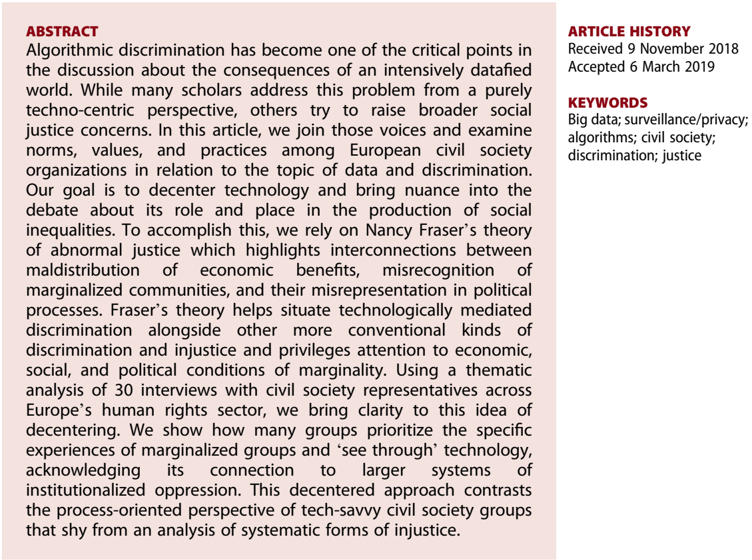
Algorithmic discrimination has become one of the critical points in the discussion about the consequences of an intensively datafied world. While many scholars address this problem from a purely techno-centric perspective, others try to raise broader social justice concerns. In this article, we join those voices and examine norms, values, and practices among European civil society organizations in relation to the topic of data and discrimination. Our goal is to decenter technology and bring nuance into the debate about its role and place in the production of social inequalities. To accomplish this, we rely on Nancy Fraser’s theory of abnormal justice which highlights interconnections between maldistribution of economic benefits, misrecognition of marginalized communities, and their misrepresentation in political processes. Fraser’s theory helps situate technologically mediated discrimination alongside other more conventional kinds of discrimination and injustice and privileges attention to economic, social, and political conditions of marginality. Using a thematic analysis of 30 interviews with civil society representatives across Europe’s human rights sector, we bring clarity to this idea of decentering. We show how many groups prioritize the specific experiences of marginalized groups and ‘see through’ technology, acknowledging its connection to larger systems of institutionalized oppression. This decentered approach contrasts the process-oriented perspective of tech-savvy civil society groups that shy from an analysis of systematic forms of injustice.
Overview
The claims and statistics of this paper haven’t been checked yet.
Free: it reads the open-access text and checks the first 5 claims that cite a source we can check. Create a free account to check every claim.
Integrity signals
Registry
Cites
Statistics
Figures



Verification
Claims the paper makes
The claims and statistics of this paper haven’t been checked yet.
Free: it reads the open-access text and checks the first 5 claims that cite a source we can check. Create a free account to check every claim.
Claims other papers make about this one
Each is checked against this paper’s own text: does it say what the citing paper says it does?
In the citing paper
“Indeed, Seeta Peña Gangadharan and Jędrzej Niklas (2019: 885) rightly state that "algorithmic discrimination and exclusionary automated systems represent one element of a larger ecosystem of discriminatory practices and procedures, and any diagnosis of problems or prescription for remedies would benefit from some measure of reflexivity in relation to this ecosystem."”
From Staring Back at the Surveillance Gaze: The Resistance of LGBTQ+ Users on Social Media (2026) · cites this paper as Gangadharan and Niklas 2019
Self-check
Percentages, sums and reported differences re-computed from the paper’s own numbers.
The self-check needs the paper’s full text.
Citations
Cites
Mapping the Margins: Intersectionality, Identity Politics, and Violence against Women of Color
Crenshaw, K. (1991) · Stanford Law Review · doi:10.2307/1229039 · Cited by 32,792
Thematic networks: an analytic tool for qualitative research
Attride-Stirling, J. (2001) · Qualitative Research · doi:10.1177/146879410100100307 · Cited by 5,506 · cited 2×
“Adopting an iterative strategy (Boyatzis, 2009), we developed a coding frame that allowed us to identify thematic networks (Attride-Stirling, 2001) including those linked to maldistribution, misrecognition, and misrepresentation, as well as those that elucidate what discrimination entails, who is affected, how it migh…”
MethodAlgorithms of Oppression: How Search Engines Reinforce Racism
Noble, S. U. (2020) · doi:10.2307/j.ctt1pwt9w5 · Cited by 2,709
Privacy-preserving data mining
Agrawal, R., & Srikant, R. (2000) · Proceedings of the 2000 ACM SIGMOD international conference on Management of data · doi:10.1145/342009.335438 · Cited by 1,719
Friedman, B., & Nissenbaum, H. (1996) · ACM Transactions on Information Systems · doi:10.1145/230538.230561 · Cited by 1,203
What is data justice? The case for connecting digital rights and freedoms globally
Taylor, L. (2017) · Big Data & Society · doi:10.1177/2053951717736335 · Cited by 802 · cited 3×
“tice, scholars appeal to frameworks for wellbeing, to post-structural influenced theories of justice, and to constructivist understandings of technology (as always value-laden) (Dencik, Hintz, & Cable, 2016; Heeks & Renken, 2016; Johnson, 2014; Taylor, 2017).”
BackgroundDiscrimination-aware data mining
Pedreshi, D., Ruggieri, S., & Turini, F. (2008) · Proceedings of the 14th ACM SIGKDD international conference on Knowledge discovery and data mining · doi:10.1145/1401890.1401959 · Cited by 676
Fairness in Machine Learning: Lessons from Political Philosophy
Binns, R. (2017) · arXiv · doi:10.48550/arxiv.1712.03586 · Cited by 676 · cited 3×
“Moreover, the literature tends to neglect important entrenched debates within political philosophy about the extent to which ‘ all instances of disparity are objectionable ’ (Binns, 2018, p. 2).”
BackgroundBerendt, B., & Preibusch, S. (2014) · Artificial Intelligence and Law · doi:10.1007/s10506-013-9152-0 · Cited by 44 · cited 1×
“…systems whose automated decisions lead to prejudice, unfair treatment, and negative and unlawful discrimination, computer scientists and engineers conceptualized and modeled ways to identify and avoid the risk of negative discrimination in automated decision systems (Berendt & Preibusch, 2014).”
Background
Research works printed but not linked: 37
- Note that Fraser's theorization evokes earlier work by Young, who paid close attention to issues of representation and closely considered 'how' in political decision making (Young, 1990, 1997, 2000).
- Barocas, S. (2015). Data mining and the discourse on discrimination. In Proceedings of the data ethics workshop. New York. Retrieved from https://dataethics.github.io/proceedings/ DataMiningandtheDiscourseOnDiscrimination.pdf
- Boyatzis, R. E. (2009). Transforming qualitative information: Thematic analysis and code develop- ment. Thousand Oaks: Sage.
- Cyril, M. A. (2005). Media and marginalization. In R. McChesney, R. Newman, & B. Scott (Eds.), The future of media: Resistance and reform in the 21st century (pp. 97-104). New York: Seven Stories Press.
- Cyril, M. A. (2008). A framework for media justice. In S. P. Gangadharan, B. De Cleen, & N. Carpentier (Eds.), Alternatives on media content, journalism, and regulation (pp. 55-56). Tartu, Estonia: Tartu University Press. Retrieved from http://www.researchingcommunication. eu/reco_book2.pdf
- Dencik, L., Hintz, A., & Cable, J. (2016). Towards data justice? The ambiguity of anti-surveillance resistance in political activism. Big Data & Society, 3(2), 1-12. doi:10.1177/2053951716679678 · DOI · Paper page
- Dunn, A., & Wilson, C. (2013). Training digital security trainers: A preliminary review of methods, needs, and challenges. Washington, DC: Internews Center for Innovation and Learning. (pp. 1-21). Retrieved from https://internews.org/sites/default/files/resources/InternewsWPDigitalSecurity_ 2013-11-29.pdf
- Dwork, C., & Mulligan, D. K. (2013). It's not privacy, and it's not fair. Stanford Law Review, 66, 35-40.
- Fraser, N. (2010). Scales of justice: Reimagining political space in a globalizing world. New York: Columbia University Press. Retrieved from http://public.eblib.com/choice/publicfullrecord. aspx?p=1584038
- Fraser, N., & Honneth, A. (2006). Redistribution or recognition? A political-philosophical exchange. London; New York: Verso.
- Fuller, S., & McCauley, D. (2016). Framing energy justice: Perspectives from activism and advocacy. Energy Research & Social Science, 11, 1-8. doi:10.1016/j.erss.2015.08.004 · DOI · Paper page
- Gandy, O. H. (1993). The panoptic sort: A political economy of personal information. Boulder, CO: Westview.
- Gangadharan, S. P. (2014). Media justice and communication rights. In C. Padovani & A. Calabrese (Eds.), Communication rights and social justice, historical accounts of transnational mobilizations (pp. 203-218). New York: Palgrave Macmillan.
- Gilliom, J. (2001). Overseers of the poor: Surveillance, resistance and the limits of privacy. Chicago: University of Chicago Press.
- Greenberg, J. (2010). Report on Roma education today: From slavery to segregation and beyond. Columbia Law Review, 110(4), 919-1001.
- Gürses, S., Kundnani, A., & Van Hoboken, J. (2016). Crypto and empire: The contradictions of counter-surveillance advocacy. Media, Culture & Society, 38(4), 576-590. doi:10.1177/ 0163443716643006 · DOI
- Haas, P. M. (1992). Introduction: Epistemic communities and international policy coordination. International Organization, 46(1), 1-35. doi:10.1017/S0020818300001442 · DOI · Paper page
- Hagman, D. G. (1971). Urban planning and development -race and poverty -past, present and future. Utah Law Review, 46, 33.
- Heeks, R., & Renken, J. (2016). Data justice for development: What would it mean? Information Development, 34(1), 90-102. doi:10.1177/0266666916678282 · DOI · Paper page
- Johnson, J. A. (2014). From open data to information justice. Ethics and Information Technology, 16 (4), 263-274. doi:10.1007/s10676-014-9351-8 · DOI
- Johnson, J. (2016). The question of information justice. Communications of the ACM, 59(3), 27-29. doi:10.1145/2879878 · DOI
- Lippert-Rasmussen, K. (2014). Born free and equal? A philosophical inquiry into the nature of dis- crimination. Oxford: Oxford University Press.
- Makkonen, T. (2012). Equal in law, unequal in fact: Racial and ethnic discrimination and the legal response thereto in Europe. Leiden; Boston: Martinus Nijhoff Publishers. · doi:10.1163/9789004217065
- Monahan, T. (2008). Editorial: Surveillance and inequality. Surveillance & Society, 5(3), 217-226. doi:10.24908/ss.v5i3.3421 · DOI
- Narayanan, A. (2018). FAT* tutorial: 21 fairness definitions and their politics. Presented at the Conference on Fairness, Accountability, and Transparency, New York. Retrieved from https:// docs.google.com/document/d/1bnQKzFAzCTcBcNvW5tsPuSDje8WWWY-SSF4wQm6TLvQ/edit?us.
- Overdorf, R., Kulynych, B., Balsa, E., Troncoso, C., & Gürses, S. (2018). POTs: Protective Optimization Technologies. ArXiv:1806.02711 [Cs]. Retrieved from http://arxiv.org/abs/1806. 02711 · arXiv
- Salamon, L. M., Sokolowski, S. W., & List, R. (2003). Global civil society: An overview (1st ed.). Baltimore, MD: Johns Hopkins Center for Civil Society Studies. Retrieved from http://www. cca.org.mx/apoyos/dls/m4/global.pdf
- Sanchez Salgado, R. (2014). Europeanizing civil society: How the EU shapes civil society organiz- ations. Basingstoke, UK: Palgrave Macmillan. · doi:10.1057/9781137355416
- Sen, A. (1980). Equality of what? In S. M. McMurrin (Ed.), The Tanner lectures on human values (pp. 197-220). Salt Lake City, UT: University of Utah Press.
- Snorton, R. (2010). New beginnings: Racing histories, democracy and media reform. International Journal of Communication, 2, 23-41.
- Topak, Ö. E. (2014). The biopolitical border in practice: Surveillance and death at the Greece- Turkey borderzones. Environment and Planning D: Society and Space, 32(5), 815-833. doi:10. 1068/d13031p · DOI
- Winner, L. (1986). The whale and the reactor. Chicago: Chicago University Press.
- Young, I. M. (1990). Justice and the politics of difference. Princeton: Princeton University Press.
- Young, I. M. (1997). Unruly categories: A critique of Nancy Fraser's dual systems theory. New Left Review, 222, 14.
- Young, I. M. (2000). Inclusion and democracy. New York: Oxford University Press.
- 10.1093/0198297556.001.0001 · DOI · Paper page
- Zuboff, S. (2019). The age of surveillance capitalism: The fight for a human future at the new frontier of power. New York: PublicAffairs.
Cited by
Roles for computing in social change
Abebe, R., Barocas, S., Kleinberg, J., Levy, K., Raghavan, M., & Robinson, D. G. (2020) · Proceedings of the 2020 Conference on Fairness, Accountability, and Transparency · doi:10.1145/3351095.3372871 · Cited by 219
“On these accounts, realizing principles of justice and equity requires addressing the root social, economic, and political origins of these problems — not optimizing around them [9, 14, 30, 36, 44, 50, 55, 74, 77, 80, 88, 92].”
BackgroundSánchez-Monedero, J., Dencik, L., & Edwards, L. (2020) · Proceedings of the 2020 Conference on Fairness, Accountability, and Transparency · doi:10.1145/3351095.3372849 · Cited by 196
Problematic Machine Behavior: A Systematic Literature Review of Algorithm Audits
Bandy, J. (2021) · Proceedings of the ACM on Human-Computer Interaction · doi:10.1145/3449148 · Cited by 193
Terms of inclusion: Data, discourse, violence
Hoffmann, A. L. (2021) · New Media & Society · doi:10.1177/1461444820958725 · Cited by 182
The decolonial turn in data and technology research: what is at stake and where is it heading?
Couldry, N., & Mejias, U. A. (2023) · Information, Communication & Society · doi:10.1080/1369118x.2021.1986102 · Cited by 177
Metadata
- Authors
- Peña Gangadharan, S., & Niklas, J.
- Affiliations
- Department of Media and Communications, London School of Economics and Political Science, London, United Kingdom
- Venue
- Information, Communication & Society
- Publisher
- Informa UK Limited
- Published
- 2019-05-13
- Volume
- 22
- Issue
- 7
- Pages
- 882-899
- ISSN
- 1369-118X
- 1468-4462
- Cited by
- 104
- References
- 9
- Language
- en
- Funders
- Open Society Foundations
About these checks
Registry, retraction, Cites and statistics results are computed, not judged, with one exception: a printed reference that no index lists is read once by a model before it counts as a citation error. Claims are extracted by a model and kept only when their quote appears verbatim in the text; each cited source is then checked, with a model’s help, for whether it says what the claim relies on. Those verdicts can be wrong — read the claim’s quote and the cited source before relying on one.
Statistics and arithmetic are recomputed, not judged.
Confidence bands are shown only for fields calibrated on our annotated test set. None is calibrated yet, so no band is shown.
What counts as a claim ›How we measure confidence ›How we check this ›
Are you an author, or do you see a problem with this page? Request a review
Data sources
Bibliographic data: Semantic Scholar, OpenAlex, Crossref.
Contains information from the Semantic Scholar Academic Graph Datasets, made available under the ODC Attribution License (ODC-BY 1.0).
Semantic Scholar’s data is described in: Kinney, R., et al. (2023). The Semantic Scholar Open Data Platform. arXiv:2301.10140.
