

The effects of teacher expectation interventions on teachers' expectations and student achievement: narrative review and meta-analysis
Open accessThe DOI matches its Crossref record; 54 of the 54 references it cites were found in a registry or an index; 1 of the 67 sources its claims cite were checked for support.
Abstract
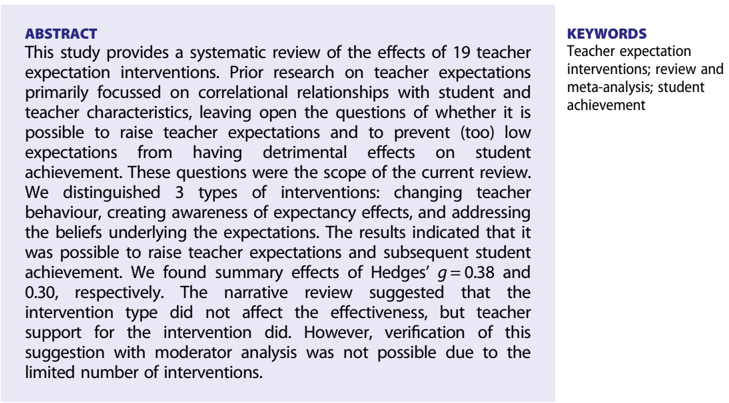
This study provides a systematic review of the effects of 19 teacher expectation interventions. Prior research on teacher expectations primarily focussed on correlational relationships with student and teacher characteristics, leaving open the questions of whether it is possible to raise teacher expectations and to prevent (too) low expectations from having detrimental effects on student achievement. These questions were the scope of the current review. We distinguished 3 types of interventions: changing teacher behaviour, creating awareness of expectancy effects, and addressing the beliefs underlying the expectations. The results indicated that it was possible to raise teacher expectations and subsequent student achievement. We found summary effects of Hedges’ g = 0.38 and 0.30, respectively. The narrative review suggested that the intervention type did not affect the effectiveness, but teacher support for the intervention did. However, verification of this suggestion with moderator analysis was not possible due to the limited number of interventions.
Overview
CoChat Summary
TL;DR
This systematic review and meta-analysis of 19 naturalistic teacher expectation interventions found that such interventions can raise teachers’ expectations and improve student achievement. Meta-analytic average effects were small to moderate: Hedges’ g = 0.38 for teacher expectations and g = 0.30 for student achievement.
Key findings
- Across 19 interventions, most combined awareness-raising with behaviour change. In the narrative review, of 12 interventions measuring teacher expectations, 6 found positive effects, 2 found mixed no/positive effects, and 4 found no significant effect; of 10 measuring student achievement, 4 found positive effects, 3 found nonsignificant changes in the desired direction, 1 found mixed effects, and 2 found no positive effects.
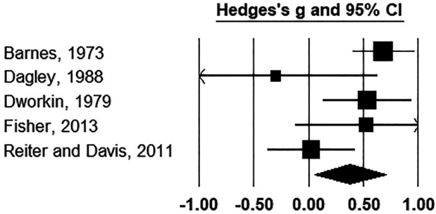
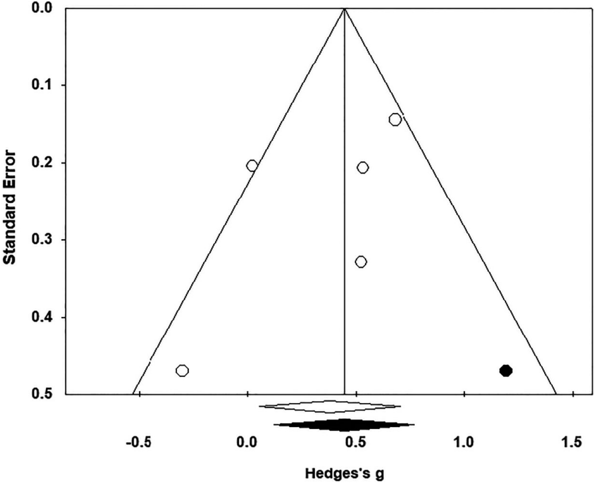
- Meta-analysis of teacher expectation outcomes (5 studies) yielded an average weighted effect of Hedges’ g = 0.38 (SE = 0.17, p = .023, 95% CI 0.05–0.70); trim-and-fill adjustment for possible publication bias gave g = 0.44 (95% CI 0.12–0.77).
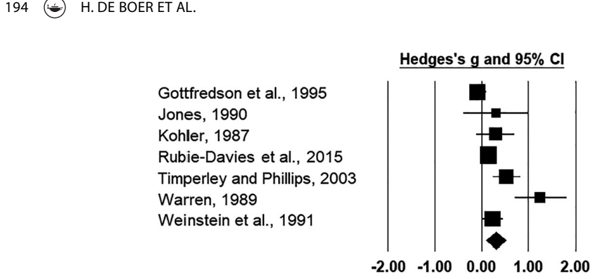
- Meta-analysis of student achievement outcomes (7 studies) yielded an average weighted effect of Hedges’ g = 0.30 (SE = 0.11, p = .005, 95% CI 0.09–0.51), with no publication bias indicated.
- Heterogeneity was present for teacher expectations (Q = 9.71, df = 4, p = .046, I² = 58.8) and student achievement (Q = 30.43, df = 6, p < .001, I² = 80.3); too few studies allowed moderator analyses, and only three studies examined both outcomes.
Methods
- Systematic review and meta-analysis of teacher expectation intervention studies conducted in naturalistic regular classroom settings without artificial manipulation of expectations. Searches in ERIC and PsycINFO at the beginning of 2018 covered publications up to the end of 2017, using title terms for teacher expectations/judgments/perceptions/aspirations/beliefs and intervention/change terms; the initial search yielded 1,307 hits, 26 potentially relevant studies, plus 4 from reference checks, with 19 interventions meeting eligibility criteria.
- Studies were coded for intervention type (behavioural, awareness, beliefs, other), duration, student sample characteristics, grade year, country, publication year, outcome types, and effect direction; findings were synthesised narratively and, where possible, quantitatively.
- Meta-analysis used Comprehensive Meta-Analysis Version 2, Hedges’ g, random-effects models, and Duval and Tweedie’s trim-and-fill procedure; 5 studies were included for teacher expectation effects and 7 for student achievement effects.
Limitations
- The paper states that the restricted number of included studies limited examination of which intervention characteristics contribute to effectiveness; the title-only search may have missed eligible studies; no stringent methodological quality criteria were applied; not all studies provided quantitative data; and only the US and New Zealand were represented.
- The paper states that only three studies examined both teacher expectations and student achievement, making it difficult to analyse whether increasing teacher expectations actually affects student achievement.
- Evident from the text: both meta-analyses showed substantial heterogeneity (I² = 58.8 and 80.3) and were based on small numbers of studies (5 and 7), limiting precision and generalisability.
Model-written summary. Check it against the paper before relying on it.
Integrity signals
Registry
Cites
Statistics
Figures


Verification
Claims the paper makes
1 Valid · 5 Not valid · 43 Not checked · 71 Own results and interpretations
The cited sources support only part of this claim — read each source’s verdict below.
In the paper
“as the interventions with disappointing results often reported that the intervention was not incorporated by the teachers and was therefore not well implemented (e.g., Perrella, 2017; Reiter & Davis, 2011).”
What the sources say
- Partly supportedcites Perrella, 2017 matched to “Exploring the influence of an early talent development program on teacher perceptions of giftedness in culturally and linguistically diverse students” (2021) sourceExperimental — accuracy not yet measured
Our copy of Perrella (dissertation on the MSDE PTD early talent program) clearly supports the uptake/implementation half of the claim: Conclusion 1 (p. n/a) states 'Findings indicated a limited capacity for transferring the experiences of the program beyond the program modules... the participants were not open to the program influencing instruction,' and teachers 'perceive themselves as talent evaluators and not talent developers,' administering lessons as 'temporary insertions in the curriculum'; participant interviews (Michael, Sara) describe vague, poorly resourced implementation ('the initial implementation didn't feel as if it was well thought out'). What the source does not support is the framing of 'interventions with disappointing results': this is a single qualitative study of one K-2 talent-development program that did not evaluate intervention outcomes, and it explicitly states 'the scope of this study did not include an analysis of factors legitimizing the fidelity of the program to participants,' while also noting all participants described changed expectations of students. The generalization across multiple disappointing interventions therefore rests on the citing authors, not on this source. (LLM, conf=0.72)
- Not matchedcites Reiter & Davis, 2011
An author–year citation the paper’s reference list doesn’t settle. We don’t search these by name.
plainstates a cause- Asserted: passes — The authors put it forward as true.
- Checkable: passes — It can be checked against evidence.
- Load-bearing: passes — The paper’s conclusions depend on it.
- Based: passes — The paper gives a reason why it holds.
- Partly supported
A result the paper reports from its own data — it cites no other source for it, so there is none to check. The quote shows it is in the paper.
In the paper
“two reported a mixed no/positive e ff ect”
plain- Asserted: passes — The authors put it forward as true.
- Checkable: passes — It can be checked against evidence.
- Load-bearing: unclear — It is unclear whether the paper’s conclusions depend on it.
- Based: passes — The paper gives a reason why it holds.
A result the paper reports from its own data — it cites no other source for it, so there is none to check. The quote shows it is in the paper.
In the paper
“Unfortunately, we noticed that not all studies had high-quality data reporting.”
plain- Asserted: passes — The authors put it forward as true.
- Checkable: passes — It can be checked against evidence.
- Load-bearing: passes — The paper’s conclusions depend on it.
- Based: passes — The paper gives a reason why it holds.
A result the paper reports from its own data — it cites no other source for it, so there is none to check. The quote shows it is in the paper.
In the paper
“Of all the included studies, 12 provided su ffi cient statistical information and were eligible for the meta-analysis.”
plain- Asserted: passes — The authors put it forward as true.
- Checkable: passes — It can be checked against evidence.
- Load-bearing: passes — The paper’s conclusions depend on it.
- Based: passes — The paper gives a reason why it holds.
A result the paper reports from its own data — it cites no other source for it, so there is none to check. The quote shows it is in the paper.
In the paper
“Six of them found a positive e ff ect”
plainstates a cause- Asserted: passes — The authors put it forward as true.
- Checkable: passes — It can be checked against evidence.
- Load-bearing: unclear — It is unclear whether the paper’s conclusions depend on it.
- Based: passes — The paper gives a reason why it holds.
65 more claims
Create a free account to see all 120 claims and to verify the 4 references still open.
- Probably not a substantial claim. 26
- It may state two separate claims as one. 28
- The quote only partly states this claim. 1
Self-check
Percentages, sums and reported differences re-computed from the paper’s own numbers.
Each contradiction between two passages listed here was confirmed by an independent check.
Rated minor: it would not touch a result — a value no result rests on, a p-value that stays on the same side of the significance level, or a conflict that is clerical, resolved elsewhere in the paper, or outside its own findings.
In the paper
§ Sketch of the interventions · p. 10
“three studies with a duration of more than one school year (J. N. Jones, Miron, & Kelaher-Young, 2012; Kerman, 1979; Perrella, 2017).”
§ Sketch of the interventions · p. 9
“| Kerman | 1979 | Yes | Yes | No | No | 1 to 12 | ? | 22 | n.a. | + n |”
Citations
Cites
Statistical Power Analysis for the Behavioral Sciences
Muller, K. (1989) · Technometrics · doi:10.1080/00401706.1989.10488618 · Cited by 99,167
Statistical Power Analysis for the Behavioral Sciences (2nd ed.).
Lachenbruch, P. A., & Cohen, J. (1989) · Journal of the American Statistical Association · doi:10.2307/2290095 · Cited by 37,395
Borenstein, M., Hedges, L. V., Higgins, J. P. T., & Rothstein, H. R. (2009) · doi:10.1002/9780470743386 · Cited by 14,225
Borenstein, M., Hedges, L. V., Higgins, J. P. T., & Rothstein, H. R. (2021) · doi:10.1002/9781119558378 · Cited by 9,799
(2008) · Cited by 6,939
Rosenthal, R., & Jacobson, L. (1968) · The Urban Review · doi:10.1007/bf02322211 · Cited by 3,878
Hattie, J. (2008) · doi:10.4324/9780203887332 · Cited by 3,051
Pygmalion in the Classroom: Teacher Expectation and Pupils' Intellectual Development.
Brookover, W. B., Rosenthal, R., & Jacobson, L. (1969) · American Sociological Review · doi:10.2307/2092211 · Cited by 1,954
Jussim, L., & Harber, K. D. (2005) · Personality and Social Psychology Review · doi:10.1207/s15327957pspr0902_3 · Cited by 1,197
Brophy, J. E., & Good, T. L. (1970) · Journal of Educational Psychology · doi:10.1037/h0029908 · Cited by 922 · cited 2×
“Several studies have identified ways in which teachers treat students for whom they have high or low expectations differently (Brophy & Good, 1970; Hughes, Gleason, & Zhang, 2005; Tenenbaum & Ruck, 2007).”
Background
Research works printed but not linked: 7
- *Barnes, E. M. S. (1973). The e ff ects of using a self-instructional module on teacher perceptions of attitudes and values of disadvantaged inner-city black youth (Unpublished doctoral dissertation). Ohio State University, Columbus, OH.
- *Dagley, P. L. (1988). The utility of cognitive self-instruction in altering teacher expectations and locus of control orientations (Unpublished doctoral dissertation). University of Georgia, Athens, GA.
- *Fisher, T. A. (2013). The impact of multiple intelligence theory on teacher perception of giftedness and the referral of African American students to gifted and talented education programs (Doctoral dissertation). Available from ProQuest Dissertations and Theses database. (UMI No. 1434728)
- *Jones, S. C. (1990). The e ff ects of the teacher expectations and student achievement program (TESA) on the reading achievement and self-esteem of suburban high school students (Unpublished doctoral dissertation). Morgan State University, Baltimore, MD.
- *Kerman, S. (1979). ' Why did you call on me? I didn ' t have my hand up! ' : Teacher expectations and student achievement. Phi Delta Kappan , 60 , 716 -718.
- *Kohler, P. A. (1987). The e ff ects of the teacher expectations and student achievement model on the achievement and self-concept of mildly handicapped students receiving resource room instruction (Unpublished doctoral dissertation). Memphis State University, Memphis, TN.
- *Warren, S. T. (1989). An investigation of self-esteem, self-concept, and scholastic achievement of at-risk ninth-graders involved in the teacher expectations and student achievement (TESA) program (Unpublished doctoral dissertation). United States International University, San Diego, CA.
Cited by
Bardach, L., Klassen, R. M., & Perry, N. E. (2022) · Educational Psychology Review · doi:10.1007/s10648-021-09614-9 · Cited by 242
“Expectations as psychological characteristic De Boer et al. (2018) Teachers’ academic expectations (defined as a teacher’s estimate of students’ academic potential) Student achievement 10 studies included in review of effects on achievement, 7 studies meta-analytically investigated, international…”
BackgroundMethodInfluentialRakesh, D., Lee, P. A., Gaikwad, A., & McLaughlin, K. A. (2024) · Journal of Child Psychology and Psychiatry · doi:10.1111/jcpp.14082 · Cited by 197
“Studies have shown that raising teacher expectations is both achievable can boost student achievement (de Boer, Timmermans, & van der Werf, 2018).”
Can educational psychology be harnessed to make changes for the greater good?
López, F. (2022) · Educational Psychologist · doi:10.1080/00461520.2022.2052293 · Cited by 69
“This is also true for a meta-analysis that aimed to identify intervention effects on teacher expectations (de Boer et al., 2018).”
BackgroundSchool Climate and Perceived Academic Performance: Direct or Resilience-Mediated Relationship?
Mateos, N. E., Fernández‐Zabala, A., Palacios, E. G., & Izar-de-la-Fuente, I. (2020) · Sustainability · doi:10.3390/su13010068 · Cited by 71
“On the one hand, the results obtained reveal that teachers’ expectations of students’ work and interest are not only linked to real academic performance, as demonstrated by previous studies [31,33,69], but are also associated with students’ own”
ResultAssociations between teacher expectations and racial disproportionality in discipline referrals
Santiago-Rosario, M. R., Whitcomb, S. A., Pearlman, J., & McIntosh, K. (2021) · Journal of School Psychology · doi:10.1016/j.jsp.2021.02.004 · Cited by 43
The Elements: Transforming Teaching through Curriculum-Based Professional Learning
Short, J. S., & Hirsh, S. A. (2020) · Issue Lab (Candid) · doi:10.15868/socialsector.37787 · Cited by 60
Teaching and learning in a multilingual Europe: findings from a cross-European study
Dockrell, J. E., Papadopoulos, T. C., Mifsud, C. L., Bourke, L., Vilageliú, O. S., Bešić, E., Seifert, S., Gasteiger‐Klicpera, B., Ralli, A. M., Dimakos, I. C., et al. (2021) · European Journal of Psychology of Education · doi:10.1007/s10212-020-00523-z · Cited by 57
Collaborative inquiry networks: the challenge to promote network leadership capacities in Chile
Pino-Yancovic, M., & Ahumada, L. (2020) · School Leadership and Management · doi:10.1080/13632434.2020.1716325 · Cited by 35
Wang, Z., Oh, W., Malanchini, M., & Borriello, G. A. (2020) · Contemporary Educational Psychology · doi:10.1016/j.cedpsych.2020.101876 · Cited by 44
Exploring pre-service language teachers’ mindsets using a sorting activity
Haukås, Å., & Mercer, S. (2021) · Innovation in Language Learning and Teaching · doi:10.1080/17501229.2021.1923721 · Cited by 48
“…and learning is complex but the degree of growth or fixed orientation and the relationship to locus of control would be important to understand for pedagogical practices, teacher expectations, as well as the subsequent impact on student achievement (cf. De Boer, Timmermans, and van der Werf 2018).”
BackgroundNunes, C., Oliveira, T., Castelli, M., & Cruz‐Jesus, F. (2023) · Heliyon · doi:10.1016/j.heliyon.2023.e13335 · Cited by 80
“Higher teacher involvement also predicted Math AA, but not Portuguese, and the effects of teacher expectations and involvement are variable, as previous results demonstrate [52].”
BackgroundResultHow to Teach an Additional Language: To task or not to task?
den Branden, K. V. (2022) · Task-based language teaching · doi:10.1075/tblt.15 · Cited by 47
Gender differences in surgical case volume among ophthalmology trainees
Gill, H. K., Niederer, R. L., & Danesh-Meyer, H. V. (2021) · Clinical and Experimental Ophthalmology · doi:10.1111/ceo.13969 · Cited by 31
Modifying biased teacher expectations in mathematics and German: A teacher intervention study
Neuenschwander, M., Mayland, C., Niederbacher, E., & Garrote, A. (2021) · Learning and Individual Differences · doi:10.1016/j.lindif.2021.101995 · Cited by 23
Timmermans, A. C., Rubie-Davies, C. M., & Wang, S. (2021) · Learning and Instruction · doi:10.1016/j.learninstruc.2021.101483 · Cited by 34
Self-citationLobos, K., Bustos, C., Cobo‐Rendón, R., Branada, C. F., Bruna, C., & Maldonado-Trapp, A. (2021) · Frontiers in Psychology · doi:10.3389/fpsyg.2021.642391 · Cited by 25
Khasawneh, M. A. S., & Khasawneh, Y. J. A. (2023) · Preprints.org · doi:10.20944/preprints202306.0730.v1 · Cited by 40
Lee, M. G. L., & Soland, J. G. (2022) · Educational Evaluation and Policy Analysis · doi:10.3102/01623737221097419 · Cited by 28
“Educators in EL-prevalent classrooms can, in some instances, expect less of EL students academically (Dabach, 2014), and there is evidence students can learn and absorb those lower expectations themselves (de Boer et al., 2018).”
BackgroundLi, J., King, R. B., Wang, Y., Leung, S. O., & Wang, C. (2023) · Learning and Individual Differences · doi:10.1016/j.lindif.2023.102344 · Cited by 23
Huang, J., Sang, G., & Chao, T.-Y. (2022) · Frontiers in Psychology · doi:10.3389/fpsyg.2021.777937 · Cited by 34
“As expected, teachers affect the educational pathways of students directly via their evaluation and decision-making of student performance in the classroom life (Timmermans et al., 2016; De Boer et al., 2018; Wang et al., 2018).”
BackgroundAndriana, E., & EVANS, D. L. (2021) · British Journal of Learning Disabilities · doi:10.1111/bld.12411 · Cited by 30
A Systematic Review on Teacher’s Expectations and Classroom Behaviors
Aydın, Ö., & Ok, A. (2022) · Uluslararası Eğitim Programları ve Öğretim Çalışmaları Dergisi · doi:10.31704/ijocis.2022.011 · Cited by 46
“More importantly, they underlined the possibility of raising teacher expectations (De Boer et al., 2018).”
BackgroundSchell, C. S., Dignath, C., Kleen, H., John, N., & Kunter, M. (2024) · Teaching and Teacher Education · doi:10.1016/j.tate.2024.104526 · Cited by 16
The role of asset-based pedagogy in an interactive view of reading
Gabriel, R. E., & López, F. (2024) · Educational Psychologist · doi:10.1080/00461520.2024.2394031 · Cited by 25
“Some researchers have found that a commitment to working toward being unprejudiced is important (Kumar, et al., 2021), which includes the kind of learning that can alter deficit-based beliefs (de Boer et al., 2018).”
Lee, H. J., Kim, S., & Bong, M. (2025) · British Journal of Educational Psychology · doi:10.1111/bjep.12764 · Cited by 21
“Improving teacher expectations also results in improved student achievement ( g = .30 in de Boer et al., 2018), with enhanced confidence or self-efficacy on the part of students functioning as a significant mediator (Wang et al., 2018).”
Does the ‘Learning Disability’ label lower teachers’ performance expectations?
Kashikar, L., Soemers, L., Lüke, T., & Grosche, M. (2023) · Social Psychology of Education · doi:10.1007/s11218-023-09775-1 · Cited by 24
“Research spanning several decades offers evidence regarding the existence of the self-fulfilling prophecy in the school context (e.g. de Boer et al., 2018; Gentrup et al., 2020; Papageorge et al., 2020; Ready & Wright, 2011; Rubie-Davies, 2007, 2010).”
BackgroundGood, T. L. (2024) · Educational Psychologist · doi:10.1080/00461520.2024.2324386 · Cited by 23
“…about teacher expectations with teachers, with varying levels of success (e.g., Cooper, 1979; Good & Brophy, 1974; Weinstein et al., 1991). de Boer et al. (2018) reviewed 18 intervention studies between 1973 and 2018 and concluded that one aspect of successful interventions was the…”
BackgroundKurth, J. A., Turner, E. L., Zagona, A. L., et al. (2024) · Research and Practice for Persons with Severe Disabilities · doi:10.1177/15407969241267283 · Cited by 13
“This finding is especially important given that teachers’ high expectations are correlated with improved student learning outcomes (de Boer et al., 2018).”
A Novel Framework for Facilitating Emergency Remote Learning During the COVID-19 Pandemic
Almutairi, F. M., Ali, N. G. H., & Ghuloum, H. F. (2021) · International Education Studies · doi:10.5539/ies.v14n5p121 · Cited by 15
Professionalism and professionalization of early stage teachers in higher education
Wardoyo, C., Herdiani, A., Susilowati, N., & Harahap, M. S. (2020) · Journal of Applied Research in Higher Education · doi:10.1108/jarhe-04-2019-0100 · Cited by 22
Hollenstein, L., Brühwiler, C., & König, J. (2024) · European Journal of Social Psychology · doi:10.1002/ejsp.3035 · Cited by 18
Mucinskas, D., Clark, S., Barendsen, L., & Gardner, H. (2025) · Frontiers in Education · doi:10.3389/feduc.2025.1466295 · Cited by 37
Goulet, J., & Morizot, J. (2022) · Learning Environments Research · doi:10.1007/s10984-022-09441-x · Cited by 11
Dixon, C. E., Russell, J., & Buchanan, A. (2022) · Sport Education and Society · doi:10.1080/13573322.2022.2031952 · Cited by 11
“He understood that his expectations of the students impact their success (De Boer et al., 2018).”
BackgroundTackling teachers’ low expectations of Black Caribbean students in English schools
Demie, F. (2022) · Equity in Education & Society · doi:10.1177/27526461211068511 · Cited by 14
“The studies by RubieDavies et al. (2013) and De Boer et al. (2018) pointed out that: Teachers differed in their average level of expectations for their students in the classroom, and that this was reflected in their teaching behaviour.”
BackgroundInfluentialUpholding heightened expectations of Indigenous children? Parents do, teachers do not
Peacock, H., Prehn, J., Guerzoni, M. A., Aitken, W., & Andersen, C. (2020) · The Australian Journal of Indigenous Education · doi:10.1017/jie.2020.28 · Cited by 9
“Needless to say, this is a difficult process as such self-examination and acknowledgement of fault require vulnerability and humility, with the recanting and alteration of belief and behaviour often being lengthy and costly (De Boer et al., 2018).”
BackgroundMethodInfluentialDixon, C. E., Hastie, P. A., & Russell, J. (2021) · Journal of Teaching in Physical Education · doi:10.1123/jtpe.2020-0157 · Cited by 8
Instructionally Embedded Assessment: Theory of Action for an Innovative System
Clark, A. K., & Karvonen, M. (2021) · Frontiers in Education · doi:10.3389/feduc.2021.724938 · Cited by 14
Camacho, D. A., Moore, S. A., Pas, E. T., & Bradshaw, C. P. (2022) · Journal of School Psychology · doi:10.1016/j.jsp.2022.06.001 · Cited by 16
Daelman, J., Lierde, K. M. V., Bettens, K., Nys, J., & D’haeseleer, E. (2023) · Folia Phoniatrica et Logopaedica · doi:10.1159/000531105 · Cited by 13
Tracking and educational inequality: a longitudinal analysis of two school reforms in Switzerland
Felouzis, G., & Charmillot, S. (2023) · British Journal of Sociology of Education · doi:10.1080/01425692.2023.2203359 · Cited by 9
First Grade GPA as a Predictor of Later Academic Performance in High School
Papadogıannıs, I., Poulopoulos, V., Platis, N., Vassilakis, C., Lepouras, G., & Wallace, M. (2023) · Knowledge · doi:10.3390/knowledge3030033 · Cited by 8
Levkovich, I., Rabin, E., Farraj, R. H., & Elyoseph, Z. (2025) · Research in Developmental Disabilities · doi:10.1016/j.ridd.2025.104970 · Cited by 9
Maloshonok, N. (2022) · European Journal of Engineering Education · doi:10.1080/03043797.2022.2134760 · Cited by 6
“This can be explained by the important role of instructors’ expectations in facilitating students’ learning and performance (De Boer, Timmermans, and Van Der Werf 2018).”
BackgroundLomholt, R. (2025) · Social Psychology of Education · doi:10.1007/s11218-024-09999-9 · Cited by 9
“Some studies show that teachers’ awareness of their expectation bias can be raised as an element in professional development and educational training programmes that integrate information about bias mechanisms with professional action plans (de Boer et al., 2018; Neuenschwander et al., 2021).”
Noklang, S. (2020) · Participatory Educational Research · doi:10.17275/per.20.43.7.3 · Cited by 13
Rowe, D. A., & Francis, G. (2020) · Teaching Exceptional Children · doi:10.1177/0040059920952007 · Cited by 8
Williams, D. R., Martin, S. R., DeBolt, M. C., Oakes, L. M., & Rast, P. (2020) · PsyArXiv (OSF Preprints) · doi:10.31234/osf.io/2ux7t · Cited by 6
Магомедовна, Ю. Э., Kapuza, A., & Kardanova, E. Y. (2022) · Voprosy Obrazovaniya/ Educational Studies Moscow · doi:10.17323/1814-9545-2022-1-189-217 · Cited by 6
Thin-Slice Judgments of Children’s Social Status and Behavior
Lansu, T. A. M., & van den Berg, Y. H. M. (2020) · The Journal of Experimental Education · doi:10.1080/00220973.2020.1808943 · Cited by 6
“Unfortunately, when implementing such programs, raising awareness does not always receive that much attention (de Boer et al., 2018).”
BackgroundMulisa, F., & Kassahun, S. (2019) · Ethiopian Journal of Education and Sciences · Cited by 4
Outcome-based education in open and distance learning
Cresencio, M. (2023) · Journal of Education and e-Learning Research · doi:10.20448/jeelr.v10i4.5043 · Cited by 4
“The findings also conform to the idea of De Boer et al. (2018) and Hu et al. (2023) that OBE effectively incorporates a student-centered approach and teachers’ higher expectations lead to positive students learning.”
BackgroundResultPostschool Goal Expectations for Youth With Intellectual and Developmental Disabilities
Wu, Y.-C., Qian, X., Lee, S., Johnson, D. R., & Thurlow, M. L. (2024) · American Journal on Intellectual and Developmental Disabilities · doi:10.1352/1944-7558-129.2.151 · Cited by 6
Artistry in teaching: A systematic literature review of the research spanning 50 years (1972–2022)
Casham, S., Sheridan, L., & Agostinho, S. (2024) · Teaching and Teacher Education · doi:10.1016/j.tate.2024.104804 · Cited by 8
Ura, S. K., DuBois, J. W., Fletcher, K. E., & Lorah, J. A. (2025) · Social and Emotional Learning Research Practice and Policy · doi:10.1016/j.sel.2025.100121 · Cited by 15
Kim, Y. A., Kim, J., & Jo, Y.-J. (2023) · International Journal of Educational Research · doi:10.1016/j.ijer.2023.102190 · Cited by 5
Making the grade: The effect of teacher grading standards on student outcomes
Gershenson, S., Holt, S., & Tyner, A. (2023) · Contemporary Economic Policy · doi:10.1111/coep.12637 · Cited by 11
A First Ever Look into Greece’s Vast Educational Data: Interesting Findings and Policy Implications
Papadogıannıs, I., Wallace, M., Poulopoulos, V., Karountzou, G., & Ekonomopoulos, D. (2021) · Education Sciences · doi:10.3390/educsci11090489 · Cited by 5
Factors Affecting Students’ Satisfaction and Academic Performance in Open & Distance Learning (ODL)
Zamri, N., Omar, N. B., Anwar, I. S. K., & Fatzel, F. H. M. (2021) · International Journal of Academic Research in Business and Social Sciences · doi:10.6007/ijarbss/v11-i11/11194 · Cited by 12
“Furthermore, actual academic performance is related not only with the teachers' expectations of students' abilities (De Boer et al., 2018) as well as student's own expectations (Mateos, et al., 2021)”
BackgroundEnglish Teacher Identity in The Context of Zoning Policy Implementation
Hapsari, A. G. S., & Budiraharjo, M. (2019) · Journal of Education Research and Evaluation · doi:10.23887/jere.v3i4.23203 · Cited by 4
“On the other hand, a teacher who has low expectation towards the students tends to hardly provide less chances for particular group of students (de Boer et al., 2018).”
BackgroundVarzaneh, M. A., Shahsavari, M. R., & Mousavi, S. (2024) · Research and Development in Medical Education · doi:10.34172/rdme.33237 · Cited by 8
Prevalence of educational myths among Ecuadorian teachers
Jimmy Zambrano, R., Chaguay, J., Mayorga, J., Kirschner, P. A., Parra, W., & Lazo, A. (2025) · Trends in Neuroscience and Education · doi:10.1016/j.tine.2025.100273 · Cited by 6
Yujiao, W., Qin, Y., Gao, K., Qi, W., & Sang, G. (2024) · School Psychology International · doi:10.1177/01430343241285337 · Cited by 7
“However, teachers tend to hold negative expectations about the future academic performance of minority, low socioeconomic status, and disadvantaged students, which more often affects students from rural backgrounds (De Boer et al., 2018; Wang et al., 2021; Yiu & Adams, 2013).”
Faraj, S. M., Salih, D. T. M., Azam, K. O., Saeed, S. A., Mahmood, O. M., & Kareem, A. H. R. (2024) · Journal of Philology and Educational Sciences · doi:10.53898/jpes2024324 · Cited by 4
Dong, Y. (2023) · Journal of Education Humanities and Social Sciences · doi:10.54097/ehss.v9i.6415 · Cited by 3
“However, the teacher's attention is always focused on the few students who will advance to higher levels of school, and they are given higher expectations and more care [4].”
BackgroundFinch, J. E., Saavedra, A., & Obradović, J. (2023) · Journal of Child and Family Studies · doi:10.1007/s10826-023-02666-1 · Cited by 9
“A meta-analysis showed that teacher expectation interventions were successful at raising teachers expectations ’ of children ’ s academic abilities through changing teachers ’ behaviors and awareness of bias, and, in some cases, able to raise students ’ academic achievement (de Boer et al., 2018).”
Investigating private and public school performance gap: A case study in Turkey
Cheema, J., Siddiqui, S., & Paarlberg, A. (2025) · International Journal of Educational Development · doi:10.1016/j.ijedudev.2025.103205 · Cited by 5
Bijl, R. A., van den Bergh, L., & Bakx, A. W. E. A. (2025) · International Journal of Educational Research Open · doi:10.1016/j.ijedro.2025.100483 · Cited by 10
Prophesied Future and Redefined Past in the Genomic Era
Kovas, Y. V., & Selita, F. (2021) · Palgrave Macmillan UK eBooks · doi:10.1057/978-1-349-96048-4_4 · Cited by 3
Matthew, Pygmalion, and Founder Effects
Acar, S. (2019) · Elsevier eBooks · doi:10.1016/b978-0-12-809324-5.23783-8 · Cited by 3
Mohebi, L. (2025) · Digital Education and E-Learning Innovations · doi:10.64220/deei.v1i1.002 · Cited by 2
Spiele, S., Janssen, J. J. H. M., Schildkamp, K., & Poortman, C. L. (2025) · Studies In Educational Evaluation · doi:10.1016/j.stueduc.2025.101528 · Cited by 21
Lomholt, R. (2026) · Social Psychology of Education · doi:10.1007/s11218-026-10169-2 · Cited by 3
“To address this issue, intervention studies have largely suggested three ways to overcome teacher expectation bias (de Boer et al., 2018): (1) change teachers’ instructional behaviours to better align with high-expectation teacher practices (McDonald et al., 2016), (2) raise teachers’ awareness of…”
The other side of the tracks: How academic streaming impacts student relationships
Maharaj, S., & Zareey, S. (2022) · Education Policy Analysis Archives · doi:10.14507/epaa.30.6905 · Cited by 15
“…(Jussim & Harber, 2005; Wigfield et al., 2015), and that teachers of low-income, working class, and racialized students often hold learning expectations that are far below those of their more affluent peers (de Boer et al., 2018; Glock et al., 2012; Muenks et al., 2018; Stevens & Vermeersch, 2010).”
BackgroundQuantifying elementary teachers’ foreknowledge about their students
Sedlacek, Q. C., & Murdock‐Perriera, L. A. (2023) · Social Psychology of Education · doi:10.1007/s11218-023-09764-4 · Cited by 4
Relationship between Academic Self-Efficacy and Test Anxiety in Middle School Students
Yun, H., & Wang, J. (2024) · Journal of Education Humanities and Social Sciences · doi:10.54097/z0jn0085 · Cited by 4
“De Boer et al.’s meta-analysis pointed out that after perceiving teacher expectations, students develop expectations and motivation, investing time and effort into completing learning tasks [29].”
BackgroundExploring how the COVID-19 pandemic impacted teacher expectations in schools
Flanagan, A. M., Cormier, D. C., Daniels, L. M., & Tremblay, M. (2024) · Social Psychology of Education · doi:10.1007/s11218-024-09924-0 · Cited by 3
“Teacher expectations for students are amenable to positive change, which is supported by intervention research (De Boer et al., 2018; Rubie-Davies et al., 2015 ).”
Wang, Y., & Ganassin, S. (2024) · Educational Review · doi:10.1080/00131911.2024.2418551 · Cited by 3
“On the other hand, teacher expectation bias may have detrimental effects on student achievement (De Boer et al., 2010; de Boer et al., 2018).”
Unlocking Multilingual Classrooms: Preprimary Teachers’ Perspectives on Inclusive Pedagogy in Spain
López-Medina, B., & Agustín, M. P. (2024) · Sustainable Multilingualism · doi:10.2478/sm-2024-0018 · Cited by 2
Li, J., Bai, J., Ouyang, L., & Lin, H. (2025) · PLoS ONE · doi:10.1371/journal.pone.0317583 · Cited by 4
Education Candidates' Perceptions of Title I Public Schools.
Richmond, J., Costner, R. H., Hit, A., & Costner, B. (2020) · SRATE journal · Cited by 2
Asztalos, A. (2022) · Research Studies in Music Education · doi:10.1177/1321103x221140283 · Cited by 2
“Conversely, when teachers have high expectations for students and provide engaging tasks of high interest, students build selfesteem, increase confidence, and improve academic performance (Boer et al., 2018; RubieDavies et al., 2006).”
BackgroundTraining of Male and Female Surgical Residents
Sorber, R. A., Weaver, M. L., & Tsai, L. L. (2020) · JAMA Surgery · doi:10.1001/jamasurg.2020.2430 · Cited by 2
School Social Workers Perceptions of the Use of Functional Behavior Assessments
Elswick, S. E., & Cuellar, M. J. (2021) · Research on Social Work Practice · doi:10.1177/1049731521990740 · Cited by 4
“Due to the increased national workload on teachers and SSWs (de Boer et al, 2018; Hussein, 2018), working in multidisciplinary teams can support the needs of the student and the practitioner by involving qualified practitioners, such as SSWs, to support the needs of assessment in practice.”
BackgroundHingstman, M., Neitzel, A. J., & Slavin, R. E. (2022) · Journal of Education for Students Placed at Risk (JESPAR) · doi:10.1080/10824669.2022.2098131 · Cited by 10
“A result of stigma might be that teachers and parents may uncon-sciously give low-ability cues throughout the day, negatively affecting students’ self-esteem and academic achievement (Clark, 1997; De Boer, Timmermans, & Van der Werf, 2018; Pit-ten Cate & Glock, 2018; Shifrer, 2013; Valås, 2001).”
BackgroundSchool emphasis on academic success: the role of principal qualifications
Sideridis, G. D., & Alghamdi, M. S. (2024) · Frontiers in Psychology · doi:10.3389/fpsyg.2024.1288174 · Cited by 10
“…known that teacher positive expectancies are associated with students’ academic success (Becker, 1952; Brophy, 1983; Rosenthal and Jacobson, 2003; Boer et al., 2018) but they can lead to the creation of self-fulfilling prophecies which can further reinforce and augment these outcomes (Merton,…”
BackgroundKoslouski, J. B., Stark, K., Chafouleas, S. M., & Riley‐Tillman, T. C. (2023) · School Mental Health · doi:10.1007/s12310-023-09570-5 · Cited by 1
Special Education of Students With Extensive Support Needs: Advancing Values
Kurth, J. A., & Zagona, A. L. (2024) · Advances in special education · doi:10.1108/s0270-401320240000038007 · Cited by 2
Smith, J., & Waller, R. D. (2024) · Emerald Group Publishing Limited eBooks · doi:10.1108/978-1-83753-332-920241012 · Cited by 1
Xue, Y., & Xiao, Y. (2024) · Lecture Notes in Education Psychology and Public Media · doi:10.54254/2753-7048/58/20241796 · Cited by 2
Konaklı, T., Kemer, M., & Çatak, S. (2025) · Psychology in the Schools · doi:10.1002/pits.23508 · Cited by 1
“Teachers' supportive expectations can have a substantial impact on students' motivation, academic performance, participation, and general involvement in the learning process (De Boer et al. 2018; Hattie 2008; Lazarová et al. 2019; Martin and Collie 2019).”
Transforming teacher beliefs through professional learning for powerful learning environments
Peteghem, H. V., Engels, N., Vandecandelaere, M., & Placklé, I. (2025) · Professional Development in Education · doi:10.1080/19415257.2025.2574064 · Cited by 2
Evaluating impact of educational research on teachers’ practice: a teacher expectations intervention
Johnston, O. (2025) · Educational Research and Evaluation · doi:10.1080/13803611.2025.2570178 · Cited by 2
“Other studies including teacher expectation interventions have showed positive impact on student learning (de Boer et al., 2018), but this study is the first to show the benefits of applying the Knowl-edge-to-action framework for interventions in education.”
Moore, J., & Cohen, G. L. (2026) · Social Psychology of Education · doi:10.1007/s11218-026-10171-8 · Cited by 2
“…1999), that formal evaluations of students’ abilities predict later achievement (Kolovou et al., 2024; Meissel et al., 2017), and that broad interventions targeting teacher expectations can improve student achievement (Rubie-Davies et al., 2015, for meta-analysis see De Boer et al., 2018).”
Hornstra, L., Poorthuis, A. M. G., Boer, I., & Bloem, J. (2026) · School Effectiveness and School Improvement · doi:10.1080/09243453.2026.2651528 · Cited by 1
Shevchuk, A., & Glock, S. (2022) · Springer eBooks · doi:10.1007/978-3-658-37262-0_1 · Cited by 4
Examining Pupils' Achievement in Primary and Secondary Schools in Greece
Papadogıannıs, I., Wallace, M., & Poulopoulos, V. (2022) · European Journal of Engineering and Technology Research · doi:10.24018/ejeng.2022.1.cie.2958 · Cited by 1
“Leadership [11], school culture [12], school climate [13], educators' expectations [14] and parental involvement [15] are all aspects of the learning environment.”
BackgroundWibowo, E. P., Lestari, A., Adrian, M., Firdausiyah, K. S., Islamy, J. H., Putri, R. D., Kemal, T., & Kurniawan, E. (2024) · OKARA Jurnal Bahasa dan Sastra · doi:10.19105/ojbs.v18i1.12676 · Cited by 4
“This is a fascinating concept, given teachers' expectations and grading procedures are likely flexible (De Boer et al., 2018; Pollio & Hochbein, 2015; Quinn, 2020), and teachers can use grades to communicate (un)satisfactory progress to students and parents (Brookhart et al., 2016).”
BackgroundExploring the mediating role of teacher expectation on whole class participation
KIRMIZI, M. (2024) · Power and Education · doi:10.1177/17577438241272594 · Cited by 3
“TE is a teacher level variable, and its impact on the students ’ academic achievement is well reported (De Boer et al., 2018; McKown and Weinstein, 2008).”
Bardach, L., Klassen, R. M., & Perry, N. E. (2020) · PsyArXiv (OSF Preprints) · doi:10.31234/osf.io/g73nc · Cited by 6
Metadata
- Authors
- de Boer, H., Timmermans, A. C., & van der Werf, M. P. C.
- Affiliations
- GION education/research, University of Groningen, Groningen, The Netherlands
- University of Groningen (NL)
- Venue
- Educational Research and Evaluation
- Publisher
- Informa UK Limited
- Published
- 2018-04-03
- Volume
- 24
- Issue
- 3-5
- Pages
- 180-200
- ISSN
- 1380-3611 (ISSN-L)
- 1744-4187
- OpenAlex
- W2903938097
- Cited by
- 144
- References
- 52
- Citations by year
- 2026: 14 · 2025: 23 · 2024: 21 · 2023: 17 · 2022: 32 · 2021: 17 · 2020: 17 · 2019: 3
- FWCI
- 1.48
- Type
- journal article
- Language
- en
- Open access
- hybrid
- doi.org
- Licence
- cc-by-nc-nd
- Locations
- Educational Research and Evaluation (publishedVersion, cc-by-nc-nd)
- University of Groningen research database (University of Groningen / Centre for Information Technology) (submittedVersion, cc-by-nc-nd)
- Topics
- Social Sciences › Psychology › Developmental and Educational Psychology › Education, Achievement, and Giftedness
- Social Sciences › Education › School Choice and Performance
- Social Sciences › Education › Educational Environments and Student Outcomes
- Keywords
- teacher expectations, academic performance, expectancy effects, teacher beliefs, intervention effectiveness
About these checks
Registry, retraction, Cites and statistics results are computed, not judged, with one exception: a printed reference that no index lists is read once by a model before it counts as a citation error. Claims are extracted by a model and kept only when their quote appears verbatim in the text; each cited source is then checked, with a model’s help, for whether it says what the claim relies on. Those verdicts can be wrong — read the claim’s quote and the cited source before relying on one.
The claim verdicts this report counts are experimental: their accuracy is not yet measured.
A language model drew the claims from the paper on 2026-10-10, under version 3 of the claim definition (model deepseek-v4.1-flash, prompt extract-v3).
A second model labelled each claim on 2026-10-10 (model jev-1.13-20260917, definition revision gold-guideline-v0.2).
Cited sources are checked with a language model’s help (qwen3.8-omni-flash).
Statistics and arithmetic are recomputed, not judged.
Confidence bands are shown only for fields calibrated on our annotated test set. None is calibrated yet, so no band is shown.
What counts as a claim ›How we measure confidence ›How we check this ›
Are you an author, or do you see a problem with this page? Request a review
Data sources
Bibliographic data: Semantic Scholar, OpenAlex, Crossref.
Contains information from the Semantic Scholar Academic Graph Datasets, made available under the ODC Attribution License (ODC-BY 1.0).
Semantic Scholar’s data is described in: Kinney, R., et al. (2023). The Semantic Scholar Open Data Platform. arXiv:2301.10140.
