

The effects of teacher expectation interventions on teachers' expectations and student achievement: narrative review and meta-analysis
Open accessThe DOI matches its Crossref record; 54 of the 54 references it cites were found in a registry or an index; 1 of the 67 sources its claims cite were checked for support.
Abstract
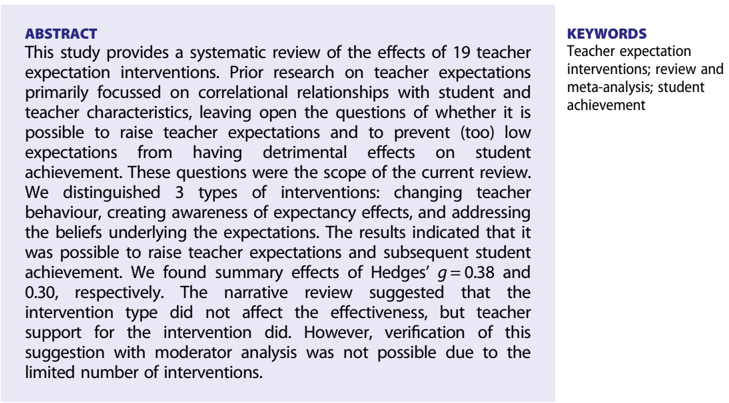
This study provides a systematic review of the effects of 19 teacher expectation interventions. Prior research on teacher expectations primarily focussed on correlational relationships with student and teacher characteristics, leaving open the questions of whether it is possible to raise teacher expectations and to prevent (too) low expectations from having detrimental effects on student achievement. These questions were the scope of the current review. We distinguished 3 types of interventions: changing teacher behaviour, creating awareness of expectancy effects, and addressing the beliefs underlying the expectations. The results indicated that it was possible to raise teacher expectations and subsequent student achievement. We found summary effects of Hedges’ g = 0.38 and 0.30, respectively. The narrative review suggested that the intervention type did not affect the effectiveness, but teacher support for the intervention did. However, verification of this suggestion with moderator analysis was not possible due to the limited number of interventions.
Overview
CoChat Summary
TL;DR
This systematic review and meta-analysis of 19 naturalistic teacher expectation interventions found that such interventions can raise teachers’ expectations and improve student achievement. Meta-analytic average effects were small to moderate: Hedges’ g = 0.38 for teacher expectations and g = 0.30 for student achievement.
Key findings
- Across 19 interventions, most combined awareness-raising with behaviour change. In the narrative review, of 12 interventions measuring teacher expectations, 6 found positive effects, 2 found mixed no/positive effects, and 4 found no significant effect; of 10 measuring student achievement, 4 found positive effects, 3 found nonsignificant changes in the desired direction, 1 found mixed effects, and 2 found no positive effects.
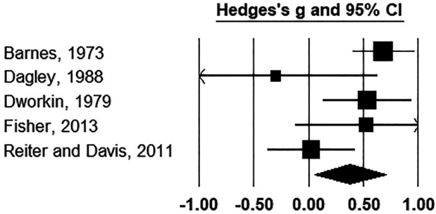
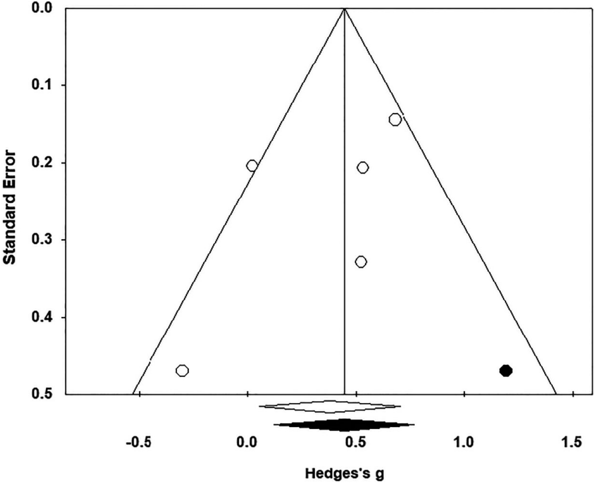
- Meta-analysis of teacher expectation outcomes (5 studies) yielded an average weighted effect of Hedges’ g = 0.38 (SE = 0.17, p = .023, 95% CI 0.05–0.70); trim-and-fill adjustment for possible publication bias gave g = 0.44 (95% CI 0.12–0.77).
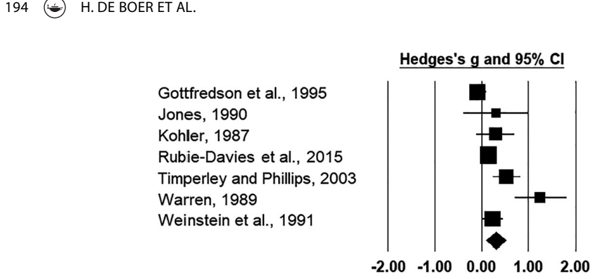
- Meta-analysis of student achievement outcomes (7 studies) yielded an average weighted effect of Hedges’ g = 0.30 (SE = 0.11, p = .005, 95% CI 0.09–0.51), with no publication bias indicated.
- Heterogeneity was present for teacher expectations (Q = 9.71, df = 4, p = .046, I² = 58.8) and student achievement (Q = 30.43, df = 6, p < .001, I² = 80.3); too few studies allowed moderator analyses, and only three studies examined both outcomes.
Methods
- Systematic review and meta-analysis of teacher expectation intervention studies conducted in naturalistic regular classroom settings without artificial manipulation of expectations. Searches in ERIC and PsycINFO at the beginning of 2018 covered publications up to the end of 2017, using title terms for teacher expectations/judgments/perceptions/aspirations/beliefs and intervention/change terms; the initial search yielded 1,307 hits, 26 potentially relevant studies, plus 4 from reference checks, with 19 interventions meeting eligibility criteria.
- Studies were coded for intervention type (behavioural, awareness, beliefs, other), duration, student sample characteristics, grade year, country, publication year, outcome types, and effect direction; findings were synthesised narratively and, where possible, quantitatively.
- Meta-analysis used Comprehensive Meta-Analysis Version 2, Hedges’ g, random-effects models, and Duval and Tweedie’s trim-and-fill procedure; 5 studies were included for teacher expectation effects and 7 for student achievement effects.
Limitations
- The paper states that the restricted number of included studies limited examination of which intervention characteristics contribute to effectiveness; the title-only search may have missed eligible studies; no stringent methodological quality criteria were applied; not all studies provided quantitative data; and only the US and New Zealand were represented.
- The paper states that only three studies examined both teacher expectations and student achievement, making it difficult to analyse whether increasing teacher expectations actually affects student achievement.
- Evident from the text: both meta-analyses showed substantial heterogeneity (I² = 58.8 and 80.3) and were based on small numbers of studies (5 and 7), limiting precision and generalisability.
Model-written summary. Check it against the paper before relying on it.
Integrity signals
Registry
Cites
Statistics
Figures


Verification
Claims the paper makes
1 Valid · 5 Not valid · 43 Not checked · 71 Own results and interpretations
The cited sources support only part of this claim — read each source’s verdict below.
In the paper
“as the interventions with disappointing results often reported that the intervention was not incorporated by the teachers and was therefore not well implemented (e.g., Perrella, 2017; Reiter & Davis, 2011).”
What the sources say
- Partly supportedcites Perrella, 2017 matched to “Exploring the influence of an early talent development program on teacher perceptions of giftedness in culturally and linguistically diverse students” (2021) sourceExperimental — accuracy not yet measured
Our copy of Perrella (dissertation on the MSDE PTD early talent program) clearly supports the uptake/implementation half of the claim: Conclusion 1 (p. n/a) states 'Findings indicated a limited capacity for transferring the experiences of the program beyond the program modules... the participants were not open to the program influencing instruction,' and teachers 'perceive themselves as talent evaluators and not talent developers,' administering lessons as 'temporary insertions in the curriculum'; participant interviews (Michael, Sara) describe vague, poorly resourced implementation ('the initial implementation didn't feel as if it was well thought out'). What the source does not support is the framing of 'interventions with disappointing results': this is a single qualitative study of one K-2 talent-development program that did not evaluate intervention outcomes, and it explicitly states 'the scope of this study did not include an analysis of factors legitimizing the fidelity of the program to participants,' while also noting all participants described changed expectations of students. The generalization across multiple disappointing interventions therefore rests on the citing authors, not on this source. (LLM, conf=0.72)
- Not matchedcites Reiter & Davis, 2011
An author–year citation the paper’s reference list doesn’t settle. We don’t search these by name.
plainstates a cause- Asserted: passes — The authors put it forward as true.
- Checkable: passes — It can be checked against evidence.
- Load-bearing: passes — The paper’s conclusions depend on it.
- Based: passes — The paper gives a reason why it holds.
- Partly supported
A result the paper reports from its own data — it cites no other source for it, so there is none to check. The quote shows it is in the paper.
In the paper
“two reported a mixed no/positive e ff ect”
plain- Asserted: passes — The authors put it forward as true.
- Checkable: passes — It can be checked against evidence.
- Load-bearing: unclear — It is unclear whether the paper’s conclusions depend on it.
- Based: passes — The paper gives a reason why it holds.
A result the paper reports from its own data — it cites no other source for it, so there is none to check. The quote shows it is in the paper.
In the paper
“Unfortunately, we noticed that not all studies had high-quality data reporting.”
plain- Asserted: passes — The authors put it forward as true.
- Checkable: passes — It can be checked against evidence.
- Load-bearing: passes — The paper’s conclusions depend on it.
- Based: passes — The paper gives a reason why it holds.
A result the paper reports from its own data — it cites no other source for it, so there is none to check. The quote shows it is in the paper.
In the paper
“Of all the included studies, 12 provided su ffi cient statistical information and were eligible for the meta-analysis.”
plain- Asserted: passes — The authors put it forward as true.
- Checkable: passes — It can be checked against evidence.
- Load-bearing: passes — The paper’s conclusions depend on it.
- Based: passes — The paper gives a reason why it holds.
A result the paper reports from its own data — it cites no other source for it, so there is none to check. The quote shows it is in the paper.
In the paper
“Six of them found a positive e ff ect”
plainstates a cause- Asserted: passes — The authors put it forward as true.
- Checkable: passes — It can be checked against evidence.
- Load-bearing: unclear — It is unclear whether the paper’s conclusions depend on it.
- Based: passes — The paper gives a reason why it holds.
65 more claims
Create a free account to see all 120 claims and to verify the 4 references still open.
- Probably not a substantial claim. 26
- It may state two separate claims as one. 28
- The quote only partly states this claim. 1
Self-check
Percentages, sums and reported differences re-computed from the paper’s own numbers.
Each contradiction between two passages listed here was confirmed by an independent check.
Rated minor: it would not touch a result — a value no result rests on, a p-value that stays on the same side of the significance level, or a conflict that is clerical, resolved elsewhere in the paper, or outside its own findings.
In the paper
§ Sketch of the interventions · p. 10
“three studies with a duration of more than one school year (J. N. Jones, Miron, & Kelaher-Young, 2012; Kerman, 1979; Perrella, 2017).”
§ Sketch of the interventions · p. 9
“| Kerman | 1979 | Yes | Yes | No | No | 1 to 12 | ? | 22 | n.a. | + n |”
Citations
Cites
Statistical Power Analysis for the Behavioral Sciences
Muller, K. (1989) · Technometrics · doi:10.1080/00401706.1989.10488618 · Cited by 99,167
Statistical Power Analysis for the Behavioral Sciences (2nd ed.).
Lachenbruch, P. A., & Cohen, J. (1989) · Journal of the American Statistical Association · doi:10.2307/2290095 · Cited by 37,395
Borenstein, M., Hedges, L. V., Higgins, J. P. T., & Rothstein, H. R. (2009) · doi:10.1002/9780470743386 · Cited by 14,225
Borenstein, M., Hedges, L. V., Higgins, J. P. T., & Rothstein, H. R. (2021) · doi:10.1002/9781119558378 · Cited by 9,799
(2008) · Cited by 6,939
Rosenthal, R., & Jacobson, L. (1968) · The Urban Review · doi:10.1007/bf02322211 · Cited by 3,878
Hattie, J. (2008) · doi:10.4324/9780203887332 · Cited by 3,051
Pygmalion in the Classroom: Teacher Expectation and Pupils' Intellectual Development.
Brookover, W. B., Rosenthal, R., & Jacobson, L. (1969) · American Sociological Review · doi:10.2307/2092211 · Cited by 1,954
Jussim, L., & Harber, K. D. (2005) · Personality and Social Psychology Review · doi:10.1207/s15327957pspr0902_3 · Cited by 1,197
Brophy, J. E., & Good, T. L. (1970) · Journal of Educational Psychology · doi:10.1037/h0029908 · Cited by 922 · cited 2×
“Several studies have identified ways in which teachers treat students for whom they have high or low expectations differently (Brophy & Good, 1970; Hughes, Gleason, & Zhang, 2005; Tenenbaum & Ruck, 2007).”
BackgroundResearch on the self-fulfilling prophecy and teacher expectations.
Brophy, J. E. (1983) · Journal of Educational Psychology · doi:10.1037//0022-0663.75.5.631 · Cited by 847
Intraclass Correlation Values for Planning Group-Randomized Trials in Education
Hedges, L. V., & Hedberg, E. C. (2007) · Educational Evaluation and Policy Analysis · doi:10.3102/0162373707299706 · Cited by 847
Tenenbaum, H. R., & Ruck, M. D. (2007) · Journal of Educational Psychology · doi:10.1037/0022-0663.99.2.253 · Cited by 828
Peters, J. L., Sutton, A. J., Jones, D. R., Abrams, K. R., & Rushton, L. (2007) · Statistics in Medicine · doi:10.1002/sim.2889 · Cited by 716
van den Bergh, L., Denessen, E., Hornstra, L., Voeten, M., & Holland, R. W. (2010) · American Educational Research Journal · doi:10.3102/0002831209353594 · Cited by 625
Teacher expectations, classroom context, and the achievement gap
McKown, C., & Weinstein, R. S. (2008) · Journal of School Psychology · doi:10.1016/j.jsp.2007.05.001 · Cited by 620
Effect Sizes in Cluster-Randomized Designs
Hedges, L. V. (2007) · Journal of Educational and Behavioral Statistics · doi:10.3102/1076998606298043 · Cited by 567
Jussim, L., Eccles, J., & Madon, S. (1996) · Advances in Experimental Social Psychology · doi:10.1016/s0065-2601(08)60240-3 · Cited by 555 · cited 1×
“…bias in evaluating the work of highexpectation students, provide them with more response opportunities, more challenging instruction, more praise, and interact with them in ways that are more supportive and caring (e.g., Babad, 1992; Brophy, 1983; Jussim & Eccles, 1992; Jussim et al., 1996).”
BackgroundReaching higher: the power of expectations in schooling
(2003) · Choice Reviews Online · doi:10.5860/choice.41-0458 · Cited by 443
Teacher expectations: II. Construction and reflection of student achievement.
Jussim, L., & Eccles, J. S. (1992) · Journal of Personality and Social Psychology · doi:10.1037//0022-3514.63.6.947 · Cited by 392
Ready, D. D., & Wright, D. L. (2011) · American Educational Research Journal · doi:10.3102/0002831210374874 · Cited by 392
Expecting the best for students: Teacher expectations and academic outcomes
Rubie‐Davies, C., Hattie, J., & Hamilton, R. (2006) · British Journal of Educational Psychology · doi:10.1348/000709905x53589 · Cited by 385
Classroom interactions: Exploring the practices of high‐ and low‐expectation teachers
Rubie‐Davies, C. M. (2007) · British Journal of Educational Psychology · doi:10.1348/000709906x101601 · Cited by 384 · cited 3×
“In general, teacher expectations influence teacher behaviour and the subsequent performance of students (e.g., Bennet, Gottesman, Rock, & Cerullo, 1993; Brophy & Good, 1970; Ready & Wright, 2011; Rubie-Davies, 2007, 2008).”
BackgroundTwo Decades of Research on Teacher Expectations: Findings and Future Directions
Good, T. L. (1987) · Journal of Teacher Education · doi:10.1177/002248718703800406 · Cited by 347
Hughes, J. N., Gleason, K. A., & Zhang, D. (2005) · Journal of School Psychology · doi:10.1016/j.jsp.2005.07.001 · Cited by 346
Reaching Higher: The Power of Expectations in Schooling
Weinstein, R. S. (2002) · doi:10.4159/9780674045040 · Cited by 306 · cited 1×
“Also, differences between teachers in the kind and degree of bias seem to be related to teacher variables, such as their background and differential beliefs between teachers concerning teaching (e.g., Rubie-Davies, 2007; Weinstein, 2002).”
BackgroundIn search of the powerful self-fulfilling prophecy
Madon, S., Jussim, L., & Eccles, J. (1997) · Journal of Personality and Social Psychology · doi:10.1037/0022-3514.72.4.791 · Cited by 304
Sustainability of teacher expectation bias effects on long-term student performance
de Boer, H., Bosker, R. J., & van der Werf, M. P. C. (2010) · Journal of Educational Psychology · doi:10.1037/a0017289 · Cited by 284 · cited 3×
“Biased teacher expectations seem to be the product of student characteristics, such as students’ gender, ethnicity, and socioeconomic status (SES) (e.g., De Boer et al., 2010; Timmermans et al., 2015).”
BackgroundThe longitudinal relations of teacher expectations to achievement in the early school years.
Hinnant, J. B., O'Brien, M., & Ghazarian, S. R. (2009) · Journal of Educational Psychology · doi:10.1037/a0014306 · Cited by 281
Teacher expectations and perceptions of student attributes: Is there a relationship?
Rubie‐Davies, C. M. (2010) · British Journal of Educational Psychology · doi:10.1348/000709909x466334 · Cited by 237
A teacher expectation intervention: Modelling the practices of high expectation teachers
Rubie-Davies, C. M., Peterson, E. R., Sibley, C. G., & Rosenthal, R. (2015) · Contemporary Educational Psychology · doi:10.1016/j.cedpsych.2014.03.003 · Cited by 222
Influence of behavior perceptions and gender on teachers' judgments of students' academic skill.
Bennett, R. E., Gottesman, R. L., Rock, D. A., & Cerullo, F. (1993) · Journal of Educational Psychology · doi:10.1037//0022-0663.85.2.347 · Cited by 181
Exploring psychological sense of community among women and men of the corporation
Pretty, G. M. H., & McCarthy, M. (1991) · Journal of Community Psychology · doi:10.1002/1520-6629(199110)19:4<351::aid-jcop2290190407>3.0.co;2-x · Cited by 165
Does nationality matter? The impact of stereotypical expectations on student teachers’ judgments
Glock, S., & Krolak-Schwerdt, S. (2013) · Social Psychology of Education · doi:10.1007/s11218-012-9197-z · Cited by 153
Glock, S., Krolak‐Schwerdt, S., Klapproth, F., & Böhmer, M. (2013) · Social Psychology of Education · doi:10.1007/s11218-013-9227-5 · Cited by 151
Early teacher expectations disproportionately affect poor children's high school performance.
Sorhagen, N. S. (2013) · Journal of Educational Psychology · doi:10.1037/a0031754 · Cited by 149
Changing and sustaining teachers’ expectations through professional development in literacy
Timperley, H. S., & Phillips, G. (2003) · Teaching and Teacher Education · doi:10.1016/s0742-051x(03)00058-1 · Cited by 140 · cited 7×
“Weinstein et al. (1991) and Timperley and Phillips (2003) reported positive effects of their interventions on the teacher expectations (as described above), as well as on student achievement.”
BackgroundMethodInfluentialChanging teacher and student behavior: An empirical investigation.
Good, T. L., & Brophy, J. E. (1974) · Journal of Educational Psychology · doi:10.1037/h0036499 · Cited by 140 · cited 4×
“Another example of how to create teacher support for the intervention was found in the study of Good and Brophy (1974).”
BackgroundInfluentialExpectations and high school change: Teacher‐researcher collaboration to prevent school failure
Weinstein, R. S., Soul#x00F9;, C. R., Collins, F., Cone, J., Mehlhorn, M., & Sintontacchi, K. (1991) · American Journal of Community Psychology · doi:10.1007/bf00938027 · Cited by 138 · cited 4×
“EDUCATIONAL RESEARCH AND EVALUATION 187 Weinstein et al. (1991) employed a pre-experimental design to evaluate the effects of their collaborative expectancy communication model on teachers’ expectations.”
BackgroundMethodInfluentialApplications of Nonverbal Behavioral Theories and Research
(2014) · Psychology Press eBooks · doi:10.4324/9781315807140 · Cited by 133
Timmermans, A. C., Kuyper, H., & van der Werf, G. (2015) · British Journal of Educational Psychology · doi:10.1111/bjep.12087 · Cited by 129
Self-citationRiley, T. (2010) · cIRcle (University of British Columbia) · doi:10.14288/1.0055749 · Cited by 107
Rubie-Davies, C. M., & Rosenthal, R. (2016) · Learning and Individual Differences · doi:10.1016/j.lindif.2016.07.014 · Cited by 90
Nonverbal communication and leakage in the behavior of biased and unbiased teachers.
Babad, E., Bernieri, F., & Rosenthal, R. (1989) · Journal of Personality and Social Psychology · doi:10.1037//0022-3514.56.1.89 · Cited by 77
Derderian-Aghajanian, A. (2010) · International Education Studies · doi:10.5539/ies.v3n1p154 · Cited by 64
Speybroeck, S., Kuppens, S., Van Damme, J., Van Petegem, P., Lamote, C., Boonen, T., & de Bilde, J. (2012) · PLoS ONE · doi:10.1371/journal.pone.0034502 · Cited by 60
Increasing Teacher Expectations for Student Achievement
Gottfredson, D. C., Marciniak, E. M., Birdseye, A. T., & Gottfredson, G. D. (1995) · The Journal of Educational Research · doi:10.1080/00220671.1995.9941294 · Cited by 56 · cited 2×
“The fifth TESA study, of Gottfredson et al. (1995), compared the effects of an intervention group with two different comparison groups on reading and math tests for students in Grades 1 to 5.”
BackgroundTeacher expectation research: A review with implications for classroom instruction
Cooper, H. M. (1984) · The Elementary School Journal · doi:10.1086/461393 · Cited by 47
The Kalamazoo Promise and Perceived Changes in Teacher Beliefs, Expectations, and Behaviors
Jones, J. N., Miron, G., & Kelaher-Young, A. J. (2012) · The Journal of Educational Research · doi:10.1080/00220671.2010.517575 · Cited by 27
Rubie-Davies, C. (2008) · 21st Century Education: A Reference Handbook · doi:10.4135/9781412964012.n27 · Cited by 19
Changing Teachers' Negative Expectations
Dworkin, N. E. (1979) · Academic Therapy · doi:10.1177/105345127901400501 · Cited by 5 · cited 5×
“Dworkin (1979) also set up a full experiment and examined an intervention starting with a whole day of instruction to teachers in positive teacher behaviours.”
BackgroundInfluentialChanging Teachers' Beliefs about Students and Learning
Smith, D. (2007) · The Whole-Faculty Study Groups Fieldbook: Lessons Learned and Best Practices from Classrooms, Districts, and Schools · doi:10.4135/9781483329116.n23 · Cited by 2
(2018) · Digital Commons@Becker (Washington University School of Medicine) · doi:10.1371/journal
Research works printed but not linked: 7
- *Barnes, E. M. S. (1973). The e ff ects of using a self-instructional module on teacher perceptions of attitudes and values of disadvantaged inner-city black youth (Unpublished doctoral dissertation). Ohio State University, Columbus, OH.
- *Dagley, P. L. (1988). The utility of cognitive self-instruction in altering teacher expectations and locus of control orientations (Unpublished doctoral dissertation). University of Georgia, Athens, GA.
- *Fisher, T. A. (2013). The impact of multiple intelligence theory on teacher perception of giftedness and the referral of African American students to gifted and talented education programs (Doctoral dissertation). Available from ProQuest Dissertations and Theses database. (UMI No. 1434728)
- *Jones, S. C. (1990). The e ff ects of the teacher expectations and student achievement program (TESA) on the reading achievement and self-esteem of suburban high school students (Unpublished doctoral dissertation). Morgan State University, Baltimore, MD.
- *Kerman, S. (1979). ' Why did you call on me? I didn ' t have my hand up! ' : Teacher expectations and student achievement. Phi Delta Kappan , 60 , 716 -718.
- *Kohler, P. A. (1987). The e ff ects of the teacher expectations and student achievement model on the achievement and self-concept of mildly handicapped students receiving resource room instruction (Unpublished doctoral dissertation). Memphis State University, Memphis, TN.
- *Warren, S. T. (1989). An investigation of self-esteem, self-concept, and scholastic achievement of at-risk ninth-graders involved in the teacher expectations and student achievement (TESA) program (Unpublished doctoral dissertation). United States International University, San Diego, CA.
Cited by
Bardach, L., Klassen, R. M., & Perry, N. E. (2022) · Educational Psychology Review · doi:10.1007/s10648-021-09614-9 · Cited by 242
“Expectations as psychological characteristic De Boer et al. (2018) Teachers’ academic expectations (defined as a teacher’s estimate of students’ academic potential) Student achievement 10 studies included in review of effects on achievement, 7 studies meta-analytically investigated, international…”
BackgroundMethodInfluentialRakesh, D., Lee, P. A., Gaikwad, A., & McLaughlin, K. A. (2024) · Journal of Child Psychology and Psychiatry · doi:10.1111/jcpp.14082 · Cited by 197
“Studies have shown that raising teacher expectations is both achievable can boost student achievement (de Boer, Timmermans, & van der Werf, 2018).”
Can educational psychology be harnessed to make changes for the greater good?
López, F. (2022) · Educational Psychologist · doi:10.1080/00461520.2022.2052293 · Cited by 69
“This is also true for a meta-analysis that aimed to identify intervention effects on teacher expectations (de Boer et al., 2018).”
BackgroundSchool Climate and Perceived Academic Performance: Direct or Resilience-Mediated Relationship?
Mateos, N. E., Fernández‐Zabala, A., Palacios, E. G., & Izar-de-la-Fuente, I. (2020) · Sustainability · doi:10.3390/su13010068 · Cited by 71
“On the one hand, the results obtained reveal that teachers’ expectations of students’ work and interest are not only linked to real academic performance, as demonstrated by previous studies [31,33,69], but are also associated with students’ own”
ResultAssociations between teacher expectations and racial disproportionality in discipline referrals
Santiago-Rosario, M. R., Whitcomb, S. A., Pearlman, J., & McIntosh, K. (2021) · Journal of School Psychology · doi:10.1016/j.jsp.2021.02.004 · Cited by 43
Metadata
- Authors
- de Boer, H., Timmermans, A. C., & van der Werf, M. P. C.
- Affiliations
- GION education/research, University of Groningen, Groningen, The Netherlands
- University of Groningen (NL)
- Venue
- Educational Research and Evaluation
- Publisher
- Informa UK Limited
- Published
- 2018-04-03
- Volume
- 24
- Issue
- 3-5
- Pages
- 180-200
- ISSN
- 1380-3611 (ISSN-L)
- 1744-4187
- OpenAlex
- W2903938097
- Cited by
- 144
- References
- 52
- Citations by year
- 2026: 14 · 2025: 23 · 2024: 21 · 2023: 17 · 2022: 32 · 2021: 17 · 2020: 17 · 2019: 3
- FWCI
- 1.48
- Type
- journal article
- Language
- en
- Open access
- hybrid
- doi.org
- Licence
- cc-by-nc-nd
- Locations
- Educational Research and Evaluation (publishedVersion, cc-by-nc-nd)
- University of Groningen research database (University of Groningen / Centre for Information Technology) (submittedVersion, cc-by-nc-nd)
- Topics
- Social Sciences › Psychology › Developmental and Educational Psychology › Education, Achievement, and Giftedness
- Social Sciences › Education › School Choice and Performance
- Social Sciences › Education › Educational Environments and Student Outcomes
- Keywords
- teacher expectations, academic performance, expectancy effects, teacher beliefs, intervention effectiveness
About these checks
Registry, retraction, Cites and statistics results are computed, not judged, with one exception: a printed reference that no index lists is read once by a model before it counts as a citation error. Claims are extracted by a model and kept only when their quote appears verbatim in the text; each cited source is then checked, with a model’s help, for whether it says what the claim relies on. Those verdicts can be wrong — read the claim’s quote and the cited source before relying on one.
The claim verdicts this report counts are experimental: their accuracy is not yet measured.
A language model drew the claims from the paper on 2026-10-10, under version 3 of the claim definition (model deepseek-v4.1-flash, prompt extract-v3).
A second model labelled each claim on 2026-10-10 (model jev-1.13-20260917, definition revision gold-guideline-v0.2).
Cited sources are checked with a language model’s help (qwen3.8-omni-flash).
Statistics and arithmetic are recomputed, not judged.
Confidence bands are shown only for fields calibrated on our annotated test set. None is calibrated yet, so no band is shown.
What counts as a claim ›How we measure confidence ›How we check this ›
Are you an author, or do you see a problem with this page? Request a review
Data sources
Bibliographic data: Semantic Scholar, OpenAlex, Crossref.
Contains information from the Semantic Scholar Academic Graph Datasets, made available under the ODC Attribution License (ODC-BY 1.0).
Semantic Scholar’s data is described in: Kinney, R., et al. (2023). The Semantic Scholar Open Data Platform. arXiv:2301.10140.
