

Using Data Linkage to Investigate Inconsistent Reporting of Self-Harm and Questionnaire Non-Response
Open accessThe DOI matches its Crossref record; 36 of the 36 references it cites were found in a registry or an index.
Abstract
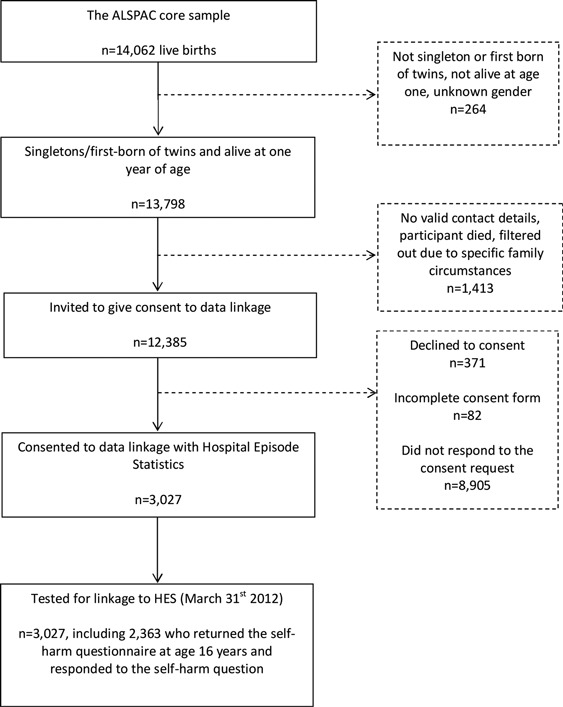
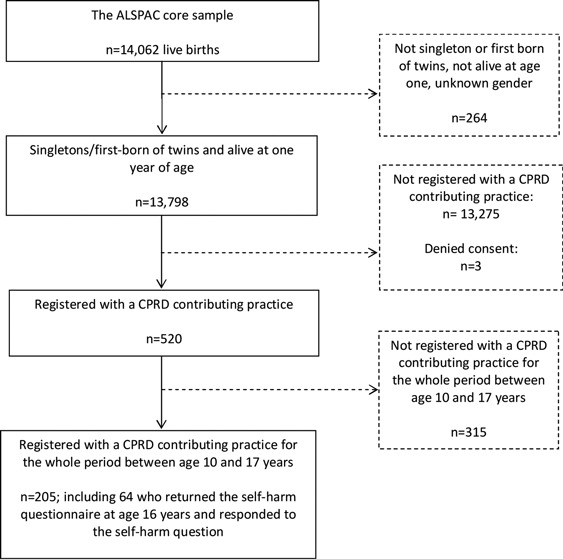
The objective of this study was to examine agreement between self-reported and medically recorded self-harm, and investigate whether the prevalence of self-harm differs in questionnaire responders vs. non-responders. A total of 4,810 participants from the Avon Longitudinal Study of Parents and Children (ALSPAC) completed a self-harm questionnaire at age 16 years. Data from consenting participants were linked to medical records (number available for analyses ranges from 205-3,027). The prevalence of self-harm leading to hospital admission was somewhat higher in questionnaire non-responders than responders (2.0 vs. 1.2%). Hospital attendance with self-harm was under-reported on the questionnaire. One third reported self-harm inconsistently over time; inconsistent reporters were less likely to have depression and fewer had self-harmed with suicidal intent. Self-harm prevalence estimates derived from self-report may be underestimated; more accurate figures may come from combining data from multiple sources.
Overview
The claims and statistics of this paper haven’t been checked yet.
Free: it reads the open-access text and checks the first 5 claims that cite a source we can check. Create a free account to check every claim.
Integrity signals
Registry
Cites
Statistics
Figures
Verification
Claims the paper makes
The claims and statistics of this paper haven’t been checked yet.
Free: it reads the open-access text and checks the first 5 claims that cite a source we can check. Create a free account to check every claim.
Claims other papers make about this one
Each is checked against this paper’s own text: does it say what the citing paper says it does?
The source backs part of the claim, not all of it — or backs it for a different population, condition or comparison.
In the citing paper
“Indeed, suicidal ideation in particular may be subject to mis-reporting (Mars et al., 2016)”
From From ideation to action: Differentiating between those who think about suicide and those who attempt suicide in a national study of young adults (2018) · cites this paper as Mars et al., 2016
Experimental — accuracy not yet measuredThe source backs part of the claim, not all of it — or backs it for a different population, condition or comparison.
In the citing paper
“we used health record and hospital representation data in the first instance, based on findings that these may provide more realistic estimates (Mars 2016).”
From Prevention of self-harm and suicide in young people up to the age of 25 in education settings (2024) · cites this paper as Mars 2016
Experimental — accuracy not yet measured
Self-check
Percentages, sums and reported differences re-computed from the paper’s own numbers.
The self-check needs the paper’s full text.
Citations
Cites
Boyd, A., Golding, J., Macleod, J., Lawlor, D. A., Fraser, A., Henderson, J., Molloy, L., Ness, A., Ring, S., & Davey Smith, G. (2013) · International Journal of Epidemiology · doi:10.1093/ije/dys064 · Cited by 2,996 · cited 3×
“The ALSPAC core enrolled sample consists of 14,541 pregnant women resident in the former county of Avon in South West England (United Kingdom), with expected delivery dates between April 1, 1991 and December 31, 1992 (Boyd et al., 2013).”
BackgroundMethodInfluentialSelf-citationBias and causal associations in observational research
Grimes, D. A., & Schulz, K. F. (2002) · The Lancet · doi:10.1016/s0140-6736(02)07451-2 · Cited by 1,553
Lewis, G., Pelosi, A. J., Araya, R., & Dunn, G. (1992) · Psychological Medicine · doi:10.1017/s0033291700030415 · Cited by 1,487
Self-citationDeliberate self harm in adolescents: self report survey in schools in England
Hawton, K., Rodham, K., Evans, E., & Weatherall, R. (2002) · BMJ · doi:10.1136/bmj.325.7374.1207 · Cited by 1,008 · cited 4×
“Most have focused on suicide attempts, which comprise only a portion of episodes (Hawton et al., 2002; Kidger et al., 2012; Muehlenkamp & Gutierrez, 2004).”
BackgroundInfluentialSelf-citationA Study of the Frequency of Self-Mutilation in a Community Sample of Adolescents
Ross, S., & Heath, N. (2002) · Journal of Youth and Adolescence · doi:10.1023/a:1014089117419 · Cited by 787 · cited 5×
“…to ask additional clarification questions could help to eliminate false positives that arise from inaccurate self-reports (Hawton et al., 2002; Ross & Heath, 2002; Velting et al., 1998), but it is also possible that the loss of anonymity found with interview assessments may result in…”
BackgroundMethodInfluentialMadge, N., Hewitt, A., Hawton, K., Wilde, E. J. D., Corcoran, P., Fekete, S., Heeringen, K. V., Leo, D. D., & Ystgaard, M. (2008) · Journal of Child Psychology and Psychiatry · doi:10.1111/j.1469-7610.2008.01879.x · Cited by 750 · cited 1×
“The self-harm questions used in the age 16 self-report questionnaire were based on those used in the CASE B. Mars et al. ARCHIVES OF SUICIDE RESEARCH 123 study (Madge et al., 2008).”
MethodSelf-citationNock, M. K., & Kessler, R. C. (2006) · Journal of Abnormal Psychology · doi:10.1037/0021-843x.115.3.616 · Cited by 680
Selective drop-out in longitudinal studies and non-biased prediction of behaviour disorders
Wolke, D., Waylen, A., Samara, M., Steer, C., Goodman, R., Ford, T., & Lamberts, K. (2009) · British Journal of Psychiatry · doi:10.1192/bjp.bp.108.053751 · Cited by 628 · cited 2×
“It is also important to note that while selective non-participation of those with self-harm and inconsistent reporting could result in distorted prevalence estimates, this does not necessarily lead to biased estimates of associations between self-harm and exposure variables (Wolke et al., 2009).”
BackgroundMental illness stigma and ethnocultural beliefs, values, and norms: An integrative review
Abdullah, T., & Brown, T. L. (2011) · Clinical Psychology Review · doi:10.1016/j.cpr.2011.05.003 · Cited by 625 · cited 1×
“The degree of stigma associated with mental illness and self-harm varies around the world (Abdullah & Brown, 2011; Evans-Lacko, Brohan, Mojtabai, & Thornicroft, 2012; Reynders, Kerkhof, Molenberghs, & Van Audenhove, 2014), therefore findings from our study may not be generalizable outside a UK…”
BackgroundThe Prevalence of Suicidal Phenomena in Adolescents: A Systematic Review of Population‐Based Studies
Evans, E., Hawton, K., Rodham, K., Psychol, C., & Deeks, J. (2005) · Suicide and Life-Threatening Behavior · doi:10.1521/suli.2005.35.3.239 · Cited by 549
Self-citationMuehlenkamp, J. J., & Gutierrez, P. M. (2004) · Suicide and Life-Threatening Behavior · doi:10.1521/suli.34.1.12.27769 · Cited by 533 · cited 1×
“Most have focused on suicide attempts, which comprise only a portion of episodes (Hawton et al., 2002; Kidger et al., 2012; Muehlenkamp & Gutierrez, 2004).”
BackgroundLinehan, M. M., Comtois, K. A., Brown, M. Z., Heard, H. L., & Wagner, A. (2006) · Psychological Assessment · doi:10.1037/1040-3590.18.3.303 · Cited by 485 · cited 1×
“Data on psychosocial characteristics were also collected in ALSPAC.”
BackgroundEvans-Lacko, S., Brohan, E., Mojtabai, R., & Thornicroft, G. (2012) · Psychological Medicine · doi:10.1017/s0033291711002558 · Cited by 427
Wechsler Intelligence Scale for Children
(2012) · SpringerReference · doi:10.1007/springerreference_184296 · Cited by 417
Mars, B., Heron, J., Crane, C., Hawton, K., Kidger, J., Lewis, G., Macleod, J., Tilling, K., & Gunnell, D. (2014) · Journal of Affective Disorders · doi:10.1016/j.jad.2014.07.009 · Cited by 189 · cited 1×
“Participants were classified as having a lifetime history of suicidal selfharm if they selected ‘‘I wanted to die’’ as a reason for harming themselves on the most recent occasion, or if they reported they had ever seriously wanted to kill themselves when self-harming (Mars et al., 2014).”
Self-citationReynders, A., Kerkhof, A. J. F. M., Molenberghs, G., & Van Audenhove, C. (2014) · Social Psychiatry and Psychiatric Epidemiology · doi:10.1007/s00127-013-0745-4 · Cited by 164
Predicting female depression across puberty: A two-nation longitudinal study
Patton, G. C., Olsson, C., Bond, L., Toumbourou, J. W., Carlin, J. B., Hemphill, S. A., & Catalano, R. F. (2008) · Journal of the American Academy of Child & Adolescent Psychiatry · doi:10.1097/chi.0b013e3181886ebe · Cited by 159 · cited 2×
“…age 8 years (6) depression symptoms, assessed at age 16 and 18 years using the short Moods and Feelings Questionnaire (SMFQ), a score of 11 or more on the SMFQ was taken as indicative of depressive symptoms (Patton et al., 2008) and (7) depressive disorder, assessed at age 18 years using the CIS-R.”
MethodAssessing psychiatric disorder with a human interviewer or a computer.
Lewis, G. (1994) · Journal of Epidemiology and Community Health · doi:10.1136/jech.48.2.207 · Cited by 150 · cited 5×
“The following variables were used: (1) participant’s gender, (2) ethnicity, (3) parent social class (professional=managerial or other occupations; the highest of maternal or paternal social class was used), (4) highest maternal educational attainment (less than O-level, O-level, A-level, or university degree) measured…”
MethodInfluentialSelf-citationAdolescent self-harm and suicidal thoughts in the ALSPAC cohort: a self-report survey in England
Kidger, J., Heron, J., Lewis, G., Evans, J., & Gunnell, D. (2012) · BMC Psychiatry · doi:10.1186/1471-244x-12-69 · Cited by 148 · cited 7×
“7%) returned it and 4,810 completed the self-harm items (Kidger et al., 2012).”
BackgroundInfluentialSelf-citationYstgaard, M., Arensman, E., Hawton, K., Madge, N., van Heeringen, K., Hewitt, A., Jan de Wilde, E., De Leo, D., & Fekete, S. (2009) · Journal of Adolescence · doi:10.1016/j.adolescence.2008.10.010 · Cited by 127 · cited 1×
“Community studies of self-harm are vital as the majority of self-harm episodes do not present to clinical services (Hawton, Rodham, Evans, & Weatherall, 2002; Kidger, Heron, Lewis, Evans, & Gunnell, 2012; Ystgaard et al., 2009).”
BackgroundSelf-citationResponse consistency in young adolescents’ drug use self‐reports: a recanting rate analysis
Percy, A., McAlister, S., Higgins, K., McCrystal, P., & Thornton, M. (2005) · Addiction · doi:10.1111/j.1360-0443.2004.00943.x · Cited by 123
Self-Reported Suicide Attempts by Adolescents
Safer, D. J. (1997) · Annals of Clinical Psychiatry · doi:10.1023/a:1022364629060 · Cited by 103 · cited 3×
“, 1998), but it is also possible that the loss of anonymity found with interview assessments may result in under-reporting of self-harm (Safer, 1997).”
BackgroundInfluentialValidation of suicide and self‐harm records in the Clinical Practice Research Datalink
Thomas, K. H., Davies, N., Metcalfe, C., Windmeijer, F., Martin, R. M., & Gunnell, D. (2013) · British Journal of Clinical Pharmacology · doi:10.1111/bcp.12059 · Cited by 84 · cited 3×
“Cases of self-harm occurring in the CPRD until December 31, 2011 were identified using appropriate Read codes for attempted suicide and self-harm (see Appendix 2) (Thomas et al., 2013).”
BackgroundMethodInfluentialSelf-citationMorthorst, B., Krogh, J., Erlangsen, A., Alberdi, F., & Nordentoft, M. (2012) · BMJ · doi:10.1136/bmj.e4972 · Cited by 84
Patton, G. C., Coffey, C., Posterino, M., Carlin, J. B., Wolfe, R. S., & Bowes, G. (1999) · Social Psychiatry and Psychiatric Epidemiology · doi:10.1007/s001270050129 · Cited by 79 · cited 5×
“The following variables were used: (1) participant’s gender, (2) ethnicity, (3) parent social class (professional=managerial or other occupations; the highest of maternal or paternal social class was used), (4) highest maternal educational attainment (less than O-level, O-level, A-level, or university degree) measured…”
MethodInfluentialChristl, B., Wittchen, H.-U., Pfister, H., Lieb, R., & Bronisch, T. (2006) · Archives of Suicide Research · doi:10.1080/13811110600582539 · Cited by 55 · cited 6×
“There is some evidence to suggest that individuals with more severe psychopathology are more likely to report self-harm consistently over time (Christl et al., 2006; Eikelenboom, Smit, Beekman, Kerkhof, & Penninx, 2014).”
BackgroundResultInfluentialOugrin, D., & Boege, I. (2013) · Journal of Adolescence · doi:10.1016/j.adolescence.2012.09.006 · Cited by 50 · cited 3×
“The agreement between different sources of data on self-reported self-harm in adolescents has previously been investigated (Bjärehed, Pettersson, Wångby-Lundh, & Lundh, 2013; O’Sullivan & Fitzgerald, 1998; Ougrin & Boege, 2013; Ross & Heath, 2002; Velting et al., 1998).”
BackgroundMethodA Closer Look at Self‐Reported Suicide Attempts: False Positives and False Negatives
Plöderl, M., Kralovec, K., Yazdi, K., & Fartacek, R. (2011) · Suicide and Life-Threatening Behavior · doi:10.1111/j.1943-278x.2010.00005.x · Cited by 50
The Value of Forgetting Suicidal Thoughts and Behavior
Klimes‐Dougan, B., Safer, M. A., Ronsaville, D., Tinsley, R., & Harris, S. J. (2007) · Suicide and Life-Threatening Behavior · doi:10.1521/suli.2007.37.4.431 · Cited by 45
Factors associated with being a false positive on the General Health Questionnaire
Bell, T., Watson, M. C., Sharp, D., Lyons, I., & Lewis, G. (2005) · Social Psychiatry and Psychiatric Epidemiology · doi:10.1007/s00127-005-0881-6 · Cited by 44
Self-citationAsking Adolescents to Explain Discrepancies in Self‐Reported Suicidality
Velting, D. M., Rathus, J. H., & Asnis, G. M. (1998) · Suicide and Life-Threatening Behavior · doi:10.1111/j.1943-278x.1998.tb00638.x · Cited by 42 · cited 8×
“…clarification questions could help to eliminate false positives that arise from inaccurate self-reports (Hawton et al., 2002; Ross & Heath, 2002; Velting et al., 1998), but it is also possible that the loss of anonymity found with interview assessments may result in under-reporting of…”
BackgroundMethodInfluentialHart, S. R., Musci, R. J., Ialongo, N., Ballard, E. D., & Wilcox, H. C. (2013) · Depression and Anxiety · doi:10.1002/da.22135 · Cited by 41 · cited 1×
“Our finding that a third of adolescents were discrepant in their reporting of lifetime self-harm over time is lower than the proportion found by Hart et al. (2013) (approximately two thirds disrepant 1 year after reporting a self-harm event) but similar to findings of other previous longitudinal…”
ResultReporting suicide attempts: consistency and its determinants in a large mental health study
Eikelenboom, M., Smit, J. H., Beekman, A. T. F., Kerkhof, A. J. F. M., & Penninx, B. W. J. H. (2014) · International Journal of Methods in Psychiatric Research · doi:10.1002/mpr.1423 · Cited by 39 · cited 3×
“…than the proportion found by Hart et al. (2013) (approximately two thirds disrepant 1 year after reporting a self-harm event) but similar to findings of other previous longitudinal research (Eikelenboom et al., 2014, Christl et al., 2006), all of which investigated reporting of suicide attempts.”
BackgroundResultSuicidal ideation and acts of self-harm among Dublin school children
O’Sullivan, M. J., & Fitzgerald, M. (1998) · Journal of Adolescence · doi:10.1006/jado.1998.0163 · Cited by 30 · cited 2×
“The agreement between different sources of data on self-reported self-harm in adolescents has previously been investigated (Bjärehed, Pettersson, Wångby-Lundh, & Lundh, 2013; O’Sullivan & Fitzgerald, 1998; Ougrin & Boege, 2013; Ross & Heath, 2002; Velting et al., 1998).”
BackgroundMethodThe Benefit of Forgetting Suicidal Ideation
Goldney, R. D., Winefield, A. H., Winefield, H. R., & Saebel, J. (2009) · Suicide and Life-Threatening Behavior · doi:10.1521/suli.2009.39.1.33 · Cited by 29
Bjärehed, J., Pettersson, K., Wångby‐Lundh, M., & Lundh, L. (2012) · The Journal of School Nursing · doi:10.1177/1059840512458527 · Cited by 24 · cited 2×
“Studies have reported inconsistency across different self-report methods, e.g., interviews vs. questionnaires (Bjärehed et al., 2013; O’Sullivan & Fitzgerald, 1998; Ougrin & Boege, 2013; Ross & Heath, 2002; Velting et al., 1998), and also when using the same self-report method across repeated…”
Method
Cited by
Causal inference with observational data: the need for triangulation of evidence
Hammerton, G., & Munafò, M. R. (2021) · Psychological Medicine · doi:10.1017/s0033291720005127 · Cited by 262
“…used in the context of mental health (Christensen, Ekholm, Gray, Glumer, & Juel, 2015; Cornish et al., 2015; Gorman et al., 2014; Gray et al., 2013; Mars et al., 2016) to examine the extent of biases from selective non-response by providing data on those that did and did not respond to assessments…”
MethodInterventions for self-harm in children and adolescents
Hawton, K., Witt, K. G., Taylor Salisbury, T. L., Arensman, E., Gunnell, D., Townsend, E., van Heeringen, K., & Hazell, P. (2015) · Cochrane Database of Systematic Reviews · doi:10.1002/14651858.cd012013 · Cited by 261
Self-citationMars, B., Heron, J., Klonsky, E. D., Moran, P., O'Connor, R. C., Tilling, K., Wilkinson, P., & Gunnell, D. (2019) · Journal of Child Psychology and Psychiatry · doi:10.1111/jcpp.12878 · Cited by 185
Self-citationWitt, K., Spittal, M. J., Carter, G., Pirkis, J., Hetrick, S., Currier, D., Robinson, J., & Milner, A. (2017) · BMC Psychiatry · doi:10.1186/s12888-017-1458-0 · Cited by 179
“Between studies, however, outcome measure definition may have affected our results in light of research findings suggesting that self-reported self-harm underestimates hospitaltreated self-harm [68].”
ResultInterventions for self-harm in children and adolescents
Witt, K. G., Hetrick, S. E., Rajaram, G., Hazell, P., Taylor Salisbury, T. L., Townsend, E., & Hawton, K. (2021) · Cochrane Database of Systematic Reviews · doi:10.1002/14651858.cd013667.pub2 · Cited by 149
Self-citation
Metadata
- Authors
- Mars, B., Cornish, R., Heron, J., Boyd, A., Crane, C., Hawton, K., Lewis, G., Tilling, K., Macleod, J., & Gunnell, D.
- Corresponding author
- Mars, Becky
- ORCID
- Venue
- Archives of Suicide Research
- Publisher
- Informa UK Limited
- Published
- 2016-01-20
- Volume
- 20
- Issue
- 2
- Pages
- 113-141
- ISSN
- 1381-1118 (ISSN-L)
- 1543-6136
- PMC
- PMC4841016
- OpenAlex
- W2280892688
- Cited by
- 96
- References
- 36
- Citations by year
- 2026: 11 · 2025: 4 · 2024: 6 · 2023: 9 · 2022: 13 · 2021: 14 · 2020: 7 · 2019: 12 · 2018: 8 · 2017: 9 · 2016: 2
- FWCI
- 14.28
- Type
- journal article
- Language
- en
- Open access
- hybrid
- doi.org
- Licence
- Locations
- Archives of Suicide Research (publishedVersion, cc-by)
- Europe PMC (PubMed Central) (publishedVersion, cc-by)
- PubMed Central (publishedVersion, cc-by)
- PubMed (publishedVersion)
- UCL Discovery (University College London) (submittedVersion)
- Bristol Research (University of Bristol) (submittedVersion, cc-by)
- Explore Bristol Research (submittedVersion, cc-by)
- Funders
- Wellcome Trust (102215)
- Medical Research Council (MR/J012661/1, MC_PC_15018, MR/K023233/1)
- Topics
- Social Sciences › Psychology › Clinical Psychology › Suicide and Self-Harm Studies
- Social Sciences › Sociology and Political Science › Survey Methodology and Nonresponse
- Social Sciences › Sociology and Political Science › Homicide, Infanticide, and Child Abuse
- Keywords
- self-harm, data linkage, underreporting, hospitalization, depression, suicidal intent, adolescent self-harm, Avon Longitudinal Study of Parents and Children, self-report accuracy
- MeSH terms
- Adolescent, Depression, Emergency Service, Hospital, Female, United Kingdom, Hospitalization, Humans, Longitudinal Studies, Male, Surveys and Questionnaires, Suicide, Attempted, Prevalence, Information Storage and Retrieval, Self-Injurious Behavior, Self Report, Suicidal Ideation
About these checks
Registry, retraction, Cites and statistics results are computed, not judged, with one exception: a printed reference that no index lists is read once by a model before it counts as a citation error. Claims are extracted by a model and kept only when their quote appears verbatim in the text; each cited source is then checked, with a model’s help, for whether it says what the claim relies on. Those verdicts can be wrong — read the claim’s quote and the cited source before relying on one.
Statistics and arithmetic are recomputed, not judged.
Confidence bands are shown only for fields calibrated on our annotated test set. None is calibrated yet, so no band is shown.
What counts as a claim ›How we measure confidence ›How we check this ›
Are you an author, or do you see a problem with this page? Request a review
Data sources
Bibliographic data: Semantic Scholar, OpenAlex, Crossref.
Contains information from the Semantic Scholar Academic Graph Datasets, made available under the ODC Attribution License (ODC-BY 1.0).
Semantic Scholar’s data is described in: Kinney, R., et al. (2023). The Semantic Scholar Open Data Platform. arXiv:2301.10140.
