

Regionalism and Alliances in the Middle East, 2011-2021: From a “Flash in the Pan” of Regional Cooperation to Liquid Alliances
Open accessThe DOI matches its Crossref record; 88 of the 88 references it cites were found in a registry or an index; none of the 25 sources its claims cite is checked for support yet.
Abstract
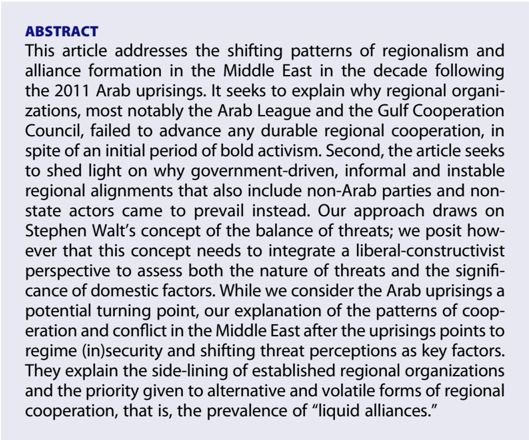
This article addresses the shifting patterns of regionalism and alliance formation in the Middle East in the decade following the 2011 Arab uprisings. It seeks to explain why regional organizations, most notably the Arab League and the Gulf Cooperation Council, failed to advance any durable regional cooperation... shifting threat perceptions and regime (in)security as key factors. They explain the side-lining of established regional organizations and the priority given to alternative and volatile forms of regional cooperation, that is, the prevalence of “liquid alliances.”
Overview
CoChat Summary
TL;DR
The article explains why the Arab League and GCC briefly engaged in bold regional cooperation after the 2011 Arab uprisings but failed to sustain it, proving a “flash in the pan” after 2013. It argues that heightened regime insecurity and diverging threat perceptions produced “liquid alliances”—informal, volatile, state and non-state alignments—as the dominant pattern of Middle East cooperation and conflict through 2021.
Key findings
- Established regional organisations failed to sustain durable cooperation. The Arab League suspended Syria’s membership in November 2011 and imposed sanctions supported by 19 of its 22 members; the GCC called for a no-fly zone over Libya and deployed the Peninsula Shield Force to Bahrain. But the regionalist momentum faded from 2013, the “Gulf Union” project failed, and the June 2017 boycott of Qatar by Saudi Arabia, the UAE, Egypt, and Bahrain paralysed the GCC until the January 2021 Al-‘Ula reconciliation.
- Liquid alliances became prevalent. Examples include the Saudi-led coalition of nine countries intervening in Yemen in March 2015; the Islamic Military Counter Terrorism Coalition (IMCTC), created in December 2015 with 41 countries but no founding treaty and an opaque governance structure; the informal “Arab Quartet” against Qatar; and the Saudi-UAE joint committee announced in December 2017.
- The authors argue that regime insecurity and shifting threat perceptions, not material power alone, drove alliance formation. Domestic and external threats to regime survival were strongly interlinked, and Walt’s balance-of-threats approach must be read through a constructivist lens to explain threat definition and salience.
- Liquid alliances include non-state actors—such as Khalifa Haftar with the UAE and Egypt, Hezbollah, Hamas, the Houthis with Iran, and Yemen’s Southern Transitional Council with the UAE—and allies in one conflict often confront each other in another.
Methods
- Qualitative analysis of regional alliance formation in the Middle East from 2011 to 2021, focusing on the Arab League, the GCC, and the emergence of liquid alliances.
- Data include 14 face-to-face interviews with senior Arab League and GCC officials, diplomats of various Arab states, and international diplomats in Cairo and Riyadh between December 2017 and February 2018, plus an additional six anonymised interviews with government officials and international diplomats conducted face-to-face or online between December 2017 and February 2021.
- The article engages Stephen Walt’s balance-of-threats theory and integrates a liberal-constructivist perspective, assessing changing preferences and threat perceptions of regional actors through official statements, press releases, and elite interviews.
Limitations
- The paper states that official statements and press releases provide limited information on internal decision-making and preference formation, which is why it relies on interviews.
- The paper states that whether the patterns of regionalism and alliance formation identified are observable in other parts of the world “certainly deserves further investigation.”
- No explicit limitations section is present; evident from the text, the analysis rests on a limited set of 20 anonymised elite interviews concentrated in Cairo and Riyadh and on a single-region case over 2011–2021.
Model-written summary. Check it against the paper before relying on it.
Integrity signals
Registry
Cites
Statistics
Figures


Verification
Claims the paper makes
0 Valid · 3 Not valid · 25 Not checked · 75 Own results and interpretations
None of the sources cited for this claim have been checked yet.
In the paper
“Nineteen of the Arab League's 22 member states supported this package of sanctions, which included a travel ban for senior officials, a freeze on Syrian government assets, a ban on transactions with Syria's central bank, and an end to all commercial transactions.10”
§ Regionalism and Alliances in the Middle East, 2011-2021: From a "Flash in the Pan" of Regional Cooperation to Liquid Alliances > Institutionalized Regional Cooperation: A Flash in the Pan
plain- Asserted: passes — The authors put it forward as true.
- Checkable: passes — It can be checked against evidence.
- Load-bearing: unclear — It is unclear whether the paper’s conclusions depend on it.
- Based: passes — The paper gives a reason why it holds.
A result the paper states — it cites no source for it, so there is none to check. The quote shows it is in the paper.
In the paper
“It seeks to explain why regional organizations, most notably the Arab League and the Gulf Cooperation Council, failed to advance any durable regional cooperation, in spite of an initial period of bold activism.”
§ Regionalism and Alliances in the Middle East, 2011-2021: From a "Flash in the Pan" of Regional Cooperation to Liquid Alliances > Abstract
plain- Asserted: passes — The authors put it forward as true.
- Checkable: passes — It can be checked against evidence.
- Load-bearing: passes — The paper’s conclusions depend on it.
- Based: passes — The paper gives a reason why it holds.
A result the paper states — it cites no source for it, so there is none to check. The quote shows it is in the paper.
In the paper
“However, the third option, that is, loose and ever-shifting security alignments, became the prevalent pattern of cooperation and conflict in the post-2011 Middle East.”
§ Regionalism and Alliances in the Middle East, 2011-2021: From a "Flash in the Pan" of Regional Cooperation to Liquid Alliances > Introduction
plain- Asserted: passes — The authors put it forward as true.
- Checkable: passes — It can be checked against evidence.
- Load-bearing: passes — The paper’s conclusions depend on it.
- Based: passes — The paper gives a reason why it holds.
None of the sources cited for this claim have been checked yet.
In the paper
“During the Doha summit in March 2013, it went a step further by inviting Syria's opposition coalition to take the country's seat on that occasion.11”
§ Regionalism and Alliances in the Middle East, 2011-2021: From a "Flash in the Pan" of Regional Cooperation to Liquid Alliances > Institutionalized Regional Cooperation: A Flash in the Pan
plain- Asserted: passes — The authors put it forward as true.
- Checkable: passes — It can be checked against evidence.
- Load-bearing: unclear — It is unclear whether the paper’s conclusions depend on it.
- Based: passes — The paper gives a reason why it holds.
A result the paper states — it cites no source for it, so there is none to check. The quote shows it is in the paper.
In the paper
“In this case, the countries of the Arab League formally endorsed Elaraby's proposal at its Sharm-el-Sheikh summit in March 2015.”
§ Regionalism and Alliances in the Middle East, 2011-2021: From a "Flash in the Pan" of Regional Cooperation to Liquid Alliances > Institutionalized Regional Cooperation: A Flash in the Pan
plain- Asserted: passes — The authors put it forward as true.
- Checkable: passes — It can be checked against evidence.
- Load-bearing: passes — The paper’s conclusions depend on it.
- Based: passes — The paper gives a reason why it holds.
63 more claims
Create a free account to see all 103 claims and to verify the 1 reference still open.
- Probably not a substantial claim. 6
- It may state two separate claims as one. 29
Self-check
Percentages, sums and reported differences re-computed from the paper’s own numbers.
Each contradiction between two passages listed here was confirmed by an independent check.
Rated minor: it would not touch a result — a value no result rests on, a p-value that stays on the same side of the significance level, or a conflict that is clerical, resolved elsewhere in the paper, or outside its own findings.
In the paper
§ Regionalism and Alliances in the Middle East, 2011-2021: From a "Flash in the Pan" of Regional Cooperation to Liquid Alliances > Institutionalized Regional Cooperation: A Flash in the Pan
“(Fawcett 2019a, 216-217).”
§ Regionalism and Alliances in the Middle East, 2011-2021: From a "Flash in the Pan" of Regional Cooperation to Liquid Alliances > References
“28. Fawcett, L. 2019a. Introduction: The Middle East and International Relations. In International relations of the Middle East, ed. L. Fawcett, 1-16. 5th ed. Oxford: Oxford University Press.”
Citations
Cites
Security: A New Framework for Analysis
Hampson, F. O., Buzan, B., Waever, O., & Wilde, J. D. (1998) · International Journal · doi:10.2307/40203739 · Cited by 6,530 · cited 1×
“Yet the MENA region can be defined as a security complex (Buzan, Wæver, and de Wilde 1998) – or as several overlapping security complexes (Halliday 2005; Hinnebusch 2003; Lawson 2006).”
BackgroundAnarchy is what states make of it: the social construction of power politics
Wendt, A. (1992) · International Organization · doi:10.1017/s0020818300027764 · Cited by 5,885 · cited 1×
“…at least tacitly implies that the definition of threats and their prioritisation are not fixed or given, but rather (inter) subjective and partly arbitrary, as constructivist approaches and critical security studies have postulated (e.g., Bilgin 2010; Krause and Williams 1997; Wendt 1992).”
BackgroundPerception and Misperception in International Politics
Jervis, R. (2017) · doi:10.1515/9781400885114 · Cited by 3,199
The Culture of national security: norms and identity in world politics
(1997) · Choice Reviews Online · doi:10.5860/choice.34-5942 · Cited by 2,135
Ontological Security in World Politics: State Identity and the Security Dilemma
Mitzen, J. (2006) · European Journal of International Relations · doi:10.1177/1354066106067346 · Cited by 1,854 · cited 1×
“It would be worth exploring to what extent our analytical framework ‘speaks’ to the literature on ontological (in)security (e.g., Darwich 2016; Mitzen 2006).”
BackgroundSecurity: A New Framework for Analysis
Buzan, B., Wæver, O., & de Wilde, J. (1997) · doi:10.1515/9781685853808 · Cited by 1,692
Critical Geopolitics: The Politics of Writing Global Space
Murphy, A. B., & Tuathail, G. O. (1998) · Geographical Review · doi:10.2307/216022 · Cited by 636
Critical geopolitics: the politics of writing global space
Derrick Sidaway, J. (1997) · International Affairs · doi:10.2307/2624476 · Cited by 603
Critical Security Studies: Concepts and Cases
Krause, K. R., & Williams, M. C. (1997) · Project Muse (Johns Hopkins University) · Cited by 601
Over-stating the Arab state: politics and society in the Middle East
(1996) · Choice Reviews Online · doi:10.5860/choice.33-4152 · Cited by 576
Norm Subsidiarity and Regional Orders: Sovereignty, Regionalism, and Rule-Making in the Third World1
Acharya, A. (2011) · International Studies Quarterly · doi:10.1111/j.1468-2478.2010.00637.x · Cited by 422 · cited 14×
“Yet the MENA region can be defined as a security complex (Buzan, Wæver, and de Wilde 1998) – or as several overlapping security complexes (Halliday 2005; Hinnebusch 2003; Lawson 2006).”
MethodInfluentialRegionalism in world politics : regional organization and international order
Fawcett, L., & Hurrell, A. (1995) · Oxford University Press eBooks · Cited by 368
Resilient Royals: How Arab Monarchies Hang On
Yom, S. L., & Gause, F. G. (2012) · Journal of Democracy · doi:10.1353/jod.2012.0062 · Cited by 305 · cited 1×
“18 The Gulf regimes thus closed ranks to collectively address a shared threat to stability and regime survival, as a realist reading of these events would have anticipated (Yom and Gause 2012).”
BackgroundArab Politics. The Search For Legitimacy
Coulson, M. C. (1979) · Verfassung in Recht und Übersee · doi:10.5771/0506-7286-1979-3-286 · Cited by 303
The Middle East in international relations: power, politics and ideology
(2005) · Choice Reviews Online · doi:10.5860/choice.43-1211 · Cited by 241
The Middle East in International Relations: Power, Politics and Ideology
Halliday, F. (2005) · doi:10.1017/cbo9780511790829 · Cited by 223
Sectarianism and conflict in Syria
Phillips, C. (2015) · Third World Quarterly · doi:10.1080/01436597.2015.1015788 · Cited by 197 · cited 2×
“With Syria descending into civil war, regional players backed and armed rival rebel groups with respect to their own geopolitical competition as Iran increasingly meddled in regional affairs as well, most notably in Syria (Abboud 2016; Malmvig et al. 2017; Phillips 2015).”
BackgroundThe International Politics of the Middle East
Hinnebusch, R. (2003) · Manchester University Press eBooks · doi:10.7228/manchester/9780719053450.001.0001 · Cited by 190
Sectarian Gulf: Bahrain, Saudi Arabia, and the Arab Spring That Wasn't
Matthiesen, T. (2013) · Stanford University Press eBooks · doi:10.1515/9780804787222 · Cited by 185
Sectarianism as Counter‐Revolution: Saudi Responses to the Arab Spring
Al‐Rasheed, M. (2011) · Studies in Ethnicity and Nationalism · doi:10.1111/j.1754-9469.2011.01129.x · Cited by 178
The Arab Spring and the Saudi-Led Counterrevolution
Kamrava, M. (2012) · Orbis · doi:10.1016/j.orbis.2011.10.011 · Cited by 166 · cited 2×
“For the major Gulf monarchies, sectarian securitisation also served the purpose of legitimising the status quo domestically and advancing the counter-revolution at the regional level (Al-Rasheed 2011; Kamrava 2012).”
BackgroundSectarianization: Mapping the New Politics of the Middle East
Hashemi, N., & Postel, D. (2017) · The Review of Faith & International Affairs · doi:10.1080/15570274.2017.1354462 · Cited by 162
The Arab cold war : Gamal ʾAbd al-Nasir and his rivals, 1958-1970
Kerr, M. H. (1971) · Medical Entomology and Zoology · Cited by 155
The New Arab Wars: Uprisings and Anarchy in the Middle East
Lynch, M. (2016) · Cited by 148
Agnew, J. A. (2002) · Routledge eBooks · doi:10.4324/9780203764343 · Cited by 140
International Relations of the Middle East
Fawcett, L. (2016) · Oxford University Press eBooks · doi:10.1093/hepl/9780198708742.001.0001 · Cited by 138
SOLINGEN, E. (2007) · American Political Science Review · doi:10.1017/s0003055407070487 · Cited by 134 · cited 1×
“Solingen (2007, 2008, 2015) highlights the causal relationship between the nature of domestic coalitions vying for power and the nature of the regional order.”
BackgroundThe Genesis, Design and Effects of Regional Institutions: Lessons from East Asia and the Middle East
Solingen, E. (2008) · International Studies Quarterly · doi:10.1111/j.1468-2478.2008.00501.x · Cited by 122 · cited 1×
“Solingen (2007, 2008, 2015) highlights the causal relationship between the nature of domestic coalitions vying for power and the nature of the regional order.”
BackgroundBALANCING WHAT? THREAT PERCEPTION AND ALLIANCE CHOICE IN THE GULF
GAUSE, F. (2003) · Security Studies · doi:10.1080/09636410490521271 · Cited by 121 · cited 2×
“In keeping with this tradition, Gregory Gause (2003) observed that states in the Middle East tend to give higher priority to threats to the regime over ‘traditional’ foreign policy concerns.”
BackgroundSectarian Politics in the Gulf: From the Iraq War to the Arab Uprisings
Wehrey, F. M. (2013) · doi:10.7312/wehr16512 · Cited by 118
The New Arab Cold War: rediscovering the Arab dimension of Middle East regional politics
VALBJØRN, M., & BANK, A. (2012) · Review of International Studies · doi:10.1017/s0260210511000283 · Cited by 113 · cited 2×
“However, while a distinct Arab dimension in regional politics persists, states and non-state actors in the Middle East continue to refer to Arab solidarity to enhance their legitimacy and justify their policies (Valbjørn and Bank 2012).”
BackgroundSectarianization. Mapping the New Politics of the Middle East.
Morales, O. H. Q. (2018) · Foro Internacional · doi:10.24201/fi.v0i0.2532 · Cited by 112 · cited 2×
“The manipulation and securitisation of sectarian identities at home and abroad served as a major strategy in this context (Hashemi and Postel 2017; Darwich and Fakhoury 2016).”
BackgroundRoutledge Handbook of the Arab Spring
Sadiki, L. (2014) · Routledge eBooks · doi:10.4324/9781315763026 · Cited by 100
A Political economy of the Middle East
Niblock, T., & Wilson, R. (2015) · Choice Reviews Online · doi:10.5860/choice.191335 · Cited by 94
Agnew, J. A. (2003) · Choice Reviews Online · doi:10.5860/choice.40-4752 · Cited by 94
(2009) · Cited by 93
The Middle East: A region without regionalism or the end of exceptionalism?
Aarts, P. (1999) · Third World Quarterly · doi:10.1080/01436599913406 · Cited by 92 · cited 2×
“1 Scholars have often considered the failure to establish solid regional arrangements, whether in the realms of security, politics, or economics, as an anomaly, allegedly reflecting the broader trend of the Middle East being immune to developments in other parts of the world (e.g., Aarts 1999, 911).”
BackgroundWhose ‘Middle East’? Geopolitical Inventions and Practices of Security
Bilgin, P. (2004) · International Relations · doi:10.1177/0047117804041739 · Cited by 91 · cited 2×
“…realities also shape the definition of interests and identities while actively producing and reproducing these realities, a central claim of constructivist IR scholarship, critical security studies, and critical geopolitics alike (e.g. Agnew 2002; Bilgin 2004; Hazbun et al. 2012; Ó Tuathail 1996).”
BackgroundBeyond Regionalism?: Regional Cooperation, Regionalism and Regionalization in the Middle East
Harders, C., & Legrenzi, M. (2008) · Cited by 79
Saudi Arabia and Iran: soft power rivalry in the Middle East
Dillman, B. (2014) · Choice Reviews Online · doi:10.5860/choice.51-4702 · Cited by 78
Contentious borders in the Middle East and North Africa: context and concepts
Sarto, R. A. D. (2017) · International Affairs · doi:10.1093/ia/iix070 · Cited by 73 · cited 2×
“As a pronounced lack of domestic legitimacy continued to characterise most Arab regimes (e.g., Del Sarto 2017; Fawcett 2017; Hudson 2015; Salloukh 2017), rulers responded by augmenting repression and violence at home and by strengthening the role of the security apparatus (Lynch 2016, 2018).”
BackgroundSelf-citationRegional Security in the Middle East: A Critical Perspective
Bilgin, P. (2019) · Thammasat University Digital Collections · doi:10.4324/9781315204123 · Cited by 72
Over-stating the Arab state politics and society in the Middle East
Ayubi, N. N. M. (n.d.) · Cited by 69
The GCC and the International Relations of the Gulf
Legrenzi, M. (2011) · I.B.Tauris eBooks · doi:10.5040/9780755609086 · Cited by 66 · cited 1×
“15 The Gulf Cooperation Council, for long considered the best-performing regional organisation in the MENA – often with an ‘exceedingly enthusiastic attitude’ (Legrenzi 2015, 2) – similarly turned into an active player in the early days of the uprisings.”
BackgroundThe intra-GCC crises: mapping GCC fragmentation after 2011
Bianco, C., & Stansfield, G. (2018) · International Affairs · doi:10.1093/ia/iiy025 · Cited by 64 · cited 7×
“Interestingly, Kuwait and Oman did not align themselves with the anti-Qatar bloc: Kuwait initially sought to mediate in the crisis, and Oman opened its ports to vessels travelling to and from Qatar, with its national airline also offering additional flights to Doha (Bianco and Stansfield 2018: 618).”
BackgroundInfluentialStates and sovereignty in the Middle East: myths and realities
Fawcett, L. (2017) · International Affairs · doi:10.1093/ia/iix122 · Cited by 60 · cited 5×
“According to a GCC official interviewed in Riyadh (December 2017), in this period ‘no individual state could tackle the challenges alone’.”
BackgroundInfluentialThe Ontological (In)security of Similarity Wahhabism Versus Islamism in Saudi Foreign Policy
Darwich, M. (2016) · Foreign Policy Analysis · doi:10.1093/fpa/orw032 · Cited by 58 · cited 1×
“It would be worth exploring to what extent our analytical framework ‘speaks’ to the literature on ontological (in)security (e.g., Darwich 2016; Mitzen 2006).”
BackgroundDarwich, M., & Fakhoury, T. (2016) · Global Discourse · doi:10.1080/23269995.2016.1259231 · Cited by 55 · cited 2×
“The manipulation and securitisation of sectarian identities at home and abroad served as a major strategy in this context (Hashemi and Postel 2017; Darwich and Fakhoury 2016).”
BackgroundCrafting Cooperation: Regional Institutions in Comparative Perspective
Johnston, A. I., & Acharya, A. (2007) · Cited by 47
Overlapping Contests and Middle East International Relations: The Return of the Weak Arab State
Salloukh, B. F. (2017) · PS Political Science & Politics · doi:10.1017/s1049096517000348 · Cited by 45 · cited 2×
“As a pronounced lack of domestic legitimacy continued to characterise most Arab regimes (e.g., Del Sarto 2017; Fawcett 2017; Hudson 2015; Salloukh 2017), rulers responded by augmenting repression and violence at home and by strengthening the role of the security apparatus (Lynch 2016, 2018).”
BackgroundArab politics the search for legitimacy
Hudson, M. C. (1977) · Cited by 42
Valbjørn, M. (2019) · Studies in Ethnicity and Nationalism · doi:10.1111/sena.12289 · Cited by 39 · cited 1×
“…of sectarian difference between Sunni and Shia in the context of the power struggle between Saudi Arabia and Iran – has been analysed extensively in the literature (e.g., Darwich and Fakhoury 2016; Hashemi and Postel 2017; Mabon 2013; Malmvig 2014; Matthiessen 2013; Rubin 2014; Valbjørn 2019).”
BackgroundCrony Capitalism in the Middle East
(2019) · Oxford University Press eBooks · doi:10.1093/oso/9780198799870.001.0001 · Cited by 39
Islam in the Balance: Ideational Threats in Arab Politics
Rubin, L. (2014) · doi:10.11126/stanford/9780804790796.001.0001 · Cited by 36
Persistent Permeability?: Regionalism, Localism, and Globalization in the Middle East
Salloukh, B. F., & Brynen, R. (2004) · Cited by 34
Saudi Arabia and Iran : soft power rivalry in the Middle East
Mabon, S. (2013) · Cited by 32
Inter-Arab alliances: regime security and Jordanian foreign policy
Ryan, C. (2009) · Choice Reviews Online · doi:10.5860/choice.47-0533 · Cited by 31
Power, Identity and Securitization in Middle East: Regional Order after the Arab Uprisings
Malmvig, H. (2013) · Mediterranean Politics · doi:10.1080/13629395.2013.856181 · Cited by 29 · cited 1×
“…of sectarian difference between Sunni and Shia in the context of the power struggle between Saudi Arabia and Iran – has been analysed extensively in the literature (e.g., Darwich and Fakhoury 2016; Hashemi and Postel 2017; Mabon 2013; Malmvig 2014; Matthiessen 2013; Rubin 2014; Valbjørn 2019).”
BackgroundUnderstanding international conflicts
Nye, J. S. (1999) · Virtual Defense Library (Ministerio de Defensa) · Cited by 29
Interregnum: The Regional Order in the Middle East and North Africa after 2011
Del Sarto, R. A., Malmvig, H., & Lecha, E. S. I. (2019) · doi:10.2139/ssrn.3367815 · Cited by 28 · cited 1×
“Importantly, (perceived) threats to regime survival originated at different levels of analysis that are nevertheless deeply inter-twined (Del Sarto, Malmvig, and Soler i Lecha 2019).”
BackgroundSelf-citationThe international system and the Syrian civil war
Phillips, C. (2022) · International Relations · doi:10.1177/00471178221097908 · Cited by 28 · cited 1×
“The end of the US-dominated multipolarity of the international system intersected with the shift towards multipolarity at the regional level, with this intersection explaining outcome (Phillips 2022).”
BackgroundThe New Arab Cold War And The Struggle For Syria
Ryan, C. R. (2020) · Figshare · doi:10.71889/5fylantbak.29870468 · Cited by 26
The Iraq War ten years on: assessing the fallout
Fawcett, L. (2013) · International Affairs · doi:10.1111/1468-2346.12020 · Cited by 25
Threats and Alliances in the Middle East: Saudi and Syrian Policies in a Turbulent Region
Darwich, M. (2019) · doi:10.1017/9781108656689 · Cited by 25 · cited 1×
“Echoing Rubin (2014), Darwich (2019) has shown that in the cases of Saudi Arabia and Syria, ideational factors are at least as important as material factors in a regime’s definition of threats.”
BackgroundSectarian Politics in the Gulf
Wehrey, F. (2013) · Columbia University Press eBooks · doi:10.7312/columbia/9780231165129.001.0001 · Cited by 21
Persistent Permeability?: Regionalism, Localism, and Globalization in the Middle East
Salloukh, B. F. (2004) · doi:10.4324/9781315247083 · Cited by 20
Constructing International Relations in the Arab World
Lawson, F. H. (2006) · Stanford University Press eBooks · doi:10.1515/9780804768023 · Cited by 19
Regionalism in Crisis: GCC Integration without Democracy
Sadiki, L. (2020) · The International Spectator · doi:10.1080/03932729.2020.1742506 · Cited by 18 · cited 1×
“These four states – the so-called Arab Quartet – also imposed travel and trade bans on the country, in full disrespect of the extensive people-to-people relations among Gulf nationals (Ulrichsen 2018; Sadiki 2020: 24).”
BackgroundAbandoning Iraq: Jordan's alliances and the politics of state identity
Lynch, M. (1998) · Security Studies · doi:10.1080/09636419808429382 · Cited by 17 · cited 1×
“…and alliance formation in the Middle East have often combined different theoretical approaches with realist baselines (e.g. Gause 2003; Hinnebusch and Ehteshami 2019; Lynch 1998), with the few self-declared realist scholars – perhaps unintentionally – often espousing not-so-realist assumptions.”
BackgroundRegional Insecurity After the Arab Uprisings
Monier, E. I. (2015) · Palgrave Macmillan UK eBooks · doi:10.1057/9781137503978 · Cited by 15
Is There a Middle East? The Evolution of a Geopolitical Concept
Miller, J. A. (2013) · The AAG Review of Books · doi:10.1080/2325548x.2013.871988 · Cited by 14
Ryan, C. R. (2009) · doi:10.5744/florida/9780813033075.001.0001 · Cited by 13
Sectarian securitization in the Middle East and the case of Israel
Del Sarto, R. A. (2021) · International Affairs · doi:10.1093/ia/iiab011 · Cited by 13 · cited 1×
“The resulting vicious cycle of insecurity, violence, and repression has become a key feature of contemporary regional politics in the Middle East (Del Sarto 2021).”
BackgroundConstructing International Relations in the Arab World
Lawson, F. H. (2006) · Stanford University Press eBooks · doi:10.11126/stanford/9780804753722.001.0001 · Cited by 10
The Middle East underpax Americana:how new, how orderly?
Hudson, M. (1992) · Third World Quarterly · doi:10.1080/01436599208420278 · Cited by 9 · cited 6×
“…with the role of external actors – usually the US – to explain alliance formation and regional order in the Middle East (e.g., Hazbun 2019; Hudson 1992) is reductive: it fails to capture the significance of (local) agency in the construction of threats, which must primarily be analysed at…”
BackgroundInfluentialMiller, R., & Cardaun, S. K. (2020) · International Affairs · doi:10.1093/ia/iiaa158 · Cited by 9 · cited 1×
“While Riyadh initially favoured the active involvement of the Arab League and the GCC in regional politics, it soon realised that there were serious ‘shortcomings of existing institutions in meeting the kingdom’s security needs’ (Miller and Cardaun 2020, 1516).”
BackgroundHazbun, W. (2020) · Stanford University Press eBooks · doi:10.1515/9780804782654-015 · Cited by 8
9. Regionalism and Alliances in the Middle East
Fawcett, L. (2019) · Oxford University Press eBooks · doi:10.1093/hepl/9780198809425.003.0009 · Cited by 5 · cited 5×
“Back then, the period of uncertainty had provided a similar impetus to strengthen regional cooperation, which nevertheless quickly receded (Fawcett 2019a, 216–217).”
BackgroundInfluentialFawcett, L. (2020) · SAGE Publications Ltd eBooks · doi:10.4135/9781529714333.n83 · Cited by 5
11. Foreign Policymaking in the Middle East: Complex Realism
Hinnebusch, R. A. J., & Ehteshami, A. (2019) · Oxford University Press eBooks · doi:10.1093/hepl/9780198809425.003.0011 · Cited by 4 · cited 2×
“…regionalism and alliance formation in the Middle East have often combined different theoretical approaches with realist baselines (e.g. Gause 2003; Hinnebusch and Ehteshami 2019; Lynch 1998), with the few self-declared realist scholars – perhaps unintentionally – often espousing not-so-realist…”
BackgroundIntroduction: The Middle East and International Relations
Fawcett, L. (2019) · Oxford University Press eBooks · doi:10.1093/hepl/9780198809425.003.0019 · Cited by 4 · cited 5×
“Back then, the period of uncertainty had provided a similar impetus to strengthen regional cooperation, which nevertheless quickly receded (Fawcett 2019a, 216–217).”
BackgroundInfluential4. The Middle East since the Cold War: The multi-layered (in)security Dilemma
Korany, B. (2016) · Oxford University Press eBooks · doi:10.1093/hepl/9780198708742.003.0005 · Cited by 4
US Policy and the Geopolitics of Insecurity in the Arab World
Hazbun, W. (2010) · Geopolitics · doi:10.1080/14650040903486918 · Cited by 3 · cited 1×
“Rather, it conceives of the regional system as a ‘multipolar structure with competing state, transnational, and societal actors’ (Hazbun 2010, 244).”
BackgroundThe Arab Cold War: Gamal 'Abd al-Nasir and His Rivals, 1958-1970. 3d ed
Kerr, M. H. (2017) · The SHAFR Guide Online · doi:10.1163/2468-1733_shafr_sim220040030 · Cited by 3
Introduction to the international politics of the Middle East
Hinnebusch, R. A. J. (2003) · Manchester University Press eBooks · doi:10.7228/manchester/9780719053450.003.0001 · Cited by 2
Introduction: Beyond Regionalism? Regional Cooperation, Regionalism and Regionalization in the Middle East
(2008) · ARCA (Università Ca' Foscari Venezia) · doi:10.4324/9781315569253-7 · Cited by 2
Arab Politics after the Uprisings: Still Searching for Legitimacy
Saleh, L. (2014) · Routledge eBooks · doi:10.4324/9781315763026-18 · Cited by 1
Introduction: The Sectarianization Thesis
Hashemi, N., & Postel, D. (2017) · Sectarianization · doi:10.1093/oso/9780190664886.003.0001
Research works printed but not linked: 16
- 2. Abboud, S. N. 2016. Syria. Cambridge; Malden: Polity Press.
- 10. Barnett, M. N. 1998. Dialogues in Arab politics. New York: Columbia University Press.
- 12. Bauman, Z. 2000. Liquid modernity. Cambridge: Polity Press.
- 26. Farouk, Y. 2019. The Middle East Strategic Alliance has a long way to go. Carnegie Middle East Centre. https://carnegieendowment.org/files/2-8_Farouk_MESA.pdf
- 35. Gause, F. G. 2022. The price of order: Settling for less in the Middle East. Foreign Affairs 101 (2):10-21.
- 36. Guazzone, L., and D. Pioppi, eds. 2009. The Arab state and neo-liberal globalization: The restructuring of the state in the Middle East. Reading: Ithaca Press.
- 38. Harel, A. 2019. Not just Qatari cash: Why violence has subsided along Gaza-Israel border. Haaretz, 9 July.
- 41. Hazbun, W. 2019. In America's wake: Turbulence and insecurity in the Middle East. Shifting global politics and the Middle East, POMEPS Study 34:14-17.
- 61. Lynch, M. 2018. The New Arab order. Foreign Affairs 97 (5):116-26.
- 64. Malmvig, H. 2017. Wars within wars: Regional actors' involvement in the battle for Syria. In New conflict dynamics: Between regional autonomy and intervention in the Middle East and North Africa, ed. R. A. Boserup, 67-78, Copenhagen: Danish Institute for International Studies.
- 74. Pinfari, M. 2013. Interregionalism and multiparty mediation: The case of Arab Africa. International Journal of Peace Studies 18 (1):83-101.
- 79. Ryan, C. R. 2015. Regime security and shifting alliances in the Middle East. In International relations theory and a changing Middle East. POMEPS Studies 16:42-26. http://pomeps.org/ 2015/09/17/international-relations-theory-and-a-new-middle-east/
- 83. Snyder, G. H. 1997. Alliance politics. Ithaca: Cornell University Press.
- 87. Solingen, E. 2015. Transcending disciplinary divide/s. In International relations theory and a changing Middle East. POMEPS Studies 16:52-61.
- 90. Ulrichsen, K. C. 2018. Missed opportunities and failed integration in the GCC. In The GCC crisis at one year: Stalemate becomes new reality, ed. Z. Azzam and I. Hard, 49-59. Washington DC: Arab Center Washington DC.
- 93. Walt, S. M. 1987. The origins of alliances. Ithaca: Cornell University Press.
Cited by
Donelli, F., & Cannon, B. J. (2025) · Geopolitics · doi:10.1080/14650045.2025.2456024 · Cited by 13
The changing regional faces of peace: Toward a new multilateralism?
Fawcett, L. (2025) · Contemporary Security Policy · doi:10.1080/13523260.2025.2460130 · Cited by 22
“Meanwhile, new alliances and accords have appeared to address a swathe of security questions, including briefly, the “Arab Quartet” against suspended GCC member Qatar, and most recently the Abraham Accords with Israel (Del Sarto & Soler i Lecha, 2024).”
Shifting dynamics of Sino-American competition in multi-aligned Middle East
Mahmood, A., & Askari, M. U. (2024) · Heliyon · doi:10.1016/j.heliyon.2024.e41053 · Cited by 3
“They have strengthened the views that the US-led world order is in decline and the multipolarity in the ME is on the rise [6].”
Charles, K., Zhanjun, W., Rajabu, I. M., Irene, E. C., & Mahmood, A. (2025) · Advances in Computational Intelligence and Robotics · doi:10.4018/979-8-3373-4217-7.ch010 · Cited by 2
Bukhari, S. R. H. (2025) · International Social Research Nexus (ISRN) · doi:10.63539/isrn.2025001 · Cited by 2
Metadata
- Authors
- Del Sarto, R. A., & Soler i Lecha, E.
- Affiliations
- Johns Hopkins University School of Advanced International Studies (SAIS)
- Universitat Autònoma de Barcelona
- Venue
- Geopolitics
- Publisher
- Informa UK Limited
- Published
- 2024-01-05
- Volume
- 29
- Issue
- 4
- Pages
- 1447-1473
- ISSN
- 1465-0045 (ISSN-L)
- 1557-3028
- OpenAlex
- W4390869440
- Cited by
- 28
- References
- 87
- Citations by year
- 2026: 10 · 2025: 16 · 2024: 2
- FWCI
- 20.08
- Type
- journal article
- Language
- en
- Open access
- hybrid
- doi.org
- Licence
- Locations
- Geopolitics (publishedVersion, cc-by-nc-nd)
- Cadmus - EUI Research Repository (European University Institute) (submittedVersion, other-oa)
- Funders
- Horizon 2020 Framework Programme (693244)
- Topics
- Social Sciences › Sociology and Political Science › Middle East Politics and Society
- Social Sciences › Sociology and Political Science › Middle East and Rwanda Conflicts
- Social Sciences › Political Science and International Relations › International Relations and Foreign Policy
- Keywords
- regionalism, regional alliances, Middle East, Arab League, Gulf Cooperation Council, Arab Spring, balance of threat, threat perception, regional organizations, non-state actors, regional cooperation
About these checks
Registry, retraction, Cites and statistics results are computed, not judged, with one exception: a printed reference that no index lists is read once by a model before it counts as a citation error. Claims are extracted by a model and kept only when their quote appears verbatim in the text; each cited source is then checked, with a model’s help, for whether it says what the claim relies on. Those verdicts can be wrong — read the claim’s quote and the cited source before relying on one.
A language model drew the claims from the paper on 2026-10-11, under version 3 of the claim definition (model deepseek-v4.1-flash, prompt extract-v3).
A second model labelled each claim on 2026-10-11 (model jev-1.13-20260917, definition revision gold-guideline-v0.2).
Statistics and arithmetic are recomputed, not judged.
Confidence bands are shown only for fields calibrated on our annotated test set. None is calibrated yet, so no band is shown.
What counts as a claim ›How we measure confidence ›How we check this ›
Are you an author, or do you see a problem with this page? Request a review
Data sources
Bibliographic data: Semantic Scholar, OpenAlex, Crossref.
Contains information from the Semantic Scholar Academic Graph Datasets, made available under the ODC Attribution License (ODC-BY 1.0).
Semantic Scholar’s data is described in: Kinney, R., et al. (2023). The Semantic Scholar Open Data Platform. arXiv:2301.10140.
