

#girls help girls#: feminist discussions and affective heterotopia in patriarchal China
Open accessThe DOI matches its Crossref record; 42 of the 42 references it cites were found in a registry or an index; 2 of the 32 sources its claims cite were checked for support.
Abstract
In June 2021, a girl named Du Meizhu revealed on Weibo (Chinese Twitter) of having been emotionally and sexually abused by the top-tier idol Kris Wu. The incident gained publicity over the month and climaxed in mid-July, when netizens started the hashtag #girls help girls# on Weibo. Rapidly topping the trending list, this incident led to heated discussions around the case and women’s social status in contemporary Chinese patriarchy. Yet unlike its #MeToo counterpart, the hashtag had been taken down hastily within hours, cutting its practitioners off from further engagements. In this paper we nonetheless propose a more positive interpretation of the incident. Combining Massumi’s affect theory with Foucault’s heterotopia, we argue that Weibo users constructed themselves an affective heterotopia in the hashtag #girls help girls#. Through an affective textual analysis of the posts in the hashtag, we argue that while vulnerable to censorship, the affective force in this heterotopia is ultimately untameable to the discursive regime, potentially leading to concrete feminist ends. In so doing, we offer methodological insight for understanding online feminist discussions in the particular context of contemporary China, adding to scholarship that transcends the global North orientation in feminist theory and politics.
Overview
CoChat Summary
TL;DR
The paper argues that Weibo users constructed an “affective heterotopia” in the hashtag #girls help girls# during the July 2021 Kris Wu sexual abuse scandal, using affect to create a feminist space that interrogated patriarchal norms despite rapid censorship. Combining Massumi’s affect theory with Foucault’s heterotopia, it analyzes 386 original posts and 500 comments to show how affective force exceeded the discursive regime.
Key findings
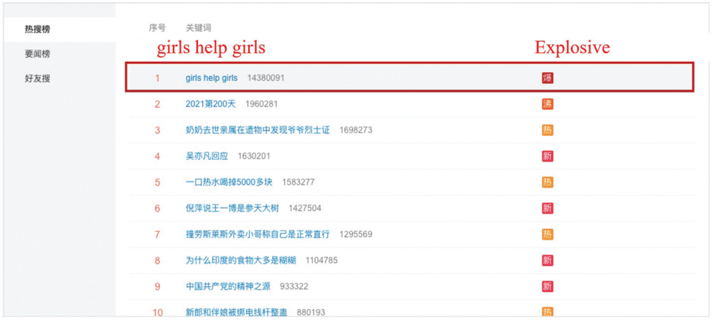
- #girls help girls# topped Weibo’s trending list by 10 am on July 19, 2021, 13 hours after Du Meizhu’s ultimatum, but was taken down within hours and disappeared around noon; users rephrased it as #girls helping girls#, #girls help girl#, and other variants, though these never regained the original tag’s explosive publicity.
- The authors identify anger, fear, solidarity, and excitement as affective forces that constituted an empathetic community, with posts interrogating gender norms, slut-shaming and chastity expectations, class disparity, and gender disparities in institutions such as the legal system.
- They argue that censorship can only target perceptible and intelligible expressions, while the pre-individual affective remainder remains untameable to the discursive regime and may lead to concrete feminist ends; the coda notes Kris Wu was detained on July 31, 2021, and sentenced in November 2022 to 13 years’ imprisonment for rape among other crimes.
- The study collected 92 original, extended posts in stage one and 294 extra original, extended posts in stage two, totaling 386 original posts and 500 comments for analysis.
Methods
- Case study of #girls help girls# on Weibo around July 19, 2021: stage one involved participant observation, favoriting, and screenshotting posts as fieldnotes; stage two in March 2022 collected posts retrospectively by searching “girls help girls” and manually simulating hashtag retrieval after the hashtag no longer indexed posts.
- Affective textual analysis of 386 original posts and 500 comments using NVivo 12.0, with inductive coding of affect in language, emojis, and pictures plus thematic analysis; the two authors coded separately and reconciled disagreements in a second collaborative round.
- Ethical measures included anonymizing quoted posts except for Kris Wu and Du Meizhu, and translating all Chinese posts themselves to prevent retrieval through keyword search.
Limitations
- Stated: the data focus on one particular case, the Kris Wu sexual scandal, and are limited in quantity due to censorship; the authors also cite the relatively small sampling size and invite future examination of multiple hashtag activisms for greater generalizability.
- Stated: the ephemerality of hashtag activism and the close entwinements of social norms with individuals’ affect in China’s cultural ecology and politics limit the argument’s scope.
- Evident from the text: the analysis is interpretive and based on a censorship-affected, non-random archive, so it cannot establish a causal link between the affective heterotopia and later legal outcomes.
Model-written summary. Check it against the paper before relying on it.
Integrity signals
Registry
Cites
Statistics
Figures


Verification
Claims the paper makes
2 Valid · 3 Not valid · 17 Not checked · 37 Own results and interpretations
The sources with a verdict support this claim; the rest weren’t checked yet, have no full text we could read, or their verdicts aren’t rated yet.
In the paper
“Indeed, scholars point out that the post-socialist era has witnessed a resurgence of patriarchy.”
§ feminist discussions and affective heterotopia in patriarchal China > Intensive negotiations of discourses in an affective heterotopia
What the sources say
- Not matchedcites Leta Hong Fincher 2016
An author–year citation the paper’s reference list doesn’t settle. We don’t search these by name.
- Not checked — no full text of the sourcecites Alicia Leung 2003 matched to “Feminism in Transition: Chinese Culture, Ideology and the Development of the Women's Movement in China” (2003) source
- Supportedcites Bingchun Meng and Yanning Huang 2017 matched to “Patriarchal capitalism with Chinese characteristics: gendered discourse of 'Double Eleven' shopping festival” (2017) source
In “The patriarchal state and the reconfiguration of the gender order” (page not provided), the paper says post-socialist market reforms opened space for the return of patriarchal values. Its concluding remarks also describe the advance of patriarchal capitalism in post-socialist China. (LLM, conf=0.93)
plainstates an association- Asserted: passes — The authors put it forward as true.
- Checkable: passes — It can be checked against evidence.
- Load-bearing: passes — The paper’s conclusions depend on it.
- Based: passes — The paper gives a reason why it holds.
- Not matched
A result the paper reports from its own data — it cites no other source for it, so there is none to check. The quote shows it is in the paper.
In the paper
“The intensity in the narratives of the harassment survivors thrashed us, which, feeding forward into the level of the perceptible and intelligible, manifested as the sensation (as far as we are concerned) and emotion (among participants as in the Weibo posts) of anger.”
§ feminist discussions and affective heterotopia in patriarchal China > Intensive negotiations of discourses in an affective heterotopia
plainstates a cause- Asserted: passes — The authors put it forward as true.
- Checkable: passes — It can be checked against evidence.
- Load-bearing: passes — The paper’s conclusions depend on it.
- Based: passes — The paper gives a reason why it holds.
- Rests on an assumption not shown here.
The paper states this without a source or data behind it here, so there is nothing to check it against. The quote shows it is in the paper.
In the paper
“We showcase that discussions in the hashtag are highly emotional, manifest as anger, fear, solidarity, and excitement.”
§ feminist discussions and affective heterotopia in patriarchal China > Introduction
plain- Asserted: passes — The authors put it forward as true.
- Checkable: passes — It can be checked against evidence.
- Load-bearing: passes — The paper’s conclusions depend on it.
- Based: unclear — It is unclear why the paper says it holds.
A result the paper reports from its own data — it cites no other source for it, so there is none to check. The quote shows it is in the paper.
In the paper
“Aside from anger, the changes in intensity among participants in the encounter with this social media event had prompted other cognitive activities, namely a reflection on women's situation in the society:”
§ feminist discussions and affective heterotopia in patriarchal China > Intensive negotiations of discourses in an affective heterotopia
plainstates a cause- Asserted: passes — The authors put it forward as true.
- Checkable: passes — It can be checked against evidence.
- Load-bearing: unclear — It is unclear whether the paper’s conclusions depend on it.
- Based: passes — The paper gives a reason why it holds.
A result the paper states — it cites no source for it, so there is none to check. The quote shows it is in the paper.
In the paper
“The civic discussions, while not completely died out, became segmented and sporadic.”
§ feminist discussions and affective heterotopia in patriarchal China > Introduction
plain- Asserted: passes — The authors put it forward as true.
- Checkable: passes — It can be checked against evidence.
- Load-bearing: passes — The paper’s conclusions depend on it.
- Based: passes — The paper gives a reason why it holds.
19 more claims
Create a free account to see all 59 claims and to verify the 2 references still open.
- It may state two separate claims as one. 22
- Probably not a substantial claim. 19
Self-check
Percentages, sums and reported differences re-computed from the paper’s own numbers.
Each contradiction between two passages listed here was confirmed by an independent check.
Rated minor: it would not touch a result — a value no result rests on, a p-value that stays on the same side of the significance level, or a conflict that is clerical, resolved elsewhere in the paper, or outside its own findings.
In the paper
§ feminist discussions and affective heterotopia in patriarchal China > Intensive negotiations of discourses in an affective heterotopia
“The "don't know what to say" in Sample 12 would be this disruption in cognition and crack in the societal discursive system”
§ feminist discussions and affective heterotopia in patriarchal China > Intensive negotiations of discourses in an affective heterotopia
“Sample 12: #girls helping girls# I will keep posting despite your taking the topic down.#girls help girls#, no way can you ever divide us.”
Citations
Cites
Gender Trouble: Feminism and the Subversion of Identity
McIntosh, M. (1991) · Feminist Review · doi:10.1057/fr.1991.33 · Cited by 29,379
(2013) · Law and Society · doi:10.1201/b16015-6 · Cited by 6,542
Foucault, M., & Miskowiec, J. (1986) · Diacritics · doi:10.2307/464648 · Cited by 5,636
Parables for the Virtual: Movement, Affect, Sensation
Massumi, B. (2002) · doi:10.1215/9780822383574 · Cited by 4,627 · cited 8×
“Indeed, Massumi (2002, 27) proposes that affect and cognition “follow different logics and pertain to different orders.””
InfluentialFoucault, M. (2005) · doi:10.4324/9780203996645 · Cited by 3,281
(2010) · Duke University Press eBooks · doi:10.1215/9780822393047 · Cited by 2,043
Shouse, E. (2005) · M/C Journal · doi:10.5204/mcj.2443 · Cited by 869
Leung, A. S. M. (2003) · Asia Pacific Journal of Management · doi:10.1023/a:1024049516797 · Cited by 256 · cited 1×
“Introduction; Alicia Leung 2003; Bingchun Meng and Yanning Huang 2017; Alex Zhao 2014).”
Clark-Parsons, R. (2021) · Feminist Media Studies · doi:10.1080/14680777.2019.1628797 · Cited by 219
After Affect: Sympathy, Synchrony, and Mimetic Communication
Gibbs, A. (2010) · The Affect Theory Reader · doi:10.1215/9780822393047-008 · Cited by 178
An emergent algorithmic culture: The data-ization of online fandom in China
Yin, Y. (2020) · International Journal of Cultural Studies · doi:10.1177/1367877920908269 · Cited by 136 · cited 2×
“…exploited the platform algorithm that bounds up publicity with “traffic data” measured by the rates of hits, likes, comments and (re)posts etc (Yiyi Yin 2020, 478). and made use of the hype of this discursive space to attract more attention for those with less public resources (social, cultural,…”
Zeng, J. (2020) · Journalism Practice · doi:10.1080/17512786.2019.1706622 · Cited by 132 · cited 2×
“To this end Sinophone fan studies provide a point of reference, where fan-media dynamism is perceived as constituting a heterotopia (Zhen Troy Chen 2018, Cheuk-Yin Li 2012, Ying Xiao 2021, Jing Jamie Zhao, Ling Yang, and Maud Lavin 2017).”
Digital masquerading: Feminist media activism in China
Tan, J. (2017) · Crime, Media, Culture: An International Journal · doi:10.1177/1741659017710063 · Cited by 122
Chen, Z. T. (2021) · Journal of Consumer Culture · doi:10.1177/1469540518787574 · Cited by 121 · cited 4×
“…and geographical locations gather on social media to consume their objects of interests, and come up with multiple “tactics” to accommodate the various norms in mainstream society and culture, which may potentially lead to cultural or social transformation (Chen 2018, Zhao, Yang, and Lavin 2017).”
InfluentialFeminist activism via social media in China
Mao, C. (2020) · Asian Journal of Women s Studies · doi:10.1080/12259276.2020.1767844 · Cited by 109
Wang, D., & Liu, S. (2021) · Qualitative Inquiry · doi:10.1177/10778004211014610 · Cited by 100 · cited 1×
“…behaviors in Chinese digital ecology, where netizens live through censorship and the ephemerality of online discussions of “sensitive” topics like gender/sexuality and civil rights, and with which they nontheless negotiate and bargain as “agent[s] of memory” (Di Wang and Sida Liu 2021, Yang 2021).”
Mapping #MeToo: A synthesis review of digital feminist research across social media platforms
Quan-Haase, A., Mendes, K., Ho, D., Lake, O., Nau, C., & Pieber, D. (2021) · New Media & Society · doi:10.1177/1461444820984457 · Cited by 94
Meng, B., & Huang, Y. (2017) · Cultural Studies · doi:10.1080/09502386.2017.1328517 · Cited by 92 · cited 1×
“Introduction; Alicia Leung 2003; Bingchun Meng and Yanning Huang 2017; Alex Zhao 2014).”
Queer/Tongzhi China: New Perspectives on Research, Activism and Media Cultures
Schroeder, W. F., Engebretsen, E. L., & Bao, H. (2015) · Research Explorer (The University of Manchester) · Cited by 85
Bao, H. (2020) · Routledge eBooks · doi:10.4324/9781003027898 · Cited by 85
Yang, Y. (2021) · Global Media and China · doi:10.1177/20594364211021316 · Cited by 84 · cited 5×
“Alternatively, China’s ambiguous censorship of “sensitive” topics like feminist discourses may expose participants of #girls help girls# to extra risks (Liao 2019, Yang 2021, Zhang 2022).”
InfluentialNau, C., Zhang, J., Quan‐Haase, A., & Mendes, K. (2022) · Feminist Media Studies · doi:10.1080/14680777.2022.2027496 · Cited by 76 · cited 1×
“In line with the global “affective turn” in feminist research (Nau et al., 2022, 3) Youth League to promote “positive energy” during COVID-19 outbreak, which backfired in the public frustration with governmental erasure of frontline female medical workers in media reports and denial of their…”
Leftover Women: The Resurgence of Gender Inequality in China
Hong Fincher, L. (2015) · Gender in Management An International Journal · doi:10.1108/gm-12-2014-0119 · Cited by 60
Leftover women: The resurgence of gender inequality in China
Graham, N. (2015) · Asian Journal of Women s Studies · doi:10.1080/12259276.2015.1062279 · Cited by 58
(2019) · International journal of communication · Cited by 54
Placeless places: resolving the paradox of Foucault's heterotopia
Knight, K. (2016) · Textual Practice · doi:10.1080/0950236x.2016.1156151 · Cited by 53 · cited 1×
“Kelvin T. Knight (2017, 147) furthers this line of argument, proposing that heterotopia refers not necessarily to real geographical spaces, “but rather to fictional representations of those sites, and of their simultaneously mythic and real dimensions”.”
Liu, Y., & Wang, W. (2022) · Feminist Media Studies · doi:10.1080/14680777.2022.2048047 · Cited by 45
Xu, J. L., Qu, L., & Zhang, G. (2022) · Policy & Internet · doi:10.1002/poi3.318 · Cited by 36
Jamie, Z. J., Ling, Y., & Lavin, M. (2017) · Hong Kong University Press eBooks · doi:10.2307/j.ctt1rfzz65.5 · Cited by 35
Feminist podcasting: a new discursive intervention on gender in Mainland China
Yang, F. (2023) · Feminist Media Studies · doi:10.1080/14680777.2022.2108876 · Cited by 24 · cited 8×
“To do so internet platforms apply algorithmic filtering of ever-growing list of keywords, and/or hire human censors to take down controversial content manually (Jeffreys and Jian, 2022, 9; Jian Xu, Lina Qu and Ge Zhang 2022, 531; Fan Yang 2022).”
InfluentialFeminist responses to COVID-19 in China through the lens of affect
Zhang, J. (2023) · Feminist Media Studies · doi:10.1080/14680777.2022.2041694 · Cited by 22 · cited 7×
“Similarly, Zhang (2022) explores the significance of emotions and affect in feminist responses to COVID-19 outbreak on Weibo and how platform affordances facilitate the affective flow.”
InfluentialGendering Jiang Shanjiao: Chinese feminist resistance on Weibo during the COVID-19 lockdown
Yang, S. X., & Zhang, B. (2021) · International Feminist Journal of Politics · doi:10.1080/14616742.2021.1927134 · Cited by 20
Doing Chinese Media Studies: A Reflection on the Field's History and Methodology
Yu, H. (2011) · Media International Australia · doi:10.1177/1329878x1113800109 · Cited by 19 · cited 1×
“Media and cultural studies scholars have noticed increasingly the “agency, connection, scope and mode of knowledge” in “mediated lives and media-oriented practices” of the everyday in online feminist discussions or social media engagement generally (Haiqing Yu 2011, 71).”
Youth and sexuality in China: A century of revolutionary change
Farrer, J. (2014) · Routledge Handbook of Sexuality Studies in East Asia · doi:10.4324/9781315774879-14 · Cited by 18
Re-inventing Confucian subjects: politics of subject-making in Chinese dating with the parents
Song, L. (2020) · Continuum · doi:10.1080/10304312.2020.1812216 · Cited by 17 · cited 1×
“These discourses are deemed detrimental to the familial structure that is at the core of China’s market economy—the dominating economic agenda in post-socialism and the nation’s rejuvenation (Lin Song 2020).”
Indenturing Celebrity: Governing China’s Entertainment Industries
Jeffreys, E. M., & Xu, J. L. (2022) · Modern China · doi:10.1177/00977004221133533 · Cited by 11
Zhao, J. J., Yang, L., & Lavin, M. (2017) · Boys’ Love, Cosplay, and Androgynous Idols · doi:10.1515/9789888390441-003 · Cited by 9
Paasonen, S. (2019) · Public Spheres of Resonance · doi:10.4324/9780429466533-5 · Cited by 8
AFFECTIVE ETHOLOGIES: monk parakeets and non-human inflections in affect theory
Smailbegović, A. (2015) · Angelaki · doi:10.1080/0969725x.2015.1065118 · Cited by 5
Xiao, Y. (2021) · Journal of Chinese Cinemas · doi:10.1080/17508061.2021.1927419 · Cited by 5 · cited 1×
“To this end Sinophone fan studies provide a point of reference, where fan-media dynamism is perceived as constituting a heterotopia (Zhen Troy Chen 2018, Cheuk-Yin Li 2012, Ying Xiao 2021, Jing Jamie Zhao, Ling Yang, and Maud Lavin 2017).”
Censorship Sensing: The Capabilities and Implications of China’s Great Firewall Under Xi Jinping
Quan, E. (2022) · ScholarsArchive (Brigham Young University) · Cited by 4
Queering Urban Popculture: Exploring Tactics in the Ho Denise Wan See (HOCC) Fandom in Hong Kong
Li, C.-Y. (2012) · BRILL eBooks · doi:10.1163/9781848881037_006 · Cited by 3
Research works printed but not linked: 1
- 13. Foucault, Michel. 1978. The History of Sexuality. 1st American. Translatededited by Robert Hurley. New York: Pantheon Books.
Cited by
Yang, Z., & Hu, Z. (2025) · Asian Journal of Women s Studies · doi:10.1080/12259276.2025.2511728 · Cited by 7
Hou, Y. (2024) · Discourse & Society · doi:10.1177/09579265241307390 · Cited by 9
“…public agenda to exploring how individuals compile an archive of feelings through hashtags to problematize main-stream gender narratives (Yang, 2022; Yang and Hu, 2024), through Weibo posts to fortify feminist solidarity (Zhou, 2024), and through podcasting to decentralize censorship (Yang, 2023).”
Wang, Y., & Chang, J. (2024) · Asian Journal of Women s Studies · doi:10.1080/12259276.2024.2418672 · Cited by 6
“…Chinese women netizens not only managed a community of support for survivors who revealed that they had been sexually abused by the well-known Chinese-Canadian pop star Kris Wu, but also strove to call attention to women ’ s living circumstances in the current patriarchal society (Yang & Hu, 2024).”
Yang, X., & Jin, Y. (2025) · Culture Health & Sexuality · doi:10.1080/13691058.2025.2508797 · Cited by 5
“More than passive recipients, women actively use social media to articulate experiences, foster solidarity, and challenge dominant narratives (Yang and Hu 2024).”
Self-citationYang, R., Li, X., Way, N., Cui, L., Yoshikawa, H., & Chen, X. (2025) · Chinese Education & Society · doi:10.1080/10611932.2025.2516455 · Cited by 5
Metadata
- Authors
- Yang, X., & Hu, N.
- Affiliations
- RMIT University (AU)
- Beijing Foreign Studies University (CN)
- Corresponding author
- Yang, Xiaofei
- ORCID
- Yang, Xiaofei
- Venue
- Feminist Media Studies
- Publisher
- Informa UK Limited
- Published
- 2023-06-27
- Volume
- 24
- Issue
- 6
- Pages
- 1298-1313
- ISSN
- 1468-0777 (ISSN-L)
- 1471-5902
- OpenAlex
- W4382241022
- Semantic Scholar
- 7bc0a633562561f20cb5ed7207ec1e09df7c8c87
- Cited by
- 29
- References
- 42
- Citations by year
- 2026: 17 · 2025: 10 · 2024: 2
- FWCI
- 12.12
- Type
- journal article
- Language
- en
- Open access
- hybrid
- doi.org
- Licence
- Locations
- Feminist Media Studies (publishedVersion, cc-by-nc-nd)
- Topics
- Social Sciences › Gender Studies › Gender, Feminism, and Media
- Social Sciences › Gender Studies › Gender and Feminist Studies
- Social Sciences › Gender Studies › Feminist Theory and Gender Studies
- Keywords
- Weibo, censorship, affect theory, Michel Foucault, Massumi, women's status, #MeToo
About these checks
Registry, retraction, Cites and statistics results are computed, not judged, with one exception: a printed reference that no index lists is read once by a model before it counts as a citation error. Claims are extracted by a model and kept only when their quote appears verbatim in the text; each cited source is then checked, with a model’s help, for whether it says what the claim relies on. Those verdicts can be wrong — read the claim’s quote and the cited source before relying on one.
The claim verdicts this report counts are experimental: their accuracy is not yet measured.
A language model drew the claims from the paper on 2026-10-10, under version 3 of the claim definition (model deepseek-v4.1-flash, prompt extract-v3).
A second model labelled each claim on 2026-10-10 (model jev-1.13-20260917, definition revision gold-guideline-v0.2).
Cited sources are checked with a language model’s help (gpt-6-sol).
Statistics and arithmetic are recomputed, not judged.
Confidence bands are shown only for fields calibrated on our annotated test set. None is calibrated yet, so no band is shown.
What counts as a claim ›How we measure confidence ›How we check this ›
Are you an author, or do you see a problem with this page? Request a review
Data sources
Bibliographic data: Semantic Scholar, OpenAlex, Crossref.
Contains information from the Semantic Scholar Academic Graph Datasets, made available under the ODC Attribution License (ODC-BY 1.0).
Semantic Scholar’s data is described in: Kinney, R., et al. (2023). The Semantic Scholar Open Data Platform. arXiv:2301.10140.
