

Picture Perfect: The Direct Effect of Manipulated Instagram Photos on Body Image in Adolescent Girls
Open accessThe DOI matches its Crossref record; 53 of the 54 references it cites were found in a registry or an index, and 1 are not checked yet; 5 of the 51 sources its claims cite were checked for support.
Abstract
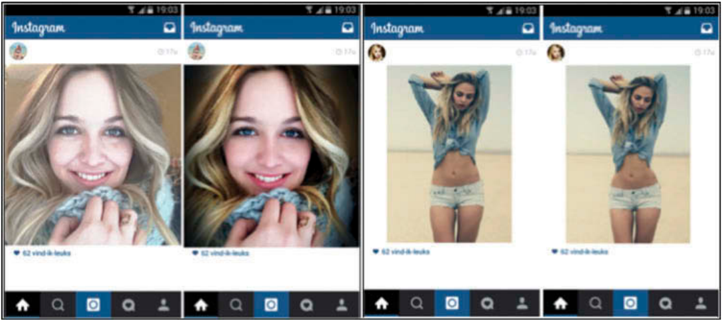
This study investigates the effect of manipulated Instagram photos on adolescent girls’ body image, and whether social comparison tendency moderates this relation. A between-subject experiment was conducted in which 144 girls (14–18 years old) were randomly exposed to either original or manipulated (retouched and reshaped) Instagram selfies. Results showed that exposure to manipulated Instagram photos directly led to lower body image. Especially, girls with higher social comparison tendencies were negatively affected by exposure to the manipulated photos. Interestingly, the manipulated photos were rated more positively than the original photos. Although the use of filters and effects was detected, reshaping of the bodies was not noticed very well. Girls in both conditions reported to find the pictures realistic. Results of this study implied that the recent societal concern about the effects of manipulated photos in social media might be justified, especially for adolescent girls with a higher social comparison tendency.
Verified 2026-11-22 · 1 reference not checked yet
Overview
Integrity signals
Registry
Cites
Statistics
Figures
Verification
Claims the paper makes
5 Valid · 1 Not valid · 24 Not checked · 37 Own results and interpretations
A result the paper reports from its own data — it cites no other source for it, so there is none to check. The quote shows it is in the paper.
In the paper
“For faces, manipulated photos scored somewhat higher ( M = 1.82; SD = .81) than the original photos ( M = 1.61; SD = .70), t (142) = -1.674; p = .051.”
plain- Asserted: passes — The authors put it forward as true.
- Checkable: passes — It can be checked against evidence.
- Load-bearing: unclear — It is unclear whether the paper’s conclusions depend on it.
- Based: passes — The paper gives a reason why it holds.
A result the paper reports from its own data — it cites no other source for it, so there is none to check. The quote shows it is in the paper.
In the paper
“Results additionally showed that level of education (included as control variable) significantly affected body image, F (1,139) = 14.618; p < .001; r = .31.”
plainstates an association- Asserted: passes — The authors put it forward as true.
- Checkable: passes — It can be checked against evidence.
- Load-bearing: unclear — It is unclear whether the paper’s conclusions depend on it.
- Based: passes — The paper gives a reason why it holds.
A result the paper reports from its own data — it cites no other source for it, so there is none to check. The quote shows it is in the paper.
In the paper
“Original photos also affected the body image of these girls more compared to ones with a lower tendency to make social comparisons, but this influence is weaker, F (1,139) = 3.016; p = .043; r = .15.”
plainstates a cause- Asserted: passes — The authors put it forward as true.
- Checkable: passes — It can be checked against evidence.
- Load-bearing: unclear — It is unclear whether the paper’s conclusions depend on it.
- Based: passes — The paper gives a reason why it holds.
A result the paper reports from its own data — it cites no other source for it, so there is none to check. The quote shows it is in the paper.
In the paper
“results revealed that the negative effect of manipulated photos is more prevalent among girls with a higher tendency to make social comparisons, F (1,139) = 18.777; p < .001; r = .34.”
plainstates an association- Asserted: passes — The authors put it forward as true.
- Checkable: passes — It can be checked against evidence.
- Load-bearing: passes — The paper’s conclusions depend on it.
- Based: passes — The paper gives a reason why it holds.
A result the paper reports from its own data — it cites no other source for it, so there is none to check. The quote shows it is in the paper.
In the paper
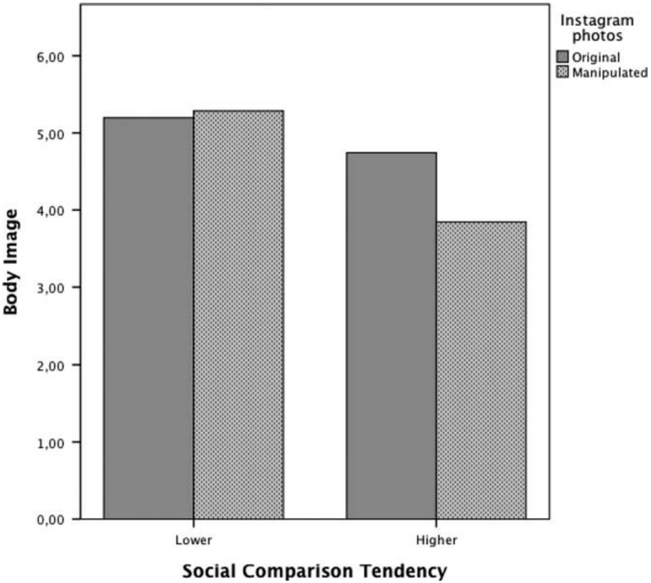
“the body image of girls with a higher tendency to make social comparisons is more negatively affected by manipulated Instagram photos ( M = 3.98; SE = .17) than by original photos ( M = 4.72; SE = .18), F (1,139) = 9.209; p = .002; r = . 25.”
plainstates a cause- Asserted: passes — The authors put it forward as true.
- Checkable: passes — It can be checked against evidence.
- Load-bearing: passes — The paper’s conclusions depend on it.
- Based: passes — The paper gives a reason why it holds.
29 more claims
Create a free account to see all 67 claims and to verify the 1 reference still open.
- Probably not a substantial claim. 23
- It may state two separate claims as one. 14
- The quote only partly states this claim. 1
Claims other papers make about this one
Each is checked against this paper’s own text: does it say what the citing paper says it does?
The source backs part of the claim, not all of it — or backs it for a different population, condition or comparison.
In the citing paper
“Experimental research consistently finds that exposure to idealized social media images, as well as the creation of self-images, results in increased body dissatisfaction [36,37,38].”
From Outcomes of a Cluster Randomized Controlled Trial of the SoMe Social Media Literacy Program for Improving Body Image-Related Outcomes in Adolescent Boys and Girls (2021) · cites this paper as [36]
Experimental — accuracy not yet measuredThe source backs part of the claim, not all of it — or backs it for a different population, condition or comparison.
In the citing paper
“Media representations of beauty and body ideals are often filtered through the lens of cultural norms, further influencing how gender impacts body image dissatisfaction.”
From Body Perceptions and Psychological Well-Being: A Review of the Impact of Social Media and Physical Measurements on Self-Esteem and Mental Health with a Focus on Body Image Satisfaction and Its Relationship with Cultural and Gender Factors (2024) · cites this paper as [172]
Experimental — accuracy not yet measuredThe source backs part of the claim, not all of it — or backs it for a different population, condition or comparison.
In the citing paper
“In individualistic cultures, media portrayals that emphasize thinness for women and muscularity for men can reinforce the gender disparities in body dissatisfaction.”
From Body Perceptions and Psychological Well-Being: A Review of the Impact of Social Media and Physical Measurements on Self-Esteem and Mental Health with a Focus on Body Image Satisfaction and Its Relationship with Cultural and Gender Factors (2024) · cites this paper as [172]
Experimental — accuracy not yet measuredThe cited source says what the claim attributes to it.
In the citing paper
“Such images have been shown to be related to increased appearance-related social comparison (Bonfanti et al., 2025), and subsequent body dissatisfaction (Kleemans et al., 2018).”
From Relation Between Social Media Use and Body Image Concerns and Disordered Eating in Adolescence: A Systematic Review and Meta-Analysis (2026) · cites this paper as Kleemans et al., 2018
5 more claims about this paper
Create a free account to see every claim other papers make about this one.
Statistics that don’t add up
Each reported p-value recomputed from its test statistic and degrees of freedom, each partial η² from its F, and each ratio, mean difference or B printed with a p checked against its own confidence interval.
Rated minor: it would not touch a result — a value no result rests on, a p-value that stays on the same side of the significance level, or a conflict that is clerical, resolved elsewhere in the paper, or outside its own findings.
In the paper
“F (1,139) = 9.209; p = .002”
Reported p = .002 · recomputed p = .003
Rated minor: it would not touch a result — a value no result rests on, a p-value that stays on the same side of the significance level, or a conflict that is clerical, resolved elsewhere in the paper, or outside its own findings.
In the paper
“t (142) = -1.674; p = .051”
Reported p = .051 · recomputed p = .096
Rated minor: it would not touch a result — a value no result rests on, a p-value that stays on the same side of the significance level, or a conflict that is clerical, resolved elsewhere in the paper, or outside its own findings.
In the paper
“t (142) = -1.347; p = .090”
Reported p = .09 · recomputed p = .180
Statistics recomputed
Every reported test result, recomputed from its test statistic and degrees of freedom. A result shows as not adding up only once an independent check has confirmed it.
- Doesn’t add upt(142) = -1.674reported p = .051 · recomputed p = .096
“t (142) = -1.674, p = .051”
- Doesn’t add upt(142) = -1.347reported p = .09 · recomputed p = .180
“t (142) = -1.347, p = .090”
- Doesn’t add upF(1, 139) = 9.209reported p = .002 · recomputed p = .003
“F (1,139) = 9.209, p = .002”
- Not confirmedF(1, 139) = 0.001reported p = .485 · recomputed p = .975
“F (1,139) = .001, p = .485”
- Not confirmedF(1, 139) = 3.016reported p = .043 · recomputed p = .085
“F (1,139) = 3.016, p = .043”
11 more recomputed tests
Create a free account to see every test the Stats check recomputed.
Self-check
Percentages, sums and reported differences re-computed from the paper’s own numbers.
Self-check results appear here once an independent check has confirmed them.
Citations
Cites
A theory of social comparison processes
Festinger, L. (1954) · Human Relations · doi:10.1177/001872675400700202 · Cited by 20,926 · cited 2×
“Especially the tendency to engage in social comparisons (Social Comparison Theory; Festinger, 1954) has proven to be influential in the relation between exposure to the thin ideal in the media and women’s body dissatisfaction (e.”
BackgroundSocial Cognitive Theory of Mass Communication
Bandura, A. (2001) · Media Psychology · doi:10.1207/s1532785xmep0303_03 · Cited by 3,386
Grabe, S., Ward, L. M., & Hyde, J. S. (2008) · Psychological Bulletin · doi:10.1037/0033-2909.134.3.460 · Cited by 2,053
Theory and research concerning social comparisons of personal attributes
Wood, J. V. (1989) · Psychological Bulletin · doi:10.1037/0033-2909.106.2.231 · Cited by 1,957
Gibbons, F. X., & Buunk, B. P. (1999) · Journal of Personality and Social Psychology · doi:10.1037/0022-3514.76.1.129 · Cited by 1,813 · cited 1×
“To measure girls’ social comparison tendency, the Iowa–Netherlands Comparison Orientation Measure (Gibbons & Buunk, 1999) was used.”
MethodSocial Comparison: Why, With Whom, and With What Effect?
Suls, J., Martin, R., & Wheeler, L. (2002) · Current Directions in Psychological Science · doi:10.1111/1467-8721.00191 · Cited by 1,012
Fardouly, J., Diedrichs, P. C., Vartanian, L. R., & Halliwell, E. (2015) · Body Image · doi:10.1016/j.bodyim.2014.12.002 · Cited by 1,009 · cited 2×
“Inspired by Fardouly et al. (2015), another criterion that was applied to the selection of stimulus materials was that photos varied in the parts of the body that were emphasized.”
MethodResultIs actual similarity necessary for attraction? A meta-analysis of actual and perceived similarity
Montoya, R. M., Horton, R. S., & Kirchner, J. (2008) · Journal of Social and Personal Relationships · doi:10.1177/0265407508096700 · Cited by 855
Keery, H., van den Berg, P., & Thompson, J. K. (2004) · Body Image · doi:10.1016/j.bodyim.2004.03.001 · Cited by 815
What We Instagram: A First Analysis of Instagram Photo Content and User Types
Hu, Y., Manikonda, L., & Kambhampati, S. (2014) · Proceedings of the International AAAI Conference on Web and Social Media · doi:10.1609/icwsm.v8i1.14578 · Cited by 807 · cited 1×
“Selfies were used because photos in this format are a popular trend on Instagram and other social network sites (Hu et al., 2014).”
MethodNetGirls: The Internet, Facebook, and body image concern in adolescent girls
Tiggemann, M., & Slater, A. (2013) · International Journal of Eating Disorders · doi:10.1002/eat.22141 · Cited by 741 · cited 2×
“As traditional media are surpassed in popularity by online social media platforms, especially among young people, it becomes important to include these newer forms of media in this line of research as well (Fardouly & Vartanian, 2015; Seetharaman, 2015; Tiggemann & Slater, 2013).”
BackgroundSocial comparison as a predictor of body dissatisfaction: A meta-analytic review.
Myers, T. A., & Crowther, J. H. (2009) · Journal of Abnormal Psychology · doi:10.1037/a0016763 · Cited by 730 · cited 2×
“Furthermore, the comparison with peers might affect their body image in a comparable manner as media images do (Myers & Crowther, 2009).”
BackgroundResultSelf-presentation and gender on MySpace
Manago, A. M., Graham, M. B., Greenfield, P. M., & Salimkhan, G. (2008) · Journal of Applied Developmental Psychology · doi:10.1016/j.appdev.2008.07.001 · Cited by 724 · cited 1×
“Less known is that “ordinary” social media users also use these techniques, as a part of impression management in self-presentation (Manago et al., 2008; Won Kim & Chock, 2015).”
Background(2013) · mediaTUM (Technical University of Munich) · Cited by 701
Beyond Body Image as a Trait: The Development and Validation of the Body Image States Scale
Cash, T. F., Fleming, E. C., Alindogan, J., Steadman, L., & Whitehead, A. (2002) · Eating Disorders · doi:10.1080/10640260290081678 · Cited by 684 · cited 1×
“Following Cash et al. (2002), a 9-point, bipolar, Likert-type scale was used with a higher score indicating a more positive body image.”
MethodFardouly, J., & Vartanian, L. R. (2015) · Body Image · doi:10.1016/j.bodyim.2014.10.004 · Cited by 522 · cited 3×
“As traditional media are surpassed in popularity by online social media platforms, especially among young people, it becomes important to include these newer forms of media in this line of research as well (Fardouly & Vartanian, 2015; Seetharaman, 2015; Tiggemann & Slater, 2013).”
BackgroundResultMyers, P. N., & Biocca, F. A. (1992) · Journal of Communication · doi:10.1111/j.1460-2466.1992.tb00802.x · Cited by 494 · cited 3×
“However, some studies actually found self-enhancing effects of exposure to thin ideal images (e.g., Henderson-King & Henderson-King, 1997; Joshi, Herman, & Polivy, 2004; Mills, Polivy & Tiggemann, 2002; Myers & Biocca, 1992).”
BackgroundResultThompson, J. K., & Heinberg, L. J. (1999) · Journal of Social Issues · doi:10.1111/0022-4537.00119 · Cited by 491 · cited 2×
“…are often presented as unrealistic standards of beauty in for example media literacy programs and the public debate, because of the well-known editing and retouching techniques used when displaying media models (e.g., Thompson & Heinberg, 1999; Yamamiya, Cash, Melnyk, Posavac, & Posavac, 2005).”
BackgroundMethodJones, D. C. (2001) · Sex Roles · doi:10.1023/a:1014815725852 · Cited by 467 · cited 3×
“Girls who compare themselves with manipulated photos of peers might think they are comparing themselves with people who are similar to them, rather than with celebrities whose bodies are seen as unattainable (Jones, 2001).”
BackgroundInfluentialIdealized media images and adolescent body image: “comparing” boys and girls
Hargreaves, D. A., & Tiggemann, M. (2004) · Body Image · doi:10.1016/j.bodyim.2004.10.002 · Cited by 424
Irving, L. M. (1990) · Journal of Social and Clinical Psychology · doi:10.1521/jscp.1990.9.2.230 · Cited by 389 · cited 1×
“These studies often revealed a relation between exposure to the thin ideal and a negative body image among young girls and women (e.g., Grabe, Ward, & Hyde, 2008; Halliwell & Dittmar, 2004; Irving, 1990;).”
BackgroundHalliwell, E., & Dittmar, H. (2004) · Journal of Social and Clinical Psychology · doi:10.1521/jscp.23.1.104.26989 · Cited by 355 · cited 1×
“These studies often revealed a relation between exposure to the thin ideal and a negative body image among young girls and women (e.g., Grabe, Ward, & Hyde, 2008; Halliwell & Dittmar, 2004; Irving, 1990;).”
BackgroundDittmar, H., & Howard, S. (2004) · Journal of Social and Clinical Psychology · doi:10.1521/jscp.23.6.768.54799 · Cited by 355 · cited 2×
“More precisely, women who more frequently engage in comparisons with others are also more negatively affected by exposure to idealized images of others, compared to women who engage in these comparisons less frequently (Dittmar & Howard, 2004).”
BackgroundComparing to perfection: How cultural norms for appearance affect social comparisons and self-image
Strahan, E. J., Wilson, A. E., Cressman, K. E., & Buote, V. M. (2006) · Body Image · doi:10.1016/j.bodyim.2006.07.004 · Cited by 352
Yamamiya, Y., Cash, T. F., Melnyk, S. E., Posavac, H. D., & Posavac, S. S. (2005) · Body Image · doi:10.1016/j.bodyim.2004.11.001 · Cited by 346
Do you “like” my photo? Facebook use maintains eating disorder risk.
Mabe, A. G., Forney, K. J., & Keel, P. K. (2014) · International Journal of Eating Disorders · doi:10.1002/eat.22254 · Cited by 321
The Internet and Adolescent Girls’ Weight Satisfaction and Drive for Thinness
Tiggemann, M., & Miller, J. (2010) · Sex Roles · doi:10.1007/s11199-010-9789-z · Cited by 296 · cited 1×
“…with the appearance of other young women in real life or in a (social) media context (e.g., Dittmar & Howard, 2004; Fardouly, Diedrichs, Vartanian, Halliwell, 2015; Fardouly & Vartanian, 2015; Mabe, Forney, & Keel, 2014; Tiggemann & Miller, 2010; Tiggemann & Slater, 2013; Vartanian & Dey, 2013).”
BackgroundEffects of Exposure to Thin Media Images: Evidence of Self-Enhancement among Restrained Eaters
Mills, J. S., Polivy, J., Herman, C. P., & Tiggemann, M. (2002) · Personality and Social Psychology Bulletin · doi:10.1177/014616702237650 · Cited by 295 · cited 3×
“Demand has been studied in this line of research and some evidence suggests that participants tend to engage in upward comparisons when the study purpose is more obvious rather than less (Mills et al., 2002).”
BackgroundBody image 2.0: Associations between social grooming on Facebook and body image concerns
Kim, J. W., & Chock, T. M. (2015) · Computers in Human Behavior · doi:10.1016/j.chb.2015.01.009 · Cited by 272
Exemplification in Communication: the influence of Case Reports on the Perception of Issues
Zillmann, D., & Brosius, H.-B. (2012) · Routledge eBooks · doi:10.4324/9781410604743 · Cited by 259 · cited 1×
“This is in line with the extensive identification literature, combining social cognitive theory (Bandura, 2002), the message-interpretation process model (Austin & Meili, 1994), and exemplification theory (Zillmann & Brosius, 2000).”
MethodDoes Ethnicity Influence Body‐Size Preference? A Comparison of Body Image and Body Size
Cachelin, F. M., Rebeck, R. M., Chung, G. H., & Pelayo, E. (2002) · Obesity Research · doi:10.1038/oby.2002.25 · Cited by 223
The development and validation of the Physical Appearance Comparison Scale-Revised (PACS-R)
Schaefer, L. M., & Thompson, J. K. (2014) · Eating Behaviors · doi:10.1016/j.eatbeh.2014.01.001 · Cited by 219 · cited 1×
“…[ 92 .1 08 .1 41 .1 4] a t 2 3: 12 0 2 Ja nu ar y 20 18 Another suggestion for future research would be to include a measure that specifically investigates appearance-related comparison tendencies, for example the Physical Appearance Comparison Scale-Revised (PACS-R, Schaefer & Thompson, 2014).”
BackgroundKnauss, C., Paxton, S. J., & Alsaker, F. D. (2008) · Sex Roles · doi:10.1007/s11199-008-9474-7 · Cited by 209
Vartanian, L. R., & Dey, S. (2013) · Body Image · doi:10.1016/j.bodyim.2013.05.004 · Cited by 201 · cited 1×
“…with the appearance of other young women in real life or in a (social) media context (e.g., Dittmar & Howard, 2004; Fardouly, Diedrichs, Vartanian, Halliwell, 2015; Fardouly & Vartanian, 2015; Mabe, Forney, & Keel, 2014; Tiggemann & Miller, 2010; Tiggemann & Slater, 2013; Vartanian & Dey, 2013).”
BackgroundWilcox, K., & Laird, J. D. (2000) · Journal of Research in Personality · doi:10.1006/jrpe.1999.2281 · Cited by 180 · cited 1×
“Previous research also revealed that the effects of exposure to the thin ideal in traditional media depend on individual susceptibility factors (e.g., Henderson-King & Henderson-King, 1997; Joshi et al., 2004; Myers & Biocca, 1992; Wilcox & Laird, 2000).”
BackgroundEffects of interpretations of televised alcohol portrayals on children's alcohol beliefs
Austin, E. W., & Meili, H. K. (1994) · Journal of Broadcasting & Electronic Media · doi:10.1080/08838159409364276 · Cited by 169 · cited 1×
“This is in line with the extensive identification literature, combining social cognitive theory (Bandura, 2002), the message-interpretation process model (Austin & Meili, 1994), and exemplification theory (Zillmann & Brosius, 2000).”
MethodParticularistic and universalistic evaluation in the social comparison process.
Miller, D. T., Turnbull, W., & McFarland, C. (1988) · Journal of Personality and Social Psychology · doi:10.1037/0022-3514.55.6.908 · Cited by 158
Media Effects on Women's Body Esteem: Social and Individual Difference Factors
Henderson‐King, E., & Henderson‐King, D. (1997) · Journal of Applied Social Psychology · doi:10.1111/j.1559-1816.1997.tb00638.x · Cited by 146 · cited 2×
“However, some studies actually found self-enhancing effects of exposure to thin ideal images (e.g., Henderson-King & Henderson-King, 1997; Joshi, Herman, & Polivy, 2004; Mills, Polivy & Tiggemann, 2002; Myers & Biocca, 1992).”
BackgroundResultBorzekowski, D. L. G., Robinson, T. N., & Killen, J. D. (2000) · Journal of Adolescent Health · doi:10.1016/s1054-139x(99)00044-0 · Cited by 146 · cited 1×
“Adolescence is a critical period for psychosocial development and earlier research showed that girls in this phase are more vulnerable for media influences because they equate their own bodies with media images (e.g., Borzekowski et al., 2000).”
BackgroundThornton, B., & Moore, S. (1993) · Personality and Social Psychology Bulletin · doi:10.1177/0146167293194012 · Cited by 143 · cited 1×
“…by the negative contrast theory, stating that women experience a contrast between themselves and the thin, idealized models and that this D ow nl oa de d by [ 92 .1 08 .1 41 .1 4] a t 2 3: 12 0 2 Ja nu ar y 20 18 leads to lower body satisfaction (Thornton & Maurice, 1999; Thornton & Moore, 1993).”
BackgroundPerceived Similarity of Exemplar Traits and Behavior: Effects on Message Evaluation
Andsager, J. L., Bemker, V., Choi, H.-L., & Torwel, V. (2006) · Communication Research · doi:10.1177/0093650205283099 · Cited by 126
Self‐enhancing effects of exposure to thin‐body images
Joshi, R., Herman, C. P., & Polivy, J. (2004) · International Journal of Eating Disorders · doi:10.1002/eat.10253 · Cited by 114 · cited 1×
“Previous research also revealed that the effects of exposure to the thin ideal in traditional media depend on individual susceptibility factors (e.g., Henderson-King & Henderson-King, 1997; Joshi et al., 2004; Myers & Biocca, 1992; Wilcox & Laird, 2000).”
BackgroundVirtually Perfect: Image Retouching and Adolescent Body Image
Harrison, K., & Hefner, V. (2014) · Media Psychology · doi:10.1080/15213269.2013.770354 · Cited by 83 · cited 2×
“In addition, future studies should include a control condition in which participants are exposed to neutral pictures (e.g., showing landscapes) or not exposed to pictures at all (cf. Harrison & Hefner, 2014), to establish baseline scores on body image in the sample.”
BackgroundPhototruth Or Photofiction?: Ethics and Media Imagery in the Digital Age
Wheeler, T. H. (2002) · Cited by 81
Physical Attractiveness Contrast Effect and the Moderating Influence of Self-Consciousness
Thornton, B., & Maurice, J. K. (1999) · Sex Roles · doi:10.1023/a:1018867409265 · Cited by 61 · cited 1×
“…by the negative contrast theory, stating that women experience a contrast between themselves and the thin, idealized models and that this D ow nl oa de d by [ 92 .1 08 .1 41 .1 4] a t 2 3: 12 0 2 Ja nu ar y 20 18 leads to lower body satisfaction (Thornton & Maurice, 1999; Thornton & Moore, 1993).”
BackgroundAdolescent Psychosocial Development
STURDEVANT, M. S., & SPEAR, B. (2002) · Journal of the American Dietetic Association · doi:10.1016/s0002-8223(02)90419-0 · Cited by 46 · cited 1×
“Adolescent girls are often found to be particularly vulnerable for being influenced by media images (e.g., Borzekowski, Robinson, & Killen, 2000) because of the psychosocial development that is characteristic for this phase (Sturdevant & Spear, 2002).”
BackgroundPerspectives on Educational Quality
Scheerens, J., Luyten, H., & van Ravens, J. (2011) · Springer briefs in education · doi:10.1007/978-94-007-0926-3_1 · Cited by 37
(2007) · I.B.Tauris eBooks · doi:10.5040/9780755699865 · Cited by 9
Scheerens, J., Luyten, H., & van Ravens, J. (2011) · Springer briefs in education · doi:10.1007/978-94-007-0926-3_3 · Cited by 7
Wheeler, T. H. (2005) · Routledge eBooks · doi:10.4324/9781410613080 · Cited by 7
State of the Real: The Aesthetics in the Digital Age
Sutton, D., Brind, S., & McKenzie, R. T. (2007) · Cited by 6
Barbero (2014) · doi:10.1016/j · Cited by 1
Lee (1998) · doi:10.1002/(sici)1098-108x(199803)23:2
(2000) · doi:10.1002/(sici)1098-108x(200004)27:3
Research works printed but not linked: 2
- Altabe, M. (1998). Ethnicity and body image: Quantitative and qualitative analysis. International journal of eating disorders , 23 (2), 153 -159. doi:10.1002/(SICI)1098-108X (199803)23:2<153::AID-EAT5>3.0.CO;2-J · doi:10.1002/(sici)1098-108x
- Turpijn, L., Kneefel, S., & van der Veer, N. (2015). Nationale social media onderzoek 2015 [National Social Media Research 2015]. Amsterdam, The Netherlands: Newcom Research & Consultancy.
Cited by
Sokolova, K., & Perez, C. (2021) · Journal of Retailing and Consumer Services · doi:10.1016/j.jretconser.2020.102276 · Cited by 335
Merino, M., Tornero-Aguilera, J. F., Rubio-Zarapuz, A., Villanueva-Tobaldo, C. V., Martín-Rodríguez, A., & Clemente-Suárez, V. J. (2024) · Healthcare · doi:10.3390/healthcare12141396 · Cited by 349
“However, in cultures with communal values, media that celebrate a broader range of body types and emphasize nonphysical attributes can help mitigate these disparities [172].”
BackgroundChoukas-Bradley, S., Roberts, S. R., Maheux, A. J., & Nesi, J. (2021) · doi:10.31234/osf.io/ju92a · Cited by 331
Tiggemann, M., & Anderberg, I. (2020) · New Media & Society · doi:10.1177/1461444819888720 · Cited by 326
Choukas-Bradley, S., Roberts, S. R., Maheux, A. J., & Nesi, J. (2022) · Clinical Child and Family Psychology Review · doi:10.1007/s10567-022-00404-5 · Cited by 333
Metadata
- Authors
- Kleemans, M., Daalmans, S., Carbaat, I., & Anschütz, D.
- Affiliations
- Radboud University Nijmegen (NL)
- Corresponding author
- Daalmans, Serena
- Venue
- Media Psychology
- Publisher
- Informa UK Limited
- Published
- 2016-12-15
- Volume
- 21
- Issue
- 1
- Pages
- 93-110
- ISSN
- 1521-3269 (ISSN-L)
- 1532-785X
- OpenAlex
- W2567680263
- Cited by
- 421
- References
- 51
- Citations by year
- 2026: 38 · 2025: 53 · 2024: 59 · 2023: 72 · 2022: 71 · 2021: 56 · 2020: 40 · 2019: 25 · 2018: 6 · 2017: 1
- FWCI
- 14.27
- Type
- journal article
- Language
- en
- Open access
- hybrid
- doi.org
- Licence
- Locations
- Media Psychology (publishedVersion, cc-by-nc-nd)
- Radboud Repository (Radboud University) (submittedVersion)
- Radboud Repository (Radboud University) (submittedVersion, other-oa)
- Topics
- Social Sciences › Psychology › Clinical Psychology › Body Image and Dysmorphia Studies
- Social Sciences › Psychology › Clinical Psychology › Eating Disorders and Behaviors
- Social Sciences › Sociology and Political Science › Impact of Technology on Adolescents
- Keywords
- Instagram, body image, photo manipulation, retouching, reshaping, social comparison, adolescent girls, selfies, social media, self-presentation, photo filters
About these checks
Registry, retraction, Cites and statistics results are computed, not judged, with one exception: a printed reference that no index lists is read once by a model before it counts as a citation error. Claims are extracted by a model and kept only when their quote appears verbatim in the text; each cited source is then checked, with a model’s help, for whether it says what the claim relies on. Those verdicts can be wrong — read the claim’s quote and the cited source before relying on one.
The claim verdicts this report counts are experimental: their accuracy is not yet measured.
A language model drew the claims from the paper on 2026-09-28, under version 3 of the claim definition (model deepseek-v4.1-flash, prompt extract-v3).
A second model labelled each claim on 2026-09-28 (model jev-1.13-20260917, definition revision gold-guideline-v0.2).
Statistics and arithmetic are recomputed, not judged.
Confidence bands are shown only for fields calibrated on our annotated test set. None is calibrated yet, so no band is shown.
What counts as a claim ›How we measure confidence ›How we check this ›
Are you an author, or do you see a problem with this page? Request a review
Data sources
Bibliographic data: Semantic Scholar, OpenAlex, Crossref.
Contains information from the Semantic Scholar Academic Graph Datasets, made available under the ODC Attribution License (ODC-BY 1.0).
Semantic Scholar’s data is described in: Kinney, R., et al. (2023). The Semantic Scholar Open Data Platform. arXiv:2301.10140.
