

Picture Perfect: The Direct Effect of Manipulated Instagram Photos on Body Image in Adolescent Girls
Open accessThe DOI matches its Crossref record; 53 of the 54 references it cites were found in a registry or an index, and 1 are not checked yet; 5 of the 51 sources its claims cite were checked for support.
Abstract
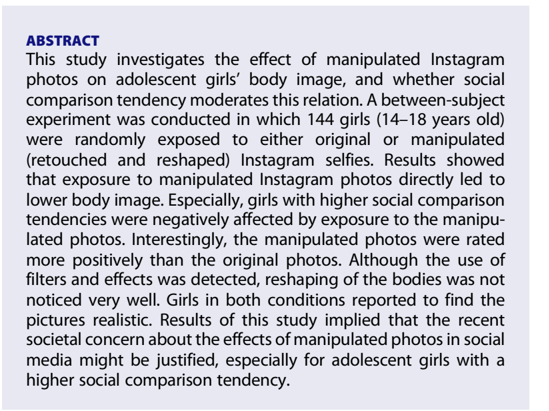
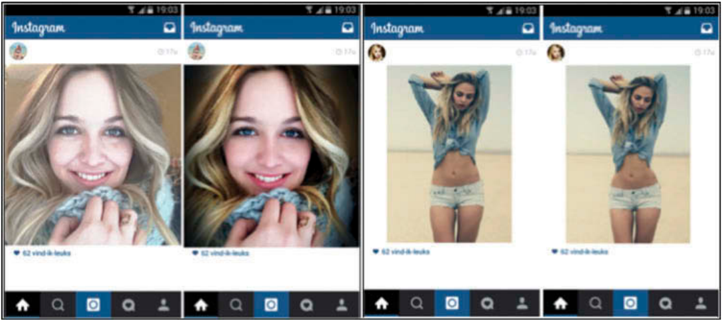
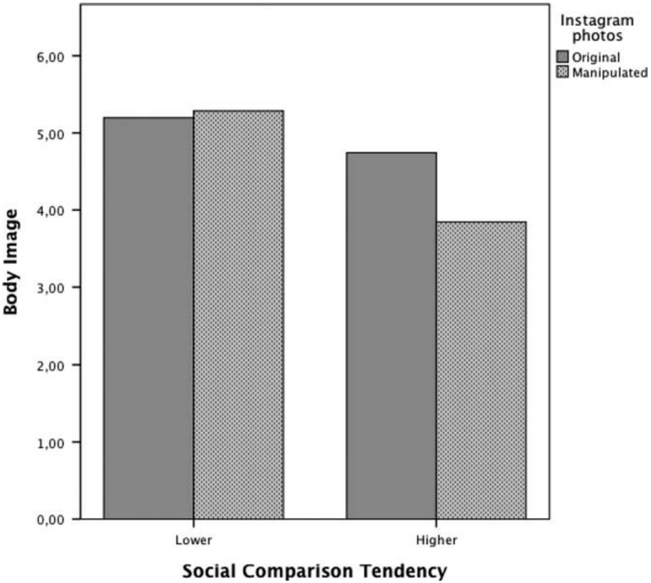
This study investigates the effect of manipulated Instagram photos on adolescent girls’ body image, and whether social comparison tendency moderates this relation. A between-subject experiment was conducted in which 144 girls (14–18 years old) were randomly exposed to either original or manipulated (retouched and reshaped) Instagram selfies. Results showed that exposure to manipulated Instagram photos directly led to lower body image. Especially, girls with higher social comparison tendencies were negatively affected by exposure to the manipulated photos. Interestingly, the manipulated photos were rated more positively than the original photos. Although the use of filters and effects was detected, reshaping of the bodies was not noticed very well. Girls in both conditions reported to find the pictures realistic. Results of this study implied that the recent societal concern about the effects of manipulated photos in social media might be justified, especially for adolescent girls with a higher social comparison tendency.
Verified 2026-11-22 · 1 reference not checked yet
Overview
Integrity signals
Registry
Cites
Statistics
Figures
Verification
Claims the paper makes
5 Valid · 1 Not valid · 24 Not checked · 37 Own results and interpretations
A result the paper reports from its own data — it cites no other source for it, so there is none to check. The quote shows it is in the paper.
In the paper
“For faces, manipulated photos scored somewhat higher ( M = 1.82; SD = .81) than the original photos ( M = 1.61; SD = .70), t (142) = -1.674; p = .051.”
plain- Asserted: passes — The authors put it forward as true.
- Checkable: passes — It can be checked against evidence.
- Load-bearing: unclear — It is unclear whether the paper’s conclusions depend on it.
- Based: passes — The paper gives a reason why it holds.
A result the paper reports from its own data — it cites no other source for it, so there is none to check. The quote shows it is in the paper.
In the paper
“Results additionally showed that level of education (included as control variable) significantly affected body image, F (1,139) = 14.618; p < .001; r = .31.”
plainstates an association- Asserted: passes — The authors put it forward as true.
- Checkable: passes — It can be checked against evidence.
- Load-bearing: unclear — It is unclear whether the paper’s conclusions depend on it.
- Based: passes — The paper gives a reason why it holds.
A result the paper reports from its own data — it cites no other source for it, so there is none to check. The quote shows it is in the paper.
In the paper
“Original photos also affected the body image of these girls more compared to ones with a lower tendency to make social comparisons, but this influence is weaker, F (1,139) = 3.016; p = .043; r = .15.”
plainstates a cause- Asserted: passes — The authors put it forward as true.
- Checkable: passes — It can be checked against evidence.
- Load-bearing: unclear — It is unclear whether the paper’s conclusions depend on it.
- Based: passes — The paper gives a reason why it holds.
A result the paper reports from its own data — it cites no other source for it, so there is none to check. The quote shows it is in the paper.
In the paper
“results revealed that the negative effect of manipulated photos is more prevalent among girls with a higher tendency to make social comparisons, F (1,139) = 18.777; p < .001; r = .34.”
plainstates an association- Asserted: passes — The authors put it forward as true.
- Checkable: passes — It can be checked against evidence.
- Load-bearing: passes — The paper’s conclusions depend on it.
- Based: passes — The paper gives a reason why it holds.
A result the paper reports from its own data — it cites no other source for it, so there is none to check. The quote shows it is in the paper.
In the paper
“the body image of girls with a higher tendency to make social comparisons is more negatively affected by manipulated Instagram photos ( M = 3.98; SE = .17) than by original photos ( M = 4.72; SE = .18), F (1,139) = 9.209; p = .002; r = . 25.”
plainstates a cause- Asserted: passes — The authors put it forward as true.
- Checkable: passes — It can be checked against evidence.
- Load-bearing: passes — The paper’s conclusions depend on it.
- Based: passes — The paper gives a reason why it holds.
29 more claims
Create a free account to see all 67 claims and to verify the 1 reference still open.
- Probably not a substantial claim. 23
- It may state two separate claims as one. 14
- The quote only partly states this claim. 1
Claims other papers make about this one
Each is checked against this paper’s own text: does it say what the citing paper says it does?
The source backs part of the claim, not all of it — or backs it for a different population, condition or comparison.
In the citing paper
“Experimental research consistently finds that exposure to idealized social media images, as well as the creation of self-images, results in increased body dissatisfaction [36,37,38].”
From Outcomes of a Cluster Randomized Controlled Trial of the SoMe Social Media Literacy Program for Improving Body Image-Related Outcomes in Adolescent Boys and Girls (2021) · cites this paper as [36]
Experimental — accuracy not yet measuredThe source backs part of the claim, not all of it — or backs it for a different population, condition or comparison.
In the citing paper
“Media representations of beauty and body ideals are often filtered through the lens of cultural norms, further influencing how gender impacts body image dissatisfaction.”
From Body Perceptions and Psychological Well-Being: A Review of the Impact of Social Media and Physical Measurements on Self-Esteem and Mental Health with a Focus on Body Image Satisfaction and Its Relationship with Cultural and Gender Factors (2024) · cites this paper as [172]
Experimental — accuracy not yet measuredThe source backs part of the claim, not all of it — or backs it for a different population, condition or comparison.
In the citing paper
“In individualistic cultures, media portrayals that emphasize thinness for women and muscularity for men can reinforce the gender disparities in body dissatisfaction.”
From Body Perceptions and Psychological Well-Being: A Review of the Impact of Social Media and Physical Measurements on Self-Esteem and Mental Health with a Focus on Body Image Satisfaction and Its Relationship with Cultural and Gender Factors (2024) · cites this paper as [172]
Experimental — accuracy not yet measuredThe cited source says what the claim attributes to it.
In the citing paper
“Such images have been shown to be related to increased appearance-related social comparison (Bonfanti et al., 2025), and subsequent body dissatisfaction (Kleemans et al., 2018).”
From Relation Between Social Media Use and Body Image Concerns and Disordered Eating in Adolescence: A Systematic Review and Meta-Analysis (2026) · cites this paper as Kleemans et al., 2018
5 more claims about this paper
Create a free account to see every claim other papers make about this one.
Statistics that don’t add up
Each reported p-value recomputed from its test statistic and degrees of freedom, each partial η² from its F, and each ratio, mean difference or B printed with a p checked against its own confidence interval.
Rated minor: it would not touch a result — a value no result rests on, a p-value that stays on the same side of the significance level, or a conflict that is clerical, resolved elsewhere in the paper, or outside its own findings.
In the paper
“F (1,139) = 9.209; p = .002”
Reported p = .002 · recomputed p = .003
Rated minor: it would not touch a result — a value no result rests on, a p-value that stays on the same side of the significance level, or a conflict that is clerical, resolved elsewhere in the paper, or outside its own findings.
In the paper
“t (142) = -1.674; p = .051”
Reported p = .051 · recomputed p = .096
Rated minor: it would not touch a result — a value no result rests on, a p-value that stays on the same side of the significance level, or a conflict that is clerical, resolved elsewhere in the paper, or outside its own findings.
In the paper
“t (142) = -1.347; p = .090”
Reported p = .09 · recomputed p = .180
Statistics recomputed
Every reported test result, recomputed from its test statistic and degrees of freedom. A result shows as not adding up only once an independent check has confirmed it.
- Doesn’t add upt(142) = -1.674reported p = .051 · recomputed p = .096
“t (142) = -1.674, p = .051”
- Doesn’t add upt(142) = -1.347reported p = .09 · recomputed p = .180
“t (142) = -1.347, p = .090”
- Doesn’t add upF(1, 139) = 9.209reported p = .002 · recomputed p = .003
“F (1,139) = 9.209, p = .002”
- Not confirmedF(1, 139) = 0.001reported p = .485 · recomputed p = .975
“F (1,139) = .001, p = .485”
- Not confirmedF(1, 139) = 3.016reported p = .043 · recomputed p = .085
“F (1,139) = 3.016, p = .043”
11 more recomputed tests
Create a free account to see every test the Stats check recomputed.
Self-check
Percentages, sums and reported differences re-computed from the paper’s own numbers.
Self-check results appear here once an independent check has confirmed them.
Citations
Cites
A theory of social comparison processes
Festinger, L. (1954) · Human Relations · doi:10.1177/001872675400700202 · Cited by 20,926 · cited 2×
“Especially the tendency to engage in social comparisons (Social Comparison Theory; Festinger, 1954) has proven to be influential in the relation between exposure to the thin ideal in the media and women’s body dissatisfaction (e.”
BackgroundSocial Cognitive Theory of Mass Communication
Bandura, A. (2001) · Media Psychology · doi:10.1207/s1532785xmep0303_03 · Cited by 3,386
Grabe, S., Ward, L. M., & Hyde, J. S. (2008) · Psychological Bulletin · doi:10.1037/0033-2909.134.3.460 · Cited by 2,053
Theory and research concerning social comparisons of personal attributes
Wood, J. V. (1989) · Psychological Bulletin · doi:10.1037/0033-2909.106.2.231 · Cited by 1,957
Gibbons, F. X., & Buunk, B. P. (1999) · Journal of Personality and Social Psychology · doi:10.1037/0022-3514.76.1.129 · Cited by 1,813 · cited 1×
“To measure girls’ social comparison tendency, the Iowa–Netherlands Comparison Orientation Measure (Gibbons & Buunk, 1999) was used.”
MethodSocial Comparison: Why, With Whom, and With What Effect?
Suls, J., Martin, R., & Wheeler, L. (2002) · Current Directions in Psychological Science · doi:10.1111/1467-8721.00191 · Cited by 1,012
Fardouly, J., Diedrichs, P. C., Vartanian, L. R., & Halliwell, E. (2015) · Body Image · doi:10.1016/j.bodyim.2014.12.002 · Cited by 1,009 · cited 2×
“Inspired by Fardouly et al. (2015), another criterion that was applied to the selection of stimulus materials was that photos varied in the parts of the body that were emphasized.”
MethodResultIs actual similarity necessary for attraction? A meta-analysis of actual and perceived similarity
Montoya, R. M., Horton, R. S., & Kirchner, J. (2008) · Journal of Social and Personal Relationships · doi:10.1177/0265407508096700 · Cited by 855
Keery, H., van den Berg, P., & Thompson, J. K. (2004) · Body Image · doi:10.1016/j.bodyim.2004.03.001 · Cited by 815
What We Instagram: A First Analysis of Instagram Photo Content and User Types
Hu, Y., Manikonda, L., & Kambhampati, S. (2014) · Proceedings of the International AAAI Conference on Web and Social Media · doi:10.1609/icwsm.v8i1.14578 · Cited by 807 · cited 1×
“Selfies were used because photos in this format are a popular trend on Instagram and other social network sites (Hu et al., 2014).”
Method
Research works printed but not linked: 2
- Altabe, M. (1998). Ethnicity and body image: Quantitative and qualitative analysis. International journal of eating disorders , 23 (2), 153 -159. doi:10.1002/(SICI)1098-108X (199803)23:2<153::AID-EAT5>3.0.CO;2-J · doi:10.1002/(sici)1098-108x
- Turpijn, L., Kneefel, S., & van der Veer, N. (2015). Nationale social media onderzoek 2015 [National Social Media Research 2015]. Amsterdam, The Netherlands: Newcom Research & Consultancy.
Cited by
Sokolova, K., & Perez, C. (2021) · Journal of Retailing and Consumer Services · doi:10.1016/j.jretconser.2020.102276 · Cited by 335
Merino, M., Tornero-Aguilera, J. F., Rubio-Zarapuz, A., Villanueva-Tobaldo, C. V., Martín-Rodríguez, A., & Clemente-Suárez, V. J. (2024) · Healthcare · doi:10.3390/healthcare12141396 · Cited by 349
“However, in cultures with communal values, media that celebrate a broader range of body types and emphasize nonphysical attributes can help mitigate these disparities [172].”
BackgroundChoukas-Bradley, S., Roberts, S. R., Maheux, A. J., & Nesi, J. (2021) · doi:10.31234/osf.io/ju92a · Cited by 331
Tiggemann, M., & Anderberg, I. (2020) · New Media & Society · doi:10.1177/1461444819888720 · Cited by 326
Choukas-Bradley, S., Roberts, S. R., Maheux, A. J., & Nesi, J. (2022) · Clinical Child and Family Psychology Review · doi:10.1007/s10567-022-00404-5 · Cited by 333
Dane, A., & Bhatia, K. (2023) · PLOS Global Public Health · doi:10.1371/journal.pgph.0001091 · Cited by 289
“Three studies indicated low social media literacy amongst participants, including difficulty switching off from damaging posts and an inability to recognise edited versus unedited posts [63, 73, 82].”
Schmuck, D., Karsay, K., Matthes, J., & Stevic, A. (2019) · Telematics and Informatics · doi:10.1016/j.tele.2019.101240 · Cited by 241
Fioravanti, G., Bocci Benucci, S., Ceragioli, G., & Casale, S. (2022) · Adolescent Research Review · doi:10.1007/s40894-022-00179-4 · Cited by 200
Pedalino, F., & Camerini, A.-L. (2022) · International Journal of Environmental Research and Public Health · doi:10.3390/ijerph19031543 · Cited by 197
“[31] found that manipulated Instagram pictures had a negative effect on female adolescents’ body image, moderated by social comparison.”
BackgroundThe Internet and Children’s Psychological Wellbeing
McDool, E., Powell, P., Roberts, J., & Taylor, K. (2020) · Journal of Health Economics · doi:10.1016/j.jhealeco.2019.102274 · Cited by 189
Uploading your best self: Selfie editing and body dissatisfaction
Tiggemann, M., Anderberg, I., & Brown, Z. (2020) · Body Image · doi:10.1016/j.bodyim.2020.03.002 · Cited by 184
The relationship between Instagram use and indicators of mental health: a systematic review
Faelens, L., Hoorelbeke, K., Cambier, R., van Put, J., Van de Putte, E., De Raedt, R., & Koster, E. H. W. (2021) · Computers in Human Behavior Reports · doi:10.1016/j.chbr.2021.100121 · Cited by 182
“…upward comparison material was related to decreases in self-rated attractiveness (Sherlock & Wagstaff, 2019), body satisfaction (Cohen et al., 2019; Kleemans et al., 2016; Tamplin et al., 2018) and body appreciation (Brown & Tiggemann, 2020; Tiggeman et al., 2020a) compared to individuals who…”
BackgroundSchreurs, L., & Vandenbosch, L. (2021) · Journal of Children and Media · doi:10.1080/17482798.2020.1809481 · Cited by 176
“Consequently, social media seem to affect these age groups the most profoundly (Kleemans et al., 2018; van Driel et al., 2019).”
BackgroundInstagram Inspiration: How Upward Comparison on Social Network Sites Can Contribute to Well-Being
Meier, A., Gilbert, A., Börner, S., & Possler, D. (2020) · Journal of Communication · doi:10.1093/joc/jqaa025 · Cited by 177
Engeln, R., Loach, R., Imundo, M. N., & Zola, A. (2020) · Body Image · doi:10.1016/j.bodyim.2020.04.007 · Cited by 171
The Appearance-Related Social Media Consciousness Scale: Development and validation with adolescents
Choukas-Bradley, S., Nesi, J., Widman, L., & Galla, B. M. (2020) · Body Image · doi:10.1016/j.bodyim.2020.02.017 · Cited by 160
Ryding, F. C., & Kuss, D. J. (2020) · Psychology of Popular Media · doi:10.1037/ppm0000264 · Cited by 162
Association Between Social Networks and Subjective Well-Being in Adolescents: A Systematic Review
Webster, D., Dunne, L., & Hunter, R. (2021) · Youth & Society · doi:10.1177/0044118x20919589 · Cited by 148
“A study with adolescent girls and Instagram found that exposure to manipulated Instagram photos leads to lower body satisfaction (Kleemans et al., 2018).”
BackgroundRoberts, S. R., Maheux, A. J., Hunt, R. A., Ladd, B. A., & Choukas-Bradley, S. (2022) · Body Image · doi:10.1016/j.bodyim.2022.03.002 · Cited by 154
de Vries, D. A., Vossen, H. G. M., & van der Kolk – van der Boom, P. (2019) · Journal of Youth and Adolescence · doi:10.1007/s10964-018-0956-9 · Cited by 141
Durau, J., Diehl, S., & Terlutter, R. (2022) · Digital Health · doi:10.1177/20552076221102769 · Cited by 213
Bonfanti, R. C., Melchiori, F., Teti, A., Albano, G., Raffard, S., Rodgers, R., & Lo Coco, G. (2025) · Body Image · doi:10.1016/j.bodyim.2024.101841 · Cited by 154
Understanding Social Media Literacy: A Systematic Review of the Concept and Its Competences
Polanco-Levicán, K., & Salvo-Garrido, S. I. (2022) · International Journal of Environmental Research and Public Health · doi:10.3390/ijerph19148807 · Cited by 240
“On the one hand, evidence shows that different authors work with this concept applied to the area of physical and mental health related to body perception [51,53,61,70], developing interventions to reduce eating disorders and the negative impact of exposure to social media because they show idealized appearances, such…”
BackgroundMcComb, S. E., & Mills, J. S. (2022) · Body Image · doi:10.1016/j.bodyim.2021.12.003 · Cited by 123
Vendemia, M. A., & DeAndrea, D. C. (2018) · Body Image · doi:10.1016/j.bodyim.2018.08.013 · Cited by 119
The Lancet Commission on self-harm
Moran, P., Chandler, A., Dudgeon, P., Kirtley, O. J., Knipe, D. W., Pirkis, J., Sinyor, M., Allister, R., Ansloos, J. P., Ball, M. A., et al. (2024) · The Lancet · doi:10.1016/s0140-6736(24)01121-8 · Cited by 160
Lee, M., & Lee, H.-H. (2021) · Computers in Human Behavior · doi:10.1016/j.chb.2020.106579 · Cited by 108
Camera-ready: Young women’s appearance-related social media consciousness.
Choukas-Bradley, S., Nesi, J., Widman, L., & Higgins, M. K. (2019) · Psychology of Popular Media Culture · doi:10.1037/ppm0000196 · Cited by 105
Tylka, T. L., Rodgers, R. F., Calogero, R. M., Thompson, J. K., & Harriger, J. A. (2023) · Body Image · doi:10.1016/j.bodyim.2023.01.004 · Cited by 140
How do “selfies” impact adolescents’ well-being and body confidence? A narrative review
McLean, S. A., Jarman, H. K., & Rodgers, R. F. (2019) · Psychology Research and Behavior Management · doi:10.2147/prbm.s177834 · Cited by 105
“degree for participants who had a higher, compared to lower, general tendency to compare themselves with others.(42) It”
ResultDi Gesto, C., Nerini, A., Policardo, G. R., & Matera, C. (2022) · Aesthetic Plastic Surgery · doi:10.1007/s00266-021-02546-3 · Cited by 102
Wang, Z., Huang, W., & Liu-Lastres, B. (2022) · Annals of Tourism Research Empirical Insights · doi:10.1016/j.annale.2022.100064 · Cited by 151
“Another possible reason is the growing trend of photo manipulation on social media (Kleemans, Daalmans, Carbaat, & Anschütz, 2018).”
Social media use and adolescent well-being: a narrative review of longitudinal studies
Course-Choi, J., & Hammond, L. (2021) · Cyberpsychology, Behavior, and Social Networking · doi:10.1089/cyber.2020.0020 · Cited by 93
The effect of #enhancement-free Instagram images and hashtags on women’s body image
Tiggemann, M., & Zinoviev, K. (2019) · Body Image · doi:10.1016/j.bodyim.2019.09.004 · Cited by 91
Gordon, C. S., Jarman, H. K., Rodgers, R. F., McLean, S. A., Slater, A., Fuller-Tyszkiewicz, M., & Paxton, S. J. (2021) · Nutrients · doi:10.3390/nu13113825 · Cited by 89
“Experimental research consistently finds that exposure to idealized social media images, as well as the creation of self-images, results in increased body dissatisfaction [36–38].”
BackgroundResultSocial Media Influence on Body Image and Cosmetic Surgery Considerations: A Systematic Review
Mironică, A., Popescu, C. A., George, D., Tegzeșiu, A. M., & Gherman, C. D. (2024) · Cureus · doi:10.7759/cureus.65626 · Cited by 205
“Individuals unhappy with their bodies or fearing negative evaluation by others are more likely to seek surgical solutions [2,15,32].”
Background“Why don’t I look like her?” How adolescent girls view social media and its connection to body image
Papageorgiou, A., Fisher, C. M., & CROSS, D. S. (2022) · BMC Women s Health · doi:10.1186/s12905-022-01845-4 · Cited by 148
Hamilton, J. L., Nesi, J., & Choukas-Bradley, S. (2020) · doi:10.31234/osf.io/5stx4 · Cited by 81
The Effects of Instagram Marketing Activities on Customer-Based Brand Equity in the Coffee Industry
Park, C.-I., & Namkung, Y. (2022) · Sustainability · doi:10.3390/su14031657 · Cited by 218
“Interaction is an important feature that differentiates SNSs from other types of media [29].”
BackgroundTaking a Short Break from Instagram: The Effects on Subjective Well-Being
Fioravanti, G., Prostamo, A., & Casale, S. (2020) · Cyberpsychology, Behavior, and Social Networking · doi:10.1089/cyber.2019.0400 · Cited by 79
Verrastro, V., Fontanesi, L., Liga, F., Cuzzocrea, F., & Gugliandolo, M. C. (2020) · Qwerty. Open and Interdisciplinary Journal of Technology, Culture and Education · doi:10.30557/qw000021 · Cited by 78
Lowe-Calverley, E., & Grieve, R. (2021) · Body Image · doi:10.1016/j.bodyim.2020.10.003 · Cited by 78
Jung, J., Barron, D. S., Lee, Y., & Swami, V. (2022) · Computers in Human Behavior · doi:10.1016/j.chb.2022.107357 · Cited by 116
Tiggemann, M. (2022) · Body Image · doi:10.1016/j.bodyim.2022.02.012 · Cited by 74
Casale, S., Gemelli, G., Calosi, C., Giangrasso, B., & Fioravanti, G. (2019) · Current Psychology · doi:10.1007/s12144-019-00229-6 · Cited by 87
“Moreover, recent experimental research (Kleemans et al. 2018) has shown that exposure to manipulated Instagram photos led to lower body satisfaction than original photos.”
BackgroundResultInfluentialThe influence of Instagram on mental well-being and purchasing decisions in a pandemic
Staniewski, M. W., & Awruk, K. (2021) · Technological Forecasting and Social Change · doi:10.1016/j.techfore.2021.121287 · Cited by 113
Mitigating Harms of Social Media for Adolescent Body Image and Eating Disorders: A Review
Mazzeo, S., Weinstock, M., Vashro, T., Henning, T., & Derrigo, K. (2024) · Psychology Research and Behavior Management · doi:10.2147/prbm.s410600 · Cited by 71
“19 Interaction with pro-anorexia content, which includes tips for weight loss and content glorifying disordered eating behaviors, is particularly problematic, as it is associated with a higher drive for thinness and body dissatisfaction.”
BackgroundMcCrory, A., Best, P., & Maddock, A. (2020) · Children and Youth Services Review · doi:10.1016/j.childyouth.2020.105053 · Cited by 70
Vendemia, M. A., & DeAndrea, D. C. (2021) · Body Image · doi:10.1016/j.bodyim.2021.01.011 · Cited by 64
Kim, H. M. (2021) · New Media & Society · doi:10.1177/1461444820956368 · Cited by 58
“Four comments were then added in the comment section right next to the body posting, just as in a real Instagram interface, except for a no-comment control condition where only the body imagery was presented without any comments (see Kleemans et al., 2018).”
BackgroundInfluentialIrmer, A., & Schmiedek, F. (2023) · Communications Psychology · doi:10.1038/s44271-023-00013-0 · Cited by 58
“…an experimental study with girls aged 14 – 18 years, those with a stronger tendency to compare themselves to others were more negatively affected (i.e., reported lower body satisfaction) by viewing (manipulated) Instagram posts than those with a weaker tendency to engage in social comparisons 73 .”
Zimmer-Gembeck, M. J., Hawes, T., & Pariz, J. (2021) · Psychology of Popular Media · doi:10.1037/ppm0000277 · Cited by 56
Dahlgren, C. L., Sundgot‐Borgen, J., Kvalem, I. L., Wennersberg, A. L., & Wisting, L. (2024) · Journal of Eating Disorders · doi:10.1186/s40337-024-00992-3 · Cited by 104
“…certain activities including viewing, manipulating, uploading photos, appearance comparisons, and seeking feedback [14, 23], may play a pivotal role in the observed association between SM use and ED pathology in adolescents [57, 58], this represents a crucial area for future research explorations.”
BackgroundRozgonjuk, D., Pruunsild, P., Jürimäe, K., Schwarz, R.-J., & Aru, J. (2020) · Mobile Media & Communication · doi:10.1177/2050157920910190 · Cited by 56
“Several studies have reported the association between Instagram use and negative body image (Hendrickse et al., 2017; Kleemans et al. 2016; Tiggemann & Zaccardo, 2018).”
BackgroundSharma, A., & Vidal, C. (2023) · Journal of Eating Disorders · doi:10.1186/s40337-023-00898-6 · Cited by 53
“Adolescents high in trait social comparison may be especially vulnerable to the deleterious effects of viewing others’ photos on body image and satisfaction [57].”
BackgroundLivingston, J., Holland, E., & Fardouly, J. (2020) · Body Image · doi:10.1016/j.bodyim.2019.12.006 · Cited by 51
Smartphone screen time reduction improves mental health: a randomized controlled trial
Pieh, C., Humer, E. C., Hoenigl, A., Schwab, J., Mayerhofer, D., Dale, R., & Haider, K. (2025) · BMC Medicine · doi:10.1186/s12916-025-03944-z · Cited by 84
Ateq, K., Alhajji, M., & Alhusseini, N. (2024) · Frontiers in Public Health · doi:10.3389/fpubh.2024.1324092 · Cited by 49
McBride, C., Costello, N., Ambwani, S., Wilhite, B. C., & Austin, S. B. (2019) · American Journal of Law & Medicine · doi:10.1177/0098858819849990 · Cited by 65
Instagram Sexualization: When posts make you feel dissatisfied and wanting to change your body
Guizzo, F., Canale, N., & Fasoli, F. (2021) · Body Image · doi:10.1016/j.bodyim.2021.06.005 · Cited by 58
Jankauskienė, R., & Bacevičienė, M. (2022) · Nutrients · doi:10.3390/nu14112227 · Cited by 67
“The media promotes appearance ideals that are stereotyped and unrealistic [20,21] and refers to thin and/or fit body image for women and muscular bodies with low body fat for men [22,23].”
BackgroundThe Impact of Social Media on Health Behaviors, a Systematic Review
Paul, B. C., & Johnson, S.-A. H. (2025) · Healthcare · doi:10.3390/healthcare13212763 · Cited by 99
How Can Adolescents Benefit from the Use of Social Networks? The iGeneration on Instagram
Cipolletta, S., Malighetti, C., Cenedese, C., & Spoto, A. (2020) · International Journal of Environmental Research and Public Health · doi:10.3390/ijerph17196952 · Cited by 82
“Overcoming the contraposition between a positive versus negative evaluation of the impact of SNS use on adolescents, which characterized most of the previous studies [48], these findings highlight that SNSs may enhance both wellbeing or risks [28,81].”
ResultCritical measurement issues in the assessment of social media influence on body image
Jarman, H. K., McLean, S. A., Griffiths, S., Teague, S. J., Rodgers, R. F., Paxton, S. J., Austen, E., Harris, E., Steward, T., Shatte, A., et al. (2022) · Body Image · doi:10.1016/j.bodyim.2021.12.007 · Cited by 46
Leaving traces behind: Using social media digital trace data to study adolescent wellbeing
Sultan, M., Scholz, C., & van den Bos, W. (2023) · Computers in Human Behavior Reports · doi:10.1016/j.chbr.2023.100281 · Cited by 54
“…2021); other studies tend to be a limited simulation of the experience of social media where, for example, participants view 10 photos on an Instagram feed (e.g., Kleemans, Daalmans, Carbaat, & Anschütz, 2018) or are told to expect comments from others (Tobin, Vanman, Verreynne, & Saeri, 2015).”
BackgroundThomas, M. F., Binder, A., Stević, A., & Matthes, J. (2023) · Telematics and Informatics · doi:10.1016/j.tele.2023.101949 · Cited by 78
Photo manipulation as a predictor of facial dissatisfaction and cosmetic procedure attitudes
Beos, N., Kemps, E., & Prichard, I. J. (2021) · Body Image · doi:10.1016/j.bodyim.2021.08.008 · Cited by 56
Niu, G., Yao, L., Tian, Y., Sun, X., & Zhou, Z. (2020) · Current Psychology · doi:10.1007/s12144-020-01043-1 · Cited by 48
Schreurs, L., & Vandenbosch, L. (2021) · Media Psychology · doi:10.1080/15213269.2021.1925561 · Cited by 49
“Probably, showing off with one’s appearance is most likely to occur through pictures on more visually oriented social media platforms such as Instagram, which are highly popular among adolescents (Kleemans et al., 2018).”
BackgroundInternet use, depression, and cognitive outcomes among Chinese adolescents
Zhou, M., & Ding, X. (2021) · Journal of Community Psychology · doi:10.1002/jcop.22779 · Cited by 40
Exposure to body diversity images as a buffer against the thin-ideal: An experimental study
Ogden, J., Gosling, C., Hazelwood, M., & Atkins, E. (2020) · Psychology, Health & Medicine · doi:10.1080/13548506.2020.1734219 · Cited by 36
Hashtag fitspiration: credibility screening and content analysis of Instagram fitness accounts
Curtis, R., Prichard, I. J., Gosse, G., Stankevicius, A., & Maher, C. A. (2023) · BMC Public Health · doi:10.1186/s12889-023-15232-7 · Cited by 57
McCrory, A., Best, P., & Maddock, A. (2022) · Health Education Research · doi:10.1093/her/cyac010 · Cited by 63
Gentzler, A. L., Hughes, J. L., Johnston, M., & Alderson, J. E. (2023) · Journal of Adolescence · doi:10.1002/jad.12243 · Cited by 34
Mañas-Viniegra, L., Veloso, A. I., & Cambra, U. C. (2019) · Sustainability · doi:10.3390/su11143977 · Cited by 45
Missing the Bigger Picture: The Need for More Research on Visual Health Misinformation
Heley, K. M., Gaysynsky, A., & King, A. J. (2022) · Science Communication · doi:10.1177/10755470221113833 · Cited by 54
“For example, the fashion industry’s extensive history of manipulating photographs of models to make them appear thinner—a practice that has now extended to social media platforms—could change viewers’ perceptions of realistic body types and affect how satisfied they are with their own bodies (Grabe et al., 2008; Kleem…”
BackgroundRevranche, M., Biscond, M., & Husky, M. M. (2021) · L Encéphale · doi:10.1016/j.encep.2021.08.006 · Cited by 69
Peng, Y., Lock, I., & Salah, A. A. (2023) · Communication Methods and Measures · doi:10.1080/19312458.2023.2277956 · Cited by 50
“…communication, prior research has shown that exposure to idealized body images typically found on visual social media platforms affect particularly young women’s self-image and may have negative effects on their well-being (Brown & Tiggemann, 2016; Kleemans et al., 2018; Vendemia & DeAndrea, 2018).”
BackgroundCountry Differences in Social Comparison on Social Media
Cheng, J., Burke, M., & de Gant, B. (2021) · Proc. ACM Hum. Comput. Interact. · doi:10.1145/3434179 · Cited by 33
“Social comparison on social media has been associated with negative outcomes such as lower self-esteem [77, 78], worse body image [23, 41], and depression [52, 61, 66, 84].”
BackgroundThe effect of different types of TikTok dance challenge videos on young women's body satisfaction
Joiner, R., Mizen, E., Pinnell, B., Siddique, L., Bradley, A., & Trevalyen, S. (2023) · Computers in Human Behavior · doi:10.1016/j.chb.2023.107856 · Cited by 54
Schreurs, L., & Vandenbosch, L. (2022) · Computers in Human Behavior · doi:10.1016/j.chb.2022.107364 · Cited by 32
Naderer, B., Peter, C., & Karsay, K. (2021) · Journal of Children and Media · doi:10.1080/17482798.2021.1938619 · Cited by 39
“The logic of these platforms, in which close friends, personal acquaintances, and celebrities/idols appear side by side, gives users the impression that all content is realistic and attainable (De Vries et al., 2018; Kleemans et al., 2018).”
BackgroundInfluentialThe healthy eating movement on social media and its psychological effects on body image
Zaharia, A., & Gonța, I. (2024) · Frontiers in Nutrition · doi:10.3389/fnut.2024.1474729 · Cited by 46
Weber, S., Messingschlager, T. V., & Stein, J. (2021) · Media Psychology · doi:10.1080/15213269.2021.1968440 · Cited by 39
Möri, M., Mongillo, F., & Fahr, A. (2022) · Frontiers in Psychology · doi:10.3389/fpsyg.2022.1009792 · Cited by 58
“For participants, the perceived body image is formed through mass media (magazines, TV) and social media (Facebook, YouTube, Instagram, and Snapchat).”
BackgroundInfluentialFioravanti, G., Tonioni, C., & Casale, S. (2021) · Scandinavian Journal of Psychology · doi:10.1111/sjop.12752 · Cited by 42
Gesto, C. D., Matera, C., Policardo, G. R., & Nerini, A. (2022) · Current Psychology · doi:10.1007/s12144-021-02675-7 · Cited by 36
Schroeder, M., & Behm‐Morawitz, E. (2024) · Computers in Human Behavior · doi:10.1016/j.chb.2024.108519 · Cited by 40
Kohler, M. T., Turner, I. N., & Webster, G. D. (2021) · Psychology of Popular Media · doi:10.1037/ppm0000310 · Cited by 26
Beyond the shallows of physical attractiveness: Perfection and objectifying gaze on Instagram
Sokolova, K., Kéfi, H., & Dutot, V. (2022) · International Journal of Information Management · doi:10.1016/j.ijinfomgt.2022.102546 · Cited by 42
Practice or performance? A content analysis of yoga-related videos on Instagram
Hinz, A., Mulgrew, K. E., Regt, T. D., & Lovell, G. P. (2021) · Body Image · doi:10.1016/j.bodyim.2021.08.002 · Cited by 29
Duan, C., Lian, S.-L., Li, Y., Niu, G., & Sun, X. (2022) · Behavioral Sciences · doi:10.3390/bs12080280 · Cited by 34
Modrzejewska, A., Czepczor‐Bernat, K., Modrzejewska, J., Roszkowska, A., Zembura, M., & Matusik, P. (2022) · Frontiers in Pediatrics · doi:10.3389/fped.2022.993460 · Cited by 39
Abbas, L. A., & Dodeen, H. M. (2021) · Media Asia · doi:10.1080/01296612.2021.2013065 · Cited by 31
The Effects of Social Media Consumption on Adolescent Psychological Well-Being
Fumagalli, E., Shrum, L. J., & Lowrey, T. M. (2023) · Journal of the Association for Consumer Research · doi:10.1086/728739 · Cited by 33
“…whether Instagram photos were enhanced (retouched or reshaped) found that those who viewed the enhanced photos reported lower body image, but this was true only for those scoring high on social comparison tendency (Kleemans et al. 2018), consistent with cross-sectional and longitudinal fi ndings.”
BackgroundDijkslag, I. R., Santos, L. B., Irene, G., & Ketelaar, P. E. (2024) · Computers in Human Behavior · doi:10.1016/j.chb.2024.108343 · Cited by 37
Zinko, R., Burgh-Woodman, H. C. D., Furner, Z. Z., & Kim, S. J. (2020) · Journal of Organizational and End User Computing · doi:10.4018/joeuc.20210301.oa5 · Cited by 31
So, B., & Kwon, K. H. (2022) · Journal of Evidence-Based Social Work · doi:10.1080/26408066.2022.2117582 · Cited by 47
Akbari, M., Seydavi, M., Zamani, E., & Griffiths, M. D. (2022) · Addiction Research & Theory · doi:10.1080/16066359.2022.2149742 · Cited by 26
“…trigger individuals to compare their appearance with other users, which is necessary for dieting, becoming thinner, and fulfilling an individual ’ s ideal body image which may result in poorer body image (Tiggemann and Miller 2010; Kim and Chock 2015; Kleemans et al. 2018; Rounsefell et al. 2020).”
BackgroundSánchez-Hernández, M. D., Herrera, M. C., & Expósito, F. (2022) · The Journal of Psychology · doi:10.1080/00223980.2021.2024120 · Cited by 33
Metadata
- Authors
- Kleemans, M., Daalmans, S., Carbaat, I., & Anschütz, D.
- Affiliations
- Radboud University Nijmegen (NL)
- Corresponding author
- Daalmans, Serena
- Venue
- Media Psychology
- Publisher
- Informa UK Limited
- Published
- 2016-12-15
- Volume
- 21
- Issue
- 1
- Pages
- 93-110
- ISSN
- 1521-3269 (ISSN-L)
- 1532-785X
- OpenAlex
- W2567680263
- Cited by
- 421
- References
- 51
- Citations by year
- 2026: 38 · 2025: 53 · 2024: 59 · 2023: 72 · 2022: 71 · 2021: 56 · 2020: 40 · 2019: 25 · 2018: 6 · 2017: 1
- FWCI
- 14.27
- Type
- journal article
- Language
- en
- Open access
- hybrid
- doi.org
- Licence
- Locations
- Media Psychology (publishedVersion, cc-by-nc-nd)
- Radboud Repository (Radboud University) (submittedVersion)
- Radboud Repository (Radboud University) (submittedVersion, other-oa)
- Topics
- Social Sciences › Psychology › Clinical Psychology › Body Image and Dysmorphia Studies
- Social Sciences › Psychology › Clinical Psychology › Eating Disorders and Behaviors
- Social Sciences › Sociology and Political Science › Impact of Technology on Adolescents
- Keywords
- Instagram, body image, photo manipulation, retouching, reshaping, social comparison, adolescent girls, selfies, social media, self-presentation, photo filters
About these checks
Registry, retraction, Cites and statistics results are computed, not judged, with one exception: a printed reference that no index lists is read once by a model before it counts as a citation error. Claims are extracted by a model and kept only when their quote appears verbatim in the text; each cited source is then checked, with a model’s help, for whether it says what the claim relies on. Those verdicts can be wrong — read the claim’s quote and the cited source before relying on one.
The claim verdicts this report counts are experimental: their accuracy is not yet measured.
A language model drew the claims from the paper on 2026-09-28, under version 3 of the claim definition (model deepseek-v4.1-flash, prompt extract-v3).
A second model labelled each claim on 2026-09-28 (model jev-1.13-20260917, definition revision gold-guideline-v0.2).
Statistics and arithmetic are recomputed, not judged.
Confidence bands are shown only for fields calibrated on our annotated test set. None is calibrated yet, so no band is shown.
What counts as a claim ›How we measure confidence ›How we check this ›
Are you an author, or do you see a problem with this page? Request a review
Data sources
Bibliographic data: Semantic Scholar, OpenAlex, Crossref.
Contains information from the Semantic Scholar Academic Graph Datasets, made available under the ODC Attribution License (ODC-BY 1.0).
Semantic Scholar’s data is described in: Kinney, R., et al. (2023). The Semantic Scholar Open Data Platform. arXiv:2301.10140.
