

The DOI matches its Crossref record; 66 of the 68 references it cites were found in a registry or an index.
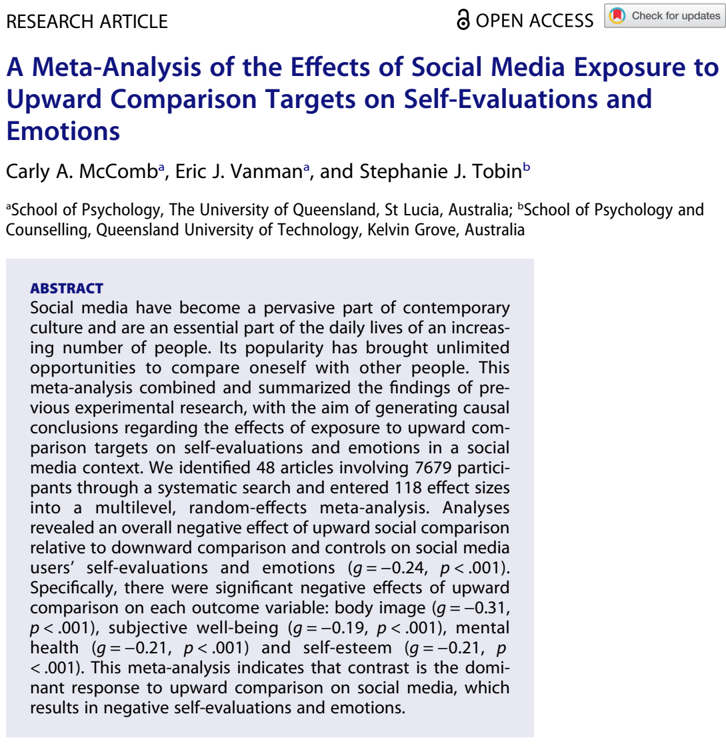
A Meta-Analysis of the Effects of Social Media Exposure to Upward Comparison Targets on Self-Evaluations and Emotions
Open accessAbstract
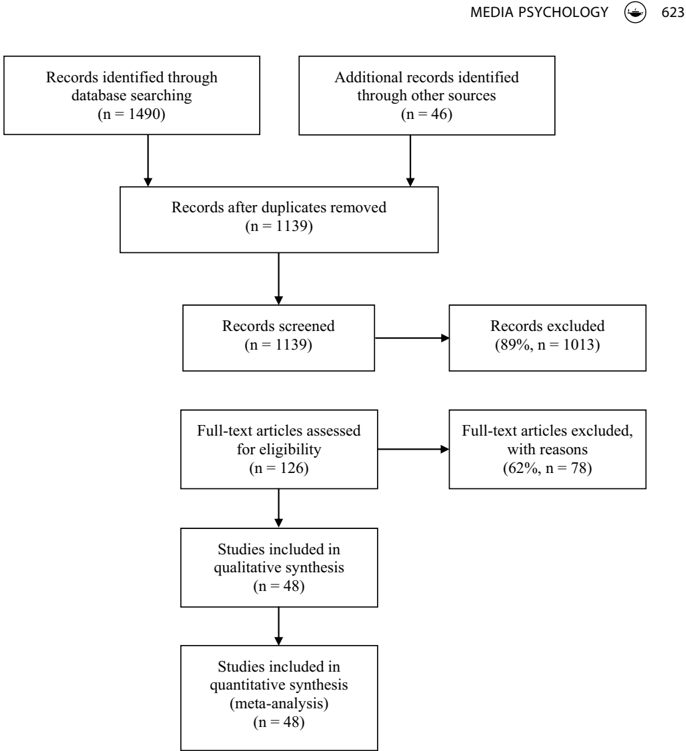
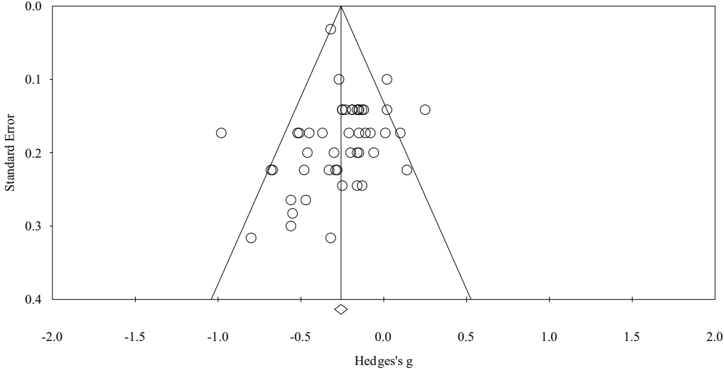
Social media have become a pervasive part of contemporary culture and are an essential part of the daily lives of an increasing number of people. Its popularity has brought unlimited opportunities to compare oneself with other people. This meta-analysis combined and summarized the findings of previous experimental research, with the aim of generating causal conclusions regarding the effects of exposure to upward comparison targets on self-evaluations and emotions in a social media context. We identified 48 articles involving 7679 participants through a systematic search and entered 118 effect sizes into a multilevel, random-effects meta-analysis. Analyses revealed an overall negative effect of upward social comparison relative to downward comparison and controls on social media users’ self-evaluations and emotions (g = −0.24, p < .001). Specifically, there were significant negative effects of upward comparison on each outcome variable: body image (g = −0.31, p < .001), subjective well-being (g = −0.19, p < .001), mental health (g = −0.21, p < .001) and self-esteem (g = −0.21, p < .001). This meta-analysis indicates that contrast is the dominant response to upward comparison on social media, which results in negative self-evaluations and emotions.
Overview
The claims and statistics of this paper haven’t been checked yet.
Run the check — free, no account needed. It reads the open-access text and checks the sources it cites.
Integrity signals
Registry
Cites
Statistics
Figures



Verification
Claims the paper makes
The claims and statistics of this paper haven’t been checked yet.
Run the check — free, no account needed. It reads the open-access text and checks the sources it cites.
Claims other papers make about this one
Each is checked against this paper’s own text: does it say what the citing paper says it does?
The cited source says what the claim attributes to it.
In the citing paper
“This finding is in line with previous evidence that social comparisons on social networking sites negatively influence self-esteem”
From The associations between social comparison on social media and young adults’ mental health (2025) · cites this paper as McComb et al., 2023
Self-check
Percentages, sums and reported differences re-computed from the paper’s own numbers.
The self-check needs the paper’s full text.
Citations
Cites
Bias in meta-analysis detected by a simple, graphical test
Egger, M., Smith, G. D., Schneider, M., & Minder, C. (1997) · BMJ · doi:10.1136/bmj.315.7109.629 · Cited by 56,722 · cited 1×
“Egger’s regression test is appropriate for small metaanalyses and assesses symmetry of the publication bias funnel plot (Egger et al., 1997).”
BackgroundA theory of social comparison processes
Festinger, L. (1954) · Human Relations · doi:10.1177/001872675400700202 · Cited by 20,926
Operating characteristics of a rank correlation test for publication bias
Begg, C. B., & Mazumdar, M. (1994) · Biometrics · doi:10.2307/2533446 · Cited by 16,955
Borenstein, M., Hedges, L. V., Higgins, J. P. T., & Rothstein, H. R. (2009) · doi:10.1002/9780470743386 · Cited by 14,225
Duval, S., & Tweedie, R. (2000) · Biometrics · doi:10.1111/j.0006-341x.2000.00455.x · Cited by 14,099
Erikson, E. H. (2026) · Zenodo (CERN European Organization for Nuclear Research) · doi:10.5281/zenodo.18614668 · Cited by 13,081
Subjective well-being: Three decades of progress.
Diener, E., Suh, E. M., Lucas, R. E., & Smith, H. L. (1999) · Psychological Bulletin · doi:10.1037/0033-2909.125.2.276 · Cited by 12,910
The Content Analysis Guidebook
Neuendorf, K. A. (2017) · doi:10.4135/9781071802878 · Cited by 9,286
Downs, S. H., & Black, N. (1998) · Journal of Epidemiology and Community Health · doi:10.1136/jech.52.6.377 · Cited by 8,252
Models of the self: self-construals and gender.
Cross, S., & Madson, L. (1997) · Psychological bulletin · doi:10.1037/0033-2909.122.1.5 · Cited by 2,851
Cited by
Sorted by citations
Items 101–167 of 167
Passive Social Media Use, Depressive Symptoms, and Mindfulness Among College Students
Delo, M. (2025) · Psychology and Education A Multidisciplinary Journal · doi:10.70838/pemj.480309
The Impact of Scroll Fatigue on Gen Z's Mental Well-Being in the Era of Influencer Marketing
Kathuria, A., Mathur, A., Yadav, M., & Saluja, A. (2025) · IGI Global eBooks · doi:10.4018/979-8-3373-4516-1.ch012
Thomas, L. M. B., & Talbot, C. V. (2025) · New Media & Society · doi:10.1177/14614448251393921
“[ P220] These experiences of social media FoMO mirror other research demonstrating negative effects on body image, well-being, and self-esteem (McComb et al., 2023).”
Meaning in life improves response to others’ self-promotion
Huh, Y. E., Scopelliti, I., & Myaeng, S. Y. (2025) · Scientific Reports · doi:10.1038/s41598-025-30505-4
Qi, X., Jiang, Y., & Lian, R. (2024) · Figshare · doi:10.6084/m9.figshare.26688806
Harnessing Machine Learning to Optimize Social Media Marketing
Dkhar, J. M., John, T. J., & Rai, P. (2026) · Lecture notes in networks and systems · doi:10.1007/978-981-96-9184-5_43
Aruoture, E. O., & Essien, J. D. (2026) · Child & Youth Care Forum · doi:10.1007/s10566-025-09919-8
“Adolescents who fre-1 quently engage with such content report greater emotional distress and lower self-esteem (Ajewumi et al., 2024; McComb et al., 2023; Orben et al., 2024).”
Gauci, C., & Vella, M. G. (2026) · Springer eBooks · doi:10.1007/978-3-030-68127-2_904-1
Instagram Passive Active Use Measure (iPAUM): Development, validation and relation to self-esteem
Tølbøll, K. B., Gerson, J., & Plagnol, A. C. (2026) · Cyberpsychology Journal of Psychosocial Research on Cyberspace · doi:10.5817/cp2026-1-10
“…that self-esteem can either be boosted or reduced when using SNSs. Comparing oneself to other users via posted content on SNSs can reduce self-esteem (Le Blanc-Brillon et al., 2025; McComb et al., 2023), while receiving feedback on posted content can enhance self-esteem (Burrow & Rainone, 2017).”
Social media, absorption, and stress: Divergent paths to self-esteem
Davis, S. W., Barahmand, U., Russo, R., Antunano, M., Asamoah, J., Bernstein, C., Bass, B., & Solodar, M. (2026) · Mediterranean Journal of Social & Behavioral Research · doi:10.29333/mjosbr/17853
“Social media platforms often expose users to a range of stress-inducing experiences, such as upward social comparison, which can lead individuals to evaluate themselves unfavorably against curated portrayals of others ’ lives (McComb et al., 2023).”
van Rooij, A. J., van der Rijst, V. G., Date, M., Tuijnman, A., Oostenbach, K. P. J., Carras, M. C., & Thrul, J. (2026) · Royal Society Open Science · doi:10.1098/rsos.250969 · Cited by 1
Yu, F., Niu, L., & Shen, Y. (2026) · Frontiers in Public Health · doi:10.3389/fpubh.2026.1765599
Díaz, M., Soriano, E., Swirsky, J. M., Rosie, M., Stewart, A., King, J., Wunsche, L., Darley, A., & Xie, H. (2026) · Emerging Adulthood · doi:10.1177/21676968261425274
“Despite these fi ndings, most research still relies on general usage measures (e.g., time or frequency; McComb et al., 2023), with fewer studies examining whether gender moderates the impact of speci fi c SMBs, particularly content posted on adjustment.”
Feng, C., Tao, V. Y. K., Zhang, H., Yu, K. G., Zhao, W. X., & Anise, M. S. W. (2026) · Current Psychology · doi:10.1007/s12144-025-08924-3
“Social media use is broadly regarded as a risk factor for both generalized anxiety (Lee et al., 2022; Lopes et al., 2022 ) and specific forms of anxiety/fear (e.g., social anxi - ety [O’Day & Heimberg, 2021 ]; appearance/body anxiety [McComb et al., 2023]).”
José, G., Silva, R. R., & Cordeiro, D. F. (2026) · Documentación de las Ciencias de la Información · doi:10.5209/dcin.104448
Wang, Z., Ding, N., Ye, H., & Lin, L. (2026) · Applied Research in Quality of Life · doi:10.1007/s11482-026-10588-5
“This finding supports the perspectives of social comparison theory (McComb et al., 2023 ), which posits that frequent viewings of social media platforms filled with idealized appearance images lead adolescents to unconsciously engage in upward comparisons.”
Bryan, S., Hamilton, M., & Zimny, D. (2026) · OBM Integrative and Complementary Medicine · doi:10.21926/obm.icm.2601012
Manifestation: research status and theoretical underpinnings
Leser, S. M., & Thoma, M. V. (2026) · Current Psychology · doi:10.1007/s12144-026-09315-y · Cited by 1
“Social media reinforces these values through curated self-presentation, upward social comparisons, and idealized por-trayals of life (Hjetland et al., 2024 ; McComb et al., 2023).”
Kirkpatrick, C. (2026) · Computers in Human Behavior · doi:10.1016/j.chb.2026.109026 · Cited by 1
Sustained Anxiety in Personalised Social Media Feeds: Social Comparison and Vigilant EngagementPreprint
Shang, Y., Claisse, C., Moignan, E. L., Bull, C., & Kirk, D. S. (2026) · SSRN Electronic Journal · doi:10.2139/ssrn.6663074
The dark side of LinkedIn use: how perfectionism moderates emotional responses of envy and shame
Kleszewski, E., & Berlips, E. (2026) · Current Psychology · doi:10.1007/s12144-026-09438-2
“Active use of SNSs involves producing information, such as posting personal updates or sharing achievements.”
InfluentialYu, E. H., Olson, C., & Moreno, M. A. (2026) · International Journal of Environmental Research and Public Health · doi:10.3390/ijerph23050605
“This intensified exposure to socially comparative content may heighten FoMO by amplifying concerns about being left out or falling behind peers [12,13].”
Does negative affective forecasting increase the risk of suicidal ideation?
Rizeq, J., Etherson, M. E., & O’Connor, R. C. (2026) · Journal of Psychiatric Research · doi:10.1016/j.jpsychires.2026.05.018
Лукашенко, Д. В. (2026) · International journal of medicine and psychology. · doi:10.58224/2658-3313-2026-9-3-258-262
The Comparative Trap: How Social Comparison Orientation Drives Problematic Generative AI (GenAI) Use
Zhang, X., & Lee, J. (2026) · International Journal of Human-Computer Interaction · doi:10.1080/10447318.2026.2668619 · Cited by 1
“Unlike social platforms centered on information display and interaction (McComb et al., 2023; Ozimek et al., 2023), in the AI era, users commonly collaborate with GenAI to improve task efficiency and output quality, thereby changing the basis on which social comparison occurs (Noy & Zhang, 2023).”
Chen, Y., Guo, X., & Zhao, W. (2026) · BMC Psychology · doi:10.1186/s40359-026-04889-5
“Such a pattern may exacerbate emotional distress by increasing upward social comparison, disrupting daily routines and displacing time for restorative activities and face-to-face social interactions [39–41].”
Qian, Y., Song, Y.-A., & Kim, Y. (2026) · Journal of Current Issues & Research in Advertising · doi:10.1080/10641734.2026.2670644
Zhang, X., Huang, T., Wang, Y., Hou, Z., & Fu, J. (2026) · PLoS ONE · doi:10.1371/journal.pone.0350109
Leer, J., & Odgers, C. L. (2026) · Policy Insights from the Behavioral and Brain Sciences · doi:10.1177/23727322261459929
“Social media platforms allow the sharing of posts, videos, and images that broadcast access to material goods and experiences in ways that facilitate upward social comparisons, which could lead to heightened feelings of disadvantage and deprivation (McComb et al., 2023).”
Problematic Social Media Use and Mental Health: The Mediating Role of Mindfulness
Kruse, F., & Nagel, A. (2026) · Psychiatry International · doi:10.3390/psychiatryint7030134
“In social media environments, such comparisons are often upward and based on selectively positive or idealized portrayals, thereby increasing vulnerability to self-criticism and negative affect [11–13].”
Huang, X., Qi, J., Dou, H., Chen, X., Xi, Y., Jia, Y., Qiaoli, X., Li, J., Qiu, H., & Liu, B. (2026) · Frontiers in Public Health · doi:10.3389/fpubh.2026.1852639
“Prior studies have shown that Internet addiction is associated with social comparison tendencies (72, 74, 75), and that social comparison, particularly upward social comparison, is closely related to body dissatisfaction and appearance anxiety (76, 77).”
Erickson, S., Kito, B., Treharne, G. J., & Fehoko, E. S. (2026) · Journal of Community & Applied Social Psychology · doi:10.1002/casp.70291
Maftuha, R. I., Andika, A., Saputra, V. A., & Triyono, A. R. H. (2026) · Revista Galega de Economía · doi:10.15304/rge.35.3.11129
“How did I make it?” The affective circulation of success narratives in Instagram videos
YILMAZ, E. (2026) · Opus uluslararası toplum araştırmaları dergisi · doi:10.26466/opusjsr.1931873
Basili, S., Baroni, M., Colombini, G., Guazzini, A., & Duradoni, M. (2026) · Psychology International · doi:10.3390/psycholint8030044
“…networks may also entail social pressure, restrictive group norms, social comparison, and social overload dynamics, as well as expectations of constant availability and reliance on peer approval (Maier et al., 2015; McComb et al., 2023; Nesi & Prinstein, 2015; Villalonga-Olives & Kawachi, 2017).”
Williamson, V. G., Allen, N. B., & Pfeifer, J. H. (2026) · Trends in Cognitive Sciences · doi:10.1016/j.tics.2026.06.010 · Cited by 2
Increasing social media use trajectories are linked to greater eating disorder symptoms
Nagata, J. M., Wong, J. H., Nayak, S., Li, E. J., Bisom-Rapp, E., Ganson, K., Testa, A. M., Baker, F. C., & Lavender, J. M. (2026) · Annals of Epidemiology · doi:10.1016/j.annepidem.2026.110195
Association between exercise-related social media use and exercise self-efficacy: a PLS-SEM approach
Mao, Y., Zhao, J., Xiang, M., Huliang, H., & Zhou, W. (2026) · Frontiers in Public Health · doi:10.3389/fpubh.2026.1895806
Zheng, W., Wang, X., Xia, C., & Weng, W. (2026) · Frontiers in Psychology · doi:10.3389/fpsyg.2026.1805325
Grönroos, R., Celuch, M., Savolainen, I., Kaakinen, M., & Oksanen, A. (2026) · Acta Psychologica · doi:10.1016/j.actpsy.2026.107491
Social media use duration and epigenetic aging among U.S. adults in the MIDUS refresher study
Rodrigues, M., Bather, J. R., Crump, A. A., Kranz, E. O., Kaphingst, K. A., Almeida, D. M., & Cuevas, A. G. (2026) · PLOS Digital Health · doi:10.1371/journal.pdig.0001570
Fitriani, L., Ekanesia, P., & Akbar, R. F. (2026) · Indonesian Journal of Multidisciplinary on Social and Technology · doi:10.69693/ijmst.v4i3.13224
Lived experience as guidance: A qualitative study of parental advice for craniosynostosis
Silvestri, T. P., Osborn, A. J., & Roberts, R. (2026) · Journal of Child Health Care · doi:10.1177/13674935261476741
Park, C., & Cho, M. (2026) · Journal of Retailing and Consumer Services · doi:10.1016/j.jretconser.2026.105023
Growing Up Connected: Teaching Children and Youth Healthy Tech Habits
Lauer, D., Lauer, R., Lauer, R., & Tomar, D. (2026) · Springer eBooks · doi:10.1007/978-3-032-12201-8_19
Vieira, L., García-Rabines, D., Cova, F., & Boudesseul, J. (2026) · Psychological Reports · doi:10.1177/00332941261480093
Algorithmisierte Medienumgebungen
Kümpel, A. S., & Fischer, M. (2026) · Springer eBooks · doi:10.1007/978-3-658-46851-4_33-1
Liu, Y.-Z., Pang, H., & Zhao, Y.-Z. (2026) · Behavioral Science · doi:10.3390/bs16091551
“The three USCT items were adapted with reference to the social-media upward-comparison literature summarized in (McComb et al., 2023).”
Karasavva, V., Khalis, A., & Mikami, A. Y. (2026) · Journal of Social Media Research · doi:10.29329/jsomer.107
“This may lead users to compare their life to that of their peers, and to conclude that their peers are living better lives (McComb et al., 2023; Meier et al., 2020).”
Adults have rather stable, yet domain-specific tendencies in social and temporal comparisons
Wrzus, C., Küchler, G., Borgdorf, K. S. A., & Aguilar‐Raab, C. (2026) · Scientific Reports · doi:10.1038/s41598-026-70006-6
Meyer, T., Zenses, A., & Nexhmedin Morina, B. (2026) · BMC Psychology · doi:10.1186/s40359-026-05536-9
“Similarly, upward comparisons frequently elicit negative emotions [3, 4].”
Einstein, D. A., Gillespie, K. M., Branjerdporn, G., White, M. J., Tobin, S. J., Lawn, S., White, N. M., Ewais, T., Mansell, W., Mowle, A., et al. (2026) · Research Square · doi:10.21203/rs.3.rs-11025484/v1
Self-citationSocial comparisons on social media and mental health: A systematic review and meta-analysisPreprint
Hoppen, T. H., Höfer, L., Schlechter, P., Holling, H., Mutz, J., & Nexhmedin Morina, B. (2026) · medRxiv · doi:10.64898/2026.09.15.26363124
Imagining Better Outcomes: Effects of Counterfactual Thinking on Sport Fans’ Continued Support
Yoo, S., Yun, L., & Ko, Y. J. (2026) · Communication & Sport · doi:10.1177/21674795261491364
Gebol-Checàn, R., Ascorbe-Peña, G., Miguel-Mariño, R., Tapullima-Mori, C., Cjuno, J., & Llanos, J. J. M. (2026) · Frontiers in Psychology · doi:10.3389/fpsyg.2026.1935089
“In transition processes such as entering university, these comparisons tend to be upward and to deteriorate self-evaluation and well-being (McComb et al., 2023), which leads the student to experience an affective reaction such as loneliness (Arnold et al., 2021; Zell and Strickhouser, 2020).”
Lin, Y., Li, Z., Li, L., Zhen, L. V., Song, T., Zhou, X., & Ni, J. (2026) · Frontiers in Psychiatry · doi:10.3389/fpsyt.2026.1962984
“…found that exposure to upward comparison targets on social media produced a small but reliable negative effect on body image and related self-evaluations (9), while a 2025 meta-analysis of 83 studies found a moderate association between online social comparison and greater body-image concerns (8).”
Smartphone Devices, Intelligent Algorithms and Rigid Cognitive Schemas
Petropoulos-Petalas, D. (2026) · Springer eBooks · doi:10.1007/978-3-031-52643-5_253-1
Dijital Temas Noktalarında Sosyal Karşılaştırma: Tüketici Psikolojisi ve Davranışsal Tepkiler
YILDIZ, S. Y., & Ibrahim, B. (2026) · Özgür Yayınları eBooks · doi:10.58830/ozgur.pub1504.c6025
Ávila, A. C., Noriega, M. D. L., & Hernández, L. Z. (2026) · Rastros Rostros · doi:10.16925/2382-4921.2026.02.04
“…que advierten sobre el «doble filo» de las redes sociales, al combinar oportunidades de información y conexión con desafíos como la desinformación, la comparación social o la distracción académica (Verduyn et al., 2020; McComb et al., 2023; Efstratiou & De Cristofaro, 2022; Baqir et al., 2024).”
S., K., & Kumaran, J. (2026) · New Ideas in Psychology · doi:10.1016/j.newideapsych.2026.101315
The Comparative Regime: How Pseudo‐Objective Standards Constitute Desire
Askari, M. (2026) · Journal for the Theory of Social Behaviour · doi:10.1111/jtsb.70068
Xu, Y., Bairen, Z., Zhu, Z., & Li, M. (2026) · Frontiers in Psychology · doi:10.3389/fpsyg.2026.1908710
Deonarain, M. (2026) · IGI Global eBooks · doi:10.4018/979-8-2600-2095-1.ch002
Xu, S., YangLiu, Tang, Q., & Ji, M. (2026) · Computers in Human Behavior · doi:10.1016/j.chb.2026.109234
Metadata
- Authors
- McComb, C. A., Vanman, E. J., & Tobin, S. J.
- Affiliations
- The University of Queensland (AU)
- Queensland University of Technology (AU)
- Corresponding author
- McComb, Carly A.
- Venue
- Media Psychology
- Publisher
- Informa UK Limited
- Published
- 2023-02-23
- Volume
- 26
- Issue
- 5
- Pages
- 612-635
- ISSN
- 1521-3269 (ISSN-L)
- 1532-785X
- OpenAlex
- W4321788928
- Cited by
- 167
- References
- 66
- Citations by year
- 2026: 83 · 2025: 58 · 2024: 21 · 2023: 5
- FWCI
- 8.49
- Type
- journal article
- Language
- en
- Open access
- hybrid
- doi.org
- Licence
- Locations
- Media Psychology (publishedVersion, cc-by-nc-nd)
- QUT ePrints (Queensland University of Technology) (submittedVersion, cc-by-nc)
- OSF Preprints (OSF Preprints) (submittedVersion)
- Funders
- specific grant from funding agencies
- Topics
- Social Sciences › Sociology and Political Science › Impact of Technology on Adolescents
- Social Sciences › Psychology › Clinical Psychology › Body Image and Dysmorphia Studies
- Social Sciences › Communication › Media and Digital Communication
- Keywords
- upward social comparison, social media exposure, self-assessment, emotions, body image, subjective well-being, mental health, self-esteem, downward social comparison, contrast effects
About these checks
Registry, retraction, Cites and statistics results are computed, not judged, with one exception: a printed reference that no index lists is read once by a model before it counts as a citation error. Claims are extracted by a model and kept only when their quote appears verbatim in the text; each cited source is then checked, with a model’s help, for whether it says what the claim relies on. Those verdicts can be wrong — read the claim’s quote and the cited source before relying on one.
Statistics and arithmetic are recomputed, not judged.
Confidence bands are shown only for fields calibrated on our annotated test set. None is calibrated yet, so no band is shown.
What counts as a claim ›How we measure confidence ›How we check this ›
Are you an author, or do you see a problem with this page? Request a review
