

The DOI matches its Crossref record; 113 of the 113 references it cites were found in a registry or an index; none of the 184 sources its claims cite is checked for support yet.
Dietary intake, nutrition knowledge, and behavior in youth team sport athletes: a scoping review and call to advance research and practice
Open accessAbstract
BACKGROUND: Youth team sport athletes face unique nutritional challenges due to the combined demands of growth, development and exercise. This scoping review systematically mapped the literature on dietary intake, nutrition knowledge, education interventions and factors influencing dietary behaviors in male and female team sport athletes aged 12-19 years. The review aimed to identify knowledge gaps, highlight methodological limitations and inform recommendations for advancing both research and practice in this population. METHODS: The review followed PRISMA-ScR guidelines and was pre-registered on the Open Science Framework. Eligible studies examined dietary intake, nutrition knowledge, education interventions and factors influencing dietary behavior in youth team sport athletes. Searches were conducted across PubMed, MEDLINE, PsycINFO, SPORTDiscus and gray literature sources. Study selection and data charting were conducted by the lead reviewer, with independent verification by a second reviewer. Findings were synthesized using descriptive analysis and thematic synthesis across these four domains. RESULTS: Fifty-seven studies involving 4,369 youth team sport athletes were included. Cross-sectional designs predominated (59.6%) and the evidence base was characterized by significant methodological inconsistencies, including wide variation in dietary assessment methods, limited adjustment for misreporting and substantial underrepresentation of female athletes who accounted for 26.9% of the total sample. Energy and carbohydrate intake were frequently reported below recommended levels, most evident during periods of intensive training and competition. However, findings from studies using doubly labeled water suggest that the magnitude of reported deficits may be overestimated due to dietary underreporting and imprecise estimation of energy expenditure. Protein and fat intake generally met recommendations although micronutrient intake often fell short, particularly for vitamins A, D, and E, calcium and iron. Nutrition knowledge was limited, particularly for sport-specific topics and none of the questionnaires used were validated for adolescent populations. Twelve education interventions were identified; education-only approaches rarely produced changes in dietary behavior, whereas interventions incorporating behavior change components tended to report improvements. Only five studies examined factors influencing dietary behavior, finding that parents, coaches and peers acted as both enablers and barriers to dietary adherence, and that environmental constraints compromised dietary quality. CONCLUSIONS: Youth team sport athletes commonly exhibit inadequate reported energy and carbohydrate intake alongside frequent micronutrient shortfalls, although the reliability of these estimates is limited by methodological constraints. Nutrition knowledge is generally poor, particularly in sport-specific areas. Dietary behaviors are shaped by individual, social and environmental influences that extend beyond knowledge alone and education interventions rarely produce sustained dietary change without the integration of behavior change strategies. Future research should prioritize more rigorous and consistent methodological approaches, improved representation of female athletes and the development of youth-specific validated assessment tools. Given the scope and persistence of the methodological inconsistencies identified, the development of an expert-led consensus statement on standards for dietary assessment, nutrition knowledge measurement, intervention design and participant characterization may help advance the quality and comparability of future research in this population.
Overview
CoChat Summary
TL;DR
This PRISMA-ScR scoping review mapped 57 studies (4,369 youth team sport athletes aged 12–19) on dietary intake, nutrition knowledge, education interventions, and factors influencing dietary behavior. It found frequently reported inadequate energy and carbohydrate intake and poor sport-specific nutrition knowledge, but major methodological inconsistencies, female underrepresentation, and unvalidated adolescent knowledge questionnaires limit confidence in the evidence.
Key findings
- Across 57 studies involving 4,369 athletes, females accounted for 26.9% of the sample (1,176 females; 3,167 males; 26 unspecified), and cross-sectional designs predominated (59.6%).
- Reported carbohydrate intake varied from 3.6 to 8.3 g/kg/day, with 76.9% (20/26) of studies reporting carbohydrate in g/kg/day showing mean values below the recommended 6–10 g/kg/day; protein intake was typically adequate (1.2–2.6 g/kg/day), while fat ranged from 0.9 to 1.8 g/kg/day.
- Nutrition knowledge scores ranged from 42% to 69.5%, with 43.8% of studies reporting poor to inadequate knowledge; none of the questionnaires used were validated for adolescent populations.
- Of 12 education interventions, 5 (41.7%) reported improved dietary behavior, all of which incorporated behavior change components beyond education alone; only 5 studies examined factors influencing dietary behavior, finding parents, coaches, and peers acted as both enablers and barriers.
Methods
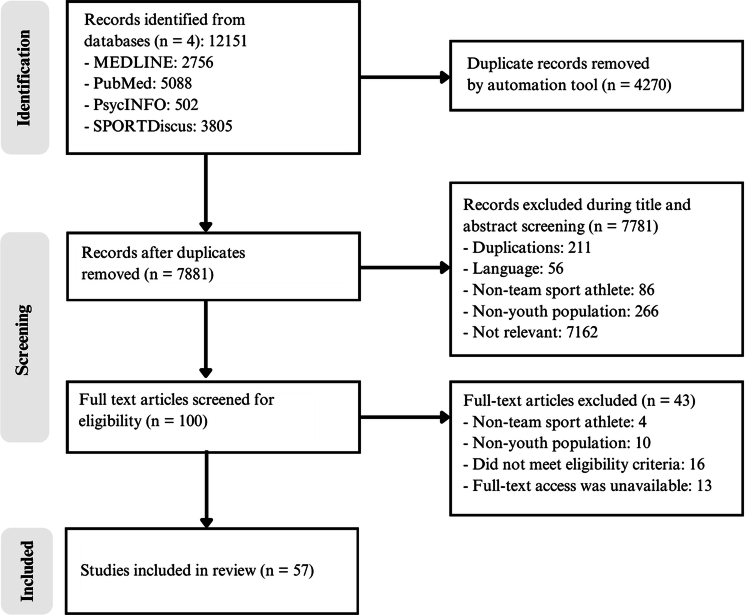
- Scoping review following PRISMA-ScR and JBI guidance, pre-registered on the Open Science Framework; searches of PubMed, MEDLINE, PsycINFO, SPORTDiscus, and gray literature were conducted between January 15 and June 7, 2024, yielding 12,151 records.
- Eligible studies examined dietary intake, nutrition knowledge, education interventions, or factors influencing dietary behavior in male and female team sport athletes aged 12–19 years; 57 studies met eligibility.
- Data were synthesized using descriptive analysis and thematic synthesis across four predefined domains; study quality was appraised with the Academy of Nutrition and Dietetics Quality Criteria Checklist, though no studies were excluded on quality.
Limitations
- Stated in the paper: only English-language publications were included, studies focused solely on vitamin or supplement use were excluded, and heterogeneity in designs, dietary assessment methods, and nutrition knowledge tools limited comparability; as a scoping review, it mapped evidence rather than evaluating efficacy or causality.
- Evident from the text: female athletes were substantially underrepresented (70.2% of studies focused exclusively on males; 10.5% solely on females), 60.9% of dietary studies did not address reporting bias, 77.2% did not report a priori power calculations, and no nutrition knowledge questionnaire was validated for adolescents.
- Evident from the text: most studies were cross-sectional (59.6%) and concentrated in soccer (64.9%), basketball (17.5%), and rugby (15.8%), limiting generalizability and causal inference.
Model-written summary. Check it against the paper before relying on it.
Integrity signals
Registry
Cites
Statistics
Figures
Verification
Claims the paper makes
0 Valid · 2 Not valid · 92 Not checked · 142 Own results and interpretations
A result the paper reports from its own data — it cites no other source for it, so there is none to check. The quote shows it is in the paper.
In the paper
“education-only approaches rarely produced changes in dietary behavior”
§ Dietary intake, nutrition knowledge, and behavior in youth team sport athletes: a scoping review and call to advance research and practice > Abstract > Results
plain- Asserted: passes — The authors put it forward as true.
- Checkable: passes — It can be checked against evidence.
- Load-bearing: passes — The paper’s conclusions depend on it.
- Based: passes — The paper gives a reason why it holds.
A result the paper reports from its own data — it cites no other source for it, so there is none to check. The quote shows it is in the paper.
In the paper
“Cross-sectional designs were most common (59.6%), offering descriptive snapshots of dietary behaviours but limiting the ability to assess change over time or establish causality.”
§ Dietary intake, nutrition knowledge, and behavior in youth team sport athletes: a scoping review and call to advance research and practice > Discussion > Methodological quality and participant representation
plain- Asserted: passes — The authors put it forward as true.
- Checkable: passes — It can be checked against evidence.
- Load-bearing: passes — The paper’s conclusions depend on it.
- Based: passes — The paper gives a reason why it holds.
A result the paper reports from its own data — it cites no other source for it, so there is none to check. The quote shows it is in the paper.
In the paper
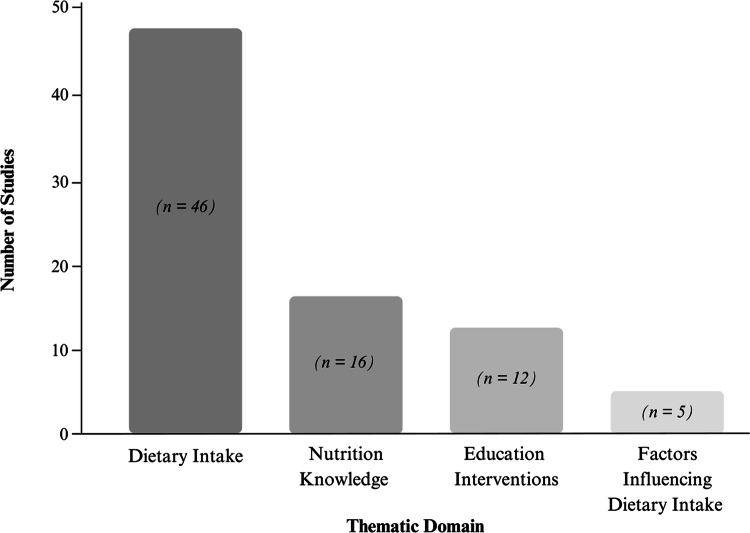
“Sixteen studies assessed nutrition knowledge in youth team sport athletes, as summarised in Table 4.”
§ Dietary intake, nutrition knowledge, and behavior in youth team sport athletes: a scoping review and call to advance research and practice > Results > Nutrition knowledge
plain- Asserted: passes — The authors put it forward as true.
- Checkable: passes — It can be checked against evidence.
- Load-bearing: unclear — It is unclear whether the paper’s conclusions depend on it.
- Based: passes — The paper gives a reason why it holds.
None of the sources cited for this claim have been checked yet.
In the paper
“The largest deficits occurred on match days and during intensive training periods, when energy expenditure increased but dietary intake did not adjust accordingly [34,60,69].”
§ Dietary intake, nutrition knowledge, and behavior in youth team sport athletes: a scoping review and call to advance research and practice > Discussion > Energy intake patterns and availability
What the sources say
- Not checked yetcites [34] Briggs M, Cockburn E, Rumbold PLS, et al. Assessment of energy intake and energy expenditure of Male adolescent academy-level soccer players during a competitive week. Nutrients. 2015; 7(10): 8392– 8401. doi: 10.3390/nu7105400 26445059 PMC4632420 source
- Not checked yetcites [60] Martinho DV, Naughton RJ, Leão C, et al. Dietary intakes and daily distribution patterns of macronutrients in youth soccer players. Front Nutr. 2023; 10: 1134845. doi: 10.3389/fnut.2023.1134845 37153912 PMC10157276 source
- Not checked yetcites [69] Russell M, Pennock A. Dietary analysis of young professional soccer players for 1 week during the competitive season. J Strength Cond Res. 2011; 25(7): 1816– 1823. doi: 10.1519/JSC.0b013e3181e7fbdd 21478767 source
plainstates a cause- Asserted: passes — The authors put it forward as true.
- Checkable: passes — It can be checked against evidence.
- Load-bearing: unclear — It is unclear whether the paper’s conclusions depend on it.
- Based: passes — The paper gives a reason why it holds.
In the paper
“Among these, one found no significant energy deficit at group level despite high energy demands [9], another identified approximately 40% underreporting of energy intake relative to measured expenditure [74] and a third reported a deficit of 389 kcal/day [10], lower than many of the deficits reported in studies relying on estimated expenditure.”
§ Dietary intake, nutrition knowledge, and behavior in youth team sport athletes: a scoping review and call to advance research and practice > Discussion > Energy intake patterns and availability
What the sources say
- Not checked yetcites [74] Silva AM, Santos DA, Matias CN, et al. Total energy expenditure assessment in elite junior basketball players: a validation study using doubly labeled water. J Strength Cond Res. 2013; 27(7): 1920– 1927. doi: 10.1519/JSC.0b013e31827361eb 22990574 source
plain- Asserted: passes — The authors put it forward as true.
- Checkable: passes — It can be checked against evidence.
- Load-bearing: passes — The paper’s conclusions depend on it.
- Based: passes — The paper gives a reason why it holds.
142 more claims
Create a free account to see all 236 claims and to verify the 181 references still open.
- It may state two separate claims as one. 71
- Probably not a substantial claim. 24
- The quote only partly states this claim. 1
Claims other papers make about this one
Each is checked against this paper’s own text: does it say what the citing paper says it does?
In the citing paper
“Previous reviews have shown that nutrition education interventions in athletes may improve nutrition knowledge, although effects on dietary intake, body composition, and performance are less consistent (9, 10).”
In the citing paper
“However, previous reviews have either focused on team-sport players irrespective of developmental stage, on nutrition education rather than broader nutritional interventions, or on scoping the field rather than systematically appraising intervention evidence across outcome domains (9, 10).”
In the citing paper
“More recently, Irwin et al. (10) mapped dietary intake, nutrition knowledge, education interventions, and behavioral influences in youth team-sport athletes, highlighting persistent methodological limitations and the need to advance research and practice in this population.”
Self-check
Percentages, sums and reported differences re-computed from the paper’s own numbers.
Each contradiction between two passages listed here was confirmed by an independent check.
Rated major: it would touch a result — a value a result rests on, reported and recomputed p-values on opposite sides of the significance level, two passages that conflict with no sign which is right, or a cited work retracted before this paper was published.
In the paper
§ Dietary intake, nutrition knowledge, and behavior in youth team sport athletes: a scoping review and call to advance research and practice > Abstract > Results
“none of the questionnaires used were validated for adolescent populations”
§ Dietary intake, nutrition knowledge, and behavior in youth team sport athletes: a scoping review and call to advance research and practice > Results > Nutrition knowledge
“Validated (validated with adolescent and young adult athletes; modified)”
Rated minor: it would not touch a result — a value no result rests on, a p-value that stays on the same side of the significance level, or a conflict that is clerical, resolved elsewhere in the paper, or outside its own findings.
In the paper
§ Dietary intake, nutrition knowledge, and behavior in youth team sport athletes: a scoping review and call to advance research and practice > Materials and methods > Data synthesis
“energy intake assessed via doubly labelled water (DLW) method”
§ Dietary intake, nutrition knowledge, and behavior in youth team sport athletes: a scoping review and call to advance research and practice > Discussion > Energy intake patterns and availability
“the four studies in this review that used doubly labelled water to assess energy expenditure [9,10,12,74]”
Rated minor: it would not touch a result — a value no result rests on, a p-value that stays on the same side of the significance level, or a conflict that is clerical, resolved elsewhere in the paper, or outside its own findings.
In the paper
“body mass increasing by 6.2 kg (4.8 kg fat-free mass, 1.6 kg fat)”
§ Dietary intake, nutrition knowledge, and behavior in youth team sport athletes: a scoping review and call to advance research and practice > Materials and methods > Data synthesis
Reported 6.2 · recomputed 6.4
Rated minor: it would not touch a result — a value no result rests on, a p-value that stays on the same side of the significance level, or a conflict that is clerical, resolved elsewhere in the paper, or outside its own findings.
In the paper
§ Dietary intake, nutrition knowledge, and behavior in youth team sport athletes: a scoping review and call to advance research and practice > Results > Education interventions
“6 months; baseline and post (intervention group only)”
§ Dietary intake, nutrition knowledge, and behavior in youth team sport athletes: a scoping review and call to advance research and practice > Materials and methods > Data synthesis
“Post-test: Overall: 6.19; Control: 5.98; Intervention: 6.39”
Rated minor: it would not touch a result — a value no result rests on, a p-value that stays on the same side of the significance level, or a conflict that is clerical, resolved elsewhere in the paper, or outside its own findings.
In the paper
§ Dietary intake, nutrition knowledge, and behavior in youth team sport athletes: a scoping review and call to advance research and practice > Results > Nutrition knowledge
“Both classroom-based and WeChat-delivered education improved knowledge”
§ Dietary intake, nutrition knowledge, and behavior in youth team sport athletes: a scoping review and call to advance research and practice > Results > Nutrition knowledge
“Pre-intervention scores: Classroom = 85%, WeChat = 84%. Post-intervention: Classroom = 88%, WeChat = 83%”
4 more findings
Create a free account to see every finding of this check.
Citations
Cites
PRISMA Extension for Scoping Reviews (PRISMA-ScR): Checklist and Explanation
Tricco, A. C., Lillie, E., Zarin, W., O'Brien, K. K., Colquhoun, H., Levac, D., Moher, D., Peters, M. D. J., Horsley, T., Weeks, L., et al. (2018) · Annals of Internal Medicine · doi:10.7326/m18-0850 · Cited by 43,565 · cited 2×
“Study selection was conducted in accordance with PRISMA-ScR recommendations [23].”
PRESS Peer Review of Electronic Search Strategies: 2015 Guideline Statement
McGowan, J., Sampson, M., Salzwedel, D. M., Cogo, E., Foerster, V., & Lefebvre, C. (2016) · Journal of Clinical Epidemiology · doi:10.1016/j.jclinepi.2016.01.021 · Cited by 5,700 · cited 1×
“The search strategy was developed in consultation with a university librarian and peer-reviewed using the PRESS (Peer Review of Electronic Search Strategies) checklist [27].”
Defining Training and Performance Caliber: A Participant Classification Framework
McKay, A. K. A., Stellingwerff, T., Smith, E. S., Martin, D. T., Mujika, I., Goosey-Tolfrey, V. L., Sheppard, J., & Burke, L. M. (2022) · International Journal of Sports Physiology and Performance · doi:10.1123/ijspp.2021-0451 · Cited by 3,093
Beyond PICO: The SPIDER Tool for Qualitative Evidence Synthesis
Cooke, A., Smith, D., & Booth, A. (2012) · Qualitative Health Research · doi:10.1177/1049732312452938 · Cited by 2,608
JBI Manual for Evidence Synthesis
(2024) · doi:10.46658/jbimes-24-01 · Cited by 2,483
Serra-Majem, L., Ribas, L., Ngo, J., Ortega, R. M., García, A., Pérez-Rodrigo, C., & Aranceta, J. (2004) · Public Health Nutrition · doi:10.1079/phn2004556 · Cited by 1,343
Nutrition and Athletic Performance
(2016) · Medicine & Science in Sports & Exercise · doi:10.1249/mss.0000000000000852 · Cited by 1,305 · cited 3×
“Current guidelines recommend 6 to 10 g/kg/day to support high training demands [93].”
InfluentialBailey, D. A., Mckay, H. A., Mirwald, R. L., Crocker, P. R. E., & Faulkner, R. A. (1999) · Journal of Bone and Mineral Research · doi:10.1359/jbmr.1999.14.10.1672 · Cited by 1,030
Carbohydrates for training and competition
Burke, L. M., Hawley, J. A., Wong, S. H. S., & Jeukendrup, A. E. (2011) · Journal of Sports Sciences · doi:10.1080/02640414.2011.585473 · Cited by 985
IOC consensus statement on relative energy deficiency in sport (RED-S): 2018 update
Mountjoy, M., Sundgot-Borgen, J. K., Burke, L. M., Ackerman, K. E., Blauwet, C., Constantini, N., Lebrun, C., Lundy, B., Melin, A. K., Meyer, N. L., et al. (2018) · British Journal of Sports Medicine · doi:10.1136/bjsports-2018-099193 · Cited by 883
Research works printed but not linked: 11
- Peters MDJ , Godfrey CM , McInerney P , et al. Methodology for JBI scoping reviews In: Aromataris E , Munn Z , editors. Joanna Briggs Institute reviewers’ manual (2015)Adelaide: The Joanna Briggs Institute; 2015. pp. 3–24.
- Covidence systematic review software. Melbourne (Australia): Veritas Health Innovation; 2024. Available from: https://www.covidence.org.
- Academy of Nutrition and Dietetics Evidence analysis manual: Steps in the Academy evidence analysis process. Chicago: Academy of Nutrition Dietetics; 2016 Available from: https://www.andeal.org/vault/2440/web/files/2016_April_EA_Manual.pdf.
- Hickson J , Schrader J , Trischler L . Preseason nutritional profile of high school basketball athletes. J Strength Cond Res. 1990;4(4):3–7.
- Koç M , Saritaş N , Kirbaş Ş . Bülbül H. Examining nutritional habits of soccer players at youth development teams. Sci Mov Health. 2016;16(2):576–584 https://www.analefefs.ro/anale-fefs/2016/i2s/pe-autori/46.pdf.
- Pavlak M Smith R Wood K . The inter-relatedness of nutrition menstrual status lean body mass and injury among high school female varsity basketball players [master’s thesis]. Allendale (MI): Grand Valley State University; 1998 Available from: https://scholarworks.gvsu.edu/theses/397.
- NutritionQuest. Block 2014.1 food frequency and activity questionnaire. Berkeley (CA): Berkeley Analytics, Inc; 2014. Available from: https://eprovide.mapi-trust.org/instruments/block-2014-food-frequency-questionnaire
- Hospital SHB . Butterworth Hospital nutritional food frequency questionnaire. Grand Rapids (MI): Spectrum Health Butterworth Hospital; 1998
- Supriya V , Ramaswami L . Knowledge, attitude and dietary practices of track and field athletic men and women aged 18–22 years. Int J Innov Res Dev. 2013;2(11). Available from: https://internationaljournalcorner.com/index.php/ijird_ojs/article/view/134032
- Burke L , Deakin V . Clinical sports nutrition. 5th North Ryde (NSW): McGraw Hill Education; 2015.
- Deakin V , Peeling P . Prevention, detection and treatment of iron depletion and deficiency in athletes In: Burke LM , Deakin V , editors. Clinical sports nutrition. 5th North Ryde (NSW): McGraw-Hill Education; 2015. pp. 266–309.
Cited by
Victoria-Montesinos, D., García-Muñoz, A. M., Mercader-Ros, M. T., Jaraba-Salinero, Y., & Figueroa-Morales, F. (2026) · Frontiers in Nutrition · doi:10.3389/fnut.2026.1939289 · Cited by 1
Lagua-Saquinga, E. L., Poveda-Morales, T. C., & Estrada-Velasco, L. J. (2026) · CIENCIAMATRIA · doi:10.35381/cm.v12i4.3042
Anthropometric assessment of nutritional status among young football athletes
Hartanto, B. A., Matadi, G. E. P., Annas, M. R., & Zulkarnain, W. D. (2026) · Journal of Pedagogy in Sport and Physical Activity · doi:10.68701/jpspa.v1i1.15
Yamamoto, T., Seguchi, M., Iio, Y., Tanaka, M., Kozai, H., Ejiri, H., Aoyama, Y., Mori, Y., & Ito, M. (2026) · Nutrients · doi:10.3390/nu18213609
Metadata
- Authors
- Irwin, N., Ó Catháin, C., Ward, C., & Kelly, D. T.
- Affiliations
- Technological University of the Shannon: Midlands Midwest (IE)
- Department of Sport and Health Science, Technological University of the Shannon
- Corresponding author
- Irwin, Neil
- Venue
- Journal of the International Society of Sports Nutrition
- Publisher
- Informa UK Limited
- Published
- 2026-05-14
- Volume
- 23
- Issue
- 1
- Pages
- 2671431-2671431
- ISSN
- 1550-2783 (ISSN-L)
- PMC
- PMC13182181
- OpenAlex
- W7161307677
- Cited by
- 4
- References
- 113
- Citations by year
- 2026: 4
- FWCI
- 3.35
- Type
- journal article
- Language
- en
- Open access
- gold
- doi.org
- Licence
- Locations
- Journal of the International Society of Sports Nutrition (publishedVersion, cc-by)
- PubMed Central (publishedVersion, cc-by)
- PubMed (publishedVersion)
- DOAJ (DOAJ: Directory of Open Access Journals) (submittedVersion, cc-by-sa)
- Funders
- Research Ireland (Grant number EBPPG/2023/1141)
- Topics
- Health Sciences › Nursing › Nutrition and Dietetics › Nutrition, Health and Food Behavior
- Health Sciences › Medicine › Public Health, Environmental and Occupational Health › Obesity, Physical Activity, Diet
- Health Sciences › Medicine › Public Health, Environmental and Occupational Health › Nutritional Studies and Diet
- Keywords
- dietary intake, nutrition knowledge, dietary behavior, nutrition education intervention, micronutrient deficiency, behavior change strategies, peer influence, environmental constraints, youth athletes, energy expenditure estimation, micronutrient intake
- MeSH terms
- Youth Sports, Evidence Gaps, Adolescent, Energy Intake, Child, Diet, Feeding Behavior, Female, Humans, Health Knowledge, Attitudes, Practice, Male, Young Adult, Athletes, Sports Nutritional Physiological Phenomena
About these checks
Registry, retraction, Cites and statistics results are computed, not judged, with one exception: a printed reference that no index lists is read once by a model before it counts as a citation error. Claims are extracted by a model and kept only when their quote appears verbatim in the text; each cited source is then checked, with a model’s help, for whether it says what the claim relies on. Those verdicts can be wrong — read the claim’s quote and the cited source before relying on one.
A language model drew the claims from the paper on 2026-11-14, under version 3 of the claim definition (model deepseek-v4.1-flash, prompt extract-v3).
A second model labelled each claim on 2026-11-14 (model jev-1.13-20260917, definition revision gold-guideline-v0.2).
Statistics and arithmetic are recomputed, not judged.
Confidence bands are shown only for fields calibrated on our annotated test set. None is calibrated yet, so no band is shown.
What counts as a claim ›How we measure confidence ›How we check this ›
Are you an author, or do you see a problem with this page? Request a review
Data sources
Bibliographic data: Semantic Scholar, OpenAlex, Crossref.
Contains information from the Semantic Scholar Academic Graph Datasets, made available under the ODC Attribution License (ODC-BY 1.0).
Semantic Scholar’s data is described in: Kinney, R., et al. (2023). The Semantic Scholar Open Data Platform. arXiv:2301.10140.
