

Co-design with marginalised people: designers’ perceptions of barriers and enablers
Open accessThe DOI matches its Crossref record; 62 of the 62 references it cites were found in a registry or an index.
Abstract
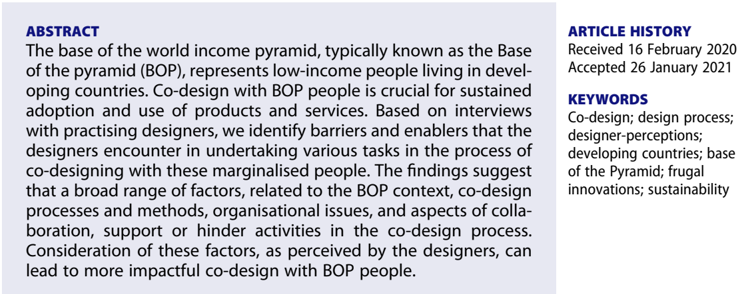
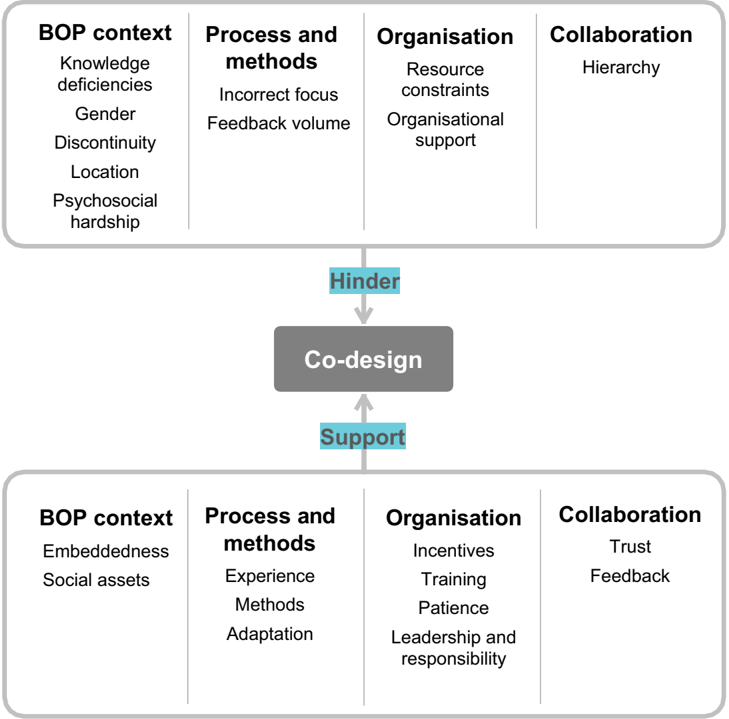
The base of the world income pyramid, typically known as the Base of the pyramid (BOP), represents low-income people living in developing countries. Co-design with BOP people is crucial for sustained adoption and use of products and services. Based on interviews with practising designers, we identify barriers and enablers that the designers encounter in undertaking various tasks in the process of co-designing with these marginalised people. The findings suggest that a broad range of factors, related to the BOP context, co-design processes and methods, organisational issues, and aspects of collaboration, support or hinder activities in the co-design process. Consideration of these factors, as perceived by the designers, can lead to more impactful co-design with BOP people.
Overview
The claims and statistics of this paper haven’t been checked yet.
Free: it reads the open-access text and checks the first 5 claims that cite a source we can check. Create a free account to check every claim.
Integrity signals
Registry
Cites
Statistics
Figures



Verification
Claims the paper makes
The claims and statistics of this paper haven’t been checked yet.
Free: it reads the open-access text and checks the first 5 claims that cite a source we can check. Create a free account to check every claim.
Claims other papers make about this one
Each is checked against this paper’s own text: does it say what the citing paper says it does?
The check wasn’t confident either way, so it gives no verdict — never disputed.
In the citing paper
“It is not surprising that the public health sciences accounts for most articles focusing on health outcomes by providing 8 articles [35,55,57,63,83,87,92,156] followed by the social sciences applied to health, which provided 2 articles [91,96], and the HCI in health research, which provided 1 article [158].”
From Digital Health Technologies for Maternal and Child Health in Africa and Other Low- and Middle-Income Countries: Cross-disciplinary Scoping Review With Stakeholder Consultation (2023) · doi:10.2196/42161 · cites this paper as [156]
Experimental — accuracy not yet measured
Self-check
Percentages, sums and reported differences re-computed from the paper’s own numbers.
The self-check needs the paper’s full text.
Citations
Cites
(1994) · Journal of the American Dietetic Association · doi:10.1016/0002-8223(94)92216-0 · Cited by 45,910
Evolving to a New Dominant Logic for Marketing
Vargo, S. L., & Lusch, R. F. (2004) · Journal of Marketing · doi:10.1509/jmkg.68.1.1.24036 · Cited by 14,779 · cited 2×
“…2008), and several studies in non-BOP segments have examined co-design, cocreation, lead-user innovation, and Nordic participatory approaches (e.g. Vargo and Lusch 2004; Grönroos 2011; von Hippel 2005), and have explored factors influencing codesign in non-BOP contexts (e.g. Kleinsmann and…”
BackgroundA General Inductive Approach for Analyzing Qualitative Evaluation Data
Thomas, D. R. (2006) · American Journal of Evaluation · doi:10.1177/1098214005283748 · Cited by 10,858 · cited 4×
“Designs that are externally conceived and simply implemented in the BOP fail to achieve sustainable adoption and impact (e.g. Nieusma 2004; Thomas 2006a; Murcott 2007; Dodson, Sterling, and Bennett 2012).”
BackgroundMethodInfluentialCo-creation and the new landscapes of design
Sanders, E. B.-N., & Stappers, P. J. (2008) · CoDesign · doi:10.1080/15710880701875068 · Cited by 5,561 · cited 3×
“Since the late 1970s, many businesses have attempted to access external knowledge by involving their customers in design process (Sanders and Stappers 2008), and several studies in non-BOP segments have examined co-design, cocreation, lead-user innovation, and Nordic participatory approaches (e.g.…”
BackgroundMethodMixed Methodology: Combining Qualitative and Quantitative Approaches
Cotten, S. R., Tashakkori, A., & Teddlie, C. (1999) · Contemporary Sociology · doi:10.2307/2655606 · Cited by 5,204
Doing Research in the Real World
Gray, S. W. (2004) · Cited by 3,879
von Hippel, E. (2005) · doi:10.7551/mitpress/2333.001.0001 · Cited by 3,768
Small is beautiful: economics as if people mattered
(2000) · Choice Reviews Online · doi:10.5860/choice.38-1061 · Cited by 2,612
(2003) · Sociology for Pharmacists · doi:10.1201/9780203381175.ch9 · Cited by 2,543
Gaver, B., Dunne, T., & Pacenti, E. (1999) · Interactions · doi:10.1145/291224.291235 · Cited by 2,303 · cited 1×
“In the context of middleand high-income markets, researchers have developed co-design methods and tools such as cultural probes and generative tool-kits using a range of stimulus items such as pictures, videos, narratives, etc. (Sanders 2000; Gaver, Dunne, and Pacenti 1999).”
Background
Research works printed but not linked: 5
- Hammond, A. L., W. J. Kramer, R. S. Katz, J. T. Tran, and C. Walker. 2007. The Next Four Billion: Market Size and Business Strategy at the Base of the Pyramid . Washington, DC: World Resources Institute. International Finance Corporation.
- Jagtap, S. 2021. 'Frugal-IDeM: An Integrated Methodology for Designing Frugal Innovations in Low- Resource Settings.' International Conference on Research into Design, ICoRD 2021, IIT Bombay, Mumbai, India.
- Nieusma, D., and D. Riley. 2010. 'Designs on Development: Engineering, Globalization and Social Justice.' Journal International Network Engineers Studies 2: 29-59.
- Papanek, V., and R. B. Fuller. 1972. Design for the Real World . London: Thames and Hudson.
- Vaajakallio, K., J. J. Lee, J. Kronqvist, and T. Mattelmäki. 2013. 'Service Co-design with the Public Sector: Challenges and Opportunities in a Healthcare Context.' Paper presented at the 7th Conference of Include Asia. Hong Kong.
Cited by
Singh, D. R., Sah, R. K., Simkhada, B., & Darwin, Z. J. (2023) · Global Health Research and Policy · doi:10.1186/s41256-023-00290-6 · Cited by 139
“However, there is also a need for more clarity and guidelines for bringing those who are in exclusion or face multiple forms of marginalisation, particularly in the LMICs [40, 43].”
Background(2023) · doi:10.2196/42161 · Cited by 106
“…not surprising that the public health sciences accounts for most articles focusing on health outcomes by providing 8 articles [35,55,57,63,83,87,92,156] followed by the social sciences applied to health, which provided 2 articles [91,96], and the HCI in health research, which provided 1 article…”
Background(2022) · doi:10.2196/preprints.42161 · Cited by 106
Rodriguez, N. M., Burleson, G., Linnes, J. C., & Sienko, K. H. (2023) · Annual Review of Biomedical Engineering · doi:10.1146/annurev-bioeng-081922-024834 · Cited by 121
Russell‐Bennett, R., Kelly, N., Letheren, K., & Chell, K. (2023) · International Journal of Market Research · doi:10.1177/14707853231151605 · Cited by 57
“There has been a positive trend in recent decades towards greater inclusion of stakeholders in proposing, designing, and carrying out research through adoption of co-design methods by researchers, governments, institutions and firms (Jagtap, 2021; Zelenko et al., 2021).”
BackgroundJagtap, S. (2022) · Research in Engineering Design · doi:10.1007/s00163-022-00384-1 · Cited by 29
“2020; Jagtap 2021a, b).”
BackgroundMethodInfluentialSelf-citationElsayed-Ali, S., Bonsignore, E., & Chan, J. (2023) · Proceedings of the ACM on Human-Computer Interaction · doi:10.1145/3579606 · Cited by 35
“A lack of funding is especially challenging for long-term engagements with activist agendas, which are common in PD [11,45].”
BackgroundJiraphanumes, K., Aujirapongpan, S., & Songkajorn, Y. (2022) · Asia Pacific Management Review · doi:10.1016/j.apmrv.2022.10.001 · Cited by 34
Overcoming barriers to mHealth co-design in low- and middle-income countries: a research toolkit
Poulsen, A., Hickie, I. B., Alam, M., Crouse, J. J., Ekambareshwar, M., Loblay, V., Song, Y. J. C., & LaMonica, H. M. (2024) · Information Technology for Development · doi:10.1080/02681102.2023.2295480 · Cited by 22
“A toolkit is presented highlighting methods to best overcome barriers to the co-design of mHealth in LMICs requires developing suitable coping strategies, methods, and tools (Jagtap, 2021; Pei ff er-Smadja et al., 2020).”
Designing Visual Cards for Digital Mental Health Research with Ethnic Minorities
Ayobi, A., Grimes, A., Mackinnon, S., Soubutts, E., Eardley, R., Gross, Z. B., Gooberman‐Hill, R., & O’Kane, A. A. (2021) · Designing Interactive Systems Conference · doi:10.1145/3461778.3462085 · Cited by 25
“However, researchers have varied skills to manage power relationships: these asymmetrical power dynamics [4, 17, 35] can make not only participants but also researchers vulnerable [9].”
BackgroundA framework for designing frugal innovations in marginalised contexts
Upadhyay, P., & Punekar, R. M. (2023) · Journal of Cleaner Production · doi:10.1016/j.jclepro.2023.137170 · Cited by 23
Participatory design meets gender equality at European higher education institutions
Iivari, N., Tervo, E., Käsmä, M., & Heikkinen, M. (2023) · CoDesign · doi:10.1080/15710882.2023.2215742 · Cited by 23
“Similar issues have been underscored in the context of co-design with marginalised groups in developing countries, where gendered power relations and gender-based norms have acted as barriers to co-design (Jagtap 2021).”
BackgroundEven, B., Crawford, S., Shittu, O. F., Lundy, M., Wertheim‐Heck, S., Samuel, F. O., Talsma, E. F., Pastori, G., Le, H. T., Hernández, R., et al. (2024) · Current Developments in Nutrition · doi:10.1016/j.cdnut.2024.104395 · Cited by 20
“Co-creation Co-creation participants' aptitude for generating and evaluating conceptual solutions is often associated with factors such as low or limited literacy and numeracy, and limited design knowledge and experience [112].”
BackgroundThat was fun, now what?: Modelizing knowledge dynamics to explain co-design's shortcomings
Dubois, L.-É., Masson, P. L., & Weil, B. (2024) · Design Studies · doi:10.1016/j.destud.2024.101274 · Cited by 13
Zhu, Y., Johnston, S., Zhu, C., & Li, Y. (2024) · International Journal of Human-Computer Studies · doi:10.1016/j.ijhcs.2024.103412 · Cited by 12
Growing biodesign ecosystems: Community exchange spaces advance biotechnology innovation
Chappell, C. R., Perez, R., & Takara, C. O. (2023) · Research Directions Biotechnology Design · doi:10.1017/btd.2023.8 · Cited by 16
Hogans, K., & McAndrews, L. E. (2022) · Fashion Practice · doi:10.1080/17569370.2022.2118333 · Cited by 16
“Research has been conducted that enable Away from Violence toward Justice designers ’ decisions in not partaking in co-design with marginalized communities emphasizing the process as a burden (Jagtap 2021).”
BackgroundAstarini, S. D., Utomo, C., & Rohman, M. A. (2022) · Designs · doi:10.3390/designs6060111 · Cited by 9
Hadjri, K., Durosaiye, I. O., Samra, S., Niennattrakul, Y., Sinuraibhan, S., Sattayakorn, S., Wungpatcharapon, S., & Ramasoot, S. (2023) · CoDesign · doi:10.1080/15710882.2023.2268596 · Cited by 9
Leung, C. L., Goka, P. K., Atangongo, B., Bingle, M. M. M., Adu, I., Atchulo, A. R., Boateng, L., Huang, K., Laiteerapong, N., Limann, G., et al. (2025) · BMC Public Health · doi:10.1186/s12889-025-25012-0 · Cited by 9
Burleson, G., Wojciechowski, L. R., Toyama, K., & Sienko, K. H. (2024) · Design Science · doi:10.1017/dsj.2024.28 · Cited by 8
“While some recommendations from engineering design literature suggest involving stakeholders to determine a broader understanding of the context of use, these mainly focus on early-stage problem definition activities (Gause & Weinberg 1989; Borgford-Parnell et al. 2013; Jagtap 2021).”
Wu, K., Quadri, G. J., Wang, A. Z., Osei-Tutu, D. K., Petersen, E. P., Koushik, V., & Szafir, D. A. (2024) · International ACM SIGACCESS Conference on Computers and Accessibility (ASSETS) · doi:10.1145/3663548.3675615 · Cited by 10
“It establishes a shared platform between researchers and participants, ensuring that the design of visualizations is not only relevant, effective, and accessible, but also reflective of the unique perspectives and needs of individuals with people with IDD [44, 49, 95].”
BackgroundKokorelias, K. M., Wasilewski, M. B., Singh, H., Valentine, D., Eaton, A. D., Sheppard, C. L., & Sirisegaram, L. (2025) · International Journal of Qualitative Methods · doi:10.1177/16094069251344357 · Cited by 5
“At the same time, engaging participants in participatory research practices, such as co-design, requires trust-building and inclusivity, especially for populations that have historically faced discrimination in healthcare settings (Christopher et al., 2008; Jagtap, 2022; Lucero, 2013).”
Juusola, K. O., Venkitachalam, K., Kleber, D. M.-S., & Popat, A. (2024) · Journal of strategy and management · doi:10.1108/jsma-12-2023-0322 · Cited by 10
Understanding Drivers and Challenges of Multi-actor Collaborations at the Local Level
Yuan, Q., Doke, K., Gascó‐Hernández, M., Gil-García, J. R., Monova-Zheleva, M., & Bogdanov, P. (2022) · Hawaii International Conference on System Sciences (HICSS) · doi:10.24251/hicss.2022.322 · Cited by 8
“Mechanisms for bidirectional communication has to be employed where organizations show sensitivity to the wide range of concerns owned by users to engage them in the collaboration [42].”
BackgroundDesigning Sustainable Livelihoods for Informal Markets in Dhaka
Hossain, S. R., Melles, G. B., & Bailey, A. (2022) · Design science and innovation · doi:10.1007/978-981-16-8452-4_2 · Cited by 7
Rong, A., & Edward, N. H. (2025) · The Design Journal · doi:10.1080/14606925.2025.2477929 · Cited by 5
“Additionally, personal disinterest for co-design can hinder the process (Jagtap 2022).”
Alo, O. A., Arslan, A., Choudrie, J., & Elo, M. (2025) · Technovation · doi:10.1016/j.technovation.2025.103231 · Cited by 9
Laying the groundwork: Building trust with a marginalised community in Mumbai, India
Goswami, B., Ho, X., Fridman, I., Jana, A., & Rajamanickam, V. (2024) · Participatory Design Conference · doi:10.1145/3661455.3669882 · Cited by 4
“This process requires repeated visits to the participants’ homes and genuine interest in their lives and issues [43].”
Conceptual Design in Informal Metalworking Microenterprises of Tanzania
Opiyo, E. Z., Jagtap, S., & Keshwani, S. (2023) · Sustainability · doi:10.3390/su15020986 · Cited by 5
Self-citationJuusola, K. O., Kleber, D. M.-S., & Popat, A. (2024) · Journal of Social Marketing · doi:10.1108/jsocm-05-2023-0106 · Cited by 5
Campoli, A., Luck, R., Shrestha, P., Pradhan, P., & Rana, P. (2024) · CoDesign · doi:10.1080/15710882.2024.2319280 · Cited by 3
Co-design with parents and designers: developing packaging concepts for children
Won, S. (2024) · CoDesign · doi:10.1080/15710882.2024.2381801 · Cited by 5
Investigating Community Engagement Practices in Short-Term Humanitarian Engineering Projects
Masood, A., & Burleson, G. (2024) · IEEE Global Humanitarian Technology Conference (GHTC) · doi:10.1109/ghtc62424.2024.10771518 · Cited by 3
“Co-design goes deeper than simply engaging a community—it is a process that encourages community members to actively contribute towards the design and implementation (i.e., decision-making) of projects that impact their lives [19].”
On diversity, pluriversality and decolonisation in design research
Brereton, M. F., & Huybrechts, L. (2024) · CoDesign · doi:10.1080/15710882.2024.2386835 · Cited by 3
Building bridges: codesigning & sense of belonging
Oncescu, J., Frigault, J. S., Headley, D., Maitland, J., & Whalen, M. (2025) · Leisure/Loisir · doi:10.1080/14927713.2025.2539698 · Cited by 4
A Reflexive Narrative of Co‐Design Within a Regional Mental Health Service in Victoria, Australia
Bennetts, S. L., Pépin, G., & Lucas, J. J. (2025) · International Journal of Mental Health Nursing · doi:10.1111/inm.70178 · Cited by 2
Indigenous Community Track and Perspectives at the Participatory Design Conference 2024
Jengan, G., Mbinge, U., Wyai, G. L. C., Muashekele, C., Stanley, C., Zaman, T., & Winschiers‐Theophilus, H. (2024) · Participatory Design Conference · doi:10.1145/3661456.3666084 · Cited by 2
“Enacting CBCD, and other variations of co-design, different indigenous communities all over the world, e.g Malaysia, Namibia, Canada, New Zealand and India, are actively involved in co-design and other participatory design projects and initiatives [1, 4, 7].”
Coexisting with Ancestors – Elongating Participation between “Pasts” and “Futures”
Okamoto, S., & Mizuno, D. (2024) · Participatory Design Conference · doi:10.1145/3661455.3669879 · Cited by 4
Conceptual Design in Metalworking Microenterprises: An Empirical Study in Tanzania
Opiyo, E. Z., Jagtap, S., & Keshwani, S. (2022) · Proceedings of the Design Society · doi:10.1017/pds.2022.252 · Cited by 2
“Many design studies have used interviews to explore many different topics (e.g., Jagtap, 2021).”
BackgroundSelf-citationOverhoff, M., & Shea, K. (2025) · Journal of Mechanical Design · doi:10.1115/1.4067715 · Cited by 1
Nakao, Y. (2025) · International Journal of Human-Computer Studies · doi:10.1016/j.ijhcs.2025.103531 · Cited by 2
Dionisi, A., & Silva, H. D. A. (2025) · Buildings · doi:10.3390/buildings15173215 · Cited by 1
Revealing the value and feedback dynamics of green space co-design through causal loop diagrams
Nguyen, N. T., Collins, A., & Collins, C. M. (2025) · npj Urban Sustainability · doi:10.1038/s42949-025-00266-0 · Cited by 1
“These challenges aggravate the power imbalancebetween menand women, thus reducing women ’ s contributions inco-designsessions 49 .”
Cocreating support: toward a digital inclusion intervention for parents in poverty
Boerkamp, L. G. P., van Deursen, A. J. A. M., van Laar, E., van der Zeeuw, A., van der Graaf, S., & Lutkenhaus, R. (2026) · CoDesign · doi:10.1080/15710882.2025.2608872 · Cited by 1
Empowering Communities on the Margins: Participatory Design in Environmental Education
Pollini, A., Giacobone, G. A., & Lungu, A. I. (2026) · Sustainability · doi:10.3390/su18115619 · Cited by 1
Stakeholders’ involvement in social design practices in Turkey
Akdur, S. G. (2023) · The Design Journal · doi:10.1080/14606925.2023.2225707 · Cited by 1
Yuan, Q., Gascó‐Hernández, M., Gil-Garcia, J. R., Taneja, V., Doke, K., Bogdanov, P., & Zheleva, M. (2023) · Hawaii International Conference on System Sciences (HICSS) · doi:10.24251/hicss.2023.244 · Cited by 2
“In the service co-creation, the difference may hinder users from authentically expressing their ideas and professionals from truly understanding users’ needs (Jagtap, 2021; Jarke, 2019).”
BackgroundCodesign in Low Resource Settings
Jagtap, S. (2024) · SpringerBriefs in applied sciences and technology · doi:10.1007/978-3-031-66156-3_3 · Cited by 1
Self-citationGuest editorial: Designing enabling technologies for marginalised groups
Fabri, M., & Newbutt, N. A. (2022) · Journal of Enabling Technologies · doi:10.1108/jet-09-2022-079 · Cited by 1
Keshwani, S., Jagtap, S., & Opiyo, E. Z. (2023) · Proceedings of the Design Society · doi:10.1017/pds.2023.322
Self-citationNakao, Y. (2024) · SSRN Electronic Journal · doi:10.2139/ssrn.4883264 · Cited by 1
The Relevance of Frugal Innovation for Sustainability
Yalaoui, F., Nguyen, N. Q., Ouazène, Y., Zemzami, M., & Merghem, L. (2024) · doi:10.1002/9781394306442.ch13
Design Strategies for Training, Awareness, and Income Generation
Jagtap, S. (2024) · SpringerBriefs in applied sciences and technology · doi:10.1007/978-3-031-66156-3_4
Self-citationPrasad, Y., Bhat, S., Saha, S. K., Ravi, M. R., & Khadilkar, P. R. (2024) · Journal of Mechanical Design · doi:10.1115/1.4067479
Co-designing with rural schools: a framework for designing nutrition learning material
Swana, C., & de Lange, R. (2025) · CoDesign · doi:10.1080/15710882.2025.2597895 · Cited by 1
McKenzie, K. J., Elvin, R., Thomas, P., & Murialdo, F. (2025) · Journal of Interior Design · doi:10.1177/10717641251364844 · Cited by 1
Designing a Water Heating System for Base of the Pyramid (BOP) Community
Bordoloi, A., & Kumar, D. U. (2025) · Springer eBooks · doi:10.1007/978-981-95-1853-1_12
A Model and Descriptive Case Example for Partnered Implementation Playbook Development
Bartels, S. M., Rai, Z., Petrakis, B. A., Dougherty, M., Song, V., McInnes, D. K., Kyrish, A. M., Lee, D., Harris, A. D., Blue-Howells, J., et al. (2026) · Global Implementation Research and Applications · doi:10.1007/s43477-026-00233-6
“…fit global contexts in which they are being implemented (e.g., considerations for playbook storage and dissemination in contexts with limited internet access, societal hierarchies that may necessitate additional considerations around implementation partner selection and engagement) (Jagtap, 2022).”
Lupo, E. (2026) · Participatory Design Conference · doi:10.1145/3789492.3796402
Niu, J., Yin, Y., & Wang, S. (2026) · Health Expectations · doi:10.1111/hex.70718 · Cited by 1
Higgins, A., Balian, L. N., Hopkins, L. H., Rama, A., Ziolkowski, R., & Rodriguez, N. M. (2026) · International Journal of Qualitative Methods · doi:10.1177/16094069261465280
Gray, C. S., Nelson, M. L. A., Singh, H., Kuluski, K., Feng, P., Fortin, C., Ghbari, H. M., Nie, J. X., Reid, R. J., Thavorn, K., et al. (2026) · doi:10.2196/preprints.107165
Rony, R. J., & Ahmed, N. (2026) · JMIR Human Factors · doi:10.2196/90675
“In future research, we can involve such RMG communities in design sessions, such as co-design or participatory design workshops, where users can cocreate or ideate the design recommendations, highlighting the practical real-world challenges and making the system inclusive [81,82].”
Distributing Expertise in Augmentative and Alternative Communication Intervention Through Codesign
Armendariz, K., & Soto, G. (2026) · American Journal of Speech-Language Pathology · doi:10.1044/2026_ajslp-26-00006
A critical feminist perspective on participation in co-design for planning practice
Mahmoudnejad, F., Santos, S. C., & Moyo, D. (2026) · Feminist Encounters A Journal of Critical Studies in Culture and Politics · doi:10.20897/femenc/19064
“This article’s focus on communities from a more disadvantaged socio-economic status is justified by the fact that, as Jagtap (2022) reminds us, residents from lower-income communities often face compounded barriers.”
Impossible practices: on the ideology of codesign
Raj, R., Blythe, M., & Rogers, J. (2026) · CoDesign · doi:10.1080/15710882.2026.2727021
Metadata
- Authors
- Jagtap, S.
- Affiliations
- Blekinge Institute of Technology (SE)
- Corresponding author
- Jagtap, Santosh
- ORCID
- Jagtap, Santosh
- Venue
- CoDesign
- Publisher
- Informa UK Limited
- Published
- 2021-02-11
- Volume
- 18
- Issue
- 3
- Pages
- 279-302
- ISSN
- 1571-0882 (ISSN-L)
- 1745-3755
- OpenAlex
- W3131975348
- Semantic Scholar
- ac48432333f29756ef11aea32370124a81acf55d
- Cited by
- 67
- References
- 61
- Citations by year
- 2026: 12 · 2025: 13 · 2024: 20 · 2023: 13 · 2022: 8 · 2021: 1
- FWCI
- 9.88
- Type
- journal article
- Language
- en
- Open access
- hybrid
- doi.org
- Licence
- Locations
- CoDesign (publishedVersion, cc-by-nc-nd)
- Diva portal (Dalarna University Library) (submittedVersion, other-oa)
- Funders
- KKS research foundation, Sweden
- Topics
- Social Sciences › Business, Management and Accounting › Business and International Management › Innovation and Socioeconomic Development
- Social Sciences › Business, Management and Accounting › Management of Technology and Innovation › Innovative Approaches in Technology and Social Development
- Physical Sciences › Engineering › Mechanical Engineering › Design Education and Practice
- Keywords
- co-design, bottom of the pyramid, low-income populations, marginalised people, designer perceptions, barriers and facilitators, collaboration, organizational challenges, product adoption, inclusive design
About these checks
Registry, retraction, Cites and statistics results are computed, not judged, with one exception: a printed reference that no index lists is read once by a model before it counts as a citation error. Claims are extracted by a model and kept only when their quote appears verbatim in the text; each cited source is then checked, with a model’s help, for whether it says what the claim relies on. Those verdicts can be wrong — read the claim’s quote and the cited source before relying on one.
Statistics and arithmetic are recomputed, not judged.
Confidence bands are shown only for fields calibrated on our annotated test set. None is calibrated yet, so no band is shown.
What counts as a claim ›How we measure confidence ›How we check this ›
Are you an author, or do you see a problem with this page? Request a review
Data sources
Bibliographic data: Semantic Scholar, OpenAlex, Crossref.
Contains information from the Semantic Scholar Academic Graph Datasets, made available under the ODC Attribution License (ODC-BY 1.0).
Semantic Scholar’s data is described in: Kinney, R., et al. (2023). The Semantic Scholar Open Data Platform. arXiv:2301.10140.
