

Co-design with marginalised people: designers’ perceptions of barriers and enablers
Open accessThe DOI matches its Crossref record; 61 of the 62 references it cites were found in a registry or an index, and 1 are not checked yet.
Abstract
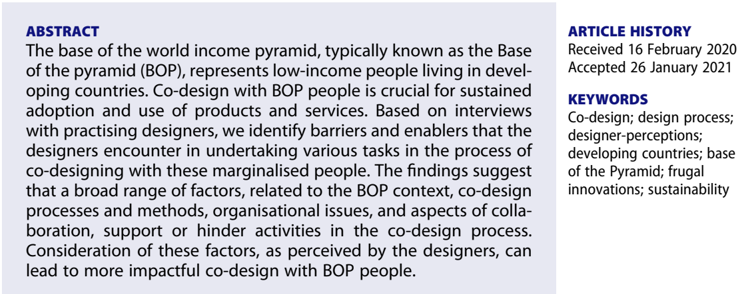
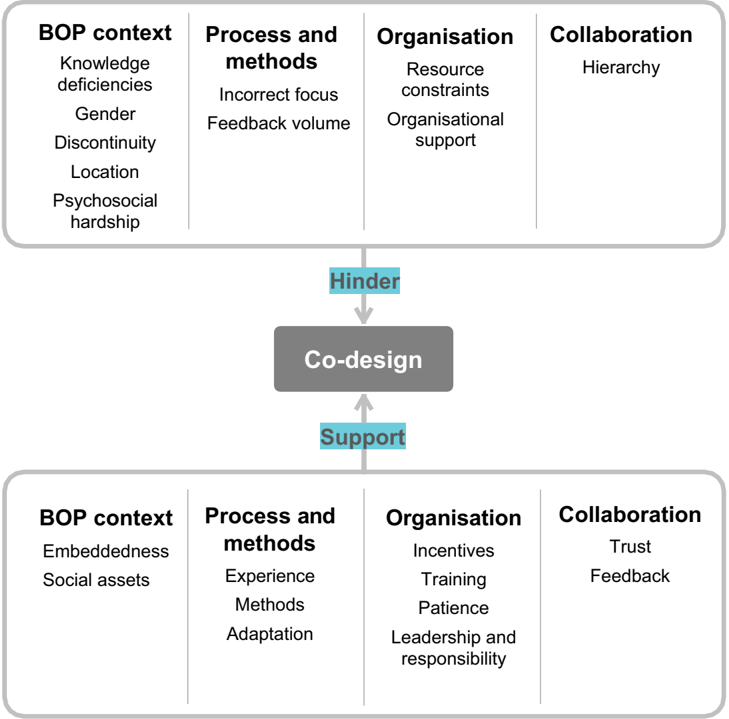
The base of the world income pyramid, typically known as the Base of the pyramid (BOP), represents low-income people living in developing countries. Co-design with BOP people is crucial for sustained adoption and use of products and services. Based on interviews with practising designers, we identify barriers and enablers that the designers encounter in undertaking various tasks in the process of co-designing with these marginalised people. The findings suggest that a broad range of factors, related to the BOP context, co-design processes and methods, organisational issues, and aspects of collaboration, support or hinder activities in the co-design process. Consideration of these factors, as perceived by the designers, can lead to more impactful co-design with BOP people.
Overview
The claims and statistics of this paper haven’t been checked yet.
Free: it reads the open-access text and checks the first 5 claims that cite a source we can check. Create a free account to check every claim.
Integrity signals
Registry
Cites
Statistics
Figures


Verification
Claims the paper makes
The claims and statistics of this paper haven’t been checked yet.
Free: it reads the open-access text and checks the first 5 claims that cite a source we can check. Create a free account to check every claim.
Claims other papers make about this one
Each is checked against this paper’s own text: does it say what the citing paper says it does?
The check wasn’t confident either way, so it gives no verdict — never disputed.
In the citing paper
“It is not surprising that the public health sciences accounts for most articles focusing on health outcomes by providing 8 articles [35,55,57,63,83,87,92,156] followed by the social sciences applied to health, which provided 2 articles [91,96], and the HCI in health research, which provided 1 article [158].”
From Digital Health Technologies for Maternal and Child Health in Africa and Other Low- and Middle-Income Countries: Cross-disciplinary Scoping Review With Stakeholder Consultation (2023) · doi:10.2196/42161 · cites this paper as [156]
Experimental — accuracy not yet measured
Self-check
Percentages, sums and reported differences re-computed from the paper’s own numbers.
The self-check needs the paper’s full text.
Citations
Cites
(1994) · Journal of the American Dietetic Association · doi:10.1016/0002-8223(94)92216-0 · Cited by 45,910
Evolving to a New Dominant Logic for Marketing
Vargo, S. L., & Lusch, R. F. (2004) · Journal of Marketing · doi:10.1509/jmkg.68.1.1.24036 · Cited by 14,779 · cited 2×
“…2008), and several studies in non-BOP segments have examined co-design, cocreation, lead-user innovation, and Nordic participatory approaches (e.g. Vargo and Lusch 2004; Grönroos 2011; von Hippel 2005), and have explored factors influencing codesign in non-BOP contexts (e.g. Kleinsmann and…”
BackgroundA General Inductive Approach for Analyzing Qualitative Evaluation Data
Thomas, D. R. (2006) · American Journal of Evaluation · doi:10.1177/1098214005283748 · Cited by 10,858 · cited 4×
“Designs that are externally conceived and simply implemented in the BOP fail to achieve sustainable adoption and impact (e.g. Nieusma 2004; Thomas 2006a; Murcott 2007; Dodson, Sterling, and Bennett 2012).”
BackgroundMethodInfluentialCo-creation and the new landscapes of design
Sanders, E. B.-N., & Stappers, P. J. (2008) · CoDesign · doi:10.1080/15710880701875068 · Cited by 5,561 · cited 3×
“Since the late 1970s, many businesses have attempted to access external knowledge by involving their customers in design process (Sanders and Stappers 2008), and several studies in non-BOP segments have examined co-design, cocreation, lead-user innovation, and Nordic participatory approaches (e.g.…”
BackgroundMethodMixed Methodology: Combining Qualitative and Quantitative Approaches
Cotten, S. R., Tashakkori, A., & Teddlie, C. (1999) · Contemporary Sociology · doi:10.2307/2655606 · Cited by 5,204
Doing Research in the Real World
Gray, S. W. (2004) · Cited by 3,879
von Hippel, E. (2005) · doi:10.7551/mitpress/2333.001.0001 · Cited by 3,768
Small is beautiful: economics as if people mattered
(2000) · Choice Reviews Online · doi:10.5860/choice.38-1061 · Cited by 2,612
(2003) · Sociology for Pharmacists · doi:10.1201/9780203381175.ch9 · Cited by 2,543
Gaver, B., Dunne, T., & Pacenti, E. (1999) · Interactions · doi:10.1145/291224.291235 · Cited by 2,303 · cited 1×
“In the context of middleand high-income markets, researchers have developed co-design methods and tools such as cultural probes and generative tool-kits using a range of stimulus items such as pictures, videos, narratives, etc. (Sanders 2000; Gaver, Dunne, and Pacenti 1999).”
Background(2006) · Cited by 2,171
The Fortune at the Bottom of the Pyramid: Eradicating Poverty Through Profits
(2005) · International Journal of Productivity and Performance Management · doi:10.1108/ijppm.2005.07954bae.003 · Cited by 1,780 · cited 4×
“challenges in satisfying basic needs, and lack access to basic facilities, such as education, security, safe drinking water, sanitation, public health, and infrastructure (e.g. Aranda Jan, Jagtap, and Moultrie 2016; Prahalad 2004).”
BackgroundInfluentialArtificial Intelligence in Architectural Design
Indonesia, U. K., Harapan, A., Indriani, D., Rizkiya, N. F., & Azbi, R. M. (2021) · International Journal of Design · doi:10.34010/injudes.v1i1.4824 · Cited by 1,633
International Journal of Design
(2021) · International Journal of Design · doi:10.34010/injudes · Cited by 1,614
Value co-creation in service logic: A critical analysis
Grönroos, C. (2011) · Marketing Theory · doi:10.1177/1470593111408177 · Cited by 1,587 · cited 2×
“…in non-BOP segments have examined co-design, cocreation, lead-user innovation, and Nordic participatory approaches (e.g. Vargo and Lusch 2004; Grönroos 2011; von Hippel 2005), and have explored factors influencing codesign in non-BOP contexts (e.g. Kleinsmann and Valkenburg 2008; Widmark et…”
BackgroundReinventing strategies for emerging markets: beyond the transnational model
London, T., & Hart, S. L. (2004) · Journal of International Business Studies · doi:10.1057/palgrave.jibs.8400099 · Cited by 1,437 · cited 1×
“Collectively, BOP consumers hold assets worth valuing 9 USD trillion (Hammond and Prahalad 2004; London and Hart 2004).”
BackgroundResearch methods in the social sciences
Mishra, S. (2005) · British Journal of Educational Technology · doi:10.1111/j.1467-8535.2005.00515_7.x · Cited by 1,137
Co‐innovation: convergenomics, collaboration, and co‐creation for organizational values
Lee, S. M., Olson, D. L., & Trimi, S. (2012) · Management Decision · doi:10.1108/00251741211227528 · Cited by 711 · cited 1×
“Co-design studies in non-BOP markets have highlighted benefits of co-design such as increased productivity and enhanced customers satisfaction (Lee, Olson, and Trimi 2012; Prahalad and Ramaswamy 2004).”
BackgroundFrugal Innovation in Emerging Markets
Zeschky, M., Widenmayer, B., & Gassmann, O. (2011) · Research-Technology Management · doi:10.5437/08956308x5404007 · Cited by 576 · cited 1×
“Such products and services are also known as frugal innovations designed for BOP people (Zeschky, Widenmayer, and Gassmann 2011; Jagtap 2021).”
BackgroundResearch Methods in Psychology
Basavanna, M. (2015) · Psychology for Nurses · doi:10.5005/jp/books/12408_3 · Cited by 399
Generative Tools for Co-designing
Sanders, E. B.-N. (2000) · Collaborative Design · doi:10.1007/978-1-4471-0779-8_1 · Cited by 294
Barriers and enablers for creating shared understanding in co-design projects
Kleinsmann, M., & Valkenburg, R. (2008) · Design Studies · doi:10.1016/j.destud.2008.03.003 · Cited by 294 · cited 2×
“…Nordic participatory approaches (e.g. Vargo and Lusch 2004; Grönroos 2011; von Hippel 2005), and have explored factors influencing codesign in non-BOP contexts (e.g. Kleinsmann and Valkenburg 2008; Widmark et al. 2011; Kleinsmann, Valkenburg, and Buijs 2007; Vaajakallio et al. 2013; Pirinen 2016).”
BackgroundGetting inspired!: understanding how and why examples are used in creative design practice
Herring, S. R., Chang, C.-C., Krantzler, J., & Bailey, B. P. (2009) · Proceedings of the SIGCHI Conference on Human Factors in Computing Systems · doi:10.1145/1518701.1518717 · Cited by 263 · cited 1×
“A number of design studies have employed interviews as a research method to investigate a broad range of topics, covering many design sectors (e.g. Cross and Cross 1996; Busby and Lloyd 1999; Herring et al. 2009; Jagtap and Johnson 2011).”
Hussain, S., Sanders, E., & Steinert, M. (2012) · International journal of design · Cited by 246
Enhancing New Product Adoption at the Base of the Pyramid: A Contextualized Model
Nakata, C., & Weidner, K. (2012) · Journal of Product Innovation Management · doi:10.1111/j.1540-5885.2011.00876.x · Cited by 246 · cited 1×
“There are many reasons why companies pursue BOP markets (Nakata and Weidner 2012).”
BackgroundEyles, H., Jull, A., Dobson, R., Firestone, R., Whittaker, R., Te Morenga, L., Goodwin, D., & Mhurchu, C. N. (2016) · Current Nutrition Reports · doi:10.1007/s13668-016-0165-7 · Cited by 222 · cited 1×
“Whilst co-design with BOP people has been discussed using various labels, it is typically interpreted as a process in which designers and BOP people work together to co-design products and services to generate value (e.g. Eyles et al. 2016; Gonzalez, Divigalpitiya, and Sakai 2017; Jagtap 2019a).”
BackgroundO'Reilly, K. (2004) · Routledge eBooks · doi:10.4324/9780203320068 · Cited by 211
The Barriers and Enablers of Co-design for Services
Pirinen, A. (2016) · Aaltodoc (Aalto University) · Cited by 204
Hammond, A. L., & Prahalad, C. K. (2004) · Foreign Policy · doi:10.2307/4147574 · Cited by 181 · cited 1×
“Collectively, BOP consumers hold assets worth valuing 9 USD trillion (Hammond and Prahalad 2004; London and Hart 2004).”
BackgroundGlobal village vs. small town: Understanding networks at the Base of the Pyramid
Rivera-Santos, M., & Rufín, C. (2010) · International Business Review · doi:10.1016/j.ibusrev.2009.07.001 · Cited by 159
Global Village vs. Small Town: Understanding Networks at the Base of the PyramidPreprint
Rivera‐Santos, M., & Rufin, C. R. (2011) · SSRN Electronic Journal · doi:10.2139/ssrn.1885390 · Cited by 152 · cited 1×
“NGOs, with their local knowledge and network, engage in co-design activities with BOP people (e.g. Rivera-Santos and Rufín 2010; Teegen 2003; Jagtap and Larsson 2013).”
BackgroundRamaswamy, V. (2004) · Cited by 144
Roy, R., Walsh, V., & Bruce, M. (1992) · Cited by 131
Alternative Design Scholarship: Working Toward Appropriate Design
Nieusma, D. (2004) · Design Issues · doi:10.1162/0747936041423280 · Cited by 125 · cited 2×
“Designs that are externally conceived and simply implemented in the BOP fail to achieve sustainable adoption and impact (e.g. Nieusma 2004; Thomas 2006a; Murcott 2007; Dodson, Sterling, and Bennett 2012).”
BackgroundReverse innovation: a global growth strategy that could pre‐empt disruption at home
Govindarajan, V., & Trimble, C. (2012) · Strategy & Leadership · doi:10.1108/10878571211257122 · Cited by 120 · cited 1×
“Furthermore, products and services specifically developed for BOP markets can be adapted and sold in middle- and highincome markets across the globe, creating additional benefits for businesses (Govindarajan and Trimble 2012).”
BackgroundBarriers to collaboration between health care, social services and schools
Widmark, C., Sandahl, C., Piuva, K., & Bergman, D. (2011) · International Journal of Integrated Care · doi:10.5334/ijic.653 · Cited by 113
Considering failure: eight years of ITID research
Dodson, L. L., Sterling, S. R., & Bennett, J. K. (2012) · International Conference on Information and Communication Technologies and Development (ICTD) · doi:10.1145/2160673.2160681 · Cited by 111 · cited 2×
“Designs that are externally conceived and simply implemented in the BOP fail to achieve sustainable adoption and impact (e.g. Nieusma 2004; Thomas 2006a; Murcott 2007; Dodson, Sterling, and Bennett 2012).”
BackgroundWinning by design: the methods of Gordon Murray, racing car designer
Cross, N., & Cross, A. C. (1996) · Design Studies · doi:10.1016/0142-694x(95)00027-o · Cited by 107 · cited 1×
“A number of design studies have employed interviews as a research method to investigate a broad range of topics, covering many design sectors (e.g. Cross and Cross 1996; Busby and Lloyd 1999; Herring et al. 2009; Jagtap and Johnson 2011).”
Cocreation at the Base of the Pyramid: Reviewing and Organizing the Diverse Conceptualizations
Nahi, T. (2016) · Organization & Environment · doi:10.1177/1086026616652666 · Cited by 93 · cited 2×
“The idea of co-design in these markets is rooted in a long tradition of design and innovation research on customer participation (e.g. Nahi 2016).”
BackgroundKleinsmann, M. S., Valkenburg, R., & Buijs, J. A. (2007) · CoDesign · doi:10.1080/15710880601170875 · Cited by 82 · cited 1×
“…Nordic participatory approaches (e.g. Vargo and Lusch 2004; Grönroos 2011; von Hippel 2005), and have explored factors influencing codesign in non-BOP contexts (e.g. Kleinsmann and Valkenburg 2008; Widmark et al. 2011; Kleinsmann, Valkenburg, and Buijs 2007; Vaajakallio et al. 2013; Pirinen 2016).”
BackgroundGross, B. (1999) · PubMed · Cited by 74
Towards A Framework for Holistic Contextual Design for Low-Resource Settings
Aranda Jan, C., Jagtap, S., & Moultrie, J. (2016) · Apollo (University of Cambridge) · doi:10.17863/cam.7254 · Cited by 74 · cited 1×
“…the profound need and importance of co-design with the BOP, several authors have highlighted a critical requirement of developing BOP-specific codesign methods and tools that are based on practitioners’ experiences of co-designing products and services with BOP people (e.g. Aranda-Jan et al. 2016).”
BackgroundSelf-citationDesign and poverty: a review of contexts, roles of poor people, and methods
Jagtap, S. (2018) · Research in Engineering Design · doi:10.1007/s00163-018-0294-7 · Cited by 72 · cited 15×
“Whilst co-design with BOP people has been discussed using various labels, it is typically interpreted as a process in which designers and BOP people work together to co-design products and services to generate value (e.g. Eyles et al. 2016; Gonzalez, Divigalpitiya, and Sakai 2017; Jagtap 2019a).”
BackgroundInfluentialSelf-citationTeegen, H. J. (2003) · Journal of International Management · doi:10.1016/s1075-4253(03)00037-1 · Cited by 69 · cited 1×
“NGOs, with their local knowledge and network, engage in co-design activities with BOP people (e.g. Rivera-Santos and Rufín 2010; Teegen 2003; Jagtap and Larsson 2013).”
BackgroundHow design process for the Base of the Pyramid differs from that for the Top of the Pyramid
Jagtap, S., Larsson, A., af Ornäs, V. H., Olander, E., Warell, A., & Khadilkar, P. R. (2014) · Design Studies · doi:10.1016/j.destud.2014.02.007 · Cited by 59 · cited 1×
“However, designers are often unfamiliar with the BOP, as they typically lack the experience of living in these societies and are detached from subsistence conditions in their daily lives (Jagtap et al. 2014).”
BackgroundSelf-citationKey guidelines for designing integrated solutions to support development of marginalised societies
Jagtap, S. (2019) · Journal of Cleaner Production · doi:10.1016/j.jclepro.2019.01.340 · Cited by 56 · cited 15×
“Whilst co-design with BOP people has been discussed using various labels, it is typically interpreted as a process in which designers and BOP people work together to co-design products and services to generate value (e.g. Eyles et al. 2016; Gonzalez, Divigalpitiya, and Sakai 2017; Jagtap 2019a).”
BackgroundInfluentialSelf-citationKanvinde, A., & Doshi, B. (1966) · Cited by 51
In-service information required by engineering designers
Jagtap, S., & Johnson, A. L. (2011) · Research in Engineering Design · doi:10.1007/s00163-011-0107-8 · Cited by 46 · cited 1×
“A number of design studies have employed interviews as a research method to investigate a broad range of topics, covering many design sectors (e.g. Cross and Cross 1996; Busby and Lloyd 1999; Herring et al. 2009; Jagtap and Johnson 2011).”
Self-citationMurcott, S. E. (2007) · Journal of International Development · doi:10.1002/jid.1353 · Cited by 44 · cited 2×
“Designs that are externally conceived and simply implemented in the BOP fail to achieve sustainable adoption and impact (e.g. Nieusma 2004; Thomas 2006a; Murcott 2007; Dodson, Sterling, and Bennett 2012).”
BackgroundCodesigning with communities to support rural water management in Uganda
Ssozi-Mugarura, F., Blake, E., & Rivett, U. (2017) · CoDesign · doi:10.1080/15710882.2017.1310904 · Cited by 44 · cited 1×
“Some studies have indicated that co-designing with BOP people improves product acceptance and adoption (e.g. Ssozi-Mugarura, Blake, and Rivett 2017; Champanis and Rivett 2012).”
BackgroundJagtap, S., Larsson, A., & Kandachar, P. (2013) · International Journal of Sustainable Society · doi:10.1504/ijssoc.2013.054712 · Cited by 43 · cited 2×
“…sociocultural divide between BOP societies and developed countries or relatively affluent areas in developing countries suggest that factors determining product success are significantly different across these contexts (Aranda Jan et al. 2016; Prahalad 2004; Jagtap, Larsson, and Kandachar 2013).”
BackgroundSelf-citationDesign, Poverty, and Sustainable Development
Thomas, A. (2006) · Design Issues · doi:10.1162/desi.2006.22.4.54 · Cited by 40 · cited 4×
“Designs that are externally conceived and simply implemented in the BOP fail to achieve sustainable adoption and impact (e.g. Nieusma 2004; Thomas 2006a; Murcott 2007; Dodson, Sterling, and Bennett 2012).”
BackgroundMethodInfluentialRethinking Design Policy in the Third World
Amir, S. (2004) · Design Issues · doi:10.1162/0747936042311995 · Cited by 32 · cited 1×
“Papanek’s proposal was unique in the 1970s when most of the designers in the industrialised world were involved in designing products for non-BOP consumers (Amir 2004).”
BackgroundDesign of Product Service Systems at the Base of The Pyramid
Jagtap, S., & Larsson, A. (2013) · Lecture notes in mechanical engineering · doi:10.1007/978-81-322-1050-4_46 · Cited by 27 · cited 1×
“NGOs, with their local knowledge and network, engage in co-design activities with BOP people (e.g. Rivera-Santos and Rufín 2010; Teegen 2003; Jagtap and Larsson 2013).”
BackgroundSelf-citationDESIGN AND FRUGAL INNOVATIONS: THREE ROLES OF RESOURCE-POOR PEOPLE
Jagtap, S., & Larsson, T. C. (2018) · Proceedings of the ... International Design Conference/Design ... · doi:10.21278/idc.2018.0152 · Cited by 25 · cited 5×
“…in Schumacher’s and Papanek’s movements and the Prahalad’s BOP approach, it is recognised in several other approaches discussed using names such as ‘community development engineering’, ‘humanitarian engineering’, ‘design for development’, ‘frugal innovations’, etc. (e.g. Jagtap and Larsson 2018).”
BackgroundInfluentialSelf-citationInfluences on Solution Search Processes in Design Organisations
Busby, J. A., & Lloyd, P. A. (1999) · Research in Engineering Design · doi:10.1007/s001630050012 · Cited by 24 · cited 1×
“A number of design studies have employed interviews as a research method to investigate a broad range of topics, covering many design sectors (e.g. Cross and Cross 1996; Busby and Lloyd 1999; Herring et al. 2009; Jagtap and Johnson 2011).”
At the Bottom of the Pyramid: Responsible Design for Responsible Business
Sethia, N. K. (2005) · Design Management Review · doi:10.1111/j.1948-7169.2005.tb00202.x · Cited by 20 · cited 1×
“Co-design supports designers in gaining insights into the needs and preferences of BOP people, their aspirations and life circumstances (Sethia 2005).”
BackgroundChampanis, M., & Rivett, U. (2012) · International Conference on Information and Communication Technologies and Development (ICTD) · doi:10.1145/2160673.2160688 · Cited by 19 · cited 1×
“Some studies have indicated that co-designing with BOP people improves product acceptance and adoption (e.g. Ssozi-Mugarura, Blake, and Rivett 2017; Champanis and Rivett 2012).”
BackgroundPrahalad, C. K. (2004) · Cited by 16
Jagtap, S. (2017) · The Design Journal · doi:10.1080/14606925.2018.1396075 · Cited by 8 · cited 1×
“In this research study, by employing direct communication and chain referral sampling, 18 participants from the NGOs in India were recruited (e.g. Bryman 2004; Jagtap 2018).”
MethodSelf-citationTHE POTENTIAL OF PARTICIPATORY DESIGN TO IMPROVE URBAN SPACES IN THE SLUMS OF CARACAS, VENEZUELA
R., C. E. G., Divigalpitiya, P., & Sakai, T. (2017) · WIT transactions on ecology and the environment · doi:10.2495/sdp170411 · Cited by 3 · cited 1×
“Whilst co-design with BOP people has been discussed using various labels, it is typically interpreted as a process in which designers and BOP people work together to co-design products and services to generate value (e.g. Eyles et al. 2016; Gonzalez, Divigalpitiya, and Sakai 2017; Jagtap 2019a).”
BackgroundBarbero (2014) · doi:10.1016/j · Cited by 1
Research works printed but not linked: 5
- Hammond, A. L., W. J. Kramer, R. S. Katz, J. T. Tran, and C. Walker. 2007. The Next Four Billion: Market Size and Business Strategy at the Base of the Pyramid . Washington, DC: World Resources Institute. International Finance Corporation.
- Jagtap, S. 2021. 'Frugal-IDeM: An Integrated Methodology for Designing Frugal Innovations in Low- Resource Settings.' International Conference on Research into Design, ICoRD 2021, IIT Bombay, Mumbai, India.
- Nieusma, D., and D. Riley. 2010. 'Designs on Development: Engineering, Globalization and Social Justice.' Journal International Network Engineers Studies 2: 29-59.
- Papanek, V., and R. B. Fuller. 1972. Design for the Real World . London: Thames and Hudson.
- Vaajakallio, K., J. J. Lee, J. Kronqvist, and T. Mattelmäki. 2013. 'Service Co-design with the Public Sector: Challenges and Opportunities in a Healthcare Context.' Paper presented at the 7th Conference of Include Asia. Hong Kong.
Cited by
Singh, D. R., Sah, R. K., Simkhada, B., & Darwin, Z. J. (2023) · Global Health Research and Policy · doi:10.1186/s41256-023-00290-6 · Cited by 139
“However, there is also a need for more clarity and guidelines for bringing those who are in exclusion or face multiple forms of marginalisation, particularly in the LMICs [40, 43].”
Background(2023) · doi:10.2196/42161 · Cited by 106
“…not surprising that the public health sciences accounts for most articles focusing on health outcomes by providing 8 articles [35,55,57,63,83,87,92,156] followed by the social sciences applied to health, which provided 2 articles [91,96], and the HCI in health research, which provided 1 article…”
BackgroundRodriguez, N. M., Burleson, G., Linnes, J. C., & Sienko, K. H. (2023) · Annual Review of Biomedical Engineering · doi:10.1146/annurev-bioeng-081922-024834 · Cited by 121
Russell‐Bennett, R., Kelly, N., Letheren, K., & Chell, K. (2023) · International Journal of Market Research · doi:10.1177/14707853231151605 · Cited by 57
“There has been a positive trend in recent decades towards greater inclusion of stakeholders in proposing, designing, and carrying out research through adoption of co-design methods by researchers, governments, institutions and firms (Jagtap, 2021; Zelenko et al., 2021).”
BackgroundJagtap, S. (2022) · Research in Engineering Design · doi:10.1007/s00163-022-00384-1 · Cited by 29
“2020; Jagtap 2021a, b).”
BackgroundMethodInfluentialSelf-citation
Metadata
- Authors
- Jagtap, S.
- Affiliations
- Blekinge Institute of Technology (SE)
- Corresponding author
- Jagtap, Santosh
- ORCID
- Jagtap, Santosh
- Venue
- CoDesign
- Publisher
- Informa UK Limited
- Published
- 2021-02-11
- Volume
- 18
- Issue
- 3
- Pages
- 279-302
- ISSN
- 1571-0882 (ISSN-L)
- 1745-3755
- OpenAlex
- W3131975348
- Cited by
- 67
- References
- 61
- Citations by year
- 2026: 12 · 2025: 13 · 2024: 20 · 2023: 13 · 2022: 8 · 2021: 1
- FWCI
- 9.88
- Type
- journal article
- Language
- en
- Open access
- hybrid
- doi.org
- Licence
- Locations
- CoDesign (publishedVersion, cc-by-nc-nd)
- Diva portal (Dalarna University Library) (submittedVersion, other-oa)
- Funders
- KKS research foundation, Sweden
- Topics
- Social Sciences › Business, Management and Accounting › Business and International Management › Innovation and Socioeconomic Development
- Social Sciences › Business, Management and Accounting › Management of Technology and Innovation › Innovative Approaches in Technology and Social Development
- Physical Sciences › Engineering › Mechanical Engineering › Design Education and Practice
- Keywords
- co-design, bottom of the pyramid, low-income populations, marginalised people, designer perceptions, barriers and facilitators, collaboration, organizational challenges, product adoption, inclusive design
About these checks
Registry, retraction, Cites and statistics results are computed, not judged, with one exception: a printed reference that no index lists is read once by a model before it counts as a citation error. Claims are extracted by a model and kept only when their quote appears verbatim in the text; each cited source is then checked, with a model’s help, for whether it says what the claim relies on. Those verdicts can be wrong — read the claim’s quote and the cited source before relying on one.
Statistics and arithmetic are recomputed, not judged.
Confidence bands are shown only for fields calibrated on our annotated test set. None is calibrated yet, so no band is shown.
What counts as a claim ›How we measure confidence ›How we check this ›
Are you an author, or do you see a problem with this page? Request a review
Data sources
Bibliographic data: Semantic Scholar, OpenAlex, Crossref.
Contains information from the Semantic Scholar Academic Graph Datasets, made available under the ODC Attribution License (ODC-BY 1.0).
Semantic Scholar’s data is described in: Kinney, R., et al. (2023). The Semantic Scholar Open Data Platform. arXiv:2301.10140.
