

Towards a framework for flourishing through social media: a systematic review of 118 research studies
Open accessThe DOI matches its Crossref record; 104 of the 104 references it cites were found in a registry or an index.
Abstract
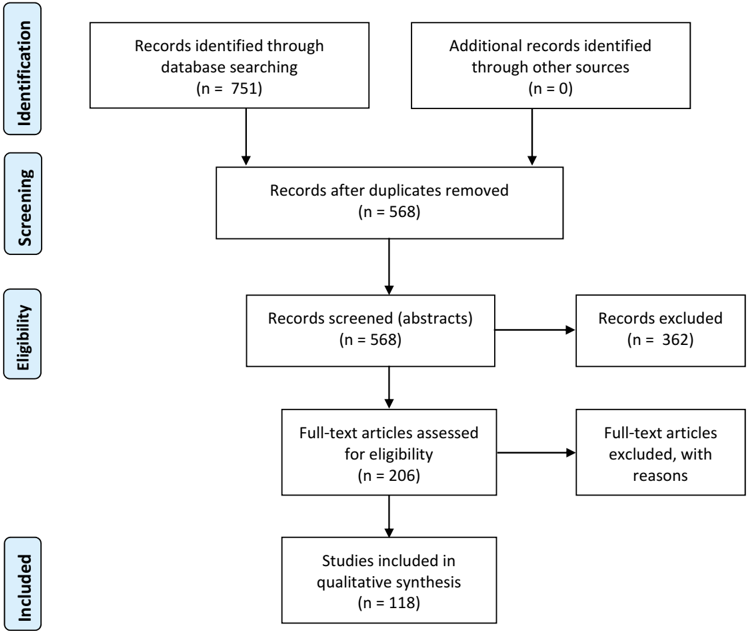
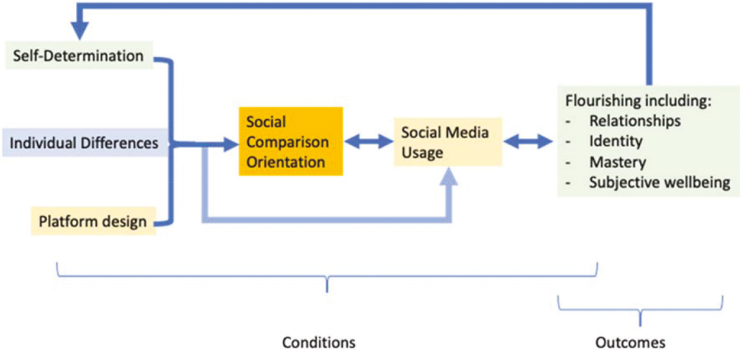
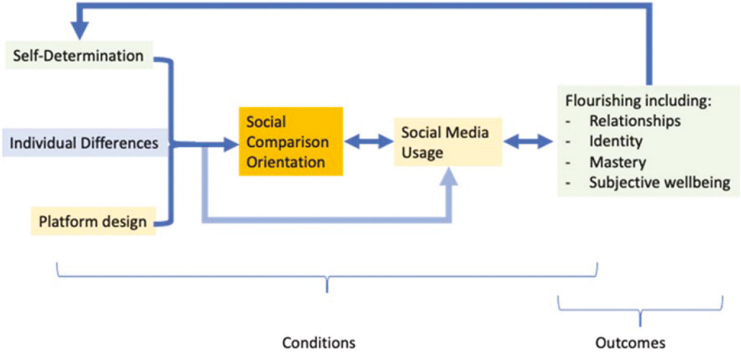
Background: Over 50% of the world uses social media. There has been significant academic and public discourse around its negative mental health impacts. There has not, however, been a broad systematic review in the field of Positive Psychology exploring the relationship between social media and wellbeing, to inform healthy social media use, and to identify if, and how, social media can support human flourishing.Objectives: To investigate the conditions and activities associated with flourishing through social media use, which might be described as ‘Flourishing through Social Media’.Method and Results: A systematic search of peer reviewed studies, identifying flourishing outcomes from usage, was conducted, resulting in 118 final studies across 7 social media platforms, 50,000+ participants, and 26 countries.Conclusions: The interaction between social media usage and flourishing is bi-directional and nuanced. Analysis through our proposed conceptual framework suggests potential for a virtuous spiral between self-determination, identity, social media usage, and flourishing.
Overview
The claims and statistics of this paper haven’t been checked yet.
Free: it reads the open-access text and checks the first 5 claims that cite a source we can check. Create a free account to check every claim.
Integrity signals
Registry
Cites
Statistics
Figures


Verification
Claims the paper makes
The claims and statistics of this paper haven’t been checked yet.
Free: it reads the open-access text and checks the first 5 claims that cite a source we can check. Create a free account to check every claim.
Claims other papers make about this one
Each is checked against this paper’s own text: does it say what the citing paper says it does?
The source backs part of the claim, not all of it — or backs it for a different population, condition or comparison.
In the citing paper
“Emerging literature increasingly emphasises that social media experiences are shaped not only by frequency of use but also by howyoung people engage with these platforms and the meanings they derive from them [4, 17, 18].”
From The Complex and Multifaceted Nature of Social Media: Perspectives From Young Adolescents, Parents and Experts (2026) · cites this paper as [17]
Experimental — accuracy not yet measuredThe check wasn’t confident either way, so it gives no verdict — never disputed.
In the citing paper
“Importantly, much of the existing research has focused on older adolescents or broad adolescent age ranges, often without distinguishing developmental diferences across adolescence [17, 33].”
From The Complex and Multifaceted Nature of Social Media: Perspectives From Young Adolescents, Parents and Experts (2026) · cites this paper as [17]
Experimental — accuracy not yet measured
Self-check
Percentages, sums and reported differences re-computed from the paper’s own numbers.
The self-check needs the paper’s full text.
Citations
Cites
Preferred Reporting Items for Systematic Reviews and Meta-Analyses: The PRISMA Statement
Moher, D., Liberati, A., Tetzlaff, J., Altman, D. G., & The PRISMA Group (2009) · PLoS Medicine · doi:10.1371/journal.pmed.1000097 · Cited by 64,042
Ryan, R. M., & Deci, E. L. (2000) · American Psychologist · doi:10.1037//0003-066x.55.1.68 · Cited by 54,599 · cited 3×
“Given the pivotal impact of motivations in this context, Self-determination Theory (SDT: Ryan & Deci, 2000, p. 68) is relevant here.”
BackgroundInfluentialA theory of social comparison processes
Festinger, L. (1954) · Human Relations · doi:10.1177/001872675400700202 · Cited by 20,926 · cited 2×
“One distinction, relating back to the original theory of social comparison (Festinger, 1954), is the distinction between comparing one’s opinions against others (opinion-based comparison) and comparing one’s abilities.”
BackgroundUsers of the world, unite! The challenges and opportunities of Social Media
Kaplan, A. M., & Haenlein, M. (2010) · Business Horizons · doi:10.1016/j.bushor.2009.09.003 · Cited by 17,875
Happiness is everything, or is it? Explorations on the meaning of psychological well-being.
Ryff, C. D. (1989) · Journal of Personality and Social Psychology · doi:10.1037/0022-3514.57.6.1069 · Cited by 14,847 · cited 2×
“, 1999), and other aspects of well-being – such as psychological well-being (Ryff, 1989) and social well-being (Keyes &”
BackgroundSubjective well-being: Three decades of progress.
Diener, E., Suh, E. M., Lucas, R. E., & Smith, H. L. (1999) · Psychological Bulletin · doi:10.1037/0033-2909.125.2.276 · Cited by 12,910
Psychology of intergroup relations
Austin, W. G., & Worchel, S. (1986) · Medical Entomology and Zoology · Cited by 10,626
Journal of Consciousness Studies
(2022) · Journal of Consciousness Studies · doi:10.53765/20512201 · Cited by 6,832
The mental health continuum: from languishing to flourishing in life.
Keyes, C. L. M. (2002) · Journal of Health and Social Behavior · doi:10.2307/3090197 · Cited by 5,133 · cited 1×
“…– such as psychological well-being (Ryff, 1989) and social well-being (Keyes & Lee, 1998) – into the broader term ‘flourishing’ because it can be, and indeed has been, considered as a fundamental component of flourishing (see Diener et al., 2010; Huppert & So, 2013; Keyes, 2002; Seligman, 2018).”
BackgroundNew well-being measures: Short scales to assess flourishing and positive and negative feelings
Diener, E., Wirtz, D., Tov, W., Kim-Prieto, C., Choi, D.-W., Oishi, S., & Biswas-Diener, R. (2010) · Social Indicators Research · doi:10.1007/s11205-009-9493-y · Cited by 4,980 · cited 1×
“…– such as psychological well-being (Ryff, 1989) and social well-being (Keyes & Lee, 1998) – into the broader term ‘flourishing’ because it can be, and indeed has been, considered as a fundamental component of flourishing (see Diener et al., 2010; Huppert & So, 2013; Keyes, 2002; Seligman, 2018).”
Background
Research works printed but not linked: 12
- Carroll, C., Booth, A., Leaviss, J., & Rick, J. (2013). “best fit” framework synthesis: Refining the method. BMC Medical Research Methodology , 13(1).
- Chen, E., & Miller, G. (2007). CHAPTER 23 - Social Context as an Individual Difference in Psychoneuroimmunology. (F. E. Ader Ed.). Academic Press. R. B. T.P. R. B. T.P.
- Corpus, J. H., Love, K. E., & Ogle, C. M. (2005). Social-comparison praise undermines intrinsic motivation when children later doubt their ability. Poster Presented at the Biennial Meeting of the Society for Research in Child Development, Atlanta, GA.
- Forsyth, D. R. (2018). Group dynamics (7th ed.). Cengage Learning.
- Gilmour, J., Machin, T., Brownlow, C., & Jeffries, C. (2019). Facebook-based social support and health: A systematic review. Psychology of Popular Media Culture.
- Hong, Q., Pluye, P., Fàbregues, S., Bartlett, G., Boardman, F., Cargo, M., … Vedel, I. (2018). Mixed Methods Appraisal Tool (MMAT), Version 2018. User guide (pp. 1–11). McGill.
- Livingstone, S., Haddon, L., Görzig, A., & Ólafsson, K. (2011). Risks and safety on the internet: The perspective of European children: Full findings and policy implications from the EU Kids Online survey of 9–16 year olds and their parents in 25 countries. LSE, London: EU Kids Online, 170.
- Livingstone, S. (2013). Online risk, harm and vulnerability: Reflections on the evidence base for child Internet safety policy. Zer: Revista de Estudios de Comunicación, 18, 13–28.
- Newport, C. (2019). Digital minimalism: Choosing a focused life in a noisy world. Penguin.
- 10.1037/0003-066X.55.1.68 · doi:10.1037/0003-066x.55.1.68 · Paper page
- Schrock, A. R. (2016). Exploring the Relationship Between Mobile Facebook and Social Capital: What Is the “Mobile Difference” for Parents of Young Children? Social Media and Society 2 (3) , .
- Zuboff, S. (2019). The Age of Surveillance Capitalism: The Fight for a Human Future at the New Frontier of Power: Barack Obama’s Books of 2019. Profile Books.
Cited by
Marciano, L., Lin, J., Sato, T., Saboor, S., & Viswanath, K. (2024) · SSM - Mental Health · doi:10.1016/j.ssmmh.2024.100331 · Cited by 80
Adolescent Social Media Use through a Self-Determination Theory Lens: A Systematic Scoping Review
West, M., Rice, S., & Vella‐Brodrick, D. (2024) · International Journal of Environmental Research and Public Health · doi:10.3390/ijerph21070862 · Cited by 125
“The global uptake and pervasive integration of social media within adolescents’ every-day lives raises questions as to how social media impacts their wellbeing [1–3].”
BackgroundInfluentialdu Toit, A., Thomson, R. J., & Page, A. (2022) · International Journal of Wellbeing · doi:10.5502/ijw.v12i2.1897 · Cited by 65
Social media use and adolescents’ well-being: A note on flourishing
Marciano, L., & Viswanath, K. (2023) · Frontiers in Psychology · doi:10.3389/fpsyg.2023.1092109 · Cited by 68
“For example, narrative identities facilitate young people to build a coherent sense of themselves from the life experiences shared online (Gudka et al., 2023).”
BackgroundRosič, J., Janicke‐Bowles, S. H., Carbone, L., Lobe, B., & Vandenbosch, L. (2022) · Frontiers in Digital Health · doi:10.3389/fdgth.2022.975557 · Cited by 44
“(5) referred to these basic psychological needs as important conditions for”
BackgroundYao, W., Hou, H., Yang, P., & Ni, S. (2024) · Education and Information Technologies · doi:10.1007/s10639-024-13017-y · Cited by 24
“…technologies on adolescents’ well-being (e.g., communication overload, excessive use), less research was conducted on their positive perceptions of their experiences and behaviors in digital communication (Gudka et al., 2023 ; Janicke-Bowles et al., 2023 ; Raney et al., 2020; Rosič et al., 2022).”
Todorovic, L., Bozhar, H., de Rooij, S. R., Bogaerts, A., Boyer, B. E., & Larsen, H. (2025) · Journal of Research on Adolescence · doi:10.1111/jora.70076 · Cited by 16
“Digital media use has been associated with both mental health strengths and difficulties, illustrating that digital media can provide an environment for both flourishing and suffering during adolescence (Gudka et al., 2021; Law et al., 2019; Raith et al., 2021; West et al., 2024).”
Zimmermann, E., & Tomczyk, S. (2025) · Journal of Prevention · doi:10.1007/s10935-025-00826-1 · Cited by 29
“Collectively, these experiences of connection, inspiration, and empowerment can promote positive well-being (Gudka et al., 2021).”
The Role of Social Network Analysis in Social Media Research
Nie, Z., Waheed, M., Kasimon, D. N. B., & Abas, W. A. B. W. (2023) · Applied Sciences · doi:10.3390/app13179486 · Cited by 22
“The feature of two stars has a higher propensity to form a closed triangle, and the triangle indicates a social network’s propensity to fragment into small cliques [25,28].”
BackgroundArtificial intelligence positive psychology and therapy
Prescott, J., & Barnes, S. (2024) · Counselling and Psychotherapy Research · doi:10.1002/capr.12784 · Cited by 17
Zimmermann, E., & Tomczyk, S. (2025) · Journal of Medical Internet Research · doi:10.2196/71510 · Cited by 24
“…focused on the risks associated with social media use among adolescents, such as addiction, cyberbullying, and exposure to harmful content [4,12,13], this study contributes to the literature on the positive potential of social media for health promotion, a gap that has been identified before [95].”
Effects of social media usage: The well-being and flourishing of housewives
Malaysia, U. U., Abdul Hamid, N., Mohd Rashid, S., Malaysia, U. U., Ishak, M. S., Malaysia, U. K., Wulan, R. R., & Telkom University, I. (2022) · Jurnal Komunikasi: Malaysian Journal of Communication · doi:10.17576/jkmjc-2022-3801-16 · Cited by 3
“In addition, a systematic literature review of 118 studies by Gudka, Gardiner, and Lomas (2021) discovered a complicated and bidirectional relationship between social media use and flourishing and proposed the possibility of an excellent curve including self-determination identity, social media…”
BackgroundKeum, B. T. (2024) · Emerging Adulthood · doi:10.1177/21676968241226492 · Cited by 17
“Against this backdrop, researchers have called for the identi fi cation of strategies to maximize fl ourishing through social media while minimizing its adverse effects (Gudka et al., 2023).”
InfluentialRoper, M., & Tobin, S. J. (2022) · Cyberpsychology Behavior and Social Networking · doi:10.1089/cyber.2021.0259 · Cited by 9
Risk language barriers in a globalized world: Insights from female managers from Slovenia
Tomec, T., & Gričar, S. (2023) · Strategic Management · doi:10.5937/straman2300054t · Cited by 23
Internet Addiction Amongst University Students Under COVID-19: Prevalence and Correlates
Shek, D. T. L., Chai, W., Dou, D., Zhu, X., Chan, C. H. M., Zhou, K., Chu, C. K. M., Chu, K.-Y., & Sun, P. C. F. (2023) · Asian Journal on Addictions · doi:10.58896/aja.v1i1.2 · Cited by 9
How People Use Instagram and Making Social Comparisons Are Associated With Psychological Wellbeing
Rai, R., Cheng, M., & Scullion, H. (2023) · Journal of Technology in Behavioral Science · doi:10.1007/s41347-023-00319-0 · Cited by 8
“However, much of the research on psychological wellbeing and social media has used a variety of scales focusing more on dysfunction, often measuring constructs like loneliness, anxiety and depression (see Gudka et al.,’s, 2021, systematic review).”
InfluentialZimmermann, E., & Tomczyk, S. (2024) · JMIR Research Protocols · doi:10.2196/51085 · Cited by 9
“Current studies focus on engaging content and tailored interventions for diverse needs [20,29,31,32] but often lack a comprehensive, evidence-based approach that integrates psychological mechanisms and behavioral change techniques [30].”
Lonely online: A social model of digital media addiction: A study in 21 countries
Błachnio, A., Przepiórka, A., Gorbaniuk, O., McNeill, M., Bendayan, R., Ben‐Ezra, M., Angeluci, A. C. B., Abreu, A. M., Blanca, M. J., Brkljačić, T., et al. (2024) · The Social Science Journal · doi:10.1080/03623319.2023.2228439 · Cited by 8
“Exploratory hypotheses seemed reasonable in those studies, given that the level of connectedness with other people is a contributing factor in flourishing (Gudka et al., 2021).”
Chirp: The Impact of Private Online Self-Disclosure on Perceived Social Support
Massachi, T., Roy, J., Choi, L., Hoefer, G., Wallace, S., & Huang, J. J. S. (2024) · Proceedings of the ACM on Human-Computer Interaction · doi:10.1145/3686966 · Cited by 5
Jakab, M. (2025) · Current Psychology · doi:10.1007/s12144-025-07906-9 · Cited by 4
“However, also positive effects of digital technologies for human growth have been described and scrutinized (e.g. Gudka et al., 2023).”
Assessment and Spatial Analysis of Land Use and Land Cover (LULC) Dynamics in the Black Volta Basin
Dayinday, S. A. (2023) · International Journal of Multidisciplinary Studies and Innovative Research · doi:10.53075/ijmsirq/453636636363 · Cited by 3
Safa, M. N., Akter, T., & Jahan, N. (2025) · Frontiers in Psychology · doi:10.3389/fpsyg.2025.1634395 · Cited by 7
“Furthermore, social capital cultivated by social media has been associated with psychological well-being and thriving, especially when facilitated by significant online interactions (Gudka et al., 2021).”
Social Media use is Associated with, but is not a Major Cause of Mental Disorder among Adolescents
Elhai, J. D., Demetrovics, Z., Casale, S., & Montag, C. (2026) · Current Addiction Reports · doi:10.1007/s40429-026-00769-5 · Cited by 3
“In fact, social media use has numerous advantages for adolescents, in promoting social support, building and bridging social capital, and maintaining in-person relationships, reviewed in [69, 70 ].”
Hilal, N. S. H. A. (2024) · Sustainability · doi:10.3390/su16219233 · Cited by 7
Fundamental processes of positive change
Briñol, P., & Petty, R. E. (2024) · European Review of Social Psychology · doi:10.1080/10463283.2024.2424146 · Cited by 4
“…of other interventions, such as expressing gratitude, being compassionate and forgiving, practicing kindness, and acceptance, appreciating beauty, savouring past and present pleasures, looking to the future with curiosity, hope and optimism, allowing for amusement, etc (e.g., Gudka et al., 2021).”
Döveling, K., Sanders, M. S., & Sommer, D. (2025) · Oxford University Press eBooks · doi:10.1093/oxfordhb/9780197689875.013.0009 · Cited by 3
Sanmugaraja, L., & Annamalai, P. (2024) · Network Computation in Neural Systems · doi:10.1080/0954898x.2024.2388109 · Cited by 1
“The ISP’s recent disclosure of system outages is crucial to the sales case (Gudka et al. 2023).”
Samson, A. R., Fielding, K. S., & Collie, N. (2025) · The Journal of Agricultural Education and Extension · doi:10.1080/1389224x.2025.2513270 · Cited by 3
Samson, A. R., Fielding, K. S., & Collie, N. (2025) · Journal of Rural Studies · doi:10.1016/j.jrurstud.2025.103742 · Cited by 3
A heuristic formula for appreciating the quality of art and its importance to wellbeing
Lomas, T. (2025) · The Journal of Positive Psychology · doi:10.1080/17439760.2025.2555577 · Cited by 2
“Finally, we might note the emergent intersection of creative arts and social media, highlighted by the rise of art-based platforms like Instagram (Gudka et al., 2023).”
Self-citationThilagavathy, S. (2025) · Sustainable Futures · doi:10.1016/j.sftr.2025.101491 · Cited by 7
Zarco-Alpuente, A., Ciudad-Fernández, V., Rosič, J., Janicke‐Bowles, S. H., Escrivá‐Martínez, T., & García, P. S. (2026) · Psicothema · doi:10.70478/psicothema.2026.38.03 · Cited by 1
“One such approach is the emerging construct of digital flourishing, which emphasizes that beneficial use of digital communication can satisfy adolescents’ developmental needs and promote both hedonic and eudaimonic well-being (Gudka et al., 2023; Janicke-Bowles et al., 2023).”
Branch-Smith, C., Hurley, D., & Salehi, N. (2026) · Health & Social Care in the Community · doi:10.1155/hsc/9924586
Alshakhsi, S. A. A., Babiker, A., Al‐Thani, D., Sindermann, C., Montag, C., & Ali, R. (2024) · Research Square · doi:10.21203/rs.3.rs-4311063/v1
Perspective Chapter: The Interactive Perspective in Social Media Usage Studies
Nie, Z., Waheed, M., Kasimon, D. N. B., & Abas, W. A. B. W. (2024) · Business, management and economics · doi:10.5772/intechopen.1004647 · Cited by 2
Barnes, S., & Prescott, J. (2025) · Emerald Group Publishing Limited eBooks · doi:10.1108/978-1-83797-428-320251009
Zimmermann, E., & Tomczyk, S. (2025) · doi:10.2196/preprints.78774
Beyond a straight line: use-disorder and social media-related well-being across regional clustersPreprint
Yankouskaya, A., Almourad, M. B., Liebherr, M., Rashid, M., & Ali, R. (2025) · Research Square · doi:10.21203/rs.3.rs-6890846/v1
Zimmermann, E., & Tomczyk, S. (2025) · JMIR Formative Research · doi:10.2196/78774
“In doing so, social media can support key developmental tasks for adolescents such as building autonomy, self-efficacy, and social capital while also providing representation and empowerment for marginalized groups [6,8-10].”
The Perfect Me Trap: How Performance and Passivity Fuel Gen Z's Inner Crisis
Anyanwu, O. K. (2025) · IGI Global eBooks · doi:10.4018/979-8-3373-4516-1.ch013
SOCIAL MEDIA ANALYTICS IN CONTEMPORARY ART PROMOTION
Bhatt, P., Chaudhary, S., Joglekar, S. T., Vidyashree, S. M., Pandey, S., & Kaur, A. (2025) · ShodhKosh Journal of Visual and Performing Arts · doi:10.29121/shodhkosh.v6.i2s.2025.6738 · Cited by 1
MAXWELL, T. K., BRANKA, L. A., Adam, A., Weitzman, E. R., & Laffel, L. M. (2026) · Diabetes Technology and Obesity Medicine · doi:10.1177/29986702251407578
Meaning in Life Is Associated with Differing Motivations to Use Social Networking Sites
Rai, R., Cheng, M., & Farnell, J. (2026) · Behavioral Sciences · doi:10.3390/bs16010120
“Gudka et al. (2021) proposed a conceptual framework by which social media users could use social media to enhance their ability to thrive or flourish (with flourishing conceptualised as a psychological wellbeing construct), and the current research adopts a similar benefit-seeking approach to SNSs.”
Influentialvan Rooij, A. J., van der Rijst, V. G., Date, M., Tuijnman, A., Oostenbach, K. P. J., Carras, M. C., & Thrul, J. (2026) · Royal Society Open Science · doi:10.1098/rsos.250969 · Cited by 1
An Opportunity Cost Framework of Digital Well‐Being
Kushlev, K. (2026) · Social and Personality Psychology Compass · doi:10.1111/spc3.70144 · Cited by 2
Burnell, K., Carranza, A. F., Garrett, S. L., Prinstein, M. J., & Telzer, E. H. (2026) · Journal of Adolescence · doi:10.1002/jad.70252
Çapuk, H., & Kim, Y. (2026) · Child & Youth Services · doi:10.1080/0145935x.2026.2719571
Examining possible antecedents of self-image and compassionate interpersonal goals on Instagram
Villoresi, D., Tobin, S. J., & Obst, P. L. (2026) · Self and Identity · doi:10.1080/15298868.2026.2727169
Cao, Y., Bi, Y., He, G., Cai, S., Shen, X., & Zhou, T. (2026) · Advances in Complex Systems · doi:10.1142/s0219525926500062
Harshitha, N., Yuvasree Kala, M., & Mahalakshmi, S. (2026) · Journal of Technology in Behavioral Science · doi:10.1007/s41347-026-00723-2
Fortuna, P. (2026) · Wiley eBooks · doi:10.1002/9781394399680.refs
Media representation: decoding the Western media representation of Africa
Biset, A. D., & Vijayalakshmi, D. T. (2026) · African Identities · doi:10.1080/14725843.2026.2751139
Metadata
- Authors
- Gudka, M., Gardiner, K. L. K., & Lomas, T.
- Affiliations
- London Business School (GB)
- University of East London (GB)
- Harvard University (US)
- Corresponding author
- Gudka, Maya
- Venue
- The Journal of Positive Psychology
- Publisher
- Informa UK Limited
- Published
- 2021-11-30
- Volume
- 18
- Issue
- 1
- Pages
- 86-105
- ISSN
- 1743-9760 (ISSN-L)
- 1743-9779
- OpenAlex
- W3217349156
- Semantic Scholar
- 539cea097f2decd1ba20e2f8a0a11d2fb311037f
- Cited by
- 54
- References
- 100
- Citations by year
- 2026: 14 · 2025: 17 · 2024: 13 · 2023: 6 · 2022: 4
- FWCI
- 1.10
- Type
- journal article
- Language
- en
- Open access
- hybrid
- doi.org
- Licence
- Locations
- The Journal of Positive Psychology (publishedVersion, cc-by-nc-nd)
- UEL Research Repository (University of East London) (submittedVersion, cc-by)
- Topics
- Social Sciences › Sociology and Political Science › Impact of Technology on Adolescents
- Social Sciences › Psychology › Social Psychology › Psychological Well-being and Life Satisfaction
- Social Sciences › Psychology › Developmental and Educational Psychology › Flow Experience in Various Fields
- Keywords
- social media use, eudaimonia, well-being, positive psychology, self-determination, identity, healthy social media use, conceptual framework, mental health
About these checks
Registry, retraction, Cites and statistics results are computed, not judged, with one exception: a printed reference that no index lists is read once by a model before it counts as a citation error. Claims are extracted by a model and kept only when their quote appears verbatim in the text; each cited source is then checked, with a model’s help, for whether it says what the claim relies on. Those verdicts can be wrong — read the claim’s quote and the cited source before relying on one.
Statistics and arithmetic are recomputed, not judged.
Confidence bands are shown only for fields calibrated on our annotated test set. None is calibrated yet, so no band is shown.
What counts as a claim ›How we measure confidence ›How we check this ›
Are you an author, or do you see a problem with this page? Request a review
Data sources
Bibliographic data: Semantic Scholar, OpenAlex, Crossref.
Contains information from the Semantic Scholar Academic Graph Datasets, made available under the ODC Attribution License (ODC-BY 1.0).
Semantic Scholar’s data is described in: Kinney, R., et al. (2023). The Semantic Scholar Open Data Platform. arXiv:2301.10140.
