

Towards a framework for flourishing through social media: a systematic review of 118 research studies
Open accessThe DOI matches its Crossref record; 104 of the 104 references it cites were found in a registry or an index.
Abstract
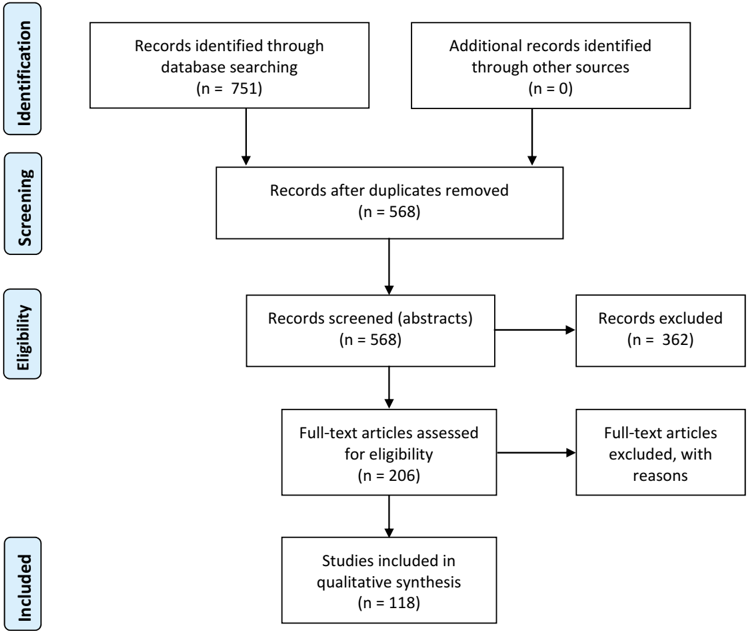
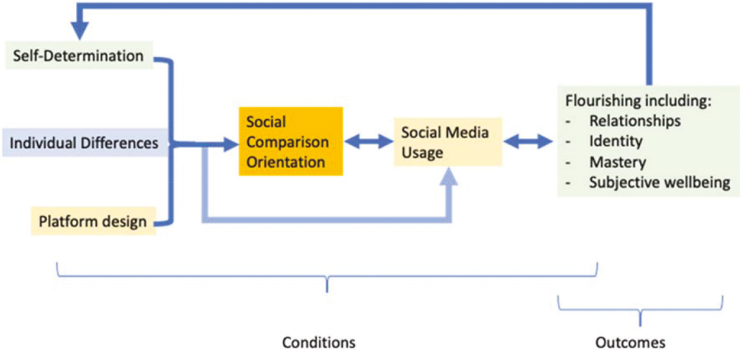
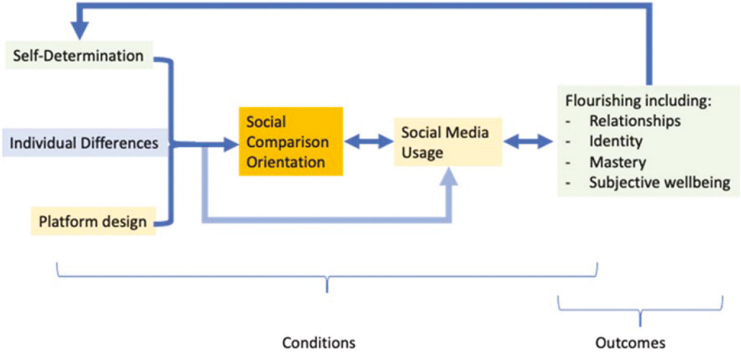
Background: Over 50% of the world uses social media. There has been significant academic and public discourse around its negative mental health impacts. There has not, however, been a broad systematic review in the field of Positive Psychology exploring the relationship between social media and wellbeing, to inform healthy social media use, and to identify if, and how, social media can support human flourishing.Objectives: To investigate the conditions and activities associated with flourishing through social media use, which might be described as ‘Flourishing through Social Media’.Method and Results: A systematic search of peer reviewed studies, identifying flourishing outcomes from usage, was conducted, resulting in 118 final studies across 7 social media platforms, 50,000+ participants, and 26 countries.Conclusions: The interaction between social media usage and flourishing is bi-directional and nuanced. Analysis through our proposed conceptual framework suggests potential for a virtuous spiral between self-determination, identity, social media usage, and flourishing.
Overview
The claims and statistics of this paper haven’t been checked yet.
Free: it reads the open-access text and checks the first 5 claims that cite a source we can check. Create a free account to check every claim.
Integrity signals
Registry
Cites
Statistics
Figures


Verification
Claims the paper makes
The claims and statistics of this paper haven’t been checked yet.
Free: it reads the open-access text and checks the first 5 claims that cite a source we can check. Create a free account to check every claim.
Claims other papers make about this one
Each is checked against this paper’s own text: does it say what the citing paper says it does?
The source backs part of the claim, not all of it — or backs it for a different population, condition or comparison.
In the citing paper
“Emerging literature increasingly emphasises that social media experiences are shaped not only by frequency of use but also by howyoung people engage with these platforms and the meanings they derive from them [4, 17, 18].”
From The Complex and Multifaceted Nature of Social Media: Perspectives From Young Adolescents, Parents and Experts (2026) · cites this paper as [17]
Experimental — accuracy not yet measuredThe check wasn’t confident either way, so it gives no verdict — never disputed.
In the citing paper
“Importantly, much of the existing research has focused on older adolescents or broad adolescent age ranges, often without distinguishing developmental diferences across adolescence [17, 33].”
From The Complex and Multifaceted Nature of Social Media: Perspectives From Young Adolescents, Parents and Experts (2026) · cites this paper as [17]
Experimental — accuracy not yet measured
Self-check
Percentages, sums and reported differences re-computed from the paper’s own numbers.
The self-check needs the paper’s full text.
Citations
Cites
Preferred Reporting Items for Systematic Reviews and Meta-Analyses: The PRISMA Statement
Moher, D., Liberati, A., Tetzlaff, J., Altman, D. G., & The PRISMA Group (2009) · PLoS Medicine · doi:10.1371/journal.pmed.1000097 · Cited by 64,042
Ryan, R. M., & Deci, E. L. (2000) · American Psychologist · doi:10.1037//0003-066x.55.1.68 · Cited by 54,599 · cited 3×
“Given the pivotal impact of motivations in this context, Self-determination Theory (SDT: Ryan & Deci, 2000, p. 68) is relevant here.”
BackgroundInfluentialA theory of social comparison processes
Festinger, L. (1954) · Human Relations · doi:10.1177/001872675400700202 · Cited by 20,926 · cited 2×
“One distinction, relating back to the original theory of social comparison (Festinger, 1954), is the distinction between comparing one’s opinions against others (opinion-based comparison) and comparing one’s abilities.”
BackgroundUsers of the world, unite! The challenges and opportunities of Social Media
Kaplan, A. M., & Haenlein, M. (2010) · Business Horizons · doi:10.1016/j.bushor.2009.09.003 · Cited by 17,875
Happiness is everything, or is it? Explorations on the meaning of psychological well-being.
Ryff, C. D. (1989) · Journal of Personality and Social Psychology · doi:10.1037/0022-3514.57.6.1069 · Cited by 14,847 · cited 2×
“, 1999), and other aspects of well-being – such as psychological well-being (Ryff, 1989) and social well-being (Keyes &”
BackgroundSubjective well-being: Three decades of progress.
Diener, E., Suh, E. M., Lucas, R. E., & Smith, H. L. (1999) · Psychological Bulletin · doi:10.1037/0033-2909.125.2.276 · Cited by 12,910
Psychology of intergroup relations
Austin, W. G., & Worchel, S. (1986) · Medical Entomology and Zoology · Cited by 10,626
Journal of Consciousness Studies
(2022) · Journal of Consciousness Studies · doi:10.53765/20512201 · Cited by 6,832
The mental health continuum: from languishing to flourishing in life.
Keyes, C. L. M. (2002) · Journal of Health and Social Behavior · doi:10.2307/3090197 · Cited by 5,133 · cited 1×
“…– such as psychological well-being (Ryff, 1989) and social well-being (Keyes & Lee, 1998) – into the broader term ‘flourishing’ because it can be, and indeed has been, considered as a fundamental component of flourishing (see Diener et al., 2010; Huppert & So, 2013; Keyes, 2002; Seligman, 2018).”
BackgroundNew well-being measures: Short scales to assess flourishing and positive and negative feelings
Diener, E., Wirtz, D., Tov, W., Kim-Prieto, C., Choi, D.-W., Oishi, S., & Biswas-Diener, R. (2010) · Social Indicators Research · doi:10.1007/s11205-009-9493-y · Cited by 4,980 · cited 1×
“…– such as psychological well-being (Ryff, 1989) and social well-being (Keyes & Lee, 1998) – into the broader term ‘flourishing’ because it can be, and indeed has been, considered as a fundamental component of flourishing (see Diener et al., 2010; Huppert & So, 2013; Keyes, 2002; Seligman, 2018).”
BackgroundKowalski, R. M., Giumetti, G. W., Schroeder, A. N., & Lattanner, M. R. (2014) · Psychological Bulletin · doi:10.1037/a0035618 · Cited by 3,266 · cited 2×
“There is considerable scholarship on the risks that children can encounter online such as cyberbullying and online grooming (e.g. Hasebrink et al., 2009; Kowalski et al., 2014).”
BackgroundKeyes, C. L. M. (1998) · Social Psychology Quarterly · doi:10.2307/2787065 · Cited by 2,924 · cited 1×
“…with subjective well-being; (Diener et al., 1999), and other aspects of well-being – such as psychological well-being (Ryff, 1989) and social well-being (Keyes & Lee, 1998) – into the broader term ‘flourishing’ because it can be, and indeed has been, considered as a fundamental component of…”
BackgroundSiddaway, A. P., Wood, A. M., & Hedges, L. V. (2019) · Annual Review of Psychology · doi:10.1146/annurev-psych-010418-102803 · Cited by 2,550 · cited 1×
“A systematic narrative synthesis approach was adopted, which is appropriate when the review covers quantitative studies using diverse methodologies or different theoretical conceptualisations (Siddaway et al., 2019).”
MethodKeles, B., McCrae, N., & Grealish, A. (2020) · International Journal of Adolescence and Youth · doi:10.1080/02673843.2019.1590851 · Cited by 1,909
Flourishing Across Europe: Application of a New Conceptual Framework for Defining Well-Being
Huppert, F. A., & So, T. T. C. (2013) · Social Indicators Research · doi:10.1007/s11205-011-9966-7 · Cited by 1,864 · cited 1×
“…– such as psychological well-being (Ryff, 1989) and social well-being (Keyes & Lee, 1998) – into the broader term ‘flourishing’ because it can be, and indeed has been, considered as a fundamental component of flourishing (see Diener et al., 2010; Huppert & So, 2013; Keyes, 2002; Seligman, 2018).”
BackgroundOn the promotion of human flourishing
VanderWeele, T. J. (2017) · Proceedings of the National Academy of Sciences · doi:10.1073/pnas.1702996114 · Cited by 1,387 · cited 1×
“Whilst the debate continues around the conceptual obscurity of synonymously used terms such as ‘happiness’, ‘wellbeing’, and ‘flourishing’, our position aligns with VanderWeele (2017) that flourishing refers to ‘complete human wellbeing’.”
BackgroundPace, R., Pluye, P., Bartlett, G., Macaulay, A. C., Salsberg, J., Jagosh, J., & Seller, R. (2012) · International Journal of Nursing Studies · doi:10.1016/j.ijnurstu.2011.07.002 · Cited by 1,331 · cited 1×
“Earlier research shows MMAT to be reliable (Pace et al., 2012) and it has since undergone development to enhance content validity.”
MethodHogan, B. (2010) · Bulletin of Science, Technology & Society · doi:10.1177/0270467610385893 · Cited by 1,318 · cited 1×
“Likewise, the ability to generate multi-media content on social media, which Hogan (2010) conceptualizes as an online ‘exhibition’, also opens up opportunities for self-presentation, self-expression, and identity-development (e.g., Karapanos et al., 2016).”
BackgroundPERMA and the building blocks of well-being
Seligman, M. (2018) · The Journal of Positive Psychology · doi:10.1080/17439760.2018.1437466 · Cited by 1,251 · cited 2×
“In co-opting ‘flourishing’ in this way, naturally we have positioned ‘happiness’ (which we define as most allied with subjective well-being; (Diener et al., 1999), and other aspects of well-being – such as psychological well-being (Ryff, 1989) and social well-being (Keyes & Lee, 1998) – into the broader term ‘flourish…”
BackgroundAppraising the Evidence: Reviewing Disparate Data Systematically
Hawker, S., Payne, S., Kerr, C., Hardey, M., & Powell, J. (2002) · Qualitative Health Research · doi:10.1177/1049732302238251 · Cited by 1,216 · cited 2×
“Hawker checklist (Hawker et al., 2002) for qualitative or mixed method studies.”
MethodNo More FOMO: Limiting Social Media Decreases Loneliness and Depression
Hunt, M. G., Marx, R., Lipson, C., & Young, J. (2018) · Journal of Social and Clinical Psychology · doi:10.1521/jscp.2018.37.10.751 · Cited by 947 · cited 1×
“Meanwhile Hunt et al. (2018) and Brailovskaia et al. (2020) found that restricting social media usage improved future usage behaviours, improving autonomy and wellbeing significantly.”
BackgroundPittman, M., & Reich, B. (2016) · Computers in Human Behavior · doi:10.1016/j.chb.2016.03.084 · Cited by 907 · cited 1×
“Qualitative results suggest this is a result of the intimacy offered by image-based social media (Pittman & Reich, 2016).”
BackgroundThe welfare effects of social media
Allcott, H., Braghieri, L., Eichmeyer, S., & Gentzkow, M. (2020) · American Economic Review · doi:10.1257/aer.20190658 · Cited by 857 · cited 1×
“Furthermore, limited regulation of information shared online, has resulted in misinformation and political polarisation (Allcott et al., 2020).”
BackgroundSocial media research: Theories, constructs and conceptual frameworks
Ngai, E. W. T., Tao, S. S. C., & Moon, K. K. L. (2015) · International Journal of Information Management · doi:10.1016/j.ijinfomgt.2014.09.004 · Cited by 760 · cited 1×
“Given social media’s popularity, psychological impacts, and potential benefits, researchers in positive psychology (Lomas et al., 2014, p. 74) and fields such as information management (Ngai et al., 2015) have called for exploration into how it can be better utilised to support wellbeing.”
BackgroundNarrative Identity and Meaning Making Across the Adult Lifespan: An Introduction
Singer, J. A. (2004) · Journal of Personality · doi:10.1111/j.0022-3506.2004.00268.x · Cited by 748
Resilience training in the workplace from 2003 to 2014: A systematic review
Robertson, I. T., Cooper, C. L., Sarkar, M., & Curran, T. (2015) · Journal of Occupational and Organizational Psychology · doi:10.1111/joop.12120 · Cited by 724
What is social comparison and how should we study it?
Wood, J. V. (1996) · Personality and Social Psychology Bulletin · doi:10.1177/0146167296225009 · Cited by 697
Social Media Use in Medical Education: A Systematic Review
Cheston, C. C., Flickinger, T. E., & Chisolm, M. S. (2013) · Academic Medicine · doi:10.1097/acm.0b013e31828ffc23 · Cited by 638 · cited 1×
“In their systematic review of social media use in medical education, Cheston et al. (2013) found learner engagement and active learning to be important benefits from social media-enabled interaction and learnergenerated content.”
BackgroundLivingstone, S., & Helsper, E. (2010) · New Media & Society · doi:10.1177/1461444809342697 · Cited by 629 · cited 1×
“Livingstone and Helsper (2010) show that restricting Internet use with the aim of reducing risks is also likely to reduce opportunities.”
BackgroundReynolds, C. R. (2008) · Encyclopedia of Special Education · doi:10.1002/9780470373699.speced0485 · Cited by 617
More information than you ever wanted: Does Facebook bring out the green-eyed monster of jealousy?
Muise, A., Christofides, E., & Desmarais, S. (2009) · CyberPsychology & Behavior · doi:10.1089/cpb.2008.0263 · Cited by 573 · cited 2×
“as specific emotions such as jealousy (Muise et al., 2009)”
BackgroundVogel, E. A., Rose, J. P., Okdie, B. M., Eckles, K., & Franz, B. (2015) · Personality and Individual Differences · doi:10.1016/j.paid.2015.06.026 · Cited by 537 · cited 1×
“For example, social comparison as a motivator has been shown to have a key negative influence over affect balance, self-esteem and self-perception (Vogel et al., 2015).”
BackgroundDeters, F. G., & Mehl, M. R. (2013) · Social Psychological and Personality Science · doi:10.1177/1948550612469233 · Cited by 523 · cited 1×
“For example, an experimentally-induced increase in status updating activity reduced loneliness, because participants felt more of a day-to-day connection with their friends (Deters & Mehl, 2013).”
BackgroundSu, R., Tay, L., & Diener, E. (2014) · Applied Psychology: Health and Well-Being · doi:10.1111/aphw.12027 · Cited by 511
What People Desire, Feel Conflicted About, and Try to Resist in Everyday Life
Hofmann, W., Vohs, K. D., & Baumeister, R. F. (2012) · Psychological Science · doi:10.1177/0956797612437426 · Cited by 490 · cited 1×
“Indeed studies suggest that social media is more addictive than both alcohol and cigarettes (Hofmann et al., 2012).”
BackgroundSocial Network Sites and Well-Being: The Role of Social Connection
Clark, J. L., Algoe, S. B., & Green, M. C. (2018) · Current Directions in Psychological Science · doi:10.1177/0963721417730833 · Cited by 451 · cited 2×
“The Stimulation Hypothesis proposes that online communication stimulates subjective wellbeing by facilitating social activities offline with close friends (Clark et al., 2018).”
BackgroundClarifying the social support theory‐research linkage
Hupcey, J. E. (1998) · Journal of Advanced Nursing · doi:10.1046/j.1365-2648.1998.01231.x · Cited by 449 · cited 1×
“One domain is social support, that is, having people to rely on for psychological or material support to cope with stress (Hupcey, 1998).”
BackgroundDoes Facebook make you lonely?: A meta analysis
Song, H., Zmyslinski-Seelig, A., Kim, J., Drent, A., Victor, A., Omori, K., & Allen, M. (2014) · Computers in Human Behavior · doi:10.1016/j.chb.2014.04.011 · Cited by 445
(2020) · doi:10.36648/1791-809x · Cited by 424
Social identities promote well‐being because they satisfy global psychological needs
Greenaway, K. H., Cruwys, T., Haslam, S. A., & Jetten, J. (2016) · European Journal of Social Psychology · doi:10.1002/ejsp.2169 · Cited by 380 · cited 1×
“Greenaway et al. (2016) argue this is because social identity satisfies basic psychological needs, including the need to belong, once again making the connection to selfdetermination theory.”
BackgroundHow Groups Affect Our Health and Well‐Being: The Path from Theory to Policy
Jetten, J., Haslam, C., Haslam, S. A., Dingle, G., & Jones, J. M. (2014) · Social Issues and Policy Review · doi:10.1111/sipr.12003 · Cited by 372 · cited 1×
“Social Identity Theory (Turner & Tajfel, 1986) has been closely linked to wellbeing (Jetten et al., 2014).”
BackgroundHasebrink, U., Livingstone, S., & Haddon, L. (2008) · Lirias · Cited by 358
Optimal experience of flow enhanced by telepresence: evidence from social media use
Pelet, J.-É., Ettis, S., & Cowart, K. (2017) · Information & Management · doi:10.1016/j.im.2016.05.001 · Cited by 354 · cited 1×
“Social media environments include dashboards of interactive information requiring deep concentration, and providing optimal challenge, such as editing and uploading content, and commenting on friends’ posts (Pelet et al., 2017).”
BackgroundWhat people desire, feel conflicted about, and try to resist in everyday life
Hofmann, W., Vohs, K. D., & Baumeister, R. F. (2018) · Self-Regulation and Self-Control · doi:10.4324/9781315175775-7 · Cited by 337
Reer, F., Tang, W. Y., & Quandt, T. (2019) · New Media & Society · doi:10.1177/1461444818823719 · Cited by 335
Need fulfillment and experiences on social media: A case on Facebook and WhatsApp
Karapanos, E., Teixeira, P., & Gouveia, R. (2016) · Computers in Human Behavior · doi:10.1016/j.chb.2015.10.015 · Cited by 316 · cited 1×
“Likewise, the ability to generate multi-media content on social media, which Hogan (2010) conceptualizes as an online ‘exhibition’, also opens up opportunities for self-presentation, self-expression, and identity-development (e.g., Karapanos et al., 2016).”
BackgroundSocial Media and Depressive Symptoms in Childhood and Adolescence: A Systematic Review
McCrae, N., Gettings, S., & Purssell, E. (2017) · Adolescent Research Review · doi:10.1007/s40894-017-0053-4 · Cited by 304 · cited 1×
“There is a significant body of research taking a pathology focus, examining deficit-based wellbeing correlates of social media usage such as depression and anxiety (e. g., McCrae et al., 2017), and discussing risks such as cyberbullying (Kowalski et al., 2014; Livingstone, 2013).”
BackgroundChen, S., Deng, Z., Xu, Y., Long, Q., Yang, J., & Yuan, J. (2017) · Frontiers in Psychology · doi:10.3389/fpsyg.2017.00001 · Cited by 288
The social media see-saw: Positive and negative influences on adolescents’ affective well-being
Weinstein, E. (2018) · New Media & Society · doi:10.1177/1461444818755634 · Cited by 282
Meier, A., & Schäfer, S. (2018) · Cyberpsychology, Behavior, and Social Networking · doi:10.1089/cyber.2017.0708 · Cited by 253 · cited 1×
“Likewise, benign envy, i.e. where the intention is not to damage the position of the superior other, can be a source of inspiration (Meier & Schäfer, 2018).”
BackgroundContent Contribution for Revenue Sharing and Reputation in Social Media: A Dynamic Structural Model
Tang, Q., Gu, B., & Whinston, A. B. (2012) · Journal of Management Information Systems · doi:10.2753/mis0742-1222290203 · Cited by 243 · cited 1×
“Examples include social connection, career development and entrepreneurial opportunities (Cooper & Naatus, 2014; Tang et al., 2012).”
BackgroundMasur, P. K., Reinecke, L., Ziegele, M., & Quiring, O. (2014) · Computers in Human Behavior · doi:10.1016/j.chb.2014.05.047 · Cited by 238 · cited 1×
“For example, Masur et al. (2014) find that thwarted autonomy offline leads to the desire to present oneself freely online, with social media offering the possibility of self-determined selfpresentation independent of social pressures.”
BackgroundDeveloping Who I Am: A Self-Determination Theory Approach to the Establishment of Healthy Identities
LA GUARDIA, J. G. (2009) · Educational Psychologist · doi:10.1080/00461520902832350 · Cited by 225 · cited 1×
“La Guardia (2009) connects identity development and SDT, arguing that autonomy, competence and relatedness underpin identity development through intrinsic motivation processes.”
BackgroundPark, S. Y., & Baek, Y. M. (2018) · Computers in Human Behavior · doi:10.1016/j.chb.2017.10.028 · Cited by 221 · cited 1×
“Opinion-based comparison via social media can, in fact, produce positive wellbeing effects and feelings of optimism and inspiration (Park & Baek, 2018).”
BackgroundSocial Media and Society: Integrating the digital with the social in digital discourse
(2023) · Discourse Approaches to Politics, Society and Culture · doi:10.1075/dapsac.100 · Cited by 192
Shyness and online social networking services
Baker, L. R., & Oswald, D. L. (2010) · Journal of Social and Personal Relationships · doi:10.1177/0265407510375261 · Cited by 191 · cited 1×
“With the latter, the text based and asynchronous characteristics of online communication can facilitate new relationships and greater intimacy (Baker & Oswald, 2010).”
BackgroundKim, B., & Kim, Y. (2017) · Computers in Human Behavior · doi:10.1016/j.chb.2017.03.033 · Cited by 187 · cited 1×
“The ability to build social capital via social media might provide one mechanism for this, as both strong ties and weak ties were found to be strengthened through social media use (e.g., Kim & Kim, 2017).”
BackgroundXiao-qian, L., Chen, W., & Popiel, P. (2015) · Computers in Human Behavior · doi:10.1016/j.chb.2015.04.066 · Cited by 173
Becker (2013) · doi:10.1089/cyber.2012.0301 · Cited by 171 · cited 1×
“To enable the translation into the offline world, social media needs to be seen as an extension of the actual relationships, and students were found to experience well-being when they manage to integrate online and general social support (Liu & Yu, 2013).”
BackgroundIndian, M., & Grieve, R. (2014) · Personality and Individual Differences · doi:10.1016/j.paid.2013.11.016 · Cited by 170 · cited 1×
“…Life satisfaction 1 Total 12 Usage Usage/Time Spent online 11 (behaviours & Content shared or experienced (self-presentation or other content) 4 experience) Nature of online Feedback 3 Active v Passive behaviour online 2 Total 20 opportunities afforded by social media (e.g., Indian & Grieve, 2014).”
BackgroundUnderstanding the consequences of public social media use for work
van Zoonen, W., Verhoeven, J. W. M., & Vliegenthart, R. (2017) · European Management Journal · doi:10.1016/j.emj.2017.07.006 · Cited by 170 · cited 1×
“Contexts include university settings, where social media offers peer support groups and learning environments (Uusiautti & Määttä, 2014), and organisations, where it can promote knowledge exchange and wellbeing (Van Zoonen et al., 2017).”
BackgroundNeubaum, G., Rösner, L., Rosenthal-von der Pütten, A. M., & Krämer, N. C. (2014) · Computers in Human Behavior · doi:10.1016/j.chb.2014.01.021 · Cited by 163 · cited 2×
“Included studies suggest social media produced short term positive emotions and offered social support via rapid emotional relief after crises (Neubaum et al., 2014).”
BackgroundKids Online: Opportunities and Risks for Children
(2009) · Bristol University Press eBooks · doi:10.46692/9781847427342 · Cited by 156
Vergeer, M., & Pelzer, B. (2009) · Journal of Computer-Mediated Communication · doi:10.1111/j.1083-6101.2009.01499.x · Cited by 145 · cited 1×
“It can help socially skilled people who can use social media to consolidate and build on their existing offline relationships (Vergeer & Pelzer, 2009) or can also help those who lack social skills (Social Compensation Hypothesis).”
BackgroundA Systematic Literature Review on Professional Identity Construction in Social Media
Kasperiūnienė, J., & Žydžiūnaitė, V. (2019) · SAGE Open · doi:10.1177/2158244019828847 · Cited by 134
Vriens, E., & van Ingen, E. (2018) · New Media & Society · doi:10.1177/1461444817724169 · Cited by 127
Cabello-Hutt, T., Cabello, P., & Claro, M. (2018) · New Media & Society · doi:10.1177/1461444817724168 · Cited by 127 · cited 1×
“However research on online opportunities has been described as scarce and more recent (Cabello-Hutt et al., 2018).”
BackgroundCharoensukmongkol, P. (2016) · Journal of Health Psychology · doi:10.1177/1359105315569096 · Cited by 122 · cited 1×
“Mindfulness has been found to be the mediating factor in whether social media usage creates burnout or not in the workplace (Charoensukmongkol, 2016); and a moderator of the relationship between social media use, selfesteem, and identity clarity (Yang et al., 2017).”
BackgroundFacebook friends, subjective well-being, social support, and personality
Lönnqvist, J., & Deters, F. G. (2015) · Computers in Human Behavior · doi:10.1016/j.chb.2015.09.002 · Cited by 120 · cited 1×
“…than binary outcomes suggesting social media is either good or bad for introverts or extraverts, findings are more nuanced, suggesting that social media can benefit both extraverts (Lönnqvist & Große Deters, 2016) or introverts in different ways, and that personality impacts usage differentially.”
BackgroundSocial media, social integration and subjective well-being among new urban migrants in China
Wei, L., & Gao, F. (2016) · Telematics and Informatics · doi:10.1016/j.tele.2016.05.017 · Cited by 118
Brailovskaia, J., & Margraf, J. (2016) · PLOS ONE · doi:10.1371/journal.pone.0166999 · Cited by 107 · cited 1×
“To give an indication of the interrelatedness of these themes, both physical health (Brailovskaia & Margraf, 2016) and psychological wellbeing were found to mediate the negative impacts of personality on social media usage (Nikbin et al., 2020).”
BackgroundFacebook in context(s): Measuring emotional responses across time and space
Bayer, J., Ellison, N., Schoenebeck, S., Brady, E., & Falk, E. B. (2018) · New Media & Society · doi:10.1177/1461444816681522 · Cited by 107 · cited 1×
“Longer term, however, positive emotions were found to be fleeting (Bayer et al., 2018) whereas social support had the potential to endure, as highlighted by two longitudinal studies.”
BackgroundSocial media for breast cancer survivors: a literature review
Falisi, A. L., Wiseman, K. P., Gaysynsky, A., Scheideler, J. K., Ramin, D. A., & Chou, W. S. (2017) · Journal of Cancer Survivorship · doi:10.1007/s11764-017-0620-5 · Cited by 107 · cited 3×
“This was of particular importance for patient groups such as those with cancer e.g., Falisi et al. (2017), those with disabilities, and for minority groups.”
BackgroundChae, J. (2018) · Telematics and Informatics · doi:10.1016/j.tele.2018.04.011 · Cited by 105 · cited 5×
“As Chae (2018) and (Binns, 2014) demonstrated, each platform has different features which are conducive to different levels of comparison and connection.”
BackgroundInfluentialChadwick, D. D., & Fullwood, C. (2018) · Cyberpsychology, Behavior, and Social Networking · doi:10.1089/cyber.2016.0689 · Cited by 104 · cited 1×
“For the latter social media offers a place where they do not need to focus their identity on their disability, nor do they have to hide it (Chadwick & Fullwood, 2018).”
BackgroundBrailovskaia, J., Teismann, T., & Margraf, J. (2018) · Computers in Human Behavior · doi:10.1016/j.chb.2018.04.045 · Cited by 104 · cited 1×
“Generally, better wellbeing also produced better outcomes from social media usage such a reduced stress (Brailovskaia et al., 2018).”
BackgroundFour Selves, Two Motives, and a Substitute Process Self-Regulation Model
Baumeister, R. F., & Tice, D. M. (1986) · Springer eBooks · doi:10.1007/978-1-4613-9564-5_3 · Cited by 98 · cited 1×
“Self-presentation describes how we communicate our own image to others and plays a crucial role in identity development (Baumeister & Tice, 1986).”
BackgroundYang, C.-C., Holden, S. M., & Carter, M. D. K. (2017) · Journal of Applied Developmental Psychology · doi:10.1016/j.appdev.2017.08.006 · Cited by 90
Chow, T. S., & Wan, H. Y. (2017) · Personality and Individual Differences · doi:10.1016/j.paid.2017.07.032 · Cited by 89 · cited 1×
“What does seem clear though is that neuroticism more associated with depressive symptoms online (Chow & Wan, 2017).”
BackgroundUysal, R., Satici, S. A., & Akin, A. (2013) · Psychological Reports · doi:10.2466/02.09.18.pr0.113x32z3 · Cited by 88 · cited 1×
“Overall, better wellbeing predicted less problematic use (e.g., Uysal et al., 2013).”
BackgroundRoy, B., Riley, C. L., Sears, L. E., & Rula, E. Y. (2018) · American Journal of Health Promotion · doi:10.1177/0890117118791993 · Cited by 84
Abstinence from social media use, subjective well-being, stress, and loneliness
Vally, Z., & D'Souza, C. G. (2019) · Perspectives In Psychiatric Care · doi:10.1111/ppc.12431 · Cited by 83 · cited 2×
“Less is generally better, but ‘zero’ is not necessarily the optimal solution, with some studies finding that abstinence reduces, or has no effect, on wellbeing (e.g., Vally & D’Souza, 2019).”
BackgroundBruggeman, H., Van Hiel, A., Van Hal, G., & Van Dongen, S. (2019) · Computers in Human Behavior · doi:10.1016/j.chb.2019.07.015 · Cited by 81 · cited 1×
“For example, Bruggeman et al. (2019) found that ‘moderate’ social media use, defined as less than 3 hours per day, had no effect on children’s wellbeing, whereas the strength of their offline social network, both in terms of its size and perceived social support, was a far stronger, positive…”
BackgroundTaking a Short Break from Instagram: The Effects on Subjective Well-Being
Fioravanti, G., Prostamo, A., & Casale, S. (2020) · Cyberpsychology, Behavior, and Social Networking · doi:10.1089/cyber.2019.0400 · Cited by 79 · cited 2×
“Finally, and partially reiterating from previous sections, social comparison can vary according to individual differences such as personality and gender (Fioravanti et al., 2020), psychological needs (Tobin et al., 2020), and platform design.”
BackgroundComing of Age (Digitally): An Ecological View of Social Media Use among College Students
Wang, Y., Niiya, M., Mark, G., Reich, S. M., & Warschauer, M. (2015) · Proceedings of the 18th ACM Conference on Computer Supported Cooperative Work & Social Computing · doi:10.1145/2675133.2675271 · Cited by 77 · cited 2×
“Increased frequency of social media use has been associated with less positive mood (Wang et al., 2015) as well THE JOURNAL OF POSITIVE PSYCHOLOGY 87”
BackgroundSocial media use and happiness in adults with autism spectrum disorder
Ward, D. M., Dill-Shackleford, K. E., & Mazurek, M. O. (2018) · Cyberpsychology, Behavior, and Social Networking · doi:10.1089/cyber.2017.0331 · Cited by 72
The LIFE Model: A Meta-Theoretical Conceptual Map for Applied Positive Psychology
Lomas, T., Hefferon, K., & Ivtzan, I. (2015) · Journal of Happiness Studies · doi:10.1007/s10902-014-9563-y · Cited by 71
Self-citationPera, R., Quinton, S., & Baima, G. (2020) · Psychology & Marketing · doi:10.1002/mar.21337 · Cited by 69 · cited 3×
“● Similarly, recognizing the tension between autonomy and relatedness identified in studies (e.g., Pera et al., 2020), one might recommend using social media intentionally for connection, but experimenting with levels of usage and periods of abstinence to proactively regulate this tension.”
BackgroundInfluentialNikbin, D., Iranmanesh, M., & Foroughi, B. (2021) · Behaviour & Information Technology · doi:10.1080/0144929x.2020.1722749 · Cited by 67
Share, like and achieve: the power of Facebook to reach health‐related goals
de la Peña, A., & Quintanilla, C. (2015) · International Journal of Consumer Studies · doi:10.1111/ijcs.12224 · Cited by 65 · cited 1×
“Turning to self-efficacy and accomplishment (4 studies), social media community discussion threads can offer a virtual community for fitness encouragement, information and sharing success, inspiring achievement of other goals (De la Peña & Quintanilla, 2015).”
BackgroundHu, X., Kim, A., Siwek, N., & Wilder, D. (2017) · Frontiers in Psychology · doi:10.3389/fpsyg.2017.00087 · Cited by 58
I am no longer alone – How do university students perceive the possibilities of social media?
Uusiautti, S., & Määttä, K. (2014) · International Journal of Adolescence and Youth · doi:10.1080/02673843.2014.919600 · Cited by 51 · cited 1×
“Contexts include university settings, where social media offers peer support groups and learning environments (Uusiautti & Määttä, 2014), and organisations, where it can promote knowledge exchange and wellbeing (Van Zoonen et al., 2017).”
BackgroundSocial media as a shield: Facebook buffers acute stress
Rus, H. M., & Tiemensma, J. (2017) · Physiology & Behavior · doi:10.1016/j.physbeh.2017.12.021 · Cited by 49 · cited 1×
“Emotional states could either be amplified (Rus & Tiemensma, 2018) or strengthened through social media use.”
BackgroundLai, H.-M., Hsieh, P.-J., & Zhang, R.-C. (2019) · Behaviour & Information Technology · doi:10.1080/0144929x.2018.1543452 · Cited by 49 · cited 1×
“For example, belongingness was a commonly discussed driver (3 studies, e.g., Lai et al., 2019) for social media use.”
BackgroundApplied Positive Psychology: Integrated Positive Practice
Lomas, T., Hefferon, K., & Ivtzan, I. (2014) · SAGE Publications Ltd eBooks · doi:10.4135/9781473909687 · Cited by 48 · cited 1×
“Given social media’s popularity, psychological impacts, and potential benefits, researchers in positive psychology (Lomas et al., 2014, p. 74) and fields such as information management (Ngai et al., 2015) have called for exploration into how it can be better utilised to support wellbeing.”
BackgroundSelf-citationBinns, A. (2014) · Journal of Media Practice · doi:10.1080/14682753.2014.960763 · Cited by 43 · cited 4×
“Social media platform design has created different environments, through what has been described as ‘choice architecture’ designed to influence our behaviour (Binns, 2014).”
BackgroundInfluentialZiv, I., & Kiasi, M. (2015) · The Journal of Psychology · doi:10.1080/00223980.2015.1110556 · Cited by 43
Linkedin As A Learning Tool In Business Education
Cooper, B., & Naatus, M. K. (2014) · American Journal of Business Education (AJBE) · doi:10.19030/ajbe.v7i4.8815 · Cited by 36 · cited 1×
“Examples include social connection, career development and entrepreneurial opportunities (Cooper & Naatus, 2014; Tang et al., 2012).”
BackgroundPassey, S. L., Bozinovski, S., Vlahos, R., Anderson, G. P., & Hansen, M. J. (2016) · PLOS ONE · doi:10.1371/journal.pone.0146882 · Cited by 36
Interpersonal goals as predictors of facebook use, social capital, and envy
Tobin, S. J., Chant, G., & Clay, R. (2020) · Cyberpsychology Behavior and Social Networking · doi:10.1089/cyber.2019.0446 · Cited by 24 · cited 4×
“Finally, and partially reiterating from previous sections, social comparison can vary according to individual differences such as personality and gender (Fioravanti et al., 2020), psychological needs (Tobin et al., 2020), and platform design.”
BackgroundInfluentialPosting Exercise Activity on Social Media for Self-Efficacy and Well-Being
Kashian, N., & Liu, Y. (2019) · Southern Communication Journal · doi:10.1080/1041794x.2019.1658801 · Cited by 22 · cited 1×
“Sharing mastery experiences on social media has also been positively associated with self-efficacy, which in turn is related to physical and mental wellbeing (Kashian & Liu, 2020).”
BackgroundOrmsby, H., Owen, A. L., & Bhogal, M. S. (2018) · Current Psychology · doi:10.1007/s12144-018-0089-z · Cited by 21 · cited 1×
“One explanation found for this was stronger links between social comparison and body dissatisfaction for women than men (Ormsby et al., 2019).”
BackgroundHappiness or Addiction: An Example of Taiwanese College Students' Use of Facebook
Yu, S. (2015) · International Journal of Technology and Human Interaction · doi:10.4018/ijthi.2015100102 · Cited by 14 · cited 2×
“Ziv and Kiassi (2015) found that social media use strengthened wellbeing for those with low initial levels of resilience.”
BackgroundThe flourishing–happiness concordance thesis: Some troubling counterexamples
Kristjansson, K. R. (2017) · The Journal of Positive Psychology · doi:10.1080/17439760.2017.1365159 · Cited by 10
Research works printed but not linked: 12
- Carroll, C., Booth, A., Leaviss, J., & Rick, J. (2013). “best fit” framework synthesis: Refining the method. BMC Medical Research Methodology , 13(1).
- Chen, E., & Miller, G. (2007). CHAPTER 23 - Social Context as an Individual Difference in Psychoneuroimmunology. (F. E. Ader Ed.). Academic Press. R. B. T.P. R. B. T.P.
- Corpus, J. H., Love, K. E., & Ogle, C. M. (2005). Social-comparison praise undermines intrinsic motivation when children later doubt their ability. Poster Presented at the Biennial Meeting of the Society for Research in Child Development, Atlanta, GA.
- Forsyth, D. R. (2018). Group dynamics (7th ed.). Cengage Learning.
- Gilmour, J., Machin, T., Brownlow, C., & Jeffries, C. (2019). Facebook-based social support and health: A systematic review. Psychology of Popular Media Culture.
- Hong, Q., Pluye, P., Fàbregues, S., Bartlett, G., Boardman, F., Cargo, M., … Vedel, I. (2018). Mixed Methods Appraisal Tool (MMAT), Version 2018. User guide (pp. 1–11). McGill.
- Livingstone, S., Haddon, L., Görzig, A., & Ólafsson, K. (2011). Risks and safety on the internet: The perspective of European children: Full findings and policy implications from the EU Kids Online survey of 9–16 year olds and their parents in 25 countries. LSE, London: EU Kids Online, 170.
- Livingstone, S. (2013). Online risk, harm and vulnerability: Reflections on the evidence base for child Internet safety policy. Zer: Revista de Estudios de Comunicación, 18, 13–28.
- Newport, C. (2019). Digital minimalism: Choosing a focused life in a noisy world. Penguin.
- 10.1037/0003-066X.55.1.68 · doi:10.1037/0003-066x.55.1.68 · Paper page
- Schrock, A. R. (2016). Exploring the Relationship Between Mobile Facebook and Social Capital: What Is the “Mobile Difference” for Parents of Young Children? Social Media and Society 2 (3) , .
- Zuboff, S. (2019). The Age of Surveillance Capitalism: The Fight for a Human Future at the New Frontier of Power: Barack Obama’s Books of 2019. Profile Books.
Cited by
Marciano, L., Lin, J., Sato, T., Saboor, S., & Viswanath, K. (2024) · SSM - Mental Health · doi:10.1016/j.ssmmh.2024.100331 · Cited by 80
Adolescent Social Media Use through a Self-Determination Theory Lens: A Systematic Scoping Review
West, M., Rice, S., & Vella‐Brodrick, D. (2024) · International Journal of Environmental Research and Public Health · doi:10.3390/ijerph21070862 · Cited by 125
“The global uptake and pervasive integration of social media within adolescents’ every-day lives raises questions as to how social media impacts their wellbeing [1–3].”
BackgroundInfluentialdu Toit, A., Thomson, R. J., & Page, A. (2022) · International Journal of Wellbeing · doi:10.5502/ijw.v12i2.1897 · Cited by 65
Social media use and adolescents’ well-being: A note on flourishing
Marciano, L., & Viswanath, K. (2023) · Frontiers in Psychology · doi:10.3389/fpsyg.2023.1092109 · Cited by 68
“For example, narrative identities facilitate young people to build a coherent sense of themselves from the life experiences shared online (Gudka et al., 2023).”
BackgroundRosič, J., Janicke‐Bowles, S. H., Carbone, L., Lobe, B., & Vandenbosch, L. (2022) · Frontiers in Digital Health · doi:10.3389/fdgth.2022.975557 · Cited by 44
“(5) referred to these basic psychological needs as important conditions for”
Background
Metadata
- Authors
- Gudka, M., Gardiner, K. L. K., & Lomas, T.
- Affiliations
- London Business School (GB)
- University of East London (GB)
- Harvard University (US)
- Corresponding author
- Gudka, Maya
- Venue
- The Journal of Positive Psychology
- Publisher
- Informa UK Limited
- Published
- 2021-11-30
- Volume
- 18
- Issue
- 1
- Pages
- 86-105
- ISSN
- 1743-9760 (ISSN-L)
- 1743-9779
- OpenAlex
- W3217349156
- Cited by
- 54
- References
- 100
- Citations by year
- 2026: 14 · 2025: 17 · 2024: 13 · 2023: 6 · 2022: 4
- FWCI
- 1.10
- Type
- journal article
- Language
- en
- Open access
- hybrid
- doi.org
- Licence
- Locations
- The Journal of Positive Psychology (publishedVersion, cc-by-nc-nd)
- UEL Research Repository (University of East London) (submittedVersion, cc-by)
- Topics
- Social Sciences › Sociology and Political Science › Impact of Technology on Adolescents
- Social Sciences › Psychology › Social Psychology › Psychological Well-being and Life Satisfaction
- Social Sciences › Psychology › Developmental and Educational Psychology › Flow Experience in Various Fields
- Keywords
- social media use, eudaimonia, well-being, positive psychology, self-determination, identity, healthy social media use, conceptual framework, mental health
About these checks
Registry, retraction, Cites and statistics results are computed, not judged, with one exception: a printed reference that no index lists is read once by a model before it counts as a citation error. Claims are extracted by a model and kept only when their quote appears verbatim in the text; each cited source is then checked, with a model’s help, for whether it says what the claim relies on. Those verdicts can be wrong — read the claim’s quote and the cited source before relying on one.
Statistics and arithmetic are recomputed, not judged.
Confidence bands are shown only for fields calibrated on our annotated test set. None is calibrated yet, so no band is shown.
What counts as a claim ›How we measure confidence ›How we check this ›
Are you an author, or do you see a problem with this page? Request a review
Data sources
Bibliographic data: Semantic Scholar, OpenAlex, Crossref.
Contains information from the Semantic Scholar Academic Graph Datasets, made available under the ODC Attribution License (ODC-BY 1.0).
Semantic Scholar’s data is described in: Kinney, R., et al. (2023). The Semantic Scholar Open Data Platform. arXiv:2301.10140.
