

Internet-delivered guided self-help Acceptance and Commitment Therapy for family carers of people with dementia (iACT4CARERS): a qualitative study of carer views and acceptability
Open accessThe DOI matches its Crossref record; 46 of the 47 references it cites were found in a registry or an index; none of the 47 sources its claims cite is checked for support yet.
Abstract
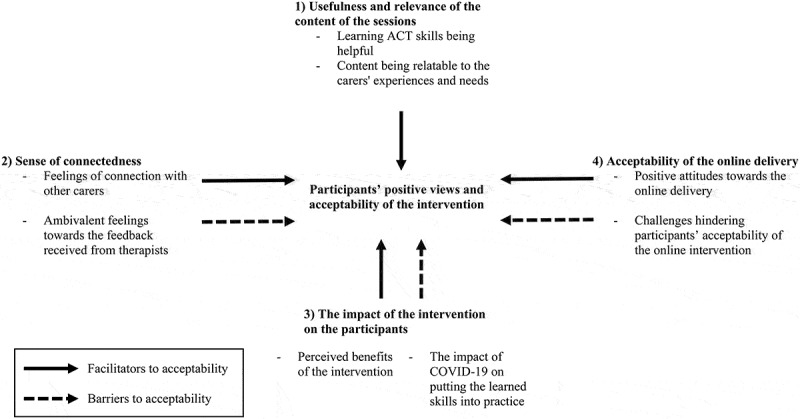
PURPOSE: To explore carers' views and acceptability of internet-delivered, therapist-guided, self-help Acceptance and Commitment Therapy (ACT) for family carers of people with dementia (iACT4CARERS). METHODS: A qualitative approach with semi-structured interviews was employed with family carers (N = 23) taking part in a feasibility study of iACT4CARERS. The interviews were audio-recorded, transcribed and analysed using thematic analysis. RESULTS: Four overarching themes were identified: 1) usefulness and relevance of the content of the sessions, 2) sense of connectedness, 3) the impact of the intervention on participants and 4) acceptability of the online delivery. Positive carer experiences and intervention acceptability were facilitated by learning helpful ACT skills, perceiving the content of the session as relatable to the carers' needs, feeling connected to other carers and the therapist during the intervention, noticing the benefits of the intervention and the user-friendliness of the online platform. Recommendations for a full-scale trial were identified, such as the inclusion of some "face-to-face" interactions (e.g., via video call) between carers and therapists to facilitate a bidirectional interaction and the provision of an additional aide-memoire to improve the learning experiences. CONCLUSION: Overall, the intervention was acceptable to the family carers. The proposed recommendations should be considered in a full-scale trial.
Overview
CoChat Summary
TL;DR
Internet-delivered, therapist-guided self-help ACT was broadly acceptable to family carers of people with dementia in a feasibility study, with carers valuing ACT skills, relatable content, connectedness, perceived benefits, and the online platform. Carers recommended adding some face-to-face/video-call bidirectional therapist contact and improving programme flexibility and aide-memoire features for a full-scale trial.
Key findings
- Four overarching themes described carers’ views: usefulness/relevance of session content, sense of connectedness, impact of the intervention, and acceptability of online delivery.
- Carers valued ACT skills, especially present-moment awareness and self-compassion; the self-compassion exercise was both highly valued and emotionally difficult for many.
- Perceived benefits included increased awareness of own needs, greater self-care, asking others for help, and increased value-based activities.
- Of 23 interviewed carers, 18/23 (78%) completed all 8 online sessions, 4/23 (18%) completed 7, and 1/23 (4%) completed 4; participants had a mean age of 62.91 years (SD 10.73), and 20/23 (87%) were female.
Methods
- Qualitative study nested in a feasibility study of iACT4CARERS, using semi-structured interviews with 23 family carers after they completed all eight online sessions or lost access after 12 weeks.
- The intervention was internet-delivered, therapist-guided self-help ACT with eight online sessions using audio, video, and text; optional online peer-support groups were also available.
- Interviews were audio-recorded, transcribed verbatim, and analysed using thematic analysis with a codebook approach; coding was led by EVH and MC with co-analysis by NK, assisted by NVivo V12, and public advisory members reviewed potential themes.
Limitations
- The paper states that participants had internet access, no baseline data were collected on internet knowledge/confidence/use, and those with little or no computer literacy may have declined to take part.
- The paper states that most participants were wives and daughters, so male carers are underrepresented; ethnicity data were not collected, and recruitment was mainly from East of England and Greater London, limiting generalizability.
- The paper states that acceptability should be explored among carers from ethnic minority groups; the text also makes evident that this was a small qualitative feasibility sample, with 9 of 33 enrolled participants lost to follow-up and one declining interview due to caring responsibilities.
Model-written summary. Check it against the paper before relying on it.
Integrity signals
Registry
Cites
Statistics
Figures
Verification
Claims the paper makes
0 Valid · 0 Not valid · 27 Not checked · 93 Own results and interpretations
A result the paper states — it cites no source for it, so there is none to check. The quote shows it is in the paper.
In the paper
“self-compassion was particularly appreciated by most of our participants”
§ Internet-delivered guided self-help Acceptance and Commitment Therapy for family carers of people with dementia (iACT4CARERS): a qualitative study of carer views and acceptability > Discussion
plain- Asserted: passes — The authors put it forward as true.
- Checkable: passes — It can be checked against evidence.
- Load-bearing: unclear — It is unclear whether the paper’s conclusions depend on it.
- Based: passes — The paper gives a reason why it holds.
A result the paper reports from its own data — it cites no other source for it, so there is none to check. The quote shows it is in the paper.
In the paper
“Four overarching themes were identified in the semi-structured interviews with carers: usefulness and relevance of the content of the sessions, sense of connectedness, the impact of the intervention on participants and acceptability of the online delivery.”
§ Internet-delivered guided self-help Acceptance and Commitment Therapy for family carers of people with dementia (iACT4CARERS): a qualitative study of carer views and acceptability > Discussion
plain- Asserted: passes — The authors put it forward as true.
- Checkable: passes — It can be checked against evidence.
- Load-bearing: passes — The paper’s conclusions depend on it.
- Based: passes — The paper gives a reason why it holds.
A result the paper reports from its own data — it cites no other source for it, so there is none to check. The quote shows it is in the paper.
In the paper
“The family carers taking part in the study expressed that the ACT skills learned throughout the intervention were helpful for improving their experiences of looking after a family member living with dementia.”
§ Internet-delivered guided self-help Acceptance and Commitment Therapy for family carers of people with dementia (iACT4CARERS): a qualitative study of carer views and acceptability > Results > Usefulness and relevance of the content of the sessions
plainstates a cause- Asserted: passes — The authors put it forward as true.
- Checkable: passes — It can be checked against evidence.
- Load-bearing: passes — The paper’s conclusions depend on it.
- Based: passes — The paper gives a reason why it holds.
A result the paper reports from its own data — it cites no other source for it, so there is none to check. The quote shows it is in the paper.
In the paper
“Another aspect that appeared to facilitate acceptability of the intervention was the simplicity and relevance of exercises and metaphors used to illustrate ACT techniques.”
§ Internet-delivered guided self-help Acceptance and Commitment Therapy for family carers of people with dementia (iACT4CARERS): a qualitative study of carer views and acceptability > Results > Usefulness and relevance of the content of the sessions
hedgedstates a cause- Asserted: passes — The authors put it forward as true.
- Checkable: passes — It can be checked against evidence.
- Load-bearing: passes — The paper’s conclusions depend on it.
- Based: passes — The paper gives a reason why it holds.
A result the paper reports from its own data — it cites no other source for it, so there is none to check. The quote shows it is in the paper.
In the paper
“Moreover, the participants felt that it was helpful to learn from other carers’ experience with the intervention and with their role in looking after a person with dementia.”
§ Internet-delivered guided self-help Acceptance and Commitment Therapy for family carers of people with dementia (iACT4CARERS): a qualitative study of carer views and acceptability > Results > Sense of connectedness
plain- Asserted: passes — The authors put it forward as true.
- Checkable: passes — It can be checked against evidence.
- Load-bearing: passes — The paper’s conclusions depend on it.
- Based: passes — The paper gives a reason why it holds.
53 more claims
Create a free account to see all 120 claims and to verify the 47 references still open.
- It may state two separate claims as one. 30
- Probably not a substantial claim. 39
- The quote only partly states this claim. 1
Claims other papers make about this one
Each is checked against this paper’s own text: does it say what the citing paper says it does?
The source backs part of the claim, not all of it — or backs it for a different population, condition or comparison.
In the citing paper
“Based on the current evidence, we conducted feasibility and acceptability studies of internet-delivered self-help ACT for family carers of people with dementia (iACT4CARERS) [13 -15] in which pre-defined criteria for progression from the feasibility study to a full-scale RCT were successfully met.”
From The clinical and cost effectiveness of internet-delivered self-help Acceptance and Commitment Therapy for family carers of people with dementia (iACT4CARERS): Study protocol for a randomised controlled trial with ethnically diverse family carers (2024) · cites this paper as [14]
Experimental — accuracy not yet measured
Self-check
Percentages, sums and reported differences re-computed from the paper’s own numbers.
Rated minor: it would not touch a result — a value no result rests on, a p-value that stays on the same side of the significance level, or a conflict that is clerical, resolved elsewhere in the paper, or outside its own findings.
In the paper
“| 41–80 hours per week | 5 (20%) |”
§ Internet-delivered guided self-help Acceptance and Commitment Therapy for family carers of people with dementia (iACT4CARERS): a qualitative study of carer views and acceptability > Results
Reported 20 · recomputed 21.73913
Rated minor: it would not touch a result — a value no result rests on, a p-value that stays on the same side of the significance level, or a conflict that is clerical, resolved elsewhere in the paper, or outside its own findings.
In the paper
“| 81 or more hours per week | 9 (40%) |”
§ Internet-delivered guided self-help Acceptance and Commitment Therapy for family carers of people with dementia (iACT4CARERS): a qualitative study of carer views and acceptability > Results
Reported 40 · recomputed 39.130435
Rated minor: it would not touch a result — a value no result rests on, a p-value that stays on the same side of the significance level, or a conflict that is clerical, resolved elsewhere in the paper, or outside its own findings.
In the paper
“| Attended 0 peer support groups | 16/23 | | Attended 1 peer support groupsAttended 2 peer support groups | 7/237/23 | | Attended 3 peer support groups | 6/23 |”
§ Internet-delivered guided self-help Acceptance and Commitment Therapy for family carers of people with dementia (iACT4CARERS): a qualitative study of carer views and acceptability > Results
Reported 23 · recomputed 36
Citations
Cites
The PHQ-9: Validity of a brief depression severity measure
Kroenke, K., Spitzer, R. L., & Williams, J. B. W. (2001) · Journal of General Internal Medicine · doi:10.1046/j.1525-1497.2001.016009606.x · Cited by 44,910
Tong, A., Sainsbury, P., & Craig, J. (2007) · International Journal for Quality in Health Care · doi:10.1093/intqhc/mzm042 · Cited by 42,509
A Brief Measure for Assessing Generalized Anxiety Disorder: The GAD-7
Spitzer, R. L., Kroenke, K., Williams, J. B. W., & Löwe, B. (2006) · Archives of Internal Medicine · doi:10.1001/archinte.166.10.1092 · Cited by 31,765
One size fits all? What counts as quality practice in (reflexive) thematic analysis?
Braun, V., & Clarke, V. (2021) · Qualitative Research in Psychology · doi:10.1080/14780887.2020.1769238 · Cited by 9,727
Sekhon, M., Cartwright, M., & Francis, J. J. (2017) · BMC Health Services Research · doi:10.1186/s12913-017-2031-8 · Cited by 3,938 · cited 1×
“Following the theoretical framework of acceptability of interventions (TFA; Sekhon et al., 2017), individual interviews explored attitudes towards the intervention, and perceived effectiveness by addressing the following research questions: (a) What is perceived by family carers as helpful or…”
InfluentialCorrelates of Physical Health of Informal Caregivers: A Meta-Analysis
Pinquart, M., & Sorensen, S. (2007) · The Journals of Gerontology Series B: Psychological Sciences and Social Sciences · doi:10.1093/geronb/62.2.p126 · Cited by 1,126
Hayes, S. C., Levin, M. E., Plumb-Vilardaga, J., Villatte, J. L., & Pistorello, J. (2013) · Behavior Therapy · doi:10.1016/j.beth.2009.08.002 · Cited by 1,120 · cited 1×
“…ability to step back from difficult thoughts and approach or allow painful emotions, focusing on the present, connecting with what is happening in the moment, clarifying and acting on what is most important to do and building larger patterns of effective values-based behaviour (Hayes et al., 2013).”
BackgroundA-Tjak, J. G. L., Davis, M. L., Morina, N., Powers, M. B., Smits, J. A. J., & Emmelkamp, P. M. G. (2015) · Psychotherapy and Psychosomatics · doi:10.1159/000365764 · Cited by 1,031
The empirical status of acceptance and commitment therapy: A review of meta-analyses
Gloster, A. T., Walder, N., Levin, M. E., Twohig, M. P., & Karekla, M. (2020) · Journal of Contextual Behavioral Science · doi:10.1016/j.jcbs.2020.09.009 · Cited by 622 · cited 1×
“…reviews have demonstrated that in-person ACT is effective in improving outcomes such as mood and quality of life in various populations including people with depression, anxiety, chronic pain, and somatic health problems (A-Tjak et al., 2015; Gloster et al., 2020; Hann & McCracken, 2014).”
BackgroundErbe, D., Eichert, H.-C., Riper, H., & Ebert, D. D. (2017) · Journal of Medical Internet Research · doi:10.2196/jmir.6588 · Cited by 532 · cited 1×
“A recent systematic review on blending face-to-face and internet-based interventions demonstrated that the blended approach can save clinician time, produce lower dropout rates and are cost-effective (Erbe et al., 2017).”
BackgroundO’Cathain, A., Hoddinott, P., Lewin, S., Thomas, K. J., Young, B., Adamson, J., Jansen, Y. J., Mills, N., Moore, G., & Donovan, J. L. (2015) · Pilot and Feasibility Studies · doi:10.1186/s40814-015-0026-y · Cited by 458 · cited 1×
“Given the often subtle and complex structures of these issues, qualitative analysis can offer in-depth insights on which aspects of the intervention should be improved: a topic that may not be fully captured in the quantitative findings (O’Cathain et al., 2015).”
The Therapeutic Relationship in E-Therapy for Mental Health: A Systematic Review
Sucala, M., Schnur, J. B., Constantino, M. J., Miller, S. J., Brackman, E. H., & Montgomery, G. H. (2012) · Journal of Medical Internet Research · doi:10.2196/jmir.2084 · Cited by 344 · cited 1×
“…professionals still believe that online-delivered interventions are less effective than face-to-face interventions due to the lack of personal contact and the extra challenges to build a strong therapeutic relationship (Kuso et al., 2021; Sucala et al., 2012; Thew, 2020; Wehmann et al., 2020).”
BackgroundMartyr, A., Nelis, S. M., Quinn, C., Wu, Y.-T., Lamont, R. A., Henderson, C., Clarke, R., Hindle, J. V., Thom, J. M., Jones, I. R., et al. (2018) · Psychological Medicine · doi:10.1017/s0033291718000405 · Cited by 311
Hann, K. E. J., & McCracken, L. M. (2014) · Journal of Contextual Behavioral Science · doi:10.1016/j.jcbs.2014.10.001 · Cited by 259 · cited 1×
“…reviews have demonstrated that in-person ACT is effective in improving outcomes such as mood and quality of life in various populations including people with depression, anxiety, chronic pain, and somatic health problems (A-Tjak et al., 2015; Gloster et al., 2020; Hann & McCracken, 2014).”
BackgroundSelf-citationLosada, A., Márquez-González, M., Romero-Moreno, R., Mausbach, B. T., López, J., Fernández-Fernández, V., & Nogales-González, C. (2015) · Journal of Consulting and Clinical Psychology · doi:10.1037/ccp0000028 · Cited by 255 · cited 1×
“…trials (RCTs) of in-person ACT for family carers of people with dementia also demonstrated that face-to-face ACT delivered by qualified psychologists is effective in treating anxiety and depression in family carers of people with dementia (Losada et al., 2015; Márquez-González et al., 2020).”
Collins, R. N., & Kishita, N. (2020) · Ageing and Society · doi:10.1017/s0144686x19000527 · Cited by 244 · cited 1×
“There is considerable evidence that family carers of people with dementia are at a higher risk of developing anxiety and depression (Collins & Kishita, 2020; Kaddour & Kishita, 2020).”
BackgroundSelf-citationBerry, N., Lobban, F., Emsley, R., & Bucci, S. (2016) · Journal of Medical Internet Research · doi:10.2196/jmir.5250 · Cited by 230 · cited 1×
“There is considerable evidence supporting that the perceived benefits of interventions are linked with greater acceptability of the intervention (Berry et al., 2016; Morrison et al., 2014).”
Brown, M., Glendenning, A., Hoon, A. E., & John, A. (2016) · Journal of Medical Internet Research · doi:10.2196/jmir.6200 · Cited by 198 · cited 1×
“…learnt online and may improve the psychological well-being of nonclinical (e.g., students) and somatic (e.g., people with chronic pain) populations (Brown et al., 2016; Thompson et al., 2021; Trindade et al., 2021), although research on internet-delivered ACT for family carers of people with…”
BackgroundTatangelo, G., McCabe, M., Macleod, A., & You, E. (2018) · International Journal of Nursing Studies · doi:10.1016/j.ijnurstu.2017.09.011 · Cited by 177 · cited 1×
“…support due to various barriers, such as reduced mobility, geographical location, lack of respite care, a shortage of skilled therapists leading to long waiting lists, and difficulties in prioritizing their own health needs (Green et al., 2012; Lappalainen et al., 2021; Tatangelo et al., 2018).”
BackgroundThompson, E. M., Destree, L., Albertella, L., & Fontenelle, L. F. (2021) · Behavior Therapy · doi:10.1016/j.beth.2020.07.002 · Cited by 177 · cited 1×
“…may improve the psychological well-being of nonclinical (e.g., students) and somatic (e.g., people with chronic pain) populations (Brown et al., 2016; Thompson et al., 2021; Trindade et al., 2021), although research on internet-delivered ACT for family carers of people with dementia remains scarce.”
BackgroundVictor, C. R., Rippon, I., Quinn, C., Nelis, S. M., Martyr, A., Hart, N., Lamont, R., & Clare, L. (2021) · Aging & Mental Health · doi:10.1080/13607863.2020.1753014 · Cited by 141
Self-Compassion, Coping Strategies, and Caregiver Burden in Caregivers of People with Dementia
Lloyd, J., Muers, J., Patterson, T. G., & Marczak, M. (2019) · Clinical Gerontologist · doi:10.1080/07317115.2018.1461162 · Cited by 140 · cited 1×
“…that self-compassion techniques can be effective for reducing such self-criticism and feelings of guilt and for improving acceptance of difficult emotions and thoughts among family carers (Gallego-Alberto et al., 2021; Han et al., 2021; Lloyd et al., 2019; Márquez-González et al., 2014).”
Eska, K., Graessel, E., Donath, C., Schwarzkopf, L., Lauterberg, J., & Holle, R. (2013) · Dementia and Geriatric Cognitive Disorders Extra · doi:10.1159/000355079 · Cited by 119 · cited 1×
“Subsequently, this can lead to negative consequences for the care recipient, such as a reduction in their quality of life, increased use of healthcare services and institutionalization (Eska et al., 2013; Guterman et al., 2019; Martyr et al., 2018).”
BackgroundTrindade, I. A., Guiomar, R., Carvalho, S. A., Duarte, J., Lapa, T., Menezes, P., Nogueira, M. R., Patrão, B., Pinto-Gouveia, J., & Castilho, P. (2021) · The Journal of Pain · doi:10.1016/j.jpain.2021.04.003 · Cited by 117 · cited 1×
“…may improve the psychological well-being of nonclinical (e.g., students) and somatic (e.g., people with chronic pain) populations (Brown et al., 2016; Thompson et al., 2021; Trindade et al., 2021), although research on internet-delivered ACT for family carers of people with dementia remains scarce.”
BackgroundMorrison, L., Moss‐Morris, R., Michie, S., & Yardley, L. (2014) · British Journal of Health Psychology · doi:10.1111/bjhp.12083 · Cited by 110 · cited 1×
“There is considerable evidence supporting that the perceived benefits of interventions are linked with greater acceptability of the intervention (Berry et al., 2016; Morrison et al., 2014).”
Anxiety in Informal Dementia Carers: A Meta-Analysis of Prevalence
Kaddour, L., & Kishita, N. (2020) · Journal of Geriatric Psychiatry and Neurology · doi:10.1177/0891988719868313 · Cited by 98 · cited 1×
“There is considerable evidence that family carers of people with dementia are at a higher risk of developing anxiety and depression (Collins & Kishita, 2020; Kaddour & Kishita, 2020).”
Self-citationAssociation Between Caregiver Depression and Emergency Department Use Among Patients With Dementia
Guterman, E. L., Allen, I. E., Josephson, S. A., Merrilees, J. J., Dulaney, S., Chiong, W., Lee, K., Bonasera, S. J., Miller, B. L., & Possin, K. L. (2019) · JAMA Neurology · doi:10.1001/jamaneurol.2019.1820 · Cited by 77
Lauritzen, J., Pedersen, P. U., Sørensen, E. E., & Bjerrum, M. B. (2015) · The JBI Database of Systematic Reviews and Implementation Reports · doi:10.11124/jbisrir-2015-2121 · Cited by 75
Márquez-González, M., Romero-Moreno, R., & Losada, A. (2010) · Casebook of clinical geropsychology · doi:10.1093/med/9780199583553.003.0003 · Cited by 57
An Online Program for Caregivers of Persons Living With Dementia: Lessons Learned
Kovaleva, M., Blevins, L., Griffiths, P. C., & Hepburn, K. (2019) · Journal of Applied Gerontology · doi:10.1177/0733464817705958 · Cited by 54
Green, A. C., Hunt, C., & Stain, H. J. (2012) · Social Psychiatry and Psychiatric Epidemiology · doi:10.1007/s00127-011-0453-x · Cited by 53
Wehmann, E., Köhnen, M., Härter, M., & Liebherz, S. (2020) · Journal of Medical Internet Research · doi:10.2196/17195 · Cited by 50
Márquez-González, M., Romero-Moreno, R., Cabrera, I., Olmos, R., Pérez-Miguel, A., & Losada, A. (2020) · Psychology and Aging · doi:10.1037/pag0000412 · Cited by 49 · cited 1×
“…trials (RCTs) of in-person ACT for family carers of people with dementia also demonstrated that face-to-face ACT delivered by qualified psychologists is effective in treating anxiety and depression in family carers of people with dementia (Losada et al., 2015; Márquez-González et al., 2020).”
Process evaluation of a social support platform ‘Inlife’ for caregivers of people with dementia
Dam, A. E. H., Christie, H. L., Smeets, C. M. J., van Boxtel, M. P. J., Verhey, F. R. J., & de Vugt, M. E. (2018) · Internet Interventions · doi:10.1016/j.invent.2018.09.002 · Cited by 40
Thew, G. R. (2020) · The Cognitive Behaviour Therapist · doi:10.1017/s1754470x20000033 · Cited by 36
Gallego-Alberto, L., Márquez-González, M., Romero-Moreno, R., Cabrera, I., & Losada, A. (2021) · Dementia · doi:10.1177/1471301219886761 · Cited by 33
Han, A., Yuen, H. K., Jenkins, J., & Yun Lee, H. (2022) · Clinical Gerontologist · doi:10.1080/07317115.2021.1908475 · Cited by 32 · cited 3×
“Moreover, a recent pilot study offering online ACT session to carers of people with dementia via videoconference (Han et al., 2021) demonstrated that the participants felt that being more self-compassionate helped them to reduce self-criticism, feelings of guilt and to start taking care of…”
Kishita, N., Gould, R. L., Farquhar, M., Contreras, M., Van Hout, E., Losada, A., Cabrera, I., Hornberger, M., Richmond, E., & McCracken, L. M. (2022) · Aging & Mental Health · doi:10.1080/13607863.2021.1985966 · Cited by 30
Self-citationContreras, M., Mioshi, E., & Kishita, N. (2021) · Health & Social Care in the Community · doi:10.1111/hsc.13552 · Cited by 26
Self-citationLappalainen, P., Pakkala, I., Lappalainen, R., & Nikander, R. (2022) · Clinical Gerontologist · doi:10.1080/07317115.2021.1912239 · Cited by 25 · cited 1×
“Previous studies have found that family carers of people with dementia desire interpersonal support (Contreras, Mioshi et al., 2021; Lauritzen et al., 2015).”
BackgroundDuggleby, W., Ploeg, J., McAiney, C., Fisher, K., Jovel Ruiz, K., Ghosh, S., Peacock, S., Markle-Reid, M., Williams, A., Triscott, J., et al. (2019) · Journal of Medical Internet Research · doi:10.2196/14254 · Cited by 22
Kuso, S., Nitsch, M., Zeiler, M., Simek, M., Adamcik, T., Dey, M., Berger, T., Krieger, T., Weisel, K. K., Zarski, A.-C., et al. (2021) · European Journal of Public Health · doi:10.1093/eurpub/ckab043 · Cited by 16 · cited 1×
“…professionals still believe that online-delivered interventions are less effective than face-to-face interventions due to the lack of personal contact and the extra challenges to build a strong therapeutic relationship (Kuso et al., 2021; Sucala et al., 2012; Thew, 2020; Wehmann et al., 2020).”
BackgroundOttaviani, A. C., Monteiro, D. Q., Oliveira, D., Gratão, A. C. M., Jacinto, A. F., Campos, C. R. F., Barham, E. J., Orlandi, F. D. S., da Cruz, K. C. T., Corrêa, L., et al. (2021) · Aging & Mental Health · doi:10.1080/13607863.2021.1975095 · Cited by 16
Dementia UK: Update(Second edition)
Prince, M. J., Knapp, M. R. J., Guerchet, M., et al. (2014) · HAL (Le Centre pour la Communication Scientifique Directe) · Cited by 13
Acceptance and Commitment Therapy with Dementia Care-Givers
Pachana, N. A., Laidlaw, K., Márquez‐González, M., Losada, A., & Romero-Moreno, R. (2014) · Oxford University Press eBooks · doi:10.1093/oxfordhb/9780199663170.013.017 · Cited by 10
Contreras, M., Van Hout, E., Farquhar, M., Gould, R. L., McCracken, L. M., Hornberger, M., Richmond, E., & Kishita, N. (2021) · The Cognitive Behaviour Therapist · doi:10.1017/s1754470x21000337 · Cited by 9
Self-citation
Cited by
Atefi, G. L., de Vugt, M. E., van Knippenberg, R. J. M., Levin, M. E., Verhey, F. R. J., & Bartels, S. L. (2023) · Clinical Psychology Review · doi:10.1016/j.cpr.2023.102341 · Cited by 33
Coumoundouros, C., Mårtensson, E., Ferraris, G., Zuidberg, J. M., von Essén, L., Sanderman, R., & Woodford, J. (2022) · JMIR Mental Health · doi:10.2196/41891 · Cited by 24
“Interventions with content not appropriately tailored to the intervention user [95,114,124,126,127,131,132,135,136,140,142, 144] or that did not capture the diversity of caregivers’ backgrounds and care situations [114,124] made it challenging for caregivers to identify with the content.”
BackgroundIndustry 4.0 and Health Care System with special reference to Mental Health
Kumar, K., Chaudhary, S., Anandaram, H., Kumar, R., Gupta, A., & Joshi, K. K. (2023) · International Conference on Intelligent Computing and Research Trends (ICRT) · doi:10.1109/icrt57042.2023.10146640 · Cited by 22
“Apart from this, this device [4] keeps on making data of your health from time to time through the internet.”
BackgroundA call for qualitative research in Contextual Behavioral Science
Jando, C., & Dionne, F. (2024) · Journal of Contextual Behavioral Science · doi:10.1016/j.jcbs.2024.100751 · Cited by 26
Mudiyanselage, C. A. K. R. A., Ewens, B. A., Smyth, A. M., Dickson, J. M., & Ang, S. G. M. (2024) · Mindfulness · doi:10.1007/s12671-024-02365-y · Cited by 9
“Emerging evidence suggests that quality of life within the informal carer population can be improved by engaging with mindfulness activities (Contreras et al., 2022; Juberg et al., 2023; Simpson et al., 2023).”
Metadata
- Authors
- Contreras, M., Van Hout, E., Farquhar, M., McCracken, L. M., Gould, R. L., Hornberger, M., Richmond, E., & Kishita, N.
- Affiliations
- University of East Anglia (GB)
- School of Health Sciences, University of East Anglia, Norwich, UK
- Uppsala University (SE)
- University College London (GB)
- Norfolk and Suffolk NHS Foundation Trust (GB)
- Corresponding author
- Kishita, Naoko
- ORCID
- Venue
- International Journal of Qualitative Studies on Health and Well-being
- Publisher
- Informa UK Limited
- Published
- 2022-04-17
- Volume
- 17
- Issue
- 1
- Pages
- 2066255-2066255
- ISSN
- 1748-2623 (ISSN-L)
- 1748-2631
- PMC
- PMC9037213
- OpenAlex
- W4224065618
- Cited by
- 24
- References
- 47
- Citations by year
- 2026: 4 · 2025: 3 · 2024: 7 · 2023: 8 · 2022: 2
- FWCI
- 4.57
- Type
- journal article
- Language
- en
- Open access
- gold
- doi.org
- Locations
- International Journal of Qualitative Studies on Health and Well-Being (publishedVersion, cc-by)
- PubMed Central (publishedVersion, cc-by)
- PubMed (publishedVersion)
- ePrints Soton (University of Southampton) (submittedVersion)
- UCL Discovery (University College London) (submittedVersion, cc-by)
- UEA Digital Repository (University of East Anglia) (submittedVersion)
- KTH Publication Database DiVA (KTH Royal Institute of Technology) (submittedVersion, other-oa)
- DOAJ (DOAJ: Directory of Open Access Journals) (submittedVersion)
- Edinburgh Research Explorer (University of Edinburgh) (submittedVersion, cc-by)
- Funders
- National Institute for Health and Care Research (PB-PG-0418-20001)
- Topics
- Social Sciences › Psychology › Clinical Psychology › Mindfulness and Compassion Interventions
- Social Sciences › Psychology › Applied Psychology › Digital Mental Health Interventions
- Health Sciences › Medicine › Psychiatry and Mental health › Dementia and Cognitive Impairment Research
- Keywords
- acceptance and commitment therapy, family caregivers, dementia, online intervention, guided self-help, treatment acceptability, caregiver experiences, online therapy, video calls, aide-mémoire
- MeSH terms
- Dementia, Humans, Caregivers, Internet, Qualitative Research, Acceptance and Commitment Therapy
About these checks
Registry, retraction, Cites and statistics results are computed, not judged, with one exception: a printed reference that no index lists is read once by a model before it counts as a citation error. Claims are extracted by a model and kept only when their quote appears verbatim in the text; each cited source is then checked, with a model’s help, for whether it says what the claim relies on. Those verdicts can be wrong — read the claim’s quote and the cited source before relying on one.
A language model drew the claims from the paper on 2026-10-04, under version 3 of the claim definition (model deepseek-v4.1-flash, prompt extract-v3).
A second model labelled each claim on 2026-10-04 (model jev-1.13-20260917, definition revision gold-guideline-v0.2).
Statistics and arithmetic are recomputed, not judged.
Confidence bands are shown only for fields calibrated on our annotated test set. None is calibrated yet, so no band is shown.
What counts as a claim ›How we measure confidence ›How we check this ›
Are you an author, or do you see a problem with this page? Request a review
Data sources
Bibliographic data: Semantic Scholar, OpenAlex, Crossref.
Contains information from the Semantic Scholar Academic Graph Datasets, made available under the ODC Attribution License (ODC-BY 1.0).
Semantic Scholar’s data is described in: Kinney, R., et al. (2023). The Semantic Scholar Open Data Platform. arXiv:2301.10140.
