

Characterization of gut microbiota composition and functions in patients with chronic alcohol overconsumption
Open accessThe DOI matches its Crossref record; 40 of the 42 references it cites were found in a registry or an index.
Abstract
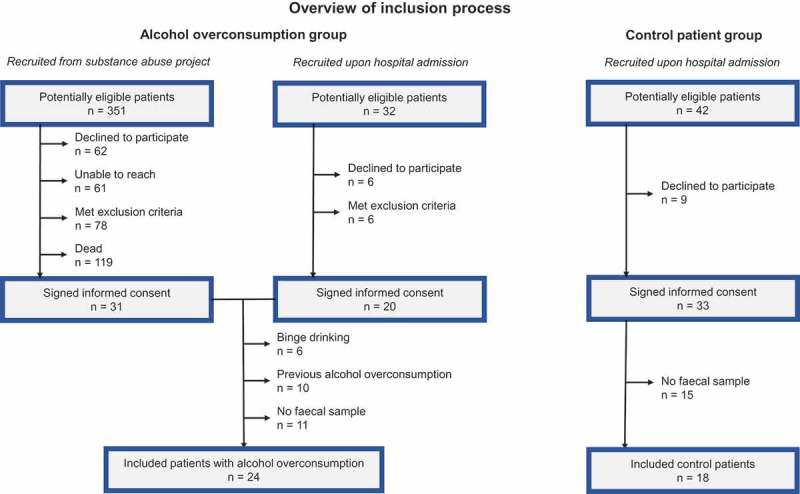
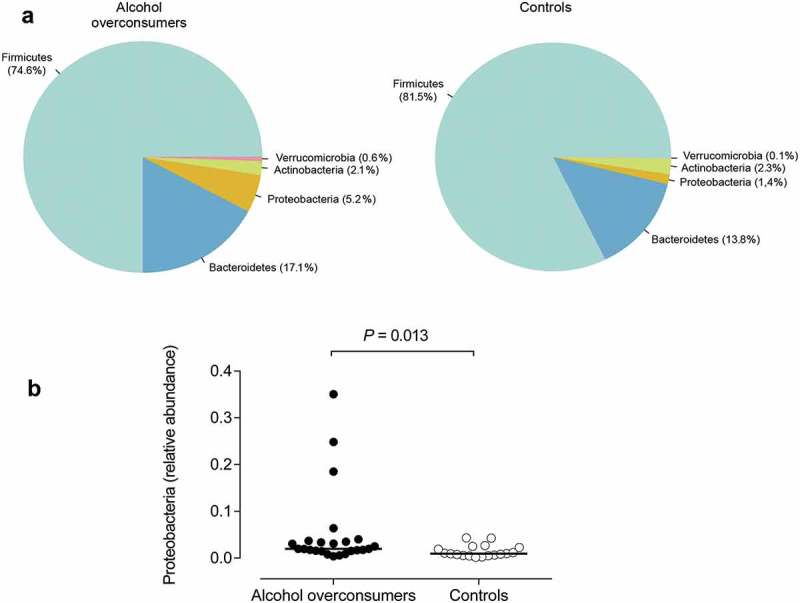
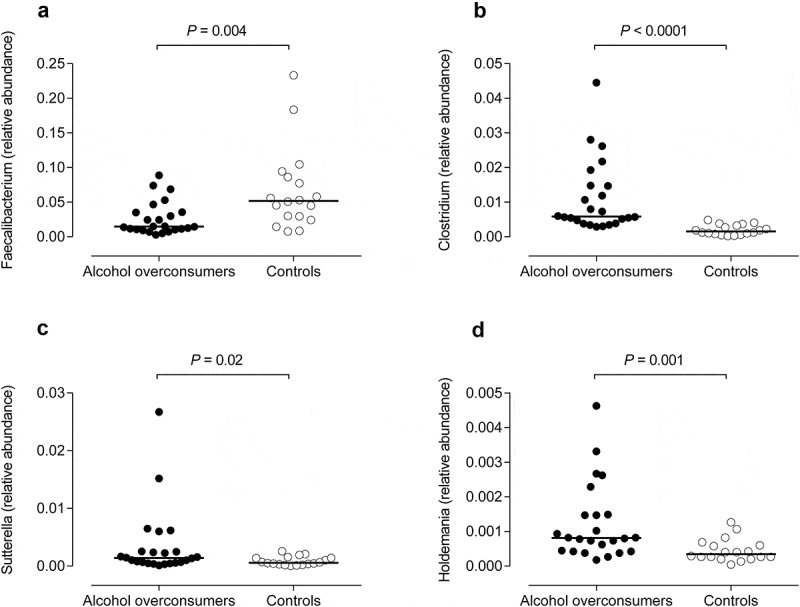
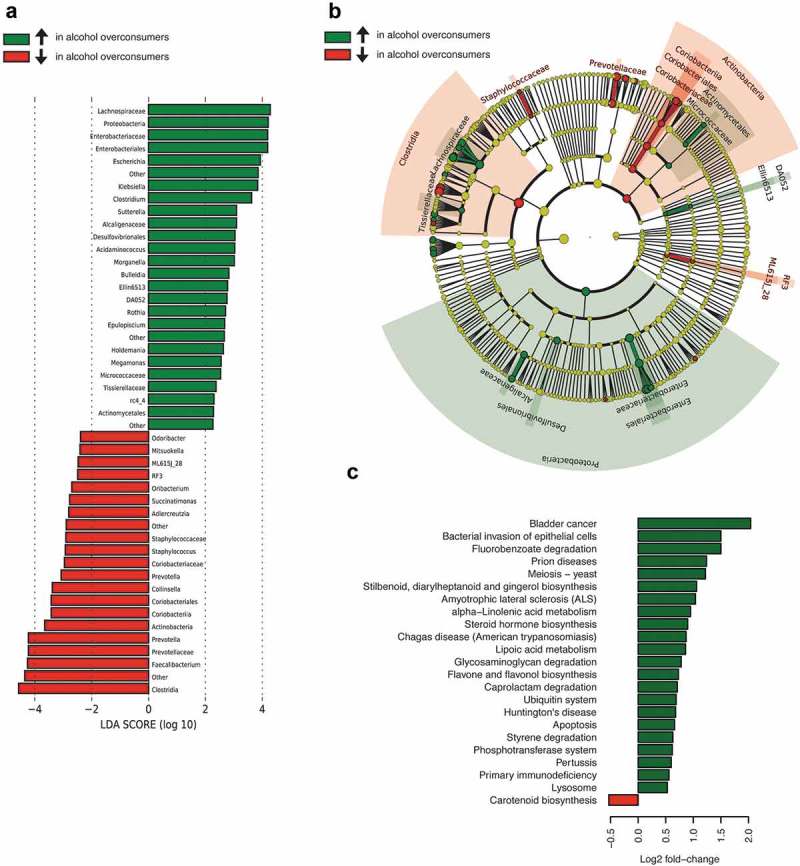
Excessive alcohol intake can alter the gut microbiota, which may underlie the pathophysiology of alcohol-related diseases. We examined gut microbiota composition and functions in patients with alcohol overconsumption for >10 years, compared to a control group of patients with a history of no or low alcohol intake. Faecal microbiota composition was assessed by 16S rRNA sequencing. Gut microbiota functions were evaluated by quantification of short-chain fatty acids (SCFAs) and predictive metagenome profiling (PICRUSt). Twenty-four patients, mean age 64.8 years (19 males), with alcohol overconsumption, and 18 control patients, mean age 58.2 years (14 males) were included. The two groups were comparable regarding basic clinical variables. Nutritional assessment revealed lower total score on the screening tool Mini Nutritional Assessment, lower muscle mass as assessed by handgrip strength, and lower plasma vitamin C levels in the alcohol overconsumption group. Bacteria from phylum Proteobacteria were found in higher relative abundance, while bacteria from genus Faecalibacterium were found in lower relative abundance in the group of alcohol overconsumers. The group also had higher levels of the genera Sutterella, Holdemania and Clostridium, and lower concentration and percentage of butyric acid. When applying PICRUSt to predict the metagenomic composition, we found that genes related to invasion of epithelial cells were more common in the group of alcohol overconsumers. We conclude that gut microbiota composition and functions in patients with alcohol overconsumption differ from patients with low consumption of alcohol, and seem to be skewed into a putative pro-inflammatory direction.
Overview
The claims and statistics of this paper haven’t been checked yet.
Free: it reads the open-access text and checks the first 5 claims that cite a source we can check. Create a free account to check every claim.
Integrity signals
Registry
Cites
Statistics
Figures
Verification
Claims the paper makes
The claims and statistics of this paper haven’t been checked yet.
Free: it reads the open-access text and checks the first 5 claims that cite a source we can check. Create a free account to check every claim.
Claims other papers make about this one
Each is checked against this paper’s own text: does it say what the citing paper says it does?
In the citing paper
“Limited evidence from human studies shows an association between microbiota composition, involving key taxa such as Faecalibacterium and Bifidobacterium, and grip strength.”
From Gut Microbiota, Muscle Mass and Function in Aging: A Focus on Physical Frailty and Sarcopenia (2019) · cites this paper as [80]
In the citing paper
“They found that alcohol overconsumers had lower hand-grip strength, higher relative abundance of Proteobacteria, Sutterella, Clostridium and Holdemania and lower relative abundance of Faecalibacterium.”
From Gut Microbiota, Muscle Mass and Function in Aging: A Focus on Physical Frailty and Sarcopenia (2019) · cites this paper as [80]
Self-check
Percentages, sums and reported differences re-computed from the paper’s own numbers.
The self-check needs the paper’s full text.
Citations
Cites
QIIME allows analysis of high-throughput community sequencing data
Caporaso, J. G., Kuczynski, J., Stombaugh, J., Bittinger, K., Bushman, F. D., Costello, E. K., Fierer, N., Peña, A. G., Goodrich, J. K., Gordon, J. I., et al. (2010) · Nature Methods · doi:10.1038/nmeth.f.303 · Cited by 34,887 · cited 1×
“0).(34) The merged reads were compared with the gold reference database using the UCHIME algorithm(35) to detect and remove chimeric reads, resulting in a set of effective reads.”
MethodUPARSE: highly accurate OTU sequences from microbial amplicon reads
Edgar, R. C. (2013) · Nature Methods · doi:10.1038/nmeth.2604 · Cited by 16,707
Metagenomic biomarker discovery and explanation
Segata, N., Izard, J., Waldron, L., Gevers, D., Miropolsky, L., Garrett, W. S., & Huttenhower, C. (2011) · Genome Biology · doi:10.1186/gb-2011-12-6-r60 · Cited by 16,192 · cited 1×
“However, we did perform a complementary and validating additional test using linear discriminant analysis effect size (LEfSe).(12) Beta diversity was analyzed using one-way ANOVA, followed by Tukey’s HSD test for weighted (takes into account amount of the different species) and unweighted (focuses only on the presence…”
MethodFLASH: fast length adjustment of short reads to improve genome assemblies
Magoč, T., & Salzberg, S. L. (2011) · Bioinformatics · doi:10.1093/bioinformatics/btr507 · Cited by 15,366
UCHIME improves sensitivity and speed of chimera detection
Edgar, R. C., Haas, B. J., Clemente, J. C., Quince, C., & Knight, R. (2011) · Bioinformatics · doi:10.1093/bioinformatics/btr381 · Cited by 15,114
Greengenes, a Chimera-Checked 16S rRNA Gene Database and Workbench Compatible with ARB
DeSantis, T. Z., Hugenholtz, P., Larsen, N., Rojas, M., Brodie, E. L., Keller, K., Huber, T., Dalevi, D., Hu, P., & Andersen, G. L. (2006) · Applied and Environmental Microbiology · doi:10.1128/aem.03006-05 · Cited by 10,891
Predictive functional profiling of microbial communities using 16S rRNA marker gene sequences
Langille, M. G. I., Zaneveld, J., Caporaso, J. G., McDonald, D., Knights, D., Reyes, J. A., Clemente, J. C., Burkepile, D. E., Vega Thurber, R. L., Knight, R., et al. (2013) · Nature Biotechnology · doi:10.1038/nbt.2676 · Cited by 9,116
KEGG as a reference resource for gene and protein annotation
Kanehisa, M., Sato, Y., Kawashima, M., Furumichi, M., & Tanabe, M. (2016) · Nucleic Acids Research · doi:10.1093/nar/gkv1070 · Cited by 7,387 · cited 1×
“The OTU count table was normalized against 16S copy number before calculating metagenomic scores for KEGG orthology (KO) terms.(40) These were further merged using the “categorize_by_function.”
MethodChanges of Intestinal Functions in Liver Cirrhosis
Fukui, H., & Wiest, R. (2016) · Inflammatory Intestinal Diseases · doi:10.1159/000444436 · Cited by 6,808
den Besten, G., van Eunen, K., Groen, A. K., Venema, K., Reijngoud, D.-J., & Bakker, B. M. (2013) · Journal of Lipid Research · doi:10.1194/jlr.r036012 · Cited by 5,048 · cited 2×
“Although the excretion of SCFAs is complex, the production seems to be regulated and is dependent on bacteria.(8) Thus, assessment of SCFAs is a recognized measure of gut microbiota function.”
Background
Research works printed but not linked: 1
- WHO Global status report on alcohol and health. World Health Organ. 2014; 1: 1– 392.
Cited by
Items 201–219 of 219
The Microbiome-Gut-Brain Axis and Alcohol Use Disorder in Adolescents Transitioning into Adulthood
Hernandez, P. S. (2024) · University of North Texas Digital Library (University of North Texas) · doi:10.12794/metadc2332618
Ding, Q., Cao, F., Lai, S., Yu, J., Zeng, Y., Valencak, T. G., Zhang, S., Zhang, X., Dou, X., Li, S., et al. (2025) · Food Frontiers · doi:10.1002/fft2.70158
Additional file 1 of Short-chain fatty acid valerate reduces voluntary alcohol intake in male mice
Bokoliya, S. C., Russell, J. T., Dorsett, Y., Panier, H. A., Singh, V., Daddi, L., Yuan, H., Dedon, L. R., Liu, Z., Zhou, Y., et al. (2024) · Figshare · doi:10.6084/m9.figshare.26054571
Dai, H., Hou, T., Wang, Q., Hou, Y., Zhu, Z., Zhu, Y., Zhao, Z., Li, M., Lin, H., Wang, S., et al. (2024) · Figshare · doi:10.6084/m9.figshare.26637534
Dai, H., Hou, T., Wang, Q., Hou, Y., Zhu, Z., Zhu, Y., Zhao, Z., Li, M., Lin, H., Wang, S., et al. (2024) · Figshare · doi:10.6084/m9.figshare.26637537
Park, J., Kato, K., Murakami, H., Hosomi, K., Tanisawa, K., Nakagata, T., Ohno, H., Konishi, K., Kawashima, H., Chen, Y.-A., et al. (2021) · Figshare · doi:10.6084/m9.figshare.14633673
Park, J., Kato, K., Murakami, H., Hosomi, K., Tanisawa, K., Nakagata, T., Ohno, H., Konishi, K., Kawashima, H., Chen, Y.-A., et al. (2021) · Figshare · doi:10.6084/m9.figshare.14633670
Mei, L., Zhou, J., Su, Y., Mao, K., Wu, J., Zhu, C., He, L., & Cui, Y. (2021) · Figshare · doi:10.6084/m9.figshare.14432069
Systemic Consequences of Chronic Ethanol Intake: From Microbiome Shifts to Metabolic Impairment
Ganjayi, M. S., Krauss, T. A., Demster, G. E., Park, S., Anspach, G., Anthony, S., Wang, S., Tranter, M., Helsley, R. N., & Baumann, C. W. (2026) · Comprehensive physiology · doi:10.1002/cph4.70132
“Chronic alcohol consumption is a well-established disruptor of gut homeostasis, it promotes potentially pathogenic bacteria, increases endotoxin-mediated intestinal permeability, and de-pletes SCFA–producing taxa (Bjørkhaug et al. 2019; de Timary et al. 2015; Patel et al. 2015).”
Li, X., Zhao, K., Chen, J., Ni, Z., Li, L., Chen, Y., Shi, W., Zhang, Y., Gao, X., Wang, C., et al. (2026) · Molecular Psychiatry · doi:10.1038/s41380-026-03597-1
“Extensive research has established the gut microbiota as a critical mediator in the etiopathogenesis and progression of AUD [10 – 12].”
Mei, J., Xia, M., Peng, L., & Li, X. (2026) · The American Journal of Drug and Alcohol Abuse · doi:10.1080/00952990.2026.2645215 · Cited by 2
“Importantly, periods of alcohol abstinence have been shown to partially restore gut barrier function and reduce systemic inflammation, accompanied by improvements in cognitive and affective measures (70).”
Erdoğan, B. R., Aksoyalp, Z. Ş., Hasip, Ç., Bağcı, B., & Aksun, S. (2026) · Journal of Basic and Clinical Health Sciences · doi:10.30621/jbachs.1862944
Biomarkers From the Microbiome to Predict ALD Progression and Its Severity: A Comprehensive Review
Mishra, S., Solanki, H., & Mandal, P. (2026) · Mediators of Inflammation · doi:10.1155/mi/7244952
Alcohol Consumption and Gut Microbiota-Derived Metabolites in Primates: A Systematic Review
Fierro-Salgado, Y. T., Reiriz, M., Calleja‐Conde, J., Cintado-Alzate, C., Bühler, K., Morales-Garcia, J. A., López‐Moreno, J. A., Giné, E., & Echeverry‐Alzate, V. (2026) · International Journal of Molecular Sciences · doi:10.3390/ijms27157012
Therapeutic modulation of the gut-brain axis in alcohol use disorder: A systematic review
Bhandari, P., Sideeg, A., Elfeki, M. A., Xie, C., & Singal, A. K. (2026) · Metabolism Open · doi:10.1016/j.metop.2026.100495
“In another study, a 29% reduction in drinking, limited to moderate-severity drinkers, aligns with evidence that metabolic dysfunction and higher BMI enhance GLP-1RA responsiveness [3,13].”
InfluentialZhang, Y., Liu, H., Fu, Y., Cai, N., An, Y., Liu, H., Jia, X., & Zhang, D. (2026) · Frontiers in Nutrition · doi:10.3389/fnut.2026.1887275
“Other studies have also reported decreases in mucin-degrading Akkermansia muciniphila and anti-inflammatory Faecalibacterium prausnitzii , indicating that alcohol disrupts microbial species critical for maintaining gut barrier function and immune balance (6, 36).”
InfluentialBasa, L., Shashikanth, N., Shukla, P. K., Shekhar, C., Meena, A. S., Jones, N., Raju, P., Nguyen, C., Swarna, S., Willis, N., et al. (2026) · The FASEB Journal · doi:10.1096/fj.202601355r
“Human studies have reported increases in Enterobacteriaceae and Ruminococcaceae , and a decrease in Akkermansia , in AUD patients without organ disease [28, 29].”
Ethanol metabolism and acetaldehyde clearance: A multi-organ symphony
Chen, C. (2026) · Biochemical Pharmacology · doi:10.1016/j.bcp.2026.118567
Total glucosides of paeony in cirrhosis: mechanisms of action via the gut–liver axis – a review
陈树兰, & Qiang, Z. (2026) · Frontiers in Gastroenterology · doi:10.3389/fgstr.2026.1981682
Metadata
- Authors
- Bjørkhaug, S. T., Aanes, H., Neupane, S. P., Bramness, J. G., Malvik, S., Henriksen, C., Skar, V., Medhus, A. W., & Valeur, J.
- Affiliations
- University of Oslo (NO)
- PatoGen (Norway) (NO)
- Innlandet Hospital Trust (NO)
- Lovisenberg Diakonale Sykehus (NO)
- Oslo University Hospital (NO)
- Corresponding author
- Valeur, Jørgen
- ORCID
- Venue
- Gut Microbes
- Publisher
- Informa UK Limited
- Published
- 2019-03-20
- Volume
- 10
- Issue
- 6
- Pages
- 663-675
- ISSN
- 1949-0976 (ISSN-L)
- 1949-0984
- PMC
- PMC6866679
- OpenAlex
- W2923426205
- Cited by
- 205
- References
- 42
- Citations by year
- 2026: 12 · 2025: 37 · 2024: 38 · 2023: 22 · 2022: 32 · 2021: 37 · 2020: 20 · 2019: 7
- FWCI
- 9.01
- Type
- journal article
- Language
- en
- Open access
- gold
- doi.org
- Licence
- Locations
- Gut Microbes (publishedVersion, cc-by-nc-nd)
- PubMed Central (publishedVersion, cc-by-nc-nd)
- PubMed (publishedVersion)
- NORA - Norwegian Open Research Archives (submittedVersion, other-oa)
- NORA - Norwegian Open Research Archives (submittedVersion, cc-by-nc-nd)
- Funders
- Lovisenberg Diakonale Sykehus (1)
- Norsk Gastroenterologisk Forening (2)
- Topics
- Life Sciences › Biochemistry, Genetics and Molecular Biology › Molecular Biology › Gut microbiota and health
- Health Sciences › Medicine › Pathology and Forensic Medicine › Alcohol Consumption and Health Effects
- Health Sciences › Dentistry › Periodontics › Oral microbiology and periodontitis research
- Keywords
- gut microbiota, alcohol-related disorders, short-chain fatty acids, butyrate, Faecalibacterium, Proteobacteria, Sutterella, Clostridium, PICRUSt, inflammation, nutritional status, vitamin C, grip strength, Mini Nutritional Assessment
- MeSH terms
- Gastrointestinal Microbiome, Adult, Aged, Aged, 80 and over, Alcoholism, Ascorbic Acid, Bacteria, Bacterial Proteins, Fatty Acids, Volatile, Feces, Female, Humans, Male, Middle Aged, RNA, Ribosomal, 16S, Vitamins, Nutrition Assessment, Hand Strength, Metagenomics
About these checks
Registry, retraction, Cites and statistics results are computed, not judged, with one exception: a printed reference that no index lists is read once by a model before it counts as a citation error. Claims are extracted by a model and kept only when their quote appears verbatim in the text; each cited source is then checked, with a model’s help, for whether it says what the claim relies on. Those verdicts can be wrong — read the claim’s quote and the cited source before relying on one.
Statistics and arithmetic are recomputed, not judged.
Confidence bands are shown only for fields calibrated on our annotated test set. None is calibrated yet, so no band is shown.
What counts as a claim ›How we measure confidence ›How we check this ›
Are you an author, or do you see a problem with this page? Request a review
Data sources
Bibliographic data: Semantic Scholar, OpenAlex, Crossref.
Contains information from the Semantic Scholar Academic Graph Datasets, made available under the ODC Attribution License (ODC-BY 1.0).
Semantic Scholar’s data is described in: Kinney, R., et al. (2023). The Semantic Scholar Open Data Platform. arXiv:2301.10140.
