

The DOI matches its Crossref record; 53 of the 53 references it cites were found in a registry or an index.
Efficacy of fecal microbiota transplantation in patients with Parkinson’s disease: clinical trial results from a randomized, placebo-controlled design
Open accessAbstract
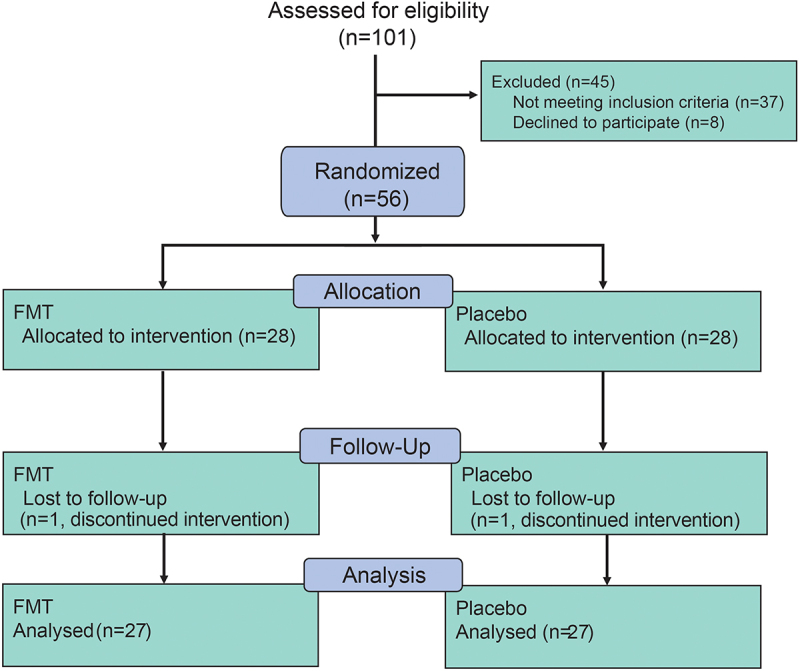
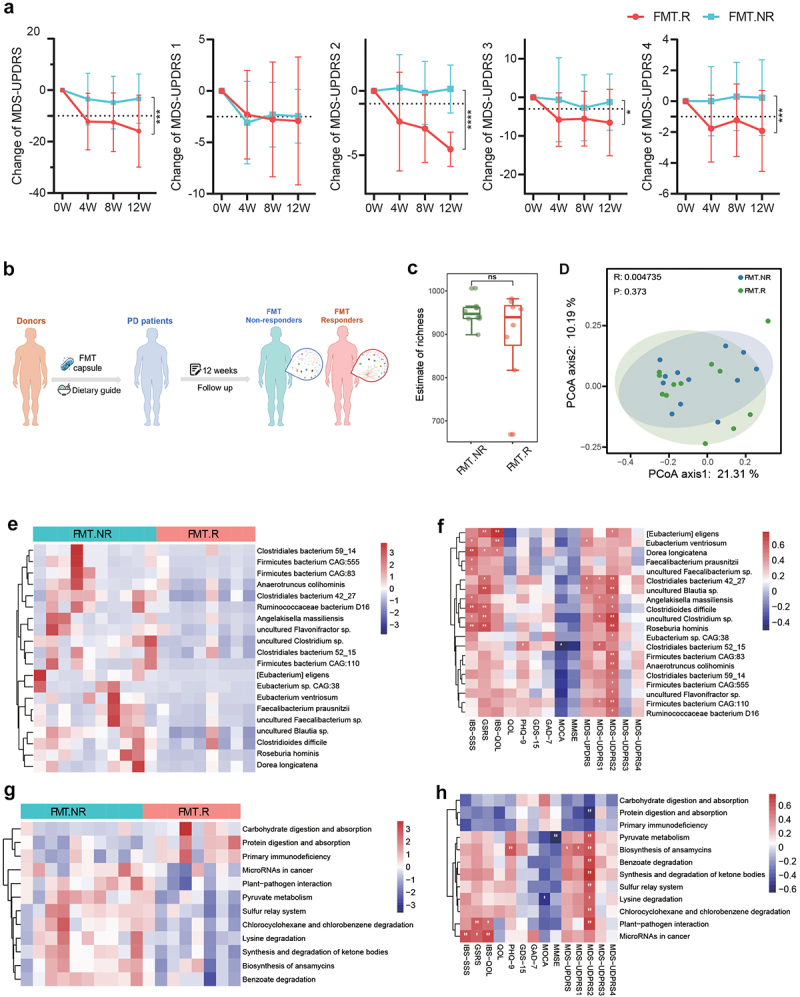
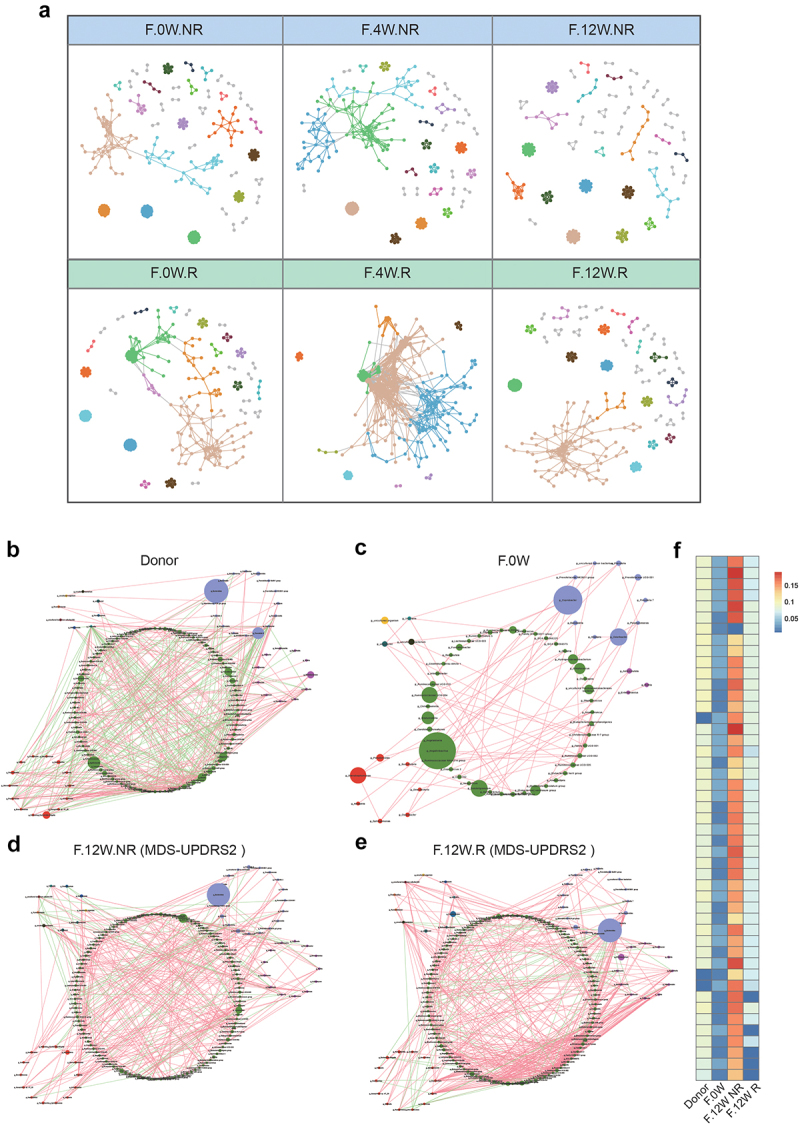
The occurrence and development of Parkinson’s disease (PD) have been demonstrated to be related to gut dysbiosis, however, the impact of fecal microbiota transplantation (FMT) on microbiota engraftment in PD patients is uncertain. We performed a randomized, placebo-controlled trial at the Department of Neurology, Army Medical University Southwest Hospital in China (ChiCTR1900021405) from February 2019 to December 2019. Fifty-six participants with mild to moderate PD (Hoehn-Yahr stage 1–3) were randomly assigned to the FMT and placebo group, 27 patients in the FMT group and 27 in the placebo group completed the whole trial. During the follow-up, no severe adverse effect was observed, and patients with FMT treatment showed significant improvement in PD-related autonomic symptoms compared with the placebo group at the end of this trial (MDS-UPDRS total score, group×time effect, B = -6.56 [−12.98, −0.13], P < 0.05). Additionally, FMT improved gastrointestinal disorders and a marked increase in the complexity of the microecological system in patients. This study demonstrated that FMT through oral administration is clinically feasible and has the potential to improve the effectiveness of current medications in the clinical symptoms of PD patients.
Overview
The claims and statistics of this paper haven’t been checked yet.
Run the check — free, no account needed. It reads the open-access text and checks the sources it cites.
Integrity signals
Registry
Cites
Statistics
Figures
Verification
Claims the paper makes
The claims and statistics of this paper haven’t been checked yet.
Run the check — free, no account needed. It reads the open-access text and checks the sources it cites.
Claims other papers make about this one
Each is checked against this paper’s own text: does it say what the citing paper says it does?
The cited source doesn’t support the claim as written.
In the citing paper
“One study reported no changes in motor function at 6 months post-FMT, although here the treatment group required smaller dose increases than placebo.”
From The gut–brain axis in early Parkinson’s disease: from prodrome to prevention (2025) · cites this paper as [207]
Checked by a reasoning model — may be wrong.
Experimental — accuracy not yet measuredThe source backs part of the claim, not all of it — or backs it for a different population, condition or comparison.
In the citing paper
“In this study, only 3% of the treatment group were reported to show a change from dysbiotic to non-dysbiotic status, compared to 33% in the placebo arm, suggesting that the FMT treatment failed to produce a significant change in the gut microbiome.”
From The gut–brain axis in early Parkinson’s disease: from prodrome to prevention (2025) · cites this paper as [207]
Experimental — accuracy not yet measuredThe cited source says what the claim attributes to it.
In the citing paper
“In these studies, the clinical findings were associated with a shift toward anti-inflammatory microbial species.”
From The gut–brain axis in early Parkinson’s disease: from prodrome to prevention (2025) · cites this paper as [207]
The cited source says what the claim attributes to it.
In the citing paper
“There are currently four RCTs with available evidence for the role of FMT in treating PD [206–209].”
From The gut–brain axis in early Parkinson’s disease: from prodrome to prevention (2025) · cites this paper as [207]
The cited source says what the claim attributes to it.
In the citing paper
“Three of these reported changes in global or motor function, and of these two reported significant improvement UPDRS PD symptom scores at 12 weeks and 12 months, respectively.”
From The gut–brain axis in early Parkinson’s disease: from prodrome to prevention (2025) · cites this paper as [207]
The check wasn’t confident either way, so it gives no verdict — never disputed.
In the citing paper
“In this study, only 3% of the treatment group were reported to show a change from dysbiotic to non-dysbiotic status, compared to 33% in the placebo arm, suggesting that the FMT treatment failed to produce a significant change in the gut microbiome.”
From The gut–brain axis in early Parkinson’s disease: from prodrome to prevention (2025) · cites this paper as [207]
Experimental — accuracy not yet measured
Self-check
Percentages, sums and reported differences re-computed from the paper’s own numbers.
The self-check needs the paper’s full text.
Citations
Cites
1 retracted
Retracted: Gut Microbiome Signatures of Risk and Prodromal Markers of Parkinson Disease
Heinzel, S., Aho, V. T. E., Suenkel, U., von Thaler, A., Schulte, C., Deuschle, C., Paulin, L., Hantunen, S., Brockmann, K., Eschweiler, G. W., et al. (2020) · Annals of Neurology · doi:10.1002/ana.25788 · Cited by 95
RetractedFast gapped-read alignment with Bowtie 2
Langmead, B., & Salzberg, S. L. (2012) · Nature Methods · doi:10.1038/nmeth.1923 · Cited by 56,400
QIIME allows analysis of high-throughput community sequencing data
Caporaso, J. G., Kuczynski, J., Stombaugh, J., Bittinger, K., Bushman, F. D., Costello, E. K., Fierer, N., Peña, A. G., Goodrich, J. K., Gordon, J. I., et al. (2010) · Nature Methods · doi:10.1038/nmeth.f.303 · Cited by 34,887
Reproducible, interactive, scalable and extensible microbiome data science using QIIME 2
Bolyen, E., Rideout, J. R., Dillon, M. R., Bokulich, N. A., Abnet, C. C., Al-Ghalith, G. A., Alexander, H., Alm, E. J., Arumugam, M., Asnicar, F., et al. (2019) · Nature Biotechnology · doi:10.1038/s41587-019-0209-9 · Cited by 23,742
Self-citationFastTree 2 – Approximately Maximum-Likelihood Trees for Large Alignments
Price, M. N., Dehal, P. S., & Arkin, A. P. (2010) · PLoS ONE · doi:10.1371/journal.pone.0009490 · Cited by 14,894
PICRUSt2 for prediction of metagenome functions
Douglas, G. M., Maffei, V. J., Zaneveld, J. R., Yurgel, S. N., Brown, J. R., Taylor, C. M., Huttenhower, C., & Langille, M. G. I. (2020) · Nature Biotechnology · doi:10.1038/s41587-020-0548-6 · Cited by 6,709
Kalia, L. V., & Lang, A. E. (2015) · The Lancet · doi:10.1016/s0140-6736(14)61393-3 · Cited by 6,184
Bloem, B. R., Okun, M. S., & Klein, C. (2021) · The Lancet · doi:10.1016/s0140-6736(21)00218-x · Cited by 3,920
Gut microbiota regulate motor deficits and neuroinflammation in a model of Parkinson's disease
Sampson, T. R., Debelius, J. W., Thron, T., Janssen, S., Shastri, G. G., Ilhan, Z. E., Challis, C., Schretter, C. E., Rocha, S., Gradinaru, V., et al. (2016) · Cell · doi:10.1016/j.cell.2016.11.018 · Cited by 3,622
Diagnosis and Treatment of Parkinson Disease: A Review
Armstrong, M. J., & Okun, M. S. (2020) · JAMA · doi:10.1001/jama.2019.22360 · Cited by 2,924
Cited by
Sorted by citations
Items 101–147 of 147
Parkinson’s Disease and the faecal microbiota transplantation. Review of current knowledge
Dudek, M., Silldorff, J., Zajac, M., Fura, T., Felińska, Z., Anczyk, S., Iszczuk, O., Gajkiewicz, M., & Zaucha, R. (2024) · Quality in Sport · doi:10.12775/qs.2024.21.54082 · Cited by 2
Research progress of intestinal microbiota on cognitive dysfunction after spinal cord injury
Tian, C., Chang, X., Wu, J., Xiao, L., Du, J., Hu, Q., & Yang, Y. (2025) · iScience · doi:10.1016/j.isci.2025.113554 · Cited by 1
Montaigne, L. S., Lassozé, S., de Lataillade, A. D. G., Oullier, T., Vibet, M., Bach‐Ngohou, K., Rolli‐Derkinderen, M., Durand, T., Dily, S. L., Alebic, I. J., et al. (2026) · npj Parkinson s Disease · doi:10.1038/s41531-026-01340-9 · Cited by 1
Chen, N., Pang, D., & Shang, H. (2025) · Microbiological Research · doi:10.1016/j.micres.2025.128436 · Cited by 3
Fecal Microbiota Transplantation in Healthy Aging: Challenges and Prospects in Personalized Medicine
Borrego-Ruiz, A., & Borrego, J. J. (2025) · Journal of Molecular and Clinical Medicine · doi:10.31083/jmcm40022 · Cited by 2
Bicknell, B. T., Liebert, A. D., McLachlan, C. S., & Kiat, H. (2026) · Journal of Clinical Medicine · doi:10.3390/jcm15010368 · Cited by 1
Changes in Gut Microbiota and Brain Function in Rats Fed with a copper-overloaded Diet
Tao, Z., Wang, M., Zhu, T., Wang, G., Zhou, J., Kang, S., Zhao, J., Liu, J., & Yang, W. (2026) · Biological Trace Element Research · doi:10.1007/s12011-026-04998-7 · Cited by 1
Fecal Microbiota Transplantation in Parkinson Disease
Pereira, M. A. O. M., Tudella, G. C. N., Klostermann, A. U., Ohannesian, V. A., Gonçalves, O. R., da Silva, R. O., Fernandes, J. V. A., Ahmed, A., Alencar, A. B., de Morais, S. T. A., et al. (2026) · Neurology · doi:10.1212/wnl.0000000000218175 · Cited by 1
Siam, A. M., Moubarak, E. S., Mahmoud, N.-E., Khelifa, H., Aljalawy, F., Hassan, A. A., Ahmed, N. A. T., Wagdy, M., Heikal, Y., & Abbas, O. (2026) · Neurological Sciences · doi:10.1007/s10072-026-09274-z · Cited by 1
Recent Advancements in Parkinson\'s Disease
Mehta, S. (2024) · Journal of Postgraduate Medicine Education and Research · doi:10.5005/jp-journals-10028-1652
Transplante de microbiota fecal no tratamento do Parkinson e outras doenças neurodegenerativas
Garcia, G., Luiz, M. E. F., Pagotto, G. L. D. O., Grecca, I. S. G., & Gianini, S. H. S. (2024) · Cuadernos de Educación y Desarrollo · doi:10.55905/cuadv16n12-218
Triadafilopoulos, G. (2024) · Springer eBooks · doi:10.1007/978-3-031-77171-2_5
Unlocking the Code of Innovation: TRIZ Theory’s Blueprint for Precision Medicine Breakthroughs
Schmidt, R. (2025) · Springer eBooks · doi:10.1007/978-3-031-77302-0_1
Olalekan, S. O., Okwute, P. G., Osonuga, I. O., Mofolorunso, A. M., Adegbesan, B. O., Ezima, E. N., & Oluwatunase, G. O. (2025) · IntechOpen eBooks · doi:10.5772/intechopen.1009908
Alaeddin, S., Ko, Y., Steiner, G. Z., Jensen, S. O., Roberts, T. L., & Ho, V. (2025) · Methods and Protocols · doi:10.3390/mps8040083
Yang, X., Liu, Z., You, T., Feng, H., Sun, F., Yao, J., Gao, Y., Yang, Y., Chen, C., & Qiu, J. (2025) · Journal of Affective Disorders · doi:10.1016/j.jad.2025.120318
Gündoğdu, A., Arıkan, M., Ulas, A., Koldaş, S. S., & Ece, G. T. (2025) · Next research. · doi:10.1016/j.nexres.2025.100846 · Cited by 1
Futuristic therapeutics in pipeline for the betterment of neurodegenerative disorders
Upadhyay, H., Das, P., Sanskriti, Biswal, S., & Das, D. (2025) · Elsevier eBooks · doi:10.1016/b978-0-443-29932-2.00014-1
Attenuating Neurotoxicity Through Fecal Microbiota Transplant: Mechanisms and Therapeutic Potential
Younis, N. K., Alfarttoosi, K. H., Sanghvi, G. V., Roopashree, R., Kashyap, A., Krithiga, T., Taher, W. M., Alwan, M., Jawad, M. J., & Al-Nuaimi, A. M. A. (2025) · Molecular Neurobiology · doi:10.1007/s12035-025-05415-1
Oprea, A., Steinman, J., Huang, G. T.-W., Soyinka, O., Brookbank, M., Abesteh, J., Hartman, M., McEvoy, A., Dionne, J. C., Milev, R. V., et al. (2025) · The Canadian Journal of Psychiatry · doi:10.1177/07067437251394369
Efficacy and Safety of Fecal Microbiota Transplantation for Parkinson’s Disease: A Systematic Review
Faria, I. C., Martins, K. A. M., Corcinio, M. M., de Oliveira, P. S., Nogueira, G. F., Bittarães, A. J. D. S. O., & Braga, M. O. (2025) · Brazilian Journal of Transplantation · doi:10.53855/bjt.v28i1.735_eng
Faria, I. C., Martins, K. A. M., Corcinio, M. M., de Oliveira, P. S., Nogueira, G. F., Bittarães, A. J. D. S. O., & Braga, M. O. (2025) · Brazilian Journal of Transplantation · doi:10.53855/bjt.v28i1.735_port
The application of fecal microbiota transplantation in Parkinson’s disease
Wang, B., Ma, D., Li, N., & Luo, T. (2025) · Frontiers in Aging Neuroscience · doi:10.3389/fnagi.2025.1713899
Chen, C., Rakotonirina, A., Borbolla, E. M., Audry, M., Kroemer, M., Ballif, A., Carrez, L., Sadeghipour, F., Bertelli, C., Guery, B. P., et al. (2025) · Journal of Drug Delivery Science and Technology · doi:10.1016/j.jddst.2025.107700 · Cited by 1
Recent Advances in Gut Microecological Research on Parkinson’s Disease-Related Constipation
夏, 杨. (2026) · Advances in Clinical Medicine · doi:10.12677/acm.2026.161113
Wang, S., Zhu, Y., Wang, J., Jin, W., Li, N., Li, Z., Chang, Y., Jiang, C. Q., & Wang, T. (2026) · Scientific Reports · doi:10.1038/s41598-026-43865-2
Kumari, N., Pal, G., Chawak, K., Arbi, S. H., & Anand, S. K. (2026) · Antonie van Leeuwenhoek · doi:10.1007/s10482-026-02281-2
Jian, X., Yu, P., Zhang, Y., Pan, H., Wu, K., Zhang, H., Zhang, H., Huang, Y., Zhao, Y., Wang, Y., et al. (2026) · EBioMedicine · doi:10.1016/j.ebiom.2026.106224
Self-citationMojica, E. P., Aranis, N., Ribeiro, J. V., Soto-Rodríguez, A., & Fregni, F. (2026) · Gut Microbiology · doi:10.1016/j.gutmic.2026.100007
Therapeutic Interventions: Modulating the Microbiome to Combat Neurodegeneration
Anandan, A., Unais, A. M., Prabhu, A. V., Saju, M. K., Sonaimuthu, K., Murugesan, H., Danielraj, F., Marimuthu, D., Shibu, M. A., & Viswanadha, V. P. (2026) · Springer eBooks · doi:10.1007/978-981-95-7494-0_8
Parkinson’s Disease and the Microbiome: A New Frontier for Early Diagnosis
Chakkittukandiyil, A., & Sajini, D. V. (2026) · Springer eBooks · doi:10.1007/978-981-95-7494-0_4
Yang, Y., Liu, X., Wang, M., Zhu, X., Yang, B., Cao, J., Song, Y., & Jiang, G. (2026) · Environment & Health · doi:10.1021/envhealth.5c00852
Self-citationAndrusiów, S., Brzoza, A., Łacina, P., Dratwa-Kuźmin, M., Raczkowska, J., Kujawa, D., Romańczuk, K., Gancarek, M., Bochen, P., Dziadkowiak, E., et al. (2026) · Frontiers in Molecular Neuroscience · doi:10.3389/fnmol.2026.1802462
Voigt, R. M., Keshavarzian, A., & Hall, D. A. (2026) · Annals of Neurology · doi:10.1002/ana.78259
Pirovano, E., Silva, I. P., Camacho, M., Canak, A., Aktaş, B., Crompton, D., Gökçe, E., Tan, F.-M., Marino, F., Domingos, J., et al. (2026) · Neurochemistry International · doi:10.1016/j.neuint.2026.106211
Liang, B., Zou, J., Mao, X., Xie, N., & Zhaohui, L. (2026) · Revista de Neurología · doi:10.31083/rn50106
Gut microbiota and brain health: Disease-specific pathways and emerging therapeutic strategies
Oriquat, G., Rizaev, J., Abdulqader, A. F., Kadhim, A. A., Jamuna, K. V., Singhal, D. K., Bainsal, N., & Mansurova, N. (2026) · Multiple Sclerosis and Related Disorders · doi:10.1016/j.msard.2026.107407
Fecal microbiota transplantation in Parkinson’s disease: a systematic review
Eissazade, N., Mosavari, H., Eghdami, S., Rohani, M., Fereshtehnejad, S., & Khoeini, T. (2026) · Neurodegenerative Disease Management · doi:10.1080/17582024.2026.2715585
Li, S., Zhao, X., Chen, M., Cheng, Y., Wu, Q., Feng, Y., Yi, A., Chen, L., Tian, Y., & Wei, Y. (2026) · Microorganisms · doi:10.3390/microorganisms14081841
Self-citationGao, X., Yan, A., Wang, Y., Liu, J., Liu, D., Hu, G., Zhang, H., Fu, S., & He, D. (2026) · Phytomedicine · doi:10.1016/j.phymed.2026.158746
Self-citationZhao, Y., Mo, Q., Liu, Y., Chen, X., Zhao, Q., Wang, H., Yan, Z., Cao, L., & Zhao, G. (2026) · Brain and Behavior · doi:10.1002/brb3.71722
The gut microbiota as a new therapeutic target in the treatment of neuropsychiatric disorders
Shtemberg, L. V., & Selimova, R. (2026) · Vrach · doi:10.29296/25877305-2026-08-04
Hasanuzzaman, M., Bang, C. S., Lee, J. J., & Gong, E. J. (2026) · Journal of Korean Medical Science · doi:10.3346/jkms.2026.41.e335
Parkinson's disease pathogenesis: From molecular insights to novel therapies
Ramli, M. D. C., Abidin, Z. Z., Okunsai, B., Umbar, G. S. A., & Mauta, T. E. (2026) · Elsevier eBooks · doi:10.1016/b978-0-443-27702-3.00027-3
Lin, W., Shu, Z., Liu, G., Fang, J., & Ding, S. (2026) · Probiotics and Antimicrobial Proteins · doi:10.1007/s12602-026-11246-w
Yang, X., Li, Y., Hu, Q., Pan, X., Hong, J., & Li, L. (2026) · Frontiers in Microbiology · doi:10.3389/fmicb.2026.1907410
Metadata
- Authors
- Cheng, Y., Tan, G., Zhu, Q., Wang, C., Ruan, G., Ying, S., Qie, J., Hu, X., Xiao, Z., Xu, F., Chen, L., Chen, M., Pei, Y., Zhang, H., Tian, Y., Chen, D., Liu, X., Huang, H., & Wei, Y.
- Affiliations
- Army Medical University (CN)
- Suzhou Municipal Hospital (CN)
- Department of Pathogen Biology-Microbiology Division, Key Laboratory of Pathogen of Jiangsu Province; The Affiliated Suzhou Hospital of Nanjing Medical University, Suzhou Municipal Hospital Gusu School, Nanjing Medical University, Jiangsu, China
- Corresponding author
- Liu, Xingyin
- Huang, Heqing
- Wei, Yanling
- ORCID
- Venue
- Gut Microbes
- Publisher
- Informa UK Limited
- Published
- 2023-12-06
- Volume
- 15
- Issue
- 2
- Pages
- 2284247-2284247
- ISSN
- 1949-0976 (ISSN-L)
- 1949-0984
- PMC
- PMC10841011
- OpenAlex
- W4389451466
- Cited by
- 147
- References
- 53
- Citations by year
- 2026: 42 · 2025: 73 · 2024: 32
- FWCI
- 25.01
- Type
- journal article
- Language
- en
- Open access
- gold
- doi.org
- Licence
- Locations
- Gut Microbes (publishedVersion, cc-by)
- PubMed Central (publishedVersion, cc-by)
- PubMed (publishedVersion)
- DOAJ (DOAJ: Directory of Open Access Journals) (submittedVersion, cc-by-sa)
- Funders
- the National Natural Science Foundation of China (82172288)
- the Special Project for Enhancement of Science and Technology Innovation Capability of Army Medical University (2019XLC3040)
- Topics
- Health Sciences › Medicine › Clinical Neurology › Parkinson's Disease Mechanisms and Treatments
- Life Sciences › Biochemistry, Genetics and Molecular Biology › Molecular Biology › Gut microbiota and health
- Health Sciences › Medicine › Gastroenterology › Gastrointestinal motility and disorders
- Keywords
- fecal microbiota transplantation, Parkinson's disease, gut dysbiosis, autonomic symptoms, gastrointestinal diseases, MDS-UPDRS, oral administration, treatment feasibility
- MeSH terms
- Gastrointestinal Microbiome, Fecal Microbiota Transplantation, China, Feces, Humans, Parkinson Disease, Treatment Outcome, Dysbiosis
About these checks
Registry, retraction, Cites and statistics results are computed, not judged, with one exception: a printed reference that no index lists is read once by a model before it counts as a citation error. Claims are extracted by a model and kept only when their quote appears verbatim in the text; each cited source is then checked, with a model’s help, for whether it says what the claim relies on. Those verdicts can be wrong — read the claim’s quote and the cited source before relying on one.
Statistics and arithmetic are recomputed, not judged.
Confidence bands are shown only for fields calibrated on our annotated test set. None is calibrated yet, so no band is shown.
What counts as a claim ›How we measure confidence ›How we check this ›
Are you an author, or do you see a problem with this page? Request a review
