

Visualizing the dental biofilm matrix by means of fluorescence lectin-binding analysis
Open accessThe DOI matches its Crossref record; 46 of the 46 references it cites were found in a registry or an index.
Abstract
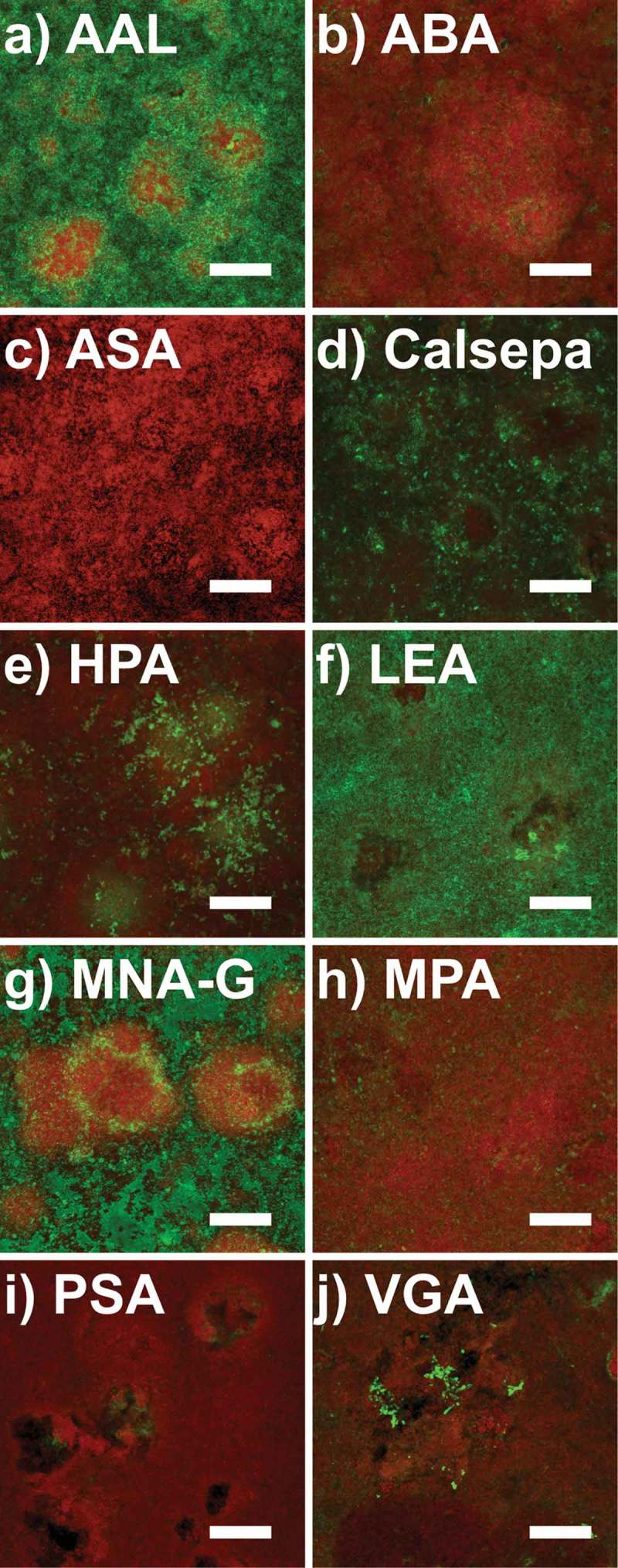
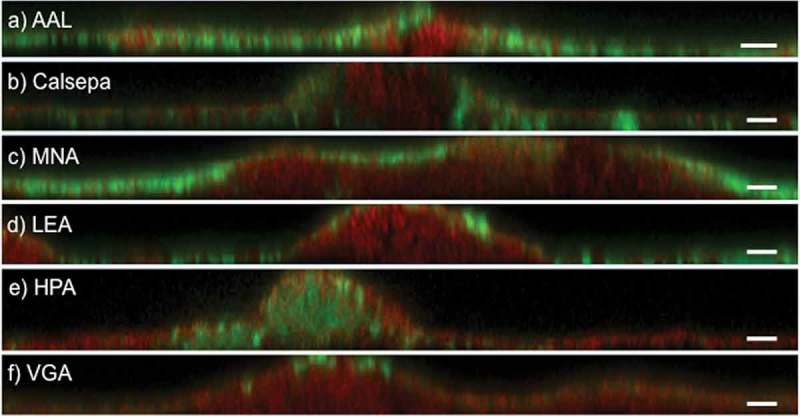
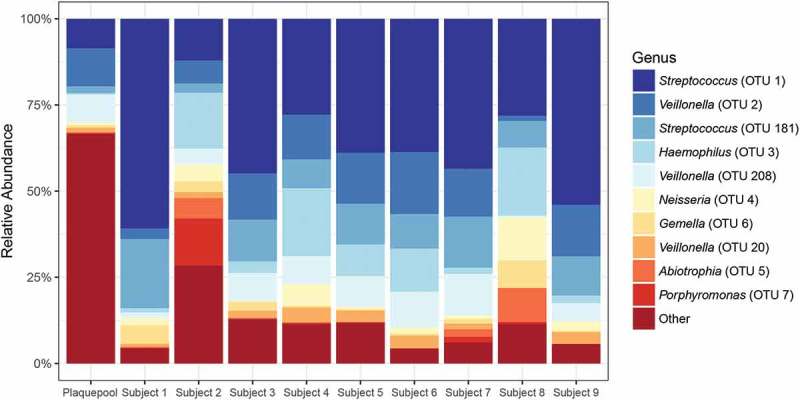
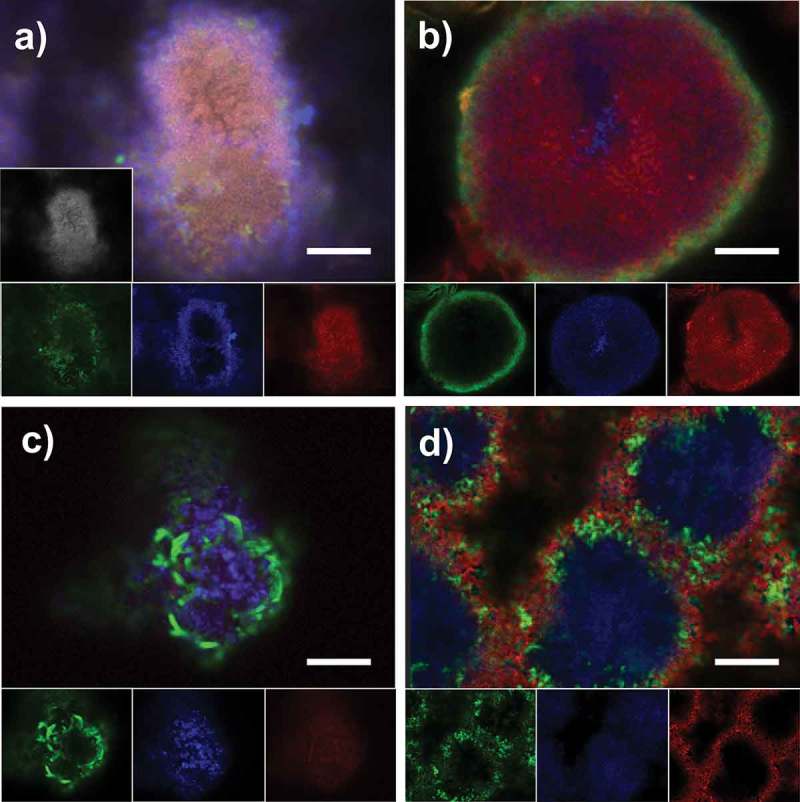
The extracellular matrix is a poorly studied, yet important component of dental biofilms. Fluorescence lectin-binding analysis (FLBA) is a powerful tool to characterize glycoconjugates in the biofilm matrix. This study aimed to systematically investigate the ability of 75 fluorescently labeled lectins to visualize and quantify extracellular glycoconjugates in dental biofilms. Lectin binding was screened on pooled supragingival biofilm samples collected from 76 subjects using confocal microscopy. FLBA was then performed with 10 selected lectins on biofilms grown in situ for 48 h in the absence of sucrose. For five lectins that proved particularly suitable, stained biovolumes were quantified and correlated to the bacterial composition of the biofilms. Additionally, combinations of up to three differently labeled lectins were tested. Of the 10 lectins, five bound particularly well in 48-h-biofilms: Aleuria aurantia (AAL), Calystega sepiem (Calsepa), Lycopersicon esculentum (LEA), Morniga-G (MNA-G) and Helix pomatia (HPA). No significant correlation between the binding of specific lectins and bacterial composition was found. Fluorescently labeled lectins enable the visualization of glycoconjugates in the dental biofilm matrix. The characterization and quantification of glycoconjugates in dental biofilms require a combination of several lectins. For 48-h-biofilms grown in absence of sucrose, AAL, Calsepa, HPA, LEA, and MNA-G are recommendable.
Overview
The claims and statistics of this paper haven’t been checked yet.
Free: it reads the open-access text and checks the first 5 claims that cite a source we can check. Create a free account to check every claim.
Integrity signals
Registry
Cites
Statistics
Figures
Verification
Claims the paper makes
The claims and statistics of this paper haven’t been checked yet.
Free: it reads the open-access text and checks the first 5 claims that cite a source we can check. Create a free account to check every claim.
Claims other papers make about this one
Each is checked against this paper’s own text: does it say what the citing paper says it does?
The source backs part of the claim, not all of it — or backs it for a different population, condition or comparison.
In the citing paper
“Using fluorescent lectin–binding analysis, a wide range of carbohydrate structures were detected in 48-hour supragingival dental biofilm grown in situ in the mouths of volunteers who abstained from ingesting sucrose.29”
From The dental plaque biofilm matrix (2021) · cites this paper as [29]
Experimental — accuracy not yet measured
Self-check
Percentages, sums and reported differences re-computed from the paper’s own numbers.
The self-check needs the paper’s full text.
Citations
Cites
R: A Language and Environment for Statistical Computing
R Core Team (2025) · doi:10.32614/r.manuals · Cited by 352,181
The SILVA ribosomal RNA gene database project: improved data processing and web-based tools
Quast, C., Pruesse, E., Yilmaz, P., Gerken, J., Schweer, T., Yarza, P., Peplies, J., & Glöckner, F. O. (2012) · Nucleic Acids Research · doi:10.1093/nar/gks1219 · Cited by 33,055 · cited 1×
“Silva SSU Ref NR release 123 database serving as a reference [35].”
MethodSchloss, P. D., Westcott, S. L., Ryabin, T., Hall, J. R., Hartmann, M., Hollister, E. B., Lesniewski, R. A., Oakley, B. B., Parks, D. H., Robinson, C. J., et al. (2009) · Applied and Environmental Microbiology · doi:10.1128/aem.01541-09 · Cited by 19,549
UPARSE: highly accurate OTU sequences from microbial amplicon reads
Edgar, R. C. (2013) · Nature Methods · doi:10.1038/nmeth.2604 · Cited by 16,707
Flemming, H.-C., & Wingender, J. (2010) · Nature Reviews Microbiology · doi:10.1038/nrmicro2415 · Cited by 10,137
PEAR: a fast and accurate Illumina Paired-End reAd mergeR
Zhang, J., Kobert, K., Flouri, T., & Stamatakis, A. (2014) · Bioinformatics · doi:10.1093/bioinformatics/btt593 · Cited by 4,497
Defining the normal bacterial flora of the oral cavity
Aas, J. A., Paster, B. J., Stokes, L. N., Olsen, I., & Dewhirst, F. E. (2005) · Journal of Clinical Microbiology · doi:10.1128/jcm.43.11.5721-5732.2005 · Cited by 3,092
Transitions in bacterial communities along the 2000 km salinity gradient of the Baltic Sea
Herlemann, D. P. R., Labrenz, M., Jürgens, K., Bertilsson, S., Waniek, J. J., & Andersson, A. F. (2011) · The ISME Journal · doi:10.1038/ismej.2011.41 · Cited by 2,885 · cited 1×
“few modifications: variable regions V3 and V4 of bacterial 16S ribosomal RNA gene were amplified using primers Bac 341F and Bac 805R [30].”
MethodOcclusal Caries: Biological Approach for Its Diagnosis and Management
Carvalho, J. C., Dige, I., Machiulskiene, V., Qvist, V., Bakhshandeh, A., Fatturi-Parolo, C., & Maltz, M. (2016) · Caries Research · doi:10.1159/000448662 · Cited by 2,153
Bowen, W. H., & Koo, H. (2011) · Caries Research · doi:10.1159/000324598 · Cited by 1,051 · cited 2×
“Much effort has been spent on elucidating the involvement of extracellular glucans and fructans, polysaccharides consisting of either glucose or fructose moieties, in the caries process [2,4].”
Background
Research works printed but not linked: 1
- Bio M PowerSoil® DNA Isolation Kit [Internet]. Carlsbad (US): MO BIO Laboratories; 2014 Available from: https://mobio.com/media/wysiwyg/pdfs/protocols/12888.pdf
Cited by
The dental plaque biofilm matrix
Jakubovics, N. S., Goodman, S. D., Mashburn‐Warren, L., Stafford, G. P., & Cieplik, F. (2021) · Periodontology 2000 · doi:10.1111/prd.12361 · Cited by 488
Extracellular polymeric substances of biofilms: Suffering from an identity crisis
Seviour, T., Derlon, N., Dueholm, M. S., Flemming, H.-C., Girbal-Neuhauser, E., Horn, H., Kjelleberg, S., van Loosdrecht, M. C. M., Lotti, T., Malpei, M. F., et al. (2019) · Water Research · doi:10.1016/j.watres.2018.11.020 · Cited by 370
Self-citationDual-Targeting Approach Degrades Biofilm Matrix and Enhances Bacterial Killing
Ren, Z., Kim, D., Paula, A. J., Hwang, G., Liu, Y., Li, J., Daniell, H., & Koo, H. (2019) · Journal of Dental Research · doi:10.1177/0022034518818480 · Cited by 68
Meng, D., Wu, J., Chen, K., Li, H., Jin, W., Shu, S., & Zhang, J. (2019) · The Science of The Total Environment · doi:10.1016/j.scitotenv.2019.05.387 · Cited by 55
Microbial Community Drivers in Anaerobic Granulation at High Salinity
Gagliano, M. C., Sudmalis, D., Pei, R., Temmink, H., & Plugge, C. M. (2020) · Frontiers in Microbiology · doi:10.3389/fmicb.2020.00235 · Cited by 51
Pietrzyk‐Brzezinska, A. J., & Bujacz, A. (2020) · International Journal of Biological Macromolecules · doi:10.1016/j.ijbiomac.2020.02.320 · Cited by 31
Panah, F. M., Lauridsen, C., Højberg, O., Jensen, H. E., & Nielsen, T. S. (2023) · BMC Microbiology · doi:10.1186/s12866-023-02874-1 · Cited by 27
“[68], was used for the preparation of 16S rRNA gene amplicons.”
MethodChatterjee, S., & Das, S. (2019) · Journal of Basic Microbiology · doi:10.1002/jobm.201900550 · Cited by 27
“The 488–490 nm/500–570 nm excitation/ emission settings are responsible for emission of green fluorescence [46].”
BackgroundIntraoral appliances for in situ oral biofilm growth: a systematic review
Abdullah, N., Al-Marzooq, F. I., Mohamad, S., Rahman, N. A., Ngo, H. C., & Samaranayake, L. P. (2019) · Journal of Oral Microbiology · doi:10.1080/20002297.2019.1647757 · Cited by 23
“Six studies quoted in this review analysed the composition of AGOB utilising NGS methods [26,27,30,32,34,38].”
BackgroundInfluentialKreth, J., & Merritt, J. L. (2022) · FEMS Microbiology Reviews · doi:10.1093/femsre/fuac052 · Cited by 20
Strategies for dispersion of cariogenic biofilms: applications and mechanisms
Chen, R., Du, M., & Liu, C. (2022) · Frontiers in Microbiology · doi:10.3389/fmicb.2022.981203 · Cited by 21
“Deoxyribonuclease In recent years, environmental DNA (eDNA) has attracted much attention as a component of the matrix of cariogenic biofilms (Pedraza et al., 2017; Tawakoli et al., 2017).”
BackgroundRey, Y. C. D., Parize, H. N., Assar, S., Göstemeyer, G., & Schlafer, S. (2024) · Biofilm · doi:10.1016/j.bioflm.2024.100202 · Cited by 22
“The microbial composition of biofilms grown intraorally is significantly more diverse, and so is their biofilm matrix, which has been shown to comprise of many distinct carbohydrate components [62,63], eDNA [64], lipids and proteins [65].”
BackgroundSelf-citationExtracellular host DNA contributes to pathogenic biofilm formation during periodontitis
Slobodianyk-Kolomoiets, M., Khlyebas, S. V., Мазур, І. П., Rudnieva, K. L., Potochilova, V. V., Iungin, O. S., Kamyshnyi, O., Kamyshna, I. I., Potters, G., Spiers, A. J., et al. (2024) · Frontiers in Cellular and Infection Microbiology · doi:10.3389/fcimb.2024.1374817 · Cited by 14
Dige, I., Paqué, P. N., Rey, Y. C. D., Lund, M., Schramm, A., & Schlafer, S. (2022) · Molecular Oral Microbiology · doi:10.1111/omi.12384 · Cited by 14
“A recent study followed a comprehensive approach and investigated the binding properties of 75 different fluorescently labeled lectins in pooled dental plaque and in biofilms grown in situ in the absence of sucrose (Tawakoli et al., 2017).”
InfluentialSelf-citationPanah, F. M., Nielsen, K. D., Simpson, G. L., Schönherz, A. A., Schramm, A., Lauridsen, C., Nielsen, T. S., Højberg, O., Fredborg, M., Purup, S., et al. (2023) · Frontiers in Microbiology · doi:10.3389/fmicb.2023.1018242 · Cited by 13
Self-citationRey, Y. C. D., Kitzinger, K., Lund, M., Schramm, A., Meyer, R. L., Wagner, M., & Schlafer, S. (2024) · Microbiome · doi:10.1186/s40168-024-01977-9 · Cited by 10
Self-citationRey, Y. C. D., Schramm, A., Meyer, R. L., Lund, M., & Schlafer, S. (2024) · Applied and Environmental Microbiology · doi:10.1128/aem.02007-23 · Cited by 9
“Interestingly, fixed biofilm samples have been stained successfully by fluorescently labeled lectins regardless of biofilm thickness (19, 20), indicating that unfixed biofilms are less penetrable.”
BackgroundSelf-citationGastrointestinal Microbial Ecology of Weaned Piglets Fed Diets with Different Levels of Glyphosate
Rani, S., Sørensen, M. T., Estellé, J., Noel, S. J., Nørskov, N. P., Krogh, U., Foldager, L., & Højberg, O. (2023) · Microbiology Spectrum · doi:10.1128/spectrum.00615-23 · Cited by 10
Rey, Y. C. D., Rikvold, P. D., Lund, M., Raittio, E. J., Schramm, A., Meyer, R. L., & Schlafer, S. (2025) · International Journal of Oral Science · doi:10.1038/s41368-025-00404-5 · Cited by 8
“21 Both the total and intercellular amounts of AAL-targeted (fucose-containing) matrix carbohydrates were signi fi cantly reduced in ARG bio fi lms, which aligns with the results of an in vitro study that showed a strong reduction induced by arginine in 3-day-old saliva bio fi lms. 22 The observed…”
InfluentialSelf-citationMicroscale analyses of the effect of arginine on oral biofilms
Assar, S., Kristensen, M. F., Rey, Y. C. D., Lund, M., Raittio, E. J., Schramm, A., Meyer, R. L., & Schlafer, S. (2025) · Journal of Dentistry · doi:10.1016/j.jdent.2025.105863 · Cited by 6
Self-citationLoewe, M. F., Doll‐Nikutta, K., Stiesch, M., & Schwestka‐Polly, R. (2024) · Journal of Orofacial Orthopedics / Fortschritte der Kieferorthopädie · doi:10.1007/s00056-024-00515-4 · Cited by 3
The Effect of Enzymes on Dental Plaque: A Randomized Controlled Trial
Rikvold, P. D., Johnsen, K. K., Rey, Y. C. D., Hansen, L. B. S., Knap, I., Holz, C., Meyer, R. L., Jørgensen, M. R., & Schlafer, S. (2025) · Journal of Dental Research · doi:10.1177/00220345251347959 · Cited by 2
“In addition to glucans and eDNA, the dental plaque matrix harbors a wide range of other polymers that contribute to mechanical stability (Tawakoli et al. 2017; Jakubovics et al. 2021; Dige et al. 2022), and a 3-enzyme combination may not be sufficient to degrade this stabilizing scaffold.”
Self-citationEvans, D. C. S., Raittio, E. J., Lund, M., Meyer, R. L., Schlafer, S., & Kristensen, M. F. (2025) · Journal of Microbiological Methods · doi:10.1016/j.mimet.2025.107298 · Cited by 1
Self-citationMolecular Tools for Oral Biofilm Analyses
Kreth, J., & Merritt, J. L. (2025) · Springer series on biofilms · doi:10.1007/978-3-031-82202-5_13
The Extracellular Matrix: A Scaffold for Microbial Community Assembly and Function
Kim, D., & Klein, M. I. (2025) · Springer series on biofilms · doi:10.1007/978-3-031-82202-5_5 · Cited by 1
Panah, F. M., Lauridsen, C., Højberg, O., Jensen, H. E., & Nielsen, T. S. (2024) · Figshare · doi:10.6084/m9.figshare.26590646
Panah, F. M., Lauridsen, C., Højberg, O., Jensen, H. E., & Nielsen, T. S. (2024) · Figshare · doi:10.6084/m9.figshare.26590652
Panah, F. M., Lauridsen, C., Højberg, O., Jensen, H. E., & Nielsen, T. S. (2024) · Figshare · doi:10.6084/m9.figshare.26590649
Labadie, M. (2019) · theses.fr (ABES) · doi:10.70675/522cf5c2z2cedz4741zb821z9f570d7c6fec
Tang, W., Zhang, Y., Zhang, J., Kong, D., & Wang, D. (2026) · Journal of Dentistry · doi:10.1016/j.jdent.2026.106778
Behera, S., & Das, S. (2026) · World Journal of Microbiology and Biotechnology · doi:10.1007/s11274-026-04958-2
“Similarly, the Nile red stain is used to stain the triglyceral-dehydes for the estimation of lipid moieties in the biofilm (Tawakoli et al. 2017; Chatterjee and Das 2020 ).”
Microbial degradation of forensic biological exhibits: Impediments and solutions
Mehar, P., Bhoyar, L., & Chavali, K. (2026) · Elsevier eBooks · doi:10.1016/b978-0-443-40634-8.00044-1
Abelgie Camila Sánchez, A., Rodríguez, L. X., V, Claudia Andrea Cruz, B., Pinilla, G., & Aguilera, S. E. (2020) · Biociencias (UNAD) · doi:10.22490/26194759.4410
Metadata
- Authors
- Tawakoli, P. N., Neu, T. R., Busck, M. M., Kuhlicke, U., Schramm, A., Attin, T., Wiedemeier, D. B., & Schlafer, S.
- Affiliations
- University of Zurich (CH)
- Helmholtz Centre for Environmental Research (DE)
- Aarhus University (DK)
- Corresponding author
- Tawakoli, Pune N.
- ORCID
- Venue
- Journal of Oral Microbiology
- Publisher
- Informa UK Limited
- Published
- 2017-01-01
- Volume
- 9
- Issue
- 1
- Pages
- 1345581
- ISSN
- 2000-2297 (ISSN-L)
- PMC
- PMC5508396
- OpenAlex
- W2730969358
- Cited by
- 33
- References
- 46
- Citations by year
- 2026: 3 · 2025: 6 · 2024: 7 · 2023: 4 · 2022: 3 · 2021: 1 · 2020: 3 · 2019: 5 · 2018: 1
- FWCI
- 3.40
- Type
- journal article
- Language
- en
- Open access
- gold
- doi.org
- Licence
- Locations
- Journal of Oral Microbiology (publishedVersion, cc-by)
- PubMed Central (publishedVersion, cc-by)
- PubMed (publishedVersion)
- Zurich Open Repository and Archive (University of Zurich) (acceptedVersion, cc-by)
- DOAJ (DOAJ: Directory of Open Access Journals) (submittedVersion, cc-by-sa)
- Scopus (Elsevier) (submittedVersion, other-oa)
- Zurich Open Repository and Archive (University of Zurich) (submittedVersion, cc-by)
- Zurich Open Repository and Archive (University of Zurich)
- Funders
- Eberhard Karls Universität Tübingen
- Helmholtz-Zentrum für Umweltforschung
- Universität Zürich
- Topics
- Health Sciences › Dentistry › Periodontics › Oral microbiology and periodontitis research
- Life Sciences › Biochemistry, Genetics and Molecular Biology › Molecular Biology › Bacterial biofilms and quorum sensing
- Life Sciences › Biochemistry, Genetics and Molecular Biology › Molecular Biology › Glycosylation and Glycoproteins Research
- Keywords
- dental plaque, extracellular matrix, glycoconjugates, supragingival plaque, lectin binding, bacterial community composition, Aleuria aurantia, tomato, Helix pomatia
About these checks
Registry, retraction, Cites and statistics results are computed, not judged, with one exception: a printed reference that no index lists is read once by a model before it counts as a citation error. Claims are extracted by a model and kept only when their quote appears verbatim in the text; each cited source is then checked, with a model’s help, for whether it says what the claim relies on. Those verdicts can be wrong — read the claim’s quote and the cited source before relying on one.
Statistics and arithmetic are recomputed, not judged.
Confidence bands are shown only for fields calibrated on our annotated test set. None is calibrated yet, so no band is shown.
What counts as a claim ›How we measure confidence ›How we check this ›
Are you an author, or do you see a problem with this page? Request a review
Data sources
Bibliographic data: Semantic Scholar, OpenAlex, Crossref.
Contains information from the Semantic Scholar Academic Graph Datasets, made available under the ODC Attribution License (ODC-BY 1.0).
Semantic Scholar’s data is described in: Kinney, R., et al. (2023). The Semantic Scholar Open Data Platform. arXiv:2301.10140.
