

Visualizing the dental biofilm matrix by means of fluorescence lectin-binding analysis
Open accessThe DOI matches its Crossref record; 46 of the 46 references it cites were found in a registry or an index.
Abstract
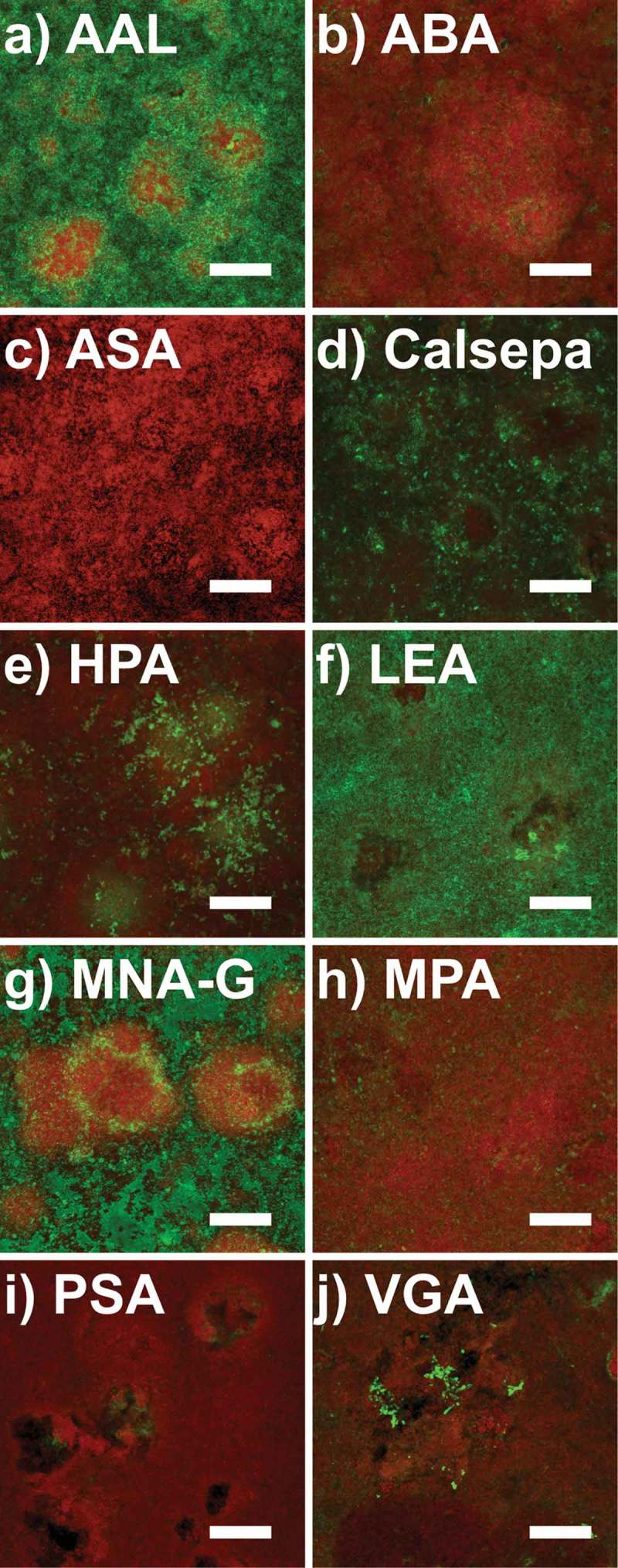
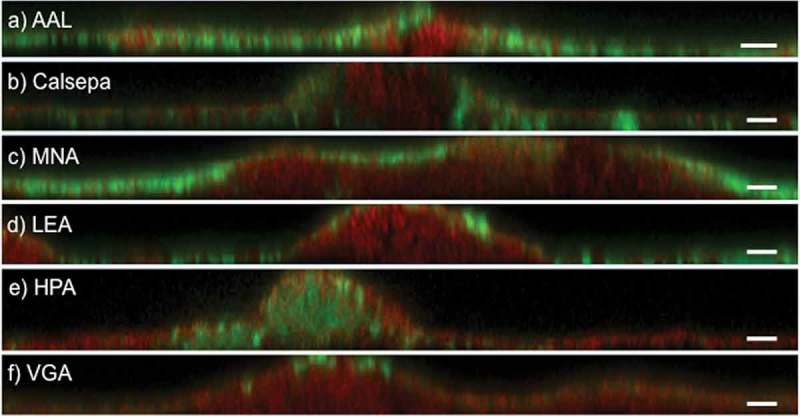
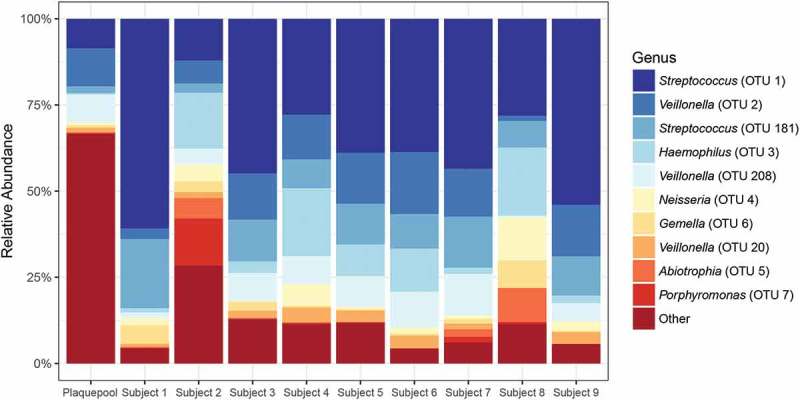
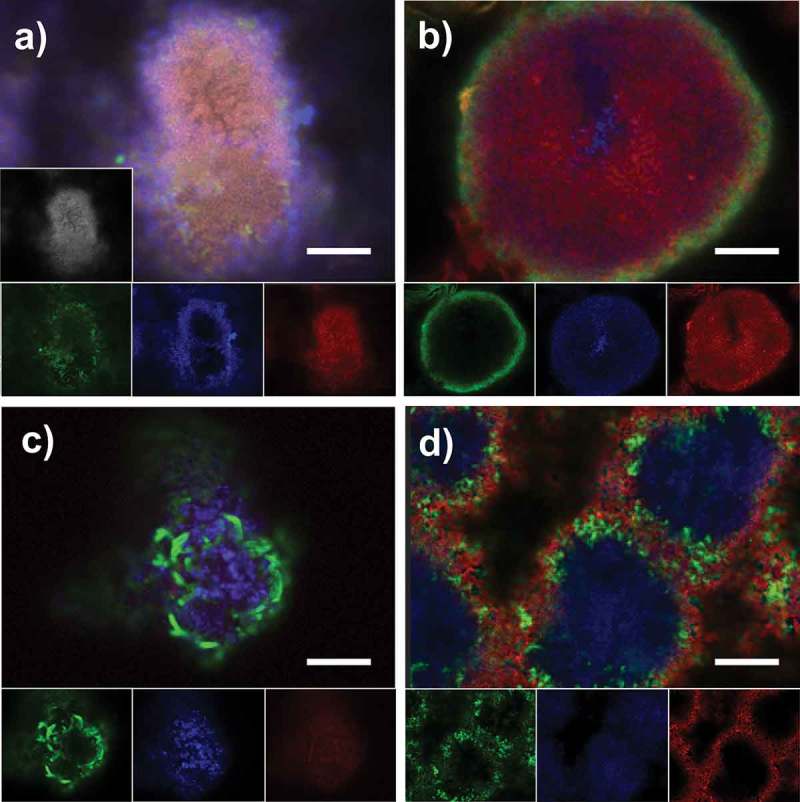
The extracellular matrix is a poorly studied, yet important component of dental biofilms. Fluorescence lectin-binding analysis (FLBA) is a powerful tool to characterize glycoconjugates in the biofilm matrix. This study aimed to systematically investigate the ability of 75 fluorescently labeled lectins to visualize and quantify extracellular glycoconjugates in dental biofilms. Lectin binding was screened on pooled supragingival biofilm samples collected from 76 subjects using confocal microscopy. FLBA was then performed with 10 selected lectins on biofilms grown in situ for 48 h in the absence of sucrose. For five lectins that proved particularly suitable, stained biovolumes were quantified and correlated to the bacterial composition of the biofilms. Additionally, combinations of up to three differently labeled lectins were tested. Of the 10 lectins, five bound particularly well in 48-h-biofilms: Aleuria aurantia (AAL), Calystega sepiem (Calsepa), Lycopersicon esculentum (LEA), Morniga-G (MNA-G) and Helix pomatia (HPA). No significant correlation between the binding of specific lectins and bacterial composition was found. Fluorescently labeled lectins enable the visualization of glycoconjugates in the dental biofilm matrix. The characterization and quantification of glycoconjugates in dental biofilms require a combination of several lectins. For 48-h-biofilms grown in absence of sucrose, AAL, Calsepa, HPA, LEA, and MNA-G are recommendable.
Overview
The claims and statistics of this paper haven’t been checked yet.
Free: it reads the open-access text and checks the first 5 claims that cite a source we can check. Create a free account to check every claim.
Integrity signals
Registry
Cites
Statistics
Figures
Verification
Claims the paper makes
The claims and statistics of this paper haven’t been checked yet.
Free: it reads the open-access text and checks the first 5 claims that cite a source we can check. Create a free account to check every claim.
Claims other papers make about this one
Each is checked against this paper’s own text: does it say what the citing paper says it does?
The source backs part of the claim, not all of it — or backs it for a different population, condition or comparison.
In the citing paper
“Using fluorescent lectin–binding analysis, a wide range of carbohydrate structures were detected in 48-hour supragingival dental biofilm grown in situ in the mouths of volunteers who abstained from ingesting sucrose.29”
From The dental plaque biofilm matrix (2021) · cites this paper as [29]
Experimental — accuracy not yet measured
Self-check
Percentages, sums and reported differences re-computed from the paper’s own numbers.
The self-check needs the paper’s full text.
Citations
Cites
R: A Language and Environment for Statistical Computing
R Core Team (2025) · doi:10.32614/r.manuals · Cited by 352,181
The SILVA ribosomal RNA gene database project: improved data processing and web-based tools
Quast, C., Pruesse, E., Yilmaz, P., Gerken, J., Schweer, T., Yarza, P., Peplies, J., & Glöckner, F. O. (2012) · Nucleic Acids Research · doi:10.1093/nar/gks1219 · Cited by 33,055 · cited 1×
“Silva SSU Ref NR release 123 database serving as a reference [35].”
MethodSchloss, P. D., Westcott, S. L., Ryabin, T., Hall, J. R., Hartmann, M., Hollister, E. B., Lesniewski, R. A., Oakley, B. B., Parks, D. H., Robinson, C. J., et al. (2009) · Applied and Environmental Microbiology · doi:10.1128/aem.01541-09 · Cited by 19,549
UPARSE: highly accurate OTU sequences from microbial amplicon reads
Edgar, R. C. (2013) · Nature Methods · doi:10.1038/nmeth.2604 · Cited by 16,707
Flemming, H.-C., & Wingender, J. (2010) · Nature Reviews Microbiology · doi:10.1038/nrmicro2415 · Cited by 10,137
PEAR: a fast and accurate Illumina Paired-End reAd mergeR
Zhang, J., Kobert, K., Flouri, T., & Stamatakis, A. (2014) · Bioinformatics · doi:10.1093/bioinformatics/btt593 · Cited by 4,497
Defining the normal bacterial flora of the oral cavity
Aas, J. A., Paster, B. J., Stokes, L. N., Olsen, I., & Dewhirst, F. E. (2005) · Journal of Clinical Microbiology · doi:10.1128/jcm.43.11.5721-5732.2005 · Cited by 3,092
Transitions in bacterial communities along the 2000 km salinity gradient of the Baltic Sea
Herlemann, D. P. R., Labrenz, M., Jürgens, K., Bertilsson, S., Waniek, J. J., & Andersson, A. F. (2011) · The ISME Journal · doi:10.1038/ismej.2011.41 · Cited by 2,885 · cited 1×
“few modifications: variable regions V3 and V4 of bacterial 16S ribosomal RNA gene were amplified using primers Bac 341F and Bac 805R [30].”
MethodOcclusal Caries: Biological Approach for Its Diagnosis and Management
Carvalho, J. C., Dige, I., Machiulskiene, V., Qvist, V., Bakhshandeh, A., Fatturi-Parolo, C., & Maltz, M. (2016) · Caries Research · doi:10.1159/000448662 · Cited by 2,153
Bowen, W. H., & Koo, H. (2011) · Caries Research · doi:10.1159/000324598 · Cited by 1,051 · cited 2×
“Much effort has been spent on elucidating the involvement of extracellular glucans and fructans, polysaccharides consisting of either glucose or fructose moieties, in the caries process [2,4].”
BackgroundQuirynen, M., & Bollen, C. M. L. (1995) · Journal of Clinical Periodontology · doi:10.1111/j.1600-051x.1995.tb01765.x · Cited by 1,037 · cited 1×
“surface roughness is of crucial importance for biofilm growth [41], the material of the underlying substrate has less influence on biofilm architecture due to”
BackgroundJuretschko, S., Timmermann, G., Schmid, M., Schleifer, K.-H., Pommerening-Röser, A., Koops, H.-P., & Wagner, M. (1998) · Applied and Environmental Microbiology · doi:10.1128/aem.64.8.3042-3051.1998 · Cited by 806 · cited 2×
“residual pooled biofilm were gently washed in DNA extraction buffer [27] to remove ethanol and PBS.”
MethodThe Pairwise Multiple Comparison of Mean Ranks Package (PMCMR)
Pohlert, T. (2016) · Cited by 714
The Exopolysaccharide Matrix: A Virulence Determinant of Cariogenic Biofilm
Koo, H., Falsetta, M. L., & Klein, M. I. (2013) · Journal of Dental Research · doi:10.1177/0022034513504218 · Cited by 523
Xiao, J., Klein, M. I., Falsetta, M. L., Lu, B., Delahunty, C. M., Yates, J. R., Heydorn, A., & Koo, H. (2012) · PLoS Pathogens · doi:10.1371/journal.ppat.1002623 · Cited by 514 · cited 1×
“scaffold for biofilm architecture and contributes to the creation and preservation of highly acidic niches [8,9].”
BackgroundKoo, H., Xiao, J., Klein, M. I., & Jeon, J. G. (2010) · Journal of Bacteriology · doi:10.1128/jb.01649-09 · Cited by 508
Marsh, P. D., & Bradshaw, D. J. (1995) · Journal of Industrial Microbiology · doi:10.1007/bf01569822 · Cited by 440 · cited 1×
“The two most prevalent oral diseases – caries and periodontitis – are caused by biofilms [1].”
BackgroundMolecular Characterization of Subject-Specific Oral Microflora during Initial Colonization of Enamel
Diaz, P. I., Chalmers, N. I., Rickard, A. H., Kong, C., Milburn, C. L., Palmer, R. J., & Kolenbrander, P. E. (2006) · Applied and Environmental Microbiology · doi:10.1128/aem.72.4.2837-2848.2006 · Cited by 426
The oral cavity—a key system to understand substratum-dependent bioadhesion on solid surfaces in man
Hannig, C., & Hannig, M. (2009) · Clinical Oral Investigations · doi:10.1007/s00784-008-0243-3 · Cited by 296 · cited 1×
“masking effects by the salivary coating [42].”
Characterization of Extracellular Polymeric Substances from Acidophilic Microbial Biofilms
Jiao, Y., Cody, G. D., Harding, A. K., Wilmes, P., Schrenk, M., Wheeler, K. E., Banfield, J. F., & Thelen, M. P. (2010) · Applied and Environmental Microbiology · doi:10.1128/aem.02289-09 · Cited by 284
Cloning of a Streptococcus mutans glucosyltransferase gene coding for insoluble glucan synthesis
Aoki, H., Shiroza, T., Hayakawa, M., Sato, S., & Kuramitsu, H. K. (1986) · Infection and Immunity · doi:10.1128/iai.53.3.587-594.1986 · Cited by 273 · cited 1×
“tal caries, releases glycosyltransferases (GtfB, C, and D) to synthetize glucans in the presence of sucrose [5,6].”
BackgroundAssessment of lectin-binding analysis for in situ detection of glycoconjugates in biofilm systems
Neu, T. R., Swerhone, G. D. W., & Lawrence, J. R. (2001) · Microbiology · doi:10.1099/00221287-147-2-299 · Cited by 253
Self-citationStaudt, C., Horn, H., Hempel, D. C., & Neu, T. R. (2004) · Biotechnology and Bioengineering · doi:10.1002/bit.20241 · Cited by 228
Self-citationHanada, N., & Kuramitsu, H. K. (1988) · Infection and Immunity · doi:10.1128/iai.56.8.1999-2005.1988 · Cited by 225 · cited 1×
“tal caries, releases glycosyltransferases (GtfB, C, and D) to synthetize glucans in the presence of sucrose [5,6].”
BackgroundAssessment of bacterial and structural dynamics in aerobic granular biofilms
Weissbrodt, D. G., Neu, T. R., Kuhlicke, U., Rappaz, Y., & Holliger, C. (2013) · Frontiers in Microbiology · doi:10.3389/fmicb.2013.00175 · Cited by 166
Self-citationLectins; biomedical perspectives
Meban, C. (1996) · General Pharmacology The Vascular System · doi:10.1016/0306-3623(96)90043-9 · Cited by 151
Effect of Sucrose Concentration on Dental Biofilm Formed in situ and on Enamel Demineralization
Aires, C. P., Tabchoury, C. P. M., Del Bel Cury, A. A., Koo, H., & Cury, J. A. (2006) · Caries Research · doi:10.1159/000088902 · Cited by 124
Zippel, B., & Neu, T. R. (2010) · Applied and Environmental Microbiology · doi:10.1128/aem.01660-10 · Cited by 124
Self-citationVacca-Smith, A. M., & Bowen, W. H. (1998) · Archives of Oral Biology · doi:10.1016/s0003-9969(97)00111-8 · Cited by 117 · cited 1×
“In turn, the binding of GtfB to bacterial surfaces converts other bacteria to glucan producers [7], yielding a rigid matrix that serves as a”
Background(1995) · CRC Press eBooks · doi:10.1201/9781482272550 · Cited by 115 · cited 1×
“higher, and binding is not only determined by the steric structure of particular oligosaccharide chains but may also be influenced by the polypeptide backbone of the glycoproteins [43,44].”
Background[10] Lectin-binding analysis in biofilm systems
Neu, T. R., & Lawrence, J. R. (1999) · Methods in enzymology on CD-ROM/Methods in enzymology · doi:10.1016/s0076-6879(99)10012-0 · Cited by 114 · cited 2×
“concentration 100 μg/mL) for 30 min at room temperature [24].”
BackgroundSelf-citationDige, I., Nilsson, H., Kilian, M., & Nyvad, B. (2007) · European Journal of Oral Sciences · doi:10.1111/j.1600-0722.2007.00494.x · Cited by 106
Burne, R. A., Chen, Y.-Y. M., Wexler, D. L., Kuramitsu, H., & Bowen, W. H. (1996) · Journal of Dental Research · doi:10.1177/00220345960750080801 · Cited by 89 · cited 1×
“Much effort has been spent on elucidating the involvement of extracellular glucans and fructans, polysaccharides consisting of either glucose or fructose moieties, in the caries process [2,4].”
BackgroundMicrobial Diversity in the Early In Vivo -Formed Dental Biofilm
Heller, D., Helmerhorst, E. J., Gower, A. C., Siqueira, W. L., Paster, B. J., & Oppenheim, F. G. (2016) · Applied and Environmental Microbiology · doi:10.1128/aem.03984-15 · Cited by 87
Zhang, R., Neu, T. R., Bellenberg, S., Kuhlicke, U., Sand, W., & Vera, M. A. (2014) · Microbial Biotechnology · doi:10.1111/1751-7915.12188 · Cited by 76
Self-citationFunctional Relationship between Sucrose and a Cariogenic Biofilm Formation
Cai, J.-N., Jung, J., Dang, M.-H., Kim, M., Yi, H., & Jeon, J. (2016) · PLoS ONE · doi:10.1371/journal.pone.0157184 · Cited by 64
Neu, T. R., & Kuhlicke, U. (2017) · Microorganisms · doi:10.3390/microorganisms5010005 · Cited by 64
Self-citationNeu, T. R., & Lawrence, J. R. (2014) · Methods in molecular biology · doi:10.1007/978-1-4939-0467-9_4 · Cited by 62 · cited 1×
“powerful tool to visualize and quantify the glycoconjugate fraction of the extracellular matrix in a nondestructive way [13,14].”
MethodSelf-citationEffect of Conventional Mouthrinses on Initial Bioadhesion to Enamel and Dentin in situ
Hannig, C., Gaeding, A., Basche, S., Richter, G., Helbig, R., & Hannig, M. (2012) · Caries Research · doi:10.1159/000345083 · Cited by 54
Mapping glycoconjugate-mediated interactions of marine Bacteroidetes with diatoms
Bennke, C. M., Neu, T. R., Fuchs, B. M., & Amann, R. (2013) · Systematic and Applied Microbiology · doi:10.1016/j.syapm.2013.05.002 · Cited by 51
Self-citationFluorescence microscopic visualization of non cellular components during initial bioadhesion in situ
Kensche, A., Basche, S., Bowen, W. H., Hannig, M., & Hannig, C. (2013) · Archives of Oral Biology · doi:10.1016/j.archoralbio.2013.07.006 · Cited by 34
The biofilm matrix ofCampylobacter jejunidetermined by fluorescence lectin-binding analysis
Turoňová, H., Neu, T. R., Ulbrich, P., Pazlarová, J., & Tresse, O. (2016) · Biofouling · doi:10.1080/08927014.2016.1169402 · Cited by 34
Self-citationArchitecture of Deinococcus geothermalis biofilms on glass and steel: a lectin study
Peltola, M., Neu, T. R., Raulio, M., Kolari, M., & Salkinoja-Salonen, M. S. (2008) · Environmental Microbiology · doi:10.1111/j.1462-2920.2008.01596.x · Cited by 29
Self-citationLuef, B., Neu, T. R., Zweimüller, I., & Peduzzi, P. (2009) · Applied and Environmental Microbiology · doi:10.1128/aem.00186-09 · Cited by 23
Self-citationZoocin A and Lauricidin in Combination Reduce Streptococcus mutans Growth in a Multispecies Biofilm
Lester, K., & Simmonds, R. S. (2012) · Caries Research · doi:10.1159/000337307 · Cited by 16
Antibodies and Lectins in Glycan Analysis -- Essentials of Glycobiology
Varki, A. P., Rd, C., Jd, E., Freeze, H. H., Stanley, P., Bertozzi, C. R., Hart, G. W., & Me, E. (2009) · Cited by 7
Research works printed but not linked: 1
- Bio M PowerSoil® DNA Isolation Kit [Internet]. Carlsbad (US): MO BIO Laboratories; 2014 Available from: https://mobio.com/media/wysiwyg/pdfs/protocols/12888.pdf
Cited by
The dental plaque biofilm matrix
Jakubovics, N. S., Goodman, S. D., Mashburn‐Warren, L., Stafford, G. P., & Cieplik, F. (2021) · Periodontology 2000 · doi:10.1111/prd.12361 · Cited by 488
Extracellular polymeric substances of biofilms: Suffering from an identity crisis
Seviour, T., Derlon, N., Dueholm, M. S., Flemming, H.-C., Girbal-Neuhauser, E., Horn, H., Kjelleberg, S., van Loosdrecht, M. C. M., Lotti, T., Malpei, M. F., et al. (2019) · Water Research · doi:10.1016/j.watres.2018.11.020 · Cited by 370
Self-citationDual-Targeting Approach Degrades Biofilm Matrix and Enhances Bacterial Killing
Ren, Z., Kim, D., Paula, A. J., Hwang, G., Liu, Y., Li, J., Daniell, H., & Koo, H. (2019) · Journal of Dental Research · doi:10.1177/0022034518818480 · Cited by 68
Meng, D., Wu, J., Chen, K., Li, H., Jin, W., Shu, S., & Zhang, J. (2019) · The Science of The Total Environment · doi:10.1016/j.scitotenv.2019.05.387 · Cited by 55
Microbial Community Drivers in Anaerobic Granulation at High Salinity
Gagliano, M. C., Sudmalis, D., Pei, R., Temmink, H., & Plugge, C. M. (2020) · Frontiers in Microbiology · doi:10.3389/fmicb.2020.00235 · Cited by 51
Metadata
- Authors
- Tawakoli, P. N., Neu, T. R., Busck, M. M., Kuhlicke, U., Schramm, A., Attin, T., Wiedemeier, D. B., & Schlafer, S.
- Affiliations
- University of Zurich (CH)
- Helmholtz Centre for Environmental Research (DE)
- Aarhus University (DK)
- Corresponding author
- Tawakoli, Pune N.
- ORCID
- Venue
- Journal of Oral Microbiology
- Publisher
- Informa UK Limited
- Published
- 2017-01-01
- Volume
- 9
- Issue
- 1
- Pages
- 1345581
- ISSN
- 2000-2297 (ISSN-L)
- PMC
- PMC5508396
- OpenAlex
- W2730969358
- Cited by
- 33
- References
- 46
- Citations by year
- 2026: 3 · 2025: 6 · 2024: 7 · 2023: 4 · 2022: 3 · 2021: 1 · 2020: 3 · 2019: 5 · 2018: 1
- FWCI
- 3.40
- Type
- journal article
- Language
- en
- Open access
- gold
- doi.org
- Licence
- Locations
- Journal of Oral Microbiology (publishedVersion, cc-by)
- PubMed Central (publishedVersion, cc-by)
- PubMed (publishedVersion)
- Zurich Open Repository and Archive (University of Zurich) (acceptedVersion, cc-by)
- DOAJ (DOAJ: Directory of Open Access Journals) (submittedVersion, cc-by-sa)
- Scopus (Elsevier) (submittedVersion, other-oa)
- Zurich Open Repository and Archive (University of Zurich) (submittedVersion, cc-by)
- Zurich Open Repository and Archive (University of Zurich)
- Funders
- Eberhard Karls Universität Tübingen
- Helmholtz-Zentrum für Umweltforschung
- Universität Zürich
- Topics
- Health Sciences › Dentistry › Periodontics › Oral microbiology and periodontitis research
- Life Sciences › Biochemistry, Genetics and Molecular Biology › Molecular Biology › Bacterial biofilms and quorum sensing
- Life Sciences › Biochemistry, Genetics and Molecular Biology › Molecular Biology › Glycosylation and Glycoproteins Research
- Keywords
- dental plaque, extracellular matrix, glycoconjugates, supragingival plaque, lectin binding, bacterial community composition, Aleuria aurantia, tomato, Helix pomatia
About these checks
Registry, retraction, Cites and statistics results are computed, not judged, with one exception: a printed reference that no index lists is read once by a model before it counts as a citation error. Claims are extracted by a model and kept only when their quote appears verbatim in the text; each cited source is then checked, with a model’s help, for whether it says what the claim relies on. Those verdicts can be wrong — read the claim’s quote and the cited source before relying on one.
Statistics and arithmetic are recomputed, not judged.
Confidence bands are shown only for fields calibrated on our annotated test set. None is calibrated yet, so no band is shown.
What counts as a claim ›How we measure confidence ›How we check this ›
Are you an author, or do you see a problem with this page? Request a review
Data sources
Bibliographic data: Semantic Scholar, OpenAlex, Crossref.
Contains information from the Semantic Scholar Academic Graph Datasets, made available under the ODC Attribution License (ODC-BY 1.0).
Semantic Scholar’s data is described in: Kinney, R., et al. (2023). The Semantic Scholar Open Data Platform. arXiv:2301.10140.
