

Active duty and ex-serving military personnel with post-traumatic stress disorder treated with psychological therapies: systematic review and meta-analysis
Open accessThe DOI matches its Crossref record; 52 of the 52 references it cites were found in a registry or an index.
Abstract
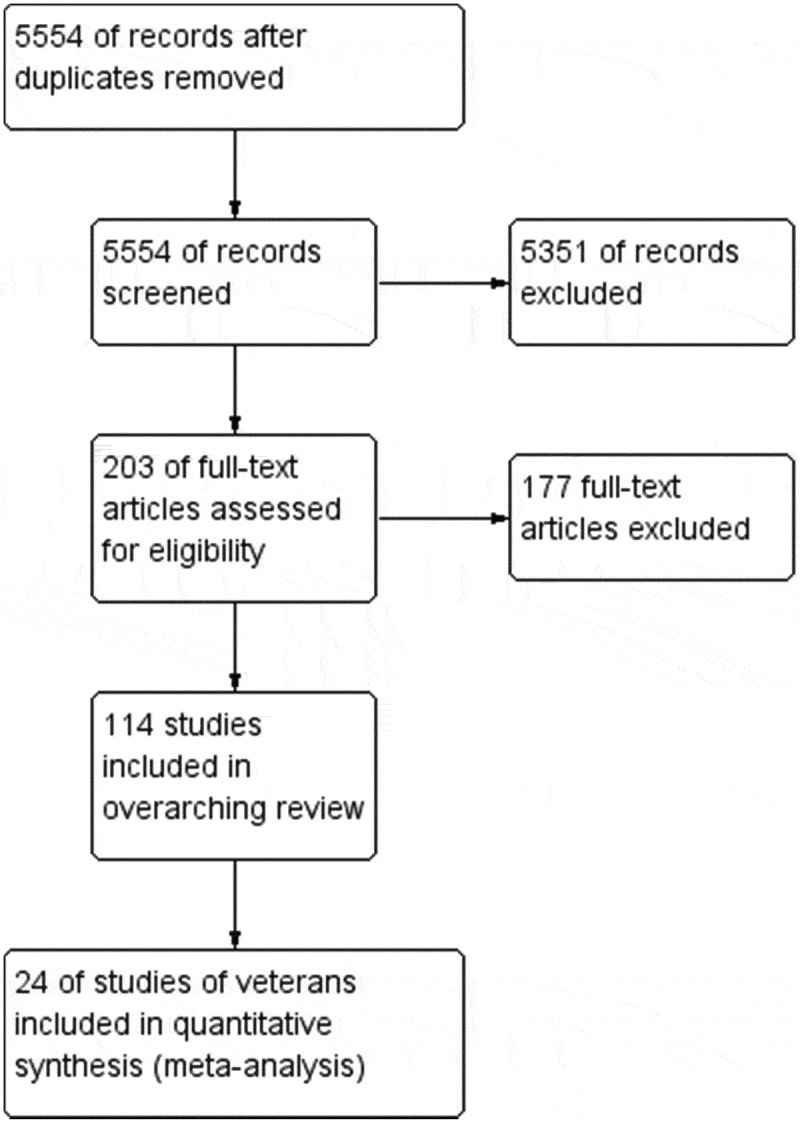
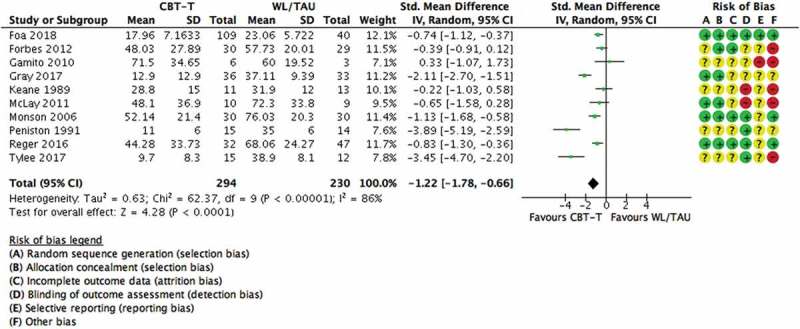
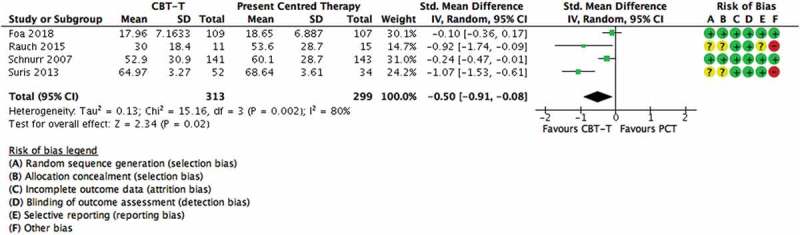
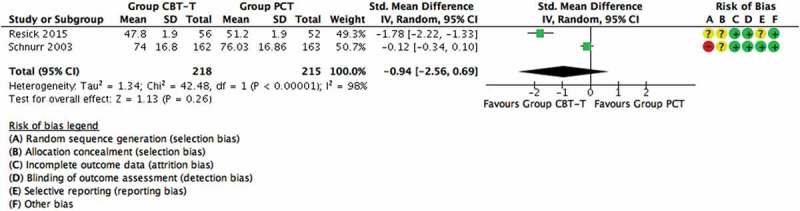
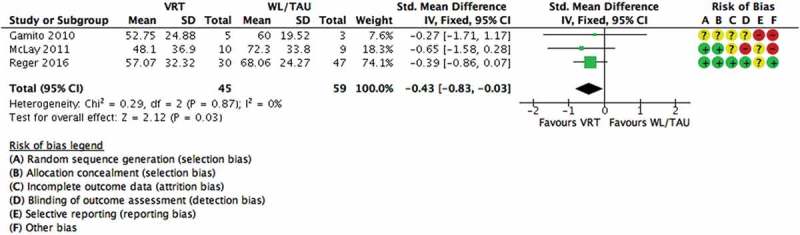
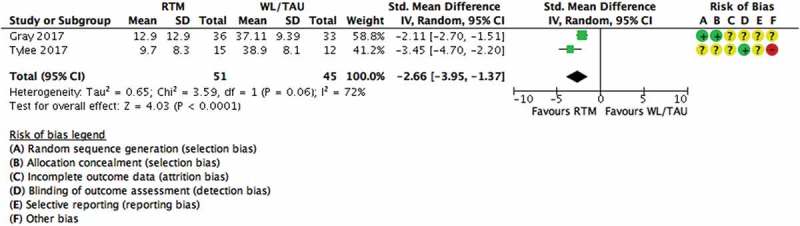
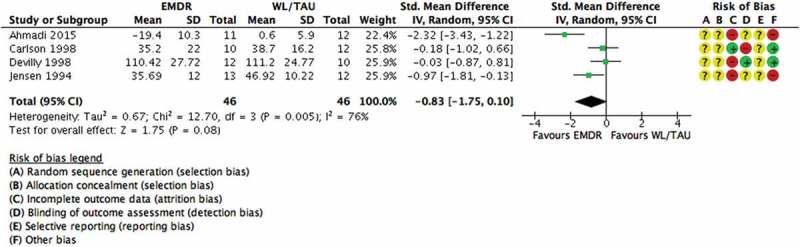
Background: Post-traumatic stress disorder (PTSD) is a major cause of morbidity amongst active duty and ex-serving military personnel. In recent years increasing efforts have been made to develop more effective treatments.Objective: To determine which psychological therapies are efficacious in treating active duty and ex-serving military personnel with post-traumatic stress disorder (PTSD).Method: A systematic review was undertaken according to Cochrane Collaboration Guidelines. The primary outcome measure was reduction in PTSD symptoms and the secondary outcome dropout.Results: Twenty-four studies with 2386 participants were included. Evidence demonstrated that CBT with a trauma focus (CBT-TF) was associated with the largest evidence of effect when compared to waitlist/usual care in reducing PTSD symptoms post treatment (10 studies; n = 524; SMD −1.22, −1.78 to −0.66). Group CBT-TF was less effective when compared to individual CBT-TF at reducing PTSD symptoms post treatment (1 study; n = 268; SMD −0.35, −0.11 to −0.59). Eye Movement Desensitization and Reprocessing (EMDR) therapy was not effective when compared to waitlist/usual care at reducing PTSD symptoms post treatment (4 studies; n = 92; SMD −0.83, −1.75 to 0.10). There was evidence of greater dropout from CBT-TF therapies compared to waitlist and Present Centred Therapy.Conclusions: The evidence, albeit limited, supports individual CBT-TF as the first-line psychological treatment of PTSD in active duty and ex-serving personnel. There is evidence for Group CBT-TF, but this is not as strong as for individual CBT-TF. EMDR cannot be recommended as a first line therapy at present and urgently requires further evaluation. Lower effect sizes than for other populations with PTSD and high levels of drop-out suggest that CBT-TF in its current formats is not optimally acceptable and further research is required to develop and evaluate more effective treatments for PTSD and complex PTSD in active duty and ex-serving military personnel.
Overview
The claims and statistics of this paper haven’t been checked yet.
Free: it reads the open-access text and checks the first 5 claims that cite a source we can check. Create a free account to check every claim.
Integrity signals
Registry
Cites
Statistics
Figures
Verification
Claims the paper makes
The claims and statistics of this paper haven’t been checked yet.
Free: it reads the open-access text and checks the first 5 claims that cite a source we can check. Create a free account to check every claim.
Claims other papers make about this one
Each is checked against this paper’s own text: does it say what the citing paper says it does?
The source backs part of the claim, not all of it — or backs it for a different population, condition or comparison.
In the citing paper
“none has been fully effective in its treatment (Kitchiner 2019)”
From Psychosocial interventions for survivors of rape and sexual assault experienced during adulthood (2023) · cites this paper as Kitchiner 2019
Experimental — accuracy not yet measuredThe source backs part of the claim, not all of it — or backs it for a different population, condition or comparison.
In the citing paper
“Post‐treatment reduction in PTSD exceeded an effect size criterion for clinical significance (standardised mean difference (SMD) ≥ 0.8) suggested by Kitchiner 2019.”
From Psychosocial interventions for survivors of rape and sexual assault experienced during adulthood (2023) · cites this paper as Kitchiner 2019
Experimental — accuracy not yet measuredThe cited source says what the claim attributes to it.
In the citing paper
“Several previous reviews of interventions for PTSD have included sexual violence and abuse survivors as a subset of the overall trauma population (Hetrick 2010; Kitchiner 2019; Roberts 2015; Roberts 2016; Steenkamp 2015)”
From Psychosocial interventions for survivors of rape and sexual assault experienced during adulthood (2023) · cites this paper as Kitchiner 2019
The cited source says what the claim attributes to it.
In the citing paper
“Our review diverges from previous findings in respect of EMDR (Kitchiner 2019), where no benefit was detected for reducing PTSD in active duty and ex‐serving military personnel with PTSD.”
From Psychosocial interventions for survivors of rape and sexual assault experienced during adulthood (2023) · cites this paper as Kitchiner 2019
The cited source says what the claim attributes to it.
In the citing paper
“Previously, it has been shown that dropout among active and ex-service military personnel is higher for TF-CBT than present-centred therapy, especially where prolonged exposure is used [155].”
Self-check
Percentages, sums and reported differences re-computed from the paper’s own numbers.
The self-check needs the paper’s full text.
Citations
Cites
The Cochrane Collaboration's tool for assessing risk of bias in randomised trials
Higgins, J. P. T., Altman, D. G., Gotzsche, P. C., Juni, P., Moher, D., Oxman, A. D., Savovic, J., Schulz, K. F., Weeks, L., Sterne, J. A. C., et al. (2011) · BMJ · doi:10.1136/bmj.d5928 · Cited by 33,817
Dermyshi, E., Wang, Y., Yan, C., Hong, W., Qiu, G., Gong, X., & Zhang, T. (2017) · Neonatology · doi:10.1159/000454668 · Cited by 24,451
The development of a Clinician-Administered PTSD Scale
Blake, D. D., Weathers, F. W., Nagy, L. M., Kaloupek, D. G., Gusman, F. D., Charney, D. S., & Keane, T. M. (1995) · Journal of Traumatic Stress · doi:10.1002/jts.2490080106 · Cited by 5,024 · cited 2×
“the Clinician Administered PTSD Scale (CAPS) (Blake et al., 1995)).”
Moral injury and moral repair in war veterans: A preliminary model and intervention strategy
Litz, B. T., Stein, N., Delaney, E., Lebowitz, L., Nash, W. P., Silva, C., & Maguen, S. (2009) · Clinical Psychology Review · doi:10.1016/j.cpr.2009.07.003 · Cited by 2,738 · cited 1×
“Reasons for dropping out will be multi-factorial, and may be due to extended, repeated, and intense nature of deployment trauma (Price, Gros, Strachan, Ruggiero, & Acierno, 2013) and service members being exposed to threats to life and morally compromising experiences that may require different treatment approaches (L…”
BackgroundThe Cochrane Database of Systematic Reviews
Handoll, H. H. (2004) · The British Journal of Hand Therapy · doi:10.1177/175899830400900201 · Cited by 1,513
Foa, E. B., Rothbaum, B. O., Riggs, D. S., & Murdock, T. B. (1991) · Journal of Consulting and Clinical Psychology · doi:10.1037/0022-006x.59.5.715 · Cited by 1,444
Resick, P. A., Nishith, P., Weaver, T. L., Astin, M. C., & Feuer, C. A. (2002) · Journal of Consulting and Clinical Psychology · doi:10.1037/0022-006x.70.4.867 · Cited by 1,294
Psychotherapy for Military-Related PTSD: A Review of Randomized Clinical Trials
Steenkamp, M. M., Litz, B. T., Hoge, C. W., & Marmar, C. R. (2015) · JAMA · doi:10.1001/jama.2015.8370 · Cited by 958
Cognitive processing therapy for veterans with military-related posttraumatic stress disorder.
Monson, C. M., Schnurr, P. P., Resick, P. A., Friedman, M. J., Young-Xu, Y., & Stevens, S. P. (2006) · Journal of Consulting and Clinical Psychology · doi:10.1037/0022-006x.74.5.898 · Cited by 865 · cited 22×
“Thirteen studies contained participants deployed to either Iraq or Afghanistan (Castillo et al., 2016; Foa et al., 2018; Forbes et al., 2012; Gray et al., 2017; McLay et al., 2017, 2011; Monson et al., 2006; Rauch et al., 2015; Reger et al., 2016; Resick et al., 2017, 2015; Sautter et al., 2015; Tylee et al., 2017; Ye…”
BackgroundInfluentialPsychological therapies for chronic post-traumatic stress disorder (PTSD) in adults
Bisson, J. I., Roberts, N. P., Andrew, M., Cooper, R., & Lewis, C. (2013) · Cochrane Database of Systematic Reviews · doi:10.1002/14651858.cd003388.pub4 · Cited by 829
Self-citation
Research works printed but not linked: 1
- RevMan (2014). Review manager 5 (RevMan 5) [Computer program] version 5.3. Copenhagen: The Nordic Cochrane Centre The Cochrane Collaboration.
Cited by
Coventry, P. A., Meader, N., Melton, H., Temple, M., Dale, H., Wright, K., Cloitre, M., Karatzias, T., Bisson, J., Roberts, N. P., et al. (2020) · PLoS Medicine · doi:10.1371/journal.pmed.1003262 · Cited by 358
“Previously, it has been shown that dropout among active and ex-service military personnel is higher for TF-CBT than present-centred therapy, especially where prolonged exposure is used [155].”
BackgroundSelf-citationReviewing the Potential of Psychedelics for the Treatment of PTSD
Krediet, E., Bostoen, T., Breeksema, J., van Schagen, A., Passie, T., & Vermetten, E. (2020) · International Journal of Neuropsychopharmacology · doi:10.1093/ijnp/pyaa018 · Cited by 260
“Yet, even after multiple modalities of psychotherapy, PTSD often remains a chronic illness, with high rates of psychiatric and medical comorbidity (Steenkamp et al., 2015; Bryant et al., 2016; Kitchiner et al., 2019).”
BackgroundPsychological treatments for post-traumatic stress disorder in adults: a network meta-analysis
Mavranezouli, I., Megnin-Viggars, O., Daly, C., Dias, S., Welton, N. J., Stockton, S., Bhutani, G., Grey, N., Leach, J., Greenberg, N., et al. (2020) · Psychological Medicine · doi:10.1017/s0033291720000070 · Cited by 212
“The recommendation for EMDR was restricted to people with non-combat-related trauma, as evidence from sub-group pairwise meta-analysis suggested a non-significant effect on people with combat-related trauma, a finding that was confirmed by a recent systematic review and meta-analysis (Kitchiner et al., 2019).”
BackgroundSchnurr, P. P., Chard, K. M., Ruzek, J. I., Chow, B. K., Resick, P. A., Foa, E. B., Marx, B. P., Friedman, M. J., Bovin, M. J., Caudle, K. L., et al. (2022) · JAMA Network Open · doi:10.1001/jamanetworkopen.2021.36921 · Cited by 185
Prevention and treatment of PTSD: the current evidence base
Bisson, J. I., & Olff, M. (2021) · European Journal of Psychotraumatology · doi:10.1080/20008198.2020.1824381 · Cited by 150
Self-citation
Metadata
- Authors
- Kitchiner, N. J., Lewis, C., Roberts, N. P., & Bisson, J. I.
- Affiliations
- Cardiff and Vale University Health Board (GB)
- Cardiff University (GB)
- Corresponding author
- Kitchiner, Neil J.
- Venue
- European Journal of Psychotraumatology
- Publisher
- Informa UK Limited
- Published
- 2019-11-08
- Volume
- 10
- Issue
- 1
- Pages
- 1684226-1684226
- ISSN
- 2000-8066 (ISSN-L)
- PMC
- PMC6853217
- OpenAlex
- W2988715426
- Cited by
- 113
- References
- 52
- Citations by year
- 2026: 13 · 2025: 17 · 2024: 15 · 2023: 24 · 2022: 16 · 2021: 13 · 2020: 14 · 2019: 1
- FWCI
- 1.74
- Type
- journal article
- Language
- en
- Open access
- gold
- doi.org
- Licence
- Locations
- European Journal of Psychotraumatology (publishedVersion, cc-by-nc)
- Europe PMC (PubMed Central) (publishedVersion, cc-by-nc)
- PubMed Central (publishedVersion, cc-by-nc)
- PubMed (publishedVersion)
- ORCA Online Research @Cardiff (Cardiff University) (acceptedVersion)
- DOAJ (DOAJ: Directory of Open Access Journals) (submittedVersion, cc-by-sa)
- Funders
- unfunded (none)
- Topics
- Social Sciences › Psychology › Clinical Psychology › Posttraumatic Stress Disorder Research
- Social Sciences › Psychology › Clinical Psychology › Psychotherapy Techniques and Applications
- Social Sciences › Psychology › Experimental and Cognitive Psychology › Sleep and related disorders
- Keywords
- post-traumatic stress disorder, military personnel, active duty military personnel, psychotherapy, trauma-focused cognitive behavioral therapy, EMDR, group cognitive behavioral therapy, dropout, treatment efficacy, complex PTSD
About these checks
Registry, retraction, Cites and statistics results are computed, not judged, with one exception: a printed reference that no index lists is read once by a model before it counts as a citation error. Claims are extracted by a model and kept only when their quote appears verbatim in the text; each cited source is then checked, with a model’s help, for whether it says what the claim relies on. Those verdicts can be wrong — read the claim’s quote and the cited source before relying on one.
Statistics and arithmetic are recomputed, not judged.
Confidence bands are shown only for fields calibrated on our annotated test set. None is calibrated yet, so no band is shown.
What counts as a claim ›How we measure confidence ›How we check this ›
Are you an author, or do you see a problem with this page? Request a review
Data sources
Bibliographic data: Semantic Scholar, OpenAlex, Crossref.
Contains information from the Semantic Scholar Academic Graph Datasets, made available under the ODC Attribution License (ODC-BY 1.0).
Semantic Scholar’s data is described in: Kinney, R., et al. (2023). The Semantic Scholar Open Data Platform. arXiv:2301.10140.
