

Active duty and ex-serving military personnel with post-traumatic stress disorder treated with psychological therapies: systematic review and meta-analysis
Open accessThe DOI matches its Crossref record; 52 of the 52 references it cites were found in a registry or an index.
Abstract
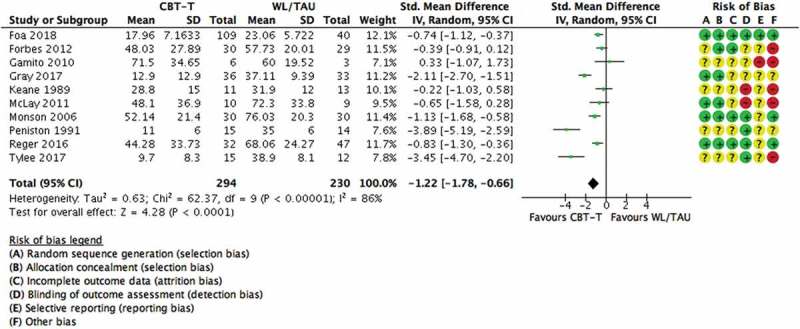
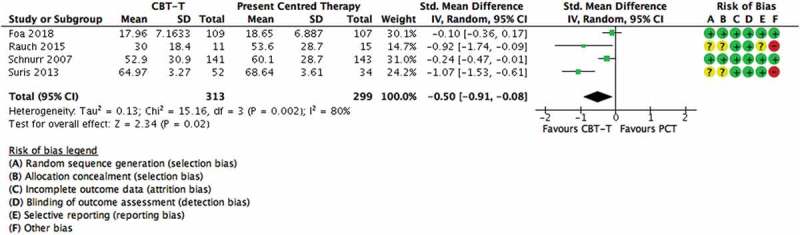
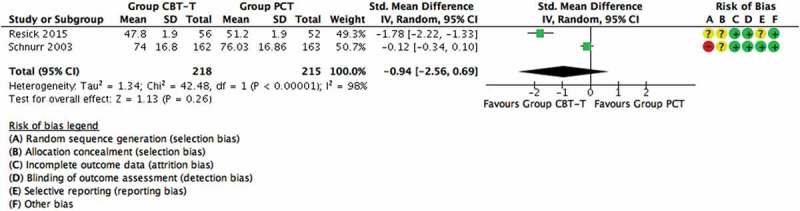
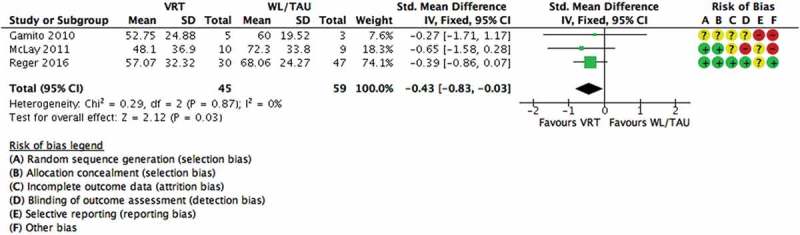
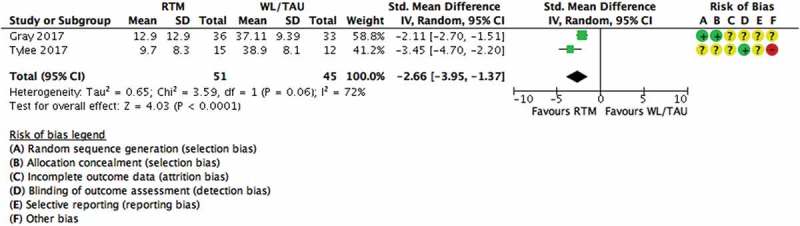
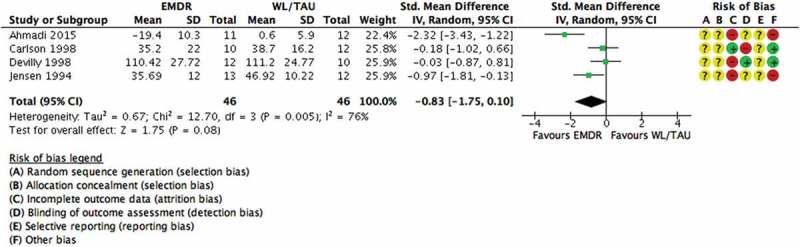
Background: Post-traumatic stress disorder (PTSD) is a major cause of morbidity amongst active duty and ex-serving military personnel. In recent years increasing efforts have been made to develop more effective treatments.Objective: To determine which psychological therapies are efficacious in treating active duty and ex-serving military personnel with post-traumatic stress disorder (PTSD).Method: A systematic review was undertaken according to Cochrane Collaboration Guidelines. The primary outcome measure was reduction in PTSD symptoms and the secondary outcome dropout.Results: Twenty-four studies with 2386 participants were included. Evidence demonstrated that CBT with a trauma focus (CBT-TF) was associated with the largest evidence of effect when compared to waitlist/usual care in reducing PTSD symptoms post treatment (10 studies; n = 524; SMD −1.22, −1.78 to −0.66). Group CBT-TF was less effective when compared to individual CBT-TF at reducing PTSD symptoms post treatment (1 study; n = 268; SMD −0.35, −0.11 to −0.59). Eye Movement Desensitization and Reprocessing (EMDR) therapy was not effective when compared to waitlist/usual care at reducing PTSD symptoms post treatment (4 studies; n = 92; SMD −0.83, −1.75 to 0.10). There was evidence of greater dropout from CBT-TF therapies compared to waitlist and Present Centred Therapy.Conclusions: The evidence, albeit limited, supports individual CBT-TF as the first-line psychological treatment of PTSD in active duty and ex-serving personnel. There is evidence for Group CBT-TF, but this is not as strong as for individual CBT-TF. EMDR cannot be recommended as a first line therapy at present and urgently requires further evaluation. Lower effect sizes than for other populations with PTSD and high levels of drop-out suggest that CBT-TF in its current formats is not optimally acceptable and further research is required to develop and evaluate more effective treatments for PTSD and complex PTSD in active duty and ex-serving military personnel.
Overview
The claims and statistics of this paper haven’t been checked yet.
Free: it reads the open-access text and checks the first 5 claims that cite a source we can check. Create a free account to check every claim.
Integrity signals
Registry
Cites
Statistics
Figures
Verification
Claims the paper makes
The claims and statistics of this paper haven’t been checked yet.
Free: it reads the open-access text and checks the first 5 claims that cite a source we can check. Create a free account to check every claim.
Claims other papers make about this one
Each is checked against this paper’s own text: does it say what the citing paper says it does?
The source backs part of the claim, not all of it — or backs it for a different population, condition or comparison.
In the citing paper
“none has been fully effective in its treatment (Kitchiner 2019)”
From Psychosocial interventions for survivors of rape and sexual assault experienced during adulthood (2023) · cites this paper as Kitchiner 2019
Experimental — accuracy not yet measuredThe source backs part of the claim, not all of it — or backs it for a different population, condition or comparison.
In the citing paper
“Post‐treatment reduction in PTSD exceeded an effect size criterion for clinical significance (standardised mean difference (SMD) ≥ 0.8) suggested by Kitchiner 2019.”
From Psychosocial interventions for survivors of rape and sexual assault experienced during adulthood (2023) · cites this paper as Kitchiner 2019
Experimental — accuracy not yet measuredThe cited source says what the claim attributes to it.
In the citing paper
“Several previous reviews of interventions for PTSD have included sexual violence and abuse survivors as a subset of the overall trauma population (Hetrick 2010; Kitchiner 2019; Roberts 2015; Roberts 2016; Steenkamp 2015)”
From Psychosocial interventions for survivors of rape and sexual assault experienced during adulthood (2023) · cites this paper as Kitchiner 2019
The cited source says what the claim attributes to it.
In the citing paper
“Our review diverges from previous findings in respect of EMDR (Kitchiner 2019), where no benefit was detected for reducing PTSD in active duty and ex‐serving military personnel with PTSD.”
From Psychosocial interventions for survivors of rape and sexual assault experienced during adulthood (2023) · cites this paper as Kitchiner 2019
The cited source says what the claim attributes to it.
In the citing paper
“Previously, it has been shown that dropout among active and ex-service military personnel is higher for TF-CBT than present-centred therapy, especially where prolonged exposure is used [155].”
Self-check
Percentages, sums and reported differences re-computed from the paper’s own numbers.
The self-check needs the paper’s full text.
Citations
Cites
The Cochrane Collaboration's tool for assessing risk of bias in randomised trials
Higgins, J. P. T., Altman, D. G., Gotzsche, P. C., Juni, P., Moher, D., Oxman, A. D., Savovic, J., Schulz, K. F., Weeks, L., Sterne, J. A. C., et al. (2011) · BMJ · doi:10.1136/bmj.d5928 · Cited by 33,817
Dermyshi, E., Wang, Y., Yan, C., Hong, W., Qiu, G., Gong, X., & Zhang, T. (2017) · Neonatology · doi:10.1159/000454668 · Cited by 24,451
The development of a Clinician-Administered PTSD Scale
Blake, D. D., Weathers, F. W., Nagy, L. M., Kaloupek, D. G., Gusman, F. D., Charney, D. S., & Keane, T. M. (1995) · Journal of Traumatic Stress · doi:10.1002/jts.2490080106 · Cited by 5,024 · cited 2×
“the Clinician Administered PTSD Scale (CAPS) (Blake et al., 1995)).”
Moral injury and moral repair in war veterans: A preliminary model and intervention strategy
Litz, B. T., Stein, N., Delaney, E., Lebowitz, L., Nash, W. P., Silva, C., & Maguen, S. (2009) · Clinical Psychology Review · doi:10.1016/j.cpr.2009.07.003 · Cited by 2,738 · cited 1×
“Reasons for dropping out will be multi-factorial, and may be due to extended, repeated, and intense nature of deployment trauma (Price, Gros, Strachan, Ruggiero, & Acierno, 2013) and service members being exposed to threats to life and morally compromising experiences that may require different treatment approaches (L…”
BackgroundThe Cochrane Database of Systematic Reviews
Handoll, H. H. (2004) · The British Journal of Hand Therapy · doi:10.1177/175899830400900201 · Cited by 1,513
Foa, E. B., Rothbaum, B. O., Riggs, D. S., & Murdock, T. B. (1991) · Journal of Consulting and Clinical Psychology · doi:10.1037/0022-006x.59.5.715 · Cited by 1,444
Resick, P. A., Nishith, P., Weaver, T. L., Astin, M. C., & Feuer, C. A. (2002) · Journal of Consulting and Clinical Psychology · doi:10.1037/0022-006x.70.4.867 · Cited by 1,294
Psychotherapy for Military-Related PTSD: A Review of Randomized Clinical Trials
Steenkamp, M. M., Litz, B. T., Hoge, C. W., & Marmar, C. R. (2015) · JAMA · doi:10.1001/jama.2015.8370 · Cited by 958
Cognitive processing therapy for veterans with military-related posttraumatic stress disorder.
Monson, C. M., Schnurr, P. P., Resick, P. A., Friedman, M. J., Young-Xu, Y., & Stevens, S. P. (2006) · Journal of Consulting and Clinical Psychology · doi:10.1037/0022-006x.74.5.898 · Cited by 865 · cited 22×
“Thirteen studies contained participants deployed to either Iraq or Afghanistan (Castillo et al., 2016; Foa et al., 2018; Forbes et al., 2012; Gray et al., 2017; McLay et al., 2017, 2011; Monson et al., 2006; Rauch et al., 2015; Reger et al., 2016; Resick et al., 2017, 2015; Sautter et al., 2015; Tylee et al., 2017; Ye…”
BackgroundInfluentialPsychological therapies for chronic post-traumatic stress disorder (PTSD) in adults
Bisson, J. I., Roberts, N. P., Andrew, M., Cooper, R., & Lewis, C. (2013) · Cochrane Database of Systematic Reviews · doi:10.1002/14651858.cd003388.pub4 · Cited by 829
Self-citation
Research works printed but not linked: 1
- RevMan (2014). Review manager 5 (RevMan 5) [Computer program] version 5.3. Copenhagen: The Nordic Cochrane Centre The Cochrane Collaboration.
Cited by
Coventry, P. A., Meader, N., Melton, H., Temple, M., Dale, H., Wright, K., Cloitre, M., Karatzias, T., Bisson, J., Roberts, N. P., et al. (2020) · PLoS Medicine · doi:10.1371/journal.pmed.1003262 · Cited by 358
“Previously, it has been shown that dropout among active and ex-service military personnel is higher for TF-CBT than present-centred therapy, especially where prolonged exposure is used [155].”
BackgroundSelf-citationReviewing the Potential of Psychedelics for the Treatment of PTSD
Krediet, E., Bostoen, T., Breeksema, J., van Schagen, A., Passie, T., & Vermetten, E. (2020) · International Journal of Neuropsychopharmacology · doi:10.1093/ijnp/pyaa018 · Cited by 260
“Yet, even after multiple modalities of psychotherapy, PTSD often remains a chronic illness, with high rates of psychiatric and medical comorbidity (Steenkamp et al., 2015; Bryant et al., 2016; Kitchiner et al., 2019).”
BackgroundPsychological treatments for post-traumatic stress disorder in adults: a network meta-analysis
Mavranezouli, I., Megnin-Viggars, O., Daly, C., Dias, S., Welton, N. J., Stockton, S., Bhutani, G., Grey, N., Leach, J., Greenberg, N., et al. (2020) · Psychological Medicine · doi:10.1017/s0033291720000070 · Cited by 212
“The recommendation for EMDR was restricted to people with non-combat-related trauma, as evidence from sub-group pairwise meta-analysis suggested a non-significant effect on people with combat-related trauma, a finding that was confirmed by a recent systematic review and meta-analysis (Kitchiner et al., 2019).”
BackgroundSchnurr, P. P., Chard, K. M., Ruzek, J. I., Chow, B. K., Resick, P. A., Foa, E. B., Marx, B. P., Friedman, M. J., Bovin, M. J., Caudle, K. L., et al. (2022) · JAMA Network Open · doi:10.1001/jamanetworkopen.2021.36921 · Cited by 185
Prevention and treatment of PTSD: the current evidence base
Bisson, J. I., & Olff, M. (2021) · European Journal of Psychotraumatology · doi:10.1080/20008198.2020.1824381 · Cited by 150
Self-citationBrewin, C. R., Atwoli, L., Bisson, J. I., Galea, S., Koenen, K. C., & Lewis‐Fernández, R. (2025) · World Psychiatry · doi:10.1002/wps.21269 · Cited by 142
“Interestingly, a meta-analysis of TF-CBTs for veterans 368 found that the strongest effect sizes were for RCTs of reconsolidation of traumatic memories.”
Self-citationEdwards‐Stewart, A., Smolenski, D. J., Bush, N. E., Cyr, B., Beech, E. H., Skopp, N. A., & Belsher, B. E. (2021) · Journal of Traumatic Stress · doi:10.1002/jts.22653 · Cited by 79
“Research has further demonstrated that treatment dropout rates for TFTs appear to be higher relative to non-TFTs (Belsher et al., 2019; Berke et al., 2019; Imel et al., 2013; Kitchiner et al., 2019).”
BackgroundA decennial review of psychotraumatology: what did we learn and where are we going?
Olff, M., Amstadter, A., Armour, C., Birkeland, M. S., Bui, E., Cloitre, M., Ehlers, A., Ford, J. D., Greene, T., Hansen, M., et al. (2019) · European Journal of Psychotraumatology · doi:10.1080/20008198.2019.1672948 · Cited by 78
Self-citationJones, C., Miguel-Cruz, A., Smith-MacDonald, L., Cruikshank, E., Baghoori, D., Kaur Chohan, A., Laidlaw, A., White, A., Cao, B., Agyapong, V., et al. (2020) · JMIR mHealth and uHealth · doi:10.2196/22079 · Cited by 62
“Psychotherapeutic interventions most strongly recommended for military members, veterans, and PSP include CPT, CBT, PE, and EMDR [34-38].”
BackgroundInfluentialvan Gelderen, M. J., Nijdam, M. J., Haagen, J. F. G., & Vermetten, E. (2020) · Psychotherapy and Psychosomatics · doi:10.1159/000505977 · Cited by 59
Litz, B. T., Rusowicz-Orazem, L., Doros, G., Grunthal, B., Gray, M., Nash, W., & Lang, A. J. (2021) · Psychiatry Research · doi:10.1016/j.psychres.2021.113761 · Cited by 59
Doody, C. B., Robertson, L., Cox, K. M., Bogue, J., Egan, J., & Sarma, K. M. (2021) · Cochrane Database of Systematic Reviews · doi:10.1002/14651858.cd013242.pub2 · Cited by 85
The Current Status of EMDR Therapy, Specific Target Areas, and Goals for the Future
Matthijssen, S. J. M. A., Lee, C. W., de Roos, C., Barron, I. G., Jarero, I., Shapiro, E., Hurley, E. C., Schubert, S. J., Baptist, J., Amann, B. L., et al. (2020) · Journal of EMDR Practice and Research · doi:10.1891/emdr-d-20-00039 · Cited by 48
“A review undertaken according to Cochrane Collaboration Guidelines (Kitchiner et al., 2019) echoed this conclusion, but also stated that this is counterintuitive given the proliferation of EMDR therapy used around the world, and the non-RCT evidence showing that EMDR is successful in treating PTSD related to active du…”
Hoppen, T. H., Meiser‐Stedman, R., Kip, A., Birkeland, M. S., & Morina, N. (2024) · The Lancet Psychiatry · doi:10.1016/s2215-0366(23)00373-5 · Cited by 111
Bisson, J. I., van Deursen, R., Hannigan, B., Kitchiner, N., Barawi, K., Jones, K., Pickles, T., Skipper, J., Young, C., Abbott, L. R., et al. (2020) · Acta Psychiatrica Scandinavica · doi:10.1111/acps.13200 · Cited by 43
“Unfortunately, many veterans remain symptomatic despite evidence-based treatment and research suggest that psychological treatments for PTSD may not be as effective for veterans as for other populations (2, 3).”
BackgroundSelf-citationPsychosocial interventions for survivors of rape and sexual assault experienced during adulthood
O'Doherty, L., Whelan, M., Carter, G. J., Brown, K., Tarzia, L., Hegarty, K., Feder, G., & Brown, S. J. (2023) · Cochrane Database of Systematic Reviews · doi:10.1002/14651858.cd013456.pub2 · Cited by 37
Toward staging differentiation for posttraumatic stress disorder treatment
Nijdam, M. J., Vermetten, E. H. G. J. M., & McFARLANE, A. C. (2022) · Acta Psychiatrica Scandinavica · doi:10.1111/acps.13520 · Cited by 47
Jacoby, V. M., Straud, C. L., Bagley, J. M., Tyler, H. C., Baker, S. N., Denejkina, A., Sippel, L. M., Kaya, R., Rozek, D. C., Fina, B. A., et al. (2022) · Journal of Traumatic Stress · doi:10.1002/jts.22812 · Cited by 41
Dighton, G., Wood, K., Armour, C., Fossey, M. J., Hogan, L., Kitchiner, N., Larcombe, J., Rogers, R. D., & Dymond, S. (2022) · International Gambling Studies · doi:10.1080/14459795.2022.2063923 · Cited by 38
“, 2018) and, although research focussing on comorbidites is limited, the association between C-PTSD and poor treatment outcomes for veterans is relatively well understood (Kitchiner et al., 2019; Murphy et al., 2019; Phelps et al., 2018).”
BackgroundSelf-citationGallegos, A. M., Heffner, K. L., Cerulli, C., Lück, P., McGuinness, S., & Pigeon, W. R. (2020) · Psychological Trauma Theory Research Practice and Policy · doi:10.1037/tra0000975 · Cited by 40
Hoppen, T. H., Kip, A., & Morina, N. (2023) · Journal of Anxiety Disorders · doi:10.1016/j.janxdis.2023.102684 · Cited by 32
Lehrner, A. L., Hildebrandt, T., Bierer, L. M., Flory, J. D., Bader, H. N., Makotkine, I., & Yehuda, R. (2021) · Behaviour Research and Therapy · doi:10.1016/j.brat.2021.103924 · Cited by 31
PTSD networks of veterans with combat versus non-combat types of index trauma
Macia, K. S., Raines, A. M., Maieritsch, K. P., & Franklin, C. L. (2020) · Journal of Affective Disorders · doi:10.1016/j.jad.2020.08.027 · Cited by 25
Koek, R. J., Avecillas-Chasin, J. M., Krahl, S. E., Chen, J. W. Y., Sultzer, D. L., Kulick, A. D., Mandelkern, M. A., Malpetti, M., Gordon, H. L., Landry, H. N., et al. (2024) · Journal of Psychiatric Research · doi:10.1016/j.jpsychires.2024.05.008 · Cited by 27
Liyanage, S. K., Addison, S., Ham, E., & Hilton, N. Z. (2021) · Journal of Clinical Nursing · doi:10.1111/jocn.16076 · Cited by 28
Walter, K. H., Hunt, W. M., Otis, N. P., Kline, A. C., Miggantz, E. L., Thomsen, C. J., & Glassman, L. H. (2023) · Psychiatry Research · doi:10.1016/j.psychres.2023.115330 · Cited by 24
“evidence-based PTSD interventions (Jacoby et al., 2022; Kitchiner et al., 2019; McLean et al., 2022; Steenkamp et al., 2015; Straud et al., 2019), the current trial showed substantial improvements in PTSD and depression outcomes following both BA+CPT and CPT.”
Backgroundvan Gelderen, M. J., Nijdam, M. J., de Vries, F., Meijer, O. C., & Vermetten, E. H. G. J. M. (2020) · Journal of Psychiatric Research · doi:10.1016/j.jpsychires.2020.08.011 · Cited by 34
“Veterans tend to benefit less from PTSD treatment as compared to other populations (Bisson et al., 2013; Kitchiner et al., 2019), which has been related to difficulties with engaging in treatment (Hundt et al., 2018).”
BackgroundMorris, H., Hatzikiriakidis, K., Savaglio, M., Dwyer, J., Lewis, C., Miller, R., & Skouteris, H. (2022) · Journal of Traumatic Stress · doi:10.1002/jts.22792 · Cited by 31
Self-citationvan Gelderen, M. J., Nijdam, M. J., Dubbink, G. E., Sleijpen, M., & Vermetten, E. H. G. J. M. (2020) · European Journal of Psychotraumatology · doi:10.1080/20008198.2020.1829400 · Cited by 22
“The causes of lower treatment outcomes in veterans are likely to be multi-factorial, but high drop-out has been identified as a central issue (Hoge et al., 2014; Kitchiner et al., 2019; Steenkamp, Litz, Hoge, & Marmar, 2015).”
BackgroundSpiller, T. R., Duek, O. A., Buta, E., Gross, G. M., Smith, N. B., & Harpaz‐Rotem, I. (2022) · Psychological Medicine · doi:10.1017/s0033291722001441 · Cited by 16
Niemeyer, H., Lorbeer, N., Mohr, J., Baer, E., & Knaevelsrud, C. (2021) · Journal of Affective Disorders · doi:10.1016/j.jad.2021.12.056 · Cited by 20
Trauma under psychedelics: how psychoactive substances impact trauma processing
Netzer, O., Magal, N., Stern, Y., Polinsky, T., Gross, R., Admon, R., & Salomon, R. (2025) · World Psychiatry · doi:10.1002/wps.21363 · Cited by 20
Representaciones sociales de un grupo de excombatientes sobre el cumplimiento del Acuerdo de Paz
Gamboa, A. J. P., Castillo, V. S., & Cano, C. A. G. (2023) · Pensamiento Americano · doi:10.21803/penamer.16.31.651 · Cited by 13
Steven, L., Hauw, J. K., Keane, M. B., & Gunawan, A. A. S. (2023) · Procedia Computer Science · doi:10.1016/j.procs.2023.10.596 · Cited by 27
Simpson, E. L., Carroll, C., Sutton, A., Forsyth, J. E., Rayner, A., Ren, S., Franklin, M. K., & Wood, E. (2025) · British Journal of Psychology · doi:10.1111/bjop.70005 · Cited by 21
“…trials (RCT) (the gold standard for evaluating effectiveness) rather than including observational studies, is more recent (Hudays et al., 2022; Kitchiner et al., 2019; Maglione et al., 2022; McGowan et al., 2016; Morris et al., 2022; National Institute for Health and Care Excellence, 2018)…”
Hamilton, T., Burback, L., Smith‐MacDonald, L., Jones, C., Brown, M. R. G., Mikolas, C., Tang, E., O’Toole, K., Vergis, P., Merino, A., et al. (2021) · Frontiers in Psychiatry · doi:10.3389/fpsyt.2021.779829 · Cited by 16
How past trauma impacts emotional intelligence: Examining the connection
Gottfredson, R. K., & Becker, W. J. (2023) · Frontiers in Psychology · doi:10.3389/fpsyg.2023.1067509 · Cited by 28
Xu, G., Li, G., Yang, Q., Li, C., & Liu, C. (2023) · Stress and Health · doi:10.1002/smi.3292 · Cited by 16
Mental Health Outcomes of Peer-led Therapeutic Adventure for Military Veterans
Bettmann, J. E., Anderson, I., Makouske, J., & Hanley, A. W. (2021) · Journal of Experiential Education · doi:10.1177/10538259211049535 · Cited by 20
“Among the veterans receiving PTSD treatments offered by the VA, only a fraction met the threshold of clinically significant gains and several had higher dropout rates than waitlist control groups (Goetter et al., 2015; Kitchiner et al., 2019).”
BackgroundPrguda, E., Evans, J., McLeay, S. C., Romaniuk, M., Phelps, A. J., Lewis, K., Brown, K., Fisher, G., Lowrie, F., Saunders‐Dow, E., et al. (2023) · Journal of Clinical Psychology · doi:10.1002/jclp.23561 · Cited by 13
Sayer, N. A., Stirman, S. W., Rosen, C. S., Kehle‐Forbes, S., Spoont, M. R., Eftekhari, A., Chard, K. M., Kaplan, A. N., & Nelson, D. B. (2023) · Journal of Consulting and Clinical Psychology · doi:10.1037/ccp0000832 · Cited by 11
O’Doherty, L., Carter, G., sleath, E., Brown, K., Brown, S., Lutman, E., Jackson, L., Heron, J. E., Kalsi, P., Ladeinde, O. C., et al. (2024) · Health and Social Care Delivery Research · doi:10.3310/ctgf3870 · Cited by 16
Jin, J., Weiman, K., Brémault‐Phillips, S., & Vermetten, E. H. G. J. M. (2022) · Frontiers in Psychiatry · doi:10.3389/fpsyt.2022.880442 · Cited by 12
Smith‐MacDonald, L., Jones, C., Brown, M. R. G., Dunleavy, R. S., VanderLaan, A., Kaneva, Z., Hamilton, T., Burback, L., Vermetten, E. H. G. J. M., & Brémault‐Phillips, S. (2023) · International Journal of Environmental Research and Public Health · doi:10.3390/ijerph20075415 · Cited by 12
“The fact that military-related trauma may not be fully explained by a fear-based paradigm may support this idea, especially since veterans do not respond as well to existing evidence-based PTSD interventions compared to civilians [18,19].”
BackgroundKip, A., Iseke, L. N., Papola, D., Gastaldon, C., Barbui, C., & Morina, N. (2022) · Clinical Psychology Review · doi:10.1016/j.cpr.2022.102239 · Cited by 11
Sexual assault as a public health problem and other developments in psychotraumatology
Olff, M. (2022) · European Journal of Psychotraumatology · doi:10.1080/20008198.2022.2045130 · Cited by 9
Kline, A. C., Otis, N. P., Crocker, L. D., Glassman, L. H., Hunt, W. M., & Walter, K. H. (2025) · Journal of Psychiatric Research · doi:10.1016/j.jpsychires.2025.01.010 · Cited by 8
Kip, A., Ritter, L., Hoppen, T. H., Papola, D., Ostuzzi, G., Barbui, C., & Morina, N. (2025) · Journal of Anxiety Disorders · doi:10.1016/j.janxdis.2025.103017 · Cited by 17
de Rijk, L., Campbell, G. M., Greenberg, N. L., & Murphy, D. (2023) · European Journal of Trauma & Dissociation · doi:10.1016/j.ejtd.2023.100326 · Cited by 8
Research on Low-Intensity Flash Technique Trauma Intervention by Prelicensed Student Clinicians
Gustavson, K., Wong, S.-L., & Le, D. (2023) · Journal of EMDR Practice and Research · doi:10.1891/emdr-2022-0059 · Cited by 7
Shea, M. T., KRUPNICK, J. L., Sautter, F. J., Mete, M., Green, B. L., Norman, S. B., Finley, S. L., & Eaton, E. M. (2023) · Journal of Anxiety Disorders · doi:10.1016/j.janxdis.2023.102770 · Cited by 9
French, L. M., Brickell, T. A., Lippa, S. M., Rogers, A. A., Cristaudo, K. E., Walker, T., Higgins, M., Bailie, J. M., Kennedy, J. E., Hungerford, L. D., et al. (2024) · Journal of Affective Disorders · doi:10.1016/j.jad.2024.05.015 · Cited by 10
Jones, C., Smith‐MacDonald, L., Brown, M. R. G., VanDehy, J., Grunnet-Jepsen, R., Ordek, V. P., Kruger, S. E., Gerhart, A. A., van Veelen, N., Nijdam, M. J., et al. (2022) · JMIR Human Factors · doi:10.2196/33682 · Cited by 11
“…but may include geographical proximity to services, perceived stigma from self and others, challenges managing operational demands of a military career with therapy attendance, barriers to establishing patient-therapist rapport, and the aforementioned issues with treatment effectiveness [19,20].”
Smith‐MacDonald, L., Pike, A., Jones, C., & Brémault‐Phillips, S. (2022) · Trauma Care · doi:10.3390/traumacare2020010 · Cited by 9
Pilot Study: The Effects of a Mountain Wilderness Experience on Combat Veteran Psychosocial Wellness
Vella, E. J., Lyman, T., & Lovering, T. (2023) · Military Behavioral Health · doi:10.1080/21635781.2023.2221463 · Cited by 6
The reconsolidation using rewind study (RETURN): trial protocol
Wright, L. A., Barawi, K., Simon, N. A., Lewis, C., Muss, D., Roberts, N. P., Kitchiner, N., & Bisson, J. I. (2021) · European Journal of Psychotraumatology · doi:10.1080/20008198.2020.1844439 · Cited by 10
Self-citationKline, A. C., Otis, N. P., Panza, K. E., McCabe, C. T., Glassman, L. H., Campbell, J. S., & Walter, K. H. (2024) · Journal of Psychiatric Research · doi:10.1016/j.jpsychires.2024.03.010 · Cited by 8
Gausemel, Å., & Filkuková, P. (2024) · Frontiers in Psychology · doi:10.3389/fpsyg.2024.1291961 · Cited by 7
Otis, N. P., Kline, A. C., Glassman, L. H., Hunt, W. M., & Walter, K. H. (2025) · Behaviour Research and Therapy · doi:10.1016/j.brat.2025.104753 · Cited by 4
Lancaster, S. L., Renno, S., & Linkh, D. J. (2025) · Journal of Traumatic Stress · doi:10.1002/jts.70008 · Cited by 5
“As noted, the treat-ment outcomes for EMDR in the current study demonstrated large effect sizes, comparable to PE and CPT, a finding that is not consistent in military populations (Kitchiner et al., 2019).”
Pang, T., Murn, L. T., Williams, D., Lawental, M., Abhayakumar, A., & Kip, K. E. (2021) · Military Medicine · doi:10.1093/milmed/usab335 · Cited by 5
Hannigan, B., Deursen, R. W. M. V., Barawi, K., Kitchiner, N., & Bisson, J. I. (2023) · PLoS ONE · doi:10.1371/journal.pone.0285763 · Cited by 6
Self-citationWilliston, S. K., Kruepke, M., Grossman, D., Litwack, S. D., & Niles, B. L. (2021) · Cognitive and Behavioral Practice · doi:10.1016/j.cbpra.2021.06.002 · Cited by 4
Holens, P. L., Rock, L., Buhler, J. N., Southall, M., Imbrogno, L., Desorcy-Nantel, C., & Romaniuk, A. (2021) · Journal of Military Veteran and Family Health · doi:10.3138/jmvfh-2021-0049 · Cited by 4
Moral Injury in a Military Context
Vermetten, E. H. G. J. M., Jetly, R., Smith‐MacDonald, L., Jones, C., & Brémault‐Phillips, S. (2023) · Springer eBooks · doi:10.1007/978-3-031-18009-5_14 · Cited by 9
Museum-based art therapy and wellbeing programme: experiences of veterans with PTSD
Baumann, J., Biscoe, N., Burnell, K. J., Lobban, J., & Murphy, D. (2023) · International Journal of Art Therapy · doi:10.1080/17454832.2023.2188409 · Cited by 3
Kline, A. C., Otis, N. P., Norman, S. B., Hunt, W. M., & Walter, K. H. (2024) · Psychotherapy Research · doi:10.1080/10503307.2024.2325519 · Cited by 4
“Better understanding attendance among active duty service members is particularly important given evidence of attenuated response to evidence-based PTSD interventions (Kitchiner et al., 2019; Steen-kamp et al., 2015).”
Reij, K. M., de Jongh, A., Swens, E. P., & Voorendonk, E. M. (2025) · European Journal of Psychotraumatology · doi:10.1080/20008066.2025.2511571 · Cited by 3
“Post-traumatic stress disorder (PTSD) is a prevalent mental health condition among veterans and a leading cause of morbidity among active and ex-military personnel (Kitchiner et al., 2019).”
Levy, E., Farchi, M. U., Manor-Binyamini, I., Turgeman, O., Matiash, C., Sloutsky, G., Manor, N., Hogesta, N., Goshen, N., & Gidron, Y. (2026) · Military Psychology · doi:10.1080/08995605.2025.2590321 · Cited by 2
“Moreover, studies show that military service is a risk factor for the service member and might lead to stress symptoms(Copeland et al., 2023; Jacoby et al., 2022; Kitchiner et al., 2019) which were associated with greater levels of stress in the spouse (Donoho et al., 2017).”
THE RECONSOLIDATION OF TRAUMATIC MEMORIES (RTM) PROTOCOL FOR PTSD: A TREATMENT THAT WORKS
Gray, R. (2022) · Psychological applications and trends · doi:10.36315/2022inpact068 · Cited by 2
Vermetten, E. H. G. J. M., & Wit, J. (2023) · Medical Research Archives · doi:10.18103/mra.v11i11.4503 · Cited by 7
MDMA for treatment of PTSD and neurorehabilitation in military populations
Dunn, W., Bershad, A. K., Krantz, D. E., & Vermetten, E. H. G. J. M. (2024) · Neurorehabilitation · doi:10.3233/nre-230270 · Cited by 2
“This anxiety and distress partly explain the early treatment discontinuation and high drop-out rates seen with current TFTs (Edwards-Stewart et al., 2021; Kitchiner et al., 2019).”
Trivedi, G. Y., Pandya, N., Thakore, P., Ramani, H., Trivedi, R. G., & Kathirvel, S. (2024) · European Journal of Trauma & Dissociation · doi:10.1016/j.ejtd.2024.100480 · Cited by 2
Motoziuk, L., Чорна, Н., Lukashuk, M., Vlasov, V., & Sobkova, S. (2024) · International Journal of Statistics in Medical Research · doi:10.6000/1929-6029.2024.13.23 · Cited by 2
“[15] showed that mild PTSD is effectively treated with cognitive-biobehavioral therapy.”
Prevention and Treatment of Post-Traumatic Stress Disorder (PTSD)
Gasyuk, M., Tverdokhlib, N., Широбоков, Ю., Mahanova, T. V., & Щербакова, О. (2023) · Revista de Cercetare si Interventie Sociala · doi:10.33788/rcis.81.5 · Cited by 2
Горбунова, В., & Hampton, R. (2025) · European Journal of Psychotraumatology · doi:10.1080/20008066.2025.2499410 · Cited by 1
“…active duty and ex-serving military personnel with PTSD put the RTM Protocol together with TF-CBT as approaches that met the threshold for clinical importance and recommended taking the RTM Protocol under consideration as a valid alternative to more established paradigms (Kitchiner et al., 2019).”
Dare, H., Kitchiner, N., & O'Connor, G. (2025) · BMJ Military Health · doi:10.1136/military-2025-002999 · Cited by 1
Self-citationExploring the Consequences of Body Disfigurement on Veterans: An Integrative Review
Orondo, J. M., & Freysteinson, W. M. (2025) · Creative Nursing · doi:10.1177/10784535251365983 · Cited by 2
Sutton, A., Carroll, C., Simpson, E. L., Forsyth, J. E., Rayner, A., Ren, S., Franklin, M. K., & Wood, E. (2025) · Clinical Psychology & Psychotherapy · doi:10.1002/cpp.70186 · Cited by 1
“Previous research has primarily focused on adult populations, exploring EMDR's effectiveness in various trauma contexts, such as combat, natural disasters and displacement (Kitchiner et al. 2019; Le Roux and Cobham 2022; Macgowan et al. 2022; Maglione et al. 2022).”
Kline, A. C., Crocker, L. D., Otis, N. P., Glassman, L. H., Hunt, W. M., & Walter, K. H. (2026) · Journal of Behavioral and Cognitive Therapy · doi:10.1016/j.jbct.2025.100567 · Cited by 1
The STRONG STAR adverse events monitoring program for psychological health clinical trials
Peterson, A. L., Roache, J. D., Brundige, A. R., & Young‐McCaughan, S. (2026) · Contemporary Clinical Trials · doi:10.1016/j.cct.2026.108302 · Cited by 1
Farmer, C. M., & Dong, L. (2020) · RAND Corporation eBooks · doi:10.7249/rra337-1 · Cited by 2
Nature videos for PTSD: protocol for a mixed-methods feasibility study
Knaust, T., Felnhofer, A., Kothgassner, O. D., Reinke, M., Browning, M. H. E. M., Höllmer, H., & Schulz, H. (2022) · European Journal of Psychotraumatology · doi:10.1080/20008198.2022.2101765 · Cited by 6
Akwe, J. A., & Hall, M. A. K. (2023) · Cureus · doi:10.7759/cureus.37309 · Cited by 1
Schnurr, P. P., Norman, S. B., & Hamblen, J. L. (2020) · JAMA · doi:10.1001/jama.2020.7548 · Cited by 3
Walker, D. D., Walton, T. O., Jaffe, A. E., Graupensperger, S. A., Rhew, I. C., & Kaysen, D. L. (2022) · SSRN Electronic Journal · doi:10.2139/ssrn.4136965 · Cited by 1
PTSD Treatments for Veterans—Reply
Steenkamp, M. M., Litz, B. T., & Marmar, C. R. (2020) · JAMA · doi:10.1001/jama.2020.7554
Jadhakhan, F., Evans, D. W., & Falla, D. (2022) · BMJ Open · doi:10.1136/bmjopen-2022-065590
EMDR Therapy with Military Veterans
Whybrow, D., Kitchiner, N., Williams, V. R., Graham, J., Hurley, E. C., & Kiernan, M. D. (2023) · Oxford University Press eBooks · doi:10.1093/oxfordhb/9780192898357.013.30
Self-citationLe statut actuel de la thérapie EMDR, les domaines cibles spécifiques et les objectifs pour l’avenir
Matthijssen, S. J. M. A., Lee, C. W., de Roos, C., Barron, I. G., Jarero, I., Shapiro, E., Hurley, E. C., Schubert, S. J., Baptist, J. A., Amann, B. L., et al. (2023) · Journal of EMDR Practice and Research · doi:10.1891/emdr-2023-0012
Grove, A. B., Green, B. A., Kaye, S. M., & Sheerin, C. M. (2024) · Brain Sciences · doi:10.3390/brainsci14020129 · Cited by 5
“While PE, CPT, and EMDR have been shown to be efficacious treatments for PTSD [48–51], the effect sizes for these frontline, evidence-based, trauma-focused treatments for PTSD remain modest [52].”
BackgroundIt Takes a Village: An Examination of Social Relationships and Mental Health
Trubits, E. F. (2024) · PDXScholar (Portland State University) · doi:10.15760/etd.3716
Post-traumatic Stress Disorder
Bisson, J. I. (2024) · Cambridge University Press eBooks · doi:10.1017/9781911623861.015 · Cited by 1
Self-citationZimmermann, P. L., Herr, K., Alliger‐Horn, C., Willmund, G., Wesemann, U., Kropp, S., Rau, H., Walther, A.-S., & Langner, F. (2024) · Trauma und Gewalt · doi:10.21706/tg-18-1-72
Gray, R. M., & Bourke, F. (2024) · Journal of Military Veteran and Family Health · doi:10.3138/jmvfh-0718-0025
Gray, R. M., & Bourke, F. (2024) · Journal of Military Veteran and Family Health · doi:10.3138/jmvfh-0718-0004
PTSD, cannabis use, and expected symptom relief: gender-moderated mediational effects
Ueno, L. F. (2023) · Scholars Archive - University at Albany (University at Albany, State University of New York) · doi:10.54014/n5dz-yakb
Walter, K. H., Otis, N. P., Crocker, L. D., Myers, H. C., Elliott, K. T. K., & Michalewicz-Kragh, B. (2025) · Frontiers in Human Neuroscience · doi:10.3389/fnhum.2025.1638576
Lebowitz, M., Halevi, G., Lowell, G. H., Ritchie, Z., Later, M. E., Chalom, E., Schudy, E. M., & MOSKOWITZ, H. R. (2025) · Journal of Textile Engineering & Fashion Technology · doi:10.15406/jteft.2025.11.00421
Metadata
- Authors
- Kitchiner, N. J., Lewis, C., Roberts, N. P., & Bisson, J. I.
- Affiliations
- Cardiff and Vale University Health Board (GB)
- Cardiff University (GB)
- Corresponding author
- Kitchiner, Neil J.
- Venue
- European Journal of Psychotraumatology
- Publisher
- Informa UK Limited
- Published
- 2019-11-08
- Volume
- 10
- Issue
- 1
- Pages
- 1684226-1684226
- ISSN
- 2000-8066 (ISSN-L)
- PMC
- PMC6853217
- OpenAlex
- W2988715426
- Cited by
- 113
- References
- 52
- Citations by year
- 2026: 13 · 2025: 17 · 2024: 15 · 2023: 24 · 2022: 16 · 2021: 13 · 2020: 14 · 2019: 1
- FWCI
- 1.74
- Type
- journal article
- Language
- en
- Open access
- gold
- doi.org
- Licence
- Locations
- European Journal of Psychotraumatology (publishedVersion, cc-by-nc)
- Europe PMC (PubMed Central) (publishedVersion, cc-by-nc)
- PubMed Central (publishedVersion, cc-by-nc)
- PubMed (publishedVersion)
- ORCA Online Research @Cardiff (Cardiff University) (acceptedVersion)
- DOAJ (DOAJ: Directory of Open Access Journals) (submittedVersion, cc-by-sa)
- Funders
- unfunded (none)
- Topics
- Social Sciences › Psychology › Clinical Psychology › Posttraumatic Stress Disorder Research
- Social Sciences › Psychology › Clinical Psychology › Psychotherapy Techniques and Applications
- Social Sciences › Psychology › Experimental and Cognitive Psychology › Sleep and related disorders
- Keywords
- post-traumatic stress disorder, military personnel, active duty military personnel, psychotherapy, trauma-focused cognitive behavioral therapy, EMDR, group cognitive behavioral therapy, dropout, treatment efficacy, complex PTSD
About these checks
Registry, retraction, Cites and statistics results are computed, not judged, with one exception: a printed reference that no index lists is read once by a model before it counts as a citation error. Claims are extracted by a model and kept only when their quote appears verbatim in the text; each cited source is then checked, with a model’s help, for whether it says what the claim relies on. Those verdicts can be wrong — read the claim’s quote and the cited source before relying on one.
Statistics and arithmetic are recomputed, not judged.
Confidence bands are shown only for fields calibrated on our annotated test set. None is calibrated yet, so no band is shown.
What counts as a claim ›How we measure confidence ›How we check this ›
Are you an author, or do you see a problem with this page? Request a review
Data sources
Bibliographic data: Semantic Scholar, OpenAlex, Crossref.
Contains information from the Semantic Scholar Academic Graph Datasets, made available under the ODC Attribution License (ODC-BY 1.0).
Semantic Scholar’s data is described in: Kinney, R., et al. (2023). The Semantic Scholar Open Data Platform. arXiv:2301.10140.
