

The sense of self in the aftermath of trauma: lessons from the default mode network in posttraumatic stress disorder
Open accessThe DOI matches its Crossref record; 105 of the 105 references it cites were found in a registry or an index.
Abstract
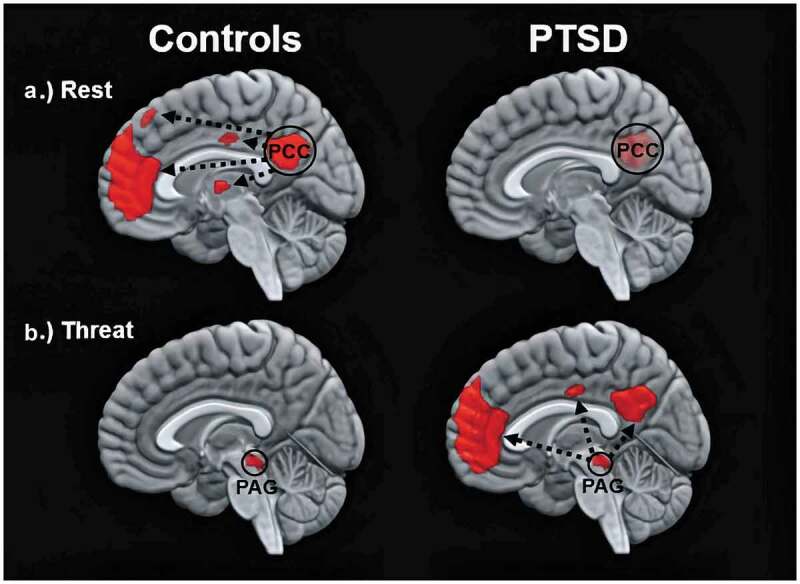
Trauma can profoundly affect the sense of self, where both cognitive and somatic disturbances to the sense of self are reported clinically by individuals with posttraumatic stress disorder (PTSD). These disturbances are captured eloquently by clinical accounts, such as, 'I do not know myself anymore,' 'I will never be able to experience normal emotions again,' and, 'I feel dead inside.' Self-related thoughts and experiences are represented neurobiologically by a large-scale, cortical network located along the brain's mid-line and referred to as the default mode network (DMN). Recruited predominantly during rest in healthy participants, the DMN is also active during self-referential and autobiographical memory processing - processes which, collectively, are thought to provide the foundation for a stable sense of self that persists across time and may be available for conscious access. In participants with PTSD, however, the DMN shows substantially reduced resting-state functional connectivity as compared to healthy individuals, with greater reductions associated with heightened PTSD symptom severity. Critically, individuals with PTSD describe frequently that their traumatic experiences have become intimately linked to their perceived sense of self, a perception which may be mediated, in part, by alterations in the DMN. Accordingly, identification of alterations in the functional connectivity of the DMN during rest, and during subliminal, trauma-related stimulus conditions, has the potential to offer critical insight into the dynamic interplay between trauma- and self-related processing in PTSD. Here, we discuss DMN-related alterations during these conditions, pointing further towards the clinical significance of these findings in relation to past- and present-centred therapies for the treatment of PTSD.
Overview
The claims and statistics of this paper haven’t been checked yet.
Free: it reads the open-access text and checks the first 5 claims that cite a source we can check. Create a free account to check every claim.
Integrity signals
Registry
Cites
Statistics
Figures
Verification
Claims the paper makes
The claims and statistics of this paper haven’t been checked yet.
Free: it reads the open-access text and checks the first 5 claims that cite a source we can check. Create a free account to check every claim.
Claims other papers make about this one
Each is checked against this paper’s own text: does it say what the citing paper says it does?
The source backs part of the claim, not all of it — or backs it for a different population, condition or comparison.
In the citing paper
“These experiences that reduce anxiety, reconfigure the sense of self in community and disengage loops of stress-evoking activation typically hidden below the level of awareness have also promoted the recent cultural selection of trance-inducing somatic and psychedelic therapies as break-through treatments for even the most intractable cases of severe psychological trauma (Lanius et al. 2020;”
From Cultural Evolution of Religion, Spirituality and Ritual: Impacts On Human Cooperation (2024) · cites this paper as Lanius et al. 2020
Experimental — accuracy not yet measuredThe source backs part of the claim, not all of it — or backs it for a different population, condition or comparison.
In the citing paper
“These individuals may seek to engage the SN and thus gain access to the DMN through intense or primally threatening somatic sensory experiences, such as car racing, extreme sports, and promiscuous sex ( van der Kolk, 1989 , 2015 ; Lanius et al., 2020 ).”
From The brain-body disconnect: A somatic sensory basis for trauma-related disorders (2022) · cites this paper as Lanius et al., 2020
Experimental — accuracy not yet measuredIn the citing paper
“Further, chronic childhood traumatization may alter development of SN and DMN circuitry, where highly activating or threatening sensory stimuli feel familiar or normal ( Lanius et al., 2020 ).”
From The brain-body disconnect: A somatic sensory basis for trauma-related disorders (2022) · cites this paper as Lanius et al., 2020
Self-check
Percentages, sums and reported differences re-computed from the paper’s own numbers.
The self-check needs the paper’s full text.
Citations
Cites
Diagnostic and Statistical Manual of Mental Disorders
American Psychiatric Association (2013) · doi:10.1176/appi.books.9780890425596 · Cited by 116,369
Diagnostic and Statistical Manual of Mental Disorders, 5th ed.
Carter, M. J. (2014) · Therapeutic Recreation Journal · Cited by 15,169
Ultrastructural Characterization of the Lower Motor System in a Mouse Model of Krabbe Disease
Cappello, V., Marchetti, L., Parlanti, P., Landi, S., Tonazzini, I., Cecchini, M., Piazza, V., & Gemmi, M. (2016) · Scientific Reports · doi:10.1038/s41598-016-0001-8 · Cited by 13,097
The Brain's Default Network: Anatomy, Function, and Relevance to Disease
Buckner, R. L., Andrews‐Hanna, J. R., & Schacter, D. L. (2008) · Annals of the New York Academy of Sciences · doi:10.1196/annals.1440.011 · Cited by 9,761 · cited 1×
“…imagery processes allow a memory to be re-experienced by recalling its more salient characteristics (i.e. emotional, sensory) – a process mediated by the medial-temporal subsystem (along with the posterior parietal cortex) (Buckner et al., 2008; Kim, 2012; Philippi, Tranel, Duff, & Rudrauf, 2013).”
BackgroundFunctional connectivity in the resting brain: a network analysis of the default mode hypothesis
Greicius, M. D., Krasnow, B., Reiss, A. L., & Menon, V. (2003) · Proceedings of the National Academy of Sciences · doi:10.1073/pnas.0135058100 · Cited by 6,358
Tulving, E. (1985) · Canadian Psychology / Psychologie canadienne · doi:10.1037/h0080017 · Cited by 4,638 · cited 2×
“self across time, occasionally referred to as ‘autonoetic consciousness’ (Fransson, 2005; Piolino et al., 2006; Tulving, 1985), where self-relevant information and events associate to produce our sense of self”
BackgroundThe construction of autobiographical memories in the self-memory system
Conway, M. A., & Pleydell-Pearce, C. W. (2000) · Psychological Review · doi:10.1037/0033-295x.107.2.261 · Cited by 4,089 · cited 1×
“…the self across time, occasionally referred to as ‘autonoetic consciousness’ (Fransson, 2005; Piolino et al., 2006; Tulving, 1985), where self-relevant information and events associate to produce our sense of self (Conway & Pleydell-Pearce, 2000; Levine, Svoboda, Hay, Winocur, & Moscovitch, 2002).”
BackgroundThe brain's default mode network
Raichle, M. E. (2015) · Annual Review of Neuroscience · doi:10.1146/annurev-neuro-071013-014030 · Cited by 3,904 · cited 2×
“…body of evidence suggests that self-referential processes, as well as past- and future-related autobiographical memory processing, are facilitated by a large-scale, intrinsic network known as the default mode network (DMN) (Greicius, Krasnow, Reiss, & Menon, 2003; for a review, see Raichle, 2015).”
BackgroundDevelopment, reliability, and validity of a dissociation scale
BERNSTEIN, E. M., & PUTNAM, F. W. (1986) · The Journal of Nervous and Mental Disease · doi:10.1097/00005053-198612000-00004 · Cited by 3,793 · cited 1×
“…like, ‘I feel dead inside,’ ‘I feel as if I am outside my body,’ ‘I feel like my body does not belong to me,’ or, ‘I feel like there is no boundary around my body’ (Bernstein & Putnam, 1986; Foa et al., 1999; Briere & Runtz, 2002; Frewen & Lanius, 2015; for a review, see Frewen et al., 2008, 2020).”
BackgroundBuckner, R. L., & Carroll, D. C. (2007) · Trends in Cognitive Sciences · doi:10.1016/j.tics.2006.11.004 · Cited by 2,691
Cited by
Items 101–164 of 164
Morton, L. (2025) · Oxford University Press eBooks · doi:10.1093/9780197804995.005.0014
Managing Anxiety About Seeing the Doctor
Morton, L. (2025) · Oxford University Press eBooks · doi:10.1093/9780197804995.005.0012
Neuroception of Psychological Safety Scale—Generic Version (NPSS-G)
Morton, L. (2025) · Oxford University Press eBooks · doi:10.1093/9780197804995.005.0017
Self-Compassionate Letter Writing
Morton, L. (2025) · Oxford University Press eBooks · doi:10.1093/9780197804995.005.0007
Neuroception of Psychological Safety Scale (NPSS): Manual and Scoring Guide
Morton, L. (2025) · Oxford University Press eBooks · doi:10.1093/9780197804995.005.0018
Pacing, Planning, and Prioritizing
Morton, L. (2025) · Oxford University Press eBooks · doi:10.1093/9780197804995.005.0013
Grounding and Mindfulness Exercises
Morton, L. (2025) · Oxford University Press eBooks · doi:10.1093/9780197804995.005.0001
SOBER: Stress Interruption Technique
Morton, L. (2025) · Oxford University Press eBooks · doi:10.1093/9780197804995.005.0010
Culturally Sensitive Healthcare
Morton, L. (2025) · Oxford University Press eBooks · doi:10.1093/9780197804995.003.0006
Morton, L. (2025) · Oxford University Press eBooks · doi:10.1093/9780197804995.003.0004
Morton, L. (2025) · Oxford University Press eBooks · doi:10.1093/9780197804995.002.0006
Working with Clients Therapeutically
Morton, L. (2025) · Oxford University Press eBooks · doi:10.1093/9780197804995.003.0007
Morton, L. (2025) · Oxford University Press eBooks · doi:10.1093/9780197804995.005.0009
Morton, L. (2025) · Oxford University Press eBooks · doi:10.1093/9780197804995.005.0005
Morton, L. (2025) · Oxford University Press eBooks · doi:10.1093/9780197804995.005.0006
Morton, L. (2025) · Oxford University Press eBooks · doi:10.1093/9780197804995.005.0008
Morton, L. (2025) · Oxford University Press eBooks · doi:10.1093/9780197804995.005.0002
Morton, L. (2025) · Oxford University Press eBooks · doi:10.1093/9780197804995.003.0008
Morton, L. (2025) · Oxford University Press eBooks · doi:10.1093/9780197804995.002.0005
Morton, L. (2025) · Oxford University Press eBooks · doi:10.1093/9780197804995.003.0009
Morton, L. (2025) · Oxford University Press eBooks · doi:10.1093/9780197804995.005.0004
Morton, L. (2025) · Oxford University Press eBooks · doi:10.1093/9780197804995.003.0001
Advance praise for Beyond the Medical Gaze
Morton, L. (2025) · Oxford University Press eBooks · doi:10.1093/9780197804995.002.0001
Healing the Healer: You Cannot Pour from an Empty Cup
Morton, L. (2025) · Oxford University Press eBooks · doi:10.1093/9780197804995.003.0005
European Association for Children in Hospital (EACH) Charter
Morton, L. (2025) · Oxford University Press eBooks · doi:10.1093/9780197804995.005.0015
Morton, L. (2025) · Oxford University Press eBooks · doi:10.1093/9780197804995.005.0016
Morton, L. (2025) · Oxford University Press eBooks · doi:10.1093/9780197804995.005.0003
Quick Reference: Core Principles of Psychologically Informed Healthcare
Morton, L. (2025) · Oxford University Press eBooks · doi:10.1093/9780197804995.002.0010
Morton, L. (2025) · Oxford University Press eBooks · doi:10.1093/9780197804995.002.0007
Morton, L. (2025) · Oxford University Press eBooks · doi:10.1093/9780197804995.005.0011
Advancing the Voices of Those Who Are Marginalized
Nelson, A. N. (2025) · Cambridge University Press eBooks · doi:10.1017/9781009592932.018
Case Studies in Macro-Level Practice
Constance-Huggins, M. A., & Pate, E. C. (2025) · Cambridge University Press eBooks · doi:10.1017/9781009592932.015
Gerge, A. (2025) · European Journal of Trauma & Dissociation · doi:10.1016/j.ejtd.2025.100615
So, M. M., Suen, Y. N., Wong, S. M. Y., Chan, S. K. W., Lee, E. H. M., Chen, E. Y. H., & Hui, C. L. M. (2025) · BJPsych Open · doi:10.1192/bjo.2025.10877
“22,26 Existing studies found that PTSD symptoms were consistently associated with affective symptoms in psychosis, but the association was less consistent with schizophrenia-specific symptoms in patients.”
Celine Mylx, L. I., Yuan, G. F., Lam, S. K. K., Reyes, M. E. S., Jaya, E. S., Mukhtar, F., Lian, A. E. Z., Derin, G., Bengwasan, P. D., Kuriala, G. K., et al. (2025) · Journal of Psychiatric Research · doi:10.1016/j.jpsychires.2025.11.023
ВЛИЯНИЕ ПСИХОЛОГИЧЕСКОЙ ТРАВМЫ НА ЛИЧНОСТЬ
Andronnikova, O. O., & Андронникова, О. О. (2025) · “Educational bulletin “Consciousness” · doi:10.26787/nydha-2686-6846-2025-27-10-4-14
Amani, M., Khodarahimi, S., Beit-Mashal, B., Karami, A., Mazraeh, N., Bougar, M. R., & Hesam, M. (2025) · Epilepsy & Behavior · doi:10.1016/j.yebeh.2025.110860
Molebatsi, K., Kumar, M., Lobakeng, T., Chiliza, B., & Ng, L. C. (2026) · BMC Psychiatry · doi:10.1186/s12888-025-07765-5 · Cited by 1
“The association of trauma with somatic symptoms by the participants underscore the utility of understanding the psychophysiological models of PTSD [56].”
Self-labeling as a survivor predicts perceived posttraumatic growth
Boals, A., King, R. L., & Griffith, E. L. (2026) · The Journal of Positive Psychology · doi:10.1080/17439760.2026.2632935
Yusefzade, I., Hosseinian, S., & Zamanshoar, E. (2026) · International Journal for the Advancement of Counselling · doi:10.1007/s10447-025-09625-z
The Impact of Pre-existing Trauma on Professionals in the Field of Social Work
Mudd-Fegett, K. (2026) · Science Discovery Psychology · doi:10.11648/j.sdps.20260101.11
Évaluer et prendre en charge le trouble dissociatif de l'identité
Binet, É. (2025) · Dunod eBooks · doi:10.3917/dunod.binet.2025.01.0295
Naranjo-Douglas, D., Gallardo, C. P., Fasce, N., & Oyanedel, J. C. (2026) · Revista Científica Arbitrada de la Fundación MenteClara · doi:10.32351/rca.v11.427
“En este sentido, la evidencia neurobiológica sobre el procesamiento del Yo (Lanius et al., 2020) demuestra que el trauma fragmenta la Red Neuronal por Defecto (DMN) —el sustrato que sustenta un sentido del Self estable y persistente en el tiempo (Raichle, 2015)—.”
Njuguna, S. D., Kivanguli, G., & Rakahu, D. (2026) · International Journal of Professional Practice · doi:10.71274/ijpp.v14i1.610
Hosser, D., & Puderbach, S. (2026) · Springer eBooks · doi:10.1007/978-3-658-48467-5_25
Parental acceptance-rejection and brain network connectivity: A naturalistic neuroimaging study
Ali, S., Ren, J., Rohner, R. P., Koirala, N., & Britner, P. A. (2026) · Neuropsychologia · doi:10.1016/j.neuropsychologia.2026.109446
The overlooked trauma: psychological violence and its impact on PTSD symptoms
Gonçalves, R., Gama, C. M. F., de Souza, S., Xavier, M., Volchan, E., Oliveira, L., Erthal, F. S., Berger, W., Mocaiber, I., & Pereira, M. G. (2026) · European Journal of Psychotraumatology · doi:10.1080/20008066.2026.2649110 · Cited by 1
“…Ehlers and Clark (2000), psychological violence can therefore be conceptualized as a violation of fundamental internal standards that are central to self-integrity, Consequently, a fragmented self-concept is accompanied by persistent, vivid recollection of traumatic memories (Lanius et al., 2020).”
„Mein Körper gehört nicht mir“: Zur Rolle des Körpers in der traumafokussierten Psychotherapie
Donat, S., Eckenberger, C., Preyer, S., & Kratzer, L. (2026) · Psychotherapie Forum · doi:10.1007/s00729-026-00308-7
“Dabei spielen insbesondere dissoziative Symptome eine Rolle, die mit tiefgreifenden Verän-derungen des Körpererlebens, der Sensorik sowie der Motorik einher gehen können (Lanius et al. 2020).”
Clancy, S. (2026) · Pastoral Psychology · doi:10.1007/s11089-026-01325-8
Self-Meaning Based Therapy: An Integrative Model of Psychotherapy
Ignacio, L., & Taylor, G. (2026) · Journal of Humanistic Psychology · doi:10.1177/00221678261441649
Kapfhammer, H. (2026) · Springer Reference Medizin · doi:10.1007/978-3-642-45028-0_73-2
Spezifisch Belastungs-assoziierte Störungen
Kapfhammer, H., Eberle, D. J., & Maercker, A. (2026) · Springer Reference Medizin · doi:10.1007/978-3-642-45028-0_71-2
Tsybenko, D. (2026) · Bulletin of Taras Shevchenko National University of Kyiv Philosophy · doi:10.17721/2523-4064.2026/14-15/15
Story, Daydreams, and the Default Mode Network
Brockman, R. (2026) · Psychodynamic Psychiatry · doi:10.1521/pdps.2026.54.2.188
Song, Y., Huang, B., Wu, J., Lin, J., Xin, K., Gao, B., Kemp, G. J., Guo, B., & Gong, Q. (2026) · Psychological Medicine · doi:10.1017/s0033291726104838
“the intrusive recollection of traumatic memories, manifesting as flashbacks and reexperiencing symptoms (Lanius, Terpou, & McKinnon, 2020).”
Nicholson, A. A., Siegel, M., Villeneuve, A. H., Angeletti, L. L., Fani, N., Hatchard, T., Northoff, G., Lanius, R. A., Pichtikova, M., Hosseini‐Kamkar, N., et al. (2026) · Neuroscience & Biobehavioral Reviews · doi:10.1016/j.neubiorev.2026.106841 · Cited by 1
Self-citationEarly risk factors and six month posttraumatic stress disorder symptom severity following trauma
Chen, X. (., Harb, F., deRoon‐Cassini, T. A., & Larson, C. L. (2026) · European Journal of Psychotraumatology · doi:10.1080/20008066.2026.2689203
“When a traumatic event becomes integral to an individual’s identity and life story, PTSD symptoms can be severe (Lanius et al., 2020; Ogle et al., 2013b).”
Basińska, M. A., & Kobielska, I. (2026) · Sztuka Leczenia · doi:10.4467/18982026szl.26.001.23586
Ketamine-induced analgesia and dissociation show distinct behavioral and neural correlates
Goldway, N., Jalon, I., Agbaria, Y., Pasternak, Y., Sar-El, R., Mirelman, D., Sarna, N., Green, N., Hendler, T., & Sharon, H. (2026) · Neuropsychopharmacology · doi:10.1038/s41386-026-02496-x
Textiles as Texts: Trauma-Witnessing, Agency and Intergenerational Memory in The Dressmaker’s Gift
Lal, K., & Mishra, S. K. (2026) · TEXTILE · doi:10.1080/14759756.2026.2714996
Uncu, Y. M. G., & Leydis, M. R. (2026) · Frontiers in Psychology · doi:10.3389/fpsyg.2026.1884838
Neuroscience-informed psychoeducation for posttraumatic stress disorder
Aupperle, R. L., El-Shafie, D., & Lavalley, C. A. (2026) · Progress in brain research · doi:10.1016/bs.pbr.2026.09.015
Memoria explícita y cognición social en desmovilizados con estrés postraumático: modelo relacional
López, C. Q., Vera, V. D. G., Espinosa, Y. P. E., Amalin, J., & Saldarriaga, S. O. (2026) · doi:10.21501/9786287765375.1
Metadata
- Authors
- Lanius, R. A., Terpou, B. A., & McKinnon, M. C.
- Affiliations
- Western University (CA)
- Homewood Research Institute (CA)
- Corresponding author
- Lanius, Ruth A.
- Venue
- European Journal of Psychotraumatology
- Publisher
- Informa UK Limited
- Published
- 2020-10-23
- Volume
- 11
- Issue
- 1
- Pages
- 1807703-1807703
- ISSN
- 2000-8066 (ISSN-L)
- PMC
- PMC7594748
- OpenAlex
- W3094488261
- Cited by
- 164
- References
- 105
- Citations by year
- 2026: 32 · 2025: 66 · 2024: 25 · 2023: 23 · 2022: 10 · 2021: 7 · 2020: 1
- FWCI
- 4.10
- Type
- journal article
- Language
- en
- Open access
- gold
- doi.org
- Licence
- Locations
- European Journal of Psychotraumatology (publishedVersion, cc-by-nc)
- PubMed Central (publishedVersion, cc-by-nc)
- PubMed (publishedVersion)
- DOAJ (DOAJ: Directory of Open Access Journals) (submittedVersion, cc-by-sa)
- Funders
- The Canadian Institutes of Health Research (#365726)
- Canadian Institute for Military and Veterans Health Research (#W7714-145967/001/SV TA-27)
- Topics
- Social Sciences › Psychology › Clinical Psychology › Posttraumatic Stress Disorder Research
- Life Sciences › Neuroscience › Cognitive Neuroscience › Functional Brain Connectivity Studies
- Health Sciences › Medicine › Clinical Neurology › Traumatic Brain Injury Research
- Keywords
- post-traumatic stress disorder, default mode network, selfhood, resting-state functional connectivity, self-referential processing, autobiographical memory
About these checks
Registry, retraction, Cites and statistics results are computed, not judged, with one exception: a printed reference that no index lists is read once by a model before it counts as a citation error. Claims are extracted by a model and kept only when their quote appears verbatim in the text; each cited source is then checked, with a model’s help, for whether it says what the claim relies on. Those verdicts can be wrong — read the claim’s quote and the cited source before relying on one.
Statistics and arithmetic are recomputed, not judged.
Confidence bands are shown only for fields calibrated on our annotated test set. None is calibrated yet, so no band is shown.
What counts as a claim ›How we measure confidence ›How we check this ›
Are you an author, or do you see a problem with this page? Request a review
Data sources
Bibliographic data: Semantic Scholar, OpenAlex, Crossref.
Contains information from the Semantic Scholar Academic Graph Datasets, made available under the ODC Attribution License (ODC-BY 1.0).
Semantic Scholar’s data is described in: Kinney, R., et al. (2023). The Semantic Scholar Open Data Platform. arXiv:2301.10140.
