

Histidine biosynthesis plays a crucial role in metal homeostasis and virulence of Aspergillus fumigatus
Open accessThe DOI matches its Crossref record; 52 of the 52 references it cites were found in a registry or an index.
Abstract
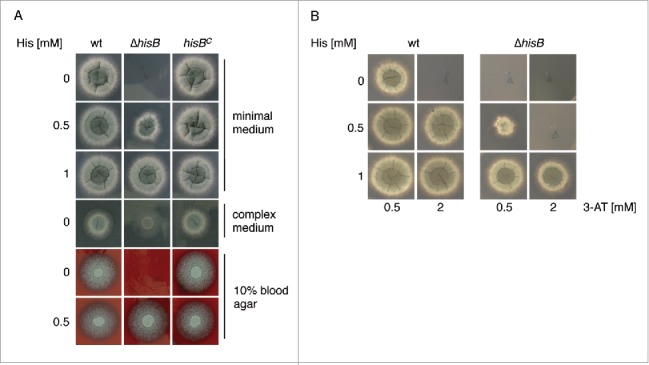
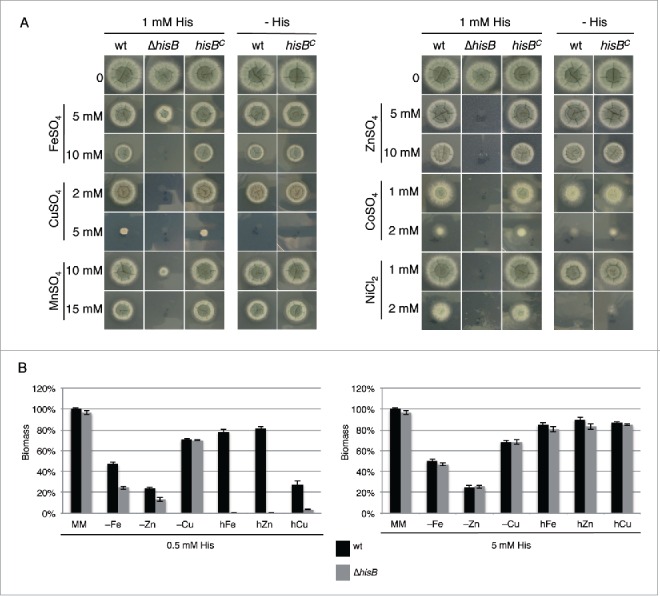
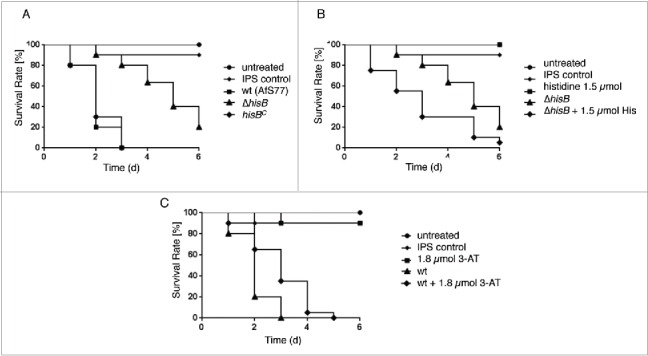
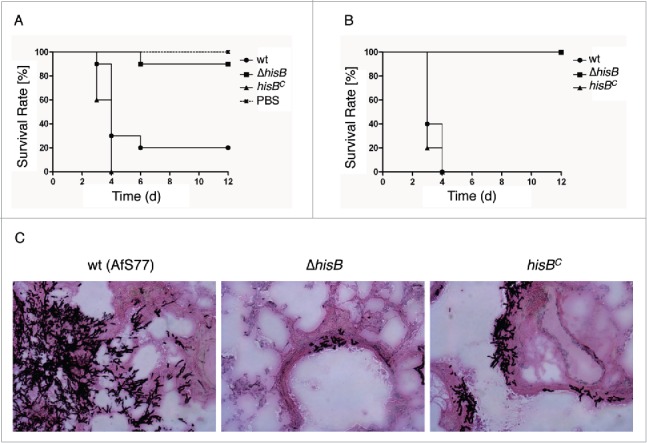
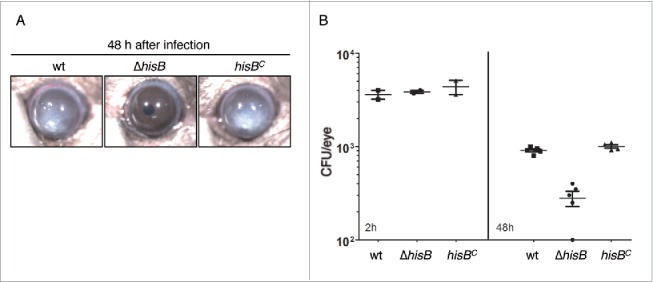
Aspergillus fumigatus is the most prevalent airborne fungal pathogen causing invasive fungal infections in immunosuppressed individuals. The histidine biosynthetic pathway is found in bacteria, archaebacteria, lower eukaryotes, and plants, but is absent in mammals. Here we demonstrate that deletion of the gene encoding imidazoleglycerol-phosphate dehydratase (HisB) in A. fumigatus causes (i) histidine auxotrophy, (ii) decreased resistance to both starvation and excess of various heavy metals, including iron, copper and zinc, which play a pivotal role in antimicrobial host defense, (iii) attenuation of pathogenicity in 4 virulence models: murine pulmonary infection, murine systemic infection, murine corneal infection, and wax moth larvae. In agreement with the in vivo importance of histidine biosynthesis, the HisB inhibitor 3-amino-1,2,4-triazole reduced the virulence of the A. fumigatus wild type and histidine supplementation partially rescued virulence of the histidine-auxotrophic mutant in the wax moth model. Taken together, this study reveals limited histidine availability in diverse A. fumigatus host niches, a crucial role for histidine in metal homeostasis, and the histidine biosynthetic pathway as being an attractive target for development of novel antifungal therapy approaches.
Overview
The claims and statistics of this paper haven’t been checked yet.
Free: it reads the open-access text and checks the first 5 claims that cite a source we can check. Create a free account to check every claim.
Integrity signals
Registry
Cites
Statistics
Figures
Verification
Claims the paper makes
The claims and statistics of this paper haven’t been checked yet.
Free: it reads the open-access text and checks the first 5 claims that cite a source we can check. Create a free account to check every claim.
Claims other papers make about this one
Each is checked against this paper’s own text: does it say what the citing paper says it does?
The source backs part of the claim, not all of it — or backs it for a different population, condition or comparison.
In the citing paper
“Other amino acids, such as lysine, tyrosine, phenylalanine, tryptophan, and histidine, are important for in vivo growth, even though mutants in their biosynthetic pathways are viable in vitro (343, 346).”
From Aspergillus fumigatus and Aspergillosis in 2019 (2019) · cites this paper as [346]
Experimental — accuracy not yet measuredIn the citing paper
“Genetic inactivation of HISB, being essential for histidine biosynthesis, displays increased sensitivity to limitation of various metals, including Mn, Cu, and Fe, along with attenuated virulence, indicating that histidine is required not only for protein biosynthesis but also for host and metal adaptation (346).”
From Aspergillus fumigatus and Aspergillosis in 2019 (2019) · cites this paper as [346]
Self-check
Percentages, sums and reported differences re-computed from the paper’s own numbers.
The self-check needs the paper’s full text.
Citations
Cites
Molecular Cloning: A Laboratory Manual
Sambrook, J., Fritsch, E., & Maniatis, T. (1989) · UCLA - Biblioteca de Ciencias de la Salud · Cited by 133,589
Molecular cloning: A laboratory manual
Deininger, P. (1990) · Analytical Biochemistry · doi:10.1016/0003-2697(90)90595-z · Cited by 84,682
The Genetics of Aspergillus nidulans
Pontecorvo, G., Roper, J. A., Chemmons, L. M., Macdonald, K. D., & Bufton, A. W. J. (1953) · Advances in Genetics · doi:10.1016/s0065-2660(08)60408-3 · Cited by 2,302
Free histidine as a metal chelator in plants that accumulate nickel
Krämer, U., Cotter-Howells, J. D., Charnock, J. M., Baker, A. J. M., & Smith, J. A. C. (1996) · Nature · doi:10.1038/379635a0 · Cited by 961 · cited 1×
“Moreover, an increased cellular histidine content was found to confer tolerance and hyperaccumulation of nickel in plants.(36,37) Taken together, these data indicate that the role of”
BackgroundTransformation of Aspergillus based on the hygromycin B resistance marker from Escherichia coli
Punt, P. J., Oliver, R. P., Dingemanse, M. A., Pouwels, P. H., & van den Hondel, C. A. M. J. J. (1987) · Gene · doi:10.1016/0378-1119(87)90164-8 · Cited by 937
Mycotic keratitis: epidemiology, diagnosis and management
Thomas, P. A., & Kaliamurthy, J. (2013) · Clinical Microbiology and Infection · doi:10.1111/1469-0691.12126 · Cited by 495 · cited 1×
“fumigatus is a common cause of visual impairment and blindness in immunocompetent patients.(23) To test whether disruption of histidine biosynthesis attenuates A.”
BackgroundSchrettl, M., Bignell, E., Kragl, C., Joechl, C., Rogers, T., Arst, H. N., Haynes, K., & Haas, H. (2004) · The Journal of Experimental Medicine · doi:10.1084/jem.20041242 · Cited by 493
Self-citationTransporters of ligands for essential metal ions in plants
Haydon, M. J., & Cobbett, C. S. (2007) · New Phytologist · doi:10.1111/j.1469-8137.2007.02051.x · Cited by 467 · cited 1×
“Moreover, histidine has a high affinity for binding metals, both as free amino acid and as metal-coordinating residues in proteins.(8) In agreement with a role in metal homeostasis, iron starvation was found to result in a fold9- increase in the cellular histidine content in A.”
BackgroundAspergillus fumigatus: saprophyte or pathogen?
Tekaia, F., & Latgé, J.-P. (2005) · Current Opinion in Microbiology · doi:10.1016/j.mib.2005.06.017 · Cited by 387 · cited 1×
“ease invasive aspergillosis, particularly in immunocompromised patients.(1) Depending on the immune status and other factors in the patients, mortality rates in con-”
BackgroundMetal ion ligands in hyperaccumulating plants
Callahan, D. L., Baker, A. J. M., Kolev, S. D., & Wedd, A. G. (2006) · JBIC Journal of Biological Inorganic Chemistry · doi:10.1007/s00775-005-0056-7 · Cited by 345
Cited by
Aspergillus fumigatus and Aspergillosis in 2019
Latgé, J.-P., & Chamilos, G. (2019) · Clinical Microbiology Reviews · doi:10.1128/cmr.00140-18 · Cited by 1,400
Contact killing and antimicrobial properties of copper
Vincent, M., Duval, R. E., Hartemann, P., & Engels‐Deutsch, M. (2018) · Journal of Applied Microbiology · doi:10.1111/jam.13681 · Cited by 694
“They demonstrated that deletion of the gene encoding imidazoleglycerol-phosphate dehydratase (HisB) reduces resistance of A. fumigatus to copper (Dietl et al. 2016).”
BackgroundInfluentialVitamin Biosynthesis as an Antifungal Target
Meir, Z., & Osherov, N. (2018) · Journal of Fungi · doi:10.3390/jof4020072 · Cited by 75
Tao, Q.-Q., Liu, L., Wang, P., Long, Q.-S., Zhao, Y., Jin, L., Xu, W.-M., Chen, Y., Li, Z., & Yang, S. (2019) · Journal of Agricultural and Food Chemistry · doi:10.1021/acs.jafc.9b02734 · Cited by 66
Cysteine: an overlooked energy and carbon source
Göbbels, L., Poehlein, A., Dumnitch, A., Egelkamp, R., Kröger, C., Haerdter, J., Hackl, T., Feld, A., Weller, H., Daniel, R., et al. (2021) · Scientific Reports · doi:10.1038/s41598-021-81103-z · Cited by 63
Metadata
- Authors
- Dietl, A.-M., Amich, J., Leal, S., Beckmann, N., Binder, U., Beilhack, A., Pearlman, E., & Haas, H.
- Affiliations
- Innsbruck Medical University (AT)
- University of Würzburg (DE)
- Case Western Reserve University (US)
- Corresponding author
- Haas, Hubertus
- ORCID
- Venue
- Virulence
- Publisher
- Informa UK Limited
- Published
- 2016-02-06
- Volume
- 7
- Issue
- 4
- Pages
- 465-476
- ISSN
- 2150-5594 (ISSN-L)
- 2150-5608
- PMC
- PMC4871644
- OpenAlex
- W2254822728
- Cited by
- 77
- References
- 52
- Citations by year
- 2026: 6 · 2025: 13 · 2024: 3 · 2023: 8 · 2022: 8 · 2021: 10 · 2020: 2 · 2019: 7 · 2018: 10 · 2017: 6 · 2016: 4
- Type
- journal article
- Language
- en
- Open access
- gold
- doi.org
- Licence
- Locations
- Virulence (publishedVersion, cc-by)
- Europe PMC (PubMed Central) (publishedVersion, cc-by)
- PubMed Central (publishedVersion, cc-by)
- PubMed (publishedVersion)
- eScholarship (California Digital Library) (submittedVersion, cc-by)
- eScholarship (California Digital Library) (submittedVersion)
- Research Explorer (The University of Manchester) (submittedVersion, cc-by)
- Funders
- Austrian Science Fund
- National Institutes of Health
- National Eye Institute (F31EY019841, R01EY018612, P30EY011373)
- Topics
- Life Sciences › Biochemistry, Genetics and Molecular Biology › Molecular Biology › Fungal and yeast genetics research
- Health Sciences › Medicine › Infectious Diseases › Antifungal resistance and susceptibility
- Health Sciences › Medicine › Infectious Diseases › Fungal Infections and Studies
- Keywords
- Aspergillus fumigatus, histidine biosynthesis, histidine auxotrophy, metal homeostasis, fungal virulence, antifungal drug targets, 3-amino-1,2,4-triazole, histidine supplementation, invasive fungal infections, heavy metal resistance, copper, zinc, corneal infection, wax moth larvae
- MeSH terms
- Amitrole, Animals, Aspergillosis, Aspergillus fumigatus, Copper, Cornea, Disease Models, Animal, Histidine, Homeostasis, Humans, Hydro-Lyases, Iron, Lung, Moths, Virulence, Zinc, Gene Expression Regulation, Fungal, Gene Deletion, Metals, Heavy, Mice
About these checks
Registry, retraction, Cites and statistics results are computed, not judged, with one exception: a printed reference that no index lists is read once by a model before it counts as a citation error. Claims are extracted by a model and kept only when their quote appears verbatim in the text; each cited source is then checked, with a model’s help, for whether it says what the claim relies on. Those verdicts can be wrong — read the claim’s quote and the cited source before relying on one.
Statistics and arithmetic are recomputed, not judged.
Confidence bands are shown only for fields calibrated on our annotated test set. None is calibrated yet, so no band is shown.
What counts as a claim ›How we measure confidence ›How we check this ›
Are you an author, or do you see a problem with this page? Request a review
How to cite
Cite CoChat for the checks on this page, and the paper for its own findings.
- This page
- CoChat. (2026). Citation check: Histidine biosynthesis plays a crucial role in metal homeostasis and virulence of Aspergillus fumigatus. https://app.cochat.ai/papers/10.1080/21505594.2016.1146848
- The paper
- Dietl, A.-M., Amich, J., Leal, S., Beckmann, N., Binder, U., Beilhack, A., Pearlman, E., & Haas, H. (2016). Histidine biosynthesis plays a crucial role in metal homeostasis and virulence of Aspergillus fumigatus. Virulence. https://doi.org/10.1080/21505594.2016.1146848
Data sources
Bibliographic data: Semantic Scholar, OpenAlex, Crossref.
Contains information from the Semantic Scholar Academic Graph Datasets, made available under the ODC Attribution License (ODC-BY 1.0).
Semantic Scholar’s data is described in: Kinney, R., et al. (2023). The Semantic Scholar Open Data Platform. arXiv:2301.10140.
