

Coping with tensions between standardization and individualization in social assistance
Open accessThe DOI matches its Crossref record, with a small difference in title or year; 56 of the 56 references it cites were found in a registry or an index.
Abstract
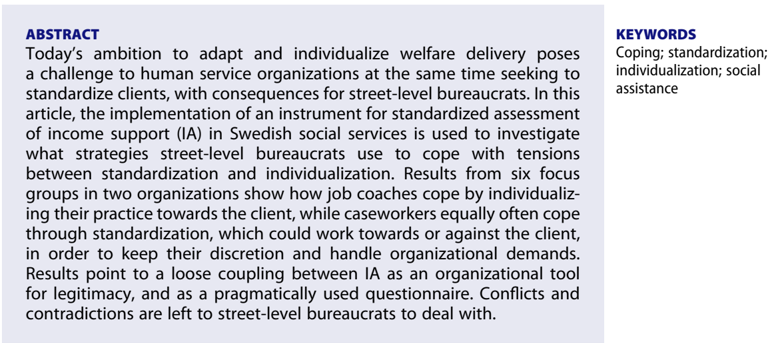
Today’s ambition to adapt and individualize welfare delivery poses a challenge to human service organizations at the same time seeking to standardize clients, with consequences for street-level bureaucrats. In this article, the implementation of an instrument for standardized assessment of income support (IA) in Swedish social services is used to investigate what strategies street-level bureaucrats use to cope with tensions between standardization and individualization. Results from six focus groups in two organizations show how job coaches cope by individualizing their practice towards the client, while caseworkers equally often cope through standardization, which could work towards or against the client, in order to keep their discretion and handle organizational demands. Results point to a loose coupling between IA as an organizational tool for legitimacy, and as a pragmatically used questionnaire. Conflicts and contradictions are left to street-level bureaucrats to deal with.
Overview
The claims and statistics of this paper haven’t been checked yet.
Free: it reads the open-access text and checks the first 5 claims that cite a source we can check. Create a free account to check every claim.
Integrity signals
Registry
Cites
Statistics
Figures


Verification
Claims the paper makes
The claims and statistics of this paper haven’t been checked yet.
Free: it reads the open-access text and checks the first 5 claims that cite a source we can check. Create a free account to check every claim.
Self-check
Percentages, sums and reported differences re-computed from the paper’s own numbers.
The self-check needs the paper’s full text.
Citations
Cites
Five misunderstandings about case-study research
Flyvbjerg, B. (2006) · Qualitative Inquiry · doi:10.1177/1077800405284363 · Cited by 14,266 · cited 1×
“In this way, the case could correspond to what Flyvbjerg (2006) describes as a critical case in that it is reasonable that these conditions could occur in other similar contexts.”
BackgroundRisk Society, Towards a New Modernity
Leiss, W., Beck, U., Ritter, M., Lash, S., & Wynne, B. (1994) · Canadian Journal of Sociology / Cahiers canadiens de sociologie · doi:10.2307/3341155 · Cited by 12,546
Street-Level Bureaucracy: Dilemmas of the Individual in Public Services
Lipsky, M. (1981) · Michigan Law Review · doi:10.2307/1288305 · Cited by 8,981
An Analysis of Coping in a Middle-Aged Community Sample
Folkman, S., & Lazarus, R. S. (1980) · Journal of Health and Social Behavior · doi:10.2307/2136617 · Cited by 6,328 · cited 1×
“We define coping as ‘behavioral efforts frontline workers employ when interacting with clients, in order to master, tolerate or reduce external and internal demands and conflicts they face on an everyday basis’ (cf. Folkman and Lazarus 1980; Tummers et al. 2015, 1100).”
BackgroundStreet-Level Bureaucracy: Dilemmas of the Individual in Public Services
Goldner, F., & Lipsky, M. (1982) · American Political Science Review · doi:10.2307/1960475 · Cited by 5,198 · cited 8×
“(Lipsky 2010, 78).”
BackgroundInfluentialReflexive Methodology: New Vistas for Qualitative Research
(2012) · QMiP Bulletin · doi:10.53841/bpsqmip.2012.1.14.101 · Cited by 3,463
Ligocki, D. T. (2018) · The Drama of Reality Television · doi:10.1163/9789004376670_002 · Cited by 2,818 · cited 1×
“Individualization is a basic characteristic of a society leaving the early stages of modernity (Bauman 2013; Beck 1992).”
BackgroundThe corrosion of character: the personal consequences of work in the new capitalism
(1999) · Choice Reviews Online · doi:10.5860/choice.36-5366 · Cited by 2,539
The Corrosion of Character: The Personal Consequences of Work in the New Capitalism
Leana, C. R., & Sennett, R. (2000) · The Academy of Management Review · doi:10.2307/259274 · Cited by 2,351 · cited 1×
“But individualization can also break down collective values and expose people to social risks, and the individual must take responsibility for social problems like poverty, unemployment and poor health (Bonoli 2007; Sennett 1998; Taylor-Gooby 2004).”
BackgroundThe SAGE Handbook of Organizational Institutionalism
Greenwood, R., Oliver, C., Lawrence, T., & Meyer, R. (2017) · SAGE Publications Ltd eBooks · doi:10.4135/9781526415066 · Cited by 2,186
Research works printed but not linked: 4
- Mattsson, T. 2015. "Barnrättsperspektivet I LVU-sammanhang [Children's Rights Perspective in Special Provision for Care of Young People Act]." In Barns och ungas rätt vid tvångsvård: förslag till ny LVU (SOU 2015:71) (pp. 1149-1178). Stockholm: Fritzes Offentliga Publikationer.
- Nordesjö, K., Ulmestig, R., & Denvall, V. (2016). Initial bedömning: Implementeringen av ett standardiserat bedömningsinstrument för försörjningsstöd i Stockholm stad [Initial assessment: the implementation of a standar- dized assessment tool for social assistance i Stockholm city]. Växjö: Linnéuniversitetet
- Rothstein, B. 1994. Vad Bör Staten Göra? Om Välfärdsstatens Moraliska Och Politiska Logik [What Should the State Do? on the Welfare State's Moral and Political Logic]. Stockholm: SNS.
- Ulmestig, R. (2007). På gränsen till fattigvård: En studie om arbetsmarknadspolitik och socialbidrag [On the verge of poor relief: A study on labor market policy and social assistance](Doctoral dissertation, Lund University)
Cited by
Marienfeldt, J. (2024) · Social Policy & Administration · doi:10.1111/spol.12991 · Cited by 72
Bakkeli, V., & Breit, E. (2021) · Social Policy and Administration · doi:10.1111/spol.12757 · Cited by 33
“Nordesjö (2020) observed that actors at different levels in an organization framed the standard in two different ways: actors at the department level emphasized conformity to the standard and outward legitimacy, while actors at the unit level framed the standard as supportive of professional…”
BackgroundBakkeli, V. (2022) · European Journal of Social Work · doi:10.1080/13691457.2022.2083085 · Cited by 15
“Standardisation and individualisation can be viewed as two opposing trends in social service organ-isations (Nordesjö et al., 2020; Ponnert & Svensson, 2016).”
BackgroundNordesjö, K., Ulmestig, R., & Scaramuzzino, G. (2023) · Nordic Social Work Research · doi:10.1080/2156857x.2023.2218385 · Cited by 19
“…question how street-level bureaucrats cope with demands of time efficiency in ADM and what significance such coping strategies have for service delivery and the social – worker client relationship (Nordesjö, Ulmestig, and Denvall 2020; Breit et al. 2021; Nordesjö, Scaramuzzino, and Ulmestig 2022).”
BackgroundSelf-citationPetroons, J., Brotcorne, P., Wagener, M., Hermans, K., & Lancker, W. V. (2025) · Social Inclusion · doi:10.17645/si.10289 · Cited by 6
“…of more rules (Evans & Harris, 2004)—for example, through code (Diver, 2021a, 2021b; Lessig, 1999)—or the standardization of practices (as shown by Nordesjö et al., 2020; even though this study did not cover standardization through ADM), actually lead to public officials having less discretion in…”
Eriksson, M., Eriksson, T., & Jonsson, E. (2023) · The TQM Journal · doi:10.1108/tqm-01-2023-0021 · Cited by 3
Goicolea, I., Bäckström, H., Lauri, M., Carbin, M., & Linander, I. (2023) · Journal of Gender-Based Violence · doi:10.1332/239868021x16903817520612 · Cited by 12
Zheng, R., & Liu, N. (2025) · Journal of Chinese Governance · doi:10.1080/23812346.2025.2520111 · Cited by 2
Nielsen, M. H. (2024) · Current Sociology · doi:10.1177/00113921231224760 · Cited by 3
“…between standardization and individualization; between fairness and responsiveness; between formal and informal display rules or as a (de)coupling of the frontline worker and the bureaucratic organization (Hansen, 2021; Mortensen and Needham, 2023; Nordesjö et al., 2022; Røhnebæk and Breit, 2022).”
Engwall, K., & Andersson, G. (2025) · European Journal of Social Work · doi:10.1080/13691457.2025.2535331 · Cited by 1
“The problems risk being hidden, which creates new challenges (Gillingham, 2021; Ljungberg et al., 2016; Nordesjö et al., 2022).”
Germundsson, N., Stranz, H., & Bergmark, Å. (2024) · Nordic Social Work Research · doi:10.1080/2156857x.2024.2440720 · Cited by 10
“These circumstances place SA caseworkers in a continuous balancing act of weighing practical judgements with legal and moral considerations, while also aiming to foster constructive relationships with clients (Nordesjö, Ulmestig, and Denvall 2020; Wagenaar 2004).”
Härd, S. (2023) · Nordic Studies on Alcohol and Drugs · doi:10.1177/14550725231175354 · Cited by 6
“…by professionals, in order to adapt the standard to fi t a particular context (Bakkeli & Breit, 2022; Björk, 2016a, 2016b; Ekendahl & Karlsson, 2021; Nordesjö et al., 2020; Ponnert & Svensson, 2016; Sletten & Bjorkquist, 2020), but there are different opinions on whether the EBP procedure should…”
BackgroundTuomola, A., & Saikkonen, P. (2026) · International Journal of Sociology and Social Policy · doi:10.1108/ijssp-08-2025-0529
Andersson, G., & Engwall, K. (2025) · European Journal of Social Work · doi:10.1080/13691457.2025.2599086
Olofsson, H. B., Carbin, M., Goicolea, I., Lauri, M., & Linander, I. (2025) · Affilia · doi:10.1177/08861099251340674
“This could arguably be related to the fact that the tension between individualized support measures and standardization is delegated to street-level social workers (Nordesjö et al., 2022).”
Metadata
- Authors
- Nordesjö, K., Ulmestig, R., & Denvall, V.
- Affiliations
- Malmö University (SE)
- Linnaeus University (SE)
- Lund University (SE)
- Corresponding author
- Nordesjö, Kettil
- Venue
- Nordic Social Work Research
- Publisher
- Informa UK Limited
- Published
- 2020-10-26
- Volume
- 12
- Issue
- 4
- Pages
- 435-449
- ISSN
- 2156-857X (ISSN-L)
- 2156-8588
- OpenAlex
- W3095567511
- Cited by
- 23
- References
- 52
- Citations by year
- 2026: 4 · 2025: 8 · 2024: 5 · 2023: 3 · 2022: 2 · 2021: 1
- FWCI
- 2.70
- Type
- journal article
- Language
- en
- Open access
- hybrid
- doi.org
- Licence
- Locations
- Nordic Social Work Research (publishedVersion, cc-by-nc-nd)
- Diva portal (Dalarna University Library) (submittedVersion, other-oa)
- KTH Publication Database DiVA (KTH Royal Institute of Technology) (submittedVersion, other-oa)
- Lund University Publications (Lund University) (submittedVersion, other-oa)
- Funders
- no financial support
- Topics
- Social Sciences › Public Administration › Public Policy and Administration Research
- Social Sciences › General Social Sciences › Social Sciences and Policies
- Social Sciences › Public Administration › Social Work Education and Practice
- Keywords
- standardization, individualization, street-level bureaucrats, social assistance, standardized assessment tools, job coaches, caseworkers, discretion, organizational legitimacy, welfare delivery, coping strategies
About these checks
Registry, retraction, Cites and statistics results are computed, not judged, with one exception: a printed reference that no index lists is read once by a model before it counts as a citation error. Claims are extracted by a model and kept only when their quote appears verbatim in the text; each cited source is then checked, with a model’s help, for whether it says what the claim relies on. Those verdicts can be wrong — read the claim’s quote and the cited source before relying on one.
Statistics and arithmetic are recomputed, not judged.
Confidence bands are shown only for fields calibrated on our annotated test set. None is calibrated yet, so no band is shown.
What counts as a claim ›How we measure confidence ›How we check this ›
Are you an author, or do you see a problem with this page? Request a review
Data sources
Bibliographic data: Semantic Scholar, OpenAlex, Crossref.
Contains information from the Semantic Scholar Academic Graph Datasets, made available under the ODC Attribution License (ODC-BY 1.0).
Semantic Scholar’s data is described in: Kinney, R., et al. (2023). The Semantic Scholar Open Data Platform. arXiv:2301.10140.
