

Coping with tensions between standardization and individualization in social assistance
Open accessThe DOI matches its Crossref record, with a small difference in title or year; 56 of the 56 references it cites were found in a registry or an index.
Abstract
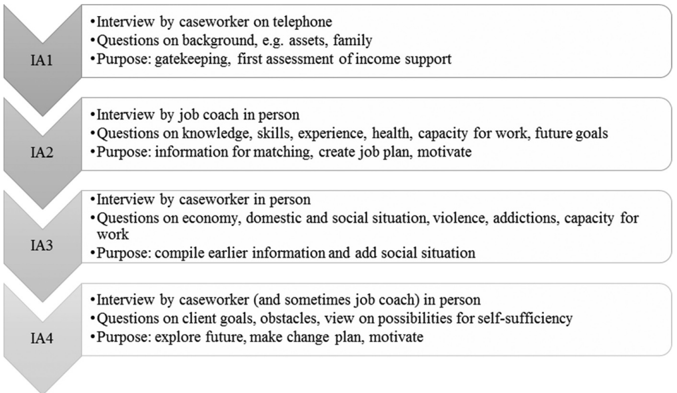
Today’s ambition to adapt and individualize welfare delivery poses a challenge to human service organizations at the same time seeking to standardize clients, with consequences for street-level bureaucrats. In this article, the implementation of an instrument for standardized assessment of income support (IA) in Swedish social services is used to investigate what strategies street-level bureaucrats use to cope with tensions between standardization and individualization. Results from six focus groups in two organizations show how job coaches cope by individualizing their practice towards the client, while caseworkers equally often cope through standardization, which could work towards or against the client, in order to keep their discretion and handle organizational demands. Results point to a loose coupling between IA as an organizational tool for legitimacy, and as a pragmatically used questionnaire. Conflicts and contradictions are left to street-level bureaucrats to deal with.
Overview
The claims and statistics of this paper haven’t been checked yet.
Free: it reads the open-access text and checks the first 5 claims that cite a source we can check. Create a free account to check every claim.
Integrity signals
Registry
Cites
Statistics
Figures


Verification
Claims the paper makes
The claims and statistics of this paper haven’t been checked yet.
Free: it reads the open-access text and checks the first 5 claims that cite a source we can check. Create a free account to check every claim.
Self-check
Percentages, sums and reported differences re-computed from the paper’s own numbers.
The self-check needs the paper’s full text.
Citations
Cites
Five misunderstandings about case-study research
Flyvbjerg, B. (2006) · Qualitative Inquiry · doi:10.1177/1077800405284363 · Cited by 14,266 · cited 1×
“In this way, the case could correspond to what Flyvbjerg (2006) describes as a critical case in that it is reasonable that these conditions could occur in other similar contexts.”
BackgroundRisk Society, Towards a New Modernity
Leiss, W., Beck, U., Ritter, M., Lash, S., & Wynne, B. (1994) · Canadian Journal of Sociology / Cahiers canadiens de sociologie · doi:10.2307/3341155 · Cited by 12,546
Street-Level Bureaucracy: Dilemmas of the Individual in Public Services
Lipsky, M. (1981) · Michigan Law Review · doi:10.2307/1288305 · Cited by 8,981
An Analysis of Coping in a Middle-Aged Community Sample
Folkman, S., & Lazarus, R. S. (1980) · Journal of Health and Social Behavior · doi:10.2307/2136617 · Cited by 6,328 · cited 1×
“We define coping as ‘behavioral efforts frontline workers employ when interacting with clients, in order to master, tolerate or reduce external and internal demands and conflicts they face on an everyday basis’ (cf. Folkman and Lazarus 1980; Tummers et al. 2015, 1100).”
BackgroundStreet-Level Bureaucracy: Dilemmas of the Individual in Public Services
Goldner, F., & Lipsky, M. (1982) · American Political Science Review · doi:10.2307/1960475 · Cited by 5,198 · cited 8×
“(Lipsky 2010, 78).”
BackgroundInfluentialReflexive Methodology: New Vistas for Qualitative Research
(2012) · QMiP Bulletin · doi:10.53841/bpsqmip.2012.1.14.101 · Cited by 3,463
Ligocki, D. T. (2018) · The Drama of Reality Television · doi:10.1163/9789004376670_002 · Cited by 2,818 · cited 1×
“Individualization is a basic characteristic of a society leaving the early stages of modernity (Bauman 2013; Beck 1992).”
BackgroundThe corrosion of character: the personal consequences of work in the new capitalism
(1999) · Choice Reviews Online · doi:10.5860/choice.36-5366 · Cited by 2,539
The Corrosion of Character: The Personal Consequences of Work in the New Capitalism
Leana, C. R., & Sennett, R. (2000) · The Academy of Management Review · doi:10.2307/259274 · Cited by 2,351 · cited 1×
“But individualization can also break down collective values and expose people to social risks, and the individual must take responsibility for social problems like poverty, unemployment and poor health (Bonoli 2007; Sennett 1998; Taylor-Gooby 2004).”
BackgroundThe SAGE Handbook of Organizational Institutionalism
Greenwood, R., Oliver, C., Lawrence, T., & Meyer, R. (2017) · SAGE Publications Ltd eBooks · doi:10.4135/9781526415066 · Cited by 2,186
(2005) · Encyclopedia of Social Theory · doi:10.4135/9781412952552.n244 · Cited by 1,403
Reflexive methodology - new vistas for qualitative research
Draper, P. (2001) · Journal of Advanced Nursing · doi:10.1046/j.1365-2648.2001.0420e.x · Cited by 1,398
Constructing mystery: Empirical matters in theory development
Alvesson, M., & Kärreman, D. (2007) · Academy of Management Review · doi:10.5465/amr.2007.26586822 · Cited by 1,319 · cited 1×
“We used abduction in a reflective dialogue between the researcher, earlier research, theory, and the empirical material as proposed by Alvesson and Kärreman (2007) and Alvesson and Sköldberg (2009).”
MethodA world of standards but not a standard world: Toward a sociology of standards and standardization
Timmermans, S., & Epstein, S. (2010) · Annual Review of Sociology · doi:10.1146/annurev.soc.012809.102629 · Cited by 1,226 · cited 3×
“Standardization regulates and calibrates social life by rendering the modern world equivalent across cultures, time, and geography (Timmermans and Epstein 2010).”
BackgroundHu, Y. (2013) · Rural Health Care Delivery · doi:10.1007/978-3-642-39982-4_17 · Cited by 1,007
Bovens, M., & Zouridis, S. (2002) · Public Administration Review · doi:10.1111/0033-3352.00168 · Cited by 964 · cited 1×
“In the area of ICT, computerization is both suggested to relocate discretion to other actors (Bovens and Zouridis 2002), or to be only one among several factors shaping discretion, where both street-level bureaucrats and clients may use ICT as an enabling tool (Buffat 2015), collectively across…”
BackgroundStreet-Level Bureaucracy, Social Work and the (Exaggerated) Death of Discretion
Evans, T. (2004) · British Journal of Social Work · doi:10.1093/bjsw/bch106 · Cited by 789
Coping During Public Service Delivery: A Conceptualization and Systematic Review of the Literature
Tummers, L. L. G., Bekkers, V., Vink, E., & Musheno, M. (2015) · Journal of Public Administration Research and Theory · doi:10.1093/jopart/muu056 · Cited by 756 · cited 12×
“Indeed, the coping strategies found in our study lie well within earlier research where street-level bureaucrats adapt their tool to their professional practice (Tummers et al. 2015).”
BackgroundMethodResultInfluentialMorgan, P., & Hasenfeld, Y. (1983) · Contemporary Sociology · doi:10.2307/2068087 · Cited by 666
Dane, E., & Hasenfeld, Y. (1984) · Administrative Science Quarterly · doi:10.2307/2392954 · Cited by 617 · cited 1×
“Human service organizations need to standardize service users through categorization of individuals due to the problem of handling the complexity of human needs (Hasenfeld 1983).”
BackgroundNew Risks, New Welfare: The Transformation of the European Welfare State
Taylor‐Gooby, P. (2004) · Kent Academic Repository (University of Kent) · Cited by 602
New Professionalism and New Public Management: Changes, Continuities and Consequences
Evetts, J. (2009) · Comparative Sociology · doi:10.1163/156913309x421655 · Cited by 534 · cited 1×
“Research has debated whether standardization is decreasing and even ending discretion (e.g. Nordesjö 2020; Skillmark et al. 2019; Barfoed and Jacobsson 2012; Evetts 2009; Munro 2004; Ponnert and Svensson 2016).”
BackgroundThe Penguin dictionary of sociology
(2007) · Choice Reviews Online · doi:10.5860/choice.44-5990 · Cited by 516
Reflexive methodology: new vistas for qualitative research
Pedler, M. (2012) · Action Learning: Research and Practice · doi:10.1080/14767333.2012.656893 · Cited by 456
The Risk Society: Towards a new modernity
Korstanje, M. E. (2009) · Jàmbá: Journal of Disaster Risk Studies · doi:10.4102/jamba.v2i2.21 · Cited by 414 · cited 1×
“Individualization is a basic characteristic of a society leaving the early stages of modernity (Bauman 2013; Beck 1992).”
BackgroundBonoli, G. (2007) · Comparative Political Studies · doi:10.1177/0010414005285755 · Cited by 403 · cited 2×
“problems like poverty, unemployment and poor health (Bonoli 2007; Sennett 1998; Taylor-Gooby 2004).”
BackgroundStreet-Level Bureaucracy and E-Government
Buffat, A. (2015) · Public Management Review · doi:10.1080/14719037.2013.771699 · Cited by 394 · cited 3×
“Pressures of standardization have also intensified through information and communication technology (ICT) although the effects on discretion are open to debate (Buffat 2015).”
BackgroundResultInfluentialIsomorphism, Diffusion and Decoupling: Concept Evolution and Theoretical Challenges
Boxenbaum, E., & Jonsson, S. (2017) · The SAGE Handbook of Organizational Institutionalism · doi:10.4135/9781446280669.n4 · Cited by 386
The Impact of Audit on Social Work Practice
Munro, E. (2004) · British Journal of Social Work · doi:10.1093/bjsw/bch130 · Cited by 322 · cited 1×
“Research has debated whether standardization is decreasing and even ending discretion (e.g. Nordesjö 2020; Skillmark et al. 2019; Barfoed and Jacobsson 2012; Evetts 2009; Munro 2004; Ponnert and Svensson 2016).”
BackgroundBroadhurst, K., Wastell, D., White, S., Hall, C., Peckover, S., Thompson, K., Pithouse, A., & Davey, D. (2010) · British Journal of Social Work · doi:10.1093/bjsw/bcn162 · Cited by 289 · cited 4×
“It also resonates with more general strategies and consequences related to decision-making tools such as quick categorization (Broadhurst et al. 2009), differences between informal and formal practice (Gillingham and Humphreys 2010) and the preservation of discretion (Dewitte et al.”
BackgroundInfluentialImplementation and the Policy Process: Opening Up the Black Box
Palumbo, D. J., & Calista, D. J. (1990) · Medical Entomology and Zoology · Cited by 283
Work and the Welfare State: Street-Level Organizations and Workfare Politics
Brodkin, E. Z., Lens, V., Adler, M., Marston, G., Knuth, M., Brussig, M., Watkins-Hayes, C., Brodkin, E. Z., Fording, R. C., Schram, S., et al. (2013) · Georgetown University Press eBooks · doi:10.1353/book26636 · Cited by 236
Work and the welfare state: street-level organizations and workfare politics
Somerville, P. (2014) · Housing, Theory and Society · doi:10.1080/14036096.2014.932540 · Cited by 207
Understanding street-level bureaucracy
(2015) · Policy Press eBooks · doi:10.1332/policypress/9781447313267.001.0001 · Cited by 202
Gillingham, P., & Humphreys, C. (2010) · British Journal of Social Work · doi:10.1093/bjsw/bcp155 · Cited by 194
Standardisation—the end of professional discretion?
Ponnert, L., & Svensson, K. (2016) · European Journal of Social Work · doi:10.1080/13691457.2015.1074551 · Cited by 177
Penguin Dictionary of Sociology
Abercrombie, N., Hill, S. M., & Turner, B. S. (1994) · Cited by 138
Decision-Making Tools and Their Influence on Caseworkers' Room for Discretion
Hoybye-Mortensen, M. (2015) · British Journal of Social Work · doi:10.1093/bjsw/bct144 · Cited by 119 · cited 3×
“Tools of decision-making, such as standardized forms, may similarly impact discretion depending on their theoretical foundation and the room for interpretation (Høybye-Mortensen 2015).”
BackgroundBaviskar, S., & Winter, S. C. (2017) · International Public Management Journal · doi:10.1080/10967494.2016.1235641 · Cited by 114
Astvik, W., & Melin, M. (2012) · Journal of Social Work · doi:10.1177/1468017311434682 · Cited by 113
Astvik, W., Melin, M., & Allvin, M. (2013) · Nordic Social Work Research · doi:10.1080/2156857x.2013.801879 · Cited by 100 · cited 1×
“Street-level bureaucrats are forced into strategies that either endanger their own health or threaten the quality of service (Astvik and Melin 2013; Astvik, Melin, and Allvin 2014).”
BackgroundRutz, S. I., Mathew, D., Robben, P. B. M., & de Bont, A. (2015) · Regulation & Governance · doi:10.1111/rego.12101 · Cited by 98 · cited 2×
“In the area of ICT, computerization is both suggested to relocate discretion to other actors (Bovens and Zouridis 2002), or to be only one among several factors shaping discretion, where both street-level bureaucrats and clients may use ICT as an enabling tool (Buffat 2015), collectively across organizational levels (…”
BackgroundBarfoed, E. M., & Jacobsson, K. (2012) · Nordic Social Work Research · doi:10.1080/2156857x.2012.667245 · Cited by 83 · cited 1×
“Research has debated whether standardization is decreasing and even ending discretion (e.g. Nordesjö 2020; Skillmark et al. 2019; Barfoed and Jacobsson 2012; Evetts 2009; Munro 2004; Ponnert and Svensson 2016).”
BackgroundDe Witte, J., Declercq, A., & Hermans, K. (2016) · British Journal of Social Work · doi:10.1093/bjsw/bcv076 · Cited by 74 · cited 1×
“They would benefit from being fitted to the users’ relationship with their clients (Skillmark and Oscarsson 2020) and it may be possible to preserve discretion through a relational approach, although this decreases the possibility for accountability (De Witte et al. 2016).”
BackgroundActivation Policy in Action : A Street-Level Study of Social Assistance in the Swedish Welfare State
Thorén, K. H. (2008) · KTH Publication Database DiVA (KTH Royal Institute of Technology) · Cited by 66
Rice, D. C. (2017) · Public Administration · doi:10.1111/padm.12307 · Cited by 56 · cited 2×
“A strong logic in favour of individualization has arisen both from the individual needs of service users and from the standpoint that individualized services are seen as efficient in reaching organizational goals (Rothstein 1994), especially for the long-term unemployed and other people with complex problems (Rice 201…”
BackgroundEvidensbaserat socialt arbete. : Teori, kritik, praktik
Bergmark, A., Bergmark, Å., & Lundström, T. (2011) · Cited by 54
Panican, A., & Ulmestig, R. (2016) · Citizenship Studies · doi:10.1080/13621025.2016.1139053 · Cited by 48 · cited 1×
“These systems are the last-safety-net of financial support and based on individual means-testing, although human needs in practice often are adapted to what the social services can offer (Panican and Ulmestig, 2016).”
BackgroundSelf-citationSkillmark, M., & Oscarsson, L. (2018) · European Journal of Social Work · doi:10.1080/13691457.2018.1540409 · Cited by 41
Assessing and labelling evidence
Nutley, S., Davies, H., & Hughes, J. (2019) · Policy Press eBooks · doi:10.51952/9781447345527.ch011 · Cited by 29
Nordesjö, K. (2020) · Human Services Organizations Management Leadership & Governance · doi:10.1080/23303131.2020.1734132 · Cited by 26 · cited 1×
“Research has debated whether standardization is decreasing and even ending discretion (e.g. Nordesjö 2020; Skillmark et al. 2019; Barfoed and Jacobsson 2012; Evetts 2009; Munro 2004; Ponnert and Svensson 2016).”
BackgroundSelf-citationDecision Making in Child and Family Welfare: The Role of Tools and Practice Frameworks
Gillingham, P., Harnett, P. H., Healy, K., Lynch, D., & Tower, M. (2017) · Children Australia · doi:10.1017/cha.2016.51 · Cited by 20 · cited 2×
“Research on decision-making tools has shown how they can be found supportive (Gillingham et al. 2017) but also time-consuming (Høybye-Mortensen 2015) and result in short cuts (Broadhurst et al. 2009) and significant differences between the informal and formal practice, prompting caution in the…”
BackgroundSkillmark, M., Gross, L. A., Kjellgren, C., & Denvall, V. (2017) · Qualitative Social Work · doi:10.1177/1473325017739461 · Cited by 19 · cited 1×
“Research has debated whether standardization is decreasing and even ending discretion (e.g. Nordesjö 2020; Skillmark et al. 2019; Barfoed and Jacobsson 2012; Evetts 2009; Munro 2004; Ponnert and Svensson 2016).”
BackgroundSelf-citationLaw enforcement and policy alienation:
Loyens, K. M. (2017) · Bristol University Press eBooks · doi:10.2307/j.ctt1t89bw0.10 · Cited by 18
Data Recording in Performance Management: Trouble With the Logics
Andersson, S. G., & Denvall, V. (2016) · American Journal of Evaluation · doi:10.1177/1098214016681510 · Cited by 12 · cited 1×
“In a context of public measurement in social work, rule breaking may be in favour of the client, the professional or the organization (cf. Groth Andersson and Denvall 2017).”
BackgroundSelf-citation
Research works printed but not linked: 4
- Mattsson, T. 2015. "Barnrättsperspektivet I LVU-sammanhang [Children's Rights Perspective in Special Provision for Care of Young People Act]." In Barns och ungas rätt vid tvångsvård: förslag till ny LVU (SOU 2015:71) (pp. 1149-1178). Stockholm: Fritzes Offentliga Publikationer.
- Nordesjö, K., Ulmestig, R., & Denvall, V. (2016). Initial bedömning: Implementeringen av ett standardiserat bedömningsinstrument för försörjningsstöd i Stockholm stad [Initial assessment: the implementation of a standar- dized assessment tool for social assistance i Stockholm city]. Växjö: Linnéuniversitetet
- Rothstein, B. 1994. Vad Bör Staten Göra? Om Välfärdsstatens Moraliska Och Politiska Logik [What Should the State Do? on the Welfare State's Moral and Political Logic]. Stockholm: SNS.
- Ulmestig, R. (2007). På gränsen till fattigvård: En studie om arbetsmarknadspolitik och socialbidrag [On the verge of poor relief: A study on labor market policy and social assistance](Doctoral dissertation, Lund University)
Cited by
Marienfeldt, J. (2024) · Social Policy & Administration · doi:10.1111/spol.12991 · Cited by 72
Bakkeli, V., & Breit, E. (2021) · Social Policy and Administration · doi:10.1111/spol.12757 · Cited by 33
“Nordesjö (2020) observed that actors at different levels in an organization framed the standard in two different ways: actors at the department level emphasized conformity to the standard and outward legitimacy, while actors at the unit level framed the standard as supportive of professional…”
BackgroundBakkeli, V. (2022) · European Journal of Social Work · doi:10.1080/13691457.2022.2083085 · Cited by 15
“Standardisation and individualisation can be viewed as two opposing trends in social service organ-isations (Nordesjö et al., 2020; Ponnert & Svensson, 2016).”
BackgroundNordesjö, K., Ulmestig, R., & Scaramuzzino, G. (2023) · Nordic Social Work Research · doi:10.1080/2156857x.2023.2218385 · Cited by 19
“…question how street-level bureaucrats cope with demands of time efficiency in ADM and what significance such coping strategies have for service delivery and the social – worker client relationship (Nordesjö, Ulmestig, and Denvall 2020; Breit et al. 2021; Nordesjö, Scaramuzzino, and Ulmestig 2022).”
BackgroundSelf-citationPetroons, J., Brotcorne, P., Wagener, M., Hermans, K., & Lancker, W. V. (2025) · Social Inclusion · doi:10.17645/si.10289 · Cited by 6
“…of more rules (Evans & Harris, 2004)—for example, through code (Diver, 2021a, 2021b; Lessig, 1999)—or the standardization of practices (as shown by Nordesjö et al., 2020; even though this study did not cover standardization through ADM), actually lead to public officials having less discretion in…”
Metadata
- Authors
- Nordesjö, K., Ulmestig, R., & Denvall, V.
- Affiliations
- Malmö University (SE)
- Linnaeus University (SE)
- Lund University (SE)
- Corresponding author
- Nordesjö, Kettil
- Venue
- Nordic Social Work Research
- Publisher
- Informa UK Limited
- Published
- 2020-10-26
- Volume
- 12
- Issue
- 4
- Pages
- 435-449
- ISSN
- 2156-857X (ISSN-L)
- 2156-8588
- OpenAlex
- W3095567511
- Semantic Scholar
- b9b1de610e7d4af7a9a788c3704a77a6569ab241
- Cited by
- 23
- References
- 52
- Citations by year
- 2026: 4 · 2025: 8 · 2024: 5 · 2023: 3 · 2022: 2 · 2021: 1
- FWCI
- 2.70
- Type
- journal article
- Language
- en
- Open access
- hybrid
- doi.org
- Licence
- Locations
- Nordic Social Work Research (publishedVersion, cc-by-nc-nd)
- Diva portal (Dalarna University Library) (submittedVersion, other-oa)
- KTH Publication Database DiVA (KTH Royal Institute of Technology) (submittedVersion, other-oa)
- Lund University Publications (Lund University) (submittedVersion, other-oa)
- Funders
- no financial support
- Topics
- Social Sciences › Public Administration › Public Policy and Administration Research
- Social Sciences › General Social Sciences › Social Sciences and Policies
- Social Sciences › Public Administration › Social Work Education and Practice
- Keywords
- standardization, individualization, street-level bureaucrats, social assistance, standardized assessment tools, job coaches, caseworkers, discretion, organizational legitimacy, welfare delivery, coping strategies
About these checks
Registry, retraction, Cites and statistics results are computed, not judged, with one exception: a printed reference that no index lists is read once by a model before it counts as a citation error. Claims are extracted by a model and kept only when their quote appears verbatim in the text; each cited source is then checked, with a model’s help, for whether it says what the claim relies on. Those verdicts can be wrong — read the claim’s quote and the cited source before relying on one.
Statistics and arithmetic are recomputed, not judged.
Confidence bands are shown only for fields calibrated on our annotated test set. None is calibrated yet, so no band is shown.
What counts as a claim ›How we measure confidence ›How we check this ›
Are you an author, or do you see a problem with this page? Request a review
Data sources
Bibliographic data: Semantic Scholar, OpenAlex, Crossref.
Contains information from the Semantic Scholar Academic Graph Datasets, made available under the ODC Attribution License (ODC-BY 1.0).
Semantic Scholar’s data is described in: Kinney, R., et al. (2023). The Semantic Scholar Open Data Platform. arXiv:2301.10140.
