

Transposable elements in Drosophila
The DOI matches its Crossref record; 124 of the 124 references it cites were found in a registry or an index.
Abstract
Transposable elements (TEs) are mobile genetic elements that can mobilize within host genomes. As TEs comprise more than 40% of the human genome and are linked to numerous diseases, understanding their mechanisms of mobilization and regulation is important. Drosophila melanogaster is an ideal model organism for the study of eukaryotic TEs as its genome contains a diverse array of active TEs. TEs universally impact host genome size via transposition and deletion events, but may also adopt unique functional roles in host organisms. There are 2 main classes of TEs: DNA transposons and retrotransposons. These classes are further divided into subgroups of TEs with unique structural and functional characteristics, demonstrating the significant variability among these elements. Despite this variability, D. melanogaster and other eukaryotic organisms utilize conserved mechanisms to regulate TEs. This review focuses on the transposition mechanisms and regulatory pathways of TEs, and their functional roles in D. melanogaster.
Overview
The claims and statistics of this paper haven’t been checked yet.
Free: it reads the open-access text and checks the first 5 claims that cite a source we can check. Create a free account to check every claim.
Integrity signals
Registry
Cites
Statistics
Figures
Verification
Claims the paper makes
The claims and statistics of this paper haven’t been checked yet.
Free: it reads the open-access text and checks the first 5 claims that cite a source we can check. Create a free account to check every claim.
Claims other papers make about this one
Each is checked against this paper’s own text: does it say what the citing paper says it does?
In the citing paper
“1731 and Tabor belong to the LTR subclass of retrotransposons (53).”
From Pathogenic tau–induced transposable element–derived dsRNA drives neuroinflammation (2023) · cites this paper as [53]
Self-check
Percentages, sums and reported differences re-computed from the paper’s own numbers.
The self-check needs the paper’s full text.
Citations
Cites
Initial sequencing and analysis of the human genome
International Human Genome Sequencing Consortium, Whitehead Institute for Biomedical Research, C. F. G. R., Lander, E. S., Linton, L. M., Birren, B., Nusbaum, C., Zody, M. C., Baldwin, J., Devon, K., Dewar, K., et al. (2001) · Nature · doi:10.1038/35057062 · Cited by 24,216
Discrete Small RNA-Generating Loci as Master Regulators of Transposon Activity in Drosophila
Brennecke, J., Aravin, A. A., Stark, A., Dus, M., Kellis, M., Sachidanandam, R., & Hannon, G. J. (2007) · Cell · doi:10.1016/j.cell.2007.01.043 · Cited by 2,524 · cited 1×
“Both the proteins and piRNAs required for this pathway are almost exclusively produced in germ cells.(30) The generation of piRNAs is distinct from that of esiRNAs, as this pathway is independent of Dcr2 and relies solely on PIWI proteins not involved in esiRNA biogenesis.”
BackgroundThe origin and behavior of mutable loci in maize
McClintock, B. (1950) · Proceedings of the National Academy of Sciences · doi:10.1073/pnas.36.6.344 · Cited by 1,747
The impact of retrotransposons on human genome evolution
Cordaux, R., & Batzer, M. A. (2009) · Nature Reviews Genetics · doi:10.1038/nrg2640 · Cited by 1,703
Alu repeats and human genomic diversity
Batzer, M. A., & Deininger, P. L. (2002) · Nature Reviews Genetics · doi:10.1038/nrg798 · Cited by 1,470
Nested Retrotransposons in the Intergenic Regions of the Maize Genome
SanMiguel, P., Tikhonov, A., Jin, Y.-K., Motchoulskaia, N., Zakharov, D., Melake-Berhan, A., Springer, P. S., Edwards, K. J., Lee, M., Avramova, Z., et al. (1996) · Science · doi:10.1126/science.274.5288.765 · Cited by 1,401
Origin and evolution of retroelements based upon their reverse transcriptase sequences
Xiong, Y., & Eickbush, T. H. (1990) · The EMBO Journal · doi:10.1002/j.1460-2075.1990.tb07536.x · Cited by 1,374 · cited 1×
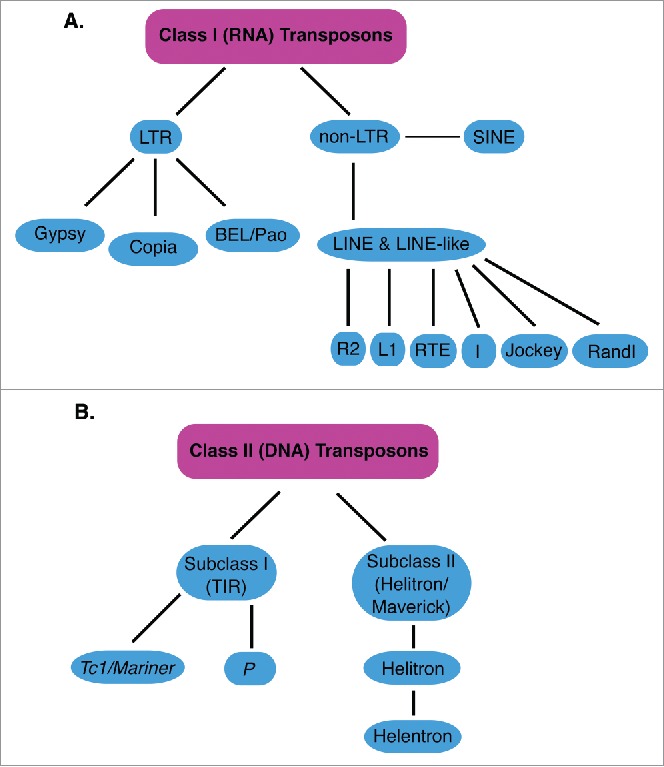
“However, despite characterization of this element as an errantivirus, phylogenetic analyses based on RT sequences still group gypsy with other LTR retrotransposons.(18,92) Several other LTR retrotransposons in Drosophila are similarly characterized due to the pres-”
BackgroundA Distinct Small RNA Pathway Silences Selfish Genetic Elements in the Germline
Vagin, V. V., Sigova, A., Li, C., Seitz, H., Gvozdev, V., & Zamore, P. D. (2006) · Science · doi:10.1126/science.1129333 · Cited by 1,342
Luan, D. D., Korman, M. H., Jakubczak, J. L., & Eickbush, T. H. (1993) · Cell · doi:10.1016/0092-8674(93)90078-5 · Cited by 1,173 · cited 4×
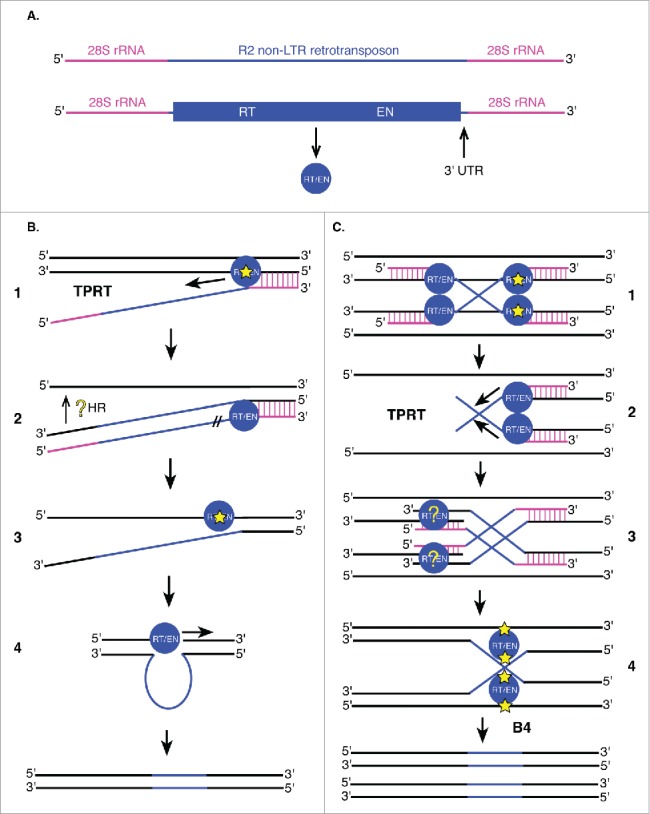
“The RT/EN encoded by R2 is responsible for both cleavage of the target DNA and reverse transcription of the element.(108) R2 RT/EN also generates the complementary R2 strand at the target site as this enzyme demonstrates DNA-dependent DNA polymerase activity and can displace the RNA template (Fig.”
BackgroundInfluentialHot L1s account for the bulk of retrotransposition in the human population
Brouha, B., Schustak, J., Badge, R. M., Lutz-Prigge, S., Farley, A. H., Moran, J. V., & Kazazian, H. H. (2003) · Proceedings of the National Academy of Sciences · doi:10.1073/pnas.0831042100 · Cited by 1,073 · cited 1×
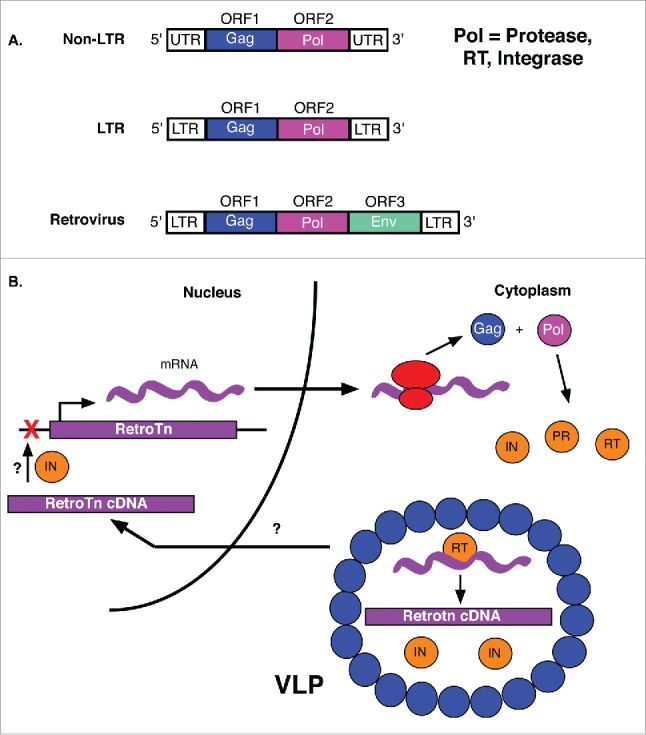
“1).(22,23) In Drosophila, however, at least 21% of non-LTR retrotransposons and 45% of LTR retrotransposons are full-length and potentially active, such as the LINE-like elements TART, jockey and Juan and the LTR retrotransposons roo, copia, blood, gypsy, and mdg1.”
Background
Research works printed but not linked: 2
- Muñoz-López M, García-Pérez JL DNA transposons: Nature and applications in genomics. Curr Genomics 2010; 11: 115- 28; PMID:20885819; https://doi.org/ 10.2174/138920210790886871 20885819 PMC2874221 · DOI · Paper page
- Nefedova LN, Liubomirskaia NV, Il'in IV, Kim AI [Precise excision of long terminal repeats of the gypsy (mdg4) retrotransposon of Drosophila melanogaster detected in Escherichia coli cells is explained by its integrase function]. Genetika 2006; 42: 1656- 63; PMID:17326385 17326385
Cited by
Pathogenic tau–induced transposable element–derived dsRNA drives neuroinflammation
Ochoa, E., Ramirez, P., Gonzalez, E., De Mange, J., Ray, W. J., Bieniek, K. F., & Frost, B. (2023) · Science Advances · doi:10.1126/sciadv.abq5423 · Cited by 73
Repetitive elements in aging and neurodegeneration
Copley, K. E., & Shorter, J. (2023) · Trends in Genetics · doi:10.1016/j.tig.2023.02.008 · Cited by 70
Romano, G., Klima, R., & Feiguin, F. (2020) · BMC Biology · doi:10.1186/s12915-020-00816-1 · Cited by 47
“This is because gypsy is a very active retrotransposon in Drosophila, responsible for the majority of the spontaneous mutations described in flies [23], and more significantly, the upregulation of this Romano et al.”
BackgroundNapoletano, F., Ferrari Bravo, G., Voto, I. A. P., Santin, A., Celora, L., Campaner, E., Dezi, C., Bertossi, A., Valentino, E., Santorsola, M., et al. (2021) · Cell Reports · doi:10.1016/j.celrep.2021.109694 · Cited by 36
Metadata
- Authors
- McCullers, T. J., & Steiniger, M.
- Affiliations
- ,
- Venue
- Mobile Genetic Elements
- Publisher
- Informa UK Limited
- Published
- 2017-05-03
- Volume
- 7
- Issue
- 3
- Pages
- 1-18
- ISSN
- 2159-256X
- PMC
- PMC5443660
- Cited by
- 70
- References
- 124
- Language
- en
About these checks
Registry, retraction, Cites and statistics results are computed, not judged, with one exception: a printed reference that no index lists is read once by a model before it counts as a citation error. Claims are extracted by a model and kept only when their quote appears verbatim in the text; each cited source is then checked, with a model’s help, for whether it says what the claim relies on. Those verdicts can be wrong — read the claim’s quote and the cited source before relying on one.
Statistics and arithmetic are recomputed, not judged.
Confidence bands are shown only for fields calibrated on our annotated test set. None is calibrated yet, so no band is shown.
What counts as a claim ›How we measure confidence ›How we check this ›
Are you an author, or do you see a problem with this page? Request a review
Data sources
Bibliographic data: Semantic Scholar, OpenAlex, Crossref.
Contains information from the Semantic Scholar Academic Graph Datasets, made available under the ODC Attribution License (ODC-BY 1.0).
Semantic Scholar’s data is described in: Kinney, R., et al. (2023). The Semantic Scholar Open Data Platform. arXiv:2301.10140.
