

Interferon-γ-induced activation of JAK1 and JAK2 suppresses tumor cell susceptibility to NK cells through upregulation of PD-L1 expression
Open accessThe DOI matches its Crossref record; 51 of the 51 references it cites were found in a registry or an index.
Abstract
Inhibition of JAK1 or JAK2 in human tumor cells was previously shown to increase susceptibility of these cells to NK cell lysis. In the present study, we examined the cellular mechanisms that mediate this effect in hematopoietic tumor cell lines and primary tumor cells. Incubation of tumor cells with supernatant from activated NK cells or interferon-gamma (IFNγ)-induced activation of pSTAT1 and increased expression of PD-L1 without altering expression of other activating or inhibitory NK cell ligands. These functional effects were blocked by chemical JAK inhibition or shRNAs targeting JAK1, JAK2 or STAT1. Inhibition of IFNγ signaling also prevented the upregulation of PD-L1 and blocking PD-L1 resulted in increased tumor lysis by NK cells. These results show that NK cell activation and secretion of IFNγ results in activation of JAK1, JAK2 and STAT1 in tumor cells, resulting in rapid up-regulation of PD-L1 expression. Increased expression of PD-L1 results in increased resistance to NK cell lysis. Blockade of JAK pathway activation prevents increased PD-L1 expression resulting in increased susceptibility of tumor cells to NK cell activity. These observations suggest that JAK pathway inhibitors as well as PD-1 and PD-L1 antibodies may work synergistically with other immune therapies by preventing IFN-induced inhibition of NK cell-mediated tumor cell lysis.
Overview
The claims and statistics of this paper haven’t been checked yet.
Free: it reads the open-access text and checks the first 5 claims that cite a source we can check. Create a free account to check every claim.
Integrity signals
Registry
Cites
Statistics
Figures
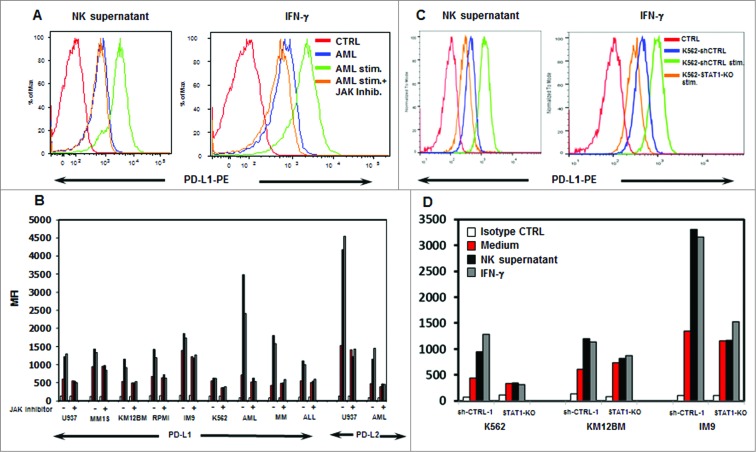
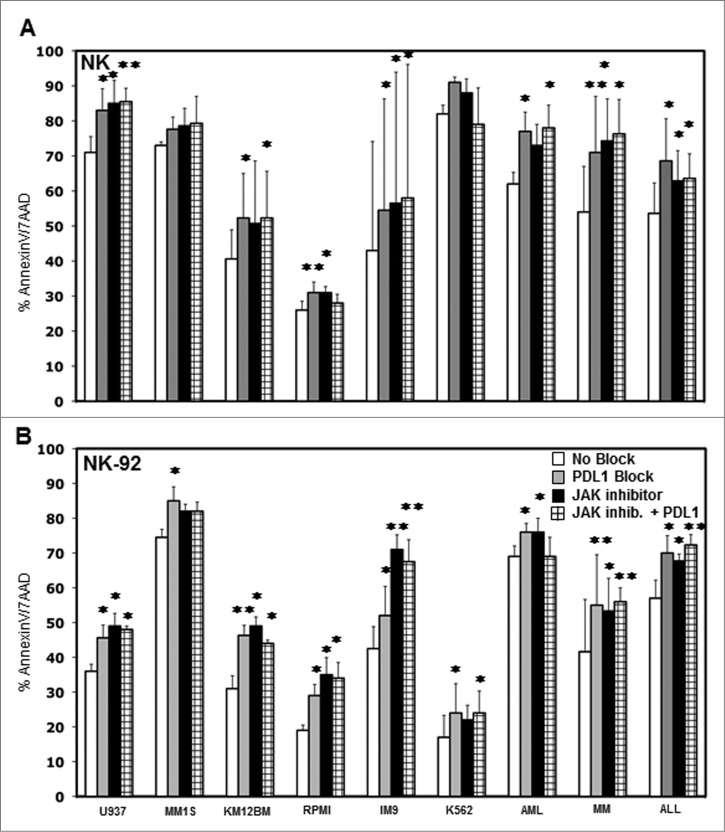
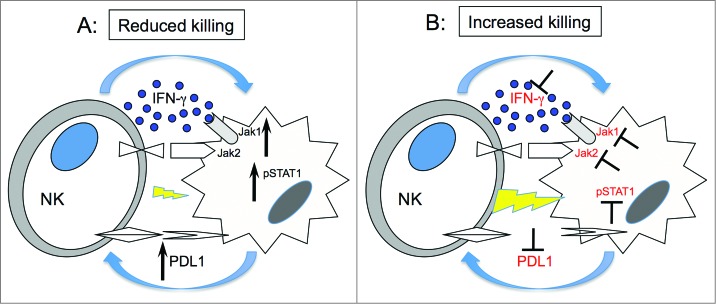
Verification
Claims the paper makes
The claims and statistics of this paper haven’t been checked yet.
Free: it reads the open-access text and checks the first 5 claims that cite a source we can check. Create a free account to check every claim.
Claims other papers make about this one
Each is checked against this paper’s own text: does it say what the citing paper says it does?
The source backs part of the claim, not all of it — or backs it for a different population, condition or comparison.
In the citing paper
“Numerous studies have observed that exposure to interferon gamma (IFN γ ) rapidly induces PD-L1 expression both in cancer cell lines and in the tumor microenvironment [7-10].”
From Characterizing the molecular regulation of inhibitory immune checkpoints with multimodal single-cell screens (2021) · cites this paper as [10]
Experimental — accuracy not yet measured
Self-check
Percentages, sums and reported differences re-computed from the paper’s own numbers.
The self-check needs the paper’s full text.
Citations
Cites
Safety, activity, and immune correlates of anti–PD-1 antibody in cancer
Topalian, S. L., Hodi, F. S., Brahmer, J. R., Gettinger, S. N., Smith, D. C., McDermott, D. F., Powderly, J. D., Carvajal, R. D., Sosman, J. A., Atkins, M. B., et al. (2012) · New England Journal of Medicine · doi:10.1056/nejmoa1200690 · Cited by 12,628
Safety and activity of anti-PD-L1 antibody in patients with advanced cancer
Brahmer, J. R., Tykodi, S. S., Chow, L. Q. M., Hwu, W.-J., Topalian, S. L., Hwu, P., Drake, C. G., Camacho, L. H., Kauh, J., Odunsi, K., et al. (2012) · New England Journal of Medicine · doi:10.1056/nejmoa1200694 · Cited by 7,945 · cited 1×
“Inhibition of the PD-1 pathway enhances T cell tumor immunity and clinical trials in several diseases using either anti-PD-L1 or anti-PD-1 antibodies have shown clinical efficacy.(47,48) Although the role of PD-1 in the negative regulation of T cell immunity is well established, much less is known about PD-1/PD-L1 and…”
BackgroundDarnell, J. E., Kerr, L. M., & Stark, G. R. (1994) · Science · doi:10.1126/science.8197455 · Cited by 6,080 · cited 1×
“JAK kinases are associated with cytokine receptors and ligand binding of these receptors rapidly induces JAK phosphorylation, which in turn activates STAT transcription factors.(11) JAK kinases have also been reported to activate other kinases such as PI3K/AKT and ERK.”
BackgroundFreeman, G. J., Long, A. J., Iwai, Y., Bourque, K., Chernova, T., Nishimura, H., Fitz, L. J., Malenkovich, N., Okazaki, T., Byrne, M. C., et al. (2000) · The Journal of Experimental Medicine · doi:10.1084/jem.192.7.1027 · Cited by 5,294
Self-citationFunctions of natural killer cells
Vivier, E., Tomasello, E., Baratin, M., Walzer, T., & Ugolini, S. (2008) · Nature Immunology · doi:10.1038/ni1582 · Cited by 3,943 · cited 1×
“Impact of NK cell: tumor cell interaction on JAK1 and JAK2 signaling JAK1 and JAK2 are associated with the IFNg receptor(14) and NK cells are known to secrete IFNg and other cytokines after activation by target cells.(15,16) We therefore hypothesized that JAK1 and JAK2 were specifically activated by cytokines released…”
BackgroundInnate or adaptive immunity? The example of natural killer cells
Vivier, E., Raulet, D. H., Moretta, A., Caligiuri, M. A., Zitvogel, L., Lanier, L. L., Yokoyama, W. M., & Ugolini, S. (2011) · Science · doi:10.1126/science.1198687 · Cited by 2,824
Lanier, L. L. (2005) · Annual Review of Immunology · doi:10.1146/annurev.immunol.23.021704.115526 · Cited by 2,769 · cited 2×
“Expression of inhibitory and activating ligands on tumor cells incubated with NK supernatant or IFNg Tumor susceptibility to NK cell recognition is profoundly influenced by MHC class I expression as well as other inhibitory/ activating ligands.(19,20) IFNg is known to modulate expression of immunomodulary molecules on…”
BackgroundDong, H., Zhu, G., Tamada, K., & Chen, L. (1999) · Nature Medicine · doi:10.1038/70932 · Cited by 2,496 · cited 1×
“stimulation can induce up-regulation of PD-L1 in monocytes and other cell types.(41,42) One effect of IFNg is to enhance expression of MHC Class I, thus facilitating T cell recognition.”
BackgroundCaligiuri, M. A. (2008) · Blood · doi:10.1182/blood-2007-09-077438 · Cited by 1,905
Up on the tightrope: natural killer cell activation and inhibition
Lanier, L. L. (2008) · Nature Immunology · doi:10.1038/ni1581 · Cited by 1,656 · cited 1×
“NK cell functions are mediated in part through direct lysis of target cells.(4,5) In addition, NK cells are an important source of immunoregulatory cytokines such as IFNg, tumor necrosis factor-a (TNFa) and granulocyte macrophage colony-stimulating factor (GMCSF).”
Background
Cited by
Items 101–200 of 356
Upregulation of PD‐L1 and PD‐L2 in neck node metastases of head and neck squamous cell carcinoma
Moratin, J., Metzger, K., Safaltin, A., Herpel, E., Hoffmann, J., Freier, K., Heß, J., & Horn, D. (2019) · Head & Neck · doi:10.1002/hed.25713 · Cited by 51
The dynamics of the inflammatory response during BBN-induced bladder carcinogenesis in mice
Degoricija, M., Korać-Prlić, J., Vilović, K., Ivanišević, T., Haupt, B. E., Palada, V., Petković, M., Karaman, I., & Terzić, J. (2019) · Journal of Translational Medicine · doi:10.1186/s12967-019-02146-5 · Cited by 50
Targeting IFN/STAT1 Pathway as a Promising Strategy to Overcome Radioresistance
Liu, S., İmani, S., Deng, Y., Pathak, J. L., Wen, Q., Chen, Y., & Wu, J. (2020) · OncoTargets and Therapy · doi:10.2147/ott.s256708 · Cited by 50
Fasano, M., Corte, C. M. D., Liello, R. D., Barra, G., Sparano, F., Viscardi, G., Iacovino, M. L., Paragliola, F., Famiglietti, V., Ciaramella, V., et al. (2020) · ESMO Open · doi:10.1136/esmoopen-2020-000753 · Cited by 50
Nastoupil, L. J., Chin, C. K., Westin, J. R., Fowler, N. H., Samaniego, F., Cheng, X., Ma, M. C. J., Wang, Z., Chu, F., Dsouza, L., et al. (2022) · Blood Advances · doi:10.1182/bloodadvances.2021006240 · Cited by 50
Falcinelli, M., Alhity, G., Baron, S., Mampay, M., Allen, M. C., Samuels, M. E., Jones, W., Cilibrasi, C., Flaherty, R. L., Giamas, G., et al. (2023) · Brain Behavior and Immunity · doi:10.1016/j.bbi.2023.02.011 · Cited by 49
“The role of the PD-1/PD-L1 axis in cancer immunology has promoted a new branch of immunebased cancer therapies against PD-1 and PD-L1; a strategy to prevent immunosuppression and improve the immune response against cancer (Bellucci, 2015).”
BackgroundBudczies, J., Denkert, C., Győrffy, B., Schirmacher, P., & Stenzinger, A. (2017) · BMC Medical Genomics · doi:10.1186/s12920-017-0308-8 · Cited by 48
Ghonime, M. G., & Cassady, K. A. (2018) · Cancer Immunology Research · doi:10.1158/2326-6066.cir-18-0014 · Cited by 47
PD-L1 and intratumoral immune response in breast cancer
Wang, Z., Milne, K., Derocher, H., Webb, J. R., Nelson, B. H., & Watson, P. H. (2017) · Oncotarget · doi:10.18632/oncotarget.18305 · Cited by 47
Zhang, W., Pang, Q., Zhang, X., Yan, C., Wang, Q., Yang, J., Yu, S., Liu, X., Pan, Y., Yuan, Z., et al. (2017) · Cancer Science · doi:10.1111/cas.13197 · Cited by 47
Li, J., Hu, H., Lian, H., Yang, S., Liu, M., He, J., Cao, B., Chen, D. S., Hu, Y., Zhi, C., et al. (2024) · International Journal of Biological Sciences · doi:10.7150/ijbs.88539 · Cited by 46
GDNF secreted by nerves enhances PD-L1 expression via JAK2-STAT1 signaling activation in HNSCC
Lin, C., Cao, W., Ren, Z., Tang, Y., Zhang, C., Yang, R., Chen, Y., Liu, Z., Peng, C., Wang, L., et al. (2017) · OncoImmunology · doi:10.1080/2162402x.2017.1353860 · Cited by 45
Wang, Y., Guo, H., Feng, Z., Wang, S., Wang, Y., He, Q., Li, G., Lin, Z., Xie, X., & Lin, Z. (2019) · Molecules · doi:10.3390/molecules24203784 · Cited by 44
“Once the tumor antigen is recognized, PD-L1 could be upregulated by interferon gamma (IFNγ), which is generated by TILs at the tumor site [7].”
BackgroundCAR-NK cells in combination therapy against cancer: A potential paradigm
Li, J., Hu, H., Lian, K., Zhang, D., Hu, P., He, Z., Zhang, Z., & Wang, Y. (2024) · Heliyon · doi:10.1016/j.heliyon.2024.e27196 · Cited by 43
Zhao, J., Zhang, P., Wang, J., Xi, Q., Zhao, X., Ji, M., & Hu, G. (2017) · Medicine · doi:10.1097/md.0000000000006102 · Cited by 43
Zhang, S., Bai, X., & Shan, F. (2020) · International Immunopharmacology · doi:10.1016/j.intimp.2020.106247 · Cited by 43
Escape of tumor cells from the NK cell cytotoxic activity
Cantoni, C., Wurzer, H., Thomas, C., & Vitale, M. (2020) · Journal of Leukocyte Biology · doi:10.1002/jlb.2mr0820-652r · Cited by 42
Oncolytic Viruses and Cancer Immunotherapy
Malhotra, J. D., & Kim, E. S. (2022) · Current Oncology Reports · doi:10.1007/s11912-022-01341-w · Cited by 42
Interleukins (Cytokines) as Biomarkers in Colorectal Cancer: Progression, Detection, and Monitoring
Maryam, S., Krukiewicz, K., Haq, I. U., Khan, A. A., Yahya, G., & Cavalu, S. D. (2023) · Journal of Clinical Medicine · doi:10.3390/jcm12093127 · Cited by 42
Underground Adaptation to a Hostile Environment: Acute Myeloid Leukemia vs. Natural Killer Cells
Dulphy, N., Chrétien, A.-S., Khaznadar, Z., Fauriat, C., Nanbakhsh, A., Caignard, A., Chouaïb, S., Olive, D., & Toubert, A. (2016) · Frontiers in Immunology · doi:10.3389/fimmu.2016.00094 · Cited by 44
Khandani, N. K., Ghahremanloo, A., & Hashemy, S. I. (2020) · Journal of Cellular Physiology · doi:10.1002/jcp.29671 · Cited by 41
“Mutations in or inhibition of JAK/STAT/IFN‐γ pathway is one mechanism by which tumor cells could prevent the response to the signals of IFN‐γ (Bazhin, von Ahn, Fritz, Werner, & Karakhanova, 2018; Bellucci et al., 2015; Darnell et al., 1994; Song et al., 2018).”
BackgroundReina-Ortiz, C., Constantinides, M., de Maudave, A. F., Présumey, J., Hernández, J., Cartron, G., Giraldos, D., Díez, R., Izquierdo, I., Azaceta, G., et al. (2020) · OncoImmunology · doi:10.1080/2162402x.2020.1853314 · Cited by 41
Emerging Role of PD-1/PD-L1 Inhibitors in Chronic Liver Diseases
Singh, V., Khurana, A., Allawadhi, P., Banothu, A. K., Bharani, K. K., & Weiskirchen, R. (2021) · Frontiers in Pharmacology · doi:10.3389/fphar.2021.790963 · Cited by 43
“Studies revealed that IFN-γ results into increased expression of PD-L1 in acute myeloid leukemia via MEK/ERK and MYD88/TRAF6 pathways (Bellucci et al., 2015).”
BackgroundMolecular Farming of Pembrolizumab and Nivolumab
Stark, M., Joubert, A. M., & Visagie, M. H. (2023) · International Journal of Molecular Sciences · doi:10.3390/ijms241210045 · Cited by 40
“Upon activation, PKD2 interacts with proteins involved in pro-survival signaling pathways, particularly extracellular signal-regulated kinase (ERK), which stimulates the nuclear factor kappa B (NF-κB) transcription factor, leading to the upregulation of PD-L1 gene expression [27,28].”
BackgroundCantoni, C., Falco, M., Vitale, M., Pietra, G., Munari, E., Pende, D., Mingari, M. C., Sivori, S., & Moretta, L. (2024) · OncoImmunology · doi:10.1080/2162402x.2024.2378520 · Cited by 39
“117 Indeed, focusing on target cells, the alteration of ligands expressed on tumor cells is an effective strategy to limit recognition and killing by NK cells.”
BackgroundCalvo, T., Reina-Ortiz, C., Giraldos, D., Gascón, M., Woods, D., Asenjo, J., Marco-Brualla, J., Azaceta, G., Izquierdo, I., Palomera, L., et al. (2020) · Scientific Reports · doi:10.1038/s41598-020-76051-z · Cited by 39
Zhou, H., Jing, S., Liu, Y., Wang, X., Duan, X., Xiong, W. G., Li, R., Peng, Y., Ai, Y., Fu, D., et al. (2022) · Cell Proliferation · doi:10.1111/cpr.13373 · Cited by 40
Current and Future Trends of Colorectal Cancer Treatment: Exploring Advances in Immunotherapy
Nikolouzakis, T. K., Chrysos, E., Docea, A. O., Fragkiadaki, P., Souglakos, J., Tsiaoussis, J., & Tsatsakis, A. (2024) · Cancers · doi:10.3390/cancers16111995 · Cited by 37
“This is possible because of the JAK1/JAK2 and STAT1 pathways, leading to tumor cell survival and disease progression [99,100].”
BackgroundLiu, Z., Zhao, Y. Q., Fang, J., Cui, R., Xiao, Y., & Xu, Q. (2017) · Oncotarget · doi:10.18632/oncotarget.18591 · Cited by 37
“Studies also showed that IFN-γ upregulated PD-L1 expression on tumor cells [22, 35] via STAT1 phosphorylation.”
ResultWu, Q., Zhao, Y., Sun, Y., Yan, X., & Wang, P. (2018) · Oncology Reports · doi:10.3892/or.2018.6177 · Cited by 37
Enhancing Neuroblastoma Immunotherapies by Engaging iNKT and NK Cells
McNerney, K. O., Karageorgos, S. A., Hogarty, M. D., & Bassiri, H. (2020) · Frontiers in Immunology · doi:10.3389/fimmu.2020.00873 · Cited by 37
The Role of Oncogenes and Redox Signaling in the Regulation of PD-L1 in Cancer
Glorieux, C., Xia, X., & Huang, P. (2021) · Cancers · doi:10.3390/cancers13174426 · Cited by 37
Tanaka, A., Zhou, Y., Ogawa, M., Shia, J., Klimstra, D. S., Wang, J. Y., & Roehrl, M. H. A. (2020) · PLoS ONE · doi:10.1371/journal.pone.0229252 · Cited by 37
Chen, Z., Yao, M., Shen, Z.-L., Li, S.-D., Xing, W., Guo, W., Li, Z., Wu, X., Ao, L., Lu, W.-Y., et al. (2023) · World Journal of Stem Cells · doi:10.4252/wjsc.v15.i8.787 · Cited by 36
Natural killer cells and tumor metastasis
Lee, H. H., Kang, H., & Cho, H. (2017) · Archives of Pharmacal Research · doi:10.1007/s12272-017-0951-9 · Cited by 36
Zhao, J., Zhou, Z.-Q., Wang, P., Chen, C., Liu, Y., Pan, Q., Zhu, Q., Tang, Y., Weng, D., & Xia, J. (2018) · Cancer Management and Research · doi:10.2147/cmar.s181949 · Cited by 35
“It has been reported that IFN-γ can induce PD-L1 expression on tumor cells.(33,34) In our study, we found that PD-L1-positive tumor had more CD8+ T cells than PD-L1-negative tumor.”
BackgroundBurgeoning Exploration of the Role of Natural Killer Cells in Anti-PD-1/PD-L1 Therapy
Bai, R., & Cui, J. (2022) · Frontiers in Immunology · doi:10.3389/fimmu.2022.886931 · Cited by 35
Kim, S. Y., Yin, J., Bohlman, S., Walker, P., Dacic, S., Kim, C., Khan, H., Liu, S. V., Ma, P. C., Nagasaka, M., et al. (2022) · JTO Clinical and Research Reports · doi:10.1016/j.jtocrr.2022.100381 · Cited by 35
The role of IFN-γ-signalling in response to immune checkpoint blockade therapy
Wong, C. W., Huang, Y., & Hurlstone, A. F. L. (2023) · Essays in Biochemistry · doi:10.1042/ebc20230001 · Cited by 35
Moinuddin, A., Poznanski, S. M., Portillo, A. L., Monteiro, J. K., & Ashkar, A. A. (2024) · Immunological Reviews · doi:10.1111/imr.13316 · Cited by 34
“156 Recognition of PD- L1-positive tumor cells by NK cells expressing PD-1 impairs their killing.”
BackgroundHot or cold: Bioengineering immune contextures into in vitro patient-derived tumor models
Too, N. S. H., Ho, N. C. W., Adine, C., Iyer, N. G., & Fong, E. L. S. (2021) · Advanced Drug Delivery Reviews · doi:10.1016/j.addr.2021.05.001 · Cited by 35
Prognostic Role of Immune Markers in Triple Negative Breast Carcinoma
Özkan, H. Ş., Uğurlu, M. Ü., Yumuk, P. F., & Kaya, H. (2020) · Pathology & Oncology Research · doi:10.1007/s12253-020-00874-4 · Cited by 34
Chen, X., Chen, F., Ren, Y., Weng, G., Xu, L., Xue, X. Y., Keng, P. C., Lee, S. O., & Chen, Y. (2019) · Journal of Cancer Research and Clinical Oncology · doi:10.1007/s00432-019-02917-z · Cited by 33
Blazanin, N., Cheng, T., Carbajal, S., & DiGiovanni, J. (2019) · Molecular Carcinogenesis · doi:10.1002/mc.23073 · Cited by 33
Wang, Y., Zhang, X., Xie, X., Chen, W., Li, M., Diao, D., & Dang, C. (2020) · Cancer Biology & Therapy · doi:10.1080/15384047.2020.1838032 · Cited by 33
Dostarlimab an Inhibitor of PD-1/PD-L1: A New Paradigm for the Treatment of Cancer
Alkholifi, F. K., & Alsaffar, R. M. (2022) · Medicina · doi:10.3390/medicina58111572 · Cited by 33
“The IFN-γ secreted by NK cells activates the JAK1, JAK2, and STAT-1 pathways, which causes tumor cells to produce the PD-L1 on their surfaces [82].”
BackgroundZhou, Q., Han, H., Lu, J.-B., Liu, T., Huang, K., Deng, C., Li, Z., Chen, J., Yao, K., Qin, Z., et al. (2020) · 癌症:英文版 · doi:10.1002/cac2.12001 · Cited by 33
Fang, M., Li, Y., Wang, P., Wang, Y., Wang, X., Wa, X., Zhang, Y., He, Z., Li, J., Li, L., et al. (2025) · Cancer Immunology Research · doi:10.1158/2326-6066.cir-24-1179 · Cited by 32
Bound, N. T., Vandenberg, C. J., Kartikasari, A. E. R., Plebanski, M., & Scott, C. L. (2022) · Frontiers in Genetics · doi:10.3389/fgene.2022.886170 · Cited by 34
Zhang, L., Xu, L., Zhu, J., Li, J., Xue, B., Gao, J., Sun, C., Zang, Y., Zhou, Y., Yang, D., et al. (2018) · Molecular Medicine Reports · doi:10.3892/mmr.2018.8781 · Cited by 31
“In order to determine the mechanism underlying the alteration of PD-L1 levels, ATM downstream regulatory factors were examined, particularly the extensively studied JAK/STAT3 signaling pathway, which is involved in PD-L1 regulation (26,27).”
PD-L1 upregulation in myeloma cells by panobinostat in combination with interferon-γ
Iwasa, M., Harada, T., Oda, A., Bat‐Erdene, A., Teramachi, J., Tenshin, H., Ashtar, M., Oura, M., Sogabe, K., Udaka, K., et al. (2019) · Oncotarget · doi:10.18632/oncotarget.26726 · Cited by 31
Exploratory Pilot Study of Circulating Biomarkers in Metastatic Renal Cell Carcinoma
Zizzari, I. G., Napoletano, C., Filippo, A. D., Botticelli, A., Gelibter, A. J., Calabrò, F., Rossi, E., Schinzari, G., Urbano, F., Pomati, G., et al. (2020) · Cancers · doi:10.3390/cancers12092620 · Cited by 31
“It was shown that IFNγ promotes the expression of PDL1 and PDL2, both on tumor cells and on immune infiltrating cells, and suppresses the effector function of tumor-specific T cells or NK cells through interaction with the immune inhibitory receptor PD1 [44,45].”
BackgroundPark, S., Oh, J. H., Park, D. J., Zhang, H., Noh, M., Kim, Y., Kim, Y.-S., Kim, H., Kim, Y., Ha, S., et al. (2021) · Frontiers in Immunology · doi:10.3389/fimmu.2020.620166 · Cited by 31
Dual Synergistic Tumor‐Specific Polymeric Nanoparticles for Efficient Chemo‐Immunotherapy
Xiang, J., Liu, K., Xu, H., Zhao, Z., Piao, Y., Shao, S., Tang, J., Shen, Y., & Zhou, Z. (2023) · Advanced Science · doi:10.1002/advs.202301216 · Cited by 31
Preclinical development and clinical studies of targeted JAK/STAT combined Anti-PD-1/PD-L1 therapy
Chen, M., & Wang, S.-L. (2024) · International Immunopharmacology · doi:10.1016/j.intimp.2024.111717 · Cited by 30
Albertí‐Valls, M., Olave, S., Olomí, A., Macià, A., & Eritja, N. (2024) · Cancers · doi:10.3390/cancers16233918 · Cited by 30
“…immune infiltration has not been deeply studied in the context of EC yet [51], in other gynecological cancers such as ovarian cancer, research shows that the pro-inflammatory cytokine interferon-gamma (IFN-γ ) can directly enhance PD-L1 expression, further contributing to tumor progression [62,63].”
Emerging Biomarkers as Predictors to Anti-Pd1/PD-L1 Therapies in Advanced Melanoma
Loo, K. L., & DAUD, A. I. (2016) · Immunotherapy · doi:10.2217/imt-2016-0039 · Cited by 30
IFN Signaling and ICB Resistance: Time is on Tumor’s Side
López‐Soto, A., Gonzalez, S. R., & Folgueras, A. R. (2017) · Trends in cancer · doi:10.1016/j.trecan.2017.01.004 · Cited by 30
Expression of PD-1 and PD-L1 in Endometrial Cancer: Molecular and Clinical Significance
Yusof, M. N. M., Chew, K. T., Kampan, N. C., & Shafiee, M. N. (2023) · International Journal of Molecular Sciences · doi:10.3390/ijms242015233 · Cited by 30
“This leads to an upregulation of PD-L1 expression on the tumour cell surface [75].”
BackgroundRegulation of PD-L1 Expression by YY1 in Cancer: Therapeutic Efficacy of Targeting YY1
Dillen, A., Bui, I., Jung, M., Agioti, S., Zaravinos, A., & Bonavida, B. (2024) · Cancers · doi:10.3390/cancers16061237 · Cited by 30
“Therefore, overexpression of YY1 may Hays and Bonavida [34] and Bellucci et al. [153] previously proposed that YY1 indirectly modulates PD-L1 expression through IFN-γ - induced activation of janus kinase-1 (JAK1), JAK2, and STAT1.”
BackgroundProspects for NK Cell Therapy of Sarcoma
Lachota, M., Vincenti, M., Winiarska, M., Boye, K., Zagożdżon, R., & Malmberg, K. (2020) · Cancers · doi:10.3390/cancers12123719 · Cited by 29
“IFN-γ can also induce programmed cell death ligand 1 (PD-L1) expression on cancer cells, subsequently inhibiting NK cell effector function [83].”
BackgroundPitroda, S. P., Stack, M. E., Liu, G.-F., Song, S.-S., Chen, L. L., Liang, H. L., Parekh, A. D., Huang, X., Roach, P., Posner, M. C., et al. (2018) · Molecular Cancer Therapeutics · doi:10.1158/1535-7163.mct-17-0667 · Cited by 27
NK cell based immunotherapy against oral squamous cell carcinoma
Zhang, Y., Xie, J., Wu, H., Huang, J., Zheng, D., Wang, S., Jia, X., He, Z., Gong, Y., Ju, L., et al. (2024) · Frontiers in Immunology · doi:10.3389/fimmu.2024.1440764 · Cited by 27
Iwasaki, T., Kohashi, K., Toda, Y., Ishihara, S., Yamada, Y., & Oda, Y. (2020) · Journal of Cancer Research and Clinical Oncology · doi:10.1007/s00432-020-03390-9 · Cited by 28
Innate Immunity in Helicobacter pylori Infection and Gastric Oncogenesis
Zhang, Y., Yan, Z., Jiao, Y., Feng, Y., Zhang, S., & Yang, A. (2025) · Helicobacter · doi:10.1111/hel.70015 · Cited by 25
Yi, X.-F., Gao, R.-L., Sun, L., Wu, Z.-X., Zhang, S., Huang, L., Han, C., & Ma, J. (2023) · Biomedicine & Pharmacotherapy · doi:10.1016/j.biopha.2023.114770 · Cited by 25
Danziger, O., Shai, B., Sabo, Y., Bacharach, E., & Ehrlich, M. (2016) · Oncotarget · doi:10.18632/oncotarget.10313 · Cited by 26
Xu, R., Zhao, X., Zhao, Y., Chen, B., Sun, L., Xu, C., Shen, B., Wang, M., Xu, W., & Zhu, W. (2017) · Cell Proliferation · doi:10.1111/cpr.12399 · Cited by 25
Molecular and clinical characterization of PTPN2 expression from RNA-seq data of 996 brain gliomas
Wang, P., Cai, H., Zhang, C., Li, Y.-M., Liu, X., Wan, J., Jiang, T., Li, S., & Yan, C. (2018) · Journal of Neuroinflammation · doi:10.1186/s12974-018-1187-4 · Cited by 25
Ryan, É. J., Creavin, B., & Sheahan, K. D. (2020) · Frontiers in Oncology · doi:10.3389/fonc.2020.01369 · Cited by 25
Li, Y., Tan, R., Li, R., Tian, R., Liu, Z., Wang, X., Chen, E., Pan, T., & Qu, H. (2023) · Journal of Inflammation · doi:10.1186/s12950-023-00341-2 · Cited by 24
“Furthermore, STAT1 phosphorylation was found to be indispensable for IFN-γ-and IL-27-induced PD-L1 expression on tumor cells and monocytes [36, 37].”
BackgroundChoi, D. S., Tremblay, D. A., Iancu‐Rubin, C., & Mascarenhas, J. O. (2017) · Annals of Hematology · doi:10.1007/s00277-016-2915-4 · Cited by 24
Padmanabhan, S., Gaire, B., Zou, Y., Uddin, M. M., DeLeon, D., & Vancurova, I. (2021) · The International Journal of Biochemistry & Cell Biology · doi:10.1016/j.biocel.2021.106093 · Cited by 24
Yuan, Q., Liang, Q., Sun, Z., Yuan, X., Hou, W., Wang, Y.-X., Wang, H., & Yu, M. (2021) · OncoImmunology · doi:10.1080/2162402x.2021.1914954 · Cited by 23
Dondero, A., Casu, B., Bellora, F., Vacca, A., Luisi, A. D., Frassanito, M. A., Cantoni, C., Gaggero, S., Olive, D., Moretta, A., et al. (2017) · Oncotarget · doi:10.18632/oncotarget.17070 · Cited by 23
Xu, L., Shen, M., Chen, X., Yang, D., Tsai, Y., Keng, P. C., Lee, S. O., & Chen, Y. (2018) · Experimental Cell Research · doi:10.1016/j.yexcr.2018.01.041 · Cited by 22
Parseh, B., Khosravi, A., Fazel, A., Ai, J., Ebrahimi‐Barough, S., Verdi, J., & Shahbazi, M. (2022) · Frontiers in Cell and Developmental Biology · doi:10.3389/fcell.2022.895284 · Cited by 22
“This negative regulatory feedback mechanism inhibits the activation of NK cells and leads to tumor survival (Bellucci et al., 2015).”
BackgroundMonitoring PD-1 Phosphorylation to Evaluate PD-1 Signaling during Antitumor Immune Responses
Bu, X., Juneja, V. R., Reynolds, C. G., Mahoney, K. M., Bu, M. T., McGuire, K. A., Maleri, S., Hua, P., Zhu, B., Klein, S. R., et al. (2021) · Cancer Immunology Research · doi:10.1158/2326-6066.cir-21-0493 · Cited by 22
Self-citationPhase II study of single-agent nivolumab in patients with myelofibrosis
Dalle, I. A., Kantarjian, H. M., Daver, N. G., Masárová, L., Pemmaraju, N., Bose, P., Garcia‐Manero, G., & Verstovšek, S. (2021) · Annals of Hematology · doi:10.1007/s00277-021-04618-5 · Cited by 23
Interferon-driven Metabolic Reprogramming and Tumor Microenvironment Remodeling
Chang, T.-H., & Ho, P. (2025) · Immune Network · doi:10.4110/in.2025.25.e8 · Cited by 22
“However, IFN-γ exposure may paradoxically increase PD-L1 expression on tumor cells, reducing their susceptibility to NK cells cytotoxicity (145).”
Lv, P., Chen, X., Fu, S., Ren, E., Liu, C., Liu, X., Jiang, L., Zeng, Y., Wang, X., & Liu, G. (2021) · Biomaterials Science · doi:10.1039/d1bm00928a · Cited by 21
Predictive Biomarkers for Immunotherapy in Endometrial Carcinoma
Pizzimenti, C., Fiorentino, V., Pepe, L. R., Franchina, M., Ruggeri, C., Ercoli, A., Ciappina, G., Berretta, M., Tuccari, G., & Ieni, A. (2025) · Cancers · doi:10.3390/cancers17152420 · Cited by 20
“IFN-γ , released by both T lymphocytes and NK cells, stimulates the upregulation of PD-L1 on the surface of target cells, encompassing tumor cells [48–50”
Rearden, R. C., Sah, A., Doff, B. L., Kobayashi, T., McKee, S. J., Leggatt, G. R., & Mattarollo, S. R. (2016) · Immunology and Cell Biology · doi:10.1038/icb.2016.9 · Cited by 20
Ozawa, Y., Harutani, Y., Oyanagi, J., Akamatsu, H., Murakami, E., Shibaki, R., Hayata, A., Sugimoto, T., Tanaka, M., Takakura, T., et al. (2020) · Cancer Science · doi:10.1111/cas.14705 · Cited by 19
Regulation of the PD-1/PD-L1 Axis and NK Cell Dysfunction by Exosomal miR-552-5p in Gastric Cancer
Tang, C.-W., Yang, J., Qin, J.-W., Wu, H., Cui, H.-P., Ge, L.-Y., & Liu, A. (2024) · Digestive Diseases and Sciences · doi:10.1007/s10620-024-08536-0 · Cited by 19
“NK cells can enhance the expression of PD-L1 in the PD-1/PD-L1 pathway in tumor cells, thereby regulating tumor progression [16].”
BackgroundMethodCavalcante, L. L., Chowdhary, A., Sosman, J. A., & Chandra, S. (2018) · American Journal of Clinical Dermatology · doi:10.1007/s40257-018-0359-4 · Cited by 19
Ott, E., Mutala, L. B., Dansette, D., Deleine, C., Duchalais, É., Podevin, J., Volteau, C., Bennouna, J., Touchefeu, Y., Fourquier, P., et al. (2019) · OncoImmunology · doi:10.1080/2162402x.2018.1562834 · Cited by 19
Endocrine immune-related adverse effects of immune-checkpoint inhibitors
Trevisani, V., Iughetti, L., Lucaccioni, L., & Predieri, B. (2023) · Expert Review of Endocrinology & Metabolism · doi:10.1080/17446651.2023.2256841 · Cited by 19
T-cell subsets and cytokines are indicative of neoadjuvant chemoimmunotherapy responses in NSCLC
Yi, L., Xu, Z., Ma, T., Wang, C., Wei, P., Xiao, B., Zhang, H., Che, N., Liu, Z., & Han, Y. (2024) · Cancer Immunology Immunotherapy · doi:10.1007/s00262-024-03687-5 · Cited by 18
“…cytokines, such as IFN-γ, induce Tregs polarization to a TH1-like state, and Tregs then increase the expression of CXCR3, IFN-γ and T-bet and suppress DC1s, thereby restraining CTL activation and inducing CTL dysfunction, which might result in CTLs not infiltrating into the tumor microenvironment.”
BackgroundGranai, M., Lazzi, S., Mancini, V., Akarca, A. U., Santi, R., Vergoni, F., Sorrentino, E., Guazzo, R., Mundo, L., Cevenini, G., et al. (2021) · Histopathology · doi:10.1111/his.14391 · Cited by 18
Type I and II interferons toward ideal vaccine and immunotherapy
Temizoz, B., & Ishii, K. J. (2021) · Expert Review of Vaccines · doi:10.1080/14760584.2021.1927724 · Cited by 18
Zhao, W., Liu, L., Li, X., & Xu, S. Q. (2022) · International Immunopharmacology · doi:10.1016/j.intimp.2022.109031 · Cited by 18
Zhu, Y., Zhang, S., Lai, Y., Pan, J., Chen, F., Wang, T., Wang, F., Xu, Z., Yang, W., & Yu, H. (2022) · Advanced Science · doi:10.1002/advs.202203263 · Cited by 18
Bommarito, D., Martin, A. M., Forcade, É., Nastke, M.-D., Ritz, J., & Bellucci, R. (2016) · Cancer Immunology Immunotherapy · doi:10.1007/s00262-016-1804-y · Cited by 18
“Conversely, as we previously showed for JAK1/JAK2 inhibition, increased tumor susceptibility to immune effector cells was only induced when NK effector cells were engaging with the tumor cells preventing IFN-γ secreted by the effector cells to upregulate PD-L1 on the tumor cell surface [37].”
MethodSelf-citationLei, S., Xu, H., Li, H., Yang, Y., Xu, F., Li, J., Wang, Z., Xing, P., Hao, X., & Wang, Y. (2023) · Thoracic Cancer · doi:10.1111/1759-7714.15021 · Cited by 17
“In addition, the expression of CD274, which encodes PDL1, could also be upregulated through inflammation mediated by interferon (IFN)-γ.(10) Whether and how the efficacy of targeted therapy would be affected by the PD-L1 expression level remains controversial.”
BackgroundChromosomal instability and inflammation: a catch-22 for cancer cells
van den Brink, A., Rodríguez, M. F. S. P., & Foijer, F. (2023) · Chromosome Research · doi:10.1007/s10577-023-09730-y · Cited by 17
“In vitro studies demonstrate type II IFN-induced STAT1 activation results in upregulation of PD-L1 expression on tumor cells, thereby inhibiting T cell and natural killer cell-mediated tumor cell killing (Liu et al. 2007; Bellucci et al. 2015).”
BackgroundIFNγ-Induced Bcl3, PD-L1 and IL-8 Signaling in Ovarian Cancer: Mechanisms and Clinical Significance
Reddy, S. P., Sadia, F. Z., Vančura, A., & Vancurova, I. (2024) · Cancers · doi:10.3390/cancers16152676 · Cited by 18
Yang, Q., Huang, G., Li, L., Li, E., & Xu, L. (2021) · Journal of Immunology Research · doi:10.1155/2021/5964752 · Cited by 17
“ICB therapy can upregulate the IFN-γ response and in turn scavenge tumor cells [56], while IFN-γ-insensitive patients display increased immune evasion and resistance to immunotherapy [13].”
BackgroundXie, Y., Ding, J., Cui, X., Wu, M. Y., Huang, C., Zhang, R., Wang, J., Li, X., Cen, S., & Zhou, J. (2019) · European Journal of Pharmaceutical Sciences · doi:10.1016/j.ejps.2019.105088 · Cited by 17
Liu, Y., Li, J.-P., Han, M., Li, J.-X., Ye, Q., Lin, S.-T., Zhou, J., Liu, S., & Zou, X. (2024) · Journal of Translational Medicine · doi:10.1186/s12967-024-05389-z · Cited by 16
“As a major CD4 + T-cell effector cytokine, IFN-γ is secreted in large quantities in localized regions of the tumor and can subsequently promote the transcription of PD-L1 in both tumor and immune cells in TME [82, 83].”
Background
Metadata
- Authors
- Bellucci, R., Martin, A., Bommarito, D., Wang, K., Hansen, S. H., Freeman, G. J., & Ritz, J.
- Affiliations
- Brigham and Women's Hospital (US)
- Dana-Farber Cancer Institute (US)
- Corresponding author
- Bellucci, Roberto
- Ritz, Jerome
- Venue
- OncoImmunology
- Publisher
- Informa UK Limited
- Published
- 2015-03-02
- Volume
- 4
- Issue
- 6
- Pages
- e1008824
- ISSN
- 2162-4011 (ISSN-L)
- 2162-402X
- PMC
- PMC4485824
- OpenAlex
- W1510735640
- Cited by
- 307
- References
- 51
- Citations by year
- 2026: 10 · 2025: 23 · 2024: 38 · 2023: 30 · 2022: 20 · 2021: 35 · 2020: 36 · 2019: 29 · 2018: 33 · 2017: 28 · 2016: 22 · 2015: 3
- FWCI
- 14.10
- Type
- journal article
- Language
- en
- Open access
- gold
- doi.org
- Licence
- cc-by-nc
- Locations
- OncoImmunology (publishedVersion, cc-by-nc)
- PubMed Central (publishedVersion, cc-by-nc)
- PubMed (publishedVersion)
- Digital Access to Scholarship at Harvard (DASH) (Harvard University) (submittedVersion, cc-by)
- Funders
- National Cancer Institute (P01CA142106, P50CA101942, R01CA183560, P01CA066996)
- Topics
- Life Sciences › Immunology and Microbiology › Immunology › Immune Cell Function and Interaction
- Health Sciences › Medicine › Oncology › Cancer Immunotherapy and Biomarkers
- Life Sciences › Immunology and Microbiology › Immunology › Cytokine Signaling Pathways and Interactions
- Keywords
- interferon-gamma, JAK1, JAK2, STAT1, PD-L1, NK cell-mediated lysis, NK cell resistance, tumor cell susceptibility, JAK inhibition, hematopoietic tumors, immune checkpoint blockade, PD-1, combination immunotherapy
About these checks
Registry, retraction, Cites and statistics results are computed, not judged, with one exception: a printed reference that no index lists is read once by a model before it counts as a citation error. Claims are extracted by a model and kept only when their quote appears verbatim in the text; each cited source is then checked, with a model’s help, for whether it says what the claim relies on. Those verdicts can be wrong — read the claim’s quote and the cited source before relying on one.
Statistics and arithmetic are recomputed, not judged.
Confidence bands are shown only for fields calibrated on our annotated test set. None is calibrated yet, so no band is shown.
What counts as a claim ›How we measure confidence ›How we check this ›
Are you an author, or do you see a problem with this page? Request a review
Data sources
Bibliographic data: Semantic Scholar, OpenAlex, Crossref.
Contains information from the Semantic Scholar Academic Graph Datasets, made available under the ODC Attribution License (ODC-BY 1.0).
Semantic Scholar’s data is described in: Kinney, R., et al. (2023). The Semantic Scholar Open Data Platform. arXiv:2301.10140.
