

Interferon-γ-induced activation of JAK1 and JAK2 suppresses tumor cell susceptibility to NK cells through upregulation of PD-L1 expression
Open accessThe DOI matches its Crossref record; 51 of the 51 references it cites were found in a registry or an index.
Abstract
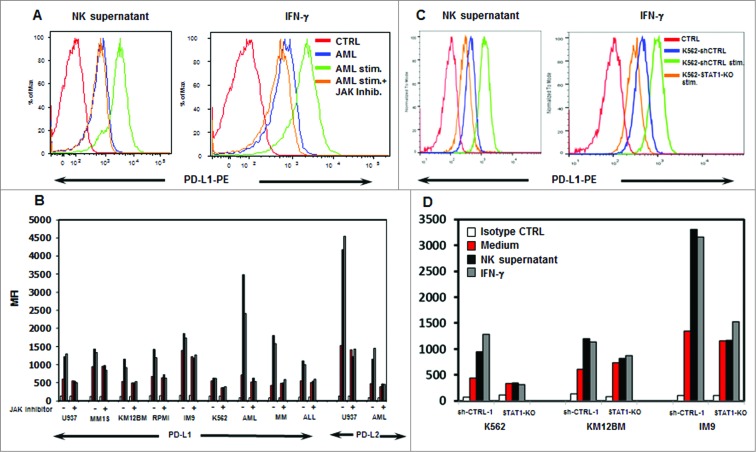
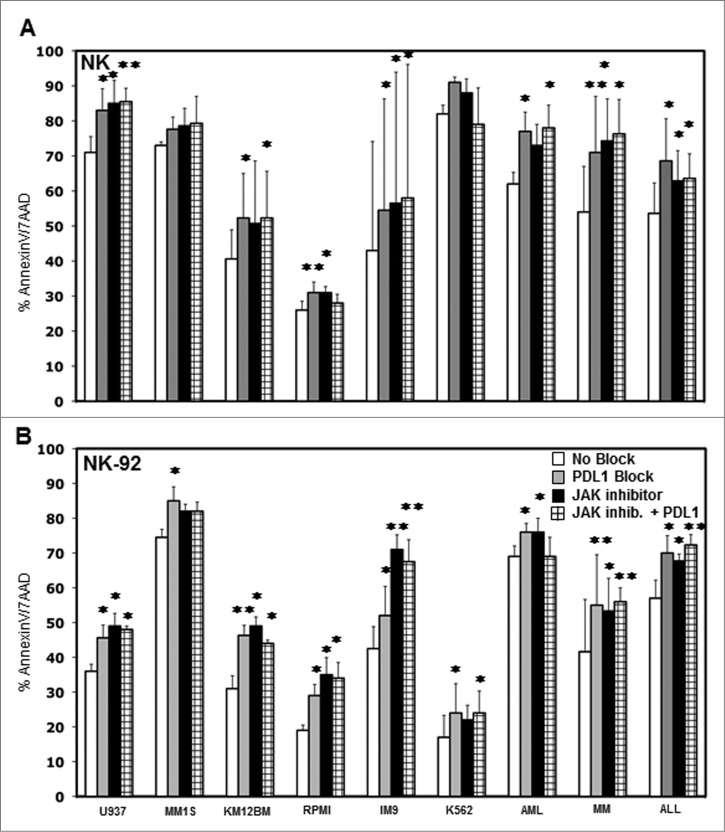
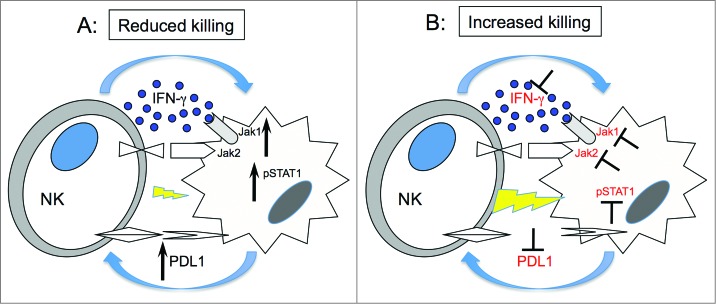
Inhibition of JAK1 or JAK2 in human tumor cells was previously shown to increase susceptibility of these cells to NK cell lysis. In the present study, we examined the cellular mechanisms that mediate this effect in hematopoietic tumor cell lines and primary tumor cells. Incubation of tumor cells with supernatant from activated NK cells or interferon-gamma (IFNγ)-induced activation of pSTAT1 and increased expression of PD-L1 without altering expression of other activating or inhibitory NK cell ligands. These functional effects were blocked by chemical JAK inhibition or shRNAs targeting JAK1, JAK2 or STAT1. Inhibition of IFNγ signaling also prevented the upregulation of PD-L1 and blocking PD-L1 resulted in increased tumor lysis by NK cells. These results show that NK cell activation and secretion of IFNγ results in activation of JAK1, JAK2 and STAT1 in tumor cells, resulting in rapid up-regulation of PD-L1 expression. Increased expression of PD-L1 results in increased resistance to NK cell lysis. Blockade of JAK pathway activation prevents increased PD-L1 expression resulting in increased susceptibility of tumor cells to NK cell activity. These observations suggest that JAK pathway inhibitors as well as PD-1 and PD-L1 antibodies may work synergistically with other immune therapies by preventing IFN-induced inhibition of NK cell-mediated tumor cell lysis.
Overview
The claims and statistics of this paper haven’t been checked yet.
Free: it reads the open-access text and checks the first 5 claims that cite a source we can check. Create a free account to check every claim.
Integrity signals
Registry
Cites
Statistics
Figures
Verification
Claims the paper makes
The claims and statistics of this paper haven’t been checked yet.
Free: it reads the open-access text and checks the first 5 claims that cite a source we can check. Create a free account to check every claim.
Claims other papers make about this one
Each is checked against this paper’s own text: does it say what the citing paper says it does?
The source backs part of the claim, not all of it — or backs it for a different population, condition or comparison.
In the citing paper
“Numerous studies have observed that exposure to interferon gamma (IFN γ ) rapidly induces PD-L1 expression both in cancer cell lines and in the tumor microenvironment [7-10].”
From Characterizing the molecular regulation of inhibitory immune checkpoints with multimodal single-cell screens (2021) · cites this paper as [10]
Experimental — accuracy not yet measured
Self-check
Percentages, sums and reported differences re-computed from the paper’s own numbers.
The self-check needs the paper’s full text.
Citations
Cites
Safety, activity, and immune correlates of anti–PD-1 antibody in cancer
Topalian, S. L., Hodi, F. S., Brahmer, J. R., Gettinger, S. N., Smith, D. C., McDermott, D. F., Powderly, J. D., Carvajal, R. D., Sosman, J. A., Atkins, M. B., et al. (2012) · New England Journal of Medicine · doi:10.1056/nejmoa1200690 · Cited by 12,628
Safety and activity of anti-PD-L1 antibody in patients with advanced cancer
Brahmer, J. R., Tykodi, S. S., Chow, L. Q. M., Hwu, W.-J., Topalian, S. L., Hwu, P., Drake, C. G., Camacho, L. H., Kauh, J., Odunsi, K., et al. (2012) · New England Journal of Medicine · doi:10.1056/nejmoa1200694 · Cited by 7,945 · cited 1×
“Inhibition of the PD-1 pathway enhances T cell tumor immunity and clinical trials in several diseases using either anti-PD-L1 or anti-PD-1 antibodies have shown clinical efficacy.(47,48) Although the role of PD-1 in the negative regulation of T cell immunity is well established, much less is known about PD-1/PD-L1 and…”
BackgroundDarnell, J. E., Kerr, L. M., & Stark, G. R. (1994) · Science · doi:10.1126/science.8197455 · Cited by 6,080 · cited 1×
“JAK kinases are associated with cytokine receptors and ligand binding of these receptors rapidly induces JAK phosphorylation, which in turn activates STAT transcription factors.(11) JAK kinases have also been reported to activate other kinases such as PI3K/AKT and ERK.”
BackgroundFreeman, G. J., Long, A. J., Iwai, Y., Bourque, K., Chernova, T., Nishimura, H., Fitz, L. J., Malenkovich, N., Okazaki, T., Byrne, M. C., et al. (2000) · The Journal of Experimental Medicine · doi:10.1084/jem.192.7.1027 · Cited by 5,294
Self-citationFunctions of natural killer cells
Vivier, E., Tomasello, E., Baratin, M., Walzer, T., & Ugolini, S. (2008) · Nature Immunology · doi:10.1038/ni1582 · Cited by 3,943 · cited 1×
“Impact of NK cell: tumor cell interaction on JAK1 and JAK2 signaling JAK1 and JAK2 are associated with the IFNg receptor(14) and NK cells are known to secrete IFNg and other cytokines after activation by target cells.(15,16) We therefore hypothesized that JAK1 and JAK2 were specifically activated by cytokines released…”
BackgroundInnate or adaptive immunity? The example of natural killer cells
Vivier, E., Raulet, D. H., Moretta, A., Caligiuri, M. A., Zitvogel, L., Lanier, L. L., Yokoyama, W. M., & Ugolini, S. (2011) · Science · doi:10.1126/science.1198687 · Cited by 2,824
Lanier, L. L. (2005) · Annual Review of Immunology · doi:10.1146/annurev.immunol.23.021704.115526 · Cited by 2,769 · cited 2×
“Expression of inhibitory and activating ligands on tumor cells incubated with NK supernatant or IFNg Tumor susceptibility to NK cell recognition is profoundly influenced by MHC class I expression as well as other inhibitory/ activating ligands.(19,20) IFNg is known to modulate expression of immunomodulary molecules on…”
BackgroundDong, H., Zhu, G., Tamada, K., & Chen, L. (1999) · Nature Medicine · doi:10.1038/70932 · Cited by 2,496 · cited 1×
“stimulation can induce up-regulation of PD-L1 in monocytes and other cell types.(41,42) One effect of IFNg is to enhance expression of MHC Class I, thus facilitating T cell recognition.”
BackgroundCaligiuri, M. A. (2008) · Blood · doi:10.1182/blood-2007-09-077438 · Cited by 1,905
Up on the tightrope: natural killer cell activation and inhibition
Lanier, L. L. (2008) · Nature Immunology · doi:10.1038/ni1581 · Cited by 1,656 · cited 1×
“NK cell functions are mediated in part through direct lysis of target cells.(4,5) In addition, NK cells are an important source of immunoregulatory cytokines such as IFNg, tumor necrosis factor-a (TNFa) and granulocyte macrophage colony-stimulating factor (GMCSF).”
Background
Cited by
IFN-γ–related mRNA profile predicts clinical response to PD-1 blockade
Ayers, M., Lunceford, J., Nebozhyn, M., Murphy, E., Loboda, A., Kaufman, D. R., Albright, A., Cheng, J. D., Kang, S. P., Shankaran, V., et al. (2017) · Journal of Clinical Investigation · doi:10.1172/jci91190 · Cited by 3,788
PD-1/PD-L1 pathway: current researches in cancer.
Han, Y., Liu, D., & Li, L. (2020) · PubMed Central · Cited by 2,290
Oncolytic viruses: a new class of immunotherapy drugs
Kaufman, H. L., Kohlhapp, F. J., & Zloza, A. (2015) · Nature Reviews Drug Discovery · doi:10.1038/nrd4663 · Cited by 1,642
“As oncolytic viruses often induce interferon (IFN) release in the local tumour microenvironment, and IFN is known to upregulate PDL1 expression on tumour cells, this combination is especially interesting 181 .”
BackgroundRoles of IFN-γ in tumor progression and regression: A review
Jorgovanovic, D., Song, M., Wang, L., & Zhang, Y. (2020) · Biomarker Research · doi:10.1186/s40364-020-00228-x · Cited by 1,234
Coinhibitory Pathways in Immunotherapy for Cancer
Baumeister, S. H., Freeman, G. J., Dranoff, G., & Sharpe, A. H. (2016) · Annual Review of Immunology · doi:10.1146/annurev-immunol-032414-112049 · Cited by 910
Self-citationMonoclonal Antibodies in Cancer Therapy
Zahavi, D., & Weiner, L. (2020) · Antibodies · doi:10.3390/antib9030034 · Cited by 831
High-dimensional single-cell analysis predicts response to anti-PD-1 immunotherapy
Krieg, C., Nowicka, M., Guglietta, S., Schindler, S., Hartmann, F. J., Weber, L. M., Dummer, R., Robinson, M. D., Levesque, M. P., & Becher, B. (2018) · Nature Medicine · doi:10.1038/nm.4466 · Cited by 735
Tumor and immune reprogramming during immunotherapy in advanced renal cell carcinoma
Bi, K., He, M. X., Bakouny, Z., Kanodia, A., Napolitano, S., Wu, J., Grimaldi, G., Braun, D. A., Cuoco, M. S., Mayorga, A., et al. (2021) · Cancer Cell · doi:10.1016/j.ccell.2021.02.015 · Cited by 618
Inhibiting PD-L1 palmitoylation enhances T-cell immune responses against tumours
Yao, H., Lan, J., Li, C., Shi, H., Brosseau, J.-P., Wang, H., Lu, H., Fang, C., Zhang, Y., Liang, L., et al. (2019) · Nature Biomedical Engineering · doi:10.1038/s41551-019-0375-6 · Cited by 568
The hallmarks of cancer immune evasion
Galassi, C., Chan, T. A., Vitale, I., & Galluzzi, L. (2024) · Cancer Cell · doi:10.1016/j.ccell.2024.09.010 · Cited by 565
Mechanisms regulating PD-L1 expression on tumor and immune cells
Chen, S., Crabill, G. A., Pritchard, T. S., McMiller, T. L., Wei, P., Pardoll, D. M., Pan, F., & Topalian, S. L. (2019) · Journal for ImmunoTherapy of Cancer · doi:10.1186/s40425-019-0770-2 · Cited by 459
Wan, W., Ao, X., Chen, Q., Yu, Y., Ao, L., Xing, W., Guo, W., Wu, X., Pu, C., Hu, X., et al. (2022) · Molecular Cancer · doi:10.1186/s12943-021-01447-y · Cited by 457
PD‐1/PD‐L1 pathway: Basic biology and role in cancer immunotherapy
Salmaninejad, A., Valilou, S. F., Shabgah, A. G., Aslani, S., Alimardani, M., Pasdar, A., & Sahebkar, A. (2019) · Journal of Cellular Physiology · doi:10.1002/jcp.28358 · Cited by 445
“NK cells increase the PD‐L1 expression on the surface of the tumor cells by secretion of the IFN‐γ through the JAK1, JAK2, and STAT1 pathways (Bellucci et al., 2015).”
BackgroundPD-L1 Distribution and Perspective for Cancer Immunotherapy—Blockade, Knockdown, or Inhibition
Wu, Y., Chen, W., Xu, Z. P., & Gu, W. (2019) · Frontiers in Immunology · doi:10.3389/fimmu.2019.02022 · Cited by 419
Chemokines Modulate Immune Surveillance in Tumorigenesis, Metastasis, and Response to Immunotherapy
Vilgelm, A. E., & Richmond, A. (2019) · Frontiers in Immunology · doi:10.3389/fimmu.2019.00333 · Cited by 379
Interferon gamma in cancer immunotherapy
Ni, L., & Lu, J. (2018) · Cancer Medicine · doi:10.1002/cam4.1700 · Cited by 360
PD-1 and its ligands are important immune checkpoints in cancer
Dong, Y., Sun, Q., & Zhang, X. (2017) · Oncotarget · doi:10.18632/oncotarget.13895 · Cited by 334
The Dark Side of IFN-γ: Its Role in Promoting Cancer Immunoevasion
Mojic, M., Takeda, K., & Hayakawa, Y. (2017) · International Journal of Molecular Sciences · doi:10.3390/ijms19010089 · Cited by 334
Zerdes, I., Matikas, A., Bergh, J., Rassidakis, G. Z., & Foukakis, T. (2018) · Oncogene · doi:10.1038/s41388-018-0303-3 · Cited by 292
Kitamura, H., Ohno, Y., Toyoshima, Y., Ohtake, J., Homma, S., Kawamura, H., Takahashi, N., & Taketomi, A. (2017) · Cancer Science · doi:10.1111/cas.13332 · Cited by 278
The good and the bad faces of STAT1 in solid tumours
Meissl, K., Macho-Maschler, S., Müller, M., & Strobl, B. (2017) · Cytokine · doi:10.1016/j.cyto.2015.11.011 · Cited by 264
Checkpoint inhibitor immunotherapy in kidney cancer
Xu, W., Atkins, M. B., & McDermott, D. F. (2020) · Nature Reviews Urology · doi:10.1038/s41585-020-0282-3 · Cited by 261
Hudson, K., Cross, N., Jordan-Mahy, N., & Leyland, R. (2020) · Frontiers in Immunology · doi:10.3389/fimmu.2020.568931 · Cited by 243
“For example, transcription factors JAK/STAT1, IRF-1 and NFκB are responsible for IFNγ-induced PD-L1 expression in hematopoietic tumors (155), lung cancer (143), and melanoma (141), respectively.”
BackgroundPapalexi, E., Mimitou, E. P., Butler, A. W., Foster, S., Bracken, B., Mauck, W. M., Wessels, H.-H., Hao, Y., Yeung, B. Z., Smibert, P., et al. (2021) · Nature Genetics · doi:10.1038/s41588-021-00778-2 · Cited by 237
PD ‐L1 blockade enhances response of pancreatic ductal adenocarcinoma to radiotherapy
Azad, A., Yin Lim, S., D'Costa, Z., Jones, K., Diana, A., Sansom, O. J., Kruger, P., Liu, S., McKenna, W. G., Dushek, O., et al. (2017) · EMBO Molecular Medicine · doi:10.15252/emmm.201606674 · Cited by 218
“We only observed upregulation of IFNc expression in PDAC cells after treatment with gemcitabine but not with RT. IFNc can activate Jak/Stat resulting in PD-L1 upregulation (Bellucci et al, 2015), which could explain PDL1 upregulation in PDAC cells after gemcitabine treatment.”
BackgroundGao, Y., Yang, J., Cai, Y., Fu, S., Zhang, N., Fu, X., & Li, L. (2018) · International Journal of Cancer · doi:10.1002/ijc.31357 · Cited by 217
PD-L1 Expression in Human Placentas and Gestational Trophoblastic Diseases
Veras, E., Kurman, R. J., Wang, T.-L., & Shih, I.-M. (2017) · International Journal of Gynecological Pathology · doi:10.1097/pgp.0000000000000305 · Cited by 206
Rah, B., Rather, R. A., Bhat, G. R., Baba, A. B., Mushtaq, I., Farooq, M., Yousuf, T., Dar, S. B., Parveen, S., Hassan, R., et al. (2022) · Frontiers in Pharmacology · doi:10.3389/fphar.2022.821344 · Cited by 202
“Constitutive phosphorylation of STAT1, STAT3, and STAT5 has been detected in many tumor cell models (Bellucci et al., 2015).”
BackgroundThe Interferon-Gamma Paradox in Cancer
Zaidi, M. R. (2019) · Journal of Interferon & Cytokine Research · doi:10.1089/jir.2018.0087 · Cited by 199
Emerging concepts in PD-1 checkpoint biology
Pauken, K. E., Torchia, J. A., Chaudhri, A., Sharpe, A. H., & Freeman, G. J. (2021) · Seminars in Immunology · doi:10.1016/j.smim.2021.101480 · Cited by 191
Self-citationFerris, R. L., Lenz, H.-J., Trotta, A. M., García-Foncillas, J., Schulten, J., Audhuy, F., Merlano, M., & Milano, G. (2018) · Cancer Treatment Reviews · doi:10.1016/j.ctrv.2017.11.008 · Cited by 190
Biomarkers for Immune Checkpoint Inhibitor-Mediated Tumor Response and Adverse Events
Nakamura, Y. (2019) · Frontiers in Medicine · doi:10.3389/fmed.2019.00119 · Cited by 185
PD-1 modulates regulatory T-cell homeostasis during low-dose interleukin-2 therapy
Asano, T., Meguri, Y., Yoshioka, T., Kishi, Y., Iwamoto, M., Nakamura, M., Sando, Y., Yagita, H., Koreth, J., Kim, H. T., et al. (2017) · Blood · doi:10.1182/blood-2016-09-741629 · Cited by 176
Self-citationLu, C., Talukder, A., Savage, N. M., Singh, N., & Liu, K. (2017) · OncoImmunology · doi:10.1080/2162402x.2017.1291106 · Cited by 176
Immune Landscape of Colorectal Cancer Tumor Microenvironment from Different Primary Tumor Location
Zhang, L., Zhao, Y., Dai, Y., Cheng, J.-N., Gong, Z., Feng, Y., Sun, C., Jia, Q., & Zhu, B. (2018) · Frontiers in Immunology · doi:10.3389/fimmu.2018.01578 · Cited by 166
“More recently, it was found that the PD-1 receptor can also be detected on activated NK cells (40, 41), suggesting that blocking this protein could facilitate CD56bright NK cell cytolytic activity.”
BackgroundAdvances in Cancer Immunotherapy in Solid Tumors
Menon, S., Shin, S., & Dy, G. (2016) · Cancers · doi:10.3390/cancers8120106 · Cited by 166
Interpretable systems biomarkers predict response to immune-checkpoint inhibitors
Lapuente-Santana, Ó., van Genderen, M., Hilbers, P. A. J., Finotello, F., & Eduati, F. (2021) · Patterns · doi:10.1016/j.patter.2021.100293 · Cited by 136
IFNγ induces PD-L1 overexpression by JAK2/STAT1/IRF-1 signaling in EBV-positive gastric carcinoma
Moon, J. W., Kong, S.-K., Kim, B. S., Kim, H. J., Lim, H., Noh, K., Kim, Y., Choi, J.-W., Lee, J.-H., & Kim, Y.-S. (2017) · Scientific Reports · doi:10.1038/s41598-017-18132-0 · Cited by 162
Sasidharan Nair, V., Toor, S. M., Ali, B. R., & Elkord, E. (2018) · Expert Opinion on Therapeutic Targets · doi:10.1080/14728222.2018.1471137 · Cited by 159
Jabbarzadeh Kaboli, P., Salimian, F., Aghapour, S., Xiang, S., Zhao, Q., Li, M., Wu, X., Du, F., Zhao, Y., Shen, J., et al. (2020) · Pharmacological Research · doi:10.1016/j.phrs.2020.104806 · Cited by 159
Type I and II Interferons in the Anti-Tumor Immune Response
Fenton, S. E., Saleiro, D., & Platanias, L. C. (2021) · Cancers · doi:10.3390/cancers13051037 · Cited by 161
“In contrast, IFNγwas shown to induce PD-L1 expression on tumor cells, reducing their susceptibility to NK cytotoxicity [91].”
BackgroundOck, C.-Y., Kim, S., Keam, B., Kim, M., Kim, T. M., Kim, J.-H., Jeon, Y. K., Lee, J.-S., Kwon, S. K., Hah, J. H., et al. (2016) · Oncotarget · doi:10.18632/oncotarget.7431 · Cited by 144
Sun, L., Wang, Q., Chen, B., Zhao, Y., Shen, B., Wang, H., Xu, J., Zhu, M., Zhao, X., Xu, C., et al. (2018) · Cell Death and Disease · doi:10.1038/s41419-018-0988-9 · Cited by 153
Erratum: Oncolytic viruses: a new class of immunotherapy drugs
Kaufman, H. L., Kohlhapp, F. J., & Zloza, A. (2016) · Nature Reviews Drug Discovery · doi:10.1038/nrd.2016.178 · Cited by 153
O -GlcNAcylation promotes tumor immune evasion by inhibiting PD-L1 lysosomal degradation
Zhu, Q., Wang, H., Chai, S., Xu, L., Lin, B., Yi, W., & Wu, L. (2023) · Proceedings of the National Academy of Sciences · doi:10.1073/pnas.2216796120 · Cited by 152
“Multiple transcription factors such as STAT (18, 19), ATF3 (20), c-Myc (21), and NF-κ B (22, 23) directly or indirectly induce the expression of CD274 encoding PD-L1.”
YY1 regulates cancer cell immune resistance by modulating PD-L1 expression
Hays, E., & Bonavida, B. (2019) · Drug Resistance Updates · doi:10.1016/j.drup.2019.04.001 · Cited by 153
“Furthermore, IFN-γ-dependent up-regulation of PD-L1 expression has been shown to be mediated by the activation of JAK1, JAK2, and STAT1 (Bellucci et al., 2015).”
BackgroundNatural Killer Cell Response to Chemotherapy-Stressed Cancer Cells: Role in Tumor Immunosurveillance
Zingoni, A., Fionda, C., Borrelli, C., Cippitelli, M., Santoni, A., & Soriani, A. (2017) · Frontiers in Immunology · doi:10.3389/fimmu.2017.01194 · Cited by 125
IFN-γ orchestrates tumor elimination, tumor dormancy, tumor escape, and progression
Aqbi, H. F., Wallace, M., Sappal, S., Payne, K. K., & Manjili, M. H. (2018) · Journal of Leukocyte Biology · doi:10.1002/jlb.5mir0917-351r · Cited by 126
Recent Findings in the Regulation of Programmed Death Ligand 1 Expression
Shen, X., Zhang, L., Li, J., Li, Y., Wang, Y., & Xu, Z. (2019) · Frontiers in Immunology · doi:10.3389/fimmu.2019.01337 · Cited by 139
Xu, L., Chen, X., Shen, M., Yang, D., Fang, L., Weng, G., Tsai, Y., Keng, P. C., Chen, Y., & Lee, S. O. (2018) · Molecular Oncology · doi:10.1002/1878-0261.12135 · Cited by 135
“These included JAK1/2 (Bellucci et al., 2015; Ikeda et al., 2016), Stat3 (Fujita et al., 2015; Marzec et al., 2008), Akt-mTOR (Lastwika et al., 2016), NFjB (Gowrishankar et al., 2015), mitogen-activated protein kinase/ERK kinase (MEK), extracellular signal-regulated kinase (ERK) (Yamamoto et al., 2009), PI3K/Akt (Xu e…”
The immune microenvironment in Hodgkin lymphoma: T cells, B cells, and immune checkpoints
Vardhana, S. A., & Younes, A. (2016) · Haematologica · doi:10.3324/haematol.2015.132761 · Cited by 133
Kjaergaard, J., Hatfield, S., Jones, G., Ohta, A., & Sitkovsky, M. (2018) · The Journal of Immunology · doi:10.4049/jimmunol.1700850 · Cited by 132
Oncolytic viruses: overcoming translational challenges
Martínez‐Quintanilla, J., Seah, I. Y. J., Chua, M. M. J., & Shah, K. (2019) · Journal of Clinical Investigation · doi:10.1172/jci122287 · Cited by 130
Bazhin, A. V., von Ahn, K., Fritz, J., Werner, J., & Karakhanova, S. (2018) · Frontiers in Immunology · doi:10.3389/fimmu.2018.02129 · Cited by 104
“Attenuation of IFNγ-induced PD-L1 expression in melanoma cells was proven to happen via down-regulation of the Jak/STAT/IRF-1 signaling pathway (67, 68), while activation of Jaks led to PD-L1 up-regulation in hematopoietic tumor cell lines and primary tumor cells (69).”
BackgroundCoombs, M. R. P., Harrison, M. E., & Hoskin, D. W. (2016) · Cancer Letters · doi:10.1016/j.canlet.2016.06.023 · Cited by 126
Su, W., Qiu, W., Li, S., Wang, S., Xie, J., Yang, Q., Xu, J., Zhang, J., Xu, Z., & Sun, Z. (2023) · Advanced Materials · doi:10.1002/adma.202209379 · Cited by 121
Immunotherapy resistance in non-small-cell lung cancer: From mechanism to clinical strategies
Zhou, S., & Yang, H. (2023) · Frontiers in Immunology · doi:10.3389/fimmu.2023.1129465 · Cited by 122
“Except for the role of IFN-g in HLA regulation, IFN-g signaling is also critical for the initiation of PD-L1 expression in cancer and host cells (58, 59).”
BackgroundKikuchi, M., Clump, D. A., Srivastava, R. M., Sun, L., Zeng, D., Díaz-Pérez, J. A., Anderson, C. J., Edwards, W. B., & Ferris, R. L. (2017) · OncoImmunology · doi:10.1080/2162402x.2017.1329071 · Cited by 121
Immune Marker Profiling and Programmed Death Ligand 1 Expression Across NSCLC Mutations
Toki, M. I., Mani, N. L., Smithy, J. W., Liu, Y., Altan, M., Wasserman, B. E., Tuktamyshov, R., Schalper, K. A., Syrigos, K. N., & Rimm, D. L. (2018) · Journal of Thoracic Oncology · doi:10.1016/j.jtho.2018.09.012 · Cited by 120
Zheng, G., Guo, Z., Li, W., Xi, W., Zuo, B., Zhang, R., Wen, W., Yang, A., & Jia, L. (2021) · Signal Transduction and Targeted Therapy · doi:10.1038/s41392-021-00629-w · Cited by 120
NK Cell-Based Immunotherapy in Cancer Metastasis
Lorenzo‐Herrero, S., López‐Soto, A., Sordo‐Bahamonde, C., González, A. P., Vitale, M., & Gonzalez, S. R. (2018) · Cancers · doi:10.3390/cancers11010029 · Cited by 119
Ashizawa, T., Iizuka, A., Nonomura, C., Kondou, R., Maeda, C., Miyata, H., Sugino, T., Mitsuya, K., Hayashi, N., Nakasu, Y., et al. (2017) · Clinical Cancer Research · doi:10.1158/1078-0432.ccr-16-0122 · Cited by 102
Zhao, T., Li, Y., Zhang, J., & Zhang, B. (2020) · Oncology Letters · doi:10.3892/ol.2020.11647 · Cited by 108
“Notably, the interferon-γ (IFN-γ )/JAK/STAT signaling pathway has been confirmed to induce PD‑L1 expression in myeloid leukemia cells, and pancreatic and gastric cancer (13,15,16).”
Fan, R., Chen, C., Mu, M., Chuan, D., Liu, H., Hou, H., Huang, J., Tong, A., Guo, G. F., & Xu, J. (2023) · ACS Nano · doi:10.1021/acsnano.2c12217 · Cited by 107
Wu, B., Song, M. L., Dong, Q., Xiang, G., Li, J., Ma, X., & Wei, F. (2022) · Theranostics · doi:10.7150/thno.74989 · Cited by 108
“Among these factors, IFN-γ in the tumor microenvironment (TME) affects both tumor and immune cells in both immunoactivating and immunosuppressive ways [13] which explains why that early approaches targeting IFN-γ in the TME largely failed to provide any clinical benefit [14-16].”
BackgroundKailayangiri, S., Altvater, B., Spurny, C., Jamitzky, S., Schelhaas, S., Jacobs, A. H., Wiek, C., Roellecke, K., Hanenberg, H., Hartmann, W., et al. (2017) · OncoImmunology · doi:10.1080/2162402x.2016.1250050 · Cited by 104
PD-1 and PD-L1 blockade in gastrointestinal malignancies
Lote, H., Cafferkey, C., & Chau, I. (2015) · Cancer Treatment Reviews · doi:10.1016/j.ctrv.2015.09.004 · Cited by 101
Chen, K., Cheng, G., Zhang, F., Zhu, G., Xu, Y., Yu, X., Huang, Z., & Fan, Y. (2020) · Lung Cancer · doi:10.1016/j.lungcan.2020.02.010 · Cited by 99
Targeting Epidermal Growth Factor Receptor in Head and Neck Cancer
Bhatia, A. K. (2022) · The Cancer Journal · doi:10.1097/ppo.0000000000000623 · Cited by 97
Cantoni, C., Huergo-Zapico, L., Parodi, M., Pedrazzi, M., Mingari, M. C., Moretta, A., Sparatore, B., Gonzalez, S. R., Olive, D., Bottino, C., et al. (2016) · Journal of Immunology Research · doi:10.1155/2016/4684268 · Cited by 91
Saleiro, D., & Platanias, L. C. (2019) · Seminars in Immunology · doi:10.1016/j.smim.2019.101299 · Cited by 87
“Also, IFNα induces PD-L1 expression on dendritic cells, via engagement of both STAT3 and p38 MAPK pathways [139], while JAK/STAT1 signaling is required for IFNγ-induced expression of PD-L1 in hematopoietic malignant cells and resistance to natural killer cell lysis [140].”
BackgroundOhno, Y., Toyoshima, Y., Yurino, H., Monma, N., Xiang, H., Sumida, K., Kaneumi, S., Terada, S., Hashimoto, S., Ikeo, K., et al. (2017) · Cancer Science · doi:10.1111/cas.13330 · Cited by 82
Stromal Modulation Reverses Primary Resistance to Immune Checkpoint Blockade in Pancreatic Cancer
Zhao, J., Xiao, Z., Li, T., Chen, H., Yuan, Y., Wang, Y., Hsiao, C.-H., Chow, D. S., Overwijk, W. W., & Li, C. (2018) · ACS Nano · doi:10.1021/acsnano.8b02481 · Cited by 86
Innate Immune Cells: A Potential and Promising Cell Population for Treating Osteosarcoma
Wang, Z., Wang, Z., Li, B., Wang, S., Chen, T., & Ye, Z. (2019) · Frontiers in Immunology · doi:10.3389/fimmu.2019.01114 · Cited by 76
Shen, M., Xu, L. J., Li, Y., Tsai, Y., Keng, P. C., Chen, Y., Lee, S. O., & Chen, Y. (2017) · Oncotarget · doi:10.18632/oncotarget.19193 · Cited by 81
Landscape of natural killer cell activity in head and neck squamous cell carcinoma
Charap, A., Enokida, T., Brody, R., Sfakianos, J. P., Miles, B. A., Bhardwaj, N., & Horowitz, A. (2020) · Journal for ImmunoTherapy of Cancer · doi:10.1136/jitc-2020-001523 · Cited by 81
The SETDB1–TRIM28 Complex Suppresses Antitumor Immunity
Lin, J., Guo, D., Liu, H., Zhou, W., Wang, C., Müller, I. I., Kossenkov, A. V., Drapkin, R., Bitler, B. G., Helin, K., et al. (2021) · Cancer Immunology Research · doi:10.1158/2326-6066.cir-21-0754 · Cited by 79
Evolutionary route of nasopharyngeal carcinoma metastasis and its clinical significance
Mei, L., Zhang, X.-L., You, R., Liu, Y., Cai, H., Liu, L., Liu, X., Zou, X., Xie, Y., Zou, R., et al. (2023) · Nature Communications · doi:10.1038/s41467-023-35995-2 · Cited by 79
Ryan, N. M., Anderson, K., Volpedo, G., Hamza, O., Varikuti, S., Satoskar, A. R., & Oghumu, S. (2019) · International Journal of Cancer · doi:10.1002/ijc.32781 · Cited by 79
Xu, B., Chen, L., Li, J., Zheng, X. W., Shi, L., Wu, C., & Jiang, J. (2016) · Oncotarget · doi:10.18632/oncotarget.12484 · Cited by 78
Lee, E. K., & Konstantinopoulos, P. A. (2020) · Therapeutic Advances in Medical Oncology · doi:10.1177/1758835920944116 · Cited by 79
Regulation of PD-L1 through direct binding of cholesterol to CRAC motifs
Wang, Q., Cao, Y., Shen, L., Xiao, T., Cao, R., Wei, S., Tang, M., Du, L., Wu, H., Wu, B., et al. (2022) · Science Advances · doi:10.1126/sciadv.abq4722 · Cited by 76
Cytokine- and TCR-Mediated Regulation of T Cell Expression of Ly6C and Sca-1
DeLong, J. H., Hall, A. O., Konradt, C., Coppock, G., Park, J., Pritchard, G. H., & Hunter, C. A. (2018) · The Journal of Immunology · doi:10.4049/jimmunol.1701154 · Cited by 76
Xu, P., Xiong, W., Lin, Y., Fan, L., Pan, H., & Li, Y. (2021) · Cell Death and Disease · doi:10.1038/s41419-021-04047-2 · Cited by 71
Deng, C., Li, Z., Guo, S., Chen, P., Chen, X., Zhou, Q., Chen, J., Yu, X., Wu, X., Ma, W., et al. (2017) · OncoImmunology · doi:10.1080/2162402x.2016.1269047 · Cited by 73
Mahmood, J., Shukla, H. D., Soman, S., Samanta, S., Singh, P., Kamlapurkar, S., Saeed, A. M., Amin, N. P., & Vujašković, Ž. (2018) · Cancers · doi:10.3390/cancers10120469 · Cited by 69
“Interestingly, during HT, normal tissue has the ability to endure the mild temperature while cancer cells are sensitive to temperature stress and succumb to death [43].”
BackgroundSoluble PD-1 ligands regulate T-cell function in Waldenstrom macroglobulinemia
Jalali, S., Price-Troska, T. L., Paludo, J., Villasboas, J. C., Kim, H.-J., Yang, Z., Novak, A. J., & Ansell, S. M. (2018) · Blood Advances · doi:10.1182/bloodadvances.2018021113 · Cited by 66
Predictive Biomarkers and Resistance Mechanisms of Checkpoint Inhibitors in Malignant Solid Tumors
Pavelescu, L. A., Enache, R. M., Roşu, O. A., Profir, M., Creţoiu, S. M., & Gașpar, B. S. (2024) · International Journal of Molecular Sciences · doi:10.3390/ijms25179659 · Cited by 66
Shukla, A., Cloutier, M., Santharam, M. A., Ramanathan, S., & Ilangumaran, S. (2021) · International Journal of Molecular Sciences · doi:10.3390/ijms22041964 · Cited by 62
Immunotherapy in pancreatic cancer: Unleash its potential through novel combinations
Guo, S., Contratto, M., Miller, G., Leichman, L., & Wu, J. J. (2017) · World Journal of Clinical Oncology · doi:10.5306/wjco.v8.i3.230 · Cited by 60
A Mechanism of Resistance to Antibody-Targeted Immune Attack
Aldeghaither, D. S., Zahavi, D. J., Murray, J. C., Fertig, E. J., Graham, G. T., Zhang, Y., O’Connell, A., Ma, J., Jablonski, S. A., & Weiner, L. M. (2019) · Cancer Immunology Research · doi:10.1158/2326-6066.cir-18-0266 · Cited by 61
Li, Y., Shen, M., Xu, L. J., Yang, X., Tsai, Y., Keng, P. C., Chen, Y., & Lee, S. O. (2017) · Scientific Reports · doi:10.1038/s41598-017-08483-z · Cited by 58
Drug response to PD-1/PD-L1 blockade: based on biomarkers
Chen, Q., Li, T., & Yue, W. (2018) · OncoTargets and Therapy · doi:10.2147/ott.s168313 · Cited by 58
Xu, L., Ma, Q., Zhu, J., Li, J., Xue, B., Gao, J., Sun, C., Zang, Y., Zhou, Y., Yang, D., et al. (2018) · Molecular Medicine Reports · doi:10.3892/mmr.2018.8905 · Cited by 56
“…that the combination of PD-1 and PD-L1 constitutes the PD-1-PD-L1 signaling pathway; in addition to this pathway's immunosuppressive effects through T cells (34), it can also inhibit the anti-tumor activity of NK cells by inhibiting the function of NKG2D ligands on the surface of tumor cells (35).”
McArthur, H. L., & Page, D. B. (2016) · PubMed · Cited by 55
Marrella, A., Dondero, A., Aiello, M., Casu, B., Olive, D., Regis, S., Bottino, C., Pende, D., Meazza, R., Caluori, G., et al. (2019) · Frontiers in Immunology · doi:10.3389/fimmu.2019.01876 · Cited by 55
Microenvironmental immune cell signatures dictate clinical outcomes for PTCL-NOS
Sugio, T., Miyawaki, K., Kato, K., Sasaki, K., Yamada, K., Iqbal, J., Miyamoto, T., Ohshima, K., Maeda, T., Miyoshi, H., et al. (2018) · Blood Advances · doi:10.1182/bloodadvances.2018018754 · Cited by 54
Chen, M., Sharma, A., Lin, Y., Wu, Y., He, Q., Gu, Y., Xu, Z. P., Monteiro, M., & Gu, W. (2019) · BMC Cancer · doi:10.1186/s12885-019-5364-3 · Cited by 53
Godiyal, Y., Maheshwari, D., Taniguchi, H., Zinzuwadia, S. S., Díaz, Y. M., Tewari, D., & Bishayee, A. (2024) · Military Medical Research · doi:10.1186/s40779-024-00586-9 · Cited by 53
Xu, L., Shen, M., Chen, X., Zhu, R., Yang, D., Tsai, Y., Keng, P. C., Chen, Y., & Lee, S. O. (2018) · The Prostate · doi:10.1002/pros.23479 · Cited by 51
Metadata
- Authors
- Bellucci, R., Martin, A., Bommarito, D., Wang, K., Hansen, S. H., Freeman, G. J., & Ritz, J.
- Affiliations
- Brigham and Women's Hospital (US)
- Dana-Farber Cancer Institute (US)
- Corresponding author
- Bellucci, Roberto
- Ritz, Jerome
- Venue
- OncoImmunology
- Publisher
- Informa UK Limited
- Published
- 2015-03-02
- Volume
- 4
- Issue
- 6
- Pages
- e1008824
- ISSN
- 2162-4011 (ISSN-L)
- 2162-402X
- PMC
- PMC4485824
- OpenAlex
- W1510735640
- Cited by
- 307
- References
- 51
- Citations by year
- 2026: 10 · 2025: 23 · 2024: 38 · 2023: 30 · 2022: 20 · 2021: 35 · 2020: 36 · 2019: 29 · 2018: 33 · 2017: 28 · 2016: 22 · 2015: 3
- FWCI
- 14.10
- Type
- journal article
- Language
- en
- Open access
- gold
- doi.org
- Licence
- cc-by-nc
- Locations
- OncoImmunology (publishedVersion, cc-by-nc)
- PubMed Central (publishedVersion, cc-by-nc)
- PubMed (publishedVersion)
- Digital Access to Scholarship at Harvard (DASH) (Harvard University) (submittedVersion, cc-by)
- Funders
- National Cancer Institute (P01CA142106, P50CA101942, R01CA183560, P01CA066996)
- Topics
- Life Sciences › Immunology and Microbiology › Immunology › Immune Cell Function and Interaction
- Health Sciences › Medicine › Oncology › Cancer Immunotherapy and Biomarkers
- Life Sciences › Immunology and Microbiology › Immunology › Cytokine Signaling Pathways and Interactions
- Keywords
- interferon-gamma, JAK1, JAK2, STAT1, PD-L1, NK cell-mediated lysis, NK cell resistance, tumor cell susceptibility, JAK inhibition, hematopoietic tumors, immune checkpoint blockade, PD-1, combination immunotherapy
About these checks
Registry, retraction, Cites and statistics results are computed, not judged, with one exception: a printed reference that no index lists is read once by a model before it counts as a citation error. Claims are extracted by a model and kept only when their quote appears verbatim in the text; each cited source is then checked, with a model’s help, for whether it says what the claim relies on. Those verdicts can be wrong — read the claim’s quote and the cited source before relying on one.
Statistics and arithmetic are recomputed, not judged.
Confidence bands are shown only for fields calibrated on our annotated test set. None is calibrated yet, so no band is shown.
What counts as a claim ›How we measure confidence ›How we check this ›
Are you an author, or do you see a problem with this page? Request a review
Data sources
Bibliographic data: Semantic Scholar, OpenAlex, Crossref.
Contains information from the Semantic Scholar Academic Graph Datasets, made available under the ODC Attribution License (ODC-BY 1.0).
Semantic Scholar’s data is described in: Kinney, R., et al. (2023). The Semantic Scholar Open Data Platform. arXiv:2301.10140.
