

Interferon-γ-induced activation of JAK1 and JAK2 suppresses tumor cell susceptibility to NK cells through upregulation of PD-L1 expression
Open accessThe DOI matches its Crossref record; 51 of the 51 references it cites were found in a registry or an index.
Abstract
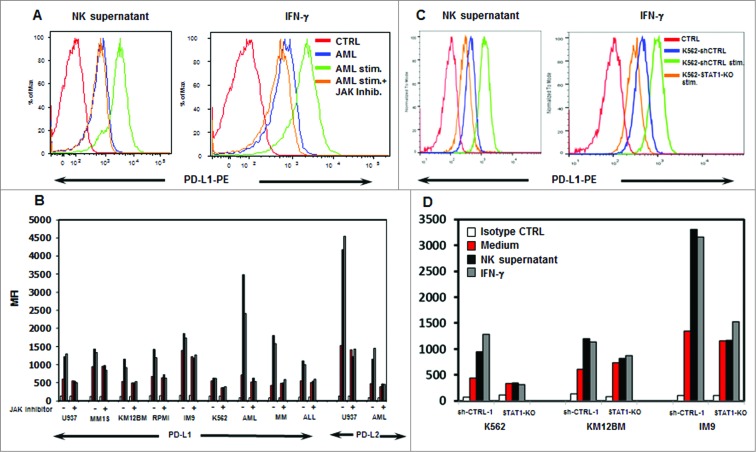
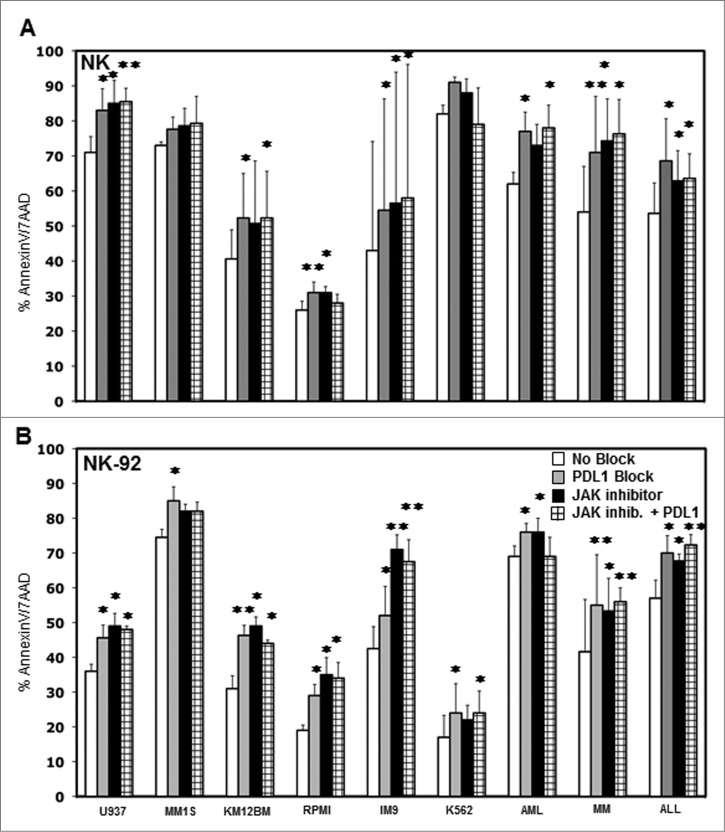
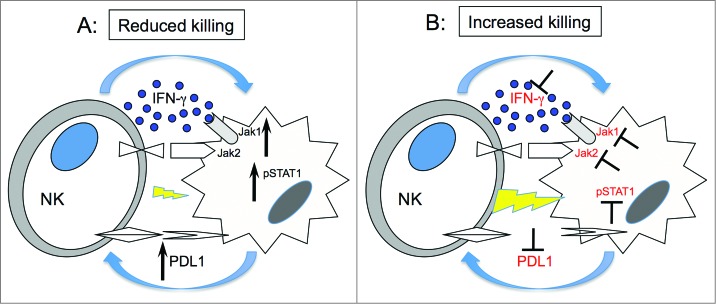
Inhibition of JAK1 or JAK2 in human tumor cells was previously shown to increase susceptibility of these cells to NK cell lysis. In the present study, we examined the cellular mechanisms that mediate this effect in hematopoietic tumor cell lines and primary tumor cells. Incubation of tumor cells with supernatant from activated NK cells or interferon-gamma (IFNγ)-induced activation of pSTAT1 and increased expression of PD-L1 without altering expression of other activating or inhibitory NK cell ligands. These functional effects were blocked by chemical JAK inhibition or shRNAs targeting JAK1, JAK2 or STAT1. Inhibition of IFNγ signaling also prevented the upregulation of PD-L1 and blocking PD-L1 resulted in increased tumor lysis by NK cells. These results show that NK cell activation and secretion of IFNγ results in activation of JAK1, JAK2 and STAT1 in tumor cells, resulting in rapid up-regulation of PD-L1 expression. Increased expression of PD-L1 results in increased resistance to NK cell lysis. Blockade of JAK pathway activation prevents increased PD-L1 expression resulting in increased susceptibility of tumor cells to NK cell activity. These observations suggest that JAK pathway inhibitors as well as PD-1 and PD-L1 antibodies may work synergistically with other immune therapies by preventing IFN-induced inhibition of NK cell-mediated tumor cell lysis.
Overview
The claims and statistics of this paper haven’t been checked yet.
Free: it reads the open-access text and checks the first 5 claims that cite a source we can check. Create a free account to check every claim.
Integrity signals
Registry
Cites
Statistics
Figures
Verification
Claims the paper makes
The claims and statistics of this paper haven’t been checked yet.
Free: it reads the open-access text and checks the first 5 claims that cite a source we can check. Create a free account to check every claim.
Claims other papers make about this one
Each is checked against this paper’s own text: does it say what the citing paper says it does?
The source backs part of the claim, not all of it — or backs it for a different population, condition or comparison.
In the citing paper
“Numerous studies have observed that exposure to interferon gamma (IFN γ ) rapidly induces PD-L1 expression both in cancer cell lines and in the tumor microenvironment [7-10].”
From Characterizing the molecular regulation of inhibitory immune checkpoints with multimodal single-cell screens (2021) · cites this paper as [10]
Experimental — accuracy not yet measured
Self-check
Percentages, sums and reported differences re-computed from the paper’s own numbers.
The self-check needs the paper’s full text.
Citations
Cites
Safety, activity, and immune correlates of anti–PD-1 antibody in cancer
Topalian, S. L., Hodi, F. S., Brahmer, J. R., Gettinger, S. N., Smith, D. C., McDermott, D. F., Powderly, J. D., Carvajal, R. D., Sosman, J. A., Atkins, M. B., et al. (2012) · New England Journal of Medicine · doi:10.1056/nejmoa1200690 · Cited by 12,628
Safety and activity of anti-PD-L1 antibody in patients with advanced cancer
Brahmer, J. R., Tykodi, S. S., Chow, L. Q. M., Hwu, W.-J., Topalian, S. L., Hwu, P., Drake, C. G., Camacho, L. H., Kauh, J., Odunsi, K., et al. (2012) · New England Journal of Medicine · doi:10.1056/nejmoa1200694 · Cited by 7,945 · cited 1×
“Inhibition of the PD-1 pathway enhances T cell tumor immunity and clinical trials in several diseases using either anti-PD-L1 or anti-PD-1 antibodies have shown clinical efficacy.(47,48) Although the role of PD-1 in the negative regulation of T cell immunity is well established, much less is known about PD-1/PD-L1 and…”
BackgroundDarnell, J. E., Kerr, L. M., & Stark, G. R. (1994) · Science · doi:10.1126/science.8197455 · Cited by 6,080 · cited 1×
“JAK kinases are associated with cytokine receptors and ligand binding of these receptors rapidly induces JAK phosphorylation, which in turn activates STAT transcription factors.(11) JAK kinases have also been reported to activate other kinases such as PI3K/AKT and ERK.”
BackgroundFreeman, G. J., Long, A. J., Iwai, Y., Bourque, K., Chernova, T., Nishimura, H., Fitz, L. J., Malenkovich, N., Okazaki, T., Byrne, M. C., et al. (2000) · The Journal of Experimental Medicine · doi:10.1084/jem.192.7.1027 · Cited by 5,294
Self-citationFunctions of natural killer cells
Vivier, E., Tomasello, E., Baratin, M., Walzer, T., & Ugolini, S. (2008) · Nature Immunology · doi:10.1038/ni1582 · Cited by 3,943 · cited 1×
“Impact of NK cell: tumor cell interaction on JAK1 and JAK2 signaling JAK1 and JAK2 are associated with the IFNg receptor(14) and NK cells are known to secrete IFNg and other cytokines after activation by target cells.(15,16) We therefore hypothesized that JAK1 and JAK2 were specifically activated by cytokines released…”
BackgroundInnate or adaptive immunity? The example of natural killer cells
Vivier, E., Raulet, D. H., Moretta, A., Caligiuri, M. A., Zitvogel, L., Lanier, L. L., Yokoyama, W. M., & Ugolini, S. (2011) · Science · doi:10.1126/science.1198687 · Cited by 2,824
Lanier, L. L. (2005) · Annual Review of Immunology · doi:10.1146/annurev.immunol.23.021704.115526 · Cited by 2,769 · cited 2×
“Expression of inhibitory and activating ligands on tumor cells incubated with NK supernatant or IFNg Tumor susceptibility to NK cell recognition is profoundly influenced by MHC class I expression as well as other inhibitory/ activating ligands.(19,20) IFNg is known to modulate expression of immunomodulary molecules on…”
BackgroundDong, H., Zhu, G., Tamada, K., & Chen, L. (1999) · Nature Medicine · doi:10.1038/70932 · Cited by 2,496 · cited 1×
“stimulation can induce up-regulation of PD-L1 in monocytes and other cell types.(41,42) One effect of IFNg is to enhance expression of MHC Class I, thus facilitating T cell recognition.”
BackgroundCaligiuri, M. A. (2008) · Blood · doi:10.1182/blood-2007-09-077438 · Cited by 1,905
Up on the tightrope: natural killer cell activation and inhibition
Lanier, L. L. (2008) · Nature Immunology · doi:10.1038/ni1581 · Cited by 1,656 · cited 1×
“NK cell functions are mediated in part through direct lysis of target cells.(4,5) In addition, NK cells are an important source of immunoregulatory cytokines such as IFNg, tumor necrosis factor-a (TNFa) and granulocyte macrophage colony-stimulating factor (GMCSF).”
BackgroundDemonstration of an interferon γ-dependent tumor surveillance system in immunocompetent mice
Kaplan, D. H., Shankaran, V., Dighe, A. S., Stockert, E., Aguet, M., Old, L. J., & Schreiber, R. D. (1998) · Proceedings of the National Academy of Sciences · doi:10.1073/pnas.95.13.7556 · Cited by 1,465
CD107a as a functional marker for the identification of natural killer cell activity
Alter, G., Malenfant, J. M., & Altfeld, M. (2004) · Journal of Immunological Methods · doi:10.1016/j.jim.2004.08.008 · Cited by 1,410
Brown, J. A., Dorfman, D. M., Ma, F.-R., Sullivan, E. L., Munoz, O., Wood, C. R., Greenfield, E. A., & Freeman, G. J. (2003) · The Journal of Immunology · doi:10.4049/jimmunol.170.3.1257 · Cited by 968 · cited 2×
“PD-L1 and PD-L2 are ligands for PD-1, a CD28 family member that inhibits T cell activation and has been demonstrated to be an important mechanism that tumor cells use to escape T cell immunity.(24,25,42,45) Our studies suggest that NK cell activation with subsequent secretion of IFNg into the tumor microenvironment ma…”
BackgroundMethodSelf-citationBiology and clinical relevance of human natural killer cells
Robertson, M., & Ritz, J. (1990) · Blood · doi:10.1182/blood.v76.12.2421.2421 · Cited by 931
Self-citationJAKs and STATs in immunity, immunodeficiency, and cancer
O'Shea, J. J., Holland, S. M., & Staudt, L. M. (2013) · New England Journal of Medicine · doi:10.1056/nejmra1202117 · Cited by 927
Gong, J.-H., Maki, G., & Klingemann, H.-G. (1994) · PubMed · Cited by 870
Smyth, M. J., Dunn, G. P., & Schreiber, R. D. (2006) · Advances in Immunology · doi:10.1016/s0065-2776(06)90001-7 · Cited by 870
Benson, D. M., Bakan, C. E., Mishra, A., Hofmeister, C. C., Efebera, Y., Becknell, B., Baiocchi, R. A., Zhang, J., Yu, J., Smith, M. K., et al. (2010) · Blood · doi:10.1182/blood-2010-02-271874 · Cited by 807 · cited 1×
“have previously demonstrated that anti-PD-1 enhances NK reactivity to myeloma cells, especially in combination with lenalidomide.(28) Our studies suggest a much broader role for the Figure 6.”
BackgroundA TEL-JAK2 Fusion Protein with Constitutive Kinase Activity in Human Leukemia
Lacronique, V., Boureux, A., Della Valle, V., Poirel, H., Quang, C. T., Mauchauffé, M., Berthou, C., Lessard, M., Berger, R., Ghysdael, J., et al. (1997) · Science · doi:10.1126/science.278.5341.1309 · Cited by 791
Enhancing SIV-specific immunity in vivo by PD-1 blockade
Velu, V., Titanji, K., Zhu, B., Husain, S., Pladevega, A., Lai, L., Vanderford, T. H., Chennareddi, L., Silvestri, G., Freeman, G. J., et al. (2009) · Nature · doi:10.1038/nature07662 · Cited by 771 · cited 1×
“PD-L1 and PD-L2 are ligands for PD-1, a CD28 family member that inhibits T cell activation and has been demonstrated to be an important mechanism that tumor cells use to escape T cell immunity.(24,25,42,45) Our studies suggest that NK cell activation with subsequent secretion of IFNg into the tumor microenvironment ma…”
BackgroundSelf-citationDighe, A. S., Richards, E., Old, L. J., & Schreiber, R. D. (1994) · Immunity · doi:10.1016/1074-7613(94)90087-6 · Cited by 663
The Two Faces of Interferon-γ in Cancer
Zaidi, M. R., & Merlino, G. (2011) · Clinical Cancer Research · doi:10.1158/1078-0432.ccr-11-0482 · Cited by 593
Human natural killer cell development and biology
Farag, S. S., & Caligiuri, M. A. (2006) · Blood Reviews · doi:10.1016/j.blre.2005.10.001 · Cited by 506 · cited 1×
“Impact of NK cell: tumor cell interaction on JAK1 and JAK2 signaling JAK1 and JAK2 are associated with the IFNg receptor(14) and NK cells are known to secrete IFNg and other cytokines after activation by target cells.(15,16) We therefore hypothesized that JAK1 and JAK2 were specifically activated by cytokines released…”
BackgroundNatural Killer Cell Education and Tolerance
Orr, M. T., & Lanier, L. L. (2010) · Cell · doi:10.1016/j.cell.2010.08.031 · Cited by 441
Targeting PD-1/PD-L1 interactions for cancer immunotherapy
Zitvogel, L., & Kroemer, G. (2012) · OncoImmunology · doi:10.4161/onci.21335 · Cited by 378
Jelinek, J., Oki, Y., Gharibyan, V., Bueso-Ramos, C., Prchal, J. T., Verstovsek, S., Beran, M., Estey, E., Kantarjian, H. M., & Issa, J.-P. J. (2005) · Blood · doi:10.1182/blood-2005-05-1800 · Cited by 369
Characterization of a cell line, NKL, derived from an aggressive human natural killer cell leukemia.
Robertson, M. J., Cochran, K., Cameron, C. A., Le, J. M., Tantravahi, R. V., & Ritz, J. (1996) · PubMed · Cited by 343
Self-citationCoughlin, C. M., Salhany, K. E., Gee, M. S., LaTemple, D. C., Kotenko, S., Ma, X., Gri, G., Wysocka, M., Kim, J. E., Liu, L., et al. (1998) · Immunity · doi:10.1016/s1074-7613(00)80585-3 · Cited by 324
Advances in targeting cell surface signalling molecules for immune modulation
Yao, S., Zhu, Y., & Chen, L. (2013) · Nature Reviews Drug Discovery · doi:10.1038/nrd3877 · Cited by 267
IFN Unresponsiveness in LNCaP Cells Due to the Lack of JAK1 Gene Expression
Dunn, G. P., Sheehan, K. C. F., Old, L. J., & Schreiber, R. D. (2005) · Cancer Research · doi:10.1158/0008-5472.can-04-4316 · Cited by 173 · cited 2×
“Several studies have shown the importance of IFNg in the efficacy of tumor vaccines and IL-12 therapies and JAK1 or JAK2 deletion has been hypothesized to be a mechanism whereby some solid tumors can evade host-protective tumor responses.(31,32) In clinical trials, IFNg therapy has been associated with melanoma regres…”
BackgroundFuller, M. J., Callendret, B., Zhu, B., Freeman, G. J., Hasselschwert, D. L., Satterfield, W., Sharpe, A. H., Dustin, L. B., Rice, C. M., Grakoui, A., et al. (2013) · Proceedings of the National Academy of Sciences · doi:10.1073/pnas.1312772110 · Cited by 173
Self-citationIFN-γ Elicits Macrophage Autophagy via the p38 MAPK Signaling Pathway
Matsuzawa, T., Kim, B.-H., Shenoy, A. R., Kamitani, S., Miyake, M., & MacMicking, J. D. (2012) · The Journal of Immunology · doi:10.4049/jimmunol.1102041 · Cited by 172
Chen, J., Feng, Y., Lu, L., Wang, H., Dai, L., Li, Y., & Zhang, P. (2012) · Immunobiology · doi:10.1016/j.imbio.2011.10.016 · Cited by 164
Boraschi, D., Censini, S., & Tagliabue, A. (1984) · The Journal of Immunology · doi:10.4049/jimmunol.133.2.764 · Cited by 163
Wiesmayr, S., Webber, S. A., Macedo, C., Popescu, I., Smith, L., Luce, J., & Metes, D. (2011) · European Journal of Immunology · doi:10.1002/eji.201141832 · Cited by 128
Janus kinase deregulation in leukemia and lymphoma
Chen, E., Staudt, L. M., & Green, A. R. (2012) · Immunity · doi:10.1016/j.immuni.2012.03.017 · Cited by 123 · cited 1×
“After cytokine binding to these receptors, JAKs undergo tyrosine phosphorylation and initiate the phosphorylation of STAT proteins, which translocate to the nucleus and initiate gene transcription.(8) JAK phosphorylation has also been shown to activate other important pathways such as PI3K, RAS,”
BackgroundBeatty, G. L., & Paterson, Y. (2000) · The Journal of Immunology · doi:10.4049/jimmunol.165.10.5502 · Cited by 119
Taniguchi, K., Petersson, M., Höglund, P., Kiessling, R., Klein, G., & Kärre, K. (1987) · Proceedings of the National Academy of Sciences · doi:10.1073/pnas.84.10.3405 · Cited by 114 · cited 2×
“One effect of IFNg is to enhance expression of MHC Class I, thus facilitating T cell recognition.(38) MHC Class I molecules also interact with inhibitory receptors on NK cells and increased expression of MHC by tumor cells is one potential mechanism whereby IFNg can reduce NK lysis.”
BackgroundResultBosserhoff, A., Kortylewski, M., Komyod, W., Kauffmann, M.-E., Heinrich, P. C., & Behrmann, I. (2004) · Journal of Investigative Dermatology · doi:10.1046/j.0022-202x.2004.22237.x · Cited by 103
Inhibition of tumor growth and enhancement of metastasis after transfection of the γ‐interferon gene
Lollini, P., Bosco, M. C., Cavallo, F., De Giovanni, C., Giovarelli, M., Landuzzi, L., Musiani, P., Modesti, A., Nicoletti, G., Palmieri, G., et al. (1993) · International Journal of Cancer · doi:10.1002/ijc.2910550224 · Cited by 96
MEYSKENS, F. L., KOPECKY, K., SAMSON, M., HERSH, E., MACDONALD, J., JAFFE, H., CROWLEY, J., & COLTMAN, C. (1990) · JNCI: Journal of the National Cancer Institute · doi:10.1093/jnci/82.12.1071-a · Cited by 66
Bukowski, J. F., & Welsh, R. M. (1985) · The Journal of Immunology · doi:10.4049/jimmunol.135.5.3537 · Cited by 65 · cited 1×
“In other models, IFNg promoted protection of lymphocytic choriomeningitis virus infected mouse embryonic fibroblasts from killing by activated NK cells.(39) Although the mechanisms responsible for these conflicting results are not clear, these studies suggest that similar to other cytokines such as TGF-b, TNF and IL-2…”
ResultMaio, M., Altomonte, M., Tatake, R. J., Zeff, R. A., & Ferrone, S. (1991) · Journal of Clinical Investigation · doi:10.1172/jci115289 · Cited by 63 · cited 1×
“Expression of inhibitory and activating ligands on tumor cells incubated with NK supernatant or IFNg Tumor susceptibility to NK cell recognition is profoundly influenced by MHC class I expression as well as other inhibitory/ activating ligands.(19,20) IFNg is known to modulate expression of immunomodulary molecules on…”
BackgroundNavarro, A., Anand-Apte, B., Tanabe, Y., Feldman, G., & Larner, A. C. (2003) · Journal of Leukocyte Biology · doi:10.1189/jlb.1002508 · Cited by 53
Dolen, Y., & Esendagli, G. (2013) · European Journal of Immunology · doi:10.1002/eji.201242814 · Cited by 48
Peña, J., Alonso, C., Solana, R., Serrano, R., Carracedo, J., & Ramirez, R. (1990) · European Journal of Immunology · doi:10.1002/eji.1830201113 · Cited by 47 · cited 1×
“found that this lack of response could be due to genetic disruption in JAK1/STAT1 signaling, but other studies have found no correlation between IFNg exposure and MHC Class I expression, especially in solid tumors.(32,43,44) NK cell recognition is regulated through a complex balance of inhibitory/activating ligands an…”
Phase II study of recombinant interferon-gamma in patients with disseminated malignant melanoma.
Et, C., Ahmann, D. L., Long, H. J., Frytak, S., Sherwin, S. A., & Mn, C. (1987) · PubMed · Cited by 41
Tyrosine kinase pathways modulate tumor susceptibility to natural killer cells
Bellucci, R., Nguyen, H.-N. P., Martin, A. M., Heinrichs, S., Schinzel, A. C., Hahn, W. C., & Ritz, J. (2012) · Journal of Clinical Investigation · doi:10.1172/jci58457 · Cited by 34
Self-citationNaganuma, H., Sasaki, A., Satoh, E., Nagasaka, M., Nakano, S., Isoe, S., & NUKUI, H. (1998) · Journal of Neuro-Oncology · doi:10.1023/a:1005902120612 · Cited by 14
Fisher, P. B., Miranda, A. F., & Babiss, L. E. (1986) · Methods in enzymology on CD-ROM/Methods in enzymology · doi:10.1016/0076-6879(86)19082-3 · Cited by 11
Depraetere, H., Depla, E., HAELEWYN, J., & LEY, M. D. (2000) · European Journal of Biochemistry · doi:10.1046/j.1432-1327.2000.01231.x · Cited by 8
Cited by
IFN-γ–related mRNA profile predicts clinical response to PD-1 blockade
Ayers, M., Lunceford, J., Nebozhyn, M., Murphy, E., Loboda, A., Kaufman, D. R., Albright, A., Cheng, J. D., Kang, S. P., Shankaran, V., et al. (2017) · Journal of Clinical Investigation · doi:10.1172/jci91190 · Cited by 3,788
PD-1/PD-L1 pathway: current researches in cancer.
Han, Y., Liu, D., & Li, L. (2020) · PubMed Central · Cited by 2,290
Oncolytic viruses: a new class of immunotherapy drugs
Kaufman, H. L., Kohlhapp, F. J., & Zloza, A. (2015) · Nature Reviews Drug Discovery · doi:10.1038/nrd4663 · Cited by 1,642
“As oncolytic viruses often induce interferon (IFN) release in the local tumour microenvironment, and IFN is known to upregulate PDL1 expression on tumour cells, this combination is especially interesting 181 .”
BackgroundRoles of IFN-γ in tumor progression and regression: A review
Jorgovanovic, D., Song, M., Wang, L., & Zhang, Y. (2020) · Biomarker Research · doi:10.1186/s40364-020-00228-x · Cited by 1,234
Coinhibitory Pathways in Immunotherapy for Cancer
Baumeister, S. H., Freeman, G. J., Dranoff, G., & Sharpe, A. H. (2016) · Annual Review of Immunology · doi:10.1146/annurev-immunol-032414-112049 · Cited by 910
Self-citation
Metadata
- Authors
- Bellucci, R., Martin, A., Bommarito, D., Wang, K., Hansen, S. H., Freeman, G. J., & Ritz, J.
- Affiliations
- Brigham and Women's Hospital (US)
- Dana-Farber Cancer Institute (US)
- Corresponding author
- Bellucci, Roberto
- Ritz, Jerome
- Venue
- OncoImmunology
- Publisher
- Informa UK Limited
- Published
- 2015-03-02
- Volume
- 4
- Issue
- 6
- Pages
- e1008824
- ISSN
- 2162-4011 (ISSN-L)
- 2162-402X
- PMC
- PMC4485824
- OpenAlex
- W1510735640
- Cited by
- 307
- References
- 51
- Citations by year
- 2026: 10 · 2025: 23 · 2024: 38 · 2023: 30 · 2022: 20 · 2021: 35 · 2020: 36 · 2019: 29 · 2018: 33 · 2017: 28 · 2016: 22 · 2015: 3
- FWCI
- 14.10
- Type
- journal article
- Language
- en
- Open access
- gold
- doi.org
- Licence
- cc-by-nc
- Locations
- OncoImmunology (publishedVersion, cc-by-nc)
- PubMed Central (publishedVersion, cc-by-nc)
- PubMed (publishedVersion)
- Digital Access to Scholarship at Harvard (DASH) (Harvard University) (submittedVersion, cc-by)
- Funders
- National Cancer Institute (P01CA142106, P50CA101942, R01CA183560, P01CA066996)
- Topics
- Life Sciences › Immunology and Microbiology › Immunology › Immune Cell Function and Interaction
- Health Sciences › Medicine › Oncology › Cancer Immunotherapy and Biomarkers
- Life Sciences › Immunology and Microbiology › Immunology › Cytokine Signaling Pathways and Interactions
- Keywords
- interferon-gamma, JAK1, JAK2, STAT1, PD-L1, NK cell-mediated lysis, NK cell resistance, tumor cell susceptibility, JAK inhibition, hematopoietic tumors, immune checkpoint blockade, PD-1, combination immunotherapy
About these checks
Registry, retraction, Cites and statistics results are computed, not judged, with one exception: a printed reference that no index lists is read once by a model before it counts as a citation error. Claims are extracted by a model and kept only when their quote appears verbatim in the text; each cited source is then checked, with a model’s help, for whether it says what the claim relies on. Those verdicts can be wrong — read the claim’s quote and the cited source before relying on one.
Statistics and arithmetic are recomputed, not judged.
Confidence bands are shown only for fields calibrated on our annotated test set. None is calibrated yet, so no band is shown.
What counts as a claim ›How we measure confidence ›How we check this ›
Are you an author, or do you see a problem with this page? Request a review
Data sources
Bibliographic data: Semantic Scholar, OpenAlex, Crossref.
Contains information from the Semantic Scholar Academic Graph Datasets, made available under the ODC Attribution License (ODC-BY 1.0).
Semantic Scholar’s data is described in: Kinney, R., et al. (2023). The Semantic Scholar Open Data Platform. arXiv:2301.10140.
