

CXCL11-Armed oncolytic poxvirus elicits potent antitumor immunity and shows enhanced therapeutic efficacy
Open accessThe DOI matches its Crossref record; 51 of the 51 references it cites were found in a registry or an index.
Abstract
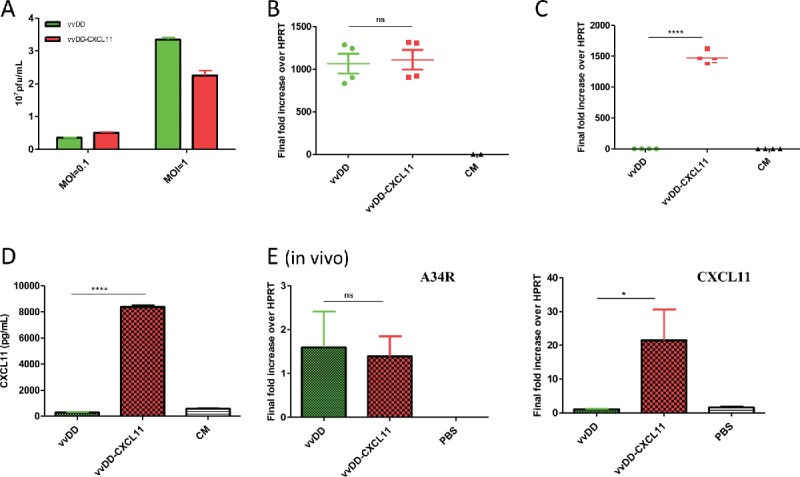
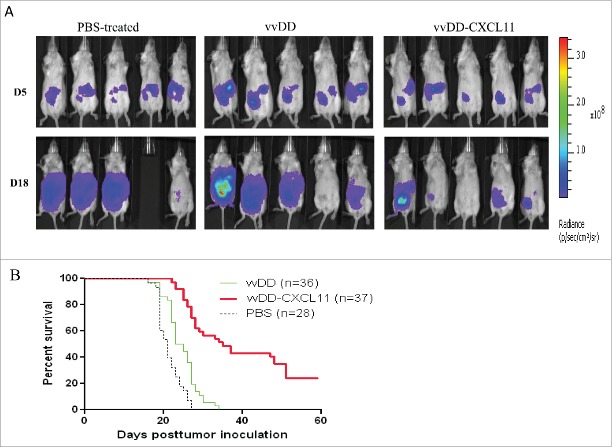
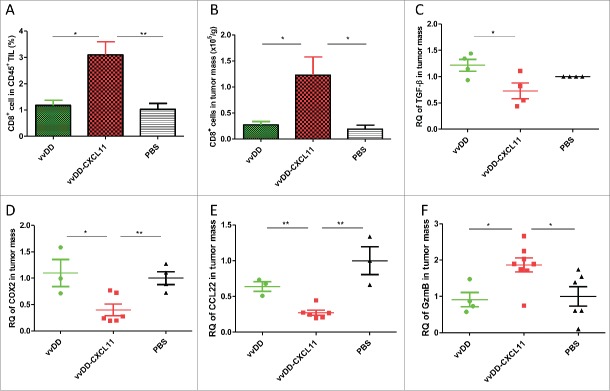
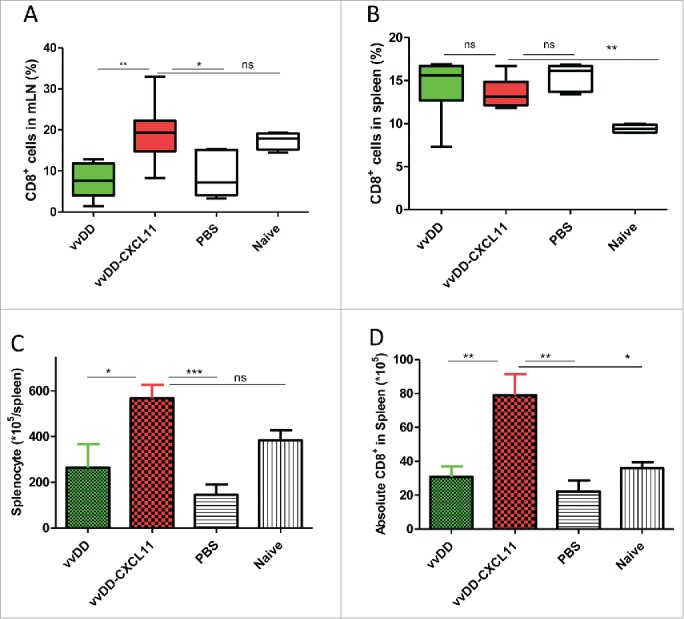
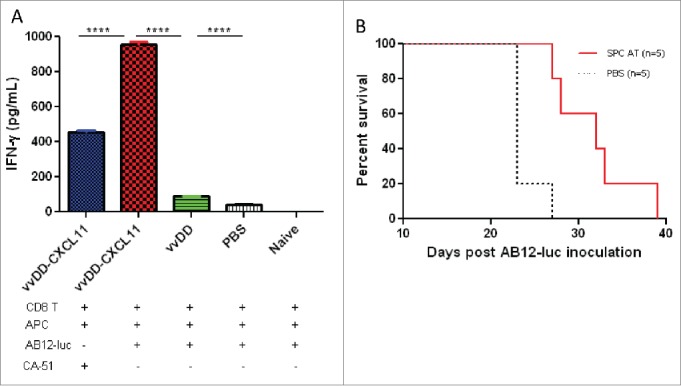
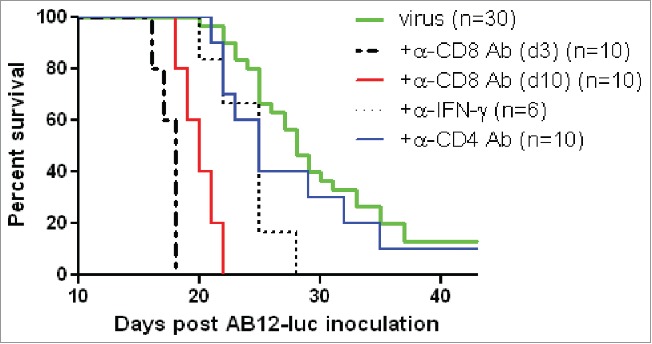
We have armed a tumor-selective oncolytic vaccinia virus (vvDD) with the chemokine (CK) CXCL11, in order to enhance its ability to attract CXCR3+ antitumor CTLs and possibly NK cells to the tumor microenvironment (TME) and improve its therapeutic efficacy. As expected, vvDD-CXCL11 attracted high numbers of tumor-specific T cells to the TME in a murine AB12 mesothelioma model. Intratumoral virus-directed CXCL11 expression enhanced local numbers of CD8+ CTLs and levels of granzyme B, while reducing expression of several suppressive molecules, TGF-β, COX2, and CCL22 in the TME. Unexpectedly, we observed that vvDD-CXCL11, but not parental vvDD, induced a systemic increase in tumor-specific IFNγ-producing CD8+ T cells in the spleen and other lymph organs, indicating the induction of systemic antitumor immunity. This effect was associated with enhanced therapeutic efficacy and a survival benefit in tumor-bearing mice treated with vvDD-CXCL11, mediated by CD8+ T cells and IFNγ, but not CD4+ T cells. These results demonstrate that intratumoral expression of CXCL11, in addition to promoting local trafficking of T cells and to a lesser extent NK cells, has a novel function as a factor eliciting systemic immunity to cancer-associated antigens. Our data provide a rationale for expressing CXCL11 to enhance the therapeutic efficacy of oncolytic viruses (OVs) and cancer vaccines.
Overview
The claims and statistics of this paper haven’t been checked yet.
Free: it reads the open-access text and checks the first 5 claims that cite a source we can check. Create a free account to check every claim.
Integrity signals
Registry
Cites
Statistics
Figures
Verification
Claims the paper makes
The claims and statistics of this paper haven’t been checked yet.
Free: it reads the open-access text and checks the first 5 claims that cite a source we can check. Create a free account to check every claim.
Claims other papers make about this one
Each is checked against this paper’s own text: does it say what the citing paper says it does?
The cited source says what the claim attributes to it.
In the citing paper
“Virus‐mediated expression of CXCL10, CXCL11, or recombinant CXCL10 injection in tumors was able to increase the infiltration of anticancer T cells in mice [364, 374, 375].”
From Tumor microenvironment signaling and therapeutics in cancer progression (2023) · cites this paper as [374]
Self-check
Percentages, sums and reported differences re-computed from the paper’s own numbers.
The self-check needs the paper’s full text.
Citations
Cites
The blockade of immune checkpoints in cancer immunotherapy
Pardoll, D. M. (2012) · Nature Reviews Cancer · doi:10.1038/nrc3239 · Cited by 13,838 · cited 2×
“Immunotherapy has shown great promise as a novel approach to cancer treatment.(1-4) However, while it shows great promise, two major challenges remain: (1) how to reverse the immunosuppressive TME and break immune tolerance; and (2) how to efficiently educate T cells to traffic to the battlefield – the tumor site.”
BackgroundType, Density, and Location of Immune Cells Within Human Colorectal Tumors Predict Clinical Outcome
Galon, J., Costes, A., Sanchez-Cabo, F., Kirilovsky, A., Mlecnik, B., Lagorce-Pagès, C., Tosolini, M., Camus, M., Berger, A., Wind, P., et al. (2006) · Science · doi:10.1126/science.1129139 · Cited by 6,516 · cited 1×
“is positively associated with overall patient survival in many types of cancer.(8-11) However, the TME is highly immunosup-”
BackgroundInnate and adaptive immune cells in the tumor microenvironment
Gajewski, T. F., Schreiber, H., & Fu, Y.-X. (2013) · Nature Immunology · doi:10.1038/ni.2703 · Cited by 4,148
Intratumoral T Cells, Recurrence, and Survival in Epithelial Ovarian Cancer
Zhang, L., Conejo-Garcia, J. R., Katsaros, D., Gimotty, P. A., Massobrio, M., Regnani, G., Makrigiannakis, A., Gray, H., Schlienger, K., Liebman, M. N., et al. (2003) · New England Journal of Medicine · doi:10.1056/nejmoa020177 · Cited by 3,397 · cited 1×
“is positively associated with overall patient survival in many types of cancer.(8-11) However, the TME is highly immunosup-”
BackgroundTalimogene Laherparepvec Improves Durable Response Rate in Patients With Advanced Melanoma
Andtbacka, R. H. I., Kaufman, H. L., Collichio, F., Amatruda, T., Senzer, N., Chesney, J., Delman, K. A., Spitler, L. E., Puzanov, I., Agarwala, S. S., et al. (2015) · Journal of Clinical Oncology · doi:10.1200/jco.2014.58.3377 · Cited by 2,634
The tumor microenvironment and its role in promoting tumor growth
Whiteside, T. L. (2008) · Oncogene · doi:10.1038/onc.2008.271 · Cited by 2,376 · cited 1×
“pressive, which not only restricts the effects of tumor-specific T cells on tumor destruction, but also impacts the infiltration efficiency of the tumor-specific T cells.(12,13) Recent studies have”
BackgroundFörster, R., Schubel, A., Breitfeld, D., Kremmer, E., Renner-Müller, I., Wolf, E., & Lipp, M. (1999) · Cell · doi:10.1016/s0092-8674(00)80059-8 · Cited by 2,367
Adoptive immunotherapy for cancer: harnessing the T cell response
Restifo, N. P., Dudley, M. E., & Rosenberg, S. A. (2012) · Nature Reviews Immunology · doi:10.1038/nri3191 · Cited by 1,688 · cited 4×
“including those involving viral vectors, immunostimulatory agents,(5-7) immune checkpoint blockade(4) or by adoptive T cell transfer.(1) Yet, despite all the efforts and rational approaches of”
BackgroundInfluentialWoo, S.-R., Turnis, M. E., Goldberg, M. V., Bankoti, J., Selby, M., Nirschl, C. J., Bettini, M. L., Gravano, D. M., Vogel, P., Liu, C. L., et al. (2012) · Cancer Research · doi:10.1158/0008-5472.can-11-1620 · Cited by 1,647
CD8+ T cells infiltrated within cancer cell nests as a prognostic factor in human colorectal cancer.
Naito, Y., Saito, K., Shiiba, K., Ohuchi, A., Saigenji, K., Nagura, H., & Ohtani, H. (1998) · PubMed · Cited by 1,399
Cited by
CXCL9, CXCL10, CXCL11/CXCR3 axis for immune activation - a target for novel cancer therapy
Tokunaga, R., Zhang, W., Naseem, M., Puccini, A., Berger, M. D., Soni, S., McSkane, M., Baba, H., & Lenz, H.-J. (2018) · Cancer Treatment Reviews · doi:10.1016/j.ctrv.2017.11.007 · Cited by 1,627
“In a mesothelioma mouse model, a tumor-selective oncolytic vaccinia virus with CXCL11 reportedly enhanced tumor-infiltrating CTLs and NK cells, but not CD4+ T cells, and prolonged survival.[75] In an autoimmune encephalomyelitis mouse model, the treatment with CXCL11-Ig fusion protein induced rapid disease remission t…”
BackgroundKey chemokines direct migration of immune cells in solid tumors
Kohli, K., Pillarisetty, V. G., & Kim, T. S. (2022) · Cancer Gene Therapy · doi:10.1038/s41417-021-00303-x · Cited by 583
Interferon-γ: teammate or opponent in the tumour microenvironment?
Gocher, A. M., Workman, C. J., & Vignali, D. A. A. (2022) · Nature Reviews Immunology · doi:10.1038/s41577-021-00566-3 · Cited by 582
Oncolytic virotherapy: basic principles, recent advances and future directions
Lin, D., Shen, Y., & Liang, T. (2023) · Signal Transduction and Targeted Therapy · doi:10.1038/s41392-023-01407-6 · Cited by 459
Targeting cytokine and chemokine signaling pathways for cancer therapy
Yi, M., Li, T., Niu, M., Zhang, H., Wu, Y., Wu, K., & Dai, Z. (2024) · Signal Transduction and Targeted Therapy · doi:10.1038/s41392-024-01868-3 · Cited by 455
Metadata
- Authors
- Liu, Z., Ravindranathan, R., Li, J., Kalinski, P., Guo, Z. S., & Bartlett, D. L.
- Affiliations
- University of Pittsburgh (US)
- Corresponding author
- Guo, Z. Sheng
- Bartlett, David L.
- Venue
- OncoImmunology
- Publisher
- Informa UK Limited
- Published
- 2015-10-29
- Volume
- 5
- Issue
- 3
- Pages
- e1091554
- ISSN
- 2162-4011 (ISSN-L)
- 2162-402X
- PMC
- PMC4839379
- OpenAlex
- W2289654340
- Cited by
- 113
- References
- 51
- Citations by year
- 2026: 11 · 2025: 9 · 2024: 11 · 2023: 9 · 2022: 17 · 2021: 11 · 2020: 14 · 2019: 10 · 2018: 9 · 2017: 6 · 2016: 5 · 2015: 1
- FWCI
- 4.78
- Type
- journal article
- Language
- en
- Open access
- gold
- doi.org
- Licence
- Locations
- OncoImmunology (publishedVersion, cc-by-nc)
- PubMed Central (publishedVersion, cc-by-nc)
- PubMed (publishedVersion)
- Funders
- National Cancer Institute (R01CA155925, P01CA132714)
- Topics
- Life Sciences › Biochemistry, Genetics and Molecular Biology › Genetics › Virus-based gene therapy research
- Life Sciences › Immunology and Microbiology › Immunology › Immunotherapy and Immune Responses
- Health Sciences › Medicine › Oncology › Cancer Immunotherapy and Biomarkers
- Keywords
- oncolytic vaccinia virus, CXCL11, oncolytic poxvirus, antitumor immunity, CD8+ T cells, interferon-gamma, tumor microenvironment, mesothelioma, CXCR3, natural killer cells, systemic immunity, cancer vaccines
About these checks
Registry, retraction, Cites and statistics results are computed, not judged, with one exception: a printed reference that no index lists is read once by a model before it counts as a citation error. Claims are extracted by a model and kept only when their quote appears verbatim in the text; each cited source is then checked, with a model’s help, for whether it says what the claim relies on. Those verdicts can be wrong — read the claim’s quote and the cited source before relying on one.
Statistics and arithmetic are recomputed, not judged.
Confidence bands are shown only for fields calibrated on our annotated test set. None is calibrated yet, so no band is shown.
What counts as a claim ›How we measure confidence ›How we check this ›
Are you an author, or do you see a problem with this page? Request a review
How to cite
Cite CoChat for the checks on this page, and the paper for its own findings.
- This page
- CoChat. (2026). Citation check: CXCL11-Armed oncolytic poxvirus elicits potent antitumor immunity and shows enhanced therapeutic efficacy. https://app.cochat.ai/papers/10.1080/2162402x.2015.1091554
- The paper
- Liu, Z., Ravindranathan, R., Li, J., Kalinski, P., Guo, Z. S., & Bartlett, D. L. (2016). CXCL11-Armed oncolytic poxvirus elicits potent antitumor immunity and shows enhanced therapeutic efficacy. OncoImmunology. https://doi.org/10.1080/2162402x.2015.1091554
Data sources
Bibliographic data: Semantic Scholar, OpenAlex, Crossref.
Contains information from the Semantic Scholar Academic Graph Datasets, made available under the ODC Attribution License (ODC-BY 1.0).
Semantic Scholar’s data is described in: Kinney, R., et al. (2023). The Semantic Scholar Open Data Platform. arXiv:2301.10140.
