

Trial watch: STING agonists in cancer therapy
Open accessThe DOI matches its Crossref record; 192 of the 192 references it cites were found in a registry or an index.
Abstract
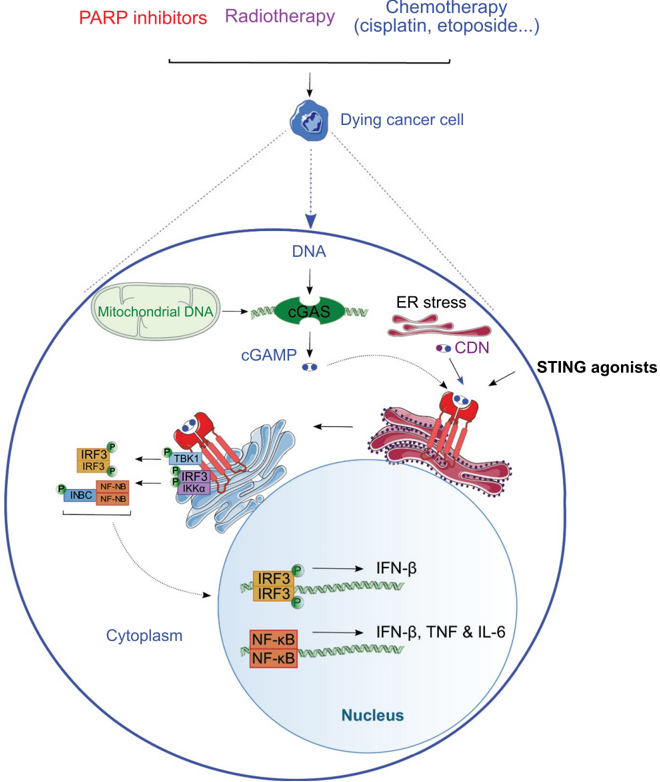
Stimulator of interferon response cGAMP interactor 1 (STING1, best known as STING) is an endoplasmic reticulum-sessile protein that serves as a signaling hub, receiving input from several pattern recognition receptors, most of which sense ectopic DNA species in the cytosol. In particular, STING ensures the production of type I interferon (IFN) in response to invading DNA viruses, bacterial pathogens, as well as DNA leaking from mitochondria or the nucleus (e.g., in cells exposed to chemotherapy or radiotherapy). As a type I IFN is critical for the initiation of anticancer immune responses, the pharmaceutical industry has generated molecules that directly activate STING for use in oncological indications. Such STING agonists are being tested in clinical trials with the rationale of activating STING in tumor cells or tumor-infiltrating immune cells (including dendritic cells) to elicit immunostimulatory effects, alone or in combination with a range of established chemotherapeutic and immunotherapeutic regimens. In this Trial Watch, we discuss preclinical evidence and accumulating clinical experience shaping the design of Phase I and Phase II trials that evaluate the safety and preliminary efficacy of STING agonists in cancer patients.
Overview
The claims and statistics of this paper haven’t been checked yet.
Free: it reads the open-access text and checks the first 5 claims that cite a source we can check. Create a free account to check every claim.
Integrity signals
Registry
Cites
Statistics
Figures
Verification
Claims the paper makes
The claims and statistics of this paper haven’t been checked yet.
Free: it reads the open-access text and checks the first 5 claims that cite a source we can check. Create a free account to check every claim.
Claims other papers make about this one
Each is checked against this paper’s own text: does it say what the citing paper says it does?
The source backs part of the claim, not all of it — or backs it for a different population, condition or comparison.
In the citing paper
“Systemic approaches to stimulating innate immunity, such as via agonism of stimulator of interferon response cGAMP interactor 1 (STING) or Toll-like receptors (TLR), have been challenging (199)(200)(201).”
From The Next Decade of Immune Checkpoint Therapy (2021) · cites this paper as [199]
Experimental — accuracy not yet measured
Self-check
Percentages, sums and reported differences re-computed from the paper’s own numbers.
The self-check needs the paper’s full text.
Citations
Cites
1 retracted
RETRACTED ARTICLE: Parkin and PINK1 mitigate STING-induced inflammation
Sliter, D. A., Martinez, J., Hao, L., Chen, X., Sun, N., Fischer, T. D., Burman, J. L., Li, Y., Zhang, Z., Narendra, D. P., et al. (2018) · Nature · doi:10.1038/s41586-018-0448-9 · Cited by 1,287
RetractedCombined Nivolumab and Ipilimumab or Monotherapy in Untreated Melanoma
Larkin, J., Chiarion-Sileni, V., Gonzalez, R., Grob, J. J., Cowey, C. L., Lao, C. D., Schadendorf, D., Dummer, R., Smylie, M., Rutkowski, P., et al. (2015) · New England Journal of Medicine · doi:10.1056/nejmoa1504030 · Cited by 8,157
Overall Survival with Combined Nivolumab and Ipilimumab in Advanced Melanoma
Wolchok, J. D., Chiarion-Sileni, V., Gonzalez, R., Rutkowski, P., Grob, J.-J., Cowey, C. L., Lao, C. D., Wagstaff, J., Schadendorf, D., Ferrucci, P. F., et al. (2017) · New England Journal of Medicine · doi:10.1056/nejmoa1709684 · Cited by 5,357
Cyclic GMP-AMP Synthase Is a Cytosolic DNA Sensor That Activates the Type I Interferon Pathway
Sun, L., Wu, J., Du, F., Chen, X., & Chen, Z. J. (2013) · Science · doi:10.1126/science.1232458 · Cited by 4,996
Nivolumab plus Ipilimumab versus Sunitinib in Advanced Renal-Cell Carcinoma
Motzer, R. J., Tannir, N. M., McDermott, D. F., Arén Frontera, O., Melichar, B., Choueiri, T. K., Plimack, E. R., Barthélémy, P., Porta, C., George, S., et al. (2018) · New England Journal of Medicine · doi:10.1056/nejmoa1712126 · Cited by 4,656
STING is an endoplasmic reticulum adaptor that facilitates innate immune signalling
Ishikawa, H., & Barber, G. N. (2008) · Nature · doi:10.1038/nature07317 · Cited by 3,576
Nivolumab plus ipilimumab in lung cancer with a high tumor mutational burden
Hellmann, M. D., Ciuleanu, T.-E., Pluzanski, A., Lee, J. S., Otterson, G. A., Audigier-Valette, C., Minenza, E., Linardou, H., Burgers, S., Salman, P., et al. (2018) · New England Journal of Medicine · doi:10.1056/nejmoa1801946 · Cited by 3,063
STING regulates intracellular DNA-mediated, type I interferon-dependent innate immunity
Ishikawa, H., Ma, Z., & Barber, G. N. (2009) · Nature · doi:10.1038/nature08476 · Cited by 2,759
Dendritic cells in cancer immunology and immunotherapy
Wculek, S. K., Cueto, F. J., Mujal, A. M., Melero, I., Krummel, M. F., & Sancho, D. (2020) · Nature Reviews Immunology · doi:10.1038/s41577-019-0210-z · Cited by 2,574
Regulation and function of the cGAS–STING pathway of cytosolic DNA sensing
Chen, Q., Sun, L., & Chen, Z. J. (2016) · Nature Immunology · doi:10.1038/ni.3558 · Cited by 2,333
Research works printed but not linked: 3
- 135. Wang Z, Dove P, Rosa D, Bossen B, Helke S, Charbonneau M, Brinen L, Dodge K, Lin GH, Galligan C, et al. Preclinical charac terization of a novel non-cyclic dinucleotide small molecule STING agonist with potent antitumor activity in mice. American Association of Cancer Research Annual Meeting 2019.
- 155. McKeage MJ, Jameson MB, Investigators ASSG. Comparative out comes of squamous and non-squamous non-small cell lung cancer (NSCLC) patients in phase II studies of ASA404 (DMXAA) retrospective analysis of pooled data. J Thorac Dis. 2010;2:199-204. doi:10.3978/j..2072-1439.2010.02.04.1. · doi:10.3978/j..2072-1439.2010.02.04.1
- 163. Endo A, Kim D, Huang K, Hao M, Mathieu S, Choi H, Majumder U, Zhu X, Shen Y, Sanders K, et al. Discovery of E7766: A representative of a novel class of macrocycle-bridged STING agonists (MBSAs) with superior potency and pan-genotypic activity. American Association for Cancer Research Annual Meeting 2019.
Cited by
Items 101–200 of 294
Skaličková, M., Vanova, K. H., Uher, O., Fialová, J. L., Petrláková, K., Masařík, M., Kejík, Z., Martasek, P., Pacák, K., & Jakubek, M. (2025) · Frontiers in Immunology · doi:10.3389/fimmu.2024.1479483 · Cited by 29
ILC3s sense gut microbiota through STING to initiate immune tolerance
Zhou, W., Zhou, J., Ahmed, A., Kim, M. J., Guo, C., & Sonnenberg, G. F. (2025) · Immunity · doi:10.1016/j.immuni.2025.05.016 · Cited by 31
DNA sensing in cancer: Pro-tumour and anti-tumour functions of cGAS–STING signalling
Wheeler, O. P. G., & Unterholzner, L. (2023) · Essays in Biochemistry · doi:10.1042/ebc20220241 · Cited by 33
Chao, C.-J., Endong, Z., Trinh, D. N., Udofa, E., Lin, H., Silvers, C., Huo, J., He, S., Zheng, J., Cai, X., et al. (2025) · Nature Communications · doi:10.1038/s41467-025-59840-w · Cited by 32
“However, current approaches to improve in situ cancer immunization (e.g., intratumoral or systemic administration of immunogenic cell death inducers and adjuvants 61 – 63 ) have only achieved modest clinical ef fi cacy.”
Pharmacological Activation of cGAS for Cancer Immunotherapy
Garland, K. M., Rosch, J. C., Carson, C. S., Wang-Bishop, L., Hanna, A., Sevimli, S., Kaer, C. V., Balko, J. M., Ascano, M., & Wilson, J. T. (2021) · Frontiers in Immunology · doi:10.3389/fimmu.2021.753472 · Cited by 27
STING in cancer immunoediting: Modeling tumor-immune dynamics throughout cancer development
Zhang, X., Chen, Y., Liu, X., Li, G., Zhang, S., Zhang, Q., Cui, Z., Qin, M., Simon, H., Terzić, J., et al. (2025) · Cancer Letters · doi:10.1016/j.canlet.2024.217410 · Cited by 31
The cGAS‒STING pathway in colorectal cancer: bridging innate immunity and therapeutic strategies
Li, W., Dong, G.-H., Bi, Y., Han, Y.-Y., Sun, L., Wang, T., Lin, Z., & Ren, X.-S. (2025) · Journal of Experimental & Clinical Cancer Research · doi:10.1186/s13046-025-03544-y · Cited by 29
“This turns immunologically “cold” tumors into “hot” ones [19, 20].”
Rossi, M., Carboni, S., Berardino-Besson, W. D., Riva, E., Santiago‐Raber, M., Belnoue, E., & Derouazi, M. (2021) · Frontiers in Immunology · doi:10.3389/fimmu.2021.695056 · Cited by 29
Xing, C., Tu, X., Huai, W., Tang, Z., Song, K., Jeltema, D., Knox, K., Dobbs, N., Yang, K., & Yan, N. (2025) · Cancer Research · doi:10.1158/0008-5472.can-24-2747 · Cited by 28
Lin, M., Cai, Y., Chen, G., Zhong, H., Li, B., Tan, L., Xiao, Z., & Shuai, X. (2023) · Biomaterials · doi:10.1016/j.biomaterials.2023.122067 · Cited by 27
Song, X., Zhou, X., Pan, Y., Liang, K., Luo, Y., Xie, W., Lv, Z., Yang, D., Wang, Y., Wu, X., et al. (2023) · Advanced Functional Materials · doi:10.1002/adfm.202306734 · Cited by 25
Understanding the role of cGAS-STING signaling in ischemic stroke: a new avenue for drug discovery
Chauhan, C., & Kaundal, R. K. (2023) · Expert Opinion on Drug Discovery · doi:10.1080/17460441.2023.2244409 · Cited by 28
“Notably, the development of STING agonists is more advanced, with several agonist currently in clinical trials for cancer treatment [140].”
BackgroundTargeted demethylation and activation of NLRC5 augment cancer immunogenicity through MHC class I
Sun, X., Watanabe, T., Oda, Y., Shen, W., Ahmad, A. M., Ouda, R., de Figueiredo, P., Kitamura, H., Tanaka, S., & Kobayashi, K. S. (2024) · Proceedings of the National Academy of Sciences · doi:10.1073/pnas.2310821121 · Cited by 28
Checkpoints and immunity in cancers: Role of GNG12
Alausa, A. O., Victor, U. C., Fadahunsi, O. S., Owolabi, N., Adeniji, A., Olatinwo, M., Ogunlana, A. T., Olaleke, B., Balogun, T. A., Ogundepo, S., et al. (2022) · Pharmacological Research · doi:10.1016/j.phrs.2022.106242 · Cited by 25
Dendritic Cell Subsets in Melanoma: Pathophysiology, Clinical Prognosis and Therapeutic Exploitation
Cuevas, E. S., Saas, P., & Aspord, C. (2023) · Cancers · doi:10.3390/cancers15082206 · Cited by 26
Cyclic GMP-AMP synthase recognizes the physical features of DNA
Dong, L., Hou, Y.-R., Xu, N., Gao, X., Sun, Z., Yang, Q., & Wang, L. (2024) · Acta Pharmacologica Sinica · doi:10.1038/s41401-024-01369-7 · Cited by 24
“In recent years, a variety of STING agonists have been developed for cancer therapy and have shown effective anti-tumor effects [61 – 63].”
Pathophysiological Roles of the cGAS-STING Inflammatory Pathway
Maekawa, H., Fain, M. E., & Wasano, K. (2023) · Physiology · doi:10.1152/physiol.00031.2022 · Cited by 25
Dossou, A. S., Mantsch, M. E., Kapic, A., Burnett, W. L., Sabnis, N. A., Coffer, J. L., Berg, R. E., Fudala, R., & Lacko, A. G. (2023) · Pharmaceutics · doi:10.3390/pharmaceutics15061685 · Cited by 24
Go, E., Yang, H., Park, W., Lee, S. J., Han, J., Kong, S. J., Lee, W. S., Han, D. K., Chon, H. J., & Kim, C. (2023) · Small · doi:10.1002/smll.202300544 · Cited by 26
Engineering cGAS-agonistic oligonucleotides as therapeutics for cancer immunotherapy
Zhou, S., Su, T., Cheng, F., Cole, J., Liu, X., Zhang, B., Alam, S., Liu, J., & Zhu, G. (2024) · Molecular Therapy — Nucleic Acids · doi:10.1016/j.omtn.2024.102126 · Cited by 25
“14 However, current small-molecule STING agonists are associated with various limitations.”
BackgroundKalinkovich, A., & Livshits, G. (2024) · Ageing Research Reviews · doi:10.1016/j.arr.2024.102602 · Cited by 25
Clinical Efficacy and Future Prospects of Immunotherapy in Lung Cancer
Kinoshita, T., Terai, H., & Yaguchi, T. (2021) · Life · doi:10.3390/life11101029 · Cited by 25
Targeting Innate Immunity in Breast Cancer Therapy: A Narrative Review
Ye, Y., Xu, C., Chen, F., Liu, Q., & Cheng, N. (2021) · Frontiers in Immunology · doi:10.3389/fimmu.2021.771201 · Cited by 21
“One clinical study NCT02981303 is conductedonmetastatictriplenegativebreastcancer(TNBC) patients to test the combination of Dectin Receptor agonist Imprime PGG and the immune checkpointblockerpembrolizumab.”
BackgroundInfluentialChemical evolution of cyclic dinucleotides: Perspective of the analogs and their preparation
Wang, Z., & Xi, Z. (2021) · Tetrahedron · doi:10.1016/j.tet.2021.132096 · Cited by 21
Polyvalent design in the cGAS-STING pathway
Bennett, Z. T., Li, S., Sumer, B. D., & Gao, J. (2021) · Seminars in Immunology · doi:10.1016/j.smim.2021.101580 · Cited by 21
Computational design of constitutively active cGAS
Dowling, Q. M., Volkman, H. E., Gray, E. E., Ovchinnikov, S., Cambier, S., Bera, A. K., Sankaran, B., Johnson, M. R., Bick, M. J., Kang, A., et al. (2023) · Nature Structural & Molecular Biology · doi:10.1038/s41594-022-00862-z · Cited by 22
“However, several first-generation molecules suffered from low efficacy or adverse reactions 7,9 .”
BackgroundLamsal, A., Andersen, S. B., Johansson, I., Vietri, M., Bokil, A. A., Kurganovs, N. J., Rylander, F., Bjørkøy, G., Pettersen, K., & Giambelluca, M. S. (2023) · Cell Communication and Signaling · doi:10.1186/s12964-023-01062-y · Cited by 19
“Even with the best-characterized STING agonist DMXAA, most of the trials with mono and combination therapy have failed due to low efficacy and toxicity issues [77].”
BackgroundTurley, J. L., Ward, R. W., Huete‐Carrasco, J., Muñoz‐Wolf, N., Roche, K., Jin, L., Bowie, A., Andersson, M., & Lavelle, E. C. (2024) · Cell Reports Medicine · doi:10.1016/j.xcrm.2024.101560 · Cited by 22
Beyond PD-1: The Next Frontier for Immunotherapy in Melanoma
Rohatgi, A., & Kirkwood, J. M. (2021) · Frontiers in Oncology · doi:10.3389/fonc.2021.640314 · Cited by 20
“Many early phase clinical trials are underway with STING agonists as monotherapy, in combination with immunotherapy, chemotherapy, or radiation (85).”
BackgroundQin, A., Wen, Z., & Xiong, S. (2023) · Cells · doi:10.3390/cells12212555 · Cited by 19
“We revealed that CS treatment resulted in the activation of STING signaling in BMDMs, as evidenced by the increased expression of phosphor-TBK1 and phosphor-NF-κ B/p65 (Figure revealed that CS treatment resulted in the activation of STING signaling in BMDMs,”
BackgroundSTINGing Cancer: Development, Clinical Application, and Targeted Delivery of STING Agonists
Nerdinger, Y. G., Binder, A. K., Bremm, F., Feuchter, N., Schaft, N., & Dörrie, J. (2025) · International Journal of Molecular Sciences · doi:10.3390/ijms26189008 · Cited by 21
“These agonists are being explored as safe and effective alternatives to conventional cancer therapies, particularly for tumors resistant to standard treatment approaches [53,54].”
The Many Ways to Deal with STING
Coderch, C., Arranz-Herrero, J., Nistal‐Villán, E., de Pascual‐Teresa, B., & Rius‐Rocabert, S. (2023) · International Journal of Molecular Sciences · doi:10.3390/ijms24109032 · Cited by 19
“Flavone acetic acid (FAA) was found to be active in a screening in mouse solid tumor models and dimethyloxoxanthenyl acetic acid (DMXAA), and a xanthone-derived agonist obtained by active synthesis reached clinical trials [177].”
BackgroundNovel emerging nano-assisted anti-cancer strategies based on the STING pathway
Li, X., Wang, H., Chen, Y., Li, Z., Liu, S., Guan, W., Lin, Y., Cao, C., Zheng, W., & Wu, J. (2023) · Acta Materia Medica · doi:10.15212/amm-2023-0023 · Cited by 23
“More importantly, DMXAA has been demonstrated to exhibit potent STING activation ability in preclinical studies [21, 22], and has been validated in immunotherapy applications [23].”
Mechanisms of Immune Modulation by Radiation
Spina, C. S., & Drake, C. G. (2021) · Seminars in Radiation Oncology · doi:10.1016/j.semradonc.2021.02.001 · Cited by 18
Ruocco, M. R., Gisonna, A., Acampora, V., D'Agostino, A. G., Carrese, B., Santoro, J., Venuta, A., Nasso, R., Rocco, N., Russo, D., et al. (2024) · International Journal of Molecular Sciences · doi:10.3390/ijms25116224 · Cited by 22
Kosaka, A., Yajima, Y., Yasuda, S., Komatsuda, H., Nagato, T., Oikawa, K., Kobayashi, H., & Ohkuri, T. (2022) · International Journal of Cancer · doi:10.1002/ijc.34394 · Cited by 17
Czapla, J., Drzyzga, A., Matuszczak, S., Cichoń, T., Rusin, M., Jarosz–Biej, M., Pilny, E., & Smolarczyk, R. (2023) · Frontiers in Oncology · doi:10.3389/fonc.2023.1249524 · Cited by 16
Soh, L.-J., Lee, S.-Y., Roebuck, M. M., & Wong, P. (2024) · Life Sciences · doi:10.1016/j.lfs.2024.123112 · Cited by 18
Ghukasyan, R., Liang, K., Chau, K., Li, L., Chan, C., Abt, E. R., Le, T. M., Park, J. Y., Wu, N., Premji, A., et al. (2023) · Clinical Cancer Research · doi:10.1158/1078-0432.ccr-22-3322 · Cited by 14
Chromosomal instability and inflammation: a catch-22 for cancer cells
van den Brink, A., Rodríguez, M. F. S. P., & Foijer, F. (2023) · Chromosome Research · doi:10.1007/s10577-023-09730-y · Cited by 17
“Therefore, efforts were made to activate this signaling using, for instance, STING agonists in clinical trials, though not (yet) specifically for CIN + cancers (Le Naour et al. 2020).”
MethodThe critical roles of STING in mitochondrial homeostasis
Zou, S., Wang, B., Yi, K., Su, D., Chen, Y., Li, N., & Geng, Q. (2023) · Biochemical Pharmacology · doi:10.1016/j.bcp.2023.115938 · Cited by 17
Immunotherapy Sensitivity of Mismatch Repair-Deficient Cancer: Mutation Load Is Not Enough
Gerlinger, M. (2021) · Cancer Cell · doi:10.1016/j.ccell.2020.12.016 · Cited by 14
Innate immune response restarts adaptive immune response in tumors
Li, W.-S., Zhang, Q., Li, Q., Liu, S.-Y., Yuan, G.-Q., & Pan, Y.-W. (2023) · Frontiers in Immunology · doi:10.3389/fimmu.2023.1260705 · Cited by 16
Chakraborty, S., Sen, U., Ventura, K., Jethalia, V., Coleman, C. J., Sridhar, S., Banerjee, A., Özakıncı, H., Mahendravarman, Y., Snioch, K., et al. (2024) · Cell Reports Medicine · doi:10.1016/j.xcrm.2024.101852 · Cited by 24
“32 STING agonists are currently under clinical investigation in combination with chemotherapy or immunotherapy 33 (NCT01057342) in SCLC, raising the question of whether the anti-tumor efficacy of lurbinectedin can be augmented by STING agonists, which could potentially be investigated in subsequent…”
STING agonists: a range of eminent mediators in cancer immunotherapy
Wen, Z., Sun, F., Wang, R., Wang, W., Zhang, H., Yang, F., Wang, M., Wang, Y., & Li, B. (2025) · Cellular Signalling · doi:10.1016/j.cellsig.2025.111914 · Cited by 14
Markowicz, J., Wołowiec, S., Rode, W., & Uram, Ł. S. (2022) · Pharmaceutics · doi:10.3390/pharmaceutics14030606 · Cited by 13
“Although due to the satisfying results of in vivo studies, V has undergone several clinical trials as a single agent or in combination with taxanes, as well as in the context of carboplatin-based chemotherapy, the results of phase III clinical trials were disappointing [16].”
BackgroundBrant, M. G., Garnett, G. A. E., Guedia, J., Lasalle, M., Lawn, S. O., Petersen, M. E., Duan, R., Méndez-Campos, J., Hirkala-Schaefer, T., Winters, G. C., et al. (2023) · Bioorganic & Medicinal Chemistry Letters · doi:10.1016/j.bmcl.2023.129348 · Cited by 19
Chowdhury, S. R., Parikh, C. N., Kaur, A. N., DeMarco, K. D., Giwa, H. K., Mishra, A. K., Murphy, K. C., Zhou, L., Ma, B., Ye, T., et al. (2025) · Proceedings of the National Academy of Sciences · doi:10.1073/pnas.2514948122 · Cited by 14
“…hot and sensitive to immunotherapy in the preclinical setting ( 6 – 14 , 48 ), STING agonists have yet to be effectively translated into cancer patient care due to systemic inflammatory toxicities, poor bioavailability, and differences between mouse and human STING signaling ( 15 – 17 , 19 ).”
Gao, F., Dong, J., Xue, C., An, L., Zhang, T., Wang, W.-J., Ou, C., & Dong, X. (2023) · Nano Today · doi:10.1016/j.nantod.2023.101831 · Cited by 12
Zeng, X., Huang, X., Yin, L., Yu, H., Wang, S., & Li, L. (2023) · Cancer Genetics · doi:10.1016/j.cancergen.2023.07.007 · Cited by 14
Kanefsky, J. S., Basse, M., Sokei, J. O., di Martino, O., Valin, L., Jaspers, Y. R. J., Martínez, E., Huhn, J. M., Marcantonio, D. D., Magee, J. A., et al. (2024) · Journal of Biological Chemistry · doi:10.1016/j.jbc.2024.107214 · Cited by 15
“Pharmacological activation of STING has shown antileukemia effects in mouse and human models of AML (15 – 17) and is currently being explored in clinical trials for a variety of blood and solid tumors (18).”
STING pathway as a cancer immunotherapy: Progress and challenges in activating anti-tumor immunity
Tabar, M. M. M., Fathi, M., Kazemi, F., Bazregari, G., & Ghasemian, A. (2024) · Molecular Biology Reports · doi:10.1007/s11033-024-09418-4 · Cited by 14
Tumor‐associated exosomes in cancer progression and therapeutic targets
Liu, X., Wu, F., Pan, W. D., Liu, G., Zhang, H., Yan, D., Zheng, S., Ma, Z., & Ren, X. (2024) · MedComm · doi:10.1002/mco2.709 · Cited by 17
Harnessing cGAS‐STING Pathway for Cancer Immunotherapy: From Bench to Clinic
Lee, D., Huntoon, K. M., Kang, M., Lü, Y., Gallup, T. D., Jiang, W., & Kim, B. Y. S. (2022) · Advanced Therapeutics · doi:10.1002/adtp.202200040 · Cited by 12
Lu, Y., Li, Z., Zhu, X., Zeng, Q., Liu, S., & Guan, W. (2025) · International Journal of Nanomedicine · doi:10.2147/ijn.s503780 · Cited by 13
“23,24 To resolve these issues, emerging drugs and delivery materials have been constructed to increase the accumulation of CDNs at tumor sites and enhance their STING activation abilities.”
PCK1 inhibits cGAS-STING activation by consumption of GTP to promote tumor immune evasion
Qin, W., Duan, Y., Hu, Z., Hou, Y., Wen, T., Ouyang, Y., Wang, Z., Sun, X. L., Chen, X., Wang, K. L., et al. (2025) · The Journal of Experimental Medicine · doi:10.1084/jem.20240902 · Cited by 15
Remodeling the Tumor Myeloid Landscape to Enhance Antitumor Antibody Immunotherapies
Hussain, K., Cragg, M. S., & Beers, S. A. (2021) · Cancers · doi:10.3390/cancers13194904 · Cited by 12
Exploiting the DNA Damage Response for Prostate Cancer Therapy
Stracker, T. H., Osagie, O. I., Escorcia, F. E., & Citrin, D. E. (2023) · Cancers · doi:10.3390/cancers16010083 · Cited by 12
Radiotherapy Combined with Intralesional Immunostimulatory Agents for Soft Tissue Sarcomas
Su, C., Kim, S. K., Wang, C. X., Kirsch, D. G., & Monjazeb, A. M. (2024) · Seminars in Radiation Oncology · doi:10.1016/j.semradonc.2024.01.001 · Cited by 13
The cGAS-STING Pathway in Pulmonary Diseases: Mechanisms and Therapeutic Potential
Zhang, Z., Jiang, J., Wu, G., Wei, X., Weng, Y., & Huang, L. (2025) · International Journal of Molecular Sciences · doi:10.3390/ijms262110423 · Cited by 13
“However, most of these trials were terminated due to poor efficacy [112].”
Hsieh, C., Chuang, P.-C., & Liu, Y. (2025) · Cancers · doi:10.3390/cancers17071250 · Cited by 14
“Another innate adjuvant route is the STING agonists, which activate the cytosolic DNA-sensing pathway, leading to a strong Type I IFN response that can mature dendritic cells and induce T cell-attracting chemokines [60,61].”
An engineered viral protein activates STAT5 to prevent T cell suppression
Zheng, Y., Gu, Z., Shudde, C. E., Piper, T. L., Wang, X., Aleck, G. A., Zhou, J., King, D., Chanda, M. K., Trinch, L., et al. (2025) · Science Immunology · doi:10.1126/sciimmunol.adn9633 · Cited by 11
Yeo, S. K., Haas, M., Manupati, K., Hao, M., Yang, F., Chen, S., & Guan, J. (2023) · Autophagy · doi:10.1080/15548627.2023.2259775 · Cited by 11
“Current efforts to activate TBK1 in tumors are based on viral mimicry strategies with agonists that can activate typical TBK1 adaptor proteins such as STING1 and MAVS [10,13–16].”
BackgroundRole of cGAS-STING in colorectal cancer: A new window for treatment strategies
Khorasani, M. (2023) · Cytokine · doi:10.1016/j.cyto.2023.156422 · Cited by 10
Alnukhali, M., Altabbakh, O., Farooqi, A. A., Pollack, A. S., Daunert, S., Deo, S. K., & Tao, W. (2024) · Current Medicinal Chemistry · doi:10.2174/0109298673273303231208071403 · Cited by 10
Small molecule innate immune modulators in cancer therapy
Goswami, A., Goyal, S., Khurana, P., Singh, K., Deb, B., & Kulkarni, A. (2024) · Frontiers in Immunology · doi:10.3389/fimmu.2024.1395655 · Cited by 13
Vaccine adjuvants for immunotherapy: type, mechanisms and clinical applications
Desai, N., Gotru, S., Salave, S., & Vora, L. K. (2025) · Frontiers in Biomaterials Science · doi:10.3389/fbiom.2025.1544465 · Cited by 14
Tackling HLA Deficiencies Head on with Oncolytic Viruses
Fisher, K. D., Hazini, A., & Seymour, L. W. (2021) · Cancers · doi:10.3390/cancers13040719 · Cited by 11
“For example, administering immune stimulants like STING agonists, chemokines, or interferons directly into the blood stream is likely to provide only a relatively short period of activation at the expense of systemic side effects, without any locoregional information to guide immune cells towards the tumor [48,49].”
BackgroundSurvival-Critical Genes Associated with Copy Number Alterations in Lung Adenocarcinoma
Rao, C. V., Xu, C., Farooqui, M., Zhang, Y., Asch, A. S., & Yamada, H. Y. (2021) · Cancers · doi:10.3390/cancers13112586 · Cited by 9
Type I interferons: One stone to concurrently kill two birds, viral infections and cancers
Kumar, A., Khani, A. T., & Swaminathan, S. (2021) · Current Research in Virological Science · doi:10.1016/j.crviro.2021.100014 · Cited by 9
Mitochondria at the Crossroads of Cholestatic Liver Injury: Targeting Novel Therapeutic Avenues
Li, X., Ruan, T., Wang, S., Sun, X., Liu, C., Yongjie, P. E. N. G., & Tao, Y.-Y. (2024) · Journal of Clinical and Translational Hepatology · doi:10.14218/jcth.2024.00087 · Cited by 18
Hou, H., Zhou, J., Sui, Q., Zhang, C., Su, Z., Cui, R., Shan, B., Xu, P., Chen, Z., Jiang, B., et al. (2025) · Journal of Medicinal Chemistry · doi:10.1021/acs.jmedchem.4c01873 · Cited by 9
Long, Y., Tang, B., Xie, F., Liu, L., Zhou, Y., Dong, J., Wang, J., Sun, C., Wang, Y., Li, R., et al. (2025) · Advanced Science · doi:10.1002/advs.202502270 · Cited by 11
Engaging Pattern Recognition Receptors in Solid Tumors to Generate Systemic Antitumor Immunity
Brown, M. C. (2022) · Cancer treatment and research · doi:10.1007/978-3-030-96376-7_3 · Cited by 8
Bakhoum, S. F. (2022) · Trends in cancer · doi:10.1016/j.trecan.2022.07.006 · Cited by 9
Development of STING probes and visualization of STING in multiple tumor types
Liu, H., Liu, J., Chen, Y., Yang, H., Fang, J., Zeng, X., Zhang, J., Peng, S., Liang, Y., Zhuang, R., et al. (2024) · European Journal of Nuclear Medicine and Molecular Imaging · doi:10.1007/s00259-024-06919-z · Cited by 8
Cancer-cell-derived cGAMP limits the activity of tumor-associated CD8+ T cells
Herbst, M., Köksal, H., Brunn, S., Zanetti, D., Domocos, I., Stefani, V. D., Gatti, M., Vivalda, F., Pereira, P., Nater, M., et al. (2025) · Cell Reports · doi:10.1016/j.celrep.2025.115510 · Cited by 10
Kodamasimham, S., Ju, H. H., Zhou, X., Haggag, Y. A., Huang, C., Ha, B.-J., Salamevich, D. A., Cho, Y. S., Wu, Q., Schwendeman, S. P., et al. (2025) · Journal of Controlled Release · doi:10.1016/j.jconrel.2025.114410 · Cited by 9
“There are more than 10 STING agonists that are currently evaluated in clinical trials either as a monotherapy or in combination with ICBs for advanced solid tumors and lymphoma [12].”
The STING/TBK1/IRF3/IFN type I pathway is defective in cystic fibrosis
Occhigrossi, L., Rossin, F., Villella, V. R., Esposito, S., Abbate, C., D’Eletto, M., Farrace, M. G., Tosco, A., Nardacci, R., Fimia, G. M., et al. (2023) · Frontiers in Immunology · doi:10.3389/fimmu.2023.1093212 · Cited by 9
Rohilla, A., Singh, A. K., Koleske, B. N., Srikrishna, G., & Bishai, W. R. (2023) · Microbiology Spectrum · doi:10.1128/spectrum.02012-23 · Cited by 10
B Cell Intrinsic STING Signaling Is Not Required for Autoreactive Germinal Center Participation
Green, K., Wittenborn, T. R., Hagert, C., Terczyńska‐Dyla, E., van Campen, N., Jensen, L., Reinert, L. S., Hartmann, R., Paludan, S. R., & Degn, S. E. (2021) · Frontiers in Immunology · doi:10.3389/fimmu.2021.782558 · Cited by 9
Hernandez-Franco, J. F., Jan, I. M., Elzey, B. D., & HogenEsch, H. (2024) · npj Vaccines · doi:10.1038/s41541-024-00943-8 · Cited by 9
“The activation of STING as a cancer therapeutic has paved the way for the development of numerous pharmacologic-class STING agonists that are now in clinical testing 36 .”
BackgroundXie, Z., Yang, Y., Ma, D., & Xi, Z. (2023) · Organic & Biomolecular Chemistry · doi:10.1039/d3ob01838e · Cited by 6
Decoding STING’s roles in cancer: immunity, pain, dormancy, and autophagy
Lin, H., Tang, Y., & Liang, X. (2025) · Molecular and Cellular Biochemistry · doi:10.1007/s11010-025-05281-4 · Cited by 7
Au naturale: use of biologically derived cyclic di-nucleotides for cancer immunotherapy
Waters, C. M. (2021) · Open Biology · doi:10.1098/rsob.210277 · Cited by 8
Jeon, M. J., Lee, H., Jo, S., Kang, M., Jeong, J. H., Jeong, S. H., Lee, J., Song, G. Y., Choo, H., Lee, S., et al. (2023) · European Journal of Medicinal Chemistry · doi:10.1016/j.ejmech.2023.115834 · Cited by 8
Cell-to-cell communications of cGAS-STING pathway in tumor immune microenvironment
Mengqiu, W. A. N. G., Xu, P., & Wu, Q. (2024) · Journal of Zhejiang University (Medical Sciences) · doi:10.3724/zdxbyxb-2023-0482 · Cited by 9
Zhang, S., Huang, L., Li, Z., Wang, Q., Liu, N., Zhang, C., Liu, X., Zhang, C., He, G., Sun, J., et al. (2025) · Neoplasia · doi:10.1016/j.neo.2025.101198 · Cited by 6
“Preclinical studies of ADAR1 inhibitors and RIG-I agonists [37] have validated dsRNA-sensing pathways as action-able targets.”
Synthesis of Novel 3’,3’‐cyclic Dinucleotide Analogues Targeting STING Protein
Magand, J., Roy, V., Meudal, H., Rose, S., Quesniaux, V. F. J., Chalupská, D., & Agrofoglio, L. A. (2022) · Asian Journal of Organic Chemistry · doi:10.1002/ajoc.202200597 · Cited by 6
Putting the sting back in STING therapy: novel delivery vehicles for improved STING activation
Khorsandi, S., Huntoon, K. M., & Lux, J. (2024) · Frontiers in Chemical Biology · doi:10.3389/fchbi.2024.1386220 · Cited by 5
Insight into the dichotomous regulation of STING activation in immunotherapy
Hu, Z., Yang, Y. K., Fang, L., Zhou, J., & Zhang, H. (2021) · Immunopharmacology and Immunotoxicology · doi:10.1080/08923973.2021.1890118 · Cited by 5
STING-ing Pain: How Can Pro-inflammatory Signaling Attenuate Pain?
Liedtke, W. (2021) · Neuroscience Bulletin · doi:10.1007/s12264-021-00672-1 · Cited by 5
“Notably, STING is a strong inducer of type-I interferons in immune cells following infections or tissue injury [5, 6].”
BackgroundImmunotherapies in breast cancer: harnessing the cancer immunity cycle
Lok, V. M., Olson-Mcpeek, S. K., Spiegelhoff, G., Cortez, J., Detz, D., & Czerniecki, B. J. (2024) · Expert Opinion on Therapeutic Targets · doi:10.1080/14728222.2024.2427038 · Cited by 4
“These have been demonstrated to initiate and drive anti-tumor responses by activation of innate sensors in both tumor and immune cells in preclinical models, and a number of early-phase clinical trials are evaluating these in combination with ICB across a variety of tumors [102].”
Stimulator of Interferon Genes (STING)-Type I Interferon Signaling: Bridging Immunity and Pain
Chiu, T.-C., Li, Y.-Y., Yu, C., Hung, K., Chu, C., Feng, P.-H., & Tan, P.-H. (2025) · Journal of Integrative Neuroscience · doi:10.31083/jin33414 · Cited by 5
Zhou, L. Q., Xu, Q., Huang, L., Zhan, P., Jin, J., Ye, M., Liu, H., Zhang, F., Wang, Z., Liu, J., et al. (2022) · Immunology · doi:10.1111/imm.13549 · Cited by 6
Cai, Y., Chen, X., Lu, T., Yu, Z., Hu, S., Liu, J., Zhou, X., & Wang, X. (2023) · BMC Cancer · doi:10.1186/s12885-023-10830-5 · Cited by 4
“Hence, TMEM173 agonists have been approved for several pre-clinical models and clinical trials [22], especially in patients with advanced and refractory tumors [23–25].”
BackgroundCytokine-driven cancer immune evasion mechanisms
Arenas, E. J. (2025) · International review of cytology · doi:10.1016/bs.ircmb.2025.01.004 · Cited by 12
Unveiling cGAS mechanisms: Insights into DNA damage and immune sensing in cancer
Cho, M.-G., & Gupta, G. P. (2025) · DNA repair · doi:10.1016/j.dnarep.2025.103868 · Cited by 6
IRF3 Knockout Results in Partial or Complete Rejection of Murine Mesothelioma
Aoki, M., Wu, L., Murakami, J., Zhao, Y. D., Yun, H., & de Perrot, M. E. (2021) · Journal of Clinical Medicine · doi:10.3390/jcm10215196 · Cited by 4
“The cGAS/STING pathway was also shown to be a possible therapeutic target in the inflammatory microenvironment and cancer [23,24].”
BackgroundTakahama, S., Ishige, K., Nogimori, T., Yasutomi, Y., Appay, V., & Yamamoto, T. (2022) · Molecular Therapy — Methods & Clinical Development · doi:10.1016/j.omtm.2022.12.008 · Cited by 4
“Thus, STING-Ls can serve as potent immunotherapeutic agents, and various types of STING-Ls have been examined in clinical trials.(23) Although the activity of the cGAS-STING axis is rigidly controlled by a negative-feedback loop,(24) sustained STING activation results in lethal STING-dependent proinflammatory diseases…”
Background
Metadata
- Authors
- Le Naour, J., Zitvogel, L., Galluzzi, L., Vacchelli, E., & Kroemer, G.
- Affiliations
- Université de Paris, Sorbonne Université, INSERM, Centre de Recherche des Cordeliers
- Inserm (FR)
- Université Paris Cité (FR)
- Université Paris-Sud (FR)
- Corresponding author
- Vacchelli, Erika
- Kroemer, Guido
- Venue
- OncoImmunology
- Publisher
- Informa UK Limited
- Published
- 2020-01
- Volume
- 9
- Issue
- 1
- Pages
- 1777624
- ISSN
- 2162-4011 (ISSN-L)
- 2162-402X
- OpenAlex
- W4211021377
- Semantic Scholar
- e00f0d53e48265a90e78cba8c4274af3df2af653
- Cited by
- 289
- References
- 189
- Citations by year
- 2026: 27 · 2025: 43 · 2024: 37 · 2023: 63 · 2022: 56 · 2021: 61 · 2020: 2
- FWCI
- 4.52
- Type
- journal article
- Language
- en
- Open access
- gold
- doi.org
- Licence
- Locations
- OncoImmunology (publishedVersion, cc-by-nc)
- HAL (submittedVersion, cc-by-nc)
- DOAJ (DOAJ: Directory of Open Access Journals) (submittedVersion)
- Funders
- Agence Nationale de la Recherche (ANR-18-IDEX-0001)
- Topics
- Life Sciences › Immunology and Microbiology › Immunology › interferon and immune responses
- Life Sciences › Immunology and Microbiology › Immunology › Immunotherapy and Immune Responses
- Health Sciences › Medicine › Oncology › Cancer Immunotherapy and Biomarkers
- Keywords
- STING agonist, STING, cancer immunotherapy, type I interferon, endoplasmic reticulum, cytosolic DNA sensing, pattern recognition receptors, tumor-infiltrating immune cells, dendritic cells, combination therapy with chemotherapy and radiotherapy, clinical trial design, drug safety and efficacy
About these checks
Registry, retraction, Cites and statistics results are computed, not judged, with one exception: a printed reference that no index lists is read once by a model before it counts as a citation error. Claims are extracted by a model and kept only when their quote appears verbatim in the text; each cited source is then checked, with a model’s help, for whether it says what the claim relies on. Those verdicts can be wrong — read the claim’s quote and the cited source before relying on one.
Statistics and arithmetic are recomputed, not judged.
Confidence bands are shown only for fields calibrated on our annotated test set. None is calibrated yet, so no band is shown.
What counts as a claim ›How we measure confidence ›How we check this ›
Are you an author, or do you see a problem with this page? Request a review
Data sources
Bibliographic data: Semantic Scholar, OpenAlex, Crossref.
Contains information from the Semantic Scholar Academic Graph Datasets, made available under the ODC Attribution License (ODC-BY 1.0).
Semantic Scholar’s data is described in: Kinney, R., et al. (2023). The Semantic Scholar Open Data Platform. arXiv:2301.10140.
