

Trial watch: STING agonists in cancer therapy
Open accessThe DOI matches its Crossref record; 192 of the 192 references it cites were found in a registry or an index.
Abstract
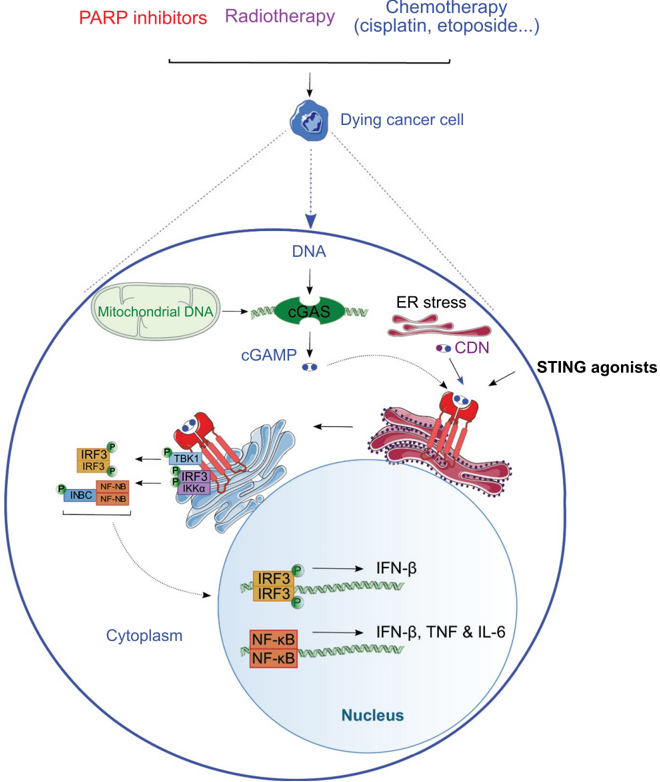
Stimulator of interferon response cGAMP interactor 1 (STING1, best known as STING) is an endoplasmic reticulum-sessile protein that serves as a signaling hub, receiving input from several pattern recognition receptors, most of which sense ectopic DNA species in the cytosol. In particular, STING ensures the production of type I interferon (IFN) in response to invading DNA viruses, bacterial pathogens, as well as DNA leaking from mitochondria or the nucleus (e.g., in cells exposed to chemotherapy or radiotherapy). As a type I IFN is critical for the initiation of anticancer immune responses, the pharmaceutical industry has generated molecules that directly activate STING for use in oncological indications. Such STING agonists are being tested in clinical trials with the rationale of activating STING in tumor cells or tumor-infiltrating immune cells (including dendritic cells) to elicit immunostimulatory effects, alone or in combination with a range of established chemotherapeutic and immunotherapeutic regimens. In this Trial Watch, we discuss preclinical evidence and accumulating clinical experience shaping the design of Phase I and Phase II trials that evaluate the safety and preliminary efficacy of STING agonists in cancer patients.
Overview
The claims and statistics of this paper haven’t been checked yet.
Free: it reads the open-access text and checks the first 5 claims that cite a source we can check. Create a free account to check every claim.
Integrity signals
Registry
Cites
Statistics
Figures
Verification
Claims the paper makes
The claims and statistics of this paper haven’t been checked yet.
Free: it reads the open-access text and checks the first 5 claims that cite a source we can check. Create a free account to check every claim.
Claims other papers make about this one
Each is checked against this paper’s own text: does it say what the citing paper says it does?
The source backs part of the claim, not all of it — or backs it for a different population, condition or comparison.
In the citing paper
“Systemic approaches to stimulating innate immunity, such as via agonism of stimulator of interferon response cGAMP interactor 1 (STING) or Toll-like receptors (TLR), have been challenging (199)(200)(201).”
From The Next Decade of Immune Checkpoint Therapy (2021) · cites this paper as [199]
Experimental — accuracy not yet measured
Self-check
Percentages, sums and reported differences re-computed from the paper’s own numbers.
The self-check needs the paper’s full text.
Citations
Cites
1 retracted
RETRACTED ARTICLE: Parkin and PINK1 mitigate STING-induced inflammation
Sliter, D. A., Martinez, J., Hao, L., Chen, X., Sun, N., Fischer, T. D., Burman, J. L., Li, Y., Zhang, Z., Narendra, D. P., et al. (2018) · Nature · doi:10.1038/s41586-018-0448-9 · Cited by 1,287
RetractedCombined Nivolumab and Ipilimumab or Monotherapy in Untreated Melanoma
Larkin, J., Chiarion-Sileni, V., Gonzalez, R., Grob, J. J., Cowey, C. L., Lao, C. D., Schadendorf, D., Dummer, R., Smylie, M., Rutkowski, P., et al. (2015) · New England Journal of Medicine · doi:10.1056/nejmoa1504030 · Cited by 8,157
Overall Survival with Combined Nivolumab and Ipilimumab in Advanced Melanoma
Wolchok, J. D., Chiarion-Sileni, V., Gonzalez, R., Rutkowski, P., Grob, J.-J., Cowey, C. L., Lao, C. D., Wagstaff, J., Schadendorf, D., Ferrucci, P. F., et al. (2017) · New England Journal of Medicine · doi:10.1056/nejmoa1709684 · Cited by 5,357
Cyclic GMP-AMP Synthase Is a Cytosolic DNA Sensor That Activates the Type I Interferon Pathway
Sun, L., Wu, J., Du, F., Chen, X., & Chen, Z. J. (2013) · Science · doi:10.1126/science.1232458 · Cited by 4,996
Nivolumab plus Ipilimumab versus Sunitinib in Advanced Renal-Cell Carcinoma
Motzer, R. J., Tannir, N. M., McDermott, D. F., Arén Frontera, O., Melichar, B., Choueiri, T. K., Plimack, E. R., Barthélémy, P., Porta, C., George, S., et al. (2018) · New England Journal of Medicine · doi:10.1056/nejmoa1712126 · Cited by 4,656
STING is an endoplasmic reticulum adaptor that facilitates innate immune signalling
Ishikawa, H., & Barber, G. N. (2008) · Nature · doi:10.1038/nature07317 · Cited by 3,576
Nivolumab plus ipilimumab in lung cancer with a high tumor mutational burden
Hellmann, M. D., Ciuleanu, T.-E., Pluzanski, A., Lee, J. S., Otterson, G. A., Audigier-Valette, C., Minenza, E., Linardou, H., Burgers, S., Salman, P., et al. (2018) · New England Journal of Medicine · doi:10.1056/nejmoa1801946 · Cited by 3,063
STING regulates intracellular DNA-mediated, type I interferon-dependent innate immunity
Ishikawa, H., Ma, Z., & Barber, G. N. (2009) · Nature · doi:10.1038/nature08476 · Cited by 2,759
Dendritic cells in cancer immunology and immunotherapy
Wculek, S. K., Cueto, F. J., Mujal, A. M., Melero, I., Krummel, M. F., & Sancho, D. (2020) · Nature Reviews Immunology · doi:10.1038/s41577-019-0210-z · Cited by 2,574
Regulation and function of the cGAS–STING pathway of cytosolic DNA sensing
Chen, Q., Sun, L., & Chen, Z. J. (2016) · Nature Immunology · doi:10.1038/ni.3558 · Cited by 2,333
Research works printed but not linked: 3
- 135. Wang Z, Dove P, Rosa D, Bossen B, Helke S, Charbonneau M, Brinen L, Dodge K, Lin GH, Galligan C, et al. Preclinical charac terization of a novel non-cyclic dinucleotide small molecule STING agonist with potent antitumor activity in mice. American Association of Cancer Research Annual Meeting 2019.
- 155. McKeage MJ, Jameson MB, Investigators ASSG. Comparative out comes of squamous and non-squamous non-small cell lung cancer (NSCLC) patients in phase II studies of ASA404 (DMXAA) retrospective analysis of pooled data. J Thorac Dis. 2010;2:199-204. doi:10.3978/j..2072-1439.2010.02.04.1. · doi:10.3978/j..2072-1439.2010.02.04.1
- 163. Endo A, Kim D, Huang K, Hao M, Mathieu S, Choi H, Majumder U, Zhu X, Shen Y, Sanders K, et al. Discovery of E7766: A representative of a novel class of macrocycle-bridged STING agonists (MBSAs) with superior potency and pan-genotypic activity. American Association for Cancer Research Annual Meeting 2019.
Cited by
Macrophages as tools and targets in cancer therapy
Mantovani, A., Allavena, P., Marchesi, F., & Garlanda, C. (2022) · Nature Reviews Drug Discovery · doi:10.1038/s41573-022-00520-5 · Cited by 1,807
Immunogenic cell stress and death
Kroemer, G., Galassi, C., Zitvogel, L., & Galluzzi, L. (2022) · Nature Immunology · doi:10.1038/s41590-022-01132-2 · Cited by 1,353
Self-citationMitochondrial control of inflammation
Marchi, S., Guilbaud, E., Tait, S. W. G., Yamazaki, T., & Galluzzi, L. (2023) · Nature Reviews Immunology · doi:10.1038/s41577-022-00760-x · Cited by 1,027
Self-citationThe Next Decade of Immune Checkpoint Therapy
Sharma, P., Siddiqui, B. A., Anandhan, S., Yadav, S. S., Subudhi, S. K., Gao, J., Goswami, S., & Allison, J. P. (2021) · Cancer Discovery · doi:10.1158/2159-8290.cd-20-1680 · Cited by 750
The cGAS–STING pathway and cancer
Samson, N., & Ablasser, A. (2022) · Nature Cancer · doi:10.1038/s43018-022-00468-w · Cited by 668
Ong, L.-T., Lee, W. C., Ma, S., Oguz, G., Niu, Z., Bao, Y., Yusuf, M., Lee, P. L., Goh, J. Y., Wang, P., et al. (2022) · Proceedings of the National Academy of Sciences · doi:10.1073/pnas.2201376119 · Cited by 572
Duong, E., Fessenden, T. B., Lutz, E., Dinter, T., Yim, L., Blatt, S., Bhutkar, A., Wittrup, K. D., & Spranger, S. (2022) · Immunity · doi:10.1016/j.immuni.2021.10.020 · Cited by 372
Chemical and Biomolecular Strategies for STING Pathway Activation in Cancer Immunotherapy
Garland, K. M., Sheehy, T. L., & Wilson, J. T. (2022) · Chemical Reviews · doi:10.1021/acs.chemrev.1c00750 · Cited by 357
Type I interferon-mediated tumor immunity and its role in immunotherapy
Yu, R., Zhu, B., & Chen, D. (2022) · Cellular and Molecular Life Sciences · doi:10.1007/s00018-022-04219-z · Cited by 309
“TLR9 agonists have been studied with ICBs in multiple tumor types, including melanoma, lymphoma, head and neck squamous cell carcinoma (HNSCC), and NSCLC (Table 1).”
BackgroundInfluentialSTING agonist diABZI induces PANoptosis and DNA mediated acute respiratory distress syndrome (ARDS)
Messaoud-Nacer, Y., Culerier, E., Rose, S., Maillet, I., Rouxel, N., Briault, S., Ryffel, B., Quesniaux, V. F. J., & Togbe, D. (2022) · Cell Death & Disease · doi:10.1038/s41419-022-04664-5 · Cited by 256
“Cyclic dinucleotide (CDN) and non-nucleotidyl STING agonists are in development for cancer immunotherapy [1, 3].”
BackgroundThe STING1 network regulates autophagy and cell death
Zhang, R., Kang, R., & Tang, D. (2021) · Signal Transduction and Targeted Therapy · doi:10.1038/s41392-021-00613-4 · Cited by 253
Myeloid cell-targeted therapies for solid tumours
Goswami, S., Anandhan, S., Raychaudhuri, D., & Sharma, P. (2023) · Nature Reviews Immunology · doi:10.1038/s41577-022-00737-w · Cited by 220
Vila, I. K., Chamma, H., Steer, A., Saccas, M., Taffoni, C., Turtoi, E., Reinert, L. S., Hussain, S., Marines, J., Jin, L., et al. (2022) · Cell Metabolism · doi:10.1016/j.cmet.2021.12.007 · Cited by 192
Targeting STING to promote antitumor immunity
Chin, E. N., Sulpizio, A., & Lairson, L. L. (2023) · Trends in Cell Biology · doi:10.1016/j.tcb.2022.06.010 · Cited by 160
STING is a cell-intrinsic metabolic checkpoint restricting aerobic glycolysis by targeting HK2
Zhang, L., Jiang, C., Zhong, Y., Sun, K., Jing, H., Song, J., Xie, J., Zhou, Y., Tian, M., Zhang, C., et al. (2023) · Nature Cell Biology · doi:10.1038/s41556-023-01185-x · Cited by 158
Leveraging NKG2D Ligands in Immuno-Oncology
Fuertes, M. B., Domaica, C. I., & Zwirner, N. W. (2021) · Frontiers in Immunology · doi:10.3389/fimmu.2021.713158 · Cited by 166
Type I and II Interferons in the Anti-Tumor Immune Response
Fenton, S. E., Saleiro, D., & Platanias, L. C. (2021) · Cancers · doi:10.3390/cancers13051037 · Cited by 161
“Finally, several clinical trials are cur ntly underway to s udy the outcomes of STING agonists alone or in combination th rapies [61].”
MethodSenescence and the tumor-immune landscape: Implications for cancer immunotherapy
Chibaya, L., Snyder, J. T., & Ruscetti, M. A. (2022) · Seminars in Cancer Biology · doi:10.1016/j.semcancer.2022.02.005 · Cited by 161
The expanding role for small molecules in immuno-oncology
Offringa, R., Kötzner, L., Huck, B. R., & Urbahns, K. (2022) · Nature Reviews Drug Discovery · doi:10.1038/s41573-022-00538-9 · Cited by 150
Wang, M. M., Coupland, S. E., Aittokallio, T. A., & Figueiredo, C. R. (2023) · British Journal of Cancer · doi:10.1038/s41416-023-02361-4 · Cited by 123
Song, H., Chen, L., Pan, X., Shen, Y., Ye, M., Wang, G., Cui, C., Zhou, Q., Tseng, Y., Gong, Z., et al. (2025) · Cancer Cell · doi:10.1016/j.ccell.2025.02.014 · Cited by 123
cGAS-STING signaling in cancer immunity and immunotherapy
Du, H., Xu, T., & Cui, M. (2020) · Biomedicine & Pharmacotherapy · doi:10.1016/j.biopha.2020.110972 · Cited by 114
Gong, W., Lu, L., Zhou, Y., Liu, J., Ma, H., Fu, L., Huang, S., Zhang, Y., Zhang, A., & Jia, Z. (2021) · American Journal of Physiology-Renal Physiology · doi:10.1152/ajprenal.00554.2020 · Cited by 108
Ma, H., Kang, Z., Foo, T. K., Shen, Z., & Xia, B. (2022) · Hepatology · doi:10.1002/hep.32335 · Cited by 104
“Recent studies have revealed that the cGAS‐ STING pathway occupies a central role in antitumor immune responses across different types of cancer with DNA damage response deficiency, including breast, ovarian, prostate, and lung cancers.[39] Our data provide more comprehensive evidence about the role of the cGAS‐STING…”
BackgroundBacteria and bacterial derivatives as delivery carriers for immunotherapy
Kang, S., Nguyen, D.-H., Yoo, S. W., & Min, J. (2021) · Advanced Drug Delivery Reviews · doi:10.1016/j.addr.2021.114085 · Cited by 106
The Trinity of cGAS, TLR9, and ALRs Guardians of the Cellular Galaxy Against Host-Derived Self-DNA
Kumar, V. (2021) · Frontiers in Immunology · doi:10.3389/fimmu.2020.624597 · Cited by 102
McAndrews, K. M., Che, S. P. Y., LeBleu, V. S., & Kalluri, R. (2021) · Journal of Biological Chemistry · doi:10.1016/j.jbc.2021.100523 · Cited by 94
“Such response with STING pathway activation has been previously reported in the context of radiation and immune checkpoint blockade (13, 36).”
BackgroundChung, C., Lin, C., Chen, C., Hsueh, C., Chang, Y., Wang, C., Chu, P., Tai, S., & Yang, M. (2023) · Advanced Science · doi:10.1002/advs.202204514 · Cited by 104
Huang, C., Shao, N., Huang, Y., Chen, J., Wang, D., Hu, G., Zhang, H., Luo, L., & Xiao, Z. (2023) · Materials Today Bio · doi:10.1016/j.mtbio.2023.100839 · Cited by 105
Zhou, S., Cheng, F., Zhang, Y., Su, T., & Zhu, G. (2023) · Accounts of Chemical Research · doi:10.1021/acs.accounts.3c00394 · Cited by 92
Nanomaterial-encapsulated STING agonists for immune modulation in cancer therapy
Chen, X., Xu, Z., Li, T., Thakur, A., Wen, Y., Zhang, K., Liu, Y., Liang, Q., Liu, W., Qin, J., et al. (2024) · Biomarker Research · doi:10.1186/s40364-023-00551-z · Cited by 96
“Until now, approximately 20 trials, including phase I and II, have been carried out to assess the clinical application of STING agonists [144].”
BackgroundActivation of human STING by a molecular glue-like compound
Li, J., Canham, S. M., Wu, H. J., Hénault, M., Chen, L., Liu, G., Chen, Y., Yu, G. Z., Miller, H., Horn̆ák, V., et al. (2023) · Nature Chemical Biology · doi:10.1038/s41589-023-01434-y · Cited by 84
“Several CDN analogs and low-molecular-weight compounds binding to the LBD of STING are currently under investigation in clinical trials 4,27 .”
Targeting Cancer Heterogeneity with Immune Responses Driven by Oncolytic Peptides
Vitale, I., Yamazaki, T., Wennerberg, E., Sveinbjørnsson, B., Rekdal, Ø., Demaria, S., & Galluzzi, L. (2021) · Trends in cancer · doi:10.1016/j.trecan.2020.12.012 · Cited by 84
Self-citationCheng, F., Su, T., Zhou, S., Liu, X., Yang, S., Lin, S., Guo, W., & Zhu, G. (2023) · Science Advances · doi:10.1126/sciadv.ade6257 · Cited by 82
Regulation of cGAS and STING signaling during inflammation and infection
Chauvin, S. D., Stinson, W. A., Platt, D. J., Poddar, S., & Miner, J. J. (2023) · Journal of Biological Chemistry · doi:10.1016/j.jbc.2023.104866 · Cited by 81
Harnessing Innate Immunity Using Biomaterials for Cancer Immunotherapy
Lee, D., Huntoon, K., Wang, Y., Jiang, W., & Kim, B. Y. S. (2021) · Advanced Materials · doi:10.1002/adma.202007576 · Cited by 74
STING agonism turns human T cells into interferon‐producing cells but impedes their functionality
Kühl, N., Linder, A., Philipp, N., Nixdorf, D., Fischer, H., Veth, S., Kuut, G., Xu, T. T., Theurich, S., Carell, T., et al. (2023) · EMBO Reports · doi:10.15252/embr.202255536 · Cited by 76
“While preclinical studies have provided promising results (Corrales et al , 2015), subsequent clinical trials have seen mixed results in terms of efficacy (Le Naour et al , 2020).”
cGAS–STING cytosolic DNA sensing pathway is suppressed by JAK2-STAT3 in tumor cells
Suter, M. A., Tan, N. Y., Thiam, C. H., Khatoo, M., MacAry, P. A., Angeli, V., Gasser, S., & Zhang, Y. (2021) · Scientific Reports · doi:10.1038/s41598-021-86644-x · Cited by 80
Jia, W., Wu, Y., Xie, Y., Yu, M., & Chen, Y. (2025) · Advanced Materials · doi:10.1002/adma.202413603 · Cited by 84
The Evolution of STING Signaling and Its Involvement in Cancer
Vashi, N., & Bakhoum, S. F. W. (2021) · Trends in Biochemical Sciences · doi:10.1016/j.tibs.2020.12.010 · Cited by 72
Tumour-derived small extracellular vesicles act as a barrier to therapeutic nanoparticle delivery
Gong, N., Zhong, W., Alameh, M., Han, X., Xue, L., El-Mayta, R. D., Zhao, G., Vaughan, A. E., Qin, Z., Xu, F., et al. (2024) · Nature Materials · doi:10.1038/s41563-024-01961-6 · Cited by 86
“Most current studies focus on the development of STING agonists to activate STING in tumours to induce anti-tumour immune responses 43 .”
Johnson, M. B., Chandler, M. R., & Afonin, K. A. (2021) · Advanced Drug Delivery Reviews · doi:10.1016/j.addr.2021.04.011 · Cited by 70
Beyond Good and Evil: Molecular Mechanisms of Type I and III IFN Functions
Dowling, J. W., & Forero, A. (2022) · The Journal of Immunology · doi:10.4049/jimmunol.2100707 · Cited by 75
Doshi, A. S., Cantin, S., Prickett, L. B., Mele, D. A., & Amiji, M. M. (2022) · Journal of Controlled Release · doi:10.1016/j.jconrel.2022.03.054 · Cited by 65
Combining targeted DNA repair inhibition and immune-oncology approaches for enhanced tumor control
Concannon, K., Morris, B. B., Gay, C. M., & Byers, L. A. (2023) · Molecular Cell · doi:10.1016/j.molcel.2022.12.031 · Cited by 81
Trial watch: intratumoral immunotherapy
Humeau, J., Naour, J. L., Galluzzi, L., Kroemer, G., & Pol, J. G. (2021) · OncoImmunology · doi:10.1080/2162402x.2021.1984677 · Cited by 67
“Therefore, the pharmaceutical industry has generated direct STING activators for oncological indications tested either alone or with various chemotherapeutic and immunotherapeutic combinatorial regimens.(67,177,178) In this dynamic, several Phase I–II trials have been recently initiated to investigate i.”
BackgroundSelf-citationTargeting STING for cancer immunotherapy: From mechanisms to translation
Huang, R., Ning, Q., Zhao, J., Zhao, X., Zeng, L., Yi, Y., & Tang, S. (2022) · International Immunopharmacology · doi:10.1016/j.intimp.2022.109304 · Cited by 66
CFI-402257, a TTK inhibitor, effectively suppresses hepatocellular carcinoma
Chan, C. Y., Chiu, D. K., Yuen, V. W., Law, C., Wong, B. P., Thu, K. L., Cescon, D. W., Soria‐Bretones, I., Cheu, J. W., Lee, D., et al. (2022) · Proceedings of the National Academy of Sciences · doi:10.1073/pnas.2119514119 · Cited by 67
The paradoxical role of radiation‐induced cGAS–STING signalling network in tumour immunity
Zhang, X., Zhang, H., Zhang, J., Yang, M., Zhu, M., Yin, Y., Fan, X., & Yu, F. (2022) · Immunology · doi:10.1111/imm.13592 · Cited by 71
“Radiation can activate ISG DCs by strongly activating STING and triggering intact IFNAR signalling [37, 55, 56].”
BackgroundVornholz, L., Isay, S. E., Kurgyis, Z., Strobl, D. C., Loll, P., Mosa, M. H., Luecken, M. D., Sterr, M., Lickert, H., Winter, C., et al. (2023) · Science Advances · doi:10.1126/sciadv.add8564 · Cited by 62
“These mentioned difficulties are exemplary reasons illustrating that although there are constantly new small-molecule STING agonist formulations being developed and tested, their success is limited ( 42 , 55 ).”
The Innate Immune Signalling Pathways: Turning RIG-I Sensor Activation against Cancer
Iurescia, S., Fioretti, D., & Rinaldi, M. (2020) · Cancers · doi:10.3390/cancers12113158 · Cited by 60
Pantelidou, C., Jadhav, H., Kothari, A., Liu, R., Wulf, G. M., Guerriero, J. L., & Shapiro, G. I. (2022) · npj Breast Cancer · doi:10.1038/s41523-022-00471-5 · Cited by 55
Garcia, G., Irudayam, J. I., Jeyachandran, A. V., Dubey, S., Chang, C. C., Cario, S. C., Price, N., Arumugam, S., Marquez, A. L., Shah, A., et al. (2023) · Cell Reports Medicine · doi:10.1016/j.xcrm.2023.101024 · Cited by 56
“In addition, evidence suggests that STING-activating compounds can be useful in mediating a robust immune response as adjuvants in vaccines against viral infections (HIV, influenza, and coronaviruses) and can be used as initiators of anticancer immunostimulatory effects.(61,62) This avenue for constructing effective v…”
BackgroundThe abscopal effect: a sense of DNA damage is in the air
Lippert, T. P., & Greenberg, R. A. (2021) · Journal of Clinical Investigation · doi:10.1172/jci148274 · Cited by 55
Turley, J. L., Moran, H. B. T., McEntee, C. P., O’Grady, K., Muñoz‐Wolf, N., Jin, L., Follmann, F., Andersen, P. L., Andersson, M., & Lavelle, E. C. (2021) · Biomaterials · doi:10.1016/j.biomaterials.2021.120961 · Cited by 48
Mekers, V. E., Kho, V. M., Ansems, M., & Adema, G. J. (2022) · Radiotherapy and Oncology · doi:10.1016/j.radonc.2022.07.014 · Cited by 49
Statins in Cancer Prevention and Therapy
Ricco, N., & Kron, S. J. (2023) · Cancers · doi:10.3390/cancers15153948 · Cited by 59
Hak, C. C. W., Rullan, A., Patin, E. C., Pedersen, M., Melcher, A. A., & Harrington, K. J. (2022) · Frontiers in Oncology · doi:10.3389/fonc.2022.971959 · Cited by 51
ALK peptide vaccination restores the immunogenicity of ALK-rearranged non-small cell lung cancer
Mota, I. A., Patrucco, E., Mastini, C., Mahadevan, N. R., Thai, T. C., Bergaggio, E., Cheong, T.-C., Leonardi, G. C., Atabay, E. K., Campisi, M., et al. (2023) · Nature Cancer · doi:10.1038/s43018-023-00591-2 · Cited by 49
Petroni, G., Pillozzi, S., & Antonuzzo, L. (2024) · Cancer Research · doi:10.1158/0008-5472.can-23-3325 · Cited by 57
“Notably, whereas STING agonists entered clinical evaluation (69), LIGHT-based therapies are still under preclinical development (70).”
BackgroundMutant p53 drives an immune cold tumor immune microenvironment in oral squamous cell carcinoma
Shi, Y., Xie, T., Wang, B., Wang, R., Cai, Y., Yuan, B., Gleber‐Netto, F. O., Tian, X., Rodriguez-Rosario, A. E., Osman, A. A., et al. (2022) · Communications Biology · doi:10.1038/s42003-022-03675-4 · Cited by 56
New Approaches to Glioblastoma
Khasraw, M., Fujita, Y., Lee-Chang, C., Balyasnikova, I. V., Najem, H., & Heimberger, A. B. (2021) · Annual Review of Medicine · doi:10.1146/annurev-med-042420-102102 · Cited by 48
Banerjee, S., Mukherjee, S., Nath, P., Mukherjee, A., Mukherjee, S., Kumar, S. K. A., De, S., & Banerjee, S. (2023) · Results in Chemistry · doi:10.1016/j.rechem.2023.101013 · Cited by 54
Cai, Y., Chen, X., Lu, T., Fang, X., Ding, M., Yu, Z., Hu, S., Liu, J., Zhou, X., & Wang, X. (2023) · International Journal of Biological Sciences · doi:10.7150/ijbs.85236 · Cited by 51
“Hence, understanding the interplay between the DDR and the cGAS-STING pathway may provide a targeting strategy for the development of effective treatment for lymphoma patients [18].”
Carlsen, L., & El‐Deiry, W. S. (2022) · Frontiers in Oncology · doi:10.3389/fonc.2022.998388 · Cited by 49
“Frontiers in Oncology 04 chemotherapy (34).”
BackgroundJeong, S., Yang, M. J., Choi, S., Kim, J., & Koh, G. Y. (2021) · Nature Communications · doi:10.1038/s41467-021-24603-w · Cited by 47
STINGing the Tumor Microenvironment to Promote Therapeutic Tertiary Lymphoid Structure Development
Filderman, J. N., Appleman, M., Chelvanambi, M., Taylor, J. L., & Storkus, W. J. (2021) · Frontiers in Immunology · doi:10.3389/fimmu.2021.690105 · Cited by 45
Wang, C., Ho, A., Chang, C., Sie, Z., Peng, C., Chang, J., & Cheng, C. (2023) · Cancer Immunology Immunotherapy · doi:10.1007/s00262-023-03379-6 · Cited by 49
“The possible mechanism is that RT-damaged DNA induces consequent activation of cGAS-STING signaling pathways, resulting in type I IFNs and ISGs expression and secretion [18, 19].”
BackgroundPu, C., Cui, H. F., Yu, H., Cheng, X., Zhang, M., Qin, L., Ning, Z., Zhang, W., Chen, S., Qian, Y., et al. (2025) · Nature Communications · doi:10.1038/s41467-025-59874-0 · Cited by 49
“We have undertaken a series of experiments and analysis to address the point of a head-to-head comparison with other reported ENPP1 inhibitors to strength the novelty of our manuscript.”
Vural, S., Palmisano, A., Reinhold, W. C., Pommier, Y. G., Teicher, B. A., & Krushkal, J. (2021) · Clinical Epigenetics · doi:10.1186/s13148-021-01026-4 · Cited by 42
Dendritic Cells: Behind the Scenes of T-Cell Infiltration into the Tumor Microenvironment
Lucarini, V., Melaiu, O., Tempora, P., D’Amico, S., Locatelli, F., & Fruci, D. (2021) · Cancers · doi:10.3390/cancers13030433 · Cited by 51
Nanotechnology for next-generation cancer immunotherapy: State of the art and future perspectives
Chen, Y. (2023) · Journal of Controlled Release · doi:10.1016/j.jconrel.2023.02.016 · Cited by 46
Mitochondrial Dysfunction-Associated Mechanisms in the Development of Chronic Liver Diseases
Arumugam, M. K., Gopal, T., Kandy, R. R. K., Boopathy, L. K., Perumal, S. K., Ganesan, M., Rasineni, K., Donohue, T. M., Osna, N. A., & Kharbanda, K. K. (2023) · Biology · doi:10.3390/biology12101311 · Cited by 51
Next-Generation Cancer Biomarkers: Extracellular Vesicle DNA as a Circulating Surrogate of Tumor DNA
Amintas, S., Vendrely, V., Dupin, C. L., Buscail, L., Laurent, C., Bournet, B., Merlio, J., Bedel, A., Moreau‐Gaudry, F., Boutin, J., et al. (2021) · Frontiers in Cell and Developmental Biology · doi:10.3389/fcell.2020.622048 · Cited by 41
Fedoriw, A., Shi, L., O’Brien, S. W., Smitheman, K. N., Wang, Y., Hou, J., Sherk, C. S., Rajapurkar, S., Laraio, J., Williams, L. J., et al. (2022) · Cancer Immunology Research · doi:10.1158/2326-6066.cir-21-0614 · Cited by 43
Kang, K., Wu, Y., Yao, Z., & Lü, Y. (2023) · Cancer Letters · doi:10.1016/j.canlet.2023.216239 · Cited by 43
Immunotherapies in chronic pain through modulation of neuroimmune interactions
Zhao, J., Huh, Y., Bortsov, A. V., Diatchenko, L. B., & Ji, R. (2023) · Pharmacology & Therapeutics · doi:10.1016/j.pharmthera.2023.108476 · Cited by 43
Vicencio, J. M., Evans, R., Green, R., An, Z., Deng, J., Treacy, C. A., Mustapha, R., Monypenny, J., Costoya, C., Lawler, K., et al. (2022) · Cell Death and Disease · doi:10.1038/s41419-022-04701-3 · Cited by 35
“STING agonists are being tested in clinical trials with the rationale of activating STING in TAMs to elicit immunostimulatory effects, alone or combined with established chemotherapy and immunotherapy [20].”
BackgroundNanoparticles for Chemoimmunotherapy Against Triple-Negative Breast Cancer
Liu, S., Li, J., Gu, L., Wu, K.-Z., & Hua, X. (2022) · International Journal of Nanomedicine · doi:10.2147/ijn.s388075 · Cited by 37
“Accumulation of cytoplasmic DNA in response to DNA viruses, bacterial pathogens, and chemotherapy activates cyclic GMP-AMP synthase to produce cyclic GMP-AMP and cyclic dinucleotide, bind and activate STING, and produce type I IFNs and various other cytokines, such as IL-6, IL-6, and IFN regulatory factor 3 via nuclea…”
BackgroundThe dark side of ferroptosis in pancreatic cancer
Liu, J., Dai, E., Kang, R., Kroemer, G., & Tang, D. (2021) · OncoImmunology · doi:10.1080/2162402x.2020.1868691 · Cited by 35
Self-citationBadía, R., García-Vidal, E., & Ballana, E. (2022) · Frontiers in Virology · doi:10.3389/fviro.2022.935933 · Cited by 42
Targeting the loss of cGAS / STING signaling in cancer
Sasaki, N., Homme, M., & Kitajima, S. (2023) · Cancer Science · doi:10.1111/cas.15913 · Cited by 35
Methodological advances in the design of peptide-based vaccines
Kalita, P., & Tripathi, T. (2022) · Drug Discovery Today · doi:10.1016/j.drudis.2022.03.004 · Cited by 37
Pu, F., Chen, F., Liu, J., Zhang, Z., & Shao, Z. (2021) · OncoTargets and Therapy · doi:10.2147/ott.s298958 · Cited by 35
Activation of STING in the pancreatic tumor microenvironment: A novel therapeutic opportunity
Chamma, H., Vila, I. K., Taffoni, C., Turtoï, A., & Laguette, N. (2022) · Cancer Letters · doi:10.1016/j.canlet.2022.215694 · Cited by 37
STING activation counters glioblastoma by vascular alteration and immune surveillance
Joseph, J. V., Blaavand, M. S., Cai, H., Vernejoul, F., Knopper, R. W., Lindhardt, T. B., Skipper, K. A., Axelgaard, E., Reinert, L. S., Mikkelsen, J. G., et al. (2023) · Cancer Letters · doi:10.1016/j.canlet.2023.216480 · Cited by 35
Pal, S., Chaudhari, R., Baurceanu, I., Hill, B. J., Nagy, B. A., & Wolf, M. T. (2024) · Advanced Materials · doi:10.1002/adma.202309843 · Cited by 33
Loss of STING expression is prognostic in non–small cell lung cancer
Lohinai, Z., Dóra, D., Caldwell, C., Rivard, C. J., Suda, K., Yu, H., Rivalland, G., Ellison, K. E., Rozeboom, L. M., Dziadziuszko, R., et al. (2022) · Journal of Surgical Oncology · doi:10.1002/jso.26804 · Cited by 33
“In the clinical setting, a number of effective small‐molecule STING agonists emerged, already under phase I‐III clinical trials, including ADU‐S100 (NCT03937141), BMS‐986301 (NCT03956680), and DMXAA specifically trialed in NSCLC (NCT00674102) combined with carboplatin and paclitaxel.(38) CDN‐based STING agonist, MK‐14…”
MethodHuang, C., Wang, H., Yang, X., Yu, Q., Wang, H., Zhang, L., Zhao, Y., & Zhu, D. (2024) · Advanced Functional Materials · doi:10.1002/adfm.202401489 · Cited by 35
Wang, Y., Liu, Y., Zhang, J., Peng, Q., Wang, X., Xiao, X., & Shi, K. (2024) · Acta Biomaterialia · doi:10.1016/j.actbio.2024.01.008 · Cited by 35
Novel Poxin Stable cGAMP‐Derivatives Are Remarkable STING Agonists
Stazzoni, S., Böhmer, D. F. R., Hernichel, F., Özdemir, D., Pappa, A., Drexler, D., Bauernfried, S., Witte, G., Wagner, M., Veth, S., et al. (2022) · Angewandte Chemie International Edition · doi:10.1002/anie.202207175 · Cited by 33
Huang, K., Chandra, D., McGrath, S. M., Dixit, V. S., Zhang, C., Wu, J., TenDyke, K., Yao, H., Hukkanen, R. R., Taylor, N., et al. (2022) · Molecular Cancer Therapeutics · doi:10.1158/1535-7163.mct-21-0780 · Cited by 30
Maximizing TLR9 Activation in Cancer Immunotherapy with Dual-Adjuvanted Spherical Nucleic Acids
Chen, P., Wang, D., Wang, Y., Zhang, L., Wang, Q., Liu, L., Li, J., Sun, X., Ren, M., Wang, R., et al. (2022) · Nano Letters · doi:10.1021/acs.nanolett.2c00723 · Cited by 30
Viral and cellular oncogenes promote immune evasion
Roetman, J. J., Apostolova, M. K. I., & Philip, M. (2022) · Oncogene · doi:10.1038/s41388-021-02145-1 · Cited by 34
“Therefore, several strategies of combining STING agonists with other immunotherapies are currently being tested in Phases I and II trials [46].”
BackgroundDevelopment of Potent Immune Modulators Targeting Stimulator of Interferon Genes Receptor
Jeon, M. J., Lee, H., Lee, J., Baek, S. Y., Lee, D.-H., Jo, S., Lee, J., Kang, M., Jung, H. R., Han, S. B., et al. (2022) · Journal of Medicinal Chemistry · doi:10.1021/acs.jmedchem.1c01795 · Cited by 30
Vavřina, Z., Perlíková, P., Milisavljevič, N., Chevrier, F., Smola, M., Smith, J., Dejmek, M., Havlíček, V., Buděšínský, M., Liboska, R., et al. (2022) · Journal of Medicinal Chemistry · doi:10.1021/acs.jmedchem.2c01305 · Cited by 30
Pharmacological Targeting of STING-Dependent IL-6 Production in Cancer Cells
Al-Asmari, S. S., Rajapakse, A., Ullah, T. R., Pépin, G., Croft, L. V., & Gantier, M. P. (2022) · Frontiers in Cell and Developmental Biology · doi:10.3389/fcell.2021.709618 · Cited by 29
Stimulatory and inhibitory activity of STING ligands on tumor-reactive human gamma/delta T cells
Serrano, R., Lettau, M., Zarobkiewicz, M. K., Wesch, D., Peters, C., & Kabelitz, D. (2022) · OncoImmunology · doi:10.1080/2162402x.2022.2030021 · Cited by 29
Pang, E. S., Daraj, G., Balka, K. R., Nardo, D. D., Macri, C., Hochrein, H., Masterman, K., Tan, P. S., Shoppee, A., Magill, Z., et al. (2022) · Frontiers in Immunology · doi:10.3389/fimmu.2022.794776 · Cited by 33
Regulation of cGAS-STING signalling in cancer: Approach for combination therapy
Vasiyani, H., Wadhwa, B., & Singh, R. K. (2023) · Biochimica et Biophysica Acta (BBA) - Reviews on Cancer · doi:10.1016/j.bbcan.2023.188896 · Cited by 33
Metadata
- Authors
- Le Naour, J., Zitvogel, L., Galluzzi, L., Vacchelli, E., & Kroemer, G.
- Affiliations
- Université de Paris, Sorbonne Université, INSERM, Centre de Recherche des Cordeliers
- Inserm (FR)
- Université Paris Cité (FR)
- Université Paris-Sud (FR)
- Corresponding author
- Vacchelli, Erika
- Kroemer, Guido
- Venue
- OncoImmunology
- Publisher
- Informa UK Limited
- Published
- 2020-01
- Volume
- 9
- Issue
- 1
- Pages
- 1777624
- ISSN
- 2162-4011 (ISSN-L)
- 2162-402X
- OpenAlex
- W4211021377
- Semantic Scholar
- e00f0d53e48265a90e78cba8c4274af3df2af653
- Cited by
- 289
- References
- 189
- Citations by year
- 2026: 27 · 2025: 43 · 2024: 37 · 2023: 63 · 2022: 56 · 2021: 61 · 2020: 2
- FWCI
- 4.52
- Type
- journal article
- Language
- en
- Open access
- gold
- doi.org
- Licence
- Locations
- OncoImmunology (publishedVersion, cc-by-nc)
- HAL (submittedVersion, cc-by-nc)
- DOAJ (DOAJ: Directory of Open Access Journals) (submittedVersion)
- Funders
- Agence Nationale de la Recherche (ANR-18-IDEX-0001)
- Topics
- Life Sciences › Immunology and Microbiology › Immunology › interferon and immune responses
- Life Sciences › Immunology and Microbiology › Immunology › Immunotherapy and Immune Responses
- Health Sciences › Medicine › Oncology › Cancer Immunotherapy and Biomarkers
- Keywords
- STING agonist, STING, cancer immunotherapy, type I interferon, endoplasmic reticulum, cytosolic DNA sensing, pattern recognition receptors, tumor-infiltrating immune cells, dendritic cells, combination therapy with chemotherapy and radiotherapy, clinical trial design, drug safety and efficacy
About these checks
Registry, retraction, Cites and statistics results are computed, not judged, with one exception: a printed reference that no index lists is read once by a model before it counts as a citation error. Claims are extracted by a model and kept only when their quote appears verbatim in the text; each cited source is then checked, with a model’s help, for whether it says what the claim relies on. Those verdicts can be wrong — read the claim’s quote and the cited source before relying on one.
Statistics and arithmetic are recomputed, not judged.
Confidence bands are shown only for fields calibrated on our annotated test set. None is calibrated yet, so no band is shown.
What counts as a claim ›How we measure confidence ›How we check this ›
Are you an author, or do you see a problem with this page? Request a review
Data sources
Bibliographic data: Semantic Scholar, OpenAlex, Crossref.
Contains information from the Semantic Scholar Academic Graph Datasets, made available under the ODC Attribution License (ODC-BY 1.0).
Semantic Scholar’s data is described in: Kinney, R., et al. (2023). The Semantic Scholar Open Data Platform. arXiv:2301.10140.
