

Trial watch: STING agonists in cancer therapy
Open accessThe DOI matches its Crossref record; 192 of the 192 references it cites were found in a registry or an index.
Abstract
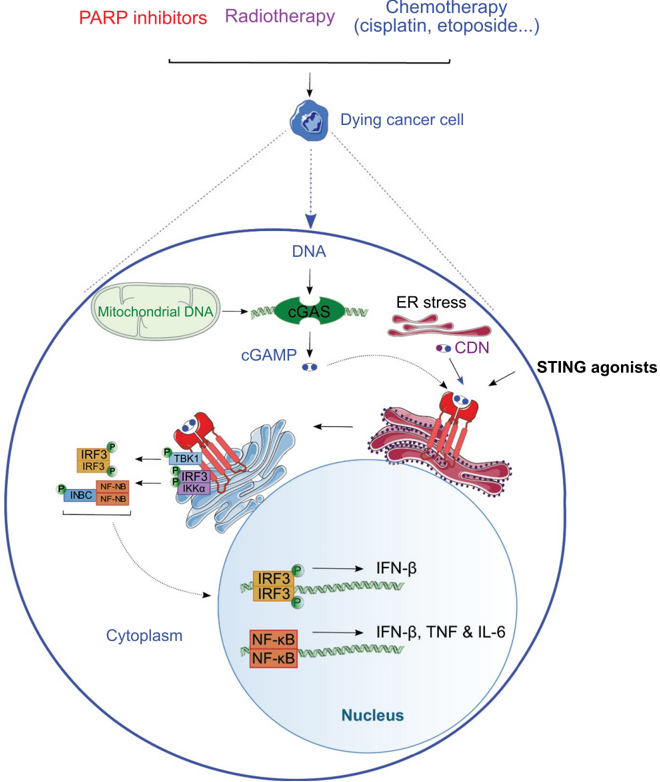
Stimulator of interferon response cGAMP interactor 1 (STING1, best known as STING) is an endoplasmic reticulum-sessile protein that serves as a signaling hub, receiving input from several pattern recognition receptors, most of which sense ectopic DNA species in the cytosol. In particular, STING ensures the production of type I interferon (IFN) in response to invading DNA viruses, bacterial pathogens, as well as DNA leaking from mitochondria or the nucleus (e.g., in cells exposed to chemotherapy or radiotherapy). As a type I IFN is critical for the initiation of anticancer immune responses, the pharmaceutical industry has generated molecules that directly activate STING for use in oncological indications. Such STING agonists are being tested in clinical trials with the rationale of activating STING in tumor cells or tumor-infiltrating immune cells (including dendritic cells) to elicit immunostimulatory effects, alone or in combination with a range of established chemotherapeutic and immunotherapeutic regimens. In this Trial Watch, we discuss preclinical evidence and accumulating clinical experience shaping the design of Phase I and Phase II trials that evaluate the safety and preliminary efficacy of STING agonists in cancer patients.
Overview
The claims and statistics of this paper haven’t been checked yet.
Free: it reads the open-access text and checks the first 5 claims that cite a source we can check. Create a free account to check every claim.
Integrity signals
Registry
Cites
Statistics
Figures
Verification
Claims the paper makes
The claims and statistics of this paper haven’t been checked yet.
Free: it reads the open-access text and checks the first 5 claims that cite a source we can check. Create a free account to check every claim.
Claims other papers make about this one
Each is checked against this paper’s own text: does it say what the citing paper says it does?
The source backs part of the claim, not all of it — or backs it for a different population, condition or comparison.
In the citing paper
“Systemic approaches to stimulating innate immunity, such as via agonism of stimulator of interferon response cGAMP interactor 1 (STING) or Toll-like receptors (TLR), have been challenging (199)(200)(201).”
From The Next Decade of Immune Checkpoint Therapy (2021) · cites this paper as [199]
Experimental — accuracy not yet measured
Self-check
Percentages, sums and reported differences re-computed from the paper’s own numbers.
The self-check needs the paper’s full text.
Citations
Cites
1 retracted
RETRACTED ARTICLE: Parkin and PINK1 mitigate STING-induced inflammation
Sliter, D. A., Martinez, J., Hao, L., Chen, X., Sun, N., Fischer, T. D., Burman, J. L., Li, Y., Zhang, Z., Narendra, D. P., et al. (2018) · Nature · doi:10.1038/s41586-018-0448-9 · Cited by 1,287
RetractedCombined Nivolumab and Ipilimumab or Monotherapy in Untreated Melanoma
Larkin, J., Chiarion-Sileni, V., Gonzalez, R., Grob, J. J., Cowey, C. L., Lao, C. D., Schadendorf, D., Dummer, R., Smylie, M., Rutkowski, P., et al. (2015) · New England Journal of Medicine · doi:10.1056/nejmoa1504030 · Cited by 8,157
Overall Survival with Combined Nivolumab and Ipilimumab in Advanced Melanoma
Wolchok, J. D., Chiarion-Sileni, V., Gonzalez, R., Rutkowski, P., Grob, J.-J., Cowey, C. L., Lao, C. D., Wagstaff, J., Schadendorf, D., Ferrucci, P. F., et al. (2017) · New England Journal of Medicine · doi:10.1056/nejmoa1709684 · Cited by 5,357
Cyclic GMP-AMP Synthase Is a Cytosolic DNA Sensor That Activates the Type I Interferon Pathway
Sun, L., Wu, J., Du, F., Chen, X., & Chen, Z. J. (2013) · Science · doi:10.1126/science.1232458 · Cited by 4,996
Nivolumab plus Ipilimumab versus Sunitinib in Advanced Renal-Cell Carcinoma
Motzer, R. J., Tannir, N. M., McDermott, D. F., Arén Frontera, O., Melichar, B., Choueiri, T. K., Plimack, E. R., Barthélémy, P., Porta, C., George, S., et al. (2018) · New England Journal of Medicine · doi:10.1056/nejmoa1712126 · Cited by 4,656
STING is an endoplasmic reticulum adaptor that facilitates innate immune signalling
Ishikawa, H., & Barber, G. N. (2008) · Nature · doi:10.1038/nature07317 · Cited by 3,576
Nivolumab plus ipilimumab in lung cancer with a high tumor mutational burden
Hellmann, M. D., Ciuleanu, T.-E., Pluzanski, A., Lee, J. S., Otterson, G. A., Audigier-Valette, C., Minenza, E., Linardou, H., Burgers, S., Salman, P., et al. (2018) · New England Journal of Medicine · doi:10.1056/nejmoa1801946 · Cited by 3,063
STING regulates intracellular DNA-mediated, type I interferon-dependent innate immunity
Ishikawa, H., Ma, Z., & Barber, G. N. (2009) · Nature · doi:10.1038/nature08476 · Cited by 2,759
Dendritic cells in cancer immunology and immunotherapy
Wculek, S. K., Cueto, F. J., Mujal, A. M., Melero, I., Krummel, M. F., & Sancho, D. (2020) · Nature Reviews Immunology · doi:10.1038/s41577-019-0210-z · Cited by 2,574
Regulation and function of the cGAS–STING pathway of cytosolic DNA sensing
Chen, Q., Sun, L., & Chen, Z. J. (2016) · Nature Immunology · doi:10.1038/ni.3558 · Cited by 2,333
Research works printed but not linked: 3
- 135. Wang Z, Dove P, Rosa D, Bossen B, Helke S, Charbonneau M, Brinen L, Dodge K, Lin GH, Galligan C, et al. Preclinical charac terization of a novel non-cyclic dinucleotide small molecule STING agonist with potent antitumor activity in mice. American Association of Cancer Research Annual Meeting 2019.
- 155. McKeage MJ, Jameson MB, Investigators ASSG. Comparative out comes of squamous and non-squamous non-small cell lung cancer (NSCLC) patients in phase II studies of ASA404 (DMXAA) retrospective analysis of pooled data. J Thorac Dis. 2010;2:199-204. doi:10.3978/j..2072-1439.2010.02.04.1. · doi:10.3978/j..2072-1439.2010.02.04.1
- 163. Endo A, Kim D, Huang K, Hao M, Mathieu S, Choi H, Majumder U, Zhu X, Shen Y, Sanders K, et al. Discovery of E7766: A representative of a novel class of macrocycle-bridged STING agonists (MBSAs) with superior potency and pan-genotypic activity. American Association for Cancer Research Annual Meeting 2019.
Cited by
Items 201–294 of 294
A clinically-relevant STING agonist restrains human TH17 cell inflammatory profile
Damasceno, L. E. A., Cunha, T. M., Cunha, F. Q., Sparwasser, T. D., & Alves-Filho, J. C. (2023) · International Immunopharmacology · doi:10.1016/j.intimp.2023.111007 · Cited by 4
IMMUNE MODULATION OF CANCER: MECHANISMS AND RESISTANCE
Lisi, L., Cari, L., Sorrentino, R., Mini, E., Fimognari, C., & Nocentini, G. (2021) · doi:10.36118/pharmadvances.2021.07 · Cited by 4
Gros, L., Ursino, C., Constanzo, J., Zangger, N., Meylan, E., Bonnefoy, N., & Faget, J. (2021) · bioRxiv (Cold Spring Harbor Laboratory) · doi:10.1101/2021.01.04.425311 · Cited by 6
Zhou, S., Su, T., Cheng, F., Cole, J., Liu, X., Zhang, B., Alam, S., Liu, J., & Zhu, G. (2023) · bioRxiv (Cold Spring Harbor Laboratory) · doi:10.1101/2023.07.13.548237 · Cited by 4
Intratumoral Immunotherapy in Breast Cancer
Baumrucker, C. C., Harris, N., Hoover, S. J., & Czerniecki, B. J. (2025) · Vaccines · doi:10.3390/vaccines13040429 · Cited by 3
“Furthermore, these agonists have been shown to activate responses in both cancer cells and immune cells, creating challenges in limiting off-target effects [35].”
Yáñez, A. J., Beltrán, J. F., Barrientos, C. A., Soto-Rauch, G., Aguilar, M. N., Isla, A., Flores-Martin, S. N., Yañez, F. T., Yuivar, Y., Ojeda, A., et al. (2025) · Frontiers in Immunology · doi:10.3389/fimmu.2025.1570871 · Cited by 3
Mosley, S. R., Lapa, N., Namdar, A., Catley, T. E., Meier‐Stephenson, F., Mowat, C., Gao, P., Sun, X., Meier‐Stephenson, V., Pyne, A. L. B., et al. (2026) · Cell Reports · doi:10.1016/j.celrep.2026.117012 · Cited by 6
Li, C. I., Ke, F., Zhao, H., Mao, S., Djibo, M., Huang, L., He, M., Wang, M., Wen, H., Liu, Z., et al. (2026) · Nature Cancer · doi:10.1038/s43018-026-01158-7 · Cited by 4
“10), similar to literature reports 8,11,14 .”
InfluentialHe, J., Huang, R., Zong, C., Li, Q., Wang, Y., Zheng, G., Wang, Y., Yang, X., Fang, Y., Fang, F., et al. (2025) · Cancer Immunology Research · doi:10.1158/2326-6066.cir-24-0405 · Cited by 3
Yuan, S.-W., Shi, H., Fu, M., Zhang, X., Xi, X.-Q., Wang, Y., Shen, T.-S., Ma, J., & Tang, C. (2024) · Biomolecules · doi:10.3390/biom14030350 · Cited by 3
Innate and adaptive immunity in cancer
Doshi, A. S., & Asrani, K. H. (2021) · Elsevier eBooks · doi:10.1016/b978-0-12-823397-9.00025-9 · Cited by 4
APOBEC3A drives STING-dependent metastasis
Bakhoum, S. F. W. (2021) · Nature Cancer · doi:10.1038/s43018-021-00286-6 · Cited by 3
Yuan, L., Kulkarni, M. M., Chiswick, E. L., Koh, C. M., Sandy, P., Nabhan, S., Sherman, W., Johnson, M. L., Wang, J., Falchook, G. S., et al. (2025) · British Journal of Clinical Pharmacology · doi:10.1002/bcp.70067 · Cited by 2
“15 This activated T-cell response has been shown to inhibit tumour growth in preclinical models 16(p11),.17,18 Prior clinical experience demonstrates that the challenges with clinical translation of immune agonists also apply to STING agonism.”
Bady, E., Ebner, J., Mandelkow, T., Huang, Z., Neipp, M., Mofid, H., Lárusson, H., Daniels, T., Isbert, C. M., Coerper, S., et al. (2025) · Pathology · doi:10.1016/j.pathol.2025.05.008 · Cited by 2
Chen, S., Cai, W., & Liu, C. (2025) · Frontiers in Immunology · doi:10.3389/fimmu.2025.1745168 · Cited by 3
Kothadiya, S., Cutshaw, G., Mathew, A. P., Zielinski, C., & Bardhan, R. (2026) · Nanoscale Horizons · doi:10.1039/d5nh00687b · Cited by 3
Zhang, S., Cao, G., Hu, X., Chen, C., & Chen, P. (2026) · International Journal of Molecular Sciences · doi:10.3390/ijms27021120 · Cited by 2
“Given that IFN-I is pivotal for launching antitumor immunity, pharmacological STING agonists have entered early-phase clinical studies intended to ignite STING signaling within malignant cells or intratumoral dendritic cells, either as monotherapy or alongside conventional regimens [18].”
The Signaling Networks of TIM-3, TGF-β, and STING in Glioblastoma
Ahmady, F., Carnie, B. M. H., Anderson, G. E. C., Achari, E., Sharma, A., Achuthan, A. A., Kannourakis, G., & Luwor, R. B. (2026) · Cells · doi:10.3390/cells15110991 · Cited by 2
Classes of therapeutics to amplify the immune response
Hu, Y., & Burkard, M. E. (2021) · Breast Cancer Research and Treatment · doi:10.1007/s10549-021-06369-3 · Cited by 2
Modulating the tumor immune microenvironment with locoregional image-guided interventions
Jain, S., & Sheth, R. A. (2023) · Frontiers in Immunology · doi:10.3389/fimmu.2022.1057597 · Cited by 3
Lamsal, A., Andersen, S. B., Johansson, I., Desgarnier, M. D., Wolowczyk, C., Engedal, N., Vietri, M., Bjørkøy, G., Giambelluca, M. S., & Pettersen, K. (2024) · Cell Communication and Signaling · doi:10.1186/s12964-024-01858-6 · Cited by 2
“However, insufficient response to treat-ment and treatment-associated toxicity remain major challenges and there is still an urgent need for superior treatment options [8].”
BackgroundHsiao, K., Murray, N. H., Mikheil, D. M., Larsen, M. A., Wang, H., Ugo, T., & Goueli, S. A. (2024) · Scientific Reports · doi:10.1038/s41598-024-82525-1 · Cited by 2
Sosnowska, D., Cheung, T. S., Sarkar, J., Opzoomer, J. W., Feehan, K. T., Anstee, J. E., Woodman, C. A., Keddar, M. R., Clayton, K., Ali, S., et al. (2025) · JCI Insight · doi:10.1172/jci.insight.191017 · Cited by 3
“STING agonists, which are currently in clinical trials across multiple tumor types (36), offer a promising strategy to trigger type I IFN responses in the TME.”
He, K., Selek, U., Barsoumian, H. B., Sezen, D., Ning, M. S., Puebla‐Osorio, N., Schoenhals, J. E., Chen, D., Leuschner, C., Cortez, M. A., et al. (2022) · Medical radiology · doi:10.1007/174_2022_315 · Cited by 2
Regulation of lipid metabolism is a primordial function of STINGPreprint
Guha, S., Re, J., Chemarin, M., Gregoire, S., Messaoud-Nacer, Y., Chamma, H., Augereau, A., Barrat, J., Acar, N., Vila, I. K., et al. (2025) · bioRxiv (Cold Spring Harbor Laboratory) · doi:10.1101/2025.11.17.688879 · Cited by 2
With Our Powers Combined: Exploring PARP Inhibitors and Immunotherapy
Kasherman, L., Karakasis, K., & Oza, A. M. (2021) · The Cancer Journal · doi:10.1097/ppo.0000000000000557 · Cited by 2
Sampaio, L. R., Dias, R. D. B., Goes, J. V. C., de Melo, R. P. M., Borges, D. D. P., Melo, M. M. D. L., de Oliveira, R. T. G., Ribeiro, H. L., Magalhães, S. M. M., & Pinheiro, R. F. (2024) · Medical Oncology · doi:10.1007/s12032-024-02376-8 · Cited by 1
“Phase I, II, and III clinical trials have started to investigate DMXAA, a significant STING agonist, for advanced solid cancers [70].”
Qian, L., Shi, J., Pei, C., Hu, J., Han, W., Yu, L., & Chu, H. (2025) · Nanotechnology Reviews · doi:10.1515/ntrev-2025-0167 · Cited by 1
Lomashvili, E. M., Kim, J., Kong, L., & Cook, P. R. (2025) · ImmunoHorizons · doi:10.1093/immhor/vlaf048 · Cited by 1
Harnessing mismatch repair deficiency for therapeutic targeting in cancers
Yenidogan, I., Tabori, U. Y., & Das, A. (2025) · Expert Opinion on Therapeutic Targets · doi:10.1080/14728222.2025.2608031 · Cited by 2
“Inhibition of MAPK or MEK signaling restores antigen presentation and increases CD8 + infiltration [116,117] whereas pharmacological activation of the STING pathway can reactivate interferon signaling and dendritic-cell priming [118,119].”
RIG-I Stimulation Enhances the Effector Function and Proliferation of Primary Human CD8+ T Cells
Mohamed, A. A., Wallerath, C., Hunkler, C., Hartmann, G., Stankovic, S., Brööks, A. G., & Schlee, M. (2026) · International Journal of Molecular Sciences · doi:10.3390/ijms27073058 · Cited by 1
Lin, R., Yang, M., Zhi, S., Lin, Z., Xie, L., Hong, Z., Huang, L., Cheng, K., & Chen, Z. (2026) · Journal of Medicinal Chemistry · doi:10.1021/acs.jmedchem.5c03402 · Cited by 1
Sampath, S. G., Tang, A. J., Chen, A. X., Viswanathan, A., Izima, C., Manriquez, A. H., Dadario, N. B., Winans, N. J., Sakka Amini, M., Rolfe, N. W., et al. (2026) · Journal of Neuro-Oncology · doi:10.1007/s11060-026-05601-8 · Cited by 3
“…yet to demonstrate efficacy for STING agonists, the use of STING agonists remains an area of active investigation for glioblastoma treatment, driven by the prospect of initiating a potent and targeted immune response via the STING pathway within the otherwise ‘cold’ tumor microenvironment [12 ].”
Multifunctional nanotherapeutics for tumor microenvironment modulation in solid tumor therapy
Yang, M., Huang, Y., Qian, W., Zhu, J., Fei, L., Jiao, Z., Wang, J., Wang, Y., Zhu, W., Chen, S., et al. (2026) · Discover Nano · doi:10.1186/s11671-026-04736-x · Cited by 2
“On the immune side, several nanovaccine and stimulator of interferon genes (STING) agonist formulations are now moving from preclinical proof of concept into early clinical testing [76, 77].”
Inducing tumor-intrinsic innate immune response to break cancer immunotherapy resistance
Blandino, J. A., & Murayama, T. (2026) · Frontiers in Medicine · doi:10.3389/fmed.2026.1892906 · Cited by 3
“Most STING agonists are still in phase I, and it’s critical to set correct dosage because excessive activation by too much agonist can provoke systemic inflammation and autoimmunity (135).”
Xu, Z. D., Zhao, H., Yue, C., Zhang, L., Li, M., Du, Y., N. Z., & Yan, L. (2022) · Gynecological Endocrinology · doi:10.1080/09513590.2022.2154338 · Cited by 1
Armored modified vaccinia Ankara in cancer immunotherapy
Atay, Ç., Medina‐Echeverz, J., Hochrein, H., Suter, M., & Hinterberger, M. (2023) · International review of cytology · doi:10.1016/bs.ircmb.2023.05.003 · Cited by 2
Evolution of Biomarkers and Treatment Outcomes of Immunotherapy in Lung Cancer
Kaler, A. K., Maskomani, S., Ritambhara, Kavyashree, K., Vadera, V., Choudhary, V., Shaikh, I. N., Goyle, S., & Mistry, R. (2023) · Current Tissue Microenvironment Reports · doi:10.1007/s43152-023-00047-w · Cited by 1
“In light of these discoveries, several clinical trials (NCT02675439, NCT03956680, NCT03010176, NCT03249792, NCT04096638) are currently investigating the effectiveness of various STING agonists [110].”
The promise, progress, and challenges of in situ immunization agents in cancer immunotherapy
Giacalone, M. J. (2024) · Progress in molecular biology and translational science · doi:10.1016/bs.pmbts.2024.02.004 · Cited by 1
Wang, Z., Ma, D., & Xi, Z. (2022) · Wiley eBooks · doi:10.1002/9781119692799.ch2 · Cited by 1
Nadeem, J., Parveen, A., & Kim, S. Y. (2023) · Preprints.org · doi:10.20944/preprints202309.1932.v1 · Cited by 1
Investigating epigenetic therapies and combinations for the treatment of cancers
O’Brien, S. W. (2023) · Digital Repository Service (Northeastern University) · doi:10.17760/d20620610 · Cited by 1
Kozbor, D., Winkler, M., Malhotra, N., Mistarz, A., Wang, S., Hutson, A. D., Gambotto, A. A., Abrams, S. I., Singh, P. K., Liu, S., et al. (2024) · Research Square · doi:10.21203/rs.3.rs-4940287/v1 · Cited by 1
Comparison of therapeutic strategies for immuno-oncology
Jang, H. L., & Sengupta, S. (2021) · Elsevier eBooks · doi:10.1016/b978-0-12-823397-9.00013-2
Something Old and Something New to Unleash the Power of Natural Killer Cells against Metastases
Demaria, S. (2021) · Cancer Immunology Research · doi:10.1158/2326-6066.cir-21-0948
“So far, early clinical testing of STING agonists has not fulfilled expectations, with modest activity as single agents and in combination with anti–PD-1, suggesting the need for new combinations that optimally leverage STING activity (3).”
BackgroundXu, Z. D., zhao, H., Yue, C., zhang, L., li, M., Wang, Y., Du, Y., & Yan, L. (2021) · Research Square · doi:10.21203/rs.3.rs-709514/v1
Neuartige Poxin‐stabile cGAMP‐Derivate als bemerkenswerte STING‐Agonisten
Stazzoni, S., Böhmer, D. F. R., Hernichel, F., Özdemir, D., Pappa, A., Drexler, D., Bauernfried, S., Witte, G., Wagner, M., Veth, S., et al. (2022) · Angewandte Chemie · doi:10.1002/ange.202207175
Doshi, A. S. (2021) · Digital Repository Service (Northeastern University) · doi:10.17760/d20416548 · Cited by 1
Emergent impact of lifestyle on tumor progression and response to therapy
Buqué, A., Montrose, D. C., & Galluzzi, L. (2022) · International review of cytology · doi:10.1016/s1937-6448(22)00132-0
Self-citationCholesterol-deficient T cell membrane-encapsulated STING agonists for tumor-targeted immunotherapyPreprint
Li, L., Zhang, M., Liu, T., Zhang, Z., Liu, Z., & Zhang, L. (2022) · bioRxiv (Cold Spring Harbor Laboratory) · doi:10.1101/2022.12.21.521349
Huang, K., Chandra, D., McGrath, S., Dixit, V. S., Zhang, C., Wu, J., TenDyke, K., Yao, H., Hukkanen, R. R., Taylor, N., et al. (2023) · doi:10.1158/1535-7163.c.6543267.v1
Li, C., Mao, S., Zhao, H., He, M., Wang, M., Liu, Z., Wen, H., Yu, Z., Wen, B., Djibo, M., et al. (2024) · bioRxiv (Cold Spring Harbor Laboratory) · doi:10.1101/2024.02.14.580378
Cai, Y., Chen, X., Lu, T., Yu, Z., Hu, S., Liu, J., Zhou, X., & Wang, X. (2023) · Figshare · doi:10.6084/m9.figshare.22688594
Landolfo, S., Raviola, S., & Andrea, M. D. (2024) · Elsevier eBooks · doi:10.1016/b978-0-128-24465-4.00049-1
Cysteine-Engineered CAR-T Cells to Counter Antigen Escape in B Cell LymphomaPreprint
Lühle, J., Krost, S., Goerdeler, F., Seitz, C. M., Seeberger, P. H., & Moscovitz, O. (2025) · bioRxiv (Cold Spring Harbor Laboratory) · doi:10.1101/2025.04.01.646520
Kotmakçı, M., Bara, B., Yildirim, Z., Öner, E., Yaman, B., Akalın, T., Özgiray, E., Kosova, B., & Çetintaş, V. B. (2025) · Journal of Drug Delivery Science and Technology · doi:10.1016/j.jddst.2025.107000 · Cited by 4
Shekfeh, M., Konaté, M. M., & Krushkal, J. (2025) · Human Genomics · doi:10.1186/s40246-025-00785-y · Cited by 1
“…of inflammation and interferon response in neurological, neurodegenerative, and musculoskeletal disorders and in clinical treatment [19, 20, 123–125], future studies may investigate whether TREX1 variants may play contributing or modifying roles in a broad range of diseases that involve…”
Radiation-dependent Nucleic Acid Sensing, and Its Possible Impact on Radiotherapy
Pickering, R. J., & Zierhut, C. (2025) · The Cancer Journal · doi:10.1097/ppo.0000000000000775
Vural, S., Palmisano, A., Reinhold, W. C., Pommier, Y., Teicher, B. A., & Krushkal, J. (2021) · Figshare · doi:10.6084/m9.figshare.14176027
Lamsal, A., Andersen, S. B., Johansson, I., Vietri, M., Bokil, A. A., Kurganovs, N. J., Rylander, F., Bjørkøy, G., Pettersen, K., & Giambelluca, M. S. (2024) · Figshare · doi:10.6084/m9.figshare.26573386
Vural, S., Palmisano, A., Reinhold, W. C., Pommier, Y., Teicher, B. A., & Krushkal, J. (2021) · Figshare · doi:10.6084/m9.figshare.14176024
Vural, S., Palmisano, A., Reinhold, W. C., Pommier, Y., Teicher, B. A., & Krushkal, J. (2021) · Figshare · doi:10.6084/m9.figshare.14176018
Lamsal, A., Andersen, S. B., Johansson, I., Vietri, M., Bokil, A. A., Kurganovs, N. J., Rylander, F., Bjørkøy, G., Pettersen, K., & Giambelluca, M. S. (2024) · Figshare · doi:10.6084/m9.figshare.26573383
Cai, Y., Chen, X., Lu, T., Yu, Z., Hu, S., Liu, J., Zhou, X., & Wang, X. (2023) · Figshare · doi:10.6084/m9.figshare.22688597
Vural, S., Palmisano, A., Reinhold, W. C., Pommier, Y., Teicher, B. A., & Krushkal, J. (2021) · Figshare · doi:10.6084/m9.figshare.14176006
Vural, S., Palmisano, A., Reinhold, W. C., Pommier, Y., Teicher, B. A., & Krushkal, J. (2021) · Figshare · doi:10.6084/m9.figshare.14176021
Lamsal, A., Andersen, S. B., Johansson, I., Vietri, M., Bokil, A. A., Kurganovs, N. J., Rylander, F., Bjørkøy, G., Pettersen, K., & Giambelluca, M. S. (2024) · Figshare · doi:10.6084/m9.figshare.26573389
Vural, S., Palmisano, A., Reinhold, W. C., Pommier, Y., Teicher, B. A., & Krushkal, J. (2021) · Figshare · doi:10.6084/m9.figshare.14176015
Fibrinogen-Drug Nanoparticles Eradicate Pancreatic and Triple-Negative Breast Cancers in MicePreprint
Razavi, R., O'Connor, M. J., & Hainfeld, J. F. (2026) · bioRxiv (Cold Spring Harbor Laboratory) · doi:10.64898/2026.03.18.711348
“Additionally, although the vascular-disrupting agent DMXAA is effective in mice, it lacks full activity in humans; however, synthetic STING agonists and alternative vascular-disrupting agents are currently under exploration ( 59 , 60 ).”
Qu, N., Zhang, M., Ji, Y., Liu, M., Liu, M., & Chen, L. J. (2026) · Immunological Investigations · doi:10.1080/08820139.2025.2590048
“Combining them with STING agonists can produce a strong synergistic antitumor immune response, significantly inhibiting tumor growth and improving survival rates in preclinical models (Le Naour et al., 2020).”
Nebot-Bral, L. (2021) · theses.fr (ABES) · doi:10.70675/e1797b79z28d4z4e65zbd29zdc771b604d21
Naour, J. L. (2022) · theses.fr (ABES) · doi:10.70675/ad2bd68az83cdz4738zb39fz6a66ef3080d3
Wanschoor, P. (2024) · theses.fr (ABES) · doi:10.70675/614376b0zfaeaz4c04zb17cz1a95b6904fe2
Schulman, J. A., Arora, K., Kwiatkowski, A. J., Chada, N. C., Steele, J. A., Pagendarm, H. M., Woodworth, M. E., Sheehy, T. L., Gibson-Corley, K. N., Balko, J. M., et al. (2026) · Biomaterials · doi:10.1016/j.biomaterials.2026.124238 · Cited by 1
The role of the cGAS-STING pathway in male reproductive disorders
Oghbaei, F., Hosseini, L., & Ghiasi, R. (2026) · Molecular Biology Reports · doi:10.1007/s11033-026-11993-7
“A study has reported that radiation-induced DNA damage activates the cGAS-STING signaling pathway, increasing immune cell infiltration, T-cell response induction, and the anti-tumor effect [ 90].”
An Overview of STING as an Anticancer Target: Structure, Function, and Inhibitors
Chang, Y., Dan, E., Zhang, H., & Cao, S. (2026) · Journal of Biosciences and Medicines · doi:10.4236/jbm.2026.146010
Qu, H., Zhou, P., Yu, J., Deng, K., Zhou, Y., Wang, N., Chen, Y., & Xia, J. (2026) · IntechOpen eBooks · doi:10.5772/intechopen.1016269
Current Perspectives on STING Agonists for Anticancer Drug Development
Kahvecioglu, D. (2026) · Chemical Biology & Drug Design · doi:10.1111/cbdd.70370
Fu, Y., Zhan, X., Liu, S., Xie, Q., Song, S., Wu, S., Sheng, J., He, H., You, X., Ling, Q., et al. (2026) · Cellular and Molecular Immunology · doi:10.1038/s41423-026-01453-4
“All the gating strategies were established using isotype-matched control antibodies to ensure speci fi city and accuracy.”
Microenvironment-defined priority pathways shape ICD-driven abscopal responses
Sun, X., Guo, D., Wang, Z., & Sun, P. (2026) · Frontiers in Immunology · doi:10.3389/fimmu.2026.1933591
Razavi, R., O’Connor, M., & Hainfeld, J. F. (2026) · ACS Pharmacology & Translational Science · doi:10.1021/acsptsci.6c00337
Context-Dependent cGAS-STING Activation Shapes Metastatic Progression and Dormancy
Akter-Yasuoka, E., 이탁, Murayama, T., & Nakayama, J. (2026) · Cells · doi:10.3390/cells15171619
Chen, L., Song, M.-H., Jin, M., Jin, H., Gong, L., Feng, J., Hao, Y., Shao, H., Gong, X., Gao, Z., et al. (2026) · Journal of Controlled Release · doi:10.1016/j.jconrel.2026.115372
Shan, M., Liao, Y., Lin, Z., Song, L., Zhang, W., Jiang, R., Zhang, H., Guo, Y., & Su, F. (2026) · APOPTOSIS · doi:10.1007/s10495-026-02450-8
“Although the results of early clinical trials did not meet expectations, they profoundly revealed the challenges faced and pointed out the direction for the optimization of the next generation of drugs [71, 72].”
Zhang, A., Fang, Y., Peng, R., Yan, M., Chen, Z., Li, T., Tan, J., Sun, L., & Chen, Z. J. (2026) · bioRxiv (Cold Spring Harbor Laboratory) · doi:10.64898/2026.10.15.759215
“Although current approaches such as STING Despite compelling preclinical efficacy, clinical translation of STING pathway activation has been hindered by pharmacokinetic and safety limitations of cyclic dinucleotide agonists, including poor permeability, short half-life and systemic toxicity 13, 39 .”
Chemical Modulation of the cGAS‐STING‐ENPP1 Axis: Medicinal Chemistry and Clinical Perspective
Shinde, A. U., & Bharate, S. B. (2026) · Medicinal Research Reviews · doi:10.1002/med.70118
BindingDB (2023) · UC San Diego · doi:10.7270/q2h1363k
Baciptosis: a new type of BAX/BAK-mediated mitochondrial cell death
Santulli, G. (2026) · Cell Cycle · doi:10.1080/15384101.2026.2757433
Yang, H., Zhang, H., Zhao, Z., Ren, Y., Xu, Y., Cai, K., Cheng, J., Liu, X., Chen, Y., & Yin, L. (2026) · Journal of the American Chemical Society · doi:10.1021/jacs.6c14840
Metadata
- Authors
- Le Naour, J., Zitvogel, L., Galluzzi, L., Vacchelli, E., & Kroemer, G.
- Affiliations
- Université de Paris, Sorbonne Université, INSERM, Centre de Recherche des Cordeliers
- Inserm (FR)
- Université Paris Cité (FR)
- Université Paris-Sud (FR)
- Corresponding author
- Vacchelli, Erika
- Kroemer, Guido
- Venue
- OncoImmunology
- Publisher
- Informa UK Limited
- Published
- 2020-01
- Volume
- 9
- Issue
- 1
- Pages
- 1777624
- ISSN
- 2162-4011 (ISSN-L)
- 2162-402X
- OpenAlex
- W4211021377
- Semantic Scholar
- e00f0d53e48265a90e78cba8c4274af3df2af653
- Cited by
- 289
- References
- 189
- Citations by year
- 2026: 27 · 2025: 43 · 2024: 37 · 2023: 63 · 2022: 56 · 2021: 61 · 2020: 2
- FWCI
- 4.52
- Type
- journal article
- Language
- en
- Open access
- gold
- doi.org
- Licence
- Locations
- OncoImmunology (publishedVersion, cc-by-nc)
- HAL (submittedVersion, cc-by-nc)
- DOAJ (DOAJ: Directory of Open Access Journals) (submittedVersion)
- Funders
- Agence Nationale de la Recherche (ANR-18-IDEX-0001)
- Topics
- Life Sciences › Immunology and Microbiology › Immunology › interferon and immune responses
- Life Sciences › Immunology and Microbiology › Immunology › Immunotherapy and Immune Responses
- Health Sciences › Medicine › Oncology › Cancer Immunotherapy and Biomarkers
- Keywords
- STING agonist, STING, cancer immunotherapy, type I interferon, endoplasmic reticulum, cytosolic DNA sensing, pattern recognition receptors, tumor-infiltrating immune cells, dendritic cells, combination therapy with chemotherapy and radiotherapy, clinical trial design, drug safety and efficacy
About these checks
Registry, retraction, Cites and statistics results are computed, not judged, with one exception: a printed reference that no index lists is read once by a model before it counts as a citation error. Claims are extracted by a model and kept only when their quote appears verbatim in the text; each cited source is then checked, with a model’s help, for whether it says what the claim relies on. Those verdicts can be wrong — read the claim’s quote and the cited source before relying on one.
Statistics and arithmetic are recomputed, not judged.
Confidence bands are shown only for fields calibrated on our annotated test set. None is calibrated yet, so no band is shown.
What counts as a claim ›How we measure confidence ›How we check this ›
Are you an author, or do you see a problem with this page? Request a review
Data sources
Bibliographic data: Semantic Scholar, OpenAlex, Crossref.
Contains information from the Semantic Scholar Academic Graph Datasets, made available under the ODC Attribution License (ODC-BY 1.0).
Semantic Scholar’s data is described in: Kinney, R., et al. (2023). The Semantic Scholar Open Data Platform. arXiv:2301.10140.
