

Trial watch: STING agonists in cancer therapy
Open accessThe DOI matches its Crossref record; 192 of the 192 references it cites were found in a registry or an index.
Abstract
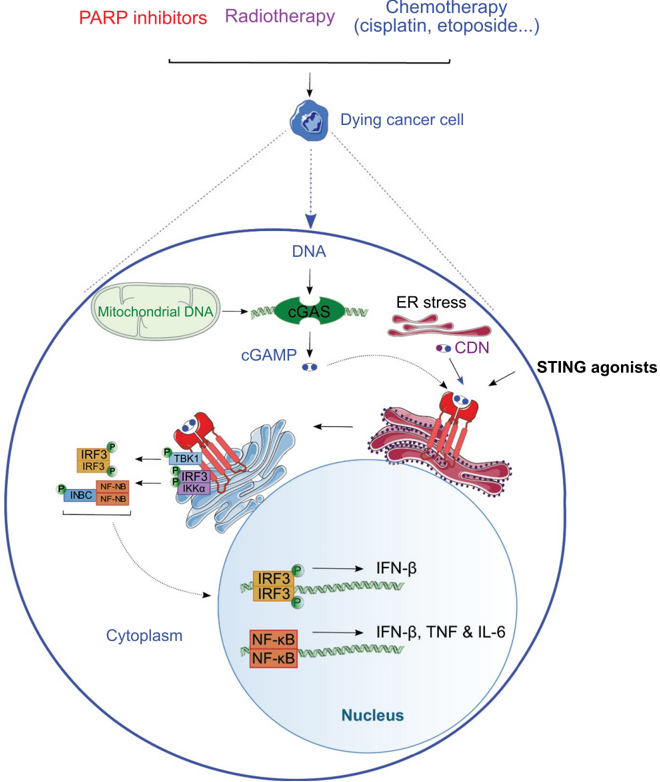
Stimulator of interferon response cGAMP interactor 1 (STING1, best known as STING) is an endoplasmic reticulum-sessile protein that serves as a signaling hub, receiving input from several pattern recognition receptors, most of which sense ectopic DNA species in the cytosol. In particular, STING ensures the production of type I interferon (IFN) in response to invading DNA viruses, bacterial pathogens, as well as DNA leaking from mitochondria or the nucleus (e.g., in cells exposed to chemotherapy or radiotherapy). As a type I IFN is critical for the initiation of anticancer immune responses, the pharmaceutical industry has generated molecules that directly activate STING for use in oncological indications. Such STING agonists are being tested in clinical trials with the rationale of activating STING in tumor cells or tumor-infiltrating immune cells (including dendritic cells) to elicit immunostimulatory effects, alone or in combination with a range of established chemotherapeutic and immunotherapeutic regimens. In this Trial Watch, we discuss preclinical evidence and accumulating clinical experience shaping the design of Phase I and Phase II trials that evaluate the safety and preliminary efficacy of STING agonists in cancer patients.
Overview
The claims and statistics of this paper haven’t been checked yet.
Free: it reads the open-access text and checks the first 5 claims that cite a source we can check. Create a free account to check every claim.
Integrity signals
Registry
Cites
Statistics
Figures
Verification
Claims the paper makes
The claims and statistics of this paper haven’t been checked yet.
Free: it reads the open-access text and checks the first 5 claims that cite a source we can check. Create a free account to check every claim.
Claims other papers make about this one
Each is checked against this paper’s own text: does it say what the citing paper says it does?
The source backs part of the claim, not all of it — or backs it for a different population, condition or comparison.
In the citing paper
“Systemic approaches to stimulating innate immunity, such as via agonism of stimulator of interferon response cGAMP interactor 1 (STING) or Toll-like receptors (TLR), have been challenging (199)(200)(201).”
From The Next Decade of Immune Checkpoint Therapy (2021) · cites this paper as [199]
Experimental — accuracy not yet measured
Self-check
Percentages, sums and reported differences re-computed from the paper’s own numbers.
The self-check needs the paper’s full text.
Citations
Cites
1 retracted
RETRACTED ARTICLE: Parkin and PINK1 mitigate STING-induced inflammation
Sliter, D. A., Martinez, J., Hao, L., Chen, X., Sun, N., Fischer, T. D., Burman, J. L., Li, Y., Zhang, Z., Narendra, D. P., et al. (2018) · Nature · doi:10.1038/s41586-018-0448-9 · Cited by 1,287
RetractedCombined Nivolumab and Ipilimumab or Monotherapy in Untreated Melanoma
Larkin, J., Chiarion-Sileni, V., Gonzalez, R., Grob, J. J., Cowey, C. L., Lao, C. D., Schadendorf, D., Dummer, R., Smylie, M., Rutkowski, P., et al. (2015) · New England Journal of Medicine · doi:10.1056/nejmoa1504030 · Cited by 8,157
Overall Survival with Combined Nivolumab and Ipilimumab in Advanced Melanoma
Wolchok, J. D., Chiarion-Sileni, V., Gonzalez, R., Rutkowski, P., Grob, J.-J., Cowey, C. L., Lao, C. D., Wagstaff, J., Schadendorf, D., Ferrucci, P. F., et al. (2017) · New England Journal of Medicine · doi:10.1056/nejmoa1709684 · Cited by 5,357
Cyclic GMP-AMP Synthase Is a Cytosolic DNA Sensor That Activates the Type I Interferon Pathway
Sun, L., Wu, J., Du, F., Chen, X., & Chen, Z. J. (2013) · Science · doi:10.1126/science.1232458 · Cited by 4,996
Nivolumab plus Ipilimumab versus Sunitinib in Advanced Renal-Cell Carcinoma
Motzer, R. J., Tannir, N. M., McDermott, D. F., Arén Frontera, O., Melichar, B., Choueiri, T. K., Plimack, E. R., Barthélémy, P., Porta, C., George, S., et al. (2018) · New England Journal of Medicine · doi:10.1056/nejmoa1712126 · Cited by 4,656
STING is an endoplasmic reticulum adaptor that facilitates innate immune signalling
Ishikawa, H., & Barber, G. N. (2008) · Nature · doi:10.1038/nature07317 · Cited by 3,576
Nivolumab plus ipilimumab in lung cancer with a high tumor mutational burden
Hellmann, M. D., Ciuleanu, T.-E., Pluzanski, A., Lee, J. S., Otterson, G. A., Audigier-Valette, C., Minenza, E., Linardou, H., Burgers, S., Salman, P., et al. (2018) · New England Journal of Medicine · doi:10.1056/nejmoa1801946 · Cited by 3,063
STING regulates intracellular DNA-mediated, type I interferon-dependent innate immunity
Ishikawa, H., Ma, Z., & Barber, G. N. (2009) · Nature · doi:10.1038/nature08476 · Cited by 2,759
Dendritic cells in cancer immunology and immunotherapy
Wculek, S. K., Cueto, F. J., Mujal, A. M., Melero, I., Krummel, M. F., & Sancho, D. (2020) · Nature Reviews Immunology · doi:10.1038/s41577-019-0210-z · Cited by 2,574
Regulation and function of the cGAS–STING pathway of cytosolic DNA sensing
Chen, Q., Sun, L., & Chen, Z. J. (2016) · Nature Immunology · doi:10.1038/ni.3558 · Cited by 2,333
The immune contexture in cancer prognosis and treatment
Fridman, W. H., Zitvogel, L., Sautès–Fridman, C., & Kroemer, G. (2017) · Nature Reviews Clinical Oncology · doi:10.1038/nrclinonc.2017.101 · Cited by 2,263
Self-citationDeng, L., Liang, H., Xu, M., Yang, X., Burnette, B., Arina, A., Li, X.-D., Mauceri, H., Beckett, M., Darga, T., et al. (2014) · Immunity · doi:10.1016/j.immuni.2014.10.019 · Cited by 2,182
Mitochondrial DNA stress primes the antiviral innate immune response
West, A. P., Khoury-Hanold, W., Staron, M., Tal, M. C., Pineda, C. M., Lang, S. M., Bestwick, M., Duguay, B. A., Raimundo, N., MacDuff, D. A., et al. (2015) · Nature · doi:10.1038/nature14156 · Cited by 1,975
STING-Dependent Cytosolic DNA Sensing Mediates Innate Immune Recognition of Immunogenic Tumors
Woo, S.-R., Fuertes, M. B., Corrales, L., Spranger, S., Furdyna, M. J., Leung, M. Y. K., Duggan, R., Wang, Y., Barber, G. N., Fitzgerald, K. A., et al. (2014) · Immunity · doi:10.1016/j.immuni.2014.10.017 · Cited by 1,917
DNA exonuclease Trex1 regulates radiotherapy-induced tumour immunogenicity
Vanpouille-Box, C., Alard, A., Aryankalayil, M. J., Sarfraz, Y., Diamond, J. M., Schneider, R. J., Inghirami, G., Coleman, C. N., Formenti, S. C., & Demaria, S. (2017) · Nature Communications · doi:10.1038/ncomms15618 · Cited by 1,834 · cited 2×
“some chemotherapeutic agents and radiotherapy, when delivered according to optimal doses and fractionation schedules, 86 also contributes to anticancer immunity, at least in some settings.(46) In line with this model, the short-hairpin RNAmediated depletion of CGAS or STING in mouse mammary carcinoma cells exposed to…”
BackgroundcGAS surveillance of micronuclei links genome instability to innate immunity
Mackenzie, K. J., Carroll, P., Martin, C.-A., Murina, O., Fluteau, A., Simpson, D. J., Olova, N., Sutcliffe, H., Rainger, J. K., Leitch, A., et al. (2017) · Nature · doi:10.1038/nature23449 · Cited by 1,752
CGAS produces a 2′-5′-linked cyclic dinucleotide second messenger that activates STING.
Ablasser, A., Goldeck, M., Cavlar, T., Deimling, T., Witte, G., Röhl, I., Hopfner, K.-P., Ludwig, J., & Hornung, V. (2013) · Nature · doi:10.1038/nature12306 · Cited by 1,695
Chromosomal instability drives metastasis through a cytosolic DNA response
Bakhoum, S. F., Ngo, B., Laughney, A. M., Cavallo, J.-A., Murphy, C. J., Ly, P., Shah, P., Sriram, R. K., Watkins, T. B. K., Taunk, N. K., et al. (2018) · Nature · doi:10.1038/nature25432 · Cited by 1,593
STING is a direct innate immune sensor of cyclic di-GMP
Burdette, D. L., Monroe, K. M., Sotelo-Troha, K., Iwig, J. S., Eckert, B., Hyodo, M., Hayakawa, Y., & Vance, R. E. (2011) · Nature · doi:10.1038/nature10429 · Cited by 1,570 · cited 2×
“Mechanistically, the accumulation of ectopic dsDNA in the cytosol activates the enzymatic function of CGAS to generate cyclic GMP-AMP (cGAMP),15,24 as well as other cyclic dinucleotides (CDNs)25,26 bind to and activate STING, triggering a signal transduction pathway that culminates in the initiation of interferon regu…”
BackgroundCorrales, L., Glickman, L. H., McWhirter, S. M., Kanne, D. B., Sivick, K. E., Katibah, G. E., Woo, S.-R., Lemmens, E., Banda, T., Leong, J. J., et al. (2015) · Cell Reports · doi:10.1016/j.celrep.2015.04.031 · Cited by 1,560 · cited 2×
“Novel STING agonists developed to circumvent the limited half-life of natural CDNs include both CDN derivatives (e.g., GSK 532)132 and CDN-unrelated agents (e.g., TTI-10001, CRD5500 and amidobenzimidazole derivatives)133–135 In vitro, GSK 532 can induce cytokine responses in human peripheral blood mononuclear cells (P…”
BackgroundImmunological effects of conventional chemotherapy and targeted anticancer agents
Galluzzi, L., Buqué, A., Kepp, O., Zitvogel, L., & Kroemer, G. (2015) · Cancer Cell · doi:10.1016/j.ccell.2015.10.012 · Cited by 1,530
Self-citationMitotic progression following DNA damage enables pattern recognition within micronuclei
Harding, S. M., Benci, J. L., Irianto, J., Discher, D. E., Minn, A. J., & Greenberg, R. A. (2017) · Nature · doi:10.1038/nature23470 · Cited by 1,508
DNA sensing by the cGAS–STING pathway in health and disease
Motwani, M., Pesiridis, S., & Fitzgerald, K. A. (2019) · Nature Reviews Genetics · doi:10.1038/s41576-019-0151-1 · Cited by 1,467 · cited 1×
“intense wave of investigation aimed at the identification and development of pharmacological STING agonists for use in cancer patients.(9,68,91,92) Historically, flavone acetic acid (FAA)”
BackgroundSTING: infection, inflammation and cancer.
Barber, G. N. (2015) · Nature Reviews Immunology · doi:10.1038/nri3921 · Cited by 1,313
Type I interferons in anticancer immunity
Zitvogel, L., Galluzzi, L., Kepp, O., Smyth, M. J., & Kroemer, G. (2015) · Nature Reviews Immunology · doi:10.1038/nri3845 · Cited by 1,305
Self-citationMitochondrial metabolism and cancer
Porporato, P. E., Filigheddu, N., Pedro, J. M. B.-S., Kroemer, G., & Galluzzi, L. (2018) · Cell Research · doi:10.1038/cr.2017.155 · Cited by 1,273
Self-citationUsing immunotherapy to boost the abscopal effect
Ngwa, W., Irabor, O. C., Schoenfeld, J. D., Hesser, J., Demaria, S., & Formenti, S. C. (2018) · Nature Reviews Cancer · doi:10.1038/nrc.2018.6 · Cited by 1,260
Fuertes, M. B., Kacha, A. K., Kline, J., Woo, S.-R., Kranz, D. M., Murphy, K. M., & Gajewski, T. F. (2011) · Journal of Experimental Medicine · doi:10.1084/jem.20101159 · Cited by 1,192
Consensus guidelines for the definition, detection and interpretation of immunogenic cell death
Galluzzi, L., Vitale, I., Warren, S., Adjemian, S., Agostinis, P., Martinez, A. B., Chan, T. A., Coukos, G., Demaria, S., Deutsch, E., et al. (2020) · Journal for ImmunoTherapy of Cancer · doi:10.1136/jitc-2019-000337 · Cited by 1,119
Self-citationGao, P., Ascano, M., Wu, Y., Barchet, W., Gaffney, B. L., Zillinger, T., Serganov, A. A., Liu, Y., Jones, R. A., Hartmann, G., et al. (2013) · Cell · doi:10.1016/j.cell.2013.04.046 · Cited by 1,101
Type I interferon is selectively required by dendritic cells for immune rejection of tumors
Diamond, M. S., Kinder, M., Matsushita, H., Mashayekhi, M., Dunn, G. P., Archambault, J. M., Lee, H., Arthur, C. D., White, J. M., Kalinke, U., et al. (2011) · Journal of Experimental Medicine · doi:10.1084/jem.20101158 · Cited by 1,081
BAK/BAX macropores facilitate mitochondrial herniation and mtDNA efflux during apoptosis
McArthur, K., Whitehead, L. W., Heddleston, J. M., Li, L., Padman, B. S., Oorschot, V., Geoghegan, N. D., Chappaz, S., Davidson, S., San Chin, H., et al. (2018) · Science · doi:10.1126/science.aao6047 · Cited by 1,072
Apoptotic Caspases Suppress mtDNA-Induced STING-Mediated Type I IFN Production
White, M. J., McArthur, K., Metcalf, D., Lane, R. M., Cambier, J. C., Herold, M. J., van Delft, M. F., Bedoui, S., Lessene, G., Ritchie, M. E., et al. (2014) · Cell · doi:10.1016/j.cell.2014.11.036 · Cited by 983
Radiotherapy induces responses of lung cancer to CTLA-4 blockade
Formenti, S. C., Rudqvist, N.-P., Golden, E., Cooper, B., Wennerberg, E., Lhuillier, C., Vanpouille-Box, C., Friedman, K., Ferrari de Andrade, L., Wucherpfennig, K. W., et al. (2018) · Nature Medicine · doi:10.1038/s41591-018-0232-2 · Cited by 928
Design of amidobenzimidazole STING receptor agonists with systemic activity
Ramanjulu, J. M., Pesiridis, G. S., Yang, J., Concha, N., Singhaus, R., Zhang, S.-Y., Tran, J.-L., Moore, P., Lehmann, S., Eberl, H. C., et al. (2018) · Nature · doi:10.1038/s41586-018-0705-y · Cited by 912
Structural mechanism of cytosolic DNA sensing by cGAS
Civril, F., Deimling, T., de Oliveira Mann, C. C., Ablasser, A., Moldt, M., Witte, G., Hornung, V., & Hopfner, K.-P. (2013) · Nature · doi:10.1038/nature12305 · Cited by 884
Burnette, B. C., Liang, H., Lee, Y., Chlewicki, L., Khodarev, N. N., Weichselbaum, R. R., Fu, Y.-X., & Auh, S. L. (2011) · Cancer Research · doi:10.1158/0008-5472.can-10-2820 · Cited by 878
Autophagy-Independent Functions of the Autophagy Machinery
Galluzzi, L., & Green, D. R. (2019) · Cell · doi:10.1016/j.cell.2019.05.026 · Cited by 863
Self-citationApoptotic Caspases Prevent the Induction of Type I Interferons by Mitochondrial DNA
Rongvaux, A., Jackson, R., Harman, C. C. D., Li, T., West, A. P., de Zoete, M. R., Wu, Y., Yordy, B., Lakhani, S. A., Kuan, C.-Y., et al. (2014) · Cell · doi:10.1016/j.cell.2014.11.037 · Cited by 847
Diner, E. J., Burdette, D. L., Wilson, S. C., Monroe, K. M., Kellenberger, C. A., Hyodo, M., Hayakawa, Y., Hammond, M. C., & Vance, R. E. (2013) · Cell Reports · doi:10.1016/j.celrep.2013.05.009 · Cited by 767
Abe, T., & Barber, G. N. (2014) · Journal of Virology · doi:10.1128/jvi.00037-14 · Cited by 767
Paludan, S. R., & Bowie, A. G. (2013) · Immunity · doi:10.1016/j.immuni.2013.05.004 · Cited by 759
STING agonist formulated cancer vaccines can cure established tumors resistant to PD-1 blockade
Fu, J., Kanne, D. B., Leong, M., Glickman, L. H., McWhirter, S. M., Lemmens, E., Mechette, K., Leong, J. J., Lauer, P., Liu, W., et al. (2015) · Science Translational Medicine · doi:10.1126/scitranslmed.aaa4306 · Cited by 720
Dunphy, G., Flannery, S. M., Almine, J. F., Connolly, D. J., Paulus, C., Jønsson, K. L., Jakobsen, M. R., Nevels, M. M., Bowie, A. G., & Unterholzner, L. (2018) · Molecular Cell · doi:10.1016/j.molcel.2018.07.034 · Cited by 648
A critical function for type I interferons in cancer immunoediting
Dunn, G. P., Bruce, A. T., Sheehan, K. C. F., Shankaran, V., Uppaluri, R., Bui, J. D., Diamond, M. S., Koebel, C. M., Arthur, C., White, J. M., et al. (2005) · Nature Immunology · doi:10.1038/ni1213 · Cited by 605
Shen, J., Zhao, W., Ju, Z., Wang, L., Peng, Y., Labrie, M., Yap, T. A., Mills, G. B., & Peng, G. (2019) · Cancer Research · doi:10.1158/0008-5472.can-18-1003 · Cited by 591
Xia, T., Konno, H., Ahn, J., & Barber, G. N. (2016) · Cell Reports · doi:10.1016/j.celrep.2015.12.029 · Cited by 589
Mitochondrial Damage Causes Inflammation via cGAS-STING Signaling in Acute Kidney Injury
Maekawa, H., Inoue, T., Ouchi, H., Jao, T.-M., Inoue, R., Nishi, H., Fujii, R., Ishidate, F., Tanaka, T., Tanaka, Y., et al. (2019) · Cell Reports · doi:10.1016/j.celrep.2019.09.050 · Cited by 586
STING activation of tumor endothelial cells initiates spontaneous and therapeutic antitumor immunity
Demaria, O., De Gassart, A., Coso, S., Gestermann, N., Di Domizio, J., Flatz, L., Gaide, O., Michielin, O., Hwu, P., Petrova, T. V., et al. (2015) · Proceedings of the National Academy of Sciences · doi:10.1073/pnas.1512832112 · Cited by 578
Autophagy, Inflammation, and Immunity: A Troika Governing Cancer and Its Treatment
Zhong, Z., Sanchez-Lopez, E., & Karin, M. (2016) · Cell · doi:10.1016/j.cell.2016.05.051 · Cited by 576
The hallmarks of successful anticancer immunotherapy
Galluzzi, L., Chan, T. A., Kroemer, G., Wolchok, J. D., & López-Soto, A. (2018) · Science Translational Medicine · doi:10.1126/scitranslmed.aat7807 · Cited by 575
Self-citationPARP inhibition elicits STING-dependent antitumor immunity in brca1-deficient ovarian cancer
Ding, L., Kim, H.-J., Wang, Q., Kearns, M., Jiang, T., Ohlson, C. E., Li, B. B., Xie, S., Liu, J. F., Stover, E. H., et al. (2018) · Cell Reports · doi:10.1016/j.celrep.2018.11.054 · Cited by 572
Innate Immune Recognition of Cancer
Woo, S.-R., Corrales, L., & Gajewski, T. F. (2015) · Annual Review of Immunology · doi:10.1146/annurev-immunol-032414-112043 · Cited by 571
Sauer, J.-D., Sotelo-Troha, K., von Moltke, J., Monroe, K. M., Rae, C. S., Brubaker, S. W., Hyodo, M., Hayakawa, Y., Woodward, J. J., Portnoy, D. A., et al. (2011) · Infection and Immunity · doi:10.1128/iai.00999-10 · Cited by 539 · cited 1×
“establish efficient IFN-dependent immune responses against Listeria monocytogenes.(81,82) Subsequent works, however, sug-”
BackgroundHydrolysis of 2′3′-cGAMP by ENPP1 and design of nonhydrolyzable analogs
Li, L., Yin, Q., Kuss, P., Maliga, Z., Millán, J. L., Wu, H., & Mitchison, T. J. (2014) · Nature Chemical Biology · doi:10.1038/nchembio.1661 · Cited by 533
Perez, E. A. (2009) · Molecular Cancer Therapeutics · doi:10.1158/1535-7163.mct-09-0366 · Cited by 521
INFECTIOUS COMPLICATIONS IN PATIENTS WITH ACUTE PROMYELOCITIC LEUKEMIA TREATED WITH THE AIDA REGIMEN
C, G., M, B., La Tagliata, R., Spadea, A., D'Andrea, M., P, M., Lo‐Coco, F., Gentile, G., Micozzi, A., Alimena, G., et al. (2003) · IRIS Research product catalog (Sapienza University of Rome) · doi:10.1038/sj · Cited by 510
DNA tumor virus oncogenes antagonize the cGAS-STING DNA-sensing pathway
Lau, L., Gray, E. E., Brunette, R. L., & Stetson, D. B. (2015) · Science · doi:10.1126/science.aab3291 · Cited by 453
Conlon, J., Burdette, D. L., Sharma, S., Bhat, N., Thompson, M., Jiang, Z., Rathinam, V. A. K., Monks, B., Jin, T., Xiao, T. S., et al. (2013) · The Journal of Immunology · doi:10.4049/jimmunol.1300097 · Cited by 434
STING: a master regulator in the cancer-immunity cycle
Zhu, Y., An, X., Zhang, X., Qiao, Y., Zheng, T., & Li, X. (2019) · Molecular Cancer · doi:10.1186/s12943-019-1087-y · Cited by 431
The Cytoplasmic DNA Sensor cGAS Promotes Mitotic Cell Death
Zierhut, C., Yamaguchi, N., Paredes, M., Luo, J.-D., Carroll, T., & Funabiki, H. (2019) · Cell · doi:10.1016/j.cell.2019.05.035 · Cited by 405 · cited 1×
“including the clinically employed poly(ADP)-ribose polymerase 1 (PARP) inhibitor olaparib, as well as experimental inhibitors of ATR serine/threonine kinase (ATR),(191) or cause mitotic disturbances, such as paclitaxel and other taxanes.(35,192)”
DNA-PK is a DNA sensor for IRF-3-dependent innate immunity
Ferguson, B. J., Mansur, D. S., Peters, N. E., Ren, H., & Smith, G. L. (2012) · eLife · doi:10.7554/elife.00047 · Cited by 404
Yang, P., An, H., Liu, X., Wen, M., Zheng, Y., Rui, Y., & Cao, X. (2010) · Nature Immunology · doi:10.1038/ni.1876 · Cited by 395
Immunological impact of cell death signaling driven by radiation on the tumor microenvironment
Rodriguez-Ruiz, M. E., Vitale, I., Harrington, K. J., Melero, I., & Galluzzi, L. (2020) · Nature Immunology · doi:10.1038/s41590-019-0561-4 · Cited by 385
Self-citationTorralba, D., Baixauli, F., Villarroya-Beltri, C., Fernández-Delgado, I., Latorre-Pellicer, A., Acín-Pérez, R., Martín-Cófreces, N. B., Jaso-Tamame, Á. L., Iborra, S., Jorge, I., et al. (2018) · Nature Communications · doi:10.1038/s41467-018-05077-9 · Cited by 375 · cited 1×
“which are the key initiators of anticancer immune responses, at least in some cases via exosome release(63) or GAP junctions.(64,65)”
BackgroundVitale, I., Manic, G., De Maria, R., Kroemer, G., & Galluzzi, L. (2017) · Molecular Cell · doi:10.1016/j.molcel.2017.04.006 · Cited by 361
Self-citationExosomes Shuttle TREX1-Sensitive IFN-Stimulatory dsDNA from Irradiated Cancer Cells to DCs
Diamond, J. M., Vanpouille-Box, C., Spada, S., Rudqvist, N.-P., Chapman, J. R., Ueberheide, B. M., Pilones, K. A., Sarfraz, Y., Formenti, S. C., & Demaria, S. (2018) · Cancer Immunology Research · doi:10.1158/2326-6066.cir-17-0581 · Cited by 358
Dendritic cell subsets and locations
(2019) · International Review of Cell and Molecular Biology · doi:10.1016/bs.ircmb.2019.07.004 · Cited by 349
Kondo, T., Kobayashi, J., Saitoh, T., Maruyama, K., Ishii, K. J., Barber, G. N., Komatsu, K., Akira, S., & Kawai, T. (2013) · Proceedings of the National Academy of Sciences · doi:10.1073/pnas.1222694110 · Cited by 345
IFI16 and cGAS cooperate in the activation of STING during DNA sensing in human keratinocytes
Almine, J. F., O’Hare, C. A. J., Dunphy, G., Haga, I. R., Naik, R. J., Atrih, A., Connolly, D. J., Taylor, J., Kelsall, I. R., Bowie, A. G., et al. (2017) · Nature Communications · doi:10.1038/ncomms14392 · Cited by 340
Moretti, J., Roy, S., Bozec, D., Martinez, J., Chapman, J. R., Ueberheide, B., Lamming, D. W., Chen, Z. J., Horng, T., Yeretssian, G., et al. (2017) · Cell · doi:10.1016/j.cell.2017.09.034 · Cited by 334 · cited 1×
“mulates autophagy, an evolutionarily conserved mechanism for the preservation of cellular and organismal homeostasis, and such a function appears to be more ancient than the initiation of IRF3 and NF-κB transcriptional activity.(34)”
BackgroundSTING pathway agonism as a cancer therapeutic
Flood, B. A., Higgs, E. F., Li, S., Luke, J. J., & Gajewski, T. F. (2019) · Immunological Reviews · doi:10.1111/imr.12765 · Cited by 334
PARP inhibition enhances tumor cell-intrinsic immunity in ERCC1-deficient non-small cell lung cancer
Chabanon, R. M., Muirhead, G., Krastev, D. B., Adam, J., Morel, D., Garrido, M., Lamb, A., Hénon, C., Dorvault, N., Rouanne, M., et al. (2019) · Journal of Clinical Investigation · doi:10.1172/jci123319 · Cited by 332
Interleukin-1β Induces mtDNA Release to Activate Innate Immune Signaling via cGAS-STING
Aarreberg, L. D., Esser-Nobis, K., Driscoll, C., Shuvarikov, A., Roby, J. A., & Gale, M. (2019) · Molecular Cell · doi:10.1016/j.molcel.2019.02.038 · Cited by 328
Lara, P. N., Douillard, J.-Y., Nakagawa, K., von Pawel, J., McKeage, M. J., Albert, I., Losonczy, G., Reck, M., Heo, D.-S., Fan, X., et al. (2011) · Journal of Clinical Oncology · doi:10.1200/jco.2011.35.0660 · Cited by 323
Apoptotic Caspases Suppress Type I Interferon Production via the Cleavage of cGAS, MAVS, and IRF3
Ning, X., Wang, Y., Jing, M., Sha, M., Lv, M., Gao, P., Zhang, R., Huang, X., Feng, J.-M., & Jiang, Z. (2019) · Molecular Cell · doi:10.1016/j.molcel.2019.02.013 · Cited by 317
STING activation reprograms tumor vasculatures and synergizes with VEGFR2 blockade
Yang, H., Lee, W. S., Kong, S. J., Kim, C. G., Kim, J. H., Chang, S. K., Kim, S., Kim, G., Chon, H. J., & Kim, C. (2019) · Journal of Clinical Investigation · doi:10.1172/jci125413 · Cited by 313
STING Recognition of Cytoplasmic DNA Instigates Cellular Defense
Abe, T., Harashima, A., Xia, T., Konno, H., Konno, K., Morales, A., Ahn, J., Gutman, D., & Barber, G. N. (2013) · Molecular Cell · doi:10.1016/j.molcel.2013.01.039 · Cited by 299
Cancer-Cell-Intrinsic cGAS Expression Mediates Tumor Immunogenicity
Schadt, L., Sparano, C., Schweiger, N. A., Silina, K., Cecconi, V., Lucchiari, G., Yagita, H., Guggisberg, E., Saba, S., Nascakova, Z., et al. (2019) · Cell Reports · doi:10.1016/j.celrep.2019.09.065 · Cited by 298 · cited 2×
“which are the key initiators of anticancer immune responses, at least in some cases via exosome release(63) or GAP junctions.(64,65)”
BackgroundThe autophagic network and cancer
Rybstein, M. D., Bravo-San Pedro, J. M., Kroemer, G., & Galluzzi, L. (2018) · Nature Cell Biology · doi:10.1038/s41556-018-0042-2 · Cited by 289
Self-citationIFI16 is required for DNA sensing in human macrophages by promoting production and function of cGAMP
Jønsson, K. L., Laustsen, A., Krapp, C., Skipper, K. A., Thavachelvam, K., Hotter, D., Egedal, J. H., Kjolby, M., Mohammadi, P., Prabakaran, T., et al. (2017) · Nature Communications · doi:10.1038/ncomms14391 · Cited by 283
Harrington, K. J., Brody, J., Ingham, M., Strauss, J., Cemerski, S., Wang, M., Tse, A., Khilnani, A., Marabelle, A., & Golan, T. (2018) · Annals of Oncology · doi:10.1093/annonc/mdy424.015 · Cited by 280
Gajewski, T. F., Corrales, L., Williams, J., Horton, B., Sivan, A., & Spranger, S. (2017) · Advances in Experimental Medicine and Biology · doi:10.1007/978-3-319-67577-0_2 · Cited by 278
Grabosch, S., Bulatovic, M., Zeng, F., Ma, T., Zhang, L., Ross, M., Brozick, J., Fang, Y., Tseng, G., Kim, E., et al. (2019) · Oncogene · doi:10.1038/s41388-018-0581-9 · Cited by 278
Dey, B., Dey, R. J., Cheung, L. S., Pokkali, S., Guo, H., Lee, J.-H., & Bishai, W. R. (2015) · Nature Medicine · doi:10.1038/nm.3813 · Cited by 268 · cited 2×
“Mechanistically, the accumulation of ectopic dsDNA in the cytosol activates the enzymatic function of CGAS to generate cyclic GMP-AMP (cGAMP),15,24 as well as other cyclic dinucleotides (CDNs)25,26 bind to and activate STING, triggering a signal transduction pathway that culminates in the initiation of interferon regu…”
BackgroundListeria monocytogenes induces IFNβ expression through an IFI16‐, cGAS‐ and STING‐dependent pathway
Hansen, K., Prabakaran, T., Laustsen, A., Jørgensen, S. E., Rahbæk, S. H., Jensen, S. B., Nielsen, R., Leber, J. H., Decker, T., Horan, K. A., et al. (2014) · The EMBO Journal · doi:10.15252/embj.201488029 · Cited by 263 · cited 1×
“establish efficient IFN-dependent immune responses against Listeria monocytogenes.(81,82) Subsequent works, however, sug-”
BackgroundCheng, N., Watkins-Schulz, R., Junkins, R. D., David, C. N., Johnson, B. M., Montgomery, S. A., Peine, K. J., Darr, D. B., Yuan, H., McKinnon, K. P., et al. (2018) · JCI Insight · doi:10.1172/jci.insight.120638 · Cited by 260
STING activation in cancer immunotherapy
Su, T., Zhang, Y., Valerie, K., Wang, X.-Y., Lin, S., & Zhu, G. (2019) · Theranostics · doi:10.7150/thno.37574 · Cited by 256 · cited 1×
“intense wave of investigation aimed at the identification and development of pharmacological STING agonists for use in cancer patients.(9,68,91,92) Historically, flavone acetic acid (FAA)”
BackgroundcGAS/STING axis mediates a topoisomerase II inhibitor–induced tumor immunogenicity
Wang, Z., Chen, J., Hu, J., Zhang, H., Xu, F., He, W., Wang, X., Li, M., Lu, W., Zeng, G., et al. (2019) · Journal of Clinical Investigation · doi:10.1172/jci127471 · Cited by 253
Ohkuri, T., Ghosh, A., Kosaka, A., Zhu, J., Ikeura, M., David, M., Watkins, S. C., Sarkar, S. N., & Okada, H. (2014) · Cancer Immunology Research · doi:10.1158/2326-6066.cir-14-0099 · Cited by 252
Cytosolic DNA Sensing in Organismal Tumor Control
Vanpouille-Box, C., Demaria, S., Formenti, S. C., & Galluzzi, L. (2018) · Cancer Cell · doi:10.1016/j.ccell.2018.05.013 · Cited by 250
Self-citationThe interferon response to intracellular DNA: Why so many receptors?
Unterholzner, L. (2013) · Immunobiology · doi:10.1016/j.imbio.2013.07.007 · Cited by 240
Trial Watch: Toll-like receptor agonists in cancer immunotherapy
Smith, M., García-Martínez, E., Pitter, M. R., Fucikova, J., Spisek, R., Zitvogel, L., Kroemer, G., & Galluzzi, L. (2018) · OncoImmunology · doi:10.1080/2162402x.2018.1526250 · Cited by 232
Self-citationSTING Ligand c-di-GMP Improves Cancer Vaccination against Metastatic Breast Cancer
Chandra, D., Quispe-Tintaya, W., Jahangir, A., Asafu-Adjei, D., Ramos, I., Sintim, H. O., Zhou, J., Hayakawa, Y., Karaolis, D. K. R., & Gravekamp, C. (2014) · Cancer Immunology Research · doi:10.1158/2326-6066.cir-13-0123 · Cited by 231
Prantner, D., Perkins, D. J., Lai, W., Williams, M. S., Sharma, S., Fitzgerald, K. A., & Vogel, S. N. (2012) · Journal of Biological Chemistry · doi:10.1074/jbc.m112.382986 · Cited by 216
STING-Mediated DNA Sensing Promotes Antitumor and Autoimmune Responses to Dying Cells
Klarquist, J., Hennies, C. M., Lehn, M. A., Reboulet, R. A., Feau, S., & Janssen, E. M. (2014) · The Journal of Immunology · doi:10.4049/jimmunol.1401869 · Cited by 211
Optimising efficacy and reducing toxicity of anticancer radioimmunotherapy
Deutsch, E., Chargari, C., Galluzzi, L., & Kroemer, G. (2019) · The Lancet Oncology · doi:10.1016/s1470-2045(19)30171-8 · Cited by 210
Self-citationHo, S. S. W., Zhang, W. Y. L., Tan, N. Y. J., Khatoo, M., Suter, M. A., Tripathi, S., Cheung, F. S. G., Lim, W. K., Tan, P. H., Ngeow, J., et al. (2016) · Immunity · doi:10.1016/j.immuni.2016.04.010 · Cited by 207
ATR Inhibition Potentiates the Radiation-induced Inflammatory Tumor Microenvironment
Dillon, M. T., Bergerhoff, K. F., Pedersen, M., Whittock, H., Crespo-Rodriguez, E., Patin, E. C., Pearson, A., Smith, H. G., Paget, J. T. E., Patel, R. R., et al. (2019) · Clinical Cancer Research · doi:10.1158/1078-0432.ccr-18-1821 · Cited by 199
Corrales, L., & Gajewski, T. F. (2015) · Clinical Cancer Research · doi:10.1158/1078-0432.ccr-15-1362 · Cited by 197
BRCA2 abrogation triggers innate immune responses potentiated by treatment with PARP inhibitors
Reisländer, T., Lombardi, E. P., Groelly, F. J., Miar, A., Porru, M., Di Vito, S., Wright, B., Lockstone, H., Biroccio, A., Harris, A., et al. (2019) · Nature Communications · doi:10.1038/s41467-019-11048-5 · Cited by 192
Meric-Bernstam, F., Sandhu, S. K., Hamid, O., Spreafico, A., Kasper, S., Dummer, R., Shimizu, T., Steeghs, N., Lewis, N., Talluto, C. C., et al. (2019) · Journal of Clinical Oncology · doi:10.1200/jco.2019.37.15_suppl.2507 · Cited by 190
Antivascular therapy of cancer: DMXAA
Baguley, B. C. (2003) · The Lancet Oncology · doi:10.1016/s1470-2045(03)01018-0 · Cited by 187
Pharmacological modulation of nucleic acid sensors - therapeutic potential and persisting obstacles
Vanpouille-Box, C., Hoffmann, J. A., & Galluzzi, L. (2019) · Nature Reviews Drug Discovery · doi:10.1038/s41573-019-0043-2 · Cited by 183
Self-citationAger, C. R., Reilley, M. J., Nicholas, C., Bartkowiak, T., Jaiswal, A. R., & Curran, M. A. (2017) · Cancer Immunology Research · doi:10.1158/2326-6066.cir-17-0049 · Cited by 180 · cited 1×
“combined with other therapeutic agents, have ultimately been attributed pronounced therapeutic effects in numerous murine models of fibrosarcoma, glioma,(80) melanoma,(66,113) as well as breast, colorectal(118) and prostate carcinoma.(119)”
BackgroundCisplatin Resistance Associated with PARP Hyperactivation
Michels, J., Vitale, I., Galluzzi, L., Adam, J., Olaussen, K. A., Kepp, O., Senovilla, L., Talhaoui, I., Guegan, J., Enot, D. P., et al. (2013) · Cancer Research · doi:10.1158/0008-5472.can-12-3000 · Cited by 176
Self-citationHuman DNA-PK activates a STING-independent DNA sensing pathway
Burleigh, K., Maltbaek, J. H., Cambier, S., Green, R., Gale, M., James, R. C., & Stetson, D. B. (2020) · Science Immunology · doi:10.1126/sciimmunol.aba4219 · Cited by 175
Predictive role of plasmatic biomarkers in advanced non-small cell lung cancer treated by nivolumab
Costantini, A., Julie, C., Dumenil, C., Hélias-Rodzewicz, Z., Tisserand, J., Dumoulin, J., Giraud, V., Labrune, S., Chinet, T., Emile, J.-F., et al. (2018) · OncoImmunology · doi:10.1080/2162402x.2018.1452581 · Cited by 168
Tumor cells suppress radiation-induced immunity by hijacking caspase 9 signaling
Han, C., Liu, Z., Zhang, Y., Shen, A., Dong, C., Zhang, A., Moore, C., Ren, Z., Lu, C., Cao, X., et al. (2020) · Nature Immunology · doi:10.1038/s41590-020-0641-5 · Cited by 163
Illicit survival of cancer cells during polyploidization and depolyploidization
Vitale, I., Galluzzi, L., Senovilla, L., Criollo, A., Jemaà, M., Castedo, M., & Kroemer, G. (2011) · Cell Death & Differentiation · doi:10.1038/cdd.2010.145 · Cited by 159
Self-citationThe role of dendritic cells in cancer
(2019) · International Review of Cell and Molecular Biology · doi:10.1016/bs.ircmb.2019.07.006 · Cited by 157
Agonists and inhibitors of the STING pathway: Potential agents for immunotherapy
Wu, J., Zhao, L., Hu, H., Li, W., & Li, Y. (2020) · Medicinal Research Reviews · doi:10.1002/med.21649 · Cited by 157 · cited 1×
“intense wave of investigation aimed at the identification and development of pharmacological STING agonists for use in cancer patients.(9,68,91,92) Historically, flavone acetic acid (FAA)”
BackgroundZhu, Q., Man, S. M., Gurung, P., Liu, Z., Vogel, P., Lamkanfi, M., & Kanneganti, T.-D. (2014) · The Journal of Immunology · doi:10.4049/jimmunol.1402051 · Cited by 153
SnapShot: CGAS-STING Signaling
Galluzzi, L., Vanpouille‐Box, C., Bakhoum, S. F. W., & Demaria, S. (2018) · Cell · doi:10.1016/j.cell.2018.03.015 · Cited by 152
Self-citationRodriguez-Ruiz, M. E., Buqué, A., Hensler, M., Chen, J., Bloy, N., Petroni, G., Sato, A., Yamazaki, T., Fucikova, J., & Galluzzi, L. (2019) · OncoImmunology · doi:10.1080/2162402x.2019.1655964 · Cited by 147
Self-citationde La Motte Rouge, T., Galluzzi, L., Olaussen, K. A., Zermati, Y., Tasdemir, E., Robert, T., Ripoche, H., Lazar, V., Dessen, P., Harper, F., et al. (2007) · Cancer Research · doi:10.1158/0008-5472.can-07-0538 · Cited by 141
Self-citationPlowman, J., Narayanan, V. L., Dykes, D. J., Szarvasi, E., Briet, P., Yoder, O. C., & Paull, K. D. (1986) · PubMed · Cited by 137
Pelster, M. S., & Amaria, R. N. (2019) · Therapeutic Advances in Medical Oncology · doi:10.1177/1758835919830826 · Cited by 137
Bommareddy, P. K., Zloza, A., Rabkin, S. D., & Kaufman, H. L. (2019) · OncoImmunology · doi:10.1080/2162402x.2019.1591875 · Cited by 136
on behalf of the Phase I/II Trials Committee of Cancer Research UK, Jameson, M. B., Thompson, P. I., Baguley, B. C., Evans, B. D., Harvey, V. J., Porter, D. J., McCrystal, M. R., Small, M., Bellenger, K., et al. (2003) · British Journal of Cancer · doi:10.1038/sj.bjc.6600992 · Cited by 135
Sauer, J.-D., Pereyre, S., Archer, K. A., Burke, T. P., Hanson, B., Lauer, P., & Portnoy, D. A. (2011) · Proceedings of the National Academy of Sciences · doi:10.1073/pnas.1019041108 · Cited by 134
Krombach, J., Hennel, R., Brix, N., Orth, M., Schoetz, U., Ernst, A., Schuster, J., Zuchtriegel, G., Reichel, C. A., Bierschenk, S., et al. (2019) · OncoImmunology · doi:10.1080/2162402x.2018.1523097 · Cited by 133
An overview on Vadimezan (DMXAA): The vascular disrupting agent
Daei Farshchi Adli, A., Jahanban‐Esfahlan, R., Seidi, K., Samandari‐Rad, S., & Zarghami, N. (2018) · Chemical Biology & Drug Design · doi:10.1111/cbdd.13166 · Cited by 125 · cited 1×
“structure of FAA, resulting in a battery of derivatives including 5,6-dimethylxanthenone-4-acetic acid (DMXAA, also known as ASA404 or vadimezan).(97,98) Well before the identification of”
BackgroundCALLEA, M., Albiges, L. K., Gupta, M., Cheng, S., Genega, E. M., Fay, A. P., Song, J., Carvo, I., Bhatt, R. S., Atkins, M. B., et al. (2015) · LA Referencia (Red Federada de Repositorios Institucionales de Publicaciones Científicas) · doi:10.1158/2326-6066 · Cited by 125
Type I interferons and dendritic cells in cancer immunotherapy
(2019) · International Review of Cell and Molecular Biology · doi:10.1016/bs.ircmb.2019.06.001 · Cited by 124
Ching, L.-M., Cao, Z., Kieda, C., Zwain, S., Jameson, M. B., & Baguley, B. C. (2002) · British Journal of Cancer · doi:10.1038/sj.bjc.6600368 · Cited by 123
Trial Watch: Immunostimulatory monoclonal antibodies in cancer therapy
Aranda, F., Vacchelli, E., Eggermont, A., Galon, J., Fridman, W. H., Zitvogel, L., Kroemer, G., & Galluzzi, L. (2014) · OncoImmunology · doi:10.4161/onci.27297 · Cited by 114
Self-citationLohard, S., Bourgeois, N., Maillet, L., Gautier, F., Fétiveau, A., Lasla, H., Nguyen, F., Vuillier, C., Dumont, A., Moreau-Aubry, A., et al. (2020) · Nature Communications · doi:10.1038/s41467-019-13689-y · Cited by 114
Philpott, M., Baguley, B. C., & Ching, L. (1995) · Cancer Chemotherapy and Pharmacology · doi:10.1007/bf00689199 · Cited by 108
Weiss, J. M., Guérin, M. V., Regnier, F., Renault, G., Galy-Fauroux, I., Vimeux, L., Feuillet, V., Peranzoni, E., Thoreau, M., Trautmann, A., et al. (2017) · OncoImmunology · doi:10.1080/2162402x.2017.1346765 · Cited by 107
on behalf of the Phase I/II Trials Committee of Cancer Research UK, Rustin, G. J. S., Bradley, C., Galbraith, S., Stratford, M., Loadman, P., Waller, S., Bellenger, K., Gumbrell, L., Folkes, L., et al. (2003) · British Journal of Cancer · doi:10.1038/sj.bjc.6600885 · Cited by 105
Kuryk, L., Møller, A.-S. W., & Jaderberg, M. (2019) · OncoImmunology · doi:10.1080/2162402x.2018.1532763 · Cited by 100
Wang, Z., & Celis, E. (2015) · Cancer Immunology, Immunotherapy · doi:10.1007/s00262-015-1713-5 · Cited by 97
Wilson, W. R., Li, A., Cowan, D. M., & Siim, B. G. (1998) · International Journal of Radiation Oncology*Biology*Physics · doi:10.1016/s0360-3016(98)00358-7 · Cited by 97
Siim, B. G., Lee, A., Shalal-Zwain, S., Pruijn, F. B., McKeage, M. J., & Wilson, W. R. (2003) · Cancer Chemotherapy and Pharmacology · doi:10.1007/s00280-002-0529-0 · Cited by 95
Mutational and Antigenic Landscape in Tumor Progression and Cancer Immunotherapy
Vitale, I., Sistigu, A., Manic, G., Rudqvist, N.-P., Trajanoski, Z., & Galluzzi, L. (2019) · Trends in Cell Biology · doi:10.1016/j.tcb.2019.01.003 · Cited by 94
Self-citationJoseph, W. R., Cao, Z., Mountjoy, K. G., Marshall, E. S., Bc, B., & Ching, L.-M. (1999) · PubMed · Cited by 86
Crosby, E. J., Wei, J., Yang, X. Y., Lei, G., Wang, T., Liu, C.-X., Agarwal, P., Korman, A. J., Morse, M. A., Gouin, K., et al. (2018) · OncoImmunology · doi:10.1080/2162402x.2017.1421891 · Cited by 84
Pruijn, F. B., van Daalen, M., Holford, N. H. G., & Wilson, W. R. (1997) · Cancer Chemotherapy and Pharmacology · doi:10.1007/s002800050611 · Cited by 78
Kim, S. H., Castro, F., Gonzalez, D., Maciag, P. C., Paterson, Y., & Gravekamp, C. (2008) · British Journal of Cancer · doi:10.1038/sj.bjc.6604526 · Cited by 77
A novel mutation panel for predicting etoposide resistance in small-cell lung cancer
Qiu, Z., Lin, A., Li, K., Lin, W., Wang, Q., Wei, T., Zhu, W., Luo, P., & Zhang, J. (2019) · Drug Design, Development and Therapy · doi:10.2147/dddt.s205633 · Cited by 74
Pedley, R. B., Boden, J. A., Boden, R. W., Boxer, G., Flynn, A. A., Keep, P. A., & Beǵent, R. H. J. (1996) · PubMed · Cited by 72
Batf3+ DCs and type I IFN are critical for the efficacy of neoadjuvant cancer immunotherapy
Liu, J., Rozeman, E. A., O’Donnell, J. S., Allen, S., Fanchi, L., Smyth, M. J., Blank, C. U., & Teng, M. W. L. (2019) · OncoImmunology · doi:10.1080/2162402x.2018.1546068 · Cited by 70
Aggarwal, C., Somaiah, N., & Simon, G. (2012) · Cancer Biology & Therapy · doi:10.4161/cbt.19594 · Cited by 69
Generating antitumor immunity by targeted radiation therapy: Role of dose and fractionation
Ko, E. C., Benjamin, K. T., & Formenti, S. C. (2018) · Advances in Radiation Oncology · doi:10.1016/j.adro.2018.08.021 · Cited by 67
Autophagy and cancer cell metabolism
(2019) · International Review of Cell and Molecular Biology · doi:10.1016/bs.ircmb.2019.06.002 · Cited by 63
Immunomodulatory Actions of Xanthenone Anticancer Agents
Baguley, B. C., & Ching, L. (1997) · BioDrugs · doi:10.2165/00063030-199708020-00005 · Cited by 60
Cauwels, A., Van Lint, S., Garcin, G., Bultinck, J., Paul, F., Gerlo, S., Van der Heyden, J., Bordat, Y., Catteeuw, D., De Cauwer, L., et al. (2018) · OncoImmunology · doi:10.1080/2162402x.2017.1398876 · Cited by 60
Cancer Immunosurveillance by T Cells
(2019) · International Review of Cell and Molecular Biology · doi:10.1016/bs.ircmb.2018.08.001 · Cited by 58
Kanwar, J. R., Kanwar, J. R., Pandey, S., Ching, L., & Krissansen, G. W. (2001) · PubMed · Cited by 51
American Association for Cancer Research Annual Meeting 2017
Sklan, A. (2017) · The Lancet Oncology · doi:10.1016/s1470-2045(17)30278-4 · Cited by 51
Preclinical in vitro and in vivo activity of 5,6-dimethylxanthenone-4-acetic acid
Laws, A. L., Matthew, A., Double, J. A., & Bibby, M. (1995) · British Journal of Cancer · doi:10.1038/bjc.1995.234 · Cited by 50 · cited 1×
“STING, intratumoral or systemic DMXAA administration was shown to exhibit IFN- and tumor necrosis factor (TNF)dependent anticancer activity against multiple mouse and rat carcinomas,(103,104) especially (but not exclusively) when tumors were grown in immunocompetent, syngeneic hosts (de facto suggesting to a mode of a…”
BackgroundKansy, B. A., Shayan, G., Jie, H.-B., Gibson, S. P., Lei, Y. L., Brandau, S., Lang, S., Schmitt, N. C., Ding, F., Lin, Y., et al. (2018) · OncoImmunology · doi:10.1080/2162402x.2018.1494112 · Cited by 50
Yang, M., Du, W., Yi, L., Wu, S., He, C., Zhai, W., Yue, C., Sun, R., Menk, A. V., Delgoffe, G. M., et al. (2020) · OncoImmunology · doi:10.1080/2162402x.2019.1708064 · Cited by 48
Dupont, R., Bérard, E., Puisset, F., Comont, T., Delord, J.-P., Guimbaud, R., Meyer, N., Mazieres, J., & Alric, L. (2020) · OncoImmunology · doi:10.1080/2162402x.2019.1682383 · Cited by 47
Ching, L., Browne, W., Tchernegovski, R., Gregory, T., Baguley, B., & Bd, P. (1998) · British Journal of Cancer · doi:10.1038/bjc.1998.495 · Cited by 46
The potential of DMXAA (ASA404) in combination with docetaxel in advanced prostate cancer
McKeage, M. J. (2008) · Expert Opinion on Investigational Drugs · doi:10.1517/13543784.17.1.23 · Cited by 46
Mohamad, O., de Leon, A. D., Schroeder, S. R., Leiker, A. J., Christie, A. L., Zhang-Velten, E. R., Trivedi, L. U., Khan, S. A., Desai, N. B., Laine, A. M., et al. (2018) · OncoImmunology · doi:10.1080/2162402x.2018.1440168 · Cited by 46
Temporal aspects of the action of ASA404 (vadimezan; DMXAA)
Baguley, B. C., & Siemann, D. W. (2010) · Expert Opinion on Investigational Drugs · doi:10.1517/13543784.2010.529128 · Cited by 44
Interplay between dendritic cells and cancer cells
(2019) · International Review of Cell and Molecular Biology · doi:10.1016/bs.ircmb.2019.07.008 · Cited by 44
Cao, Z., Joseph, W. R., Browne, W., Mountjoy, K. G., Palmer, B. D., Baguley, B. C., & Ching, L. (1999) · British Journal of Cancer · doi:10.1038/sj.bjc.6690415 · Cited by 42
cGAS-independent STING activation in response to DNA damage
Unterholzner, L., & Dunphy, G. (2019) · Molecular & Cellular Oncology · doi:10.1080/23723556.2018.1558682 · Cited by 39
McPhail, L. D., McIntyre, D. J. O., Ludwig, C., Kestell, P., Griffiths, J. R., Kelland, L. R., & Robinson, S. P. (2006) · Neoplasia · doi:10.1593/neo.05739 · Cited by 38
Flavone 8-acetic acid: our current understanding of its mechanism of action in solid tumours
Cummings, J., & Smyth, J. F. (1989) · Cancer Chemotherapy and Pharmacology · doi:10.1007/bf00304756 · Cited by 38
Khunger, A., Rytlewski, J. A., Fields, P., Yusko, E. C., & Tarhini, A. A. (2019) · OncoImmunology · doi:10.1080/2162402x.2019.1652538 · Cited by 38
Phase I and pharmacokinetic study of LM985 (flavone acetic acid ester).
Dj, K., Kaye, S. B., Graham, J., Cassidy, J., Harding, M. W., Setanoians, A., McGrath, J. C., Vezin, W. R., Cunningham, D., & Forrest, G. J. (1986) · PubMed · Cited by 37
American Association for Cancer Research Annual Meeting 2018
Martín, Y. D. P. (2018) · The Lancet Oncology · doi:10.1016/s1470-2045(18)30329-2 · Cited by 35
Activating the Nucleic Acid-Sensing Machinery for Anticancer Immunity
(2019) · International Review of Cell and Molecular Biology · doi:10.1016/bs.ircmb.2018.08.006 · Cited by 35 · cited 2×
“In summary, STING occupies a central role in the activation of tumor-targeting immune responses,(5,66,67) which generated considerable attention around the possibility to develop chemical STING agonists for use in oncological indications.(68) In”
BackgroundThe versatile plasmacytoid dendritic cell: Function, heterogeneity, and plasticity
(2019) · International Review of Cell and Molecular Biology · doi:10.1016/bs.ircmb.2019.10.002 · Cited by 35
Kroemer, G., & Galluzzi, L. (2015) · OncoImmunology · doi:10.1080/2162402x.2015.1058037 · Cited by 33
Self-citationStimulating T Cells Against Cancer With Agonist Immunostimulatory Monoclonal Antibodies
(2019) · International Review of Cell and Molecular Biology · doi:10.1016/bs.ircmb.2018.07.003 · Cited by 30
ZHANG, S. H., Zhang, Y., Shen, J., Zhang, S., Chen, L., Gu, J., Mruk, J. S., Cheng, G., Zhu, L., Kunapuli, S. P., et al. (2013) · Journal of Thrombosis and Haemostasis · doi:10.1111/jth.12362 · Cited by 29
T Lymphocyte–Based Cancer Immunotherapeutics
Borrie, A. E., & Vareki, S. M. (2018) · International review of cytology · doi:10.1016/bs.ircmb.2018.05.010 · Cited by 29
Negative Regulation of Cytosolic Sensing of DNA
Abe, T., & Shapira, S. D. (2018) · International review of cytology · doi:10.1016/bs.ircmb.2018.09.002 · Cited by 29
Apoptotic caspases cut down the immunogenicity of radiation
Buqué, A., Rodriguez-Ruiz, M. E., Fucikova, J., & Galluzzi, L. (2019) · OncoImmunology · doi:10.1080/2162402x.2019.1655364 · Cited by 28
Self-citationAmerican Association for Cancer Research Annual Meeting 2016
Coburn, C. (2016) · The Lancet Oncology · doi:10.1016/s1470-2045(16)30110-3 · Cited by 27
Liu, J. J., Ching, L., Goldthorpe, M. A., Sutherland, R., Baguley, B. C., Kirker, J. A., & McKeage, M. J. (2006) · Cancer Chemotherapy and Pharmacology · doi:10.1007/s00280-006-0321-7 · Cited by 24
Murata, R., & Horsman, M. R. (2004) · International Journal of Hyperthermia · doi:10.1080/02656730310001619370 · Cited by 24
Targeting STING pathways for the treatment of cancer
Gravekamp, C., & Chandra, D. (2015) · OncoImmunology · doi:10.4161/2162402x.2014.988463 · Cited by 22
Crystal structure of the dimeric coiled-coil domain of the cytosolic nucleic acid sensor LRRFIP1
Nguyen, J. B., & Modis, Y. (2012) · Journal of Structural Biology · doi:10.1016/j.jsb.2012.10.006 · Cited by 20
Warming up the tumor microenvironment in order to enhance immunogenicity
Humbert, M., & Hugues, S. (2018) · OncoImmunology · doi:10.1080/2162402x.2018.1510710 · Cited by 18
Jameson, M. B., Sharp, D. M., Sissingh, J. I., Hogg, C. R., Thompson, P. I., McKeage, M. J., Jeffery, M., Waller, S., Acton, G., Green, C., et al. (2009) · Investigative Opthalmology & Visual Science · doi:10.1167/iovs.08-2068 · Cited by 17
Metabolism in the tumor microenvironment: insights from single-cell analysis
Xiao, Z., Locasale, J. W., & Dai, Z. (2020) · OncoImmunology · doi:10.1080/2162402x.2020.1726556 · Cited by 17
Mitochondria and pathogen immunity: from killer to firestarter
Riley, J. S., & Tait, S. W. G. (2019) · The EMBO Journal · doi:10.15252/embj.2019102325 · Cited by 16
Necrosis in non-tumour tissues caused by flavone acetic acid and 5,6-dimethyl xanthenone acetic acid
Zwi, L. J., Bc, B., Gavin, J. B., & Wilson, W. (1990) · British Journal of Cancer · doi:10.1038/bjc.1990.412 · Cited by 15 · cited 1×
“structure of FAA, resulting in a battery of derivatives including 5,6-dimethylxanthenone-4-acetic acid (DMXAA, also known as ASA404 or vadimezan).(97,98) Well before the identification of”
BackgroundDaga, H., Hida, T., Ishikawa, S., Shimizu, J., Tokunaga, S., Horio, Y., Kobayashi, K., & Takeda, K. (2011) · Japanese Journal of Clinical Oncology · doi:10.1093/jjco/hyr110 · Cited by 13
Koster, B. D., de Jong, T. D., van den Hout, M. F. C. M., Sluijter, B. J. R., Vuylsteke, R. J. C. L. M., Molenkamp, B. G., Vosslamber, S., van den Tol, M. P., van den Eertwegh, A. J. M., & de Gruijl, T. D. (2019) · OncoImmunology · doi:10.1080/2162402x.2019.1708066 · Cited by 10
STINGing the Tumor's immune evasion mechanism
Kim, Y. J. (2018) · OncoImmunology · doi:10.1080/2162402x.2015.1083673 · Cited by 9
Dodion, P. F., Abrams, J. S., Gérard, B., Crespeigne, N., Peeters, B., Berchem, C. V., & Kenis, Y. (1987) · European Journal of Cancer and Clinical Oncology · doi:10.1016/0277-5379(87)90288-4 · Cited by 7
Molecular selection for 'smart' study design in lung cancer
Psyrri, A. K., & Burtness, B. A. (2010) · Nature Reviews Clinical Oncology · doi:10.1038/nrclinonc.2010.156 · Cited by 4
Nucleic Acid Sensing at the Interface Between Innate and Adaptive Immunity
Vanpouille‐Box, C., & Galluzzi, L. (2019) · International review of cytology · doi:10.1016/s1937-6448(19)30041-3 · Cited by 2
Self-citationBarbero (2014) · doi:10.1016/j · Cited by 1
Research works printed but not linked: 3
- 135. Wang Z, Dove P, Rosa D, Bossen B, Helke S, Charbonneau M, Brinen L, Dodge K, Lin GH, Galligan C, et al. Preclinical charac terization of a novel non-cyclic dinucleotide small molecule STING agonist with potent antitumor activity in mice. American Association of Cancer Research Annual Meeting 2019.
- 155. McKeage MJ, Jameson MB, Investigators ASSG. Comparative out comes of squamous and non-squamous non-small cell lung cancer (NSCLC) patients in phase II studies of ASA404 (DMXAA) retrospective analysis of pooled data. J Thorac Dis. 2010;2:199-204. doi:10.3978/j..2072-1439.2010.02.04.1. · doi:10.3978/j..2072-1439.2010.02.04.1
- 163. Endo A, Kim D, Huang K, Hao M, Mathieu S, Choi H, Majumder U, Zhu X, Shen Y, Sanders K, et al. Discovery of E7766: A representative of a novel class of macrocycle-bridged STING agonists (MBSAs) with superior potency and pan-genotypic activity. American Association for Cancer Research Annual Meeting 2019.
Cited by
Macrophages as tools and targets in cancer therapy
Mantovani, A., Allavena, P., Marchesi, F., & Garlanda, C. (2022) · Nature Reviews Drug Discovery · doi:10.1038/s41573-022-00520-5 · Cited by 1,807
Immunogenic cell stress and death
Kroemer, G., Galassi, C., Zitvogel, L., & Galluzzi, L. (2022) · Nature Immunology · doi:10.1038/s41590-022-01132-2 · Cited by 1,353
Self-citationMitochondrial control of inflammation
Marchi, S., Guilbaud, E., Tait, S. W. G., Yamazaki, T., & Galluzzi, L. (2023) · Nature Reviews Immunology · doi:10.1038/s41577-022-00760-x · Cited by 1,027
Self-citationThe Next Decade of Immune Checkpoint Therapy
Sharma, P., Siddiqui, B. A., Anandhan, S., Yadav, S. S., Subudhi, S. K., Gao, J., Goswami, S., & Allison, J. P. (2021) · Cancer Discovery · doi:10.1158/2159-8290.cd-20-1680 · Cited by 750
The cGAS–STING pathway and cancer
Samson, N., & Ablasser, A. (2022) · Nature Cancer · doi:10.1038/s43018-022-00468-w · Cited by 668
Metadata
- Authors
- Le Naour, J., Zitvogel, L., Galluzzi, L., Vacchelli, E., & Kroemer, G.
- Affiliations
- Université de Paris, Sorbonne Université, INSERM, Centre de Recherche des Cordeliers
- Inserm (FR)
- Université Paris Cité (FR)
- Université Paris-Sud (FR)
- Corresponding author
- Vacchelli, Erika
- Kroemer, Guido
- Venue
- OncoImmunology
- Publisher
- Informa UK Limited
- Published
- 2020-01
- Volume
- 9
- Issue
- 1
- Pages
- 1777624
- ISSN
- 2162-4011 (ISSN-L)
- 2162-402X
- OpenAlex
- W4211021377
- Cited by
- 289
- References
- 189
- Citations by year
- 2026: 27 · 2025: 43 · 2024: 37 · 2023: 63 · 2022: 56 · 2021: 61 · 2020: 2
- FWCI
- 4.52
- Type
- journal article
- Language
- en
- Open access
- gold
- doi.org
- Licence
- Locations
- OncoImmunology (publishedVersion, cc-by-nc)
- HAL (submittedVersion, cc-by-nc)
- DOAJ (DOAJ: Directory of Open Access Journals) (submittedVersion)
- Funders
- Agence Nationale de la Recherche (ANR-18-IDEX-0001)
- Topics
- Life Sciences › Immunology and Microbiology › Immunology › interferon and immune responses
- Life Sciences › Immunology and Microbiology › Immunology › Immunotherapy and Immune Responses
- Health Sciences › Medicine › Oncology › Cancer Immunotherapy and Biomarkers
- Keywords
- STING agonist, STING, cancer immunotherapy, type I interferon, endoplasmic reticulum, cytosolic DNA sensing, pattern recognition receptors, tumor-infiltrating immune cells, dendritic cells, combination therapy with chemotherapy and radiotherapy, clinical trial design, drug safety and efficacy
About these checks
Registry, retraction, Cites and statistics results are computed, not judged, with one exception: a printed reference that no index lists is read once by a model before it counts as a citation error. Claims are extracted by a model and kept only when their quote appears verbatim in the text; each cited source is then checked, with a model’s help, for whether it says what the claim relies on. Those verdicts can be wrong — read the claim’s quote and the cited source before relying on one.
Statistics and arithmetic are recomputed, not judged.
Confidence bands are shown only for fields calibrated on our annotated test set. None is calibrated yet, so no band is shown.
What counts as a claim ›How we measure confidence ›How we check this ›
Are you an author, or do you see a problem with this page? Request a review
Data sources
Bibliographic data: Semantic Scholar, OpenAlex, Crossref.
Contains information from the Semantic Scholar Academic Graph Datasets, made available under the ODC Attribution License (ODC-BY 1.0).
Semantic Scholar’s data is described in: Kinney, R., et al. (2023). The Semantic Scholar Open Data Platform. arXiv:2301.10140.
