

Novel FKS1 and FKS2 modifications in a high-level echinocandin resistant clinical isolate of Candida glabrata
Open accessThe DOI matches its Crossref record; 29 of the 29 references it cites were found in a registry or an index.
Abstract
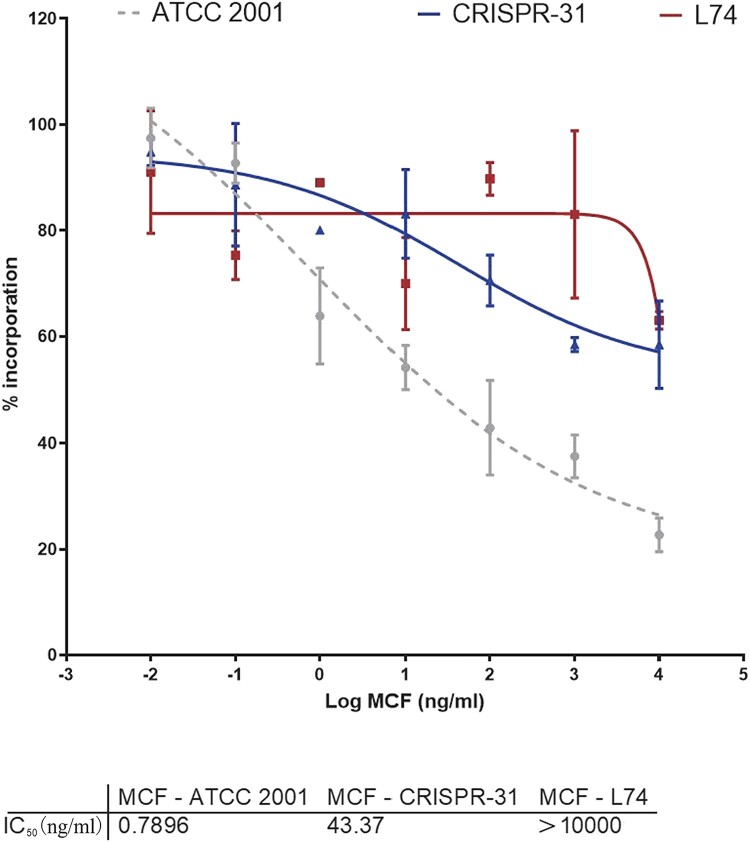
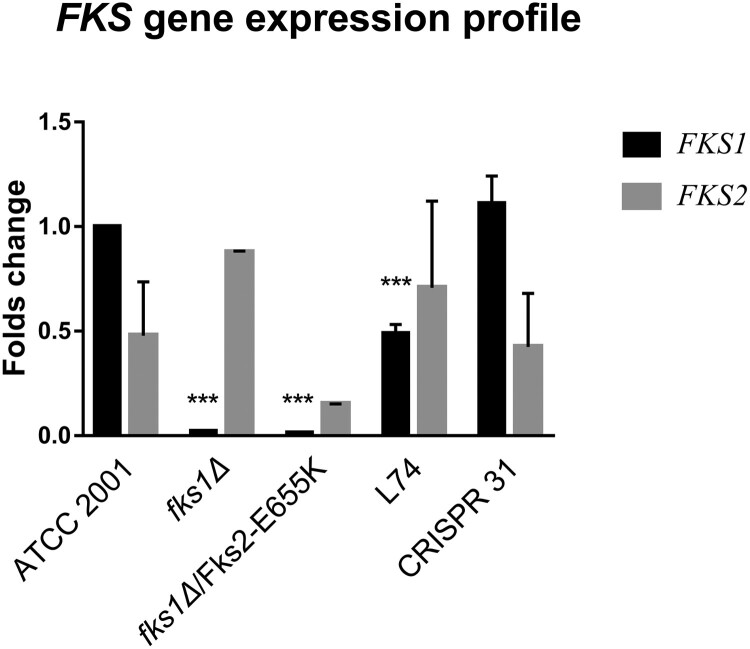
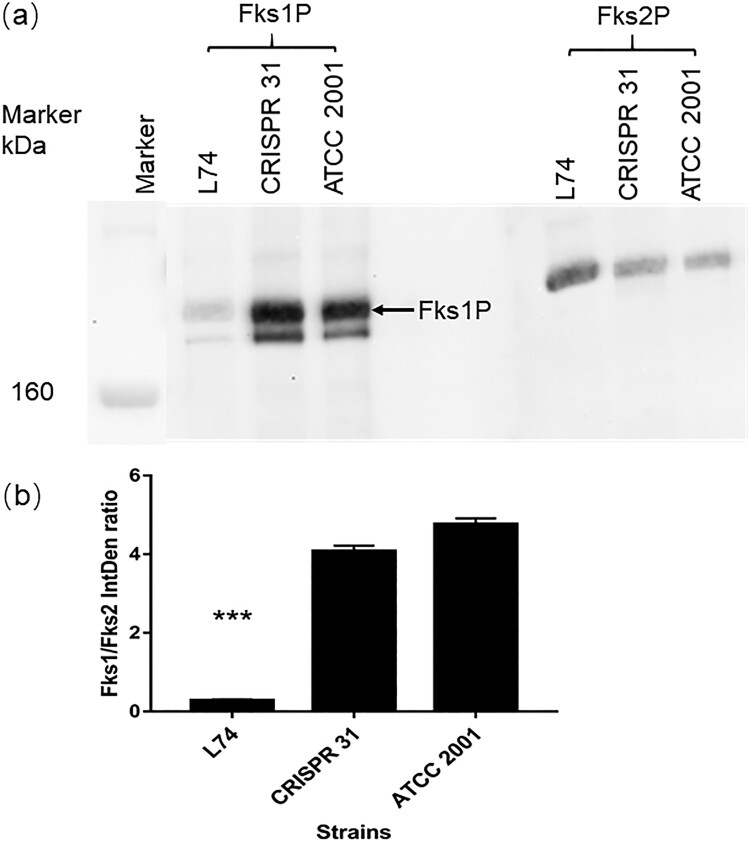
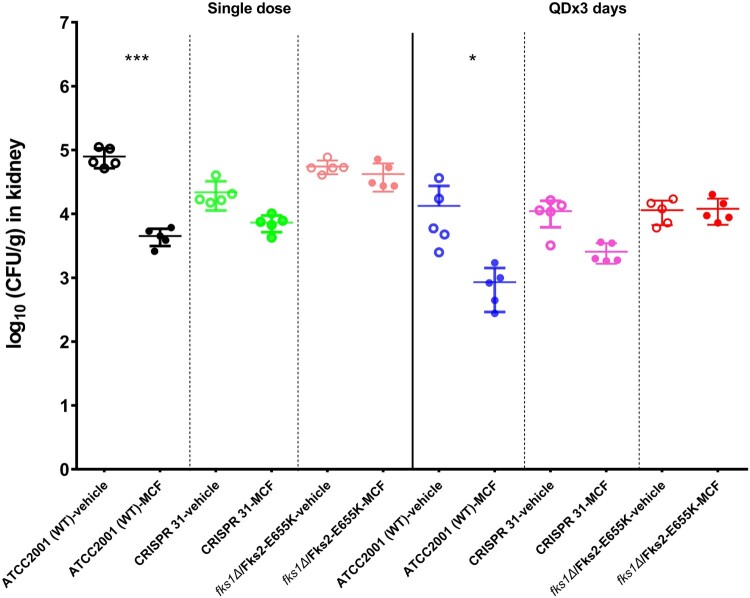
Echinocandin resistance in Candida glabrata poses a serious clinical challenge. The underlying resistance mechanism of a pan-echinocandin-resistant C. glabrata isolate (strain L74) was investigated in this study. FKS mutants carrying specific mutations found in L74 were reconstructed by the Alt-R CRISPR-Cas9 system (Fks1 WT/Fks2-E655K, strain CRISPR 31) and site-directed mutagenesis (strain fks1Δ/Fks2-E655K). Sequence analysis of strain L74 revealed a premature stop codon W508stop in FKS1 and an E655K mutation preceding the hotspot 1 region in FKS2. Introduction of the Fks2-E655K mutation in ATCC 2001 (strain CRISPR 31) conferred a modest reduction in susceptibility. However, the same FKS2 mutation in the fks1Δ background (strain fks1Δ/Fks2-E655K) resulted in high levels of resistance to echinocandins. Glucan synthase isolated from L74 was dramatically less sensitive to micafungin (MCF) relative to ATCC 2001. Both FKS1/FKS2 transcript ratios and Fks1/Fks2 protein ratios were significantly lower in L74 and fks1Δ/Fks2-E655K compared to ATCC 2001 and CRISPR 31 (P <0.05). Mice challenged with CRISPR 31 and fks1Δ/Fks2-E655K mutants failed to respond to MCF. In conclusion, the high-level of echinocandin resistance in the clinical isolate of C. glabrata L74 was concluded to result from the combination of null function of Fks1 and the point mutation E655K in Fks2.
Overview
The claims and statistics of this paper haven’t been checked yet.
Free: it reads the open-access text and checks the first 5 claims that cite a source we can check. Create a free account to check every claim.
Integrity signals
Registry
Cites
Statistics
Figures
Verification
Claims the paper makes
The claims and statistics of this paper haven’t been checked yet.
Free: it reads the open-access text and checks the first 5 claims that cite a source we can check. Create a free account to check every claim.
Claims other papers make about this one
Each is checked against this paper’s own text: does it say what the citing paper says it does?
The cited source says what the claim attributes to it.
In the citing paper
“This finding suggests a potential compensatory mechanism, given the functional redundancy between FKS1 and FKS242–44.”
From Targeting epigenetic regulators to overcome drug resistance in the emerging human fungal pathogen Candida auris (2025) · cites this paper as [43]
Self-check
Percentages, sums and reported differences re-computed from the paper’s own numbers.
The self-check needs the paper’s full text.
Citations
Cites
Analysis of Relative Gene Expression Data Using Real-Time Quantitative PCR and the 2−ΔΔCT Method
Livak, K. J., & Schmittgen, T. D. (2001) · Methods · doi:10.1006/meth.2001.1262 · Cited by 180,860
Pappas, P. G., Kauffman, C. A., Andes, D. R., Clancy, C. J., Marr, K. A., Ostrosky-Zeichner, L., Reboli, A. C., Schuster, M. G., Vazquez, J. A., Walsh, T. J., et al. (2016) · Clinical Infectious Diseases · doi:10.1093/cid/civ933 · Cited by 4,200
Epidemiology of Invasive Candidiasis: a Persistent Public Health Problem
Pfaller, M. A., & Diekema, D. J. (2007) · Clinical Microbiology Reviews · doi:10.1128/cmr.00029-06 · Cited by 4,174 · cited 1×
“Candida species, non-albicans Candida have an increasing role, particularly in high-risk populations, with Candida glabrata being one of the most prominent species [1,3,4].”
BackgroundHow to calculate sample size in animal studies?
Charan, J., & Kantharia, N. D. (2013) · Journal of Pharmacology and Pharmacotherapeutics · doi:10.4103/0976-500x.119726 · Cited by 1,881 · cited 1×
“adequate on the basis of the resource equation method [20].”
MethodPappas, P. G., Lionakis, M. S., Arendrup, M. C., Ostrosky-Zeichner, L., & Kullberg, B. J. (2018) · Nature Reviews Disease Primers · doi:10.1038/nrdp.2018.26 · Cited by 1,636
Kullberg, B. J., & Arendrup, M. C. (2015) · New England Journal of Medicine · doi:10.1056/nejmra1315399 · Cited by 1,315 · cited 1×
“Candida species, non-albicans Candida have an increasing role, particularly in high-risk populations, with Candida glabrata being one of the most prominent species [1,3,4].”
BackgroundPappas, P. G., Kauffman, C. A., Andes, D. R., Clancy, C. J., Marr, K. A., Ostrosky-Zeichner, L., Reboli, A. C., Schuster, M. G., Vazquez, J. A., Walsh, T. J., et al. (2016) · Clinical Infectious Diseases · doi:10.1093/cid/civ1194 · Cited by 1,298
The global problem of antifungal resistance: prevalence, mechanisms, and management
Perlin, D. S., Rautemaa-Richardson, R., & Alastruey-Izquierdo, A. (2017) · The Lancet Infectious Diseases · doi:10.1016/s1473-3099(17)30316-x · Cited by 1,055
Self-citationAlexander, B. D., Johnson, M. D., Pfeiffer, C. D., Jiménez-Ortigosa, C., Catania, J., Booker, R., Castanheira, M., Messer, S. A., Perlin, D. S., & Pfaller, M. A. (2013) · Clinical Infectious Diseases · doi:10.1093/cid/cit136 · Cited by 778 · cited 2×
“glabrata has increased and posed a serious clinical challenge [6,7].”
BackgroundSelf-citationGlobal trends in the distribution of Candida species causing candidemia
Guinea, J. (2014) · Clinical Microbiology and Infection · doi:10.1111/1469-0691.12539 · Cited by 680 · cited 2×
“northern and eastern areas of Europe [8,21].”
Park, S., Kelly, R., Kahn, J. N., Robles, J., Hsu, M.-J., Register, E., Li, W., Vyas, V., Fan, H., Abruzzo, G., et al. (2005) · Antimicrobial Agents and Chemotherapy · doi:10.1128/aac.49.8.3264-3273.2005 · Cited by 434 · cited 2×
“purification by-product entrapment were performed, as described previously [16].”
BackgroundMethodSelf-citationMechanisms of echinocandin antifungal drug resistance
Perlin, D. S. (2015) · Annals of the New York Academy of Sciences · doi:10.1111/nyas.12831 · Cited by 313 · cited 2×
“glabrata [10], no FKS mutation within the proposed”
BackgroundSelf-citationPham, C. D., Iqbal, N., Bolden, C. B., Kuykendall, R. J., Harrison, L. H., Farley, M. M., Schaffner, W., Beldavs, Z. G., Chiller, T. M., Park, B. J., et al. (2014) · Antimicrobial Agents and Chemotherapy · doi:10.1128/aac.03255-14 · Cited by 231 · cited 1×
“glabrata has increased and posed a serious clinical challenge [6,7].”
BackgroundKitada, K., Yamaguchi, E., & Arisawa, M. (1995) · Gene · doi:10.1016/0378-1119(95)00552-h · Cited by 166 · cited 2×
“glabrata strain ATCC 2001 and ATCC 200989 (2001 HTU) [11] were obtained from the American Type Culture Collection (Manassas, VA).”
MethodDrug-Resistant Candida glabrata Infection in Cancer Patients
Farmakiotis, D., Tarrand, J. J., & Kontoyiannis, D. P. (2014) · Emerging Infectious Diseases · doi:10.3201/eid2011.140685 · Cited by 152
Katiyar, S. K., Alastruey-Izquierdo, A., Healey, K. R., Johnson, M. E., Perlin, D. S., & Edlind, T. D. (2012) · Antimicrobial Agents and Chemotherapy · doi:10.1128/aac.00813-12 · Cited by 148 · cited 7×
“previous study, which demonstrated that the Fks1Fks2 redundancy attenuates the impact of resistanceconferring HS mutations [12].”
BackgroundMethodSelf-citationUse of RNA-Protein Complexes for Genome Editing in Non- albicans Candida Species
Grahl, N., Demers, E. G., Crocker, A. W., & Hogan, D. A. (2017) · mSphere · doi:10.1128/msphere.00218-17 · Cited by 133
Li, Q., Skinner, J., & Bennett, J. E. (2012) · BMC Molecular Biology · doi:10.1186/1471-2199-13-22 · Cited by 85 · cited 1×
“gene was used as reference gene to normalize the data [17].”
MethodAzole Resistance in Candida glabrata
Whaley, S. G., & Rogers, P. D. (2016) · Current Infectious Disease Reports · doi:10.1007/s11908-016-0554-5 · Cited by 85 · cited 1×
“glabrata is of particular concern due to its high rate of azole resistance [5].”
BackgroundBizerra, F. C., Jimenez-Ortigosa, C., Souza, A. C. R., Breda, G. L., Queiroz-Telles, F., Perlin, D. S., & Colombo, A. L. (2014) · Antimicrobial Agents and Chemotherapy · doi:10.1128/aac.02189-13 · Cited by 63 · cited 1×
“Previous exposure to echinocandins has been clearly recognized as a risk factor for the development of resistance [24].”
BackgroundSelf-citationHou, X., Xiao, M., Chen, S. C.-A., Kong, F., Wang, H., Chu, Y.-Z., Kang, M., Sun, Z.-Y., Hu, Z.-D., Li, R.-Y., et al. (2017) · Frontiers in Microbiology · doi:10.3389/fmicb.2017.00880 · Cited by 53 · cited 4×
“northern and eastern areas of Europe [8,21].”
BackgroundSelf-citationShingu, Y., Tokai, T., Agawa, Y., Toyota, K., Ahmed, S., Kawagishi-Kobayashi, M., Komatsu, A., Mikawa, T., Yamamoto, M., Wakasa, K., et al. (2012) · BMC Molecular Biology · doi:10.1186/1471-2199-13-1 · Cited by 38
Magill, S. S., Swoboda, S. M., Shields, C. E., Colantuoni, E. A., Fothergill, A. W., Merz, W. G., Lipsett, P. A., & Hendrix, C. W. (2009) · Annals of Surgery · doi:10.1097/sla.0b013e31819ed914 · Cited by 38 · cited 1×
“The infection was thought to be acquired after the patient’s abdominal operation, supporting the notion that the gastrointestinal tract is a prominent reservoir for Candida colonization [25] and”
BackgroundCheng, S., Clancy, C. J., Hartman, D. J., Hao, B., & Nguyen, M. H. (2014) · Infection and Immunity · doi:10.1128/iai.00062-14 · Cited by 38 · cited 1×
“that IAC is an important source of resistant infections [26].”
BackgroundUse of an Animal Model of Disseminated Candidiasis in the Evaluation of Antifungal Therapy
Andes, D. (2005) · Antifungal Agents · doi:10.1385/1-59259-943-5:111 · Cited by 28 · cited 1×
“A well-established neutropenic mouse model of disseminated candidiasis was used for this study [19].”
MethodPerez, M., Ladero, V., del Rio, B., Redruello, B., de Jong, A., Kuipers, O., Kok, J., Martin, M. C., Fernandez, M., & Alvarez, M. A. (2017) · Frontiers in Microbiology · doi:10.3389/fmicb.2017.02107 · Cited by 23
Xiao, M., Fan, X., Hou, X., Chen, S., Wang, H., Kong, F., Sun, Z.-Y., Chu, Y.-Z., & Xu, Y.-C. (2018) · Infection and Drug Resistance · doi:10.2147/idr.s152785 · Cited by 22 · cited 5×
“glabrata obtained from an intra-abdominal candidiasis (IAC) patient [9].”
BackgroundSelf-citationNiimi, K., Woods, M. A., Maki, K., Nakayama, H., Hatakenaka, K., Chibana, H., Ikeda, F., Ueno, K., Niimi, M., Cannon, R. D., et al. (2012) · Journal of Antimicrobial Chemotherapy · doi:10.1093/jac/dks112 · Cited by 18 · cited 1×
“tibility, but the combination of both severely reduced susceptibility [23].”
BackgroundGenetic Transformation of Candida glabrata by Electroporation
Istel, F., Schwarzm�ller, T., Tscherner, M., & Kuchler, K. (2015) · BIO-PROTOCOL · doi:10.21769/bioprotoc.1528 · Cited by 14
Cited by
Drug-Resistant Fungi: An Emerging Challenge Threatening Our Limited Antifungal Armamentarium
Arastehfar, A., Gabaldón, T., Garcia-Rubio, R., Jenks, J. D., Hoenigl, M., Salzer, H. J. F., Ilkit, M., Lass-Flörl, C., & Perlin, D. S. (2020) · Antibiotics · doi:10.3390/antibiotics9120877 · Cited by 292
“It is noteworthy that in some cases, mutations just outside of the HS regions can cause echinocandin resistance [160] and also occasionally, echinocandin-susceptible isolates harbor a weak mutation in HS regions that results in therapeutic failure [27].”
BackgroundSelf-citationEchinocandins – structure, mechanism of action and use in antifungal therapy
Szymański, M., Chmielewska, S., Czyżewska, U., Malinowska, M., & Tylicki, A. (2022) · Journal of Enzyme Inhibition and Medicinal Chemistry · doi:10.1080/14756366.2022.2050224 · Cited by 270
Hoenigl, M., Arastehfar, A. A., Arendrup, M. C., Brüggemann, R. J. M., Carvalho, A., Chiller, T. M., Chen, W., Egger, M., Feys, S., Gangneux, J., et al. (2024) · Clinical Microbiology Reviews · doi:10.1128/cmr.00074-23 · Cited by 187
The Quiet and Underappreciated Rise of Drug-Resistant Invasive Fungal Pathogens
Arastehfar, A., Lass-Flörl, C., Garcia-Rubio, R., Daneshnia, F., Ilkit, M., Boekhout, T., Gabaldon, T., & Perlin, D. S. (2020) · Journal of Fungi · doi:10.3390/jof6030138 · Cited by 145
“Of note, mutations occurring outside of these HS regions can also lead to echinocandin therapeutic failure [54].”
BackgroundInfluentialSelf-citationPosteraro, B., Torelli, R., Vella, A., Leone, P. M., Angelis, G. D., Carolis, E. D., Ventura, G., Sanguinetti, M., & Fantoni, M. (2020) · Journal of Fungi · doi:10.3390/jof6030163 · Cited by 108
“This combination strategy would allow for encompassing cases of mutations occurring outside of HS FKS regions in echinocandin-resistant isolates [54], or cases of echinocandin-susceptible isolates carrying mutations in HS FKS regions in which the patients infected with such isolates show therapeutic failure following…”
Background
Metadata
- Authors
- Hou, X., Healey, K. R., Shor, E., Kordalewska, M., Ortigosa, C. J., Paderu, P., Xiao, M., Wang, H., Zhao, Y., Lin, L.-Y., Zhang, Y.-H., Li, Y.-Z., Xu, Y.-C., Perlin, D. S., & Zhao, Y.
- Affiliations
- Chinese Academy of Medical Sciences & Peking Union Medical College (CN)
- William Paterson University (US)
- Hackensack Meridian Health (US)
- Center for Discovery and Innovation, Hackensack Meridian Health
- Seton Hall University (US)
- Peking University (CN)
- Central Laboratory, Hebei Yanda Hospital
- Department of Clinical Laboratory, Peking Union Medical College Hospital, Chinese Academy of Medical Sciences
- Corresponding author
- Zhao, Yanan
- ORCID
- Venue
- Emerging Microbes & Infections
- Publisher
- Informa UK Limited
- Published
- 2019-01
- Volume
- 8
- Issue
- 1
- Pages
- 1619-1625
- ISSN
- 2222-1751 (ISSN-L)
- PMC
- PMC6853239
- OpenAlex
- W2986127095
- Cited by
- 43
- References
- 29
- Citations by year
- 2026: 1 · 2025: 11 · 2024: 3 · 2023: 6 · 2022: 11 · 2021: 4 · 2020: 6 · 2019: 1
- FWCI
- 4.21
- Type
- journal article
- Language
- en
- Open access
- gold
- doi.org
- Locations
- Emerging Microbes & Infections (publishedVersion, cc-by)
- Europe PMC (PubMed Central) (publishedVersion, cc-by)
- PubMed Central (publishedVersion, cc-by)
- PubMed (publishedVersion)
- DOAJ (DOAJ: Directory of Open Access Journals) (submittedVersion)
- Funders
- National Nature Science Foundation of China (81971979)
- National Major Science and Technology Project for the Control and Prevention of Major Infectious Diseases of China (2017ZX10103004, 2018ZX10712001)
- Hebei Science and Technology Project (17277775D)
- NIH (AI109025)
- U.S. National Institutes of Health
- Topics
- Health Sciences › Medicine › Infectious Diseases › Antifungal resistance and susceptibility
- Life Sciences › Biochemistry, Genetics and Molecular Biology › Molecular Biology › Fungal and yeast genetics research
- Life Sciences › Agricultural and Biological Sciences › Plant Science › Fungal Plant Pathogen Control
- Keywords
- Candida glabrata, echinocandin resistance, FKS1, FKS2, glucan synthase, micafungin, resistance mechanisms, antifungal susceptibility, clinical isolates
- MeSH terms
- Animals, Antifungal Agents, Candidiasis, Female, Fungal Proteins, Glucosyltransferases, Humans, Mice, Inbred BALB C, Microbial Sensitivity Tests, Drug Resistance, Fungal, Candida glabrata, Mice, Echinocandins
About these checks
Registry, retraction, Cites and statistics results are computed, not judged, with one exception: a printed reference that no index lists is read once by a model before it counts as a citation error. Claims are extracted by a model and kept only when their quote appears verbatim in the text; each cited source is then checked, with a model’s help, for whether it says what the claim relies on. Those verdicts can be wrong — read the claim’s quote and the cited source before relying on one.
Statistics and arithmetic are recomputed, not judged.
Confidence bands are shown only for fields calibrated on our annotated test set. None is calibrated yet, so no band is shown.
What counts as a claim ›How we measure confidence ›How we check this ›
Are you an author, or do you see a problem with this page? Request a review
Data sources
Bibliographic data: Semantic Scholar, OpenAlex, Crossref.
Contains information from the Semantic Scholar Academic Graph Datasets, made available under the ODC Attribution License (ODC-BY 1.0).
Semantic Scholar’s data is described in: Kinney, R., et al. (2023). The Semantic Scholar Open Data Platform. arXiv:2301.10140.
