

Induction of amphotericin B resistance in susceptible Candida auris by extracellular vesicles
Open accessThe DOI matches its Crossref record; 36 of the 36 references it cites were found in a registry or an index.
Abstract
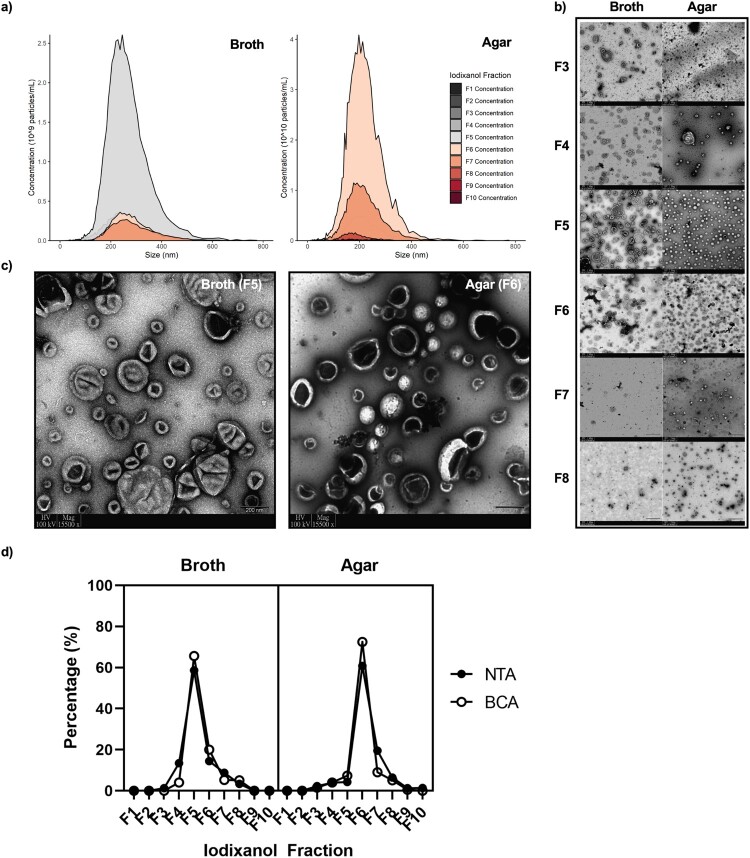
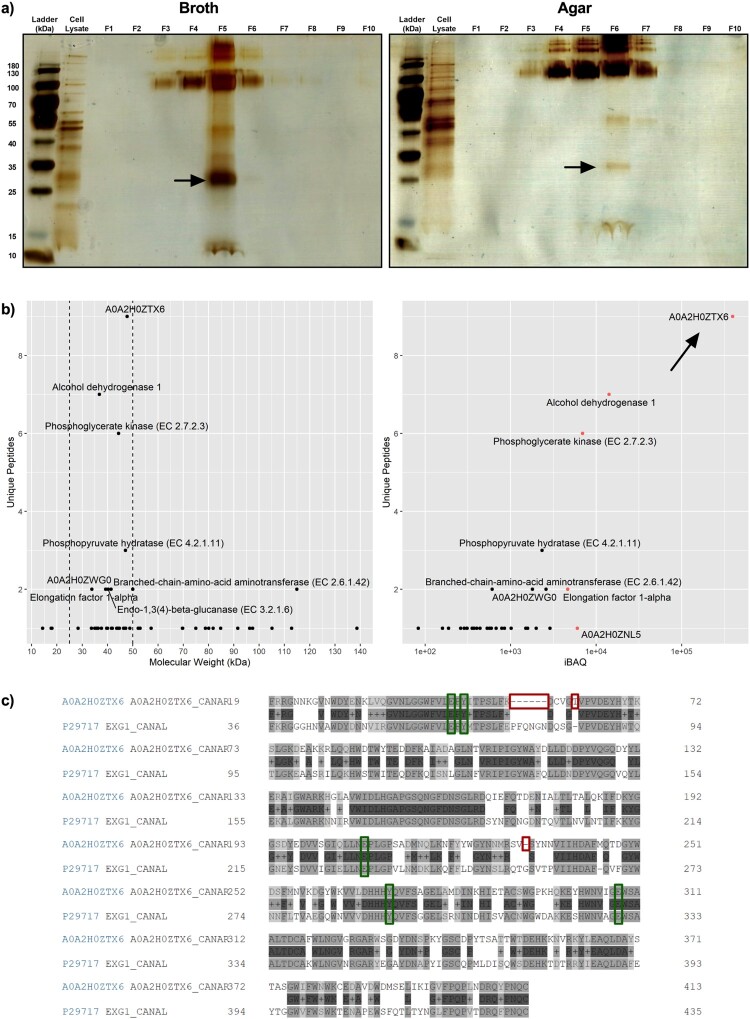
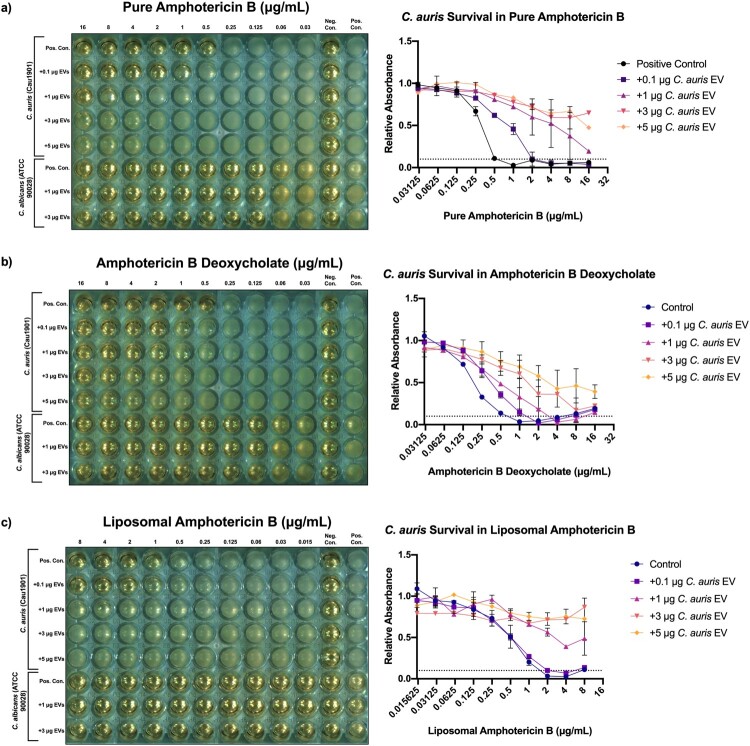
Drug resistance derived from extracellular vesicles (EVs) is an increasingly important research area but has seldom been described regarding fungal pathogens. Here, we characterized EVs derived from a triazole-resistant but amphotericin B-susceptible strain of Candida auris. Nano- to microgram concentrations of C. auris EVs prepared from both broth and solid agar cultures could robustly increase the yeast’s survival against both pure and clinical amphotericin B formulations in a dose-dependent manner, resulting in up to 16-fold changes of minimum inhibitory concentration. Meanwhile, this effect was not observed upon addition of these EVs to C. albicans, nor upon addition of C. albicans EVs to C. auris. No change in susceptibilities was observed upon EV treatment for fluconazole, voriconazole, micafungin, and flucytosine. Mass spectrometry indicated the presence of immunogenic-/drug resistance-implicated proteins in C. auris EVs, including alcohol dehydrogenase 1 as well as C. albicans Mp65-like and Xog1-like proteins in high quantities. Based on these observations, we propose a potential species-specific role for EVs in amphotericin B resistance in C. auris. These observations may provide critical insights into treatment of multidrug-resistant C. auris.
Overview
The claims and statistics of this paper haven’t been checked yet.
Free: it reads the open-access text and checks the first 5 claims that cite a source we can check. Create a free account to check every claim.
Integrity signals
Registry
Cites
Statistics
Figures
Verification
Claims the paper makes
The claims and statistics of this paper haven’t been checked yet.
Free: it reads the open-access text and checks the first 5 claims that cite a source we can check. Create a free account to check every claim.
Claims other papers make about this one
Each is checked against this paper’s own text: does it say what the citing paper says it does?
The source backs part of the claim, not all of it — or backs it for a different population, condition or comparison.
In the citing paper
“Furthermore, C. auris can rapidly acquire resistance under the selective pressure of antifungal treatments or other specific conditions16–19.”
From Targeting epigenetic regulators to overcome drug resistance in the emerging human fungal pathogen Candida auris (2025) · cites this paper as [17]
Experimental — accuracy not yet measured
Self-check
Percentages, sums and reported differences re-computed from the paper’s own numbers.
The self-check needs the paper’s full text.
Citations
Cites
Isolation and Characterization of Exosomes from Cell Culture Supernatants and Biological Fluids
Théry, C., Amigorena, S., Raposo, G., & Clayton, A. (2006) · Current Protocols in Cell Biology · doi:10.1002/0471143030.cb0322s30 · Cited by 5,766 · cited 1×
“Here, the classically described concavecupped EVs [27] were successfully isolated from broth and agar cultures of C.”
BackgroundSatoh, K., Makimura, K., Hasumi, Y., Nishiyama, Y., Uchida, K., & Yamaguchi, H. (2009) · Microbiology and Immunology · doi:10.1111/j.1348-0421.2008.00083.x · Cited by 1,381 · cited 2×
“ered and described in 2009 from the external ear canal discharge of a patient in Japan [2].”
BackgroundEfficient RNA drug delivery using red blood cell extracellular vesicles
Usman, W. M., Pham, T. C., Kwok, Y. Y., Vu, L. T., Ma, V., Peng, B., Chan, Y. S., Wei, L., Chin, S. M., Azad, A., et al. (2018) · Nature Communications · doi:10.1038/s41467-018-04791-8 · Cited by 663 · cited 1×
“blood cell EVs were isolated according to Usman and colleagues’ protocol [21].”
MethodContribution of bacterial outer membrane vesicles to innate bacterial defense
Manning, A. J., & Kuehn, M. J. (2011) · BMC Microbiology · doi:10.1186/1471-2180-11-258 · Cited by 622 · cited 1×
“[17,18], and act as bacteriophage decoys [17].”
Muñoz, J. F., Gade, L., Chow, N. A., Loparev, V. N., Juieng, P., Berkow, E. L., Farrer, R. A., Litvintseva, A. P., & Cuomo, C. A. (2018) · Nature Communications · doi:10.1038/s41467-018-07779-6 · Cited by 458
Arendrup, M. C., Cuenca-Estrella, M., Lass-Flörl, C., & Hope, W. (2012) · Clinical Microbiology and Infection · doi:10.1111/j.1469-0691.2012.03880.x · Cited by 451
An Endothelial-to-Adipocyte Extracellular Vesicle Axis Governed by Metabolic State
Crewe, C., Joffin, N., Rutkowski, J. M., Kim, M., Zhang, F., Towler, D. A., Gordillo, R., & Scherer, P. E. (2018) · Cell · doi:10.1016/j.cell.2018.09.005 · Cited by 408
Rumbo, C., Fernández-Moreira, E., Merino, M., Poza, M., Mendez, J. A., Soares, N. C., Mosquera, A., Chaves, F., & Bou, G. (2011) · Antimicrobial Agents and Chemotherapy · doi:10.1128/aac.00929-10 · Cited by 351 · cited 1×
“outer membrane vesicles (OMVs) can horizontally transfer carbapenemases and their corresponding genes [15,16], sequester antimicrobial peptides”
BackgroundCell-to-cell Communication by Extracellular Vesicles: Focus on Microglia
Paolicelli, R. C., Bergamini, G., & Rajendran, L. (2019) · Neuroscience · doi:10.1016/j.neuroscience.2018.04.003 · Cited by 338
Extracellular vesicles and anti-cancer drug resistance
Namee, N. M., & O'Driscoll, L. (2018) · Biochimica et Biophysica Acta (BBA) - Reviews on Cancer · doi:10.1016/j.bbcan.2018.07.003 · Cited by 274 · cited 1×
“In mammalian and bacterial cells, EVs have been implicated in cell–cell communication [8–11], immunomodulation [12], and drug resistance [13,14].”
Background
Cited by
Wen, M., Wang, J., Ou, Z., Nie, G., Chen, Y., Li, M., Wu, Z., Xiong, S., Zhou, H., Yang, Z., et al. (2023) · Interdisciplinary medicine · doi:10.1002/inmd.20230017 · Cited by 77
Microbial extracellular vesicles contribute to antimicrobial resistance
Jiang, B., Lai, Y., Xiao, W., Zhong, T., Liu, F., Gong, J., & Huang, J. (2024) · PLoS Pathogens · doi:10.1371/journal.ppat.1012143 · Cited by 76
Mechanisms of pathogenicity for the emerging fungus Candida auris
Horton, M. V., Holt, A. M., & Nett, J. E. (2023) · PLOS Pathogens · doi:10.1371/journal.ppat.1011843 · Cited by 67
Microbe-induced gene silencing boosts crop protection against soil-borne fungal pathogens
Wen, H.-G., Zhao, J., Zhang, B., Gao, F., Wu, X., Yan, Y., Zhang, J., & Guo, H. (2023) · Nature Plants · doi:10.1038/s41477-023-01507-9 · Cited by 65
The emerging role of extracellular vesicles in fungi: a double-edged sword
Lai, Y., Jiang, B., Hou, F., Huang, X.-H., Ling, B., Lü, H., Zhong, T., & Huang, J. (2023) · Frontiers in Microbiology · doi:10.3389/fmicb.2023.1216895 · Cited by 43
“Application of the first-line antifungal agent caspofungin could increase the production levels of EVs, and also alter the types and amounts of their RNA and protein contents, which induced resistance in Candida auris (Chan et al., 2022).”
BackgroundImmunomodulatory Potential of Fungal Extracellular Vesicles: Insights for Therapeutic Applications
Nenciarini, S., & Cavalieri, D. (2023) · Biomolecules · doi:10.3390/biom13101487 · Cited by 37
Rizzo, J., Trottier, A., Moyrand, F., Coppée, J., Maufrais, C., Zimbres, A. C. G., Dang, T. T. V., Alanio, A., Desnos‐Ollivier, M., Mouyna, I., et al. (2023) · mBio · doi:10.1128/mbio.00870-23 · Cited by 36
Zhang, Y., Zeng, L., Huang, X., Wang, Y., Chen, G., Moses, M., Zou, Y., Xiong, S., Xue, W., Dong, Y., et al. (2025) · Nature Communications · doi:10.1038/s41467-025-59898-6 · Cited by 33
Melanization of Candida auris Is Associated with Alteration of Extracellular pH
Smith, D. F. Q., Mudrak, N. J., Zamith‐Miranda, D., Honorato, L., Nimrichter, L., Chrissian, C., Smith, B., Gerfen, G. J., Stark, R. E., Nosanchuk, J. D., et al. (2022) · Journal of Fungi · doi:10.3390/jof8101068 · Cited by 30
“auris 482 resistance to amphotericin B, adhesion to epithelial cells, and survival within macrophages (58,59).”
BackgroundFungal extracellular vesicle-mediated regulation: from virulence factor to clinical application
Liu, J., & Hu, X. (2023) · Frontiers in Microbiology · doi:10.3389/fmicb.2023.1205477 · Cited by 31
“EVs purified from Candida auris improved antifungal resistance to amphotericin B formulations (Chan et al., 2022).”
BackgroundBrandt, P., Singha, R., & Ene, I. V. (2024) · mBio · doi:10.1128/mbio.03045-23 · Cited by 20
The multiple frontiers in the study of extracellular vesicles produced by fungi
Rodrigues, M. L., May, R. C., & Janbon, G. (2023) · Microbes and Infection · doi:10.1016/j.micinf.2023.105233 · Cited by 17
Candida auris skin tropism and antifungal resistance are mediated by carbonic anhydrase Nce103
Phan-Canh, T., Coman, C., Lackner, M., Troppmair, N., Müller, C., Cerbu, D., Seiser, S., Penninger, P., Tsymala, I., Khunweeraphong, N., et al. (2025) · Nature Microbiology · doi:10.1038/s41564-025-02189-z · Cited by 16
Antifungal efficacy of natural antiseptic products against Candida auris
Wu, W.-G., Luk, K. S., Hung, M.-F., Tsang, W.-Y., Lee, K.-P., Lam, B. H.-S., Cheng, K.-L., Cheung, W.-S., Tang, H.-L., & To, W. (2024) · Medical Mycology · doi:10.1093/mmy/myae060 · Cited by 15
Self-citationEthosomal Nanoformulations for Combinational Photothermal Therapy of Fungal Keratitis
Mudigunda, S. V., Sankaranarayanan, S. A., Bantal, V., Pemmaraju, D. B., & Rengan, A. K. (2023) · Advanced Therapeutics · doi:10.1002/adtp.202200331 · Cited by 14
Huang, P., Li, W., Guan, J., Jia, Y., Wang, D., Chen, Y., Xiao, N., Ou, S., Wang, Y., & Yang, B. (2025) · Journal of Functional Biomaterials · doi:10.3390/jfb16010025 · Cited by 13
“Both oral mucosal cell-derived extracellular vesicles and Candida albicans endogenous extracellular vesicles have been shown to influence the growth and development of drug resistance in oral candidiasis [119,120].”
Unveiling the fungal frontier: mycological insights into inflammatory bowel disease
Chen, S., Yi, M., Yi, X., Zhou, Y., Song, H., & Zeng, M. (2025) · Frontiers in Immunology · doi:10.3389/fimmu.2025.1551289 · Cited by 11
Fungal extracellular vesicles mediate conserved cross-species communication and immunomodulation
Piraine, R. E. A., Froldi, J. L., Oliveira, H., dos Santos, P. W. D. S., Oliveira, B. T. M., Rezende, C. P., Tavares, L., Trentin, G., Nogueira, L. F. B., Colombo, A. L., et al. (2026) · mBio · doi:10.1128/mbio.03469-25 · Cited by 11
A novel pH-responsive monomer inhibits Candida albicans via a dual antifungal mode of action
Li, H., Shi, Y., Chen, H., Liang, J., Zhang, S., Li, B., Chen, J., Li, M., Peng, X., Zhou, X., et al. (2024) · Journal of Materials Chemistry B · doi:10.1039/d4tb00851k · Cited by 8
Kulig, K., Rudolphi-Skórska, E., Barbasz, A., Surowiec, M., Wronowska, E., Kowalik, K., Satała, D., Braś, G., Woźnicka, O., Karnas, E., et al. (2025) · Microbiology · doi:10.1099/mic.0.001565 · Cited by 7
“Particular C. auris enzymes found in vesicles, including alcohol dehydrogenase and proteins similar to C. albicans Mp65 and Xog1, have been indicated as involved in the increased resistance of C. auris to the investigated antifungal drug [22].”
The impact of Aureobasidium melanogenum cells and extracellular vesicles on human cell lines
Černoša, A., Gostinčar, C., Holcar, M., Kostanjšek, R., Lenassi, M., & Gunde‐Cimerman, N. (2025) · Scientific Reports · doi:10.1038/s41598-024-84189-3 · Cited by 8
Things you wanted to know about fungal extracellular vesicles (but were afraid to ask)
Reis, F. C. G., & Rodrigues, M. L. (2025) · PLoS neglected tropical diseases · doi:10.1371/journal.pntd.0013038 · Cited by 5
Epidemiologia, biologia, resistência a antifúngicos e virulência do fungo emergente Candida auris
Pereira, C. M., Barros, N. B. D., & Martins, T. S. (2022) · Brazilian Journal of Development · doi:10.34117/bjdv8n11-274 · Cited by 4
Four-Arm δ-Ornithine-Based Polypeptoids Resensitize Voriconazole against Azole-Resistant C. albicans
Cao, Y., Han, M., & Ji, S. (2024) · ACS Infectious Diseases · doi:10.1021/acsinfecdis.3c00548 · Cited by 3
Chau, E. C.-T., Hau, P., Murillo, M., Tsang, C., Tam, E. W. T., Seto, S. W., Lee, C., & Chow, F. W. (2025) · Extracellular Vesicles and Circulating Nucleic Acids · doi:10.20517/evcna.2025.49 · Cited by 2
Self-citationLas-Casas, L. D. O., Mellon, D. A., Bezerra, B. T., de Souza, C. M., Reis, F. C. G., & Rodrigues, M. L. (2026) · Microbiology Spectrum · doi:10.1128/spectrum.03604-25 · Cited by 2
Analysis of Cryptococcus Extracellular Vesicles
Reis, F. C. G., Castelli, R. F., Kuczera, D., de Oliveira, H. C., & Rodrigues, M. L. (2024) · Methods in molecular biology · doi:10.1007/978-1-0716-3722-7_23
Surveillance of pathogenic yeasts in hospital environments in Taiwan in 2020
Tsai, D.-J., Hsieh, L.-Y., Chung, P., Chen, Y.-Z., Jhou, Y.-J., Tseng, K., Yang, C., Yeh, Y.-C., Lin, S.-Y., Lee, S. S., et al. (2024) · Journal of Microbiology Immunology and Infection · doi:10.1016/j.jmii.2024.08.011
CANDIDA AURIS - A NEW THREAT IN NOSOCOMIAL INFECTIONS
Lucaciu-Lupulescu, T. E., Olariu, T., & Fendrihan, S. (2024) · Romanian Archives of Microbiology and Immunology · doi:10.54044/rami.2024.02.04
Imunologia & Doenças Infecciosas e Parasitárias - Ed IX
de Almeida, C. C., Freitas, G. B. L. D., Lopes, J. F. L., Lobato, G. C., Pereira, A. C. M., Silva, D. C. E., & de Oliveira, K. L. (2026) · Editora Pasteur eBooks · doi:10.59290/978-65-6029-315-1
Candida auris: vigilância, prevenção e manejo terapêutico frente à resistência emergente
PIRES, A. C., LIMA, C. B. D., Vicenzi, F. J., & RODRIGUES, R. S. D. A. (2026) · Editora Pasteur eBooks · doi:10.59290/5020619424
Mota, C., Hwang, H., & Kang, H. A. (2026) · The Journal of Microbiology · doi:10.71150/jm.2606008 · Cited by 1
“In contrast, in C. auris , exogenously added EVs increase amphotericin B resistance in a dose-dependent manner without affecting C. albicans , indicating that EVs can actively disseminate resistance rather than simply correlating with it (Chan et al., 2022).”
Deculty, C., Flamant, P., Moyrand, F., Commère, P., Novault, S., Gil, M., Elj, R., Matondo, M., Janbon, G., & Mouyna, I. (2026) · mBio · doi:10.1128/mbio.02302-26
“For example, EVs can induce amphotericin B resistance in Candida auris (54).”
Extracellular vesicles of pathogenic fungi: biogenesis, immune regulation and therapeutic potential
Wu, J., Qu, X., Yang, L., Wang, X., Xu, L., & Zhang, Y. (2026) · Frontiers in Cellular and Infection Microbiology · doi:10.3389/fcimb.2026.1922490
Metadata
- Authors
- Chan, W., Chow, F. W.-N., Tsang, C.-C., Liu, X., Yao, W., Chan, T. T.-Y., Siu, G. K.-H., Ho, A. Y.-M., Luk, K. S., Lau, S. K.-P., & Woo, P. C.-Y.
- Affiliations
- University of Hong Kong (HK)
- Hong Kong Polytechnic University (HK)
- Tung Wah College (HK)
- The Hong Kong Polytechnic University
- Princess Margaret Cancer Centre (CA)
- National Chung Hsing University (TW)
- Corresponding author
- Lau, Susanna Kar-Pui
- Woo, Patrick Chiu-Yat
- ORCID
- Venue
- Emerging Microbes & Infections
- Publisher
- Informa UK Limited
- Published
- 2022-07-27
- Volume
- 11
- Issue
- 1
- Pages
- 1900-1909
- ISSN
- 2222-1751 (ISSN-L)
- PMC
- PMC9341352
- OpenAlex
- W4283802476
- Semantic Scholar
- 455599dedb646318fa4586f2200c52979945dc23
- Cited by
- 31
- References
- 36
- Citations by year
- 2026: 5 · 2025: 8 · 2024: 8 · 2023: 8 · 2022: 2
- FWCI
- 3.17
- Type
- journal article
- Language
- en
- Open access
- gold
- doi.org
- Licence
- Locations
- Emerging Microbes & Infections (publishedVersion, cc-by-nc)
- PubMed Central (publishedVersion, cc-by-nc)
- PubMed (publishedVersion)
- PolyU Institutional Research Archive (Hong Kong Polytechnic University) (submittedVersion, cc-by)
- DOAJ (DOAJ: Directory of Open Access Journals) (submittedVersion, cc-by-sa)
- Funders
- General Research Fund
- Research Grants Council, University Grants Committee
- Ministry of Education
- Topics
- Health Sciences › Medicine › Infectious Diseases › Antifungal resistance and susceptibility
- Life Sciences › Biochemistry, Genetics and Molecular Biology › Molecular Biology › Extracellular vesicles in disease
- Life Sciences › Biochemistry, Genetics and Molecular Biology › Molecular Biology › Fungal and yeast genetics research
- Keywords
- Candida auris, amphotericin B resistance, extracellular vesicles, triazole resistance, antifungal resistance, Candida albicans, minimum inhibitory concentration, ADH1, multidrug resistance
- MeSH terms
- Extracellular Vesicles, Candida auris, Amphotericin B, Antifungal Agents, Candida, Candida albicans, Candidiasis, Humans, Microbial Sensitivity Tests
About these checks
Registry, retraction, Cites and statistics results are computed, not judged, with one exception: a printed reference that no index lists is read once by a model before it counts as a citation error. Claims are extracted by a model and kept only when their quote appears verbatim in the text; each cited source is then checked, with a model’s help, for whether it says what the claim relies on. Those verdicts can be wrong — read the claim’s quote and the cited source before relying on one.
Statistics and arithmetic are recomputed, not judged.
Confidence bands are shown only for fields calibrated on our annotated test set. None is calibrated yet, so no band is shown.
What counts as a claim ›How we measure confidence ›How we check this ›
Are you an author, or do you see a problem with this page? Request a review
Data sources
Bibliographic data: Semantic Scholar, OpenAlex, Crossref.
Contains information from the Semantic Scholar Academic Graph Datasets, made available under the ODC Attribution License (ODC-BY 1.0).
Semantic Scholar’s data is described in: Kinney, R., et al. (2023). The Semantic Scholar Open Data Platform. arXiv:2301.10140.
