

Induction of amphotericin B resistance in susceptible Candida auris by extracellular vesicles
Open accessThe DOI matches its Crossref record; 36 of the 36 references it cites were found in a registry or an index.
Abstract
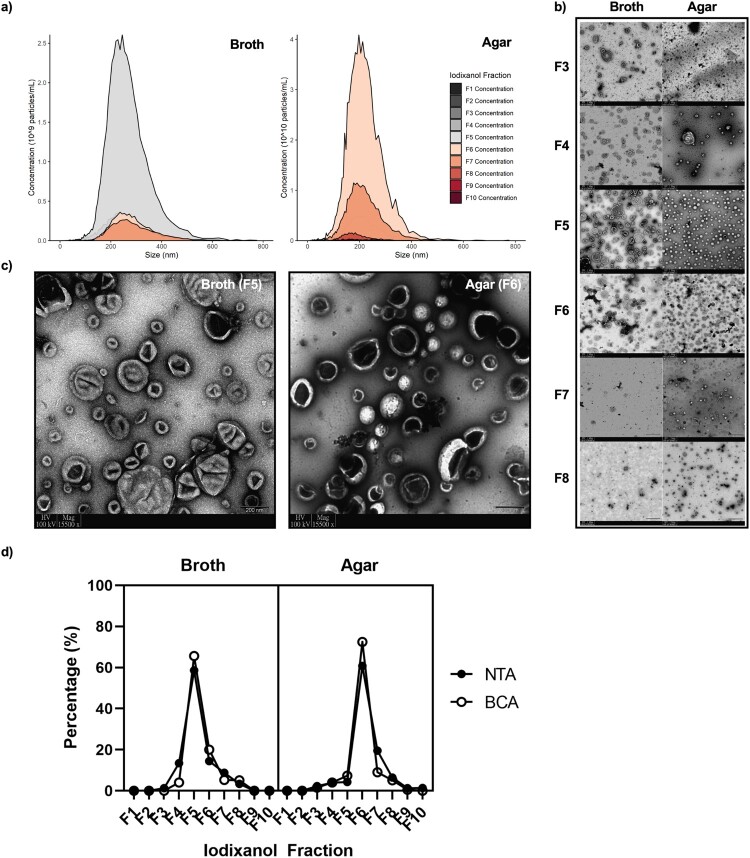
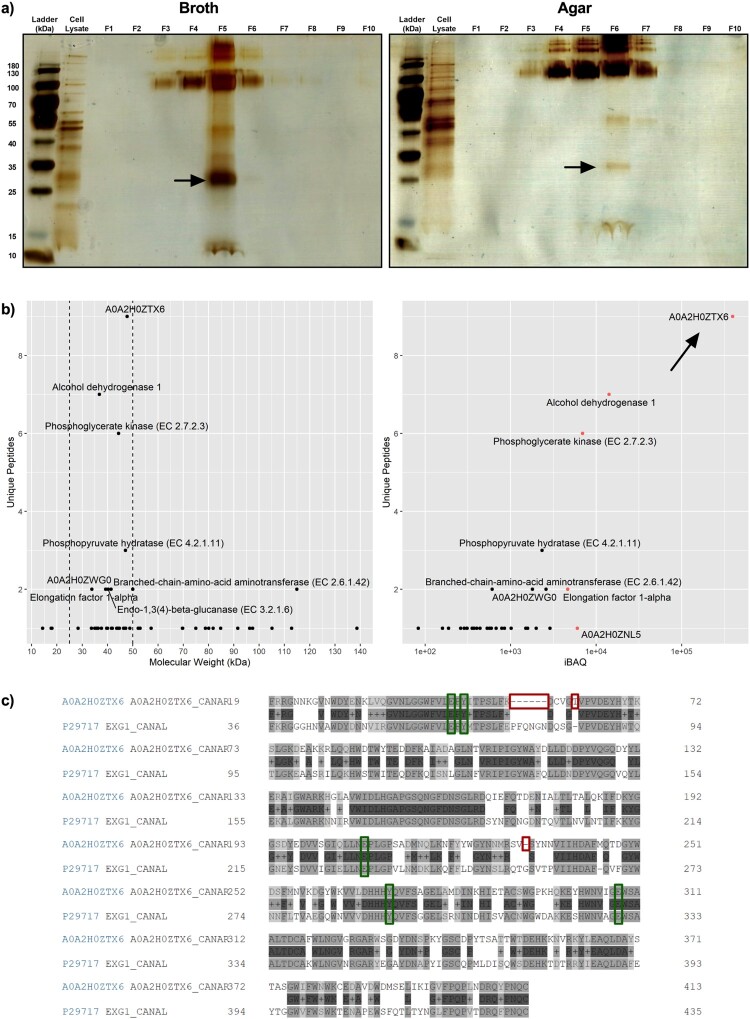
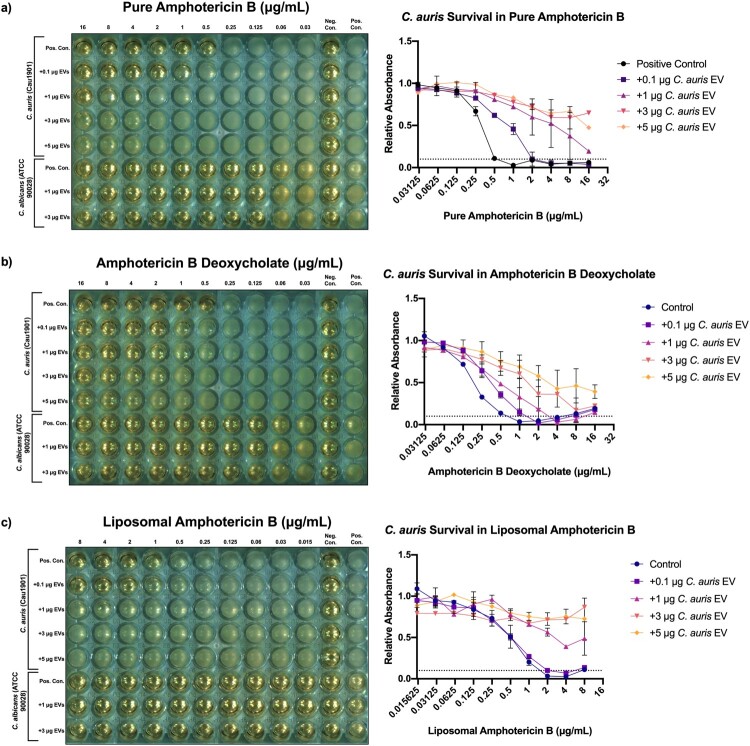
Drug resistance derived from extracellular vesicles (EVs) is an increasingly important research area but has seldom been described regarding fungal pathogens. Here, we characterized EVs derived from a triazole-resistant but amphotericin B-susceptible strain of Candida auris. Nano- to microgram concentrations of C. auris EVs prepared from both broth and solid agar cultures could robustly increase the yeast’s survival against both pure and clinical amphotericin B formulations in a dose-dependent manner, resulting in up to 16-fold changes of minimum inhibitory concentration. Meanwhile, this effect was not observed upon addition of these EVs to C. albicans, nor upon addition of C. albicans EVs to C. auris. No change in susceptibilities was observed upon EV treatment for fluconazole, voriconazole, micafungin, and flucytosine. Mass spectrometry indicated the presence of immunogenic-/drug resistance-implicated proteins in C. auris EVs, including alcohol dehydrogenase 1 as well as C. albicans Mp65-like and Xog1-like proteins in high quantities. Based on these observations, we propose a potential species-specific role for EVs in amphotericin B resistance in C. auris. These observations may provide critical insights into treatment of multidrug-resistant C. auris.
Overview
The claims and statistics of this paper haven’t been checked yet.
Free: it reads the open-access text and checks the first 5 claims that cite a source we can check. Create a free account to check every claim.
Integrity signals
Registry
Cites
Statistics
Figures
Verification
Claims the paper makes
The claims and statistics of this paper haven’t been checked yet.
Free: it reads the open-access text and checks the first 5 claims that cite a source we can check. Create a free account to check every claim.
Claims other papers make about this one
Each is checked against this paper’s own text: does it say what the citing paper says it does?
The source backs part of the claim, not all of it — or backs it for a different population, condition or comparison.
In the citing paper
“Furthermore, C. auris can rapidly acquire resistance under the selective pressure of antifungal treatments or other specific conditions16–19.”
From Targeting epigenetic regulators to overcome drug resistance in the emerging human fungal pathogen Candida auris (2025) · cites this paper as [17]
Experimental — accuracy not yet measured
Self-check
Percentages, sums and reported differences re-computed from the paper’s own numbers.
The self-check needs the paper’s full text.
Citations
Cites
Isolation and Characterization of Exosomes from Cell Culture Supernatants and Biological Fluids
Théry, C., Amigorena, S., Raposo, G., & Clayton, A. (2006) · Current Protocols in Cell Biology · doi:10.1002/0471143030.cb0322s30 · Cited by 5,766 · cited 1×
“Here, the classically described concavecupped EVs [27] were successfully isolated from broth and agar cultures of C.”
BackgroundSatoh, K., Makimura, K., Hasumi, Y., Nishiyama, Y., Uchida, K., & Yamaguchi, H. (2009) · Microbiology and Immunology · doi:10.1111/j.1348-0421.2008.00083.x · Cited by 1,381 · cited 2×
“ered and described in 2009 from the external ear canal discharge of a patient in Japan [2].”
BackgroundEfficient RNA drug delivery using red blood cell extracellular vesicles
Usman, W. M., Pham, T. C., Kwok, Y. Y., Vu, L. T., Ma, V., Peng, B., Chan, Y. S., Wei, L., Chin, S. M., Azad, A., et al. (2018) · Nature Communications · doi:10.1038/s41467-018-04791-8 · Cited by 663 · cited 1×
“blood cell EVs were isolated according to Usman and colleagues’ protocol [21].”
MethodContribution of bacterial outer membrane vesicles to innate bacterial defense
Manning, A. J., & Kuehn, M. J. (2011) · BMC Microbiology · doi:10.1186/1471-2180-11-258 · Cited by 622 · cited 1×
“[17,18], and act as bacteriophage decoys [17].”
Muñoz, J. F., Gade, L., Chow, N. A., Loparev, V. N., Juieng, P., Berkow, E. L., Farrer, R. A., Litvintseva, A. P., & Cuomo, C. A. (2018) · Nature Communications · doi:10.1038/s41467-018-07779-6 · Cited by 458
Arendrup, M. C., Cuenca-Estrella, M., Lass-Flörl, C., & Hope, W. (2012) · Clinical Microbiology and Infection · doi:10.1111/j.1469-0691.2012.03880.x · Cited by 451
An Endothelial-to-Adipocyte Extracellular Vesicle Axis Governed by Metabolic State
Crewe, C., Joffin, N., Rutkowski, J. M., Kim, M., Zhang, F., Towler, D. A., Gordillo, R., & Scherer, P. E. (2018) · Cell · doi:10.1016/j.cell.2018.09.005 · Cited by 408
Rumbo, C., Fernández-Moreira, E., Merino, M., Poza, M., Mendez, J. A., Soares, N. C., Mosquera, A., Chaves, F., & Bou, G. (2011) · Antimicrobial Agents and Chemotherapy · doi:10.1128/aac.00929-10 · Cited by 351 · cited 1×
“outer membrane vesicles (OMVs) can horizontally transfer carbapenemases and their corresponding genes [15,16], sequester antimicrobial peptides”
BackgroundCell-to-cell Communication by Extracellular Vesicles: Focus on Microglia
Paolicelli, R. C., Bergamini, G., & Rajendran, L. (2019) · Neuroscience · doi:10.1016/j.neuroscience.2018.04.003 · Cited by 338
Extracellular vesicles and anti-cancer drug resistance
Namee, N. M., & O'Driscoll, L. (2018) · Biochimica et Biophysica Acta (BBA) - Reviews on Cancer · doi:10.1016/j.bbcan.2018.07.003 · Cited by 274 · cited 1×
“In mammalian and bacterial cells, EVs have been implicated in cell–cell communication [8–11], immunomodulation [12], and drug resistance [13,14].”
BackgroundArendrup, M. C., Prakash, A., Meletiadis, J., Sharma, C., & Chowdhary, A. (2017) · Antimicrobial Agents and Chemotherapy · doi:10.1128/aac.00485-17 · Cited by 270 · cited 1×
“auris [29] or from sensitive to resistant against this drug according to the ten-”
BackgroundCandida albicans biofilm–induced vesicles confer drug resistance through matrix biogenesis
Zarnowski, R., Sanchez, H., Covelli, A. S., Dominguez, E., Jaromin, A., Bernhardt, J., Mitchell, K. F., Heiss, C., Azadi, P., Mitchell, A., et al. (2018) · PLOS Biology · doi:10.1371/journal.pbio.2006872 · Cited by 260 · cited 2×
“plementary membrane material through membrane fusion [19].”
BackgroundAcinetobacter baumannii Secretes Cytotoxic Outer Membrane Protein A via Outer Membrane Vesicles
Jin, J. S., Kwon, S.-O., Moon, D. C., Gurung, M., Lee, J. H., Kim, S. I., & Lee, J. C. (2011) · PLoS ONE · doi:10.1371/journal.pone.0017027 · Cited by 255 · cited 1×
“outer membrane vesicles (OMVs) can horizontally transfer carbapenemases and their corresponding genes [15,16], sequester antimicrobial peptides”
BackgroundReview on Antifungal Resistance Mechanisms in the Emerging Pathogen Candida auris
Chaabane, F., Graf, A., Jequier, L., & Coste, A. T. (2019) · Frontiers in Microbiology · doi:10.3389/fmicb.2019.02788 · Cited by 223
Candida auris: Disinfectants and Implications for Infection Control
Ku, T. S. N., Walraven, C. J., & Lee, S. A. (2018) · Frontiers in Microbiology · doi:10.3389/fmicb.2018.00726 · Cited by 177 · cited 1×
“novel fungal pathogen is also notorious for its persistence in the environment, especially in healthcare facilities due to its resistance to common disinfectants [4].”
BackgroundThe Role of Extracellular Vesicles in the Hallmarks of Cancer and Drug Resistance
Xavier, C. P. R., Caires, H. R., Barbosa, M. A. G., Bergantim, R., Guimarães, J. E., & Vasconcelos, M. H. (2020) · Cells · doi:10.3390/cells9051141 · Cited by 172 · cited 1×
“In mammalian and bacterial cells, EVs have been implicated in cell–cell communication [8–11], immunomodulation [12], and drug resistance [13,14].”
BackgroundChen, J., Tian, S., Han, X., Chu, Y., Wang, Q., Zhou, B., & Shang, H. (2020) · BMC Infectious Diseases · doi:10.1186/s12879-020-05543-0 · Cited by 159
Extracellular Vesicles in Fungi: Past, Present, and Future Perspectives
Rizzo, J., Rodrigues, M. L., & Janbon, G. (2020) · Frontiers in Cellular and Infection Microbiology · doi:10.3389/fcimb.2020.00346 · Cited by 158 · cited 2×
“Yet, the roles of EVs in fungi have not been as welldefined [8].”
BackgroundExtracellular vesicles secreted by Saccharomyces cerevisiae are involved in cell wall remodelling
Zhao, K., Bleackley, M., Chisanga, D., Gangoda, L., Fonseka, P., Liem, M., Kalra, H., Al Saffar, H., Keerthikumar, S., Ang, C.-S., et al. (2019) · Communications Biology · doi:10.1038/s42003-019-0538-8 · Cited by 154 · cited 2×
“and therefore may have helped compensate for the inhibition of (1,3)-β-D-glucan synthase upon caspofungin treatment [20].”
BackgroundKuipers, M. E., Hokke, C. H., Smits, H. H., & Hoen, E. N. M. N. (2018) · Frontiers in Microbiology · doi:10.3389/fmicb.2018.02182 · Cited by 139 · cited 1×
“In mammalian and bacterial cells, EVs have been implicated in cell–cell communication [8–11], immunomodulation [12], and drug resistance [13,14].”
BackgroundReis, F. C. G., Borges, B. S., Jozefowicz, L. J., Sena, B. A. G., Garcia, A. W. A., Medeiros, L. C. S., Martins, S. T., Honorato, L., Schrank, A., Vainstein, M. H., et al. (2019) · mSphere · doi:10.1128/msphere.00080-19 · Cited by 116 · cited 1×
“ducing comparatively greater yield, decreased labour and material cost, as well as reduced biosafety risk [26], EV collection from colonies grown on a solid”
BackgroundSecretion of an Argonaute protein by a parasitic nematode and the evolution of its siRNA guides
Chow, F. W., Koutsovoulos, G., Ovando‐Vázquez, C., Neophytou, K., Bermúdez‐Barrientos, J. R., Laetsch, D. R., Robertson, E., Kumar, S., Claycomb, J. M., Blaxter, M., et al. (2019) · Nucleic Acids Research · doi:10.1093/nar/gkz142 · Cited by 110
Self-citationKulkarni, H. M., Swamy, C. V. B., & Jagannadham, M. V. (2014) · Journal of Proteome Research · doi:10.1021/pr4009223 · Cited by 107 · cited 1×
“[17,18], and act as bacteriophage decoys [17].”
Protective effect of fungal extracellular vesicles against murine candidiasis
Vargas, G., Honorato, L., Guimarães, A. J., Rodrigues, M. L., Reis, F. C. G., Vale, A. M., Ray, A., Nosanchuk, J. D., & Nimrichter, L. (2020) · Cellular Microbiology · doi:10.1111/cmi.13238 · Cited by 89 · cited 2×
“also largely composed of ergosterol [35].”
BackgroundMesa-Arango, A. C., Rueda, C., Román, E., Quintin, J., Terrón, M. C., Luque, D., Netea, M. G., Pla, J., & Zaragoza, O. (2016) · Antimicrobial Agents and Chemotherapy · doi:10.1128/aac.02681-15 · Cited by 86 · cited 1×
“have been associated with amphotericin B resistance [36], so structural enzymes present in EVs may act to repair or prevent membrane damage.”
BackgroundProtein markers for Candida albicans EVs include claudin‐like Sur7 family proteins
Dawson, C. S., Garcia‐Ceron, D., Rajapaksha, H., Faou, P., Bleackley, M. R., & Anderson, M. A. (2020) · Journal of Extracellular Vesicles · doi:10.1080/20013078.2020.1750810 · Cited by 83 · cited 1×
“albicans yeast EVs and biofilm cell lysate [25].”
Karkowska‐Kuleta, J., Kulig, K., Karnas, E., Zuba‐Surma, E. K., Woźnicka, O., Pyza, E., Kuleta, P., Osyczka, A., Rąpała‐Kozik, M., & Kozik, A. (2020) · Cells · doi:10.3390/cells9071722 · Cited by 83
Beyond the wall:Candida albicans secret(e)s to survive
Sorgo, A. G., Heilmann, C. J., Brul, S., de Koster, C. G., & Klis, F. M. (2013) · FEMS Microbiology Letters · doi:10.1111/1574-6968.12049 · Cited by 74 · cited 2×
“has been implicated in transporting glucan across membranes for biofilm formation, and thus may play some role in biofilm-derived drug resistance [33].”
BackgroundAlatoom, A., Sartawi, M., Lawlor, K., AbdelWareth, L., Thomsen, J., Nusair, A., & Mirza, I. (2018) · International Journal of Infectious Diseases · doi:10.1016/j.ijid.2018.02.005 · Cited by 70 · cited 1×
“corresponding clinical dosages can still result in treatment failure [6,7].”
BackgroundTurbinmicin inhibits Candida biofilm growth by disrupting fungal vesicle-mediated trafficking
Zhao, M., Zhang, F., Zarnowski, R., Barns, K., Jones, R., Fossen, J., Sanchez, H., Rajski, S. R., Audhya, A., Bugni, T. S., et al. (2021) · Journal of Clinical Investigation · doi:10.1172/jci145123 · Cited by 62 · cited 1×
“By extension, novel drugs targeting EV trafficking such as turbinmicin [37] may find synergistic”
BackgroundVazquez, J. A., Arganoza, M. T., Boikov, D., Yoon, S., Sobel, J. D., & Akins, R. A. (1998) · Journal of Clinical Microbiology · doi:10.1128/jcm.36.9.2690-2695.1998 · Cited by 48
Tsai, P.-W., Yang, C.-Y., Chang, H.-T., & Lan, C.-Y. (2011) · PLoS ONE · doi:10.1371/journal.pone.0021394 · Cited by 47 · cited 1×
“bial peptide cathelicidin LL-37 which plays a key role in the antimicrobial barrier function in skin and epithelial surfaces [32].”
BackgroundPietrella, D., Lupo, P., Rachini, A., Sandini, S., Ciervo, A., Perito, S., Bistoni, F., & Vecchiarelli, A. (2008) · Infection and Immunity · doi:10.1128/iai.00669-08 · Cited by 35 · cited 1×
“Th1 cytokine pattern in antigen-presenting cells and led to T cell activation [34].”
BackgroundKrueger, A. B., Carnell-Morris, P., & Carpenter, J. F. (2016) · Journal of Pharmaceutical Sciences · doi:10.1016/j.xphs.2016.02.005 · Cited by 31 · cited 1×
“Furthermore, NTA has been found to favour larger sized particles in a heterogenous population [31].”
BackgroundTheCandidaGenome Database: Facilitating research onCandida albicansmolecular biology
Costanzo, M. C., Arnaud, M. B., Skrzypek, M. S., Binkley, G., Lane, C. D., Miyasato, S. R., & Sherlock, G. (2006) · FEMS Yeast Research · doi:10.1111/j.1567-1364.2006.00074.x · Cited by 27 · cited 1×
“The resulting protein profile was subject to Gene Ontology (GO) analysis using the Candida Genome Database Gene Ontology Slim Mapper [22].”
MethodAntifungal Resistance: An Emerging Battlefield
Woo, P. C. Y., Tsang, C., & Lau, S. K. P. (2020) · Future Microbiology · doi:10.2217/fmb-2019-0330 · Cited by 2 · cited 4×
“and anidulafungin; while it was only susceptible to amphotericin B and was wild-type to micafungin [5].”
BackgroundInfluentialSelf-citation
Cited by
Wen, M., Wang, J., Ou, Z., Nie, G., Chen, Y., Li, M., Wu, Z., Xiong, S., Zhou, H., Yang, Z., et al. (2023) · Interdisciplinary medicine · doi:10.1002/inmd.20230017 · Cited by 77
Microbial extracellular vesicles contribute to antimicrobial resistance
Jiang, B., Lai, Y., Xiao, W., Zhong, T., Liu, F., Gong, J., & Huang, J. (2024) · PLoS Pathogens · doi:10.1371/journal.ppat.1012143 · Cited by 76
Mechanisms of pathogenicity for the emerging fungus Candida auris
Horton, M. V., Holt, A. M., & Nett, J. E. (2023) · PLOS Pathogens · doi:10.1371/journal.ppat.1011843 · Cited by 67
Microbe-induced gene silencing boosts crop protection against soil-borne fungal pathogens
Wen, H.-G., Zhao, J., Zhang, B., Gao, F., Wu, X., Yan, Y., Zhang, J., & Guo, H. (2023) · Nature Plants · doi:10.1038/s41477-023-01507-9 · Cited by 65
The emerging role of extracellular vesicles in fungi: a double-edged sword
Lai, Y., Jiang, B., Hou, F., Huang, X.-H., Ling, B., Lü, H., Zhong, T., & Huang, J. (2023) · Frontiers in Microbiology · doi:10.3389/fmicb.2023.1216895 · Cited by 43
“Application of the first-line antifungal agent caspofungin could increase the production levels of EVs, and also alter the types and amounts of their RNA and protein contents, which induced resistance in Candida auris (Chan et al., 2022).”
Background
Metadata
- Authors
- Chan, W., Chow, F. W.-N., Tsang, C.-C., Liu, X., Yao, W., Chan, T. T.-Y., Siu, G. K.-H., Ho, A. Y.-M., Luk, K. S., Lau, S. K.-P., & Woo, P. C.-Y.
- Affiliations
- University of Hong Kong (HK)
- Hong Kong Polytechnic University (HK)
- Tung Wah College (HK)
- The Hong Kong Polytechnic University
- Princess Margaret Cancer Centre (CA)
- National Chung Hsing University (TW)
- Corresponding author
- Lau, Susanna Kar-Pui
- Woo, Patrick Chiu-Yat
- ORCID
- Venue
- Emerging Microbes & Infections
- Publisher
- Informa UK Limited
- Published
- 2022-07-27
- Volume
- 11
- Issue
- 1
- Pages
- 1900-1909
- ISSN
- 2222-1751 (ISSN-L)
- PMC
- PMC9341352
- OpenAlex
- W4283802476
- Cited by
- 31
- References
- 36
- Citations by year
- 2026: 5 · 2025: 8 · 2024: 8 · 2023: 8 · 2022: 2
- FWCI
- 3.17
- Type
- journal article
- Language
- en
- Open access
- gold
- doi.org
- Licence
- Locations
- Emerging Microbes & Infections (publishedVersion, cc-by-nc)
- PubMed Central (publishedVersion, cc-by-nc)
- PubMed (publishedVersion)
- PolyU Institutional Research Archive (Hong Kong Polytechnic University) (submittedVersion, cc-by)
- DOAJ (DOAJ: Directory of Open Access Journals) (submittedVersion, cc-by-sa)
- Funders
- General Research Fund
- Research Grants Council, University Grants Committee
- Ministry of Education
- Topics
- Health Sciences › Medicine › Infectious Diseases › Antifungal resistance and susceptibility
- Life Sciences › Biochemistry, Genetics and Molecular Biology › Molecular Biology › Extracellular vesicles in disease
- Life Sciences › Biochemistry, Genetics and Molecular Biology › Molecular Biology › Fungal and yeast genetics research
- Keywords
- Candida auris, amphotericin B resistance, extracellular vesicles, triazole resistance, antifungal resistance, Candida albicans, minimum inhibitory concentration, ADH1, multidrug resistance
- MeSH terms
- Extracellular Vesicles, Candida auris, Amphotericin B, Antifungal Agents, Candida, Candida albicans, Candidiasis, Humans, Microbial Sensitivity Tests
About these checks
Registry, retraction, Cites and statistics results are computed, not judged, with one exception: a printed reference that no index lists is read once by a model before it counts as a citation error. Claims are extracted by a model and kept only when their quote appears verbatim in the text; each cited source is then checked, with a model’s help, for whether it says what the claim relies on. Those verdicts can be wrong — read the claim’s quote and the cited source before relying on one.
Statistics and arithmetic are recomputed, not judged.
Confidence bands are shown only for fields calibrated on our annotated test set. None is calibrated yet, so no band is shown.
What counts as a claim ›How we measure confidence ›How we check this ›
Are you an author, or do you see a problem with this page? Request a review
Data sources
Bibliographic data: Semantic Scholar, OpenAlex, Crossref.
Contains information from the Semantic Scholar Academic Graph Datasets, made available under the ODC Attribution License (ODC-BY 1.0).
Semantic Scholar’s data is described in: Kinney, R., et al. (2023). The Semantic Scholar Open Data Platform. arXiv:2301.10140.
