

Common Goods for Health: Economic Rationale and Tools for Prioritization
Open accessThe DOI matches its Crossref record; 34 of the 34 references it cites were found in a registry or an index.
Abstract
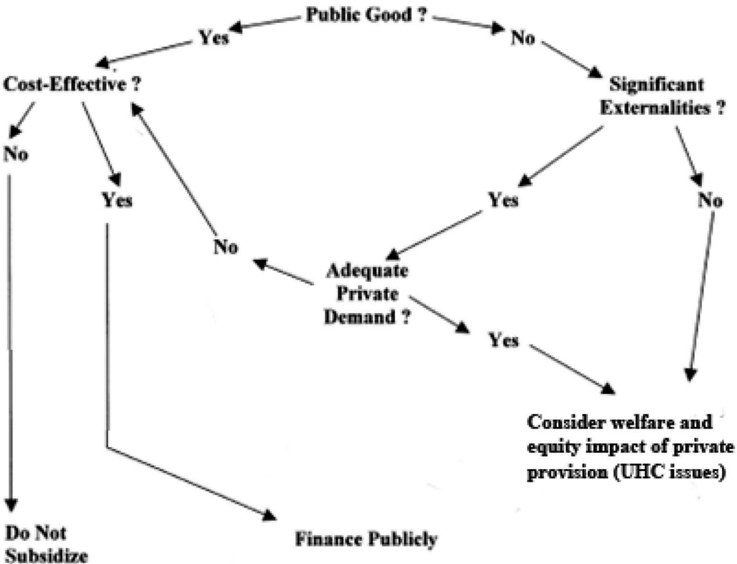
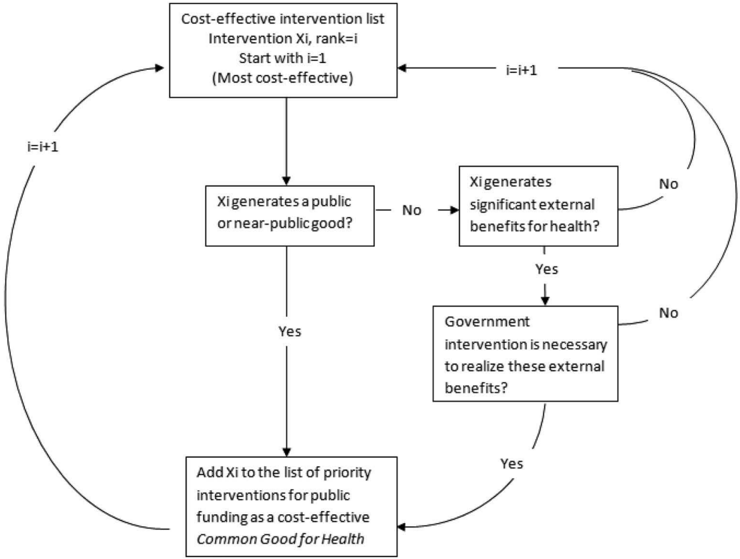
This paper presents the economic rationale for treating Common Goods for Health (CGH) as priorities for public intervention. We use the concept of market failure as a central argument for identifying CGH and apply cost-effectiveness analysis (CEA) as a normative tool to prioritize CGH interventions in public finance decisions. We show that CGH are consistent with traditional lists of public health core functions but cannot be identified separately from non-CGH activities in such lists. We propose a public finance decision tree, adapted from existing health economics tools, to identify CGH activities within the set of cost-effective interventions for the health sector. We test the framework by applying it to the 2018 Disease Control Priority (DCP) list of interventions recommended for public funding and find that less than 10% of cost-effective interventions unconditionally qualify as CGH, while another two-thirds may or may not qualify depending on context and form. We conclude that while CEA can be used as a tool to prioritize CGH, the scarcity of such analyses for CGH interventions may be partly responsible for the lack of priority given to them. We encourage further research to address methodological and resource challenges to assessing the cost-effectiveness of CGH intervention packages, in particular those involving large investments and long-term benefits.
Overview
The claims and statistics of this paper haven’t been checked yet.
Free: it reads the open-access text and checks the first 5 claims that cite a source we can check. Create a free account to check every claim.
Integrity signals
Registry
Cites
Statistics
Figures


Verification
Claims the paper makes
The claims and statistics of this paper haven’t been checked yet.
Free: it reads the open-access text and checks the first 5 claims that cite a source we can check. Create a free account to check every claim.
Self-check
Percentages, sums and reported differences re-computed from the paper’s own numbers.
The self-check needs the paper’s full text.
Citations
Cites
Olson, M. (1965) · doi:10.4159/9780674041660 · Cited by 14,191
Methods for the Economic Evaluation of Health Care Programmes
Drummond, M. E., Sculpher, M. J., Torrance, G. W., O’Brien, B. J., & Stoddart, G. L. (2005) · doi:10.1093/oso/9780198529446.001.0001 · Cited by 13,648
The Logic of Collective Action: Public Goods and the Theory of Groups.
Sufrin, S. C., & Olson, M. (1966) · Industrial and Labor Relations Review · doi:10.2307/2521228 · Cited by 11,518
The Pure Theory of Public Expenditure
Samuelson, P. A. (1954) · The Review of Economics and Statistics · doi:10.2307/1925895 · Cited by 7,458
Methods for the economic evaluation of health care programmes
Wilson, S. H. (1987) · Journal of Epidemiology and Community Health · doi:10.1136/jech.41.4.355-a · Cited by 4,275 · cited 1×
“Health economists have therefore developed cost-effectiveness analysis (CEA) as a more practical normative tool for comparing alternative uses of available funds within the publicly funded health sector.(19) CEA is particularly relevant when the sector is seeking to optimize the use of resources subject to a fixed bud…”
MethodCollective action and the evolution of social norms.
Ostrom, E. (2000) · Journal of Economic Perspectives · doi:10.1257/jep.14.3.137 · Cited by 4,195
Jackson, P. M., Atkinson, A. B., & Stiglitz, J. E. (1981) · The Economic Journal · doi:10.2307/2232622 · Cited by 1,626
Public Finance in Theory and Practice.
Prest, A. R., Musgrave, R. A., & Musgrave, P. B. (1974) · The Economic Journal · doi:10.2307/2231053 · Cited by 1,604
Whalley, J., Atkinson, A. B., & Stiglitz, J. E. (1982) · Economica · doi:10.2307/2553530 · Cited by 1,556
The Theory of Public Finance: A Study in Public Economy.
Colm, G., & Musgrave, R. A. (1960) · The Journal of Finance · doi:10.2307/2976491 · Cited by 1,428 · cited 1×
“In their purest form, public goods have two characteristics that are likely to induce market failure: non-rivalry in consumption and non-excludability.(9,11) Non-rivalry describes when consumption by one person does not reduce availability to others; for example, information provision is often non-rival, as consumptio…”
Background
Research works printed but not linked: 8
- 17. Hinrichs HH, Taylor GM. Program budgeting and benefit-cost analysis. Pacific Palisades (CA): Goodyear; 1969.
- 18. Boardman AE, Greenberg DH, Vining AR, Weimer DL. Costbenefit analysis: concepts and practice. 5th ed. Cambridge (UK):Cambridge University Press; 2018.
- 10.1017/9781108235594 · doi:10.1017/9781108235594 · Paper page
- 24. World Federation of Public Health Associations. A systems framework for healthy policy. London (UK): Commonwealth Secretariat; 2016. [accessed 2018 Aug 31]. https://www.thecom monwealth-healthhub.net/systems-framework-healthy-policy/.
- 25. Institute of Medicine (US). Committee for the study of the future of public health. Washington (DC): National Academies Press; 1988.
- 27. Pan American Health Organization. Public health in the Americas: conceptual renewal, performance assessment and bases for action. Washington (DC): PAHO; 2002.
- 30. World Health Organization. From burden to ' best buys ' : reducing the economic impact of non-communicable diseases in lowand middle-income countries. Geneva (CH): World Economic Forum; 2011. [accessed 2018 Aug 28]. http://apps. who.int/medicinedocs/en/d/Js18804en/.
- 33. DCP3. Disease Control Priorities: About the Project. University of Washington, Department of Global Health [accessed Jan 18 2019]. http://dcp-3.org/about-project.
Cited by
The Lancet Global Health Commission on financing primary health care: putting people at the centre
Hanson, K., Brikci, N., Erlangga, D., Alebachew, A., De Allegri, M., Balabanova, D., Blecher, M., Cashin, C., Esperato, A., Hipgrave, D., et al. (2022) · The Lancet Global Health · doi:10.1016/s2214-109x(22)00005-5 · Cited by 525
Global health 2050: the path to halving premature death by mid-century
Jamison, D. T., Summers, L. H., Chang, A. Y., Karlsson, O., Mao, W., Norheim, O. F., Ogbuoji, O., Schäferhoff, M., Watkins, D., Adeyi, O., et al. (2024) · The Lancet · doi:10.1016/s0140-6736(24)01439-9 · Cited by 125
Self-citationGlobal Cancer Surgery: pragmatic solutions to improve cancer surgery outcomes worldwide
Are, C., Murthy, S. S., Sullivan, R. J., Schissel, M. E., Chowdhury, S., Alatise, O., Anaya, D., Are, M., Balch, C. M., Bartlett, D. L., et al. (2023) · The Lancet Oncology · doi:10.1016/s1470-2045(23)00412-6 · Cited by 107
Financing global common goods for health: when the world is a country
Yamey, G., Jamison, D., Hanssen, O., & Soucat, A. (2019) · Health Systems & Reform · doi:10.1080/23288604.2019.1663118 · Cited by 59
Self-citationWhen Both Markets and Governments Fail Health
Yazbeck, A. S., & Soucat, A. (2019) · Health Systems & Reform · doi:10.1080/23288604.2019.1660756 · Cited by 56
“The next article, “Common Goods for Health: Economic Rationale and Tools for Prioritization” by Gaudin, Smith, Soucat, and Yazbeck, provides the theoretical constructs that underpin the definition of CGH in two ways.(3) First, the article tackles the traditional approach to public finance”
BackgroundSelf-citationFinancing Common Goods for Health: Fundamental for Health, the Foundation for UHC
Soucat, A. L. B. (2019) · Health Systems & Reform · doi:10.1080/23288604.2019.1671125 · Cited by 61
“in evidence that remain only concern identifying the precise economic benefits of specific interventions.(6) CGH by definition require collective action by many actors.”
BackgroundSelf-citationA Framework for Improving Policy Priorities in Managing COVID-19 Challenges in Developing Countries
Rasul, G. (2020) · Frontiers in Public Health · doi:10.3389/fpubh.2020.589681 · Cited by 54
“Appropriate incentive mechanisms can be developed to encourage private investment in social goods, including improvements in the healthcare system (37, 40).”
BackgroundFinancing Common Goods for Health: A Country Agenda
Sparkes, S. P., Kutzin, J., & Earle, A. J. (2019) · Health Systems & Reform · doi:10.1080/23288604.2019.1659126 · Cited by 34
“fragile or conflict-affected areas, or low-income countries) external assistance will be needed to ensure the provision of CGH.(3,4) This financing consideration directly complements policy efforts to move towards Universal Health Coverage (UHC) that focus on ensuring effective access for the entire population to qual…”
BackgroundPeters, D. H., Hanssen, O., Gutierrez, J. C., Abrahams, J., & Nyenswah, T. (2019) · Health Systems & Reform · doi:10.1080/23288604.2019.1660104 · Cited by 32
“prioritized; however, in our opinion, these health EDRM CGH have a truly compelling rationale for public financing.(12)”
BackgroundInfluentialCOVID-19 in Pakistan: Challenges and priorities
Sohil, F., Sohail, M. U., & Shabbir, J. (2021) · Cogent Medicine · doi:10.1080/2331205x.2021.1966179 · Cited by 30
“Due to low financial status, most low income countries are struggling in social capital like forest, clean water, fresh air, biodiversity, and climate may facilitate human well-being and achieve long run resilience (IOM, 2013, Gaudin et al., 2019).”
BackgroundNonvignon, J., Soucat, A., Ofori-Adu, P., & Adeyi, O. (2024) · Health Policy and Planning · doi:10.1093/heapol/czad092 · Cited by 23
“Global burden of disease estimates provide broad parameters to identify these unmet needs for technology-based interventions and policy measures, such as taxes, to curb the consumption of harmful products with negative externalities, a prime example of which is tobacco (Gaudin et al. , 2019).”
BackgroundSelf-citationSoucat, A., Tandon, A., & Gonzales Pier, E. (2023) · BMJ Global Health · doi:10.1136/bmjgh-2022-010755 · Cited by 22
“24 Designing EPHS may also improve advocacy for resource mobilisation by creating a narrative of progress and success on outcomes, as happened in Mexico.”
Self-citationThe Case for Public Financing of Environmental Common Goods for Health
Lo, S., Gaudin, S., Corvalán, C., Earle, A. J., Hanssen, O., Prüss‐Üstün, A., Neira, M., & Soucat, A. L. B. (2019) · Health Systems & Reform · doi:10.1080/23288604.2019.1669948 · Cited by 21
“The economic rationale for public financing of CGH, as presented elsewhere in this special issue, limits the realm of CGH to interventions that have the characteristics of public goods (non-rival and non-excludable) or that generate large benefits to society that are not accounted for adequately by the private sector…”
BackgroundInfluentialSelf-citationKayhan, B. M., Yeni, F. B., Özçelik, G., & Ayyıldız, E. (2024) · Annals of Operations Research · doi:10.1007/s10479-024-06441-3 · Cited by 22
“This nexus between common goods in health and the healthcare supply chain (HSC) points out the indispensable role of supply chain (SC) management in effectively distributing and delivering these crucial resources to diverse communities (Gaudin et al., 2019; Soucat, 2019).”
Carlini, J., Lehman, K., Dharmesti, M., & Knox, K. (2023) · Journal of Philanthropy and Marketing · doi:10.1002/nvsm.1796 · Cited by 17
Gaudin, S., & Yazbeck, A. S. (2021) · Health Systems & Reform · doi:10.1080/23288604.2021.1902671 · Cited by 11
“Given the importance of public health measures, a standalone Population and Public-Health Services category would be desirable; the questionnaire could also be refined and adapted to provide information on subcategories of potential global interest and to identify specific challenges of global importance, in particula…”
Self-citationWill the Quest for UHC be Derailed?
Sparkes, S. P., Eozenou, P., Evans, D., Kurowski, C., Kutzin, J., & Tandon, A. (2021) · Health Systems & Reform · doi:10.1080/23288604.2021.1929796 · Cited by 12
“In most cases, common goods for health are relatively affordable, and therefore can be financed through incremental public financing.(70) However, external assistance will need to play an important role in low-income, fragile settings to buttress domestic financing efforts.”
BackgroundNational investment case development for pathogen genomics
Khoo, Y. K., Wulandari, S., Getchell, M., Moe, L., Kumar, S., Liu, E. J., Sun, Y., Pang, J., Mishra, S., Clapham, H., et al. (2025) · Cell Genomics · doi:10.1016/j.xgen.2025.100781 · Cited by 6
“20 Despite these limitations, the morbidity, mortality, and economic consequences of disease outbreaks have been well documented.”
Why Do Societies Ever Produce Common Goods for Health?
Savedoff, W. D. (2019) · Health Systems & Reform · doi:10.1080/23288604.2019.1655982 · Cited by 6
“The papers argue that societies underinvest in CGH for behavioral reasons, such as underestimating risk and shortterm thinking(1); as well as economic reasons, such as externalities and free-riding (which create incentives for people to act without regard to the full social costs and benefits of their decisions).(2)”
Background[Evolution and Application of Disease Control Priorities].
Pan, J., Wang, X., Wang, C., Xu, D., Zou, K., & Li, Q. (2024) · 四川大学学报:医学版 · doi:10.12182/20240160603 · Cited by 2
Global Healthcare Financing: Economics, Methods, and Strategies for Sustainable Healthcare
Kabaniha, G. A., Ataguba, J. E.-O., & Kutzin, J. (2020) · Springer eBooks · doi:10.1007/978-3-030-05325-3_68-1 · Cited by 5
DNDi and the Global Politics of Neglected Tropical Diseases
Fraundorfer, M. (2025) · Oxford University Press eBooks · doi:10.1093/9780198905325.003.0001 · Cited by 1
Pharmaceutical Knowledge Commons
Fraundorfer, M. (2025) · Oxford University Press eBooks · doi:10.1093/9780198905325.003.0002 · Cited by 1
Pharmaceutical Knowledge Commons for the Most Neglected Populations in Global Health
Fraundorfer, M. (2025) · doi:10.1093/9780198905325.001.0001 · Cited by 1
Soucat, A. L. B., Gaudin, S., & Yazbeck, A. S. (2025) · Health Systems & Reform · doi:10.1080/23288604.2025.2550883 · Cited by 1
“8,36 Research on the drivers of T2DM and on what has worked in addressing this disease, reviewed above, offers a set of potential interventions that can be assessed against the CGH guidelines.”
Self-citationGlobal Healthcare Financing: Economics, Methods, and Strategies for Sustainable Healthcare
Kabaniha, G. A., Ataguba, J. E.-O., & Kutzin, J. (2021) · Springer eBooks · doi:10.1007/978-3-030-05325-3_68-2 · Cited by 1
Collaborative mechanisms for sustainable health innovation: The case of vaccines and antibiotics
Garden, H. (2023) · OECD science, technology and industry policy papers · doi:10.1787/3e8d40dc-en · Cited by 4
Global Healthcare Financing: Economics, Methods, and Strategies for Sustainable Healthcare
Kabaniha, G. A., Ataguba, J. E.-O., & Kutzin, J. (2021) · Springer eBooks · doi:10.1007/978-3-030-45009-0_68 · Cited by 2
Health system preparedness and long-term benefits to achieve health security
Rhodes, N., Brown, G. W., Choupe, L. B. T., Ho, M., Chungong, S., & Kandel, N. (2023) · Elsevier eBooks · doi:10.1016/b978-0-323-90945-7.00001-4
Transforming the Treatment for Sleeping Sickness with Oral Pills
Fraundorfer, M. (2025) · Oxford University Press eBooks · doi:10.1093/9780198905325.003.0005
Fraundorfer, M. (2025) · Oxford University Press eBooks · doi:10.1093/9780198905325.003.0007
List of Abbreviations and Acronyms
Fraundorfer, M. (2025) · Oxford University Press eBooks · doi:10.1093/9780198905325.002.0007
Fraundorfer, M. (2025) · Oxford University Press eBooks · doi:10.1093/9780198905325.002.0005
Fraundorfer, M. (2025) · Oxford University Press eBooks · doi:10.1093/9780198905325.002.0006
Piercing through the Silence of Chagas Disease
Fraundorfer, M. (2025) · Oxford University Press eBooks · doi:10.1093/9780198905325.003.0003
Connecting World Regions to Resist Leishmania Parasites
Fraundorfer, M. (2025) · Oxford University Press eBooks · doi:10.1093/9780198905325.003.0004
Situating DNDi’s Pharmaceutical Knowledge Commons in Global Health
Fraundorfer, M. (2025) · Oxford University Press eBooks · doi:10.1093/9780198905325.003.0006
Vilasanjuan, R. (2025) · Oxford University Press eBooks · doi:10.1093/9780198905325.002.0004
Financing pandemic preparedness
Sparkes, S. P., Mirelman, A. J., Earle, A. J., Rakesh, A., & Abrahams, J. (2026) · Cambridge University Press eBooks · doi:10.1017/9781009746274.019
Metadata
- Authors
- Gaudin, S., Smith, P. C., Soucat, A., & Yazbeck, A. S.
- Affiliations
- Oberlin College (US)
- Imperial College London (GB)
- Director for Health Systems, Governance and Financing, World Health Organization, Geneva, Switzerland
- Johns Hopkins University (US)
- Corresponding author
- Smith, Peter C.
- Venue
- Health Systems & Reform
- Publisher
- Informa UK Limited
- Published
- 2019-10-02
- Volume
- 5
- Issue
- 4
- Pages
- 280-292
- ISSN
- 2328-8604 (ISSN-L)
- 2328-8620
- OpenAlex
- W2969843505
- Cited by
- 39
- References
- 34
- Citations by year
- 2026: 1 · 2025: 14 · 2024: 4 · 2023: 5 · 2022: 1 · 2021: 5 · 2020: 2 · 2019: 7
- FWCI
- 4.68
- Type
- journal article
- Language
- en
- Open access
- gold
- doi.org
- Licence
- Locations
- Health Systems & Reform (publishedVersion, cc-by)
- PubMed (publishedVersion)
- White Rose Research Online (University of Leeds, The University of Sheffield, University of York) (submittedVersion)
- DOAJ (DOAJ: Directory of Open Access Journals) (submittedVersion, cc-by-sa)
- Funders
- World Health Organization
- European Commission
- Topics
- Social Sciences › Economics, Econometrics and Finance › Economics and Econometrics › Health Systems, Economic Evaluations, Quality of Life
- Health Sciences › Medicine › Public Health, Environmental and Occupational Health › Public Health Policies and Education
- Social Sciences › Economics, Econometrics and Finance › Economics and Econometrics › Pharmaceutical Economics and Policy
- Keywords
- market failure, cost-effectiveness analysis, disease control priorities
- MeSH terms
- Economics, Medical, Health Priorities, Humans, Social Justice, Resource Allocation
About these checks
Registry, retraction, Cites and statistics results are computed, not judged, with one exception: a printed reference that no index lists is read once by a model before it counts as a citation error. Claims are extracted by a model and kept only when their quote appears verbatim in the text; each cited source is then checked, with a model’s help, for whether it says what the claim relies on. Those verdicts can be wrong — read the claim’s quote and the cited source before relying on one.
Statistics and arithmetic are recomputed, not judged.
Confidence bands are shown only for fields calibrated on our annotated test set. None is calibrated yet, so no band is shown.
What counts as a claim ›How we measure confidence ›How we check this ›
Are you an author, or do you see a problem with this page? Request a review
Data sources
Bibliographic data: Semantic Scholar, OpenAlex, Crossref.
Contains information from the Semantic Scholar Academic Graph Datasets, made available under the ODC Attribution License (ODC-BY 1.0).
Semantic Scholar’s data is described in: Kinney, R., et al. (2023). The Semantic Scholar Open Data Platform. arXiv:2301.10140.
