

Common Goods for Health: Economic Rationale and Tools for Prioritization
Open accessThe DOI matches its Crossref record; 34 of the 34 references it cites were found in a registry or an index.
Abstract
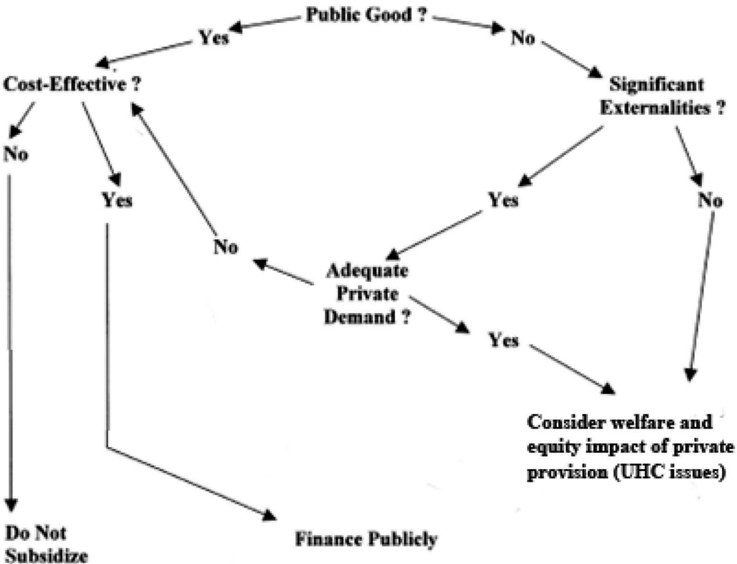
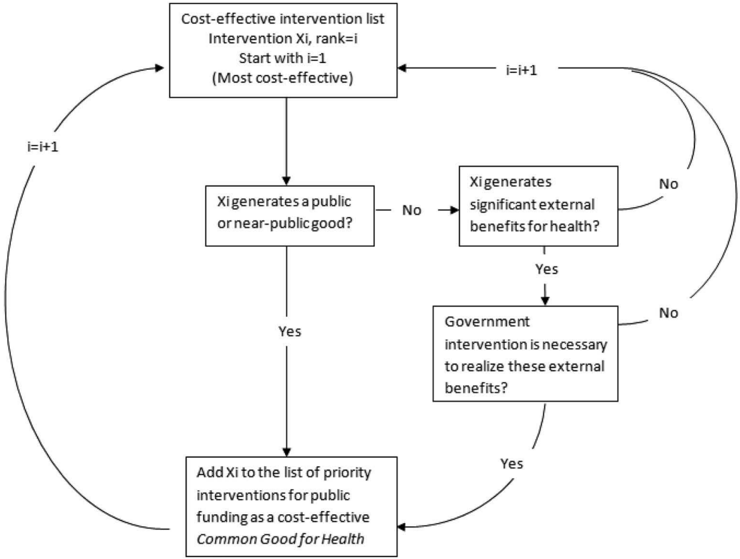
This paper presents the economic rationale for treating Common Goods for Health (CGH) as priorities for public intervention. We use the concept of market failure as a central argument for identifying CGH and apply cost-effectiveness analysis (CEA) as a normative tool to prioritize CGH interventions in public finance decisions. We show that CGH are consistent with traditional lists of public health core functions but cannot be identified separately from non-CGH activities in such lists. We propose a public finance decision tree, adapted from existing health economics tools, to identify CGH activities within the set of cost-effective interventions for the health sector. We test the framework by applying it to the 2018 Disease Control Priority (DCP) list of interventions recommended for public funding and find that less than 10% of cost-effective interventions unconditionally qualify as CGH, while another two-thirds may or may not qualify depending on context and form. We conclude that while CEA can be used as a tool to prioritize CGH, the scarcity of such analyses for CGH interventions may be partly responsible for the lack of priority given to them. We encourage further research to address methodological and resource challenges to assessing the cost-effectiveness of CGH intervention packages, in particular those involving large investments and long-term benefits.
Overview
The claims and statistics of this paper haven’t been checked yet.
Free: it reads the open-access text and checks the first 5 claims that cite a source we can check. Create a free account to check every claim.
Integrity signals
Registry
Cites
Statistics
Figures


Verification
Claims the paper makes
The claims and statistics of this paper haven’t been checked yet.
Free: it reads the open-access text and checks the first 5 claims that cite a source we can check. Create a free account to check every claim.
Self-check
Percentages, sums and reported differences re-computed from the paper’s own numbers.
The self-check needs the paper’s full text.
Citations
Cites
Olson, M. (1965) · doi:10.4159/9780674041660 · Cited by 14,191
Methods for the Economic Evaluation of Health Care Programmes
Drummond, M. E., Sculpher, M. J., Torrance, G. W., O’Brien, B. J., & Stoddart, G. L. (2005) · doi:10.1093/oso/9780198529446.001.0001 · Cited by 13,648
The Logic of Collective Action: Public Goods and the Theory of Groups.
Sufrin, S. C., & Olson, M. (1966) · Industrial and Labor Relations Review · doi:10.2307/2521228 · Cited by 11,518
The Pure Theory of Public Expenditure
Samuelson, P. A. (1954) · The Review of Economics and Statistics · doi:10.2307/1925895 · Cited by 7,458
Methods for the economic evaluation of health care programmes
Wilson, S. H. (1987) · Journal of Epidemiology and Community Health · doi:10.1136/jech.41.4.355-a · Cited by 4,275 · cited 1×
“Health economists have therefore developed cost-effectiveness analysis (CEA) as a more practical normative tool for comparing alternative uses of available funds within the publicly funded health sector.(19) CEA is particularly relevant when the sector is seeking to optimize the use of resources subject to a fixed bud…”
MethodCollective action and the evolution of social norms.
Ostrom, E. (2000) · Journal of Economic Perspectives · doi:10.1257/jep.14.3.137 · Cited by 4,195
Jackson, P. M., Atkinson, A. B., & Stiglitz, J. E. (1981) · The Economic Journal · doi:10.2307/2232622 · Cited by 1,626
Public Finance in Theory and Practice.
Prest, A. R., Musgrave, R. A., & Musgrave, P. B. (1974) · The Economic Journal · doi:10.2307/2231053 · Cited by 1,604
Whalley, J., Atkinson, A. B., & Stiglitz, J. E. (1982) · Economica · doi:10.2307/2553530 · Cited by 1,556
The Theory of Public Finance: A Study in Public Economy.
Colm, G., & Musgrave, R. A. (1960) · The Journal of Finance · doi:10.2307/2976491 · Cited by 1,428 · cited 1×
“In their purest form, public goods have two characteristics that are likely to induce market failure: non-rivalry in consumption and non-excludability.(9,11) Non-rivalry describes when consumption by one person does not reduce availability to others; for example, information provision is often non-rival, as consumptio…”
BackgroundCountry-Level Cost-Effectiveness Thresholds: Initial Estimates and the Need for Further Research
Woods, B., Revill, P., Sculpher, M., & Claxton, K. (2016) · Value in Health · doi:10.1016/j.jval.2016.02.017 · Cited by 884 · cited 1×
“by high-income countries because of the lower levels of funds available, although estimation of operational threshold levels has hitherto proved challenging.(21) In all decisions based on cost-effectiveness, additional contextual factors must also be considered, as part of a properly informed deliberative process.”
BackgroundBoardman, A. E. (2015) · International Encyclopedia of the Social & Behavioral Sciences · doi:10.1016/b978-0-08-097086-8.71068-3 · Cited by 421
Public Goods and Public Choices
Ostrom, V., & Ostrom, E. (2019) · Alternatives for Delivering Public Services · doi:10.4324/9780429047978-2 · Cited by 356
The Millennium Development Goals for Health: Rising to the Challenges
Bank, W. (2004) · World Bank, Washington, DC eBooks · doi:10.1596/0-8213-5767-0 · Cited by 341 · cited 1×
“Wagstaff and Claeson’s synthesis of different lists resulted in a list of public health responsibilities and core functions that has the advantage of being comprehensive yet compact.(6)”
BackgroundAlternatives For Delivering Public Services: Toward Improved Performance
Savas, E. S. (1978) · Medical Entomology and Zoology · Cited by 303
Debas, H. T., Donkor, P., Gawande, A. A., Jamison, D. T. T., Kruk, M. E., & Mock, C. (2015) · Cited by 267
Disease Control Priorities, Third Edition (Volume 9): Improving Health and Reducing Poverty
Jamison, D. T., Gelband, H., Horton, S., Jha, P., Laxminarayan, R., Mock, C. N., & Nugent, R. (2017) · World Bank, Washington, DC eBooks · doi:10.1596/978-1-4648-0527-1 · Cited by 220
The Millennium Development Goals for Health: rising to the challenges
Killen, B. (2005) · Bulletin of the World Health Organization · doi:10.1590/s0042-96862005001100022 · Cited by 157
Universal Public Finance of Tuberculosis Treatment in India: An Extended Cost‐Effectiveness Analysis
Verguet, S., Laxminarayan, R., & Jamison, D. T. (2015) · Health Economics · doi:10.1002/hec.3019 · Cited by 155 · cited 1×
“It is also possible to augment CE calculations with distributional considerations, using approaches such as extended cost-effectiveness analysis, which disaggregates the costs and benefits of an intervention by social group.(20) In principle, all uses of health system funds can be ranked”
Public spending on health care: how are different criteria related?
Musgrove, P. (1999) · Health Policy · doi:10.1016/s0168-8510(99)00024-x · Cited by 129 · cited 2×
“decision framework for health to separate CGH interventions from other public health priorities.(28) We then apply the modified framework to a widely disseminated list of interventions recommended for public funding in order to assess”
BackgroundMethodRanking 93 health interventions for low- and middle-income countries by cost-effectiveness
Horton, S., Gelband, H., Jamison, D., Levin, C., Nugent, R., & Watkins, D. (2017) · PLOS ONE · doi:10.1371/journal.pone.0182951 · Cited by 102 · cited 1×
“We apply the methodology described above to the latest DCP3 list of recommended health-sector interventions.(34,35) We chose the list of interventions with CE estimates (ref.”
MethodMark versus Luke? Appropriate methods for the evaluation of public health interventionsPreprint
Claxton, K., Sculpher, M., & Aj, C. (2007) · RePEc: Research Papers in Economics · Cited by 69
Financing global common goods for health: when the world is a country
Yamey, G., Jamison, D., Hanssen, O., & Soucat, A. (2019) · Health Systems & Reform · doi:10.1080/23288604.2019.1663118 · Cited by 59
Self-citationWhen Both Markets and Governments Fail Health
Yazbeck, A. S., & Soucat, A. (2019) · Health Systems & Reform · doi:10.1080/23288604.2019.1660756 · Cited by 56 · cited 1×
“interventions exhibiting two fundamental characteristics: (i) market failures due to their public good nature or the large health externalities they generate; and (ii) strong potential impact on human life.(1) It explained the need to adequately recognize and finance such services, which are historically underfunded w…”
BackgroundSelf-citationECONOMIC ANALYSIS FOR HEALTH PROJECTS
Hammer, J. S. (1997) · The World Bank Research Observer · doi:10.1093/wbro/12.1.47 · Cited by 55
The cost-effectiveness of public health interventions examined by NICE from 2011 to 2016
Owen, L., Pennington, B., Fischer, A., & Jeong, K. (2017) · Journal of Public Health · doi:10.1093/pubmed/fdx119 · Cited by 54 · cited 1×
“And the UK’s National Institute for Health Care Excellence has compiled CE analysis results for all interventions in its guidelines.(32) However, the most comprehensive lists of recommended health interventions suitable for countries of different income levels based on CE estimates are in reports produced by the DCP n…”
MethodHauck, K., Morton, A., Chalkidou, K., Chi, Y.-L., Culyer, A. J., Levin, C., Meacock, R., Over, M., Thomas, R., Vassall, A., et al. (2018) · Social Science & Medicine · doi:10.1016/j.socscimed.2018.10.030 · Cited by 50 · cited 1×
“However, CEA has hitherto found such evaluation challenging and research has only recently offered practical tools for adopting a functional approach to evaluation.(29)”
MethodSelf-citationDefining and Assessing Public Health Functions: A Global Analysis
Martin-Moreno, J. M., Harris, M., Jakubowski, E., & Kluge, H. H. P. (2015) · Annual Review of Public Health · doi:10.1146/annurev-publhealth-032315-021429 · Cited by 44
Montgomery, M. R., & Bean, R. N. (1999) · Public Choice · doi:10.1023/a:1018301628084 · Cited by 42
Hunt, A. S. P. (2011) · OECD environment working papers · doi:10.1787/5kg9qx8dsx43-en · Cited by 28
Bump, J. B., Reddiar, S. K., & Soucat, A. L. B. (2019) · Health Systems & Reform · doi:10.1080/23288604.2019.1661212 · Cited by 26 · cited 1×
“relation to CGH is discussed in the paper by Bump and colleagues in this special issue.(37) In fact, we have implicitly assumed that government intervention is capable of generat-”
MethodSelf-citationThe Case for Public Financing of Environmental Common Goods for Health
Lo, S., Gaudin, S., Corvalán, C., Earle, A. J., Hanssen, O., Prüss‐Üstün, A., Neira, M., & Soucat, A. L. B. (2019) · Health Systems & Reform · doi:10.1080/23288604.2019.1669948 · Cited by 21
Self-citationThe case for investing in public health: a public health summary report for EPHO 8
Nurse, J., Dorey, S., Yao, L., Sigfrid, L., Yfantopolous, P., McDaid, D., Yfantopolous, J., & Moreno, J. M. M. (2014) · Cited by 20
Cost-Effectiveness Analysis in Disease Control Priorities, Third Edition
Horton, S. (2017) · doi:10.1596/978-1-4648-0527-1/pt3.ch7 · Cited by 6 · cited 1×
“We apply the methodology described above to the latest DCP3 list of recommended health-sector interventions.(34,35) We chose the list of interventions with CE estimates (ref.”
Method
Research works printed but not linked: 8
- 17. Hinrichs HH, Taylor GM. Program budgeting and benefit-cost analysis. Pacific Palisades (CA): Goodyear; 1969.
- 18. Boardman AE, Greenberg DH, Vining AR, Weimer DL. Costbenefit analysis: concepts and practice. 5th ed. Cambridge (UK):Cambridge University Press; 2018.
- 10.1017/9781108235594 · doi:10.1017/9781108235594 · Paper page
- 24. World Federation of Public Health Associations. A systems framework for healthy policy. London (UK): Commonwealth Secretariat; 2016. [accessed 2018 Aug 31]. https://www.thecom monwealth-healthhub.net/systems-framework-healthy-policy/.
- 25. Institute of Medicine (US). Committee for the study of the future of public health. Washington (DC): National Academies Press; 1988.
- 27. Pan American Health Organization. Public health in the Americas: conceptual renewal, performance assessment and bases for action. Washington (DC): PAHO; 2002.
- 30. World Health Organization. From burden to ' best buys ' : reducing the economic impact of non-communicable diseases in lowand middle-income countries. Geneva (CH): World Economic Forum; 2011. [accessed 2018 Aug 28]. http://apps. who.int/medicinedocs/en/d/Js18804en/.
- 33. DCP3. Disease Control Priorities: About the Project. University of Washington, Department of Global Health [accessed Jan 18 2019]. http://dcp-3.org/about-project.
Cited by
The Lancet Global Health Commission on financing primary health care: putting people at the centre
Hanson, K., Brikci, N., Erlangga, D., Alebachew, A., De Allegri, M., Balabanova, D., Blecher, M., Cashin, C., Esperato, A., Hipgrave, D., et al. (2022) · The Lancet Global Health · doi:10.1016/s2214-109x(22)00005-5 · Cited by 525
Global health 2050: the path to halving premature death by mid-century
Jamison, D. T., Summers, L. H., Chang, A. Y., Karlsson, O., Mao, W., Norheim, O. F., Ogbuoji, O., Schäferhoff, M., Watkins, D., Adeyi, O., et al. (2024) · The Lancet · doi:10.1016/s0140-6736(24)01439-9 · Cited by 125
Self-citationGlobal Cancer Surgery: pragmatic solutions to improve cancer surgery outcomes worldwide
Are, C., Murthy, S. S., Sullivan, R. J., Schissel, M. E., Chowdhury, S., Alatise, O., Anaya, D., Are, M., Balch, C. M., Bartlett, D. L., et al. (2023) · The Lancet Oncology · doi:10.1016/s1470-2045(23)00412-6 · Cited by 107
Financing global common goods for health: when the world is a country
Yamey, G., Jamison, D., Hanssen, O., & Soucat, A. (2019) · Health Systems & Reform · doi:10.1080/23288604.2019.1663118 · Cited by 59
Self-citationWhen Both Markets and Governments Fail Health
Yazbeck, A. S., & Soucat, A. (2019) · Health Systems & Reform · doi:10.1080/23288604.2019.1660756 · Cited by 56
“The next article, “Common Goods for Health: Economic Rationale and Tools for Prioritization” by Gaudin, Smith, Soucat, and Yazbeck, provides the theoretical constructs that underpin the definition of CGH in two ways.(3) First, the article tackles the traditional approach to public finance”
BackgroundSelf-citation
Metadata
- Authors
- Gaudin, S., Smith, P. C., Soucat, A., & Yazbeck, A. S.
- Affiliations
- Oberlin College (US)
- Imperial College London (GB)
- Director for Health Systems, Governance and Financing, World Health Organization, Geneva, Switzerland
- Johns Hopkins University (US)
- Corresponding author
- Smith, Peter C.
- Venue
- Health Systems & Reform
- Publisher
- Informa UK Limited
- Published
- 2019-10-02
- Volume
- 5
- Issue
- 4
- Pages
- 280-292
- ISSN
- 2328-8604 (ISSN-L)
- 2328-8620
- OpenAlex
- W2969843505
- Cited by
- 39
- References
- 34
- Citations by year
- 2026: 1 · 2025: 14 · 2024: 4 · 2023: 5 · 2022: 1 · 2021: 5 · 2020: 2 · 2019: 7
- FWCI
- 4.68
- Type
- journal article
- Language
- en
- Open access
- gold
- doi.org
- Licence
- Locations
- Health Systems & Reform (publishedVersion, cc-by)
- PubMed (publishedVersion)
- White Rose Research Online (University of Leeds, The University of Sheffield, University of York) (submittedVersion)
- DOAJ (DOAJ: Directory of Open Access Journals) (submittedVersion, cc-by-sa)
- Funders
- World Health Organization
- European Commission
- Topics
- Social Sciences › Economics, Econometrics and Finance › Economics and Econometrics › Health Systems, Economic Evaluations, Quality of Life
- Health Sciences › Medicine › Public Health, Environmental and Occupational Health › Public Health Policies and Education
- Social Sciences › Economics, Econometrics and Finance › Economics and Econometrics › Pharmaceutical Economics and Policy
- Keywords
- market failure, cost-effectiveness analysis, disease control priorities
- MeSH terms
- Economics, Medical, Health Priorities, Humans, Social Justice, Resource Allocation
About these checks
Registry, retraction, Cites and statistics results are computed, not judged, with one exception: a printed reference that no index lists is read once by a model before it counts as a citation error. Claims are extracted by a model and kept only when their quote appears verbatim in the text; each cited source is then checked, with a model’s help, for whether it says what the claim relies on. Those verdicts can be wrong — read the claim’s quote and the cited source before relying on one.
Statistics and arithmetic are recomputed, not judged.
Confidence bands are shown only for fields calibrated on our annotated test set. None is calibrated yet, so no band is shown.
What counts as a claim ›How we measure confidence ›How we check this ›
Are you an author, or do you see a problem with this page? Request a review
Data sources
Bibliographic data: Semantic Scholar, OpenAlex, Crossref.
Contains information from the Semantic Scholar Academic Graph Datasets, made available under the ODC Attribution License (ODC-BY 1.0).
Semantic Scholar’s data is described in: Kinney, R., et al. (2023). The Semantic Scholar Open Data Platform. arXiv:2301.10140.
